 Скачать презентацию FDA s Current Considerations of Parvovirus B 19 Nucleic
1b18cfc10a683a3c6ea54c11f3771d89.ppt
- Количество слайдов: 8



FDA’s Current Considerations of Parvovirus B 19 Nucleic Acid Testing (NAT) Mei-ying W. Yu, Ph. D Division of Hematology CBER/FDA Extraordinary So. GAT Meeting on Parvovirus B 19 NIBSC, UK; March 2, 2007
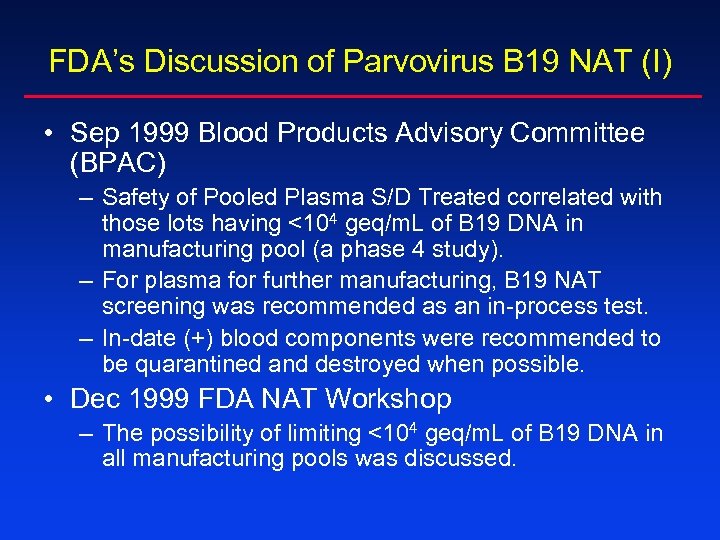
FDA’s Discussion of Parvovirus B 19 NAT (I) • Sep 1999 Blood Products Advisory Committee (BPAC) – Safety of Pooled Plasma S/D Treated correlated with those lots having <104 geq/m. L of B 19 DNA in manufacturing pool (a phase 4 study). – For plasma for further manufacturing, B 19 NAT screening was recommended as an in-process test. – In-date (+) blood components were recommended to be quarantined and destroyed when possible. • Dec 1999 FDA NAT Workshop – The possibility of limiting <104 geq/m. L of B 19 DNA in all manufacturing pools was discussed.
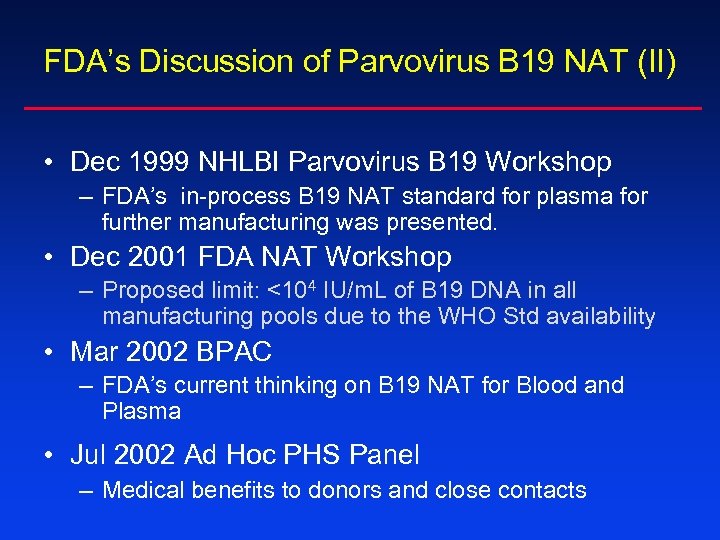
FDA’s Discussion of Parvovirus B 19 NAT (II) • Dec 1999 NHLBI Parvovirus B 19 Workshop – FDA’s in-process B 19 NAT standard for plasma for further manufacturing was presented. • Dec 2001 FDA NAT Workshop – Proposed limit: <104 IU/m. L of B 19 DNA in all manufacturing pools due to the WHO Std availability • Mar 2002 BPAC – FDA’s current thinking on B 19 NAT for Blood and Plasma • Jul 2002 Ad Hoc PHS Panel – Medical benefits to donors and close contacts
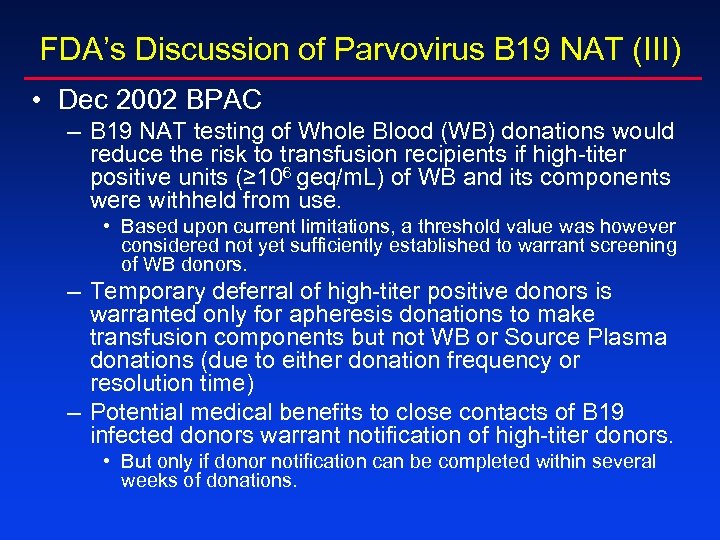
FDA’s Discussion of Parvovirus B 19 NAT (III) • Dec 2002 BPAC – B 19 NAT testing of Whole Blood (WB) donations would reduce the risk to transfusion recipients if high-titer positive units (≥ 106 geq/m. L) of WB and its components were withheld from use. • Based upon current limitations, a threshold value was however considered not yet sufficiently established to warrant screening of WB donors. – Temporary deferral of high-titer positive donors is warranted only for apheresis donations to make transfusion components but not WB or Source Plasma donations (due to either donation frequency or resolution time) – Potential medical benefits to close contacts of B 19 infected donors warrant notification of high-titer donors. • But only if donor notification can be completed within several weeks of donations.
In-Process B 19 NAT Testing of Plasma for Further Manufacturing (I) • Minipool NAT testing (Pool size: 96 – 512) – Most Source Plasma fractionators are performing hightiter B 19 minipool NAT screening by in-house methods. – Sensitivities of NAT assays differ, but most tests will exclude original donations exceeding a B 19 DNA level of 105 to 107 IU/m. L. – Reactive minipools are resolved to single reactive donations, which are rejected. – Blood collection establishments voluntarily retrieve and discard in-date components to prevent their use in transfusion when a donor of plasma is found to have high titer B 19. • Little is known about the minimal infectious dose for B 19. However, we reported that infusion of 2 X 10⁴ IU of B 19 DNA in a FVIII product devoid of anti-B 19 Ig. G infected a seronegative individual (Wu et al, Transfusion 2005).
In-Process B 19 NAT Testing of Plasma for Further Manufacturing (II) • Manufacturing pool NAT testing – To ensure that high-titer plasma donations are removed as a result of minipool NAT screening, the viral load in manufacturing pools destined for plasma derivatives is measured directly and can be limited to ≤ 104 IU/m. L of B 19 DNA, the standard proposed by the FDA. • Anti-B 19 in large pools complexes/neutralizes virus • Some manufacturing procedures clear 4 logs of the virus when validated using a model parvovirus.
In-Process B 19 NAT Testing of Plasma for Further Manufacturing (III) • FDA has reviewed and approved some in-house B 19 NAT procedures for minipools and manufacturing pools under Biologics Licensing Applications (BLAs) or their supplements for plasma derivatives. – B 19 NAT testing is validated as an analytical procedure with respect to sensitivity, specificity, and reproducibility. – Primers and probes used for B 19 NAT testing should be chosen so that all B 19 genotypes can be detected.
Issues To Be Considered • Because of known risks to those individuals who are pregnant, chronically anemic, and immuno-compromised, B 19 NAT testing may be changed to donor screening testing if commercial tests are available as kits and the resolution time to confirmation (i. e. , minipool single (+) donation) is short, similar to NAT for HCV/HIV/HBV. – Currently the mean resolution time by industry is long (25 to 60 days, PPTA presentation at Dec 2002 BPAC). – Unresolved issues • “Up-front” donor screening • Lookback –retrieval of in-date products; notification of recipients
Скачать презентацию FDA s Current Considerations of Parvovirus B 19 Nucleic
1b18cfc10a683a3c6ea54c11f3771d89.ppt