 Скачать презентацию FDA Method Development and Regulatory Application in Collaboration
f12c76dea52308441191465ec2b04691.ppt
- Количество слайдов: 43



FDA Method Development and Regulatory Application in Collaboration with State Partners The FDA Foods & Veterinary Medicine Research Enterprise Jeffrey L. Ward DVM, MS, Ph. D Senior Science Advisor FDA Office of Foods and Veterinary Medicine Governmental Food and Feed Laboratories Accreditation Meeting February 3, 2016
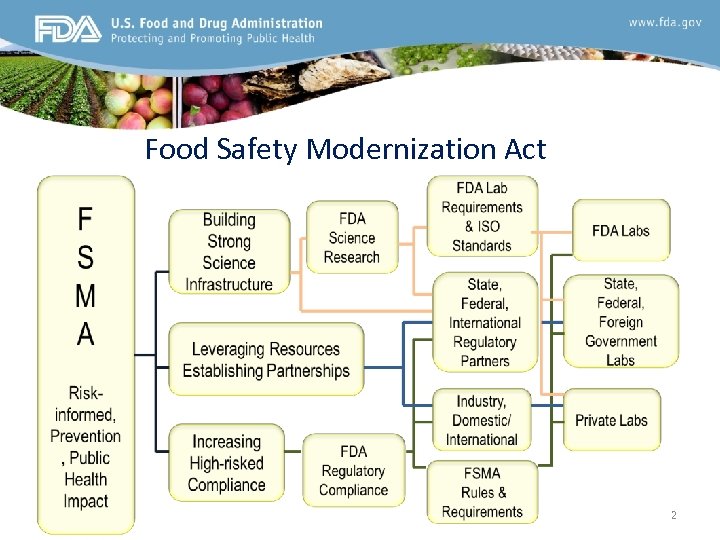
Food Safety Modernization Act 2
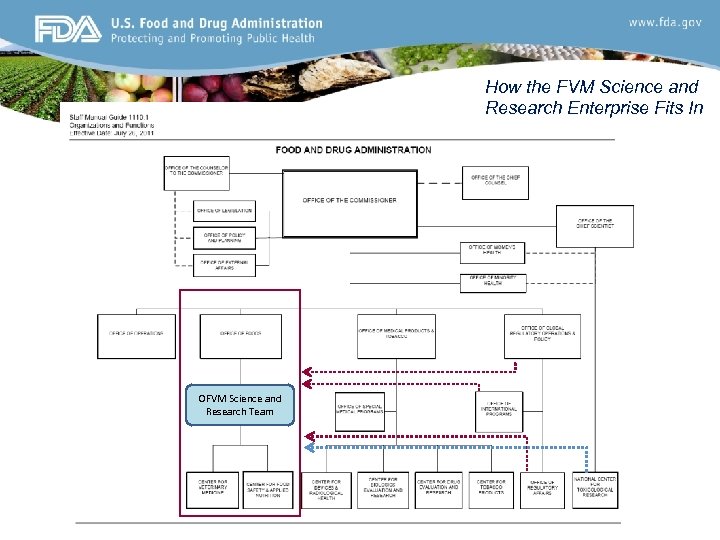
How the FVM Science and Research Enterprise Fits In OFVM Science and Research Team
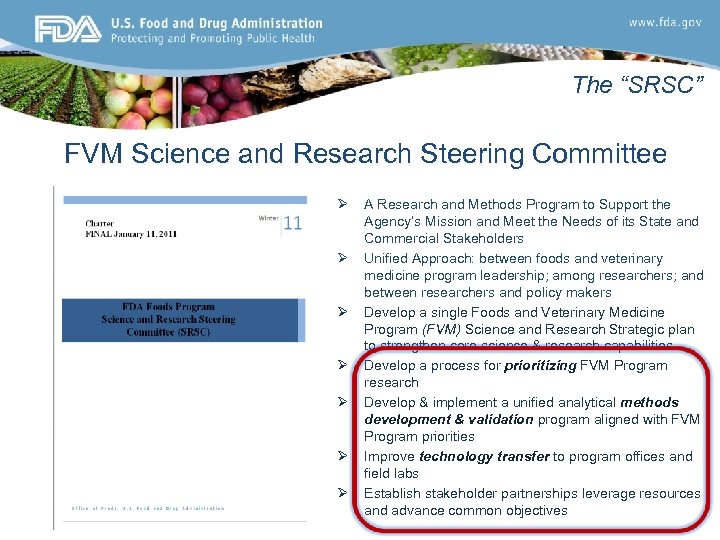
The “SRSC” FVM Science and Research Steering Committee Ø Ø Ø Ø A Research and Methods Program to Support the Agency’s Mission and Meet the Needs of its State and Commercial Stakeholders Unified Approach: between foods and veterinary medicine program leadership; among researchers; and between researchers and policy makers Develop a single Foods and Veterinary Medicine Program (FVM) Science and Research Strategic plan to strengthen core science & research capabilities Develop a process for prioritizing FVM Program research Develop & implement a unified analytical methods development & validation program aligned with FVM Program priorities Improve technology transfer to program offices and field labs Establish stakeholder partnerships leverage resources and advance common objectives
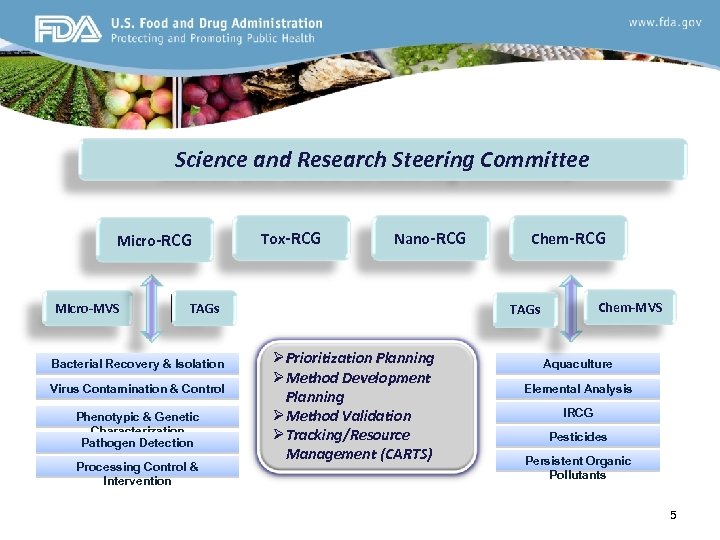
Science and Research Steering Committee Micro-RCG Micro-MVS Tox-RCG Nano-RCG TAGs Bacterial Recovery & Isolation Virus Contamination & Control Phenotypic & Genetic Characterization Pathogen Detection Processing Control & Intervention Chem-RCG Chem-MVS TAGs ØPrioritization Planning ØMethod Development Planning ØMethod Validation ØTracking/Resource Management (CARTS) Aquaculture Elemental Analysis IRCG Pesticides Persistent Organic Pollutants 5
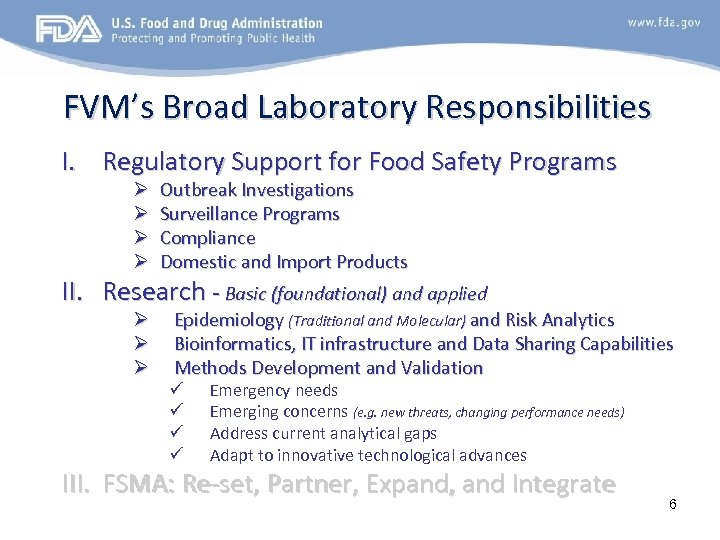
FVM’s Broad Laboratory Responsibilities I. Regulatory Support for Food Safety Programs Ø Ø Outbreak Investigations Surveillance Programs Compliance Domestic and Import Products II. Research - Basic (foundational) and applied Ø Ø Ø Epidemiology (Traditional and Molecular) and Risk Analytics Bioinformatics, IT infrastructure and Data Sharing Capabilities Methods Development and Validation ü ü Emergency needs Emerging concerns (e. g. new threats, changing performance needs) Address current analytical gaps Adapt to innovative technological advances III. FSMA: Re-set, Partner, Expand, and Integrate 6
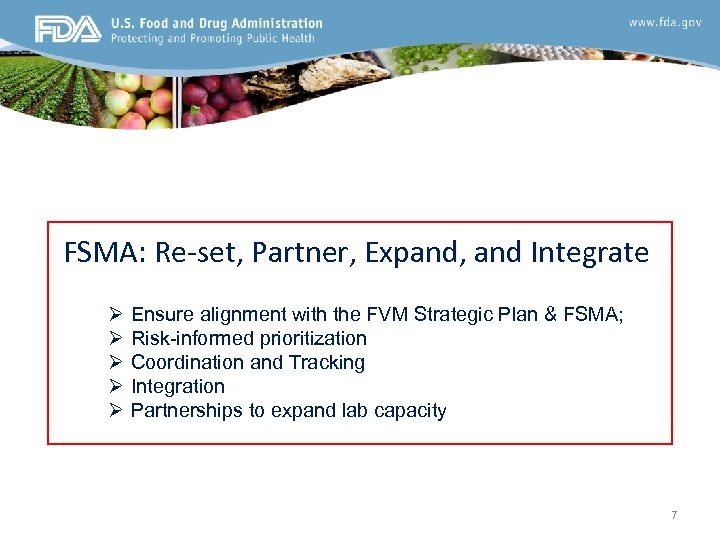
FSMA: Re-set, Partner, Expand, and Integrate Ø Ø Ø Ensure alignment with the FVM Strategic Plan & FSMA; Risk-informed prioritization Coordination and Tracking Integration Partnerships to expand lab capacity 7
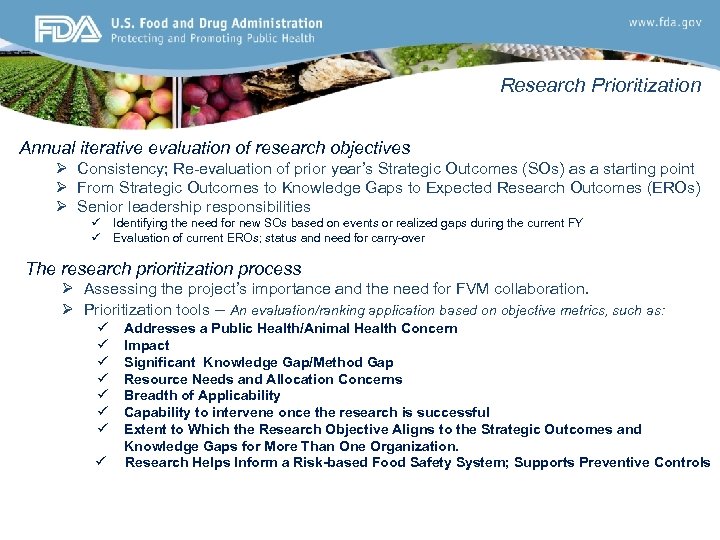
Research Prioritization Annual iterative evaluation of research objectives Ø Consistency; Re-evaluation of prior year’s Strategic Outcomes (SOs) as a starting point Ø From Strategic Outcomes to Knowledge Gaps to Expected Research Outcomes (EROs) Ø Senior leadership responsibilities ü ü Identifying the need for new SOs based on events or realized gaps during the current FY Evaluation of current EROs; status and need for carry-over The research prioritization process Ø Assessing the project’s importance and the need for FVM collaboration. Ø Prioritization tools – An evaluation/ranking application based on objective metrics, such as: ü ü ü ü Addresses a Public Health/Animal Health Concern Impact Significant Knowledge Gap/Method Gap Resource Needs and Allocation Concerns Breadth of Applicability Capability to intervene once the research is successful Extent to Which the Research Objective Aligns to the Strategic Outcomes and Knowledge Gaps for More Than One Organization. Research Helps Inform a Risk-based Food Safety System; Supports Preventive Controls
Hazard/Risk-based Strategies The Future-state Vision Redefining our approach to developing a strategic program that leads to safer foods by better targeting and more efficient use of laboratory resources through the systematic identification of high risk commodities and an associated hazard i. e. microbial pathogen, chemical analyte, etc. and the analytical tools needed to address the risk. 9
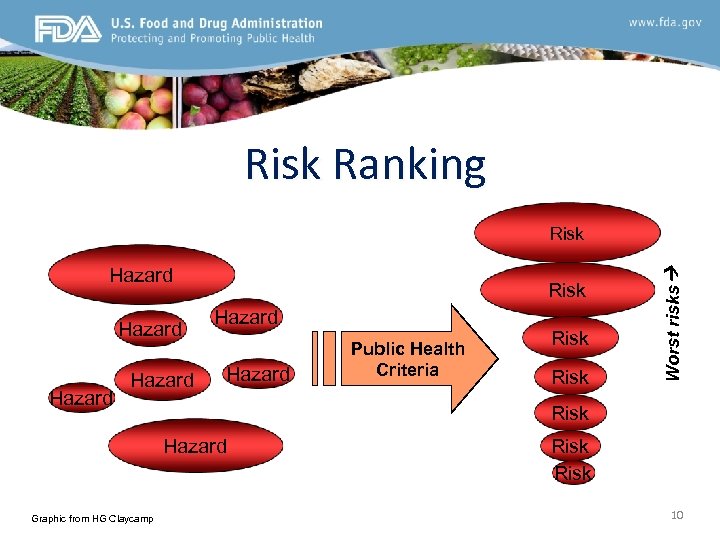
Risk Ranking Hazard Risk Hazard Risk Hazard Graphic from HG Claycamp Public Health Criteria Worst risks Risk 10
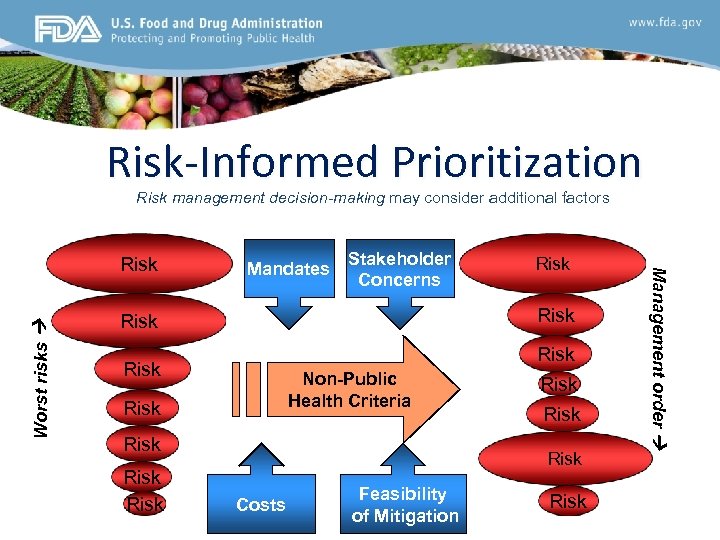
Risk-Informed Prioritization Risk management decision-making may consider additional factors Worst risks Mandates Stakeholder Concerns Risk Non-Public Health Criteria Risk Risk Costs Feasibility of Mitigation Risk Management order Risk
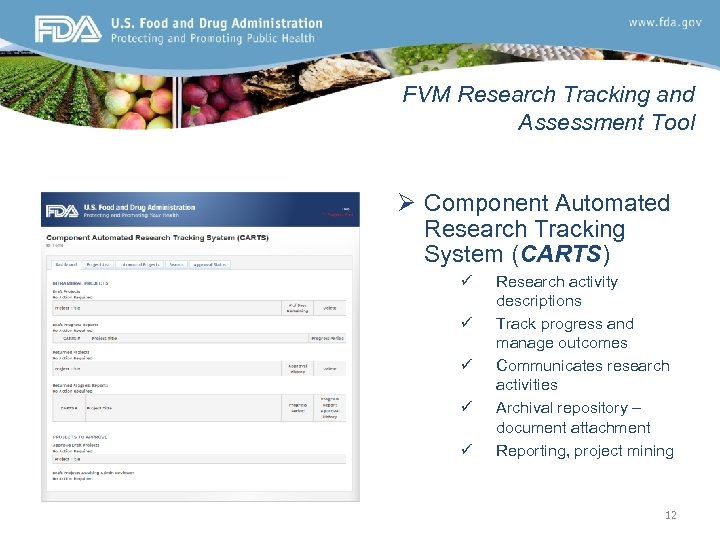
FVM Research Tracking and Assessment Tool Ø Component Automated Research Tracking System (CARTS) CARTS ü ü ü Research activity descriptions Track progress and manage outcomes Communicates research activities Archival repository – document attachment Reporting, project mining 12
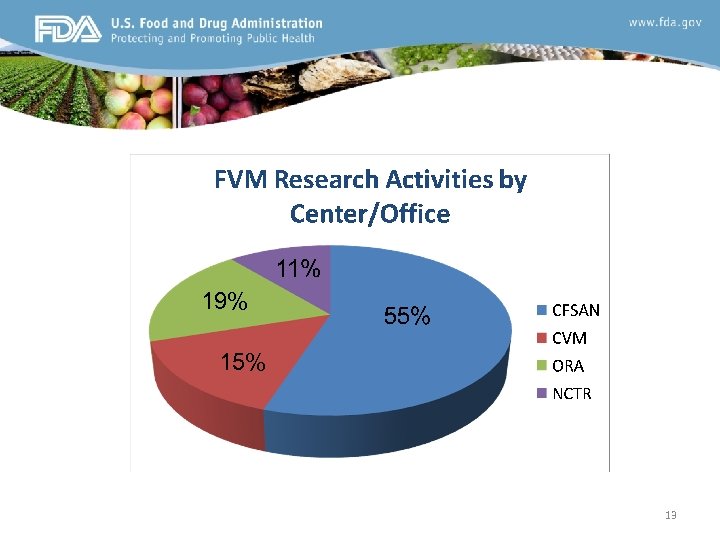
19% 15% 13
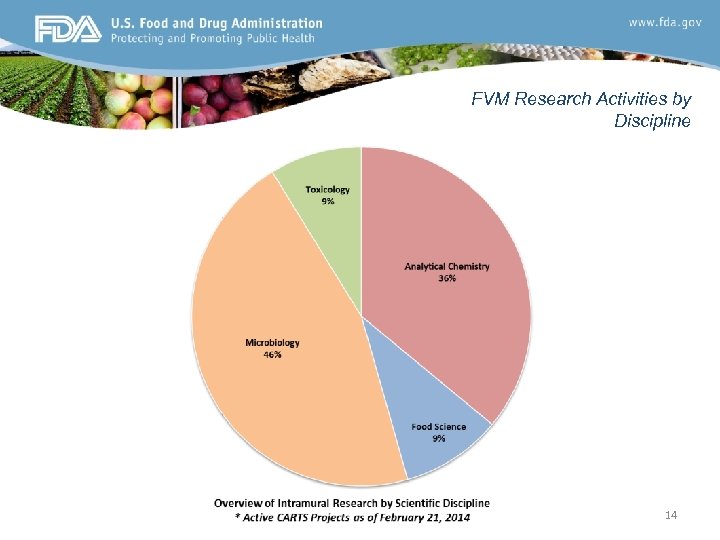
FVM Research Activities by Discipline 14
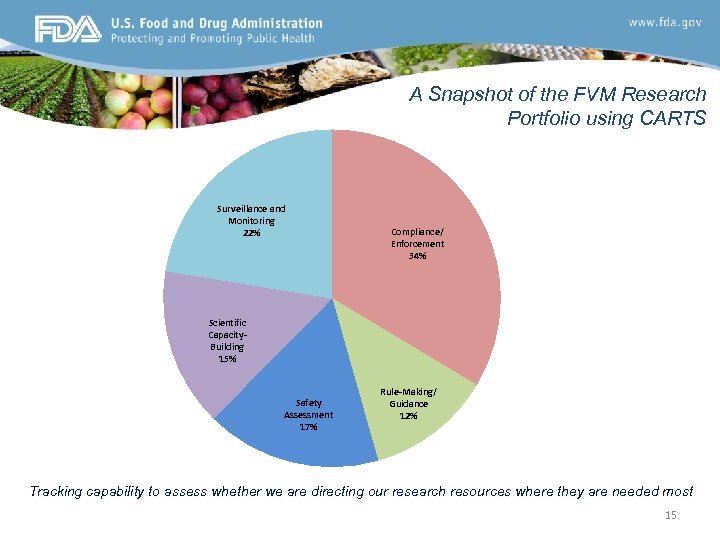
A Snapshot of the FVM Research Portfolio using CARTS Surveillance and Monitoring 22% Compliance/ Enforcement 34% Scientific Capacity. Building 15% Safety Assessment 17% Rule-Making/ Guidance 12% Tracking capability to assess whether we are directing our research resources where they are needed most 15
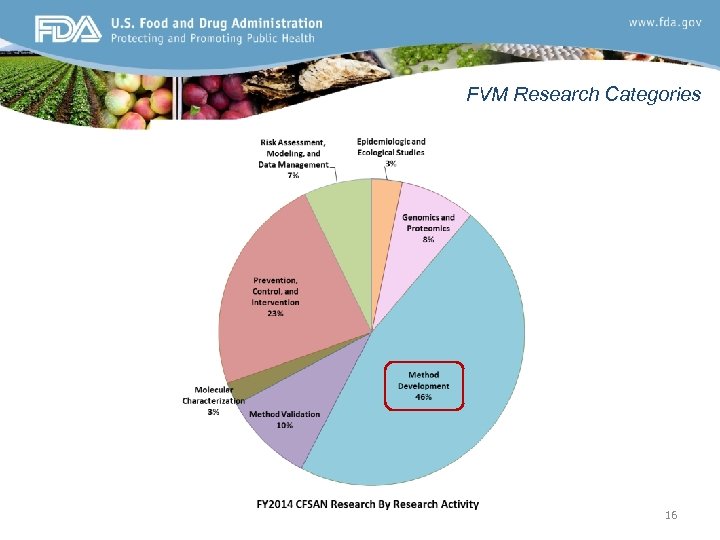
FVM Research Categories 16
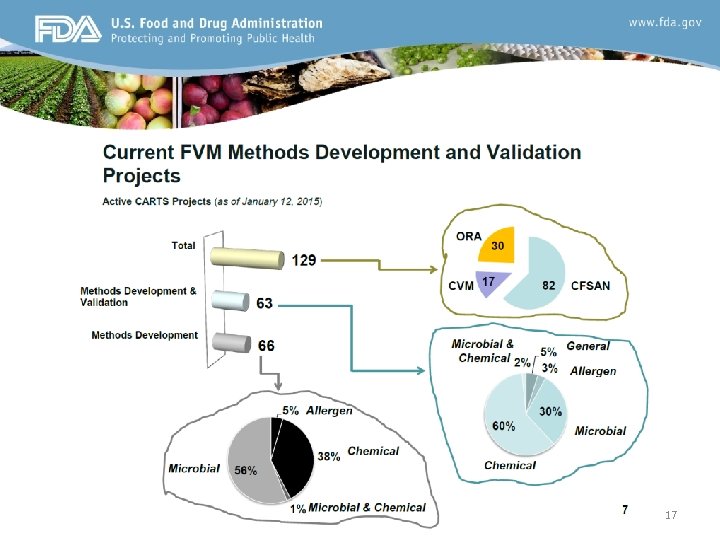
17
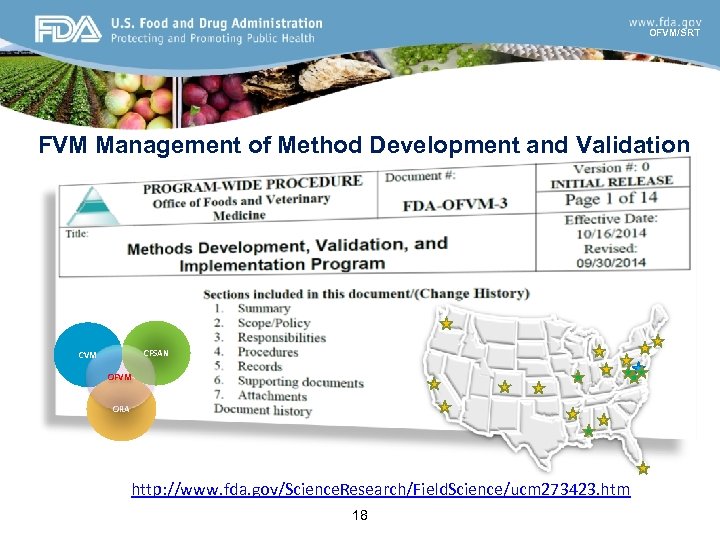
OFVM/SRT FVM Management of Method Development and Validation “The M-D-V-I-P” CFSAN CVM OFVM ORA http: //www. fda. gov/Science. Research/Field. Science/ucm 273423. htm 18
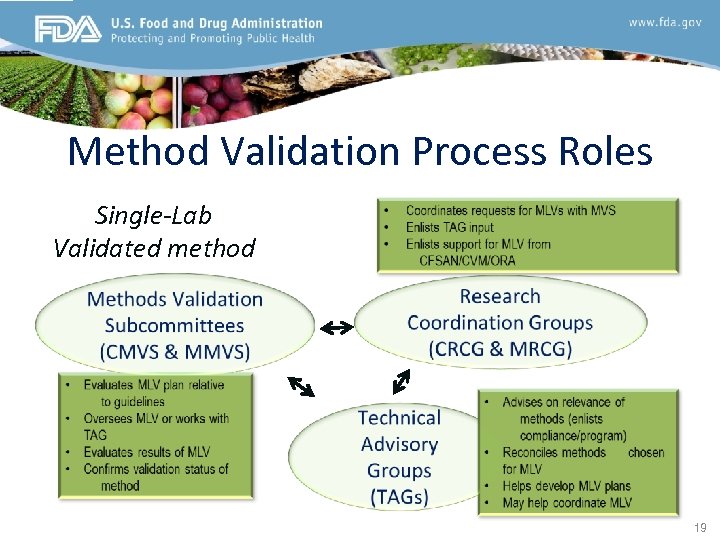
Method Validation Process Roles Single-Lab Validated method 19
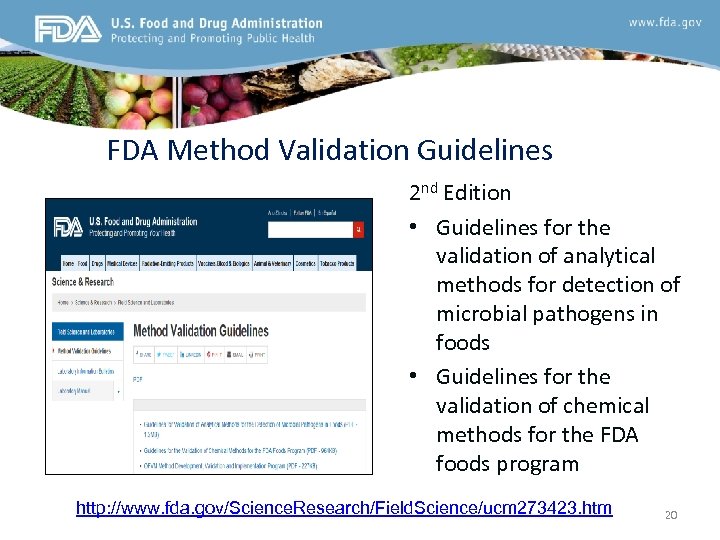
FDA Method Validation Guidelines 2 nd Edition • Guidelines for the validation of analytical methods for detection of microbial pathogens in foods • Guidelines for the validation of chemical methods for the FDA foods program http: //www. fda. gov/Science. Research/Field. Science/ucm 273423. htm 20
Moving Forward with FSMA Partnerships to Achieve Our Food Safety Mission ØFSMA Partnerships for laboratory capacity building Ø Partnerships to harness technology and develop innovative applications 21
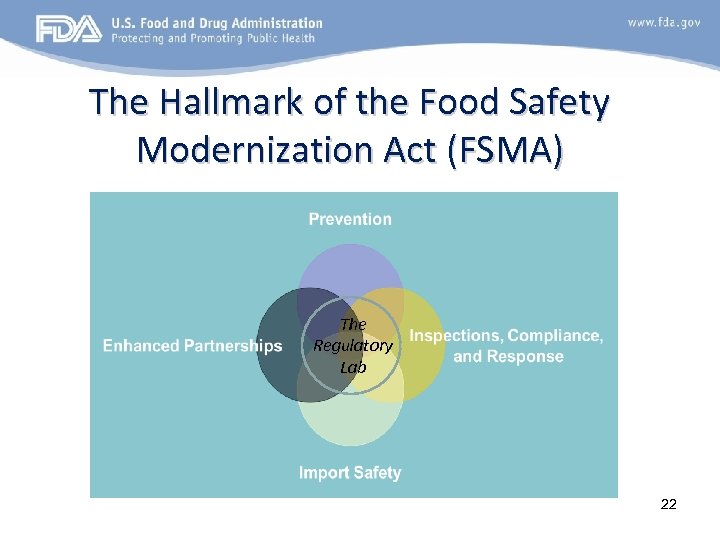
The Hallmark of the Food Safety Modernization Act (FSMA) The Regulatory Lab 22
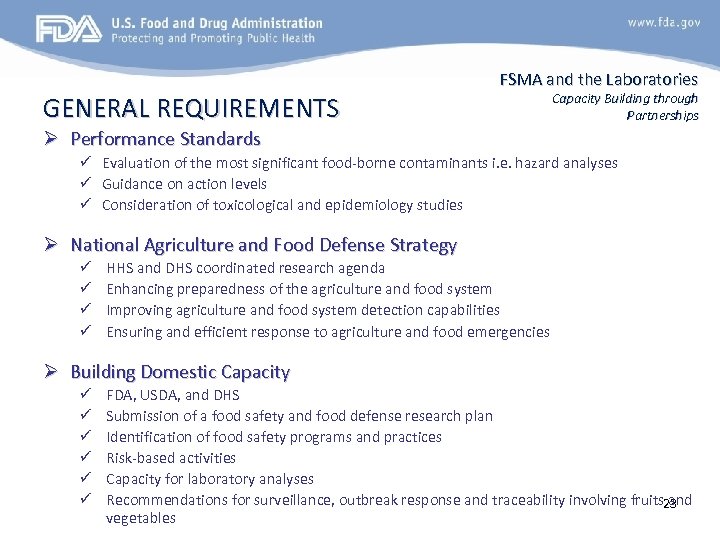
GENERAL REQUIREMENTS FSMA and the Laboratories Capacity Building through Partnerships Ø Performance Standards ü Evaluation of the most significant food-borne contaminants i. e. hazard analyses ü Guidance on action levels ü Consideration of toxicological and epidemiology studies Ø National Agriculture and Food Defense Strategy ü ü HHS and DHS coordinated research agenda Enhancing preparedness of the agriculture and food system Improving agriculture and food system detection capabilities Ensuring and efficient response to agriculture and food emergencies Ø Building Domestic Capacity ü ü ü FDA, USDA, and DHS Submission of a food safety and food defense research plan Identification of food safety programs and practices Risk-based activities Capacity for laboratory analyses Recommendations for surveillance, outbreak response and traceability involving fruits and 23 vegetables
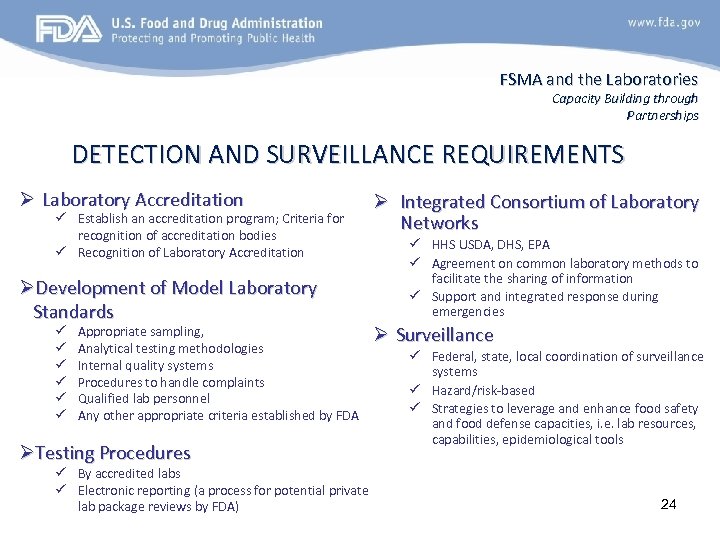
FSMA and the Laboratories Capacity Building through Partnerships DETECTION AND SURVEILLANCE REQUIREMENTS Ø Laboratory Accreditation ü Establish an accreditation program; Criteria for recognition of accreditation bodies ü Recognition of Laboratory Accreditation ØDevelopment of Model Laboratory Standards ü ü ü Appropriate sampling, Analytical testing methodologies Internal quality systems Procedures to handle complaints Qualified lab personnel Any other appropriate criteria established by FDA ØTesting Procedures ü By accredited labs ü Electronic reporting (a process for potential private lab package reviews by FDA) Ø Integrated Consortium of Laboratory Networks ü HHS USDA, DHS, EPA ü Agreement on common laboratory methods to facilitate the sharing of information ü Support and integrated response during emergencies Ø Surveillance ü Federal, state, local coordination of surveillance systems ü Hazard/risk-based ü Strategies to leverage and enhance food safety and food defense capacities, i. e. lab resources, capabilities, epidemiological tools 24
FSMA and the Laboratories Capacity Building through Partnerships INTERNATIONAL COLLABORATIONS Ø Building Capacity of Foreign Governments with Respect to Food Safety ü Expand the technical, scientific, and regulatory capacity of foreign countries exporting food to the U. S. ü Provisions for electronic data sharing, mutual recognition of inspection reports ü Multilateral acceptance of laboratory methods and detection techniques 25
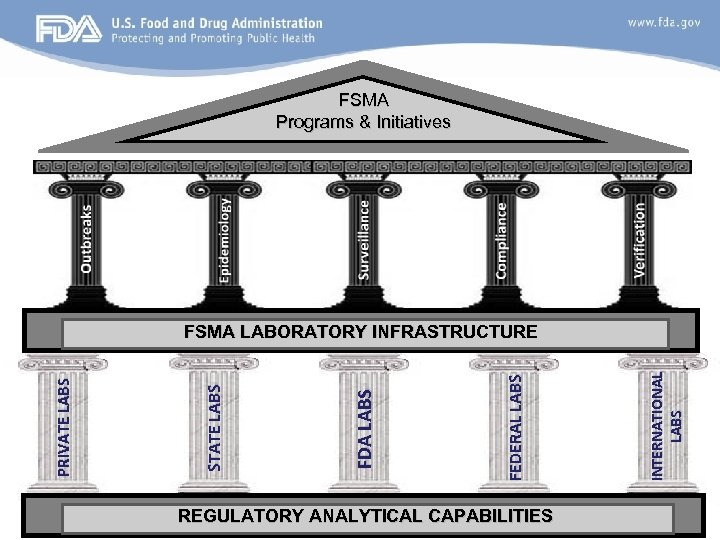
FSMA Programs & Initiatives REGULATORY ANALYTICAL CAPABILITIES INTERNATIONAL LABS FEDERAL LABS FDA LABS STATE LABS PRIVATE LABS FSMA LABORATORY INFRASTRUCTURE
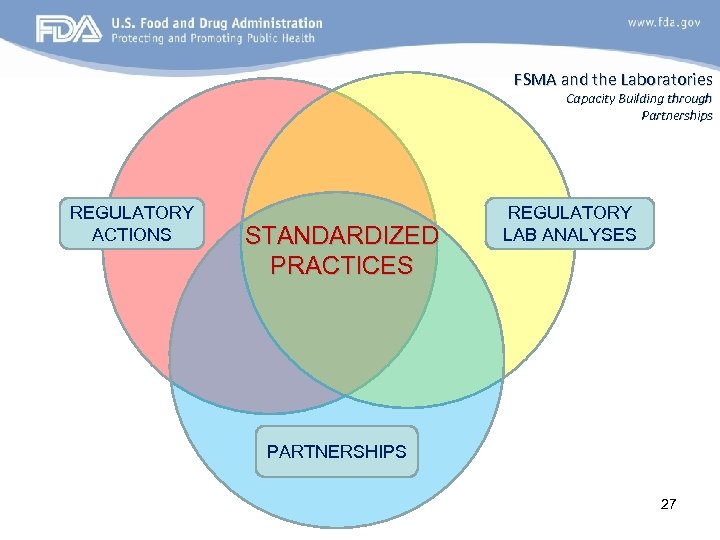
FSMA and the Laboratories Capacity Building through Partnerships REGULATORY ACTIONS STANDARDIZED PRACTICES REGULATORY LAB ANALYSES PARTNERSHIPS 27
FSMA and the Laboratories Capacity Building through Partnerships Success hinges on: ØMutual Reliance ØData sharing capabilities ØAcceptance of laboratory data 28
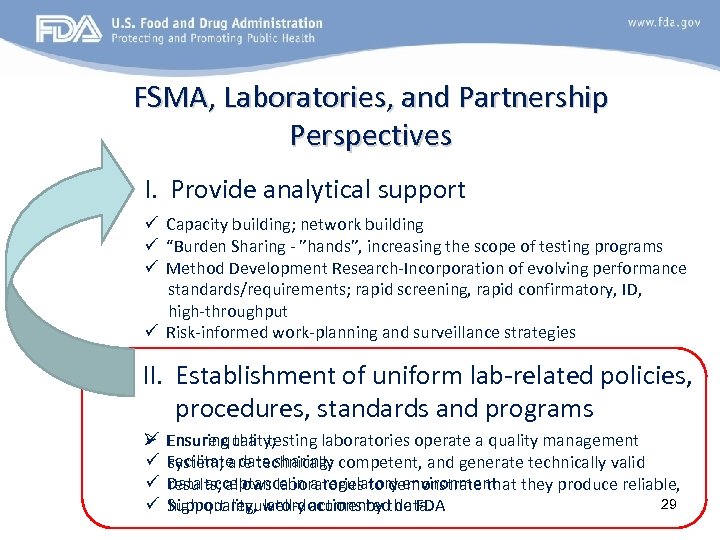
FSMA, Laboratories, and Partnership Perspectives Ø I. Provide analytical support ü Capacity building; network building ü “Burden Sharing - ”hands”, increasing the scope of testing programs ü Method Development Research-Incorporation of evolving performance standards/requirements; rapid screening, rapid confirmatory, ID, high-throughput ü Risk-informed work-planning and surveillance strategies Ø II. Establishment of uniform lab-related policies, procedures, standards and programs ü Ensure quality; Ø Ensuring that testing laboratories operate a quality management ü Facilitate data sharing; system; are technically competent, and generate technically valid ü Data acceptance in a regulatory environment results; allows laboratories to demonstrate that they produce reliable, 29 ü Support regulatory actions by the FDA high quality, well-documented data.
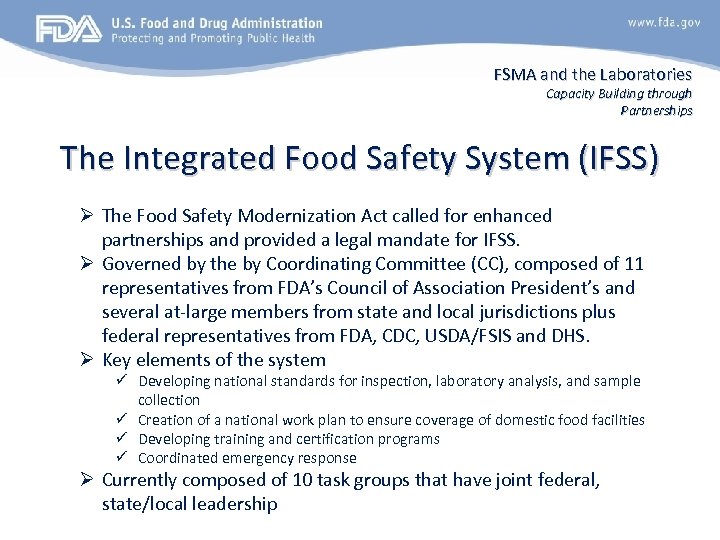
FSMA and the Laboratories Capacity Building through Partnerships The Integrated Food Safety System (IFSS) Ø The Food Safety Modernization Act called for enhanced partnerships and provided a legal mandate for IFSS. Ø Governed by the by Coordinating Committee (CC), composed of 11 representatives from FDA’s Council of Association President’s and several at-large members from state and local jurisdictions plus federal representatives from FDA, CDC, USDA/FSIS and DHS. Ø Key elements of the system ü Developing national standards for inspection, laboratory analysis, and sample collection ü Creation of a national work plan to ensure coverage of domestic food facilities ü Developing training and certification programs ü Coordinated emergency response Ø Currently composed of 10 task groups that have joint federal, state/local leadership
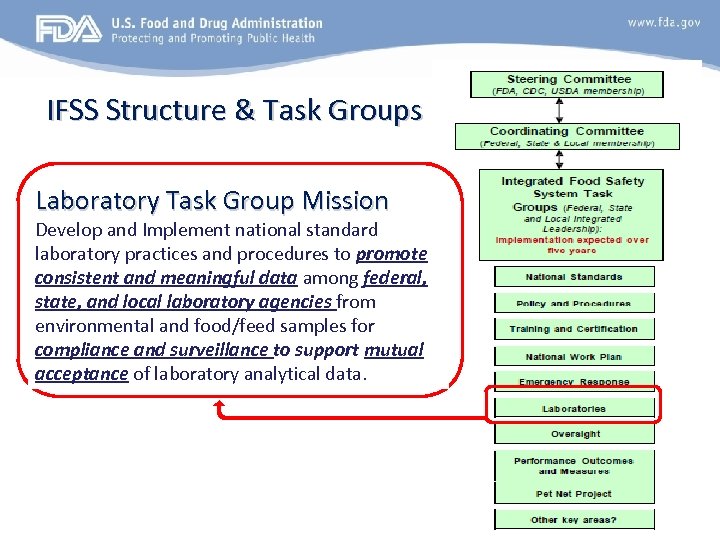
IFSS Structure & Task Groups Laboratory Task Group Mission Develop and Implement national standard laboratory practices and procedures to promote consistent and meaningful data among federal, state, and local laboratory agencies from environmental and food/feed samples for compliance and surveillance to support mutual acceptance of laboratory analytical data.
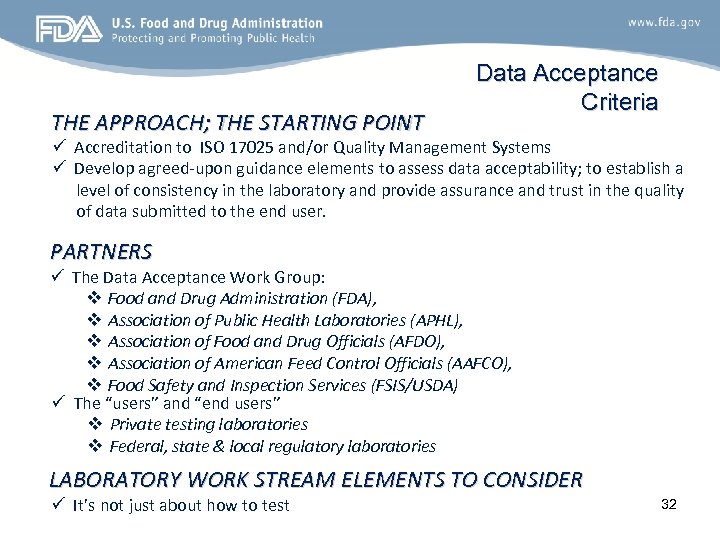
THE APPROACH; THE STARTING POINT Data Acceptance Criteria ü Accreditation to ISO 17025 and/or Quality Management Systems ü Develop agreed-upon guidance elements to assess data acceptability; to establish a level of consistency in the laboratory and provide assurance and trust in the quality of data submitted to the end user. PARTNERS ü The Data Acceptance Work Group: v Food and Drug Administration (FDA), v Association of Public Health Laboratories (APHL), v Association of Food and Drug Officials (AFDO), v Association of American Feed Control Officials (AAFCO), v Food Safety and Inspection Services (FSIS/USDA) ü The “users” and “end users” v Private testing laboratories v Federal, state & local regulatory laboratories LABORATORY WORK STREAM ELEMENTS TO CONSIDER ü It’s not just about how to test 32
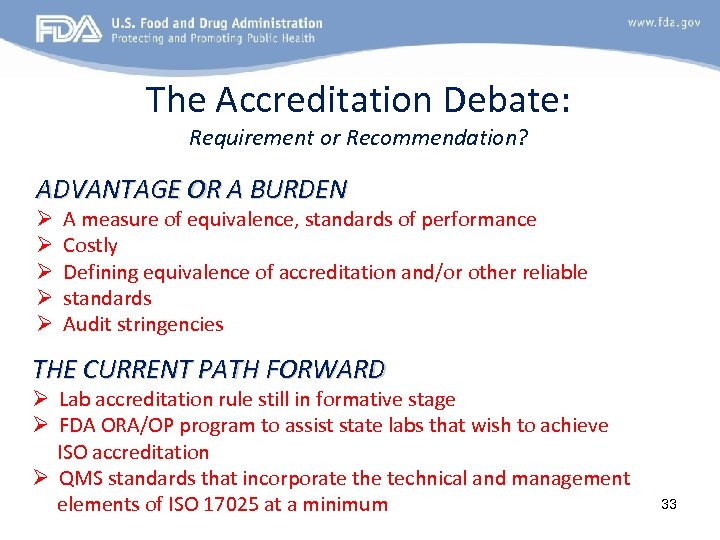
The Accreditation Debate: Requirement or Recommendation? ADVANTAGE OR A BURDEN Ø Ø Ø A measure of equivalence, standards of performance Costly Defining equivalence of accreditation and/or other reliable standards Audit stringencies THE CURRENT PATH FORWARD Ø Lab accreditation rule still in formative stage Ø FDA ORA/OP program to assist state labs that wish to achieve ISO accreditation Ø QMS standards that incorporate the technical and management elements of ISO 17025 at a minimum 33

y r to ula g Re QMS Minimum Elements to Assess ˄ Data Acceptability Ø All laboratories (accredited or not) should be operating under a Quality Management System (QMS) Ø Governs all activities that directly or indirectly contribute to the quality of testing; minimum set of standards; Ø May involve additional criteria for food/feed program coordination and alignment Ø Partnership for Food Protection Laboratory Task Group: “Food/Feed Testing Laboratories Best Practices Manual” Pre-analytical 1. 2. 3. 4. Program requirements Sample collection Chain of custody Sample receipt Laboratory Analyses Post-analytical 1. Reports 2. Record keeping 3. Data Packages 34
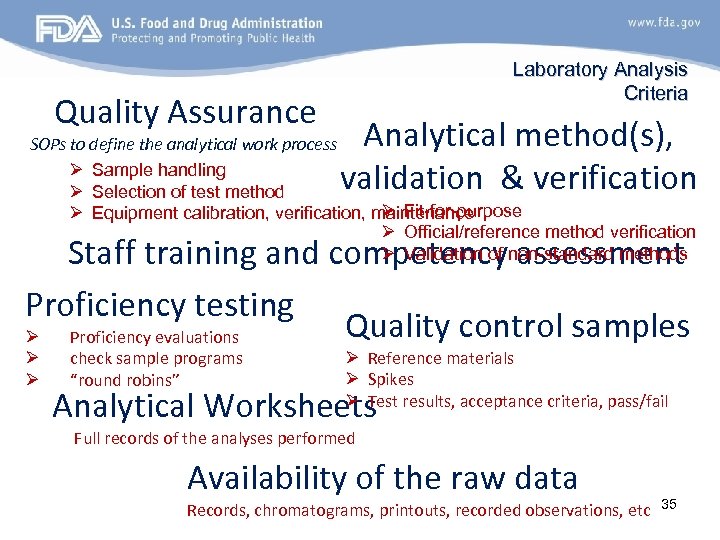
Quality Assurance Laboratory Analysis Criteria Analytical method(s), validation & verification SOPs to define the analytical work process Ø Sample handling Ø Selection of test method Ø Fit-for-purpose Ø Equipment calibration, verification, maintenance Ø Official/reference method verification Ø Validation of non-standard methods Staff training and competency assessment Proficiency testing Quality control samples Ø Proficiency evaluations Ø Ø check sample programs “round robins” Ø Reference materials Ø Spikes Ø Test results, acceptance criteria, pass/fail Analytical Worksheets Full records of the analyses performed Availability of the raw data Records, chromatograms, printouts, recorded observations, etc 35
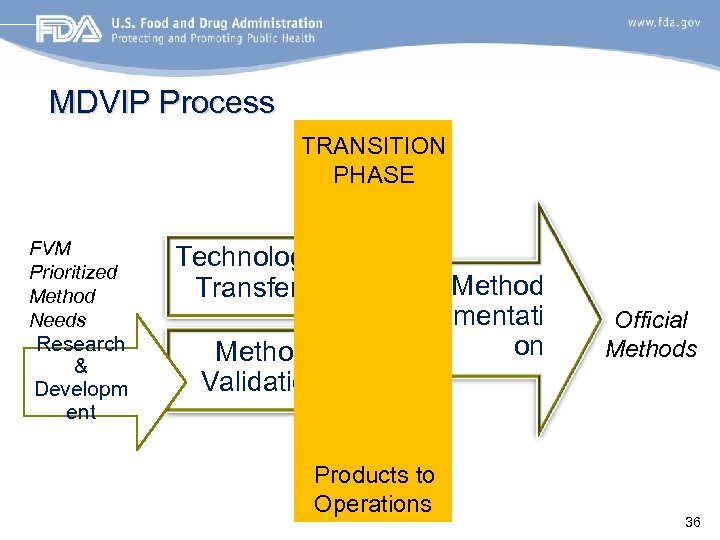
MDVIP Process TRANSITION PHASE FVM Prioritized Method Needs Research & Developm ent Technology Transfer Method Validation Method Implementati on Products to Operations Official Methods 36
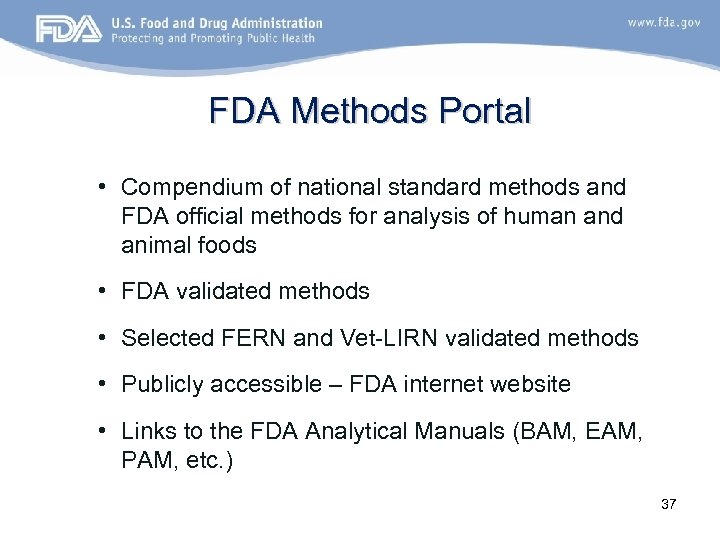
FDA Methods Portal • Compendium of national standard methods and FDA official methods for analysis of human and animal foods • FDA validated methods • Selected FERN and Vet-LIRN validated methods • Publicly accessible – FDA internet website • Links to the FDA Analytical Manuals (BAM, EAM, PAM, etc. ) 37
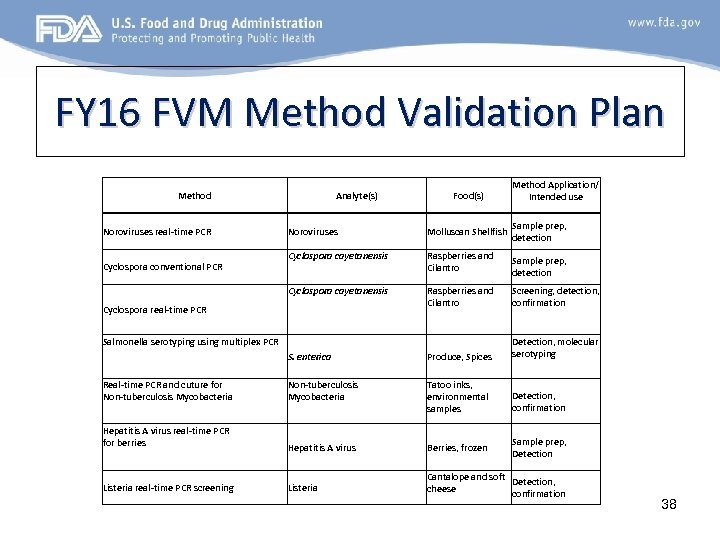
FY 16 FVM Method Validation Plan Method Noroviruses real-time PCR Analyte(s) Food(s) Method Application/ Intended use Sample prep, detection Noroviruses Molluscan Shellfish Cyclospora cayetanensis Raspberries and Cilantro Screening, detection, confirmation S. enterica Produce, Spices Detection, molecular serotyping Real-time PCR and cuture for Non-tuberculosis Mycobacteria Tatoo inks, environmental samples Detection, confirmation Hepatitis A virus real-time PCR for berries Hepatitis A virus Berries, frozen Sample prep, Detection Listeria real-time PCR screening Listeria Cantalope and soft Detection, cheese confirmation Cyclospora conventional PCR Cyclospora real-time PCR Salmonella serotyping using multiplex PCR Sample prep, detection 38
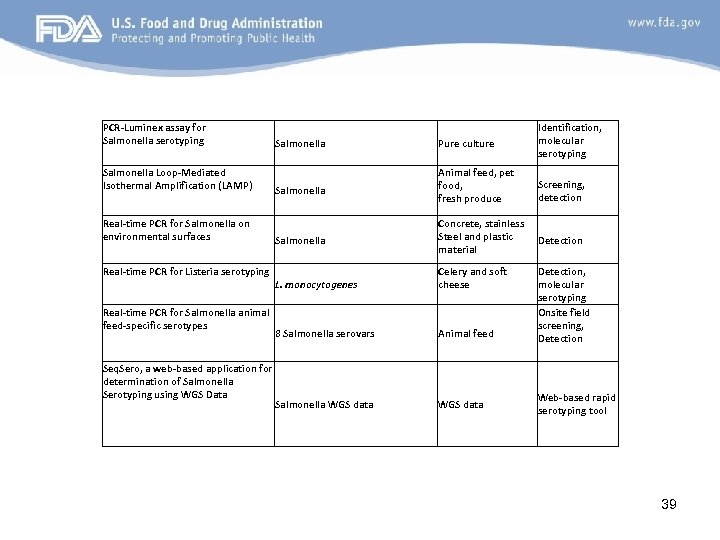
PCR-Luminex assay for Salmonella serotyping Salmonella Loop-Mediated Isothermal Amplification (LAMP) Real-time PCR for Salmonella on environmental surfaces Salmonella Pure culture Identification, molecular serotyping Salmonella Animal feed, pet food, fresh produce Screening, detection Salmonella Concrete, stainless Steel and plastic material Detection Real-time PCR for Listeria serotyping L. monocytogenes Real-time PCR for Salmonella animal feed-specific serotypes Seq. Sero, a web-based application for determination of Salmonella Serotyping using WGS Data Celery and soft cheese 8 Salmonella serovars Animal feed Salmonella WGS data Detection, molecular serotyping Onsite field screening, Detection Web-based rapid serotyping tool 39
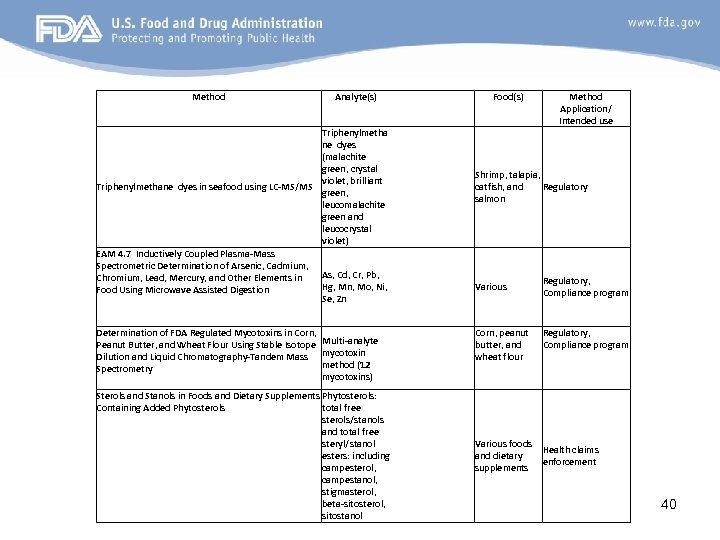
Method Analyte(s) Food(s) Triphenylmetha ne dyes (malachite green, crystal violet, brilliant Triphenylmethane dyes in seafood using LC-MS/MS green, leucomalachite green and leucocrystal violet) EAM 4. 7 Inductively Coupled Plasma-Mass Spectrometric Determination of Arsenic, Cadmium, As, Cd, Cr, Pb, Chromium, Lead, Mercury, and Other Elements in Hg, Mn, Mo, Ni, Food Using Microwave Assisted Digestion Se, Zn Determination of FDA Regulated Mycotoxins in Corn, Peanut Butter, and Wheat Flour Using Stable Isotope Multi-analyte Dilution and Liquid Chromatography-Tandem Mass mycotoxin method (12 Spectrometry mycotoxins) Sterols and Stanols in Foods and Dietary Supplements Phytosterols: Containing Added Phytosterols total free sterols/stanols and total free steryl/stanol esters: including campesterol, campestanol, stigmasterol, beta-sitosterol, sitostanol Method Application/ Intended use Shrimp, talapia, catfish, and Regulatory salmon Various Corn, peanut butter, and wheat flour Various foods and dietary supplements Regulatory, Compliance program Health claims enforcement 40
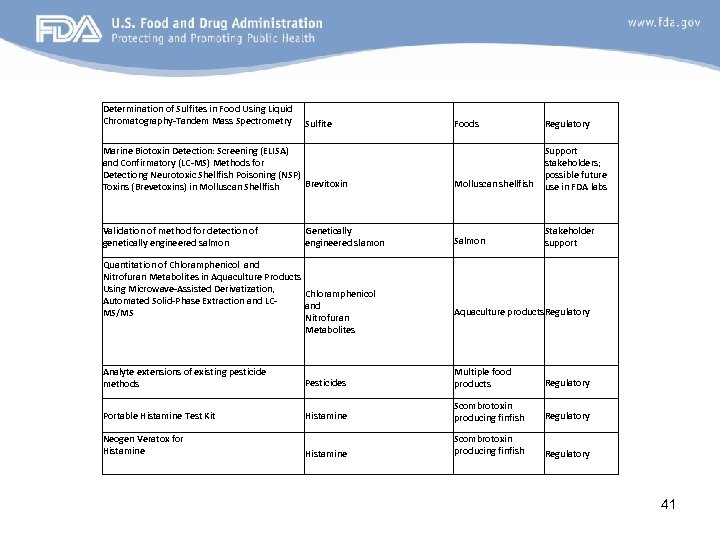
Determination of Sulfites in Food Using Liquid Chromatography-Tandem Mass Spectrometry Sulfite Marine Biotoxin Detection: Screening (ELISA) and Confirmatory (LC-MS) Methods for Detectiong Neurotoxic Shellfish Poisoning (NSP) Brevitoxin Toxins (Brevetoxins) in Molluscan Shellfish Validation of method for detection of genetically engineered salmon Genetically engineered slamon Quantitation of Chloramphenicol and Nitrofuran Metabolites in Aquaculture Products Using Microwave-Assisted Derivatization, Chloramphenicol Automated Solid-Phase Extraction and LCand MS/MS Nitrofuran Metabolites Foods Regulatory Molluscan shellfish Support stakeholders; possible future use in FDA labs Salmon Stakeholder support Aquaculture products. Regulatory Analyte extensions of existing pesticide methods Pesticides Multiple food products Regulatory Portable Histamine Test Kit Histamine Scombrotoxin producing finfish Regulatory Neogen Veratox for Histamine 41
Concluding Thoughts: What Do We Gain? ØLasting success and impact of FSMA and the FDA’s future vision for an integrated food and feed safety system depends on the strength of partnerships e. g. State labs, FERN, Vet. LIRN ØStandardization of laboratory capabilities and competencies provide confidence of the integrity and scientific validity of laboratory analytical data for acceptance. ØAnalytical support for an integrated food and feed safety system; mutual reliance; systems recognition that involves partnerships with other federal agencies, with state public health and agricultural agencies, with other public and private stakeholders, and international bodies ØImpact v Outbreak investigations, v Surveillance activities ü Import safety strategies ü Sampling strategies 42
THANK YOU Jeffrey. Ward@fda. hhs. gov 43
Скачать презентацию FDA Method Development and Regulatory Application in Collaboration
f12c76dea52308441191465ec2b04691.ppt