


 Скачать презентацию FCM National Programs First Nation-Municipal Community Infrastructure Partnership
6a7a4649fd26e8f09bc5d205d6d3f236.ppt
- Количество слайдов: 123
 FCM National Programs First Nation-Municipal Community Infrastructure Partnership Program (CIPP) Suzanne Moccia, CIPP Program Manager Emily Savage, CIPP Program Assistant Mark Allison, Whistler Centre for Sustainability 18 May 2011, Little Salmon/Carmacks First Nation, YK
 Housekeeping and House Rules • Location of exits and fire safety equipment • Suffering is optional! • Washroom location • Coffee/tea/water • Break times • Smoking • Cell phones… turned off or silent best! • No such thing as a stupid question • Don’t hold that thought! • Workshop timing… we’ll get you out by 4: 30 • Other? CIPP Toolkit Workshop – 18 May 2011 2
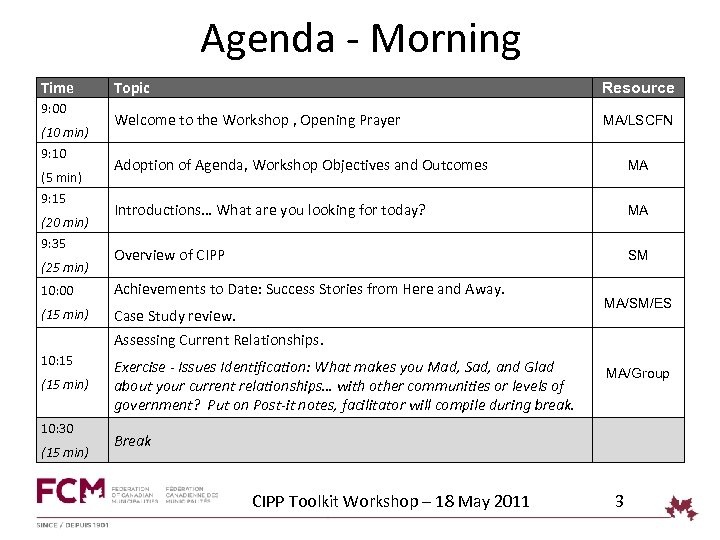 Agenda - Morning Time 9: 00 (10 min) 9: 10 (5 min) 9: 15 (20 min) 9: 35 (25 min) Topic Resource Welcome to the Workshop , Opening Prayer MA/LSCFN Adoption of Agenda, Workshop Objectives and Outcomes MA Introductions… What are you looking for today? MA Overview of CIPP SM 10: 00 Achievements to Date: Success Stories from Here and Away. (15 min) Case Study review. MA/SM/ES Assessing Current Relationships. 10: 15 (15 min) 10: 30 (15 min) Exercise - Issues Identification: What makes you Mad, Sad, and Glad about your current relationships… with other communities or levels of government? Put on Post-it notes, facilitator will compile during break. MA/Group Break CIPP Toolkit Workshop – 18 May 2011 3
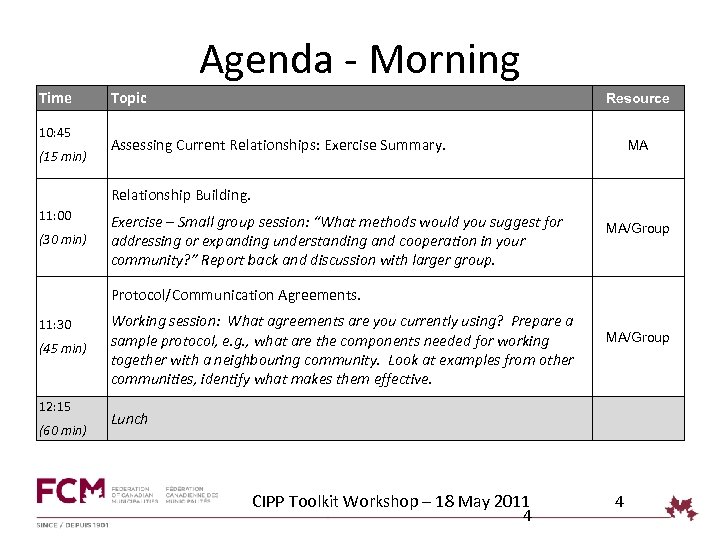 Agenda - Morning Time 10: 45 (15 min) Topic Resource Assessing Current Relationships: Exercise Summary. MA Relationship Building. 11: 00 (30 min) Exercise – Small group session: “What methods would you suggest for addressing or expanding understanding and cooperation in your community? ” Report back and discussion with larger group. MA/Group Protocol/Communication Agreements. 11: 30 (45 min) 12: 15 (60 min) Working session: What agreements are you currently using? Prepare a sample protocol, e. g. , what are the components needed for working together with a neighbouring community. Look at examples from other communities, identify what makes them effective. MA/Group Lunch CIPP Toolkit Workshop – 18 May 2011 4 4
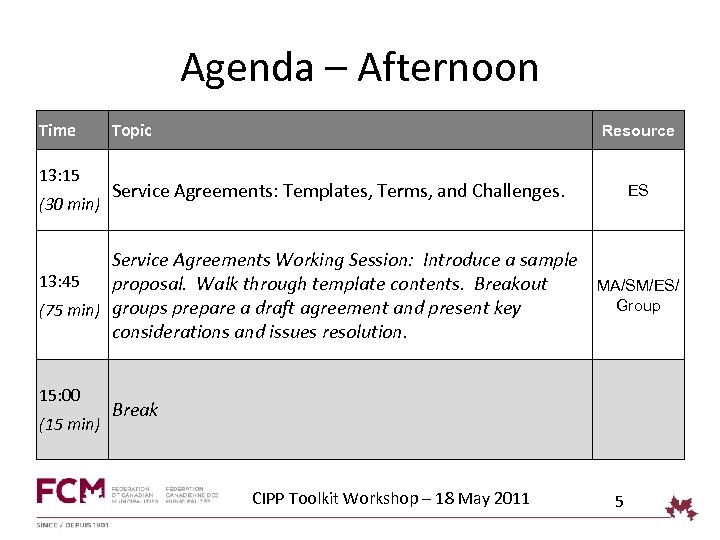 Agenda – Afternoon Time 13: 15 (30 min) Topic Resource Service Agreements: Templates, Terms, and Challenges. Service Agreements Working Session: Introduce a sample 13: 45 proposal. Walk through template contents. Breakout (75 min) groups prepare a draft agreement and present key considerations and issues resolution. 15: 00 (15 min) ES MA/SM/ES/ Group Break CIPP Toolkit Workshop – 18 May 2011 5
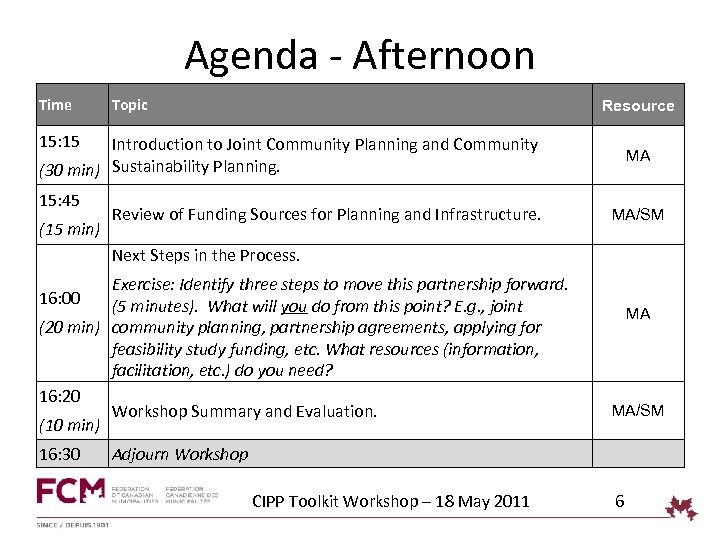 Agenda - Afternoon Time Topic Resource 15: 15 Introduction to Joint Community Planning and Community (30 min) Sustainability Planning. 15: 45 (15 min) Review of Funding Sources for Planning and Infrastructure. MA MA/SM Next Steps in the Process. Exercise: Identify three steps to move this partnership forward. 16: 00 (5 minutes). What will you do from this point? E. g. , joint (20 min) community planning, partnership agreements, applying for feasibility study funding, etc. What resources (information, facilitation, etc. ) do you need? 16: 20 Workshop Summary and Evaluation. (10 min) 16: 30 MA MA/SM Adjourn Workshop CIPP Toolkit Workshop – 18 May 2011 6
 Tips for a Successful Workshop 1. Everyone participates 2. Start and finish sessions on time… or agree together to change the times 3. One conversation at a time 4. Focus on the topic at hand 5. Different opinions are welcome 6. Listen first to understand, then speak openly 7. Challenge ideas, not individuals 8. Follow through on actions and commitments 7
 Learning Objectives • • • Improve understanding among First Nations and Municipalities of the benefits, costs, and rationale associated with municipal service agreements (MTSA); Inform First Nations and adjacent Municipalities of the national scope of MTSA (e. g. , types of agreements, locations, etc. ); Provide the information, tools, and capacity building to facilitate effective development, completion and long term sustainability of MTAs; Improve understanding of the resources and skills required for partnering around community services. Learn from YOU how to improve the toolkit for the Yukon CIPP Toolkit Workshop – 18 May 2011 8
 Workshop Outcomes • Get to know other communities better! • Identify the needs of local municipal and First Nations communities • Provide an overview of the CIPP program and examples of successful joint projects • Assess current relationships and identify ways for communities to work together • Outline the uses of protocols and communications agreements CIPP Toolkit Workshop – 18 May 2011 9
 Workshop Outcomes • Introduce the CIPP Service Agreement Toolkit • Work hands-on on a sample project to learn how to apply the Toolkit contents • Learn about the benefits and mechanics of joint community sustainability planning • Review potential project funding/resources • Identify opportunities for partnerships and the next steps in the partnership process • Networking! 10
 Introductions • Who are we? • Who are you? – Your name – Your community – Your role in the community – What are you looking for today? CIPP Toolkit Workshop – 18 May 2011 11
 CIPP Program Overview CIPP Toolkit Workshop – 18 May 2011 12
 Background • Build and foster partnerships between First Nation and municipal governments, to improve the provision of community infrastructure • Community infrastructure is a timely issue • It is about healthy communities • Past examples of successful First Nation and municipal government partnerships (i. e. , LMP) • Opportunity to address current issues of community infrastructure via new partnerships between First Nation and municipal governments CIPP Toolkit Workshop – 18 May 2011 13
 Program Objective To improve the ability of adjacent First Nation and municipal governments to form partnerships that lead to improved water and wastewater infrastructure and related services in a sustainable manner CIPP Toolkit Workshop – 18 May 2011 14
 Program Phases Two Major Phases: 1. Research and Knowledge: Development of Toolkit (FALL 2010 – SPRING 2011) 2. First Nation-Municipal Partnership Training Workshops (2011 -2012) CIPP Toolkit Workshop – 18 May 2011 15
 Service Agreements: A National Scope • Service agreements are a common trend across the country • Diverse audience: rural and urban, small and large populations • More than 1300 service agreements exist between First Nations and Municipalities • Often times, service agreements take approximately 2 years to negotiate and become operational • Cooperation on diverse services: water, wastewater, fire protection, solid waste, animal control, recreation, snow removal, street lights, road maintenance, etc. CIPP Toolkit Workshop – 18 May 2011 16
 Status of Agreements in BC • Approximately 650 Agreements although many remain informal and unrecorded • Significant opportunity for service agreements due to relationships between governments • The complexity of agreements and how well they function varies greatly across the province: Osoyoos, Metro Vancouver, Hazelton-Gitanmaax. CIPP Toolkit Workshop – 18 May 2011 17
 Why Service Agreements? • Partnerships can reduce costs associated with service provision, enhance social and economic development, and build capacity within both First Nation and municipal governments • Funds can be leveraged from various funders which only one partner may have access to • Ensures ongoing communication and collaboration CIPP Toolkit Workshop – 18 May 2011 18
 Toolkit Focus CIPP Toolkit Workshop – 18 May 2011 19
 Booklet 1 Project Overview Purpose: • • • Explain the purpose of CIPP Provide an overview of the Toolkit Note the status of existing partnerships Explain the benefits of a service agreement Provide an steps which can help municipalities and First Nations decide whether a service agreement is the right option for them CIPP Toolkit Workshop – 18 May 2011 20
 Booklet 2 Guide to Relationship Building Purpose: • Ensure that partners understand the roles of key actors in each form of government • Explain the services each government provides • Demonstrate similarities and differences • Address common questions and myths about both municipalities and First Nations • Provide common forms of ADR, their use, and outline benefits and drawbacks of each method CIPP Toolkit Workshop – 18 May 2011 21
 Booklet 3 Guide to Service Agreements Purpose: • Explain the mechanics of a service agreement in plain language including common clauses • Note recommended service agreement provisions • Include information on: feasibility, negotiation, and pricing • Tools: Templates for: Water and Waste Water, Solid Waste, Fire Protection CIPP Toolkit Workshop – 18 May 2011 22
 Booklet 4 Resources and Other Considerations Purpose: • Highlight innovative ways in which municipalities and First Nations are working together • Provide information on sources for funding through a variety of sources • Annotated Bibliography CIPP Toolkit Workshop – 18 May 2011 23
 Using the CIPP Toolkit • Provides tools which can be taken directly from the book: – Checklists – Templates • Reference guide providing links to provincial opportunities and national resources • Useful for both elected political officials and technical staff CIPP Toolkit Workshop – 18 May 2011 24
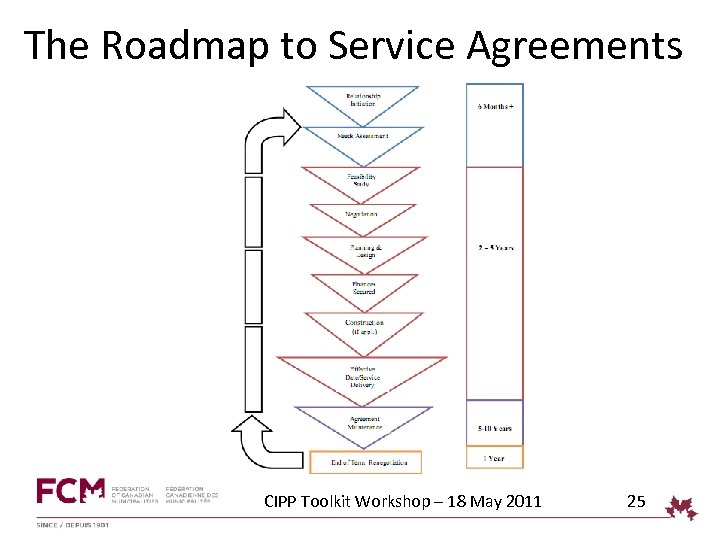 The Roadmap to Service Agreements CIPP Toolkit Workshop – 18 May 2011 25
 Questions? CIPP Toolkit Workshop – 18 May 2011 26
 Achievements to date CIPP Toolkit Workshop – 18 May 2011 27
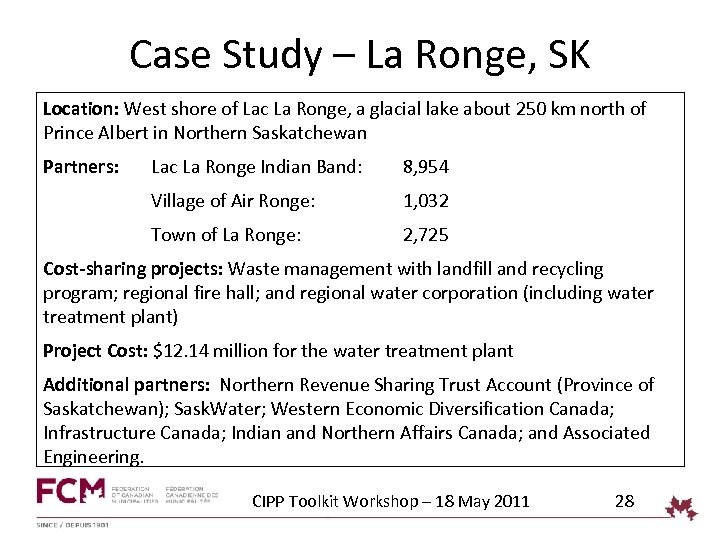 Case Study – La Ronge, SK Location: West shore of Lac La Ronge, a glacial lake about 250 km north of Prince Albert in Northern Saskatchewan Partners: Lac La Ronge Indian Band: 8, 954 Village of Air Ronge: 1, 032 Town of La Ronge: 2, 725 Cost-sharing projects: Waste management with landfill and recycling program; regional fire hall; and regional water corporation (including water treatment plant) Project Cost: $12. 14 million for the water treatment plant Additional partners: Northern Revenue Sharing Trust Account (Province of Saskatchewan); Sask. Water; Western Economic Diversification Canada; Infrastructure Canada; Indian and Northern Affairs Canada; and Associated Engineering. CIPP Toolkit Workshop – 18 May 2011 28
 Keys to Success Trusting relationship • An established relationship based on trust and regular communication can avoid some of the challenges involved in setting up new entities. Consider future needs and requirements • When considering options for future water needs, ensure that current and anticipated regulatory requirements and future water demands are considered. CIPP Toolkit Workshop – 18 May 2011 29
 Lessons Learned Relationships take time • It can take time to establish a solid, trusting relationship with neighbouring communities. Historically, the three communities went through growing pains to establish the formal and informal structures necessary to deliver joint community services. Cooperation across all levels • Establishing a complex entity such as a regional water corporation requires cooperation from all levels of leadership to project management and implementation staff. Consider regional water solutions • If water solutions for a small community are being explored, the most viable solution could be a regional solution involving neighbouring communities. CIPP Toolkit Workshop – 18 May 2011 30
 Case Study – BC Sunshine Coast Location: British Columbia’s Upper Sunshine Coast, 125 km north of Vancouver Partners: Sliammon First Nation: 1, 000 City of Powell River: 14, 000 Project cost: $ 2 million for the sea walk (funding provided by the provincial government) Additional partners: Government of British Columbia CIPP Toolkit Workshop – 18 May 2011 31
 Keys to Success • Keep working on the relationship with your neighbor and adapt to new challenges along the way. • “There will be contentious issues and personality conflicts which is why it is so important to have trust as the foundation, ” former Sliammon Chief L. Maynard Harry • “Patience, understanding and respectm, ” Mayor Alsgard, City of Powell River • “Relationship building needs to be done on a daily basis, ” Stan Westby, CAO, City of Powell River CIPP Toolkit Workshop – 18 May 2011 32
 Lessons Learned • Regular meetings with consistent attendance is a critical part of relationship building. • Delegate responsibilities. • “Look at the political chemistry and then determine how you can work together, ” Mayor Alsgard, City of Powell River • “The biggest risk is the biggest reward, ” Stan Westby, CAO, City of Powell River • “The leadership has to be willing to put in the time. For example, the Mayor makes an effort to attend all meetings. The trust established between the two communities would erode if someone missed too many meetings, ” former Sliammon Chief L. Maynard Harry CIPP Toolkit Workshop – 18 May 2011 33
 Case Study – Peace River Region Location: Peace River region of Northwestern Alberta Partners: Northern Sunrise County: Village of Nampa: Woodland Cree First Nation: 2, 880 373 986 Cost-sharing projects: Water treatment plant (New water Ltd. ); wastewater; fire protection; family and community support services; seniors’ transportation program and a recreational facility. Capital costs: Phase one: $46 million (the three communities contributed $12 million in total) Other funding: $34 million from various grants including $4 million from Indian and Northern Affairs Canada, and $3 million from the Province of Alberta CIPP Toolkit Workshop – 18 May 2011 34
 Keys to Success Grant funding • Communities may want to consider applying for government and other grant programs to subsidize infrastructure projects. Spirit of cooperation and regular communication • Maintaining a spirit of cooperation and commitment between parties makes for successful long-term working relationships. Regular communication ensures that problems are dealt with early and solutions benefit all communities involved, Striking the right balance in committees • When establishing a committee to oversee the process of developing a new entity, ensure that all relevant parties (communities, private sector, provincial and federal governments) are at the table. Also ensure that committee members have a variety of skills and backgrounds. CIPP Toolkit Workshop – 18 May 2011 35
 Lessons Learned Innovative Problem Solving • When problems arise, identify each party’s needs, think “outside the box”, and focus on finding solutions together. CIPP Toolkit Workshop – 18 May 2011 36
 Case Study – Hazelton/Gitanmaax Location: West Central British Columbia near the junction of the Skeena and Bulkley Rivers Partners: Village of Hazelton: 292 Gitanmaax First Nation: 850 Cost-sharing projects: Water treatment plant, sanitary sewer system, water line maintenance, transit, and fire protection Additional Partners: Indian and Northern Affairs Canada CIPP Toolkit Workshop – 18 May 2011 37
 Keys to Success Communication: • Having open communication and regular meetings between community leadership promotes strong working relationships. Discuss the ‘big picture” and communicate these goals to each other’s councils. Relationship Building: • Fostering communication at all levels (executive, administrative, and technical levels) is key to building positive working relationships. • Developing mutual respect and a sense of equal say and equal partnership in all matters can deepen trust between working groups. CIPP Toolkit Workshop – 18 May 2011 38
 Lessons Learned • Seek to develop regular meeting times between councils and, if possible, consistent attendance from the same individuals • Strive for open, honest communication and transparency • Find ways to work through the challenges of cultural differences in processes and management styles CIPP Toolkit Workshop – 18 May 2011 39
 Questions? CIPP Toolkit Workshop – 18 May 2011 40
 Achievements • Exercise: What agreements have Yukon municipalities and First Nations already achieved together? CIPP Toolkit Workshop – 18 May 2011 41
 Assessing current relationships… MAD, SAD, and GLAD CIPP Toolkit Workshop – 18 May 2011 42
 MAD • Things that are: – Sources of irritation – Lead to resentment – Create anger – Isolate communities or partners – Cause hard feelings CIPP Toolkit Workshop – 18 May 2011 43
 SAD • Things that are: – Disappointing – Lead to isolation – Below expectations – Unnecessary misunderstandings – Confusing CIPP Toolkit Workshop – 18 May 2011 44
 GLAD • The that are: – Sources of pride and unity – Increase the quality of life – Expand understanding and cooperation – Promote community harmony and sharing CIPP Toolkit Workshop – 18 May 2011 45
 Exercise: MADs, SADs, GLADs Part 1 (15 min): • What makes you MAD, SAD, or GLAD about your current and past relationships with other communities, or levels of government? – One MAD, SAD, or GLAD per Post-It – When ready, put them up on the corresponding sheet on the wall CIPP Toolkit Workshop – 18 May 2011 46
 Time for a break! Please be back in 15 minutes
 Agenda - Morning Time 10: 45 (15 min) Topic Resource Assessing Current Relationships: Exercise Summary. MA Relationship Building. 11: 00 (30 min) Exercise – Small group session: “What methods would you suggest for addressing or expanding understanding and cooperation in your community? ” Report back and discussion with larger group. MA/Group Protocol/Communication Agreements. 11: 30 (45 min) 12: 15 (60 min) Working session: What agreements are you currently using? Prepare a sample protocol, e. g. , what are the components needed for working together with a neighbouring community. Look at examples from other communities, identify what makes them effective. MA/Group Lunch CIPP Toolkit Workshop – 18 May 2011 48 48
 MADs, SADs, GLADs Part 2 (15 min): • What are we doing well? – Discussion about GLADs CIPP Toolkit Workshop – 18 May 2011 49
 MADs, SADs, GLADs Part 3 (35 min): • Where and how can we do better? – Categorization of MADs and SADs into things that participants have power to change versus no power to change – Set next steps on changing what group has power over CIPP Toolkit Workshop – 18 May 2011 50
 Relationship and Partnership Building CIPP Toolkit Workshop – 18 May 2011 51
 What is a Relationship? “The way in which two or more people or organizations regard and behave toward each other. ” CIPP Toolkit Workshop – 18 May 2011 52
 What is a Partnership? “An ongoing working relationship where risks and benefits are shared. ” This implies that each partner is equally involved in: • Co-creating the partnership’s activities • Bringing contributions (of different kinds) to the partnership • Committing to mutual accountability Source: Partnership Brokers Project (IBLF) CIPP Toolkit Workshop – 18 May 2011 53
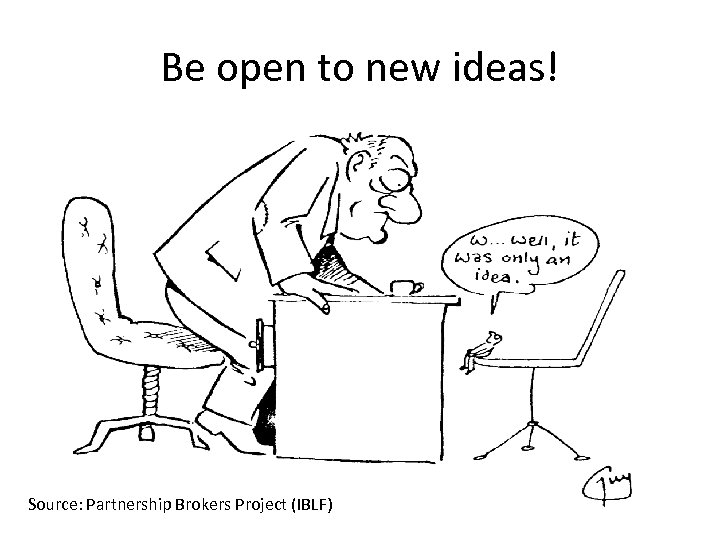 Be open to new ideas! Source: Partnership Brokers Project (IBLF)
 Be transparent – don’t hide behind a mask! Source: Partnership Brokers Project (IBLF)
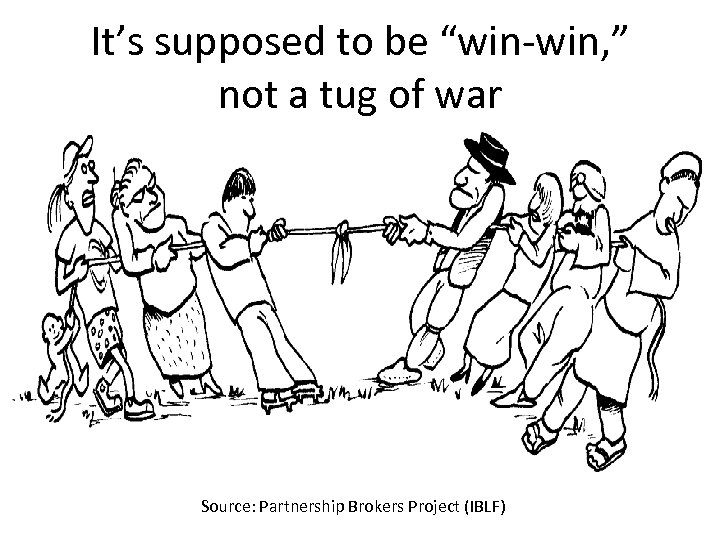 It’s supposed to be “win-win, ” not a tug of war Source: Partnership Brokers Project (IBLF)
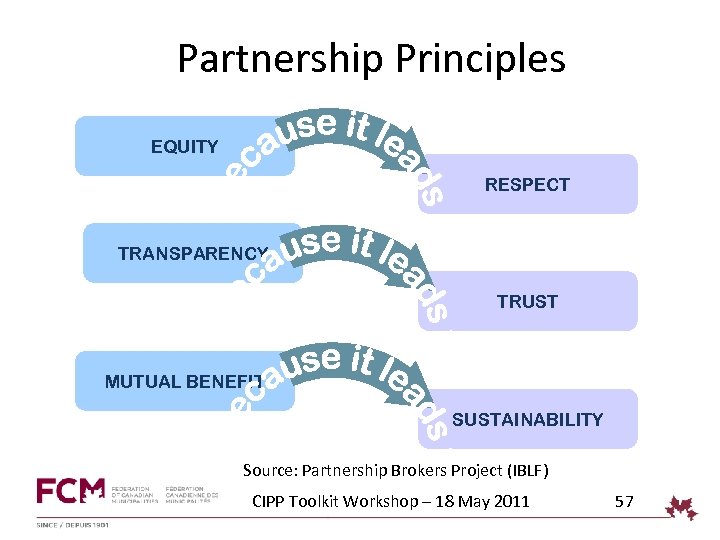 Partnership Principles EQUITY RESPECT TRANSPARENCY TRUST MUTUAL BENEFIT SUSTAINABILITY Source: Partnership Brokers Project (IBLF) CIPP Toolkit Workshop – 18 May 2011 57
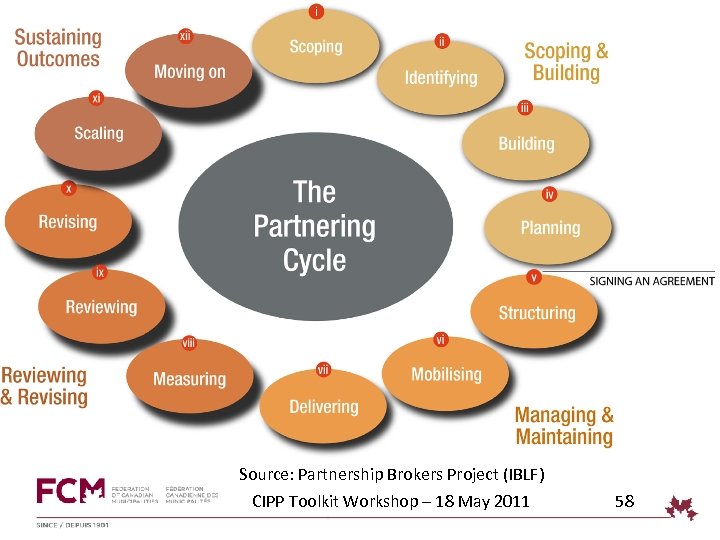 Source: Partnership Brokers Project (IBLF) CIPP Toolkit Workshop – 18 May 2011 58
 Challenges Relationship and partnership challenges are internal and external, requiring consideration of: • • Context in which the partnership is operating Context in which you are operating Partners (individuals) with whom you are working Partner organizations forming the partnership Cultural diversity Task(s) the partners are undertaking Management structures for the process Level of the team’s skills and competencies Source: Partnership Brokers Project (IBLF) CIPP Toolkit Workshop – 18 May 2011 59
 Challenging People Some people wear ‘different hats’ within partnerships. . . they can almost seem to be three different people! • An individual with professional expertise, specialist knowledge and / or unique experience • A representative of their organisation and their organisation’s expectations • A personality with a particular style of behaviour (introvert/extrovert; activist / analyst; assertive / reactive; etc. ) Source: Partnership Brokers Project (IBLF) CIPP Toolkit Workshop – 18 May 2011 60
 Always focus on problems, not personalities! “There is no such thing as a ‘difficult person’, but there are often situations where people behave in ways that we find difficult to deal with” Source: Andrew Acland, Perfect People Skills CIPP Toolkit Workshop – 18 May 2011 61
 Questions? CIPP Toolkit Workshop – 18 May 2011 62
 Exercise – Relationship Building • Break into small groups of 5 or 6 • Appoint a recorder/spokesperson • Discuss the question from your experience or what you’ve seen elsewhere that works: “What methods would you suggest for addressing or expanding understanding and cooperation in your community? ” • Report back your key methods. CIPP Toolkit Workshop – 18 May 2011 63
 Relationship and Partnership Communications CIPP Toolkit Workshop – 18 May 2011 64
 Why would a municipality and First Nations want to communicate and work together? • Improving working relationships (community-to-community, government-to-government) • Enhancing social standards • Providing growth and new opportunities to both municipal and First Nations communities • Skills sharing and creating a stronger labour force • Increasing capacity with both political and technical staff, due to knowledge sharing • Creating working partnerships that become business as usual • Accommodating regulatory changes • Providing better levels of service • Saving resources CIPP Toolkit Workshop – 18 May 2011 65
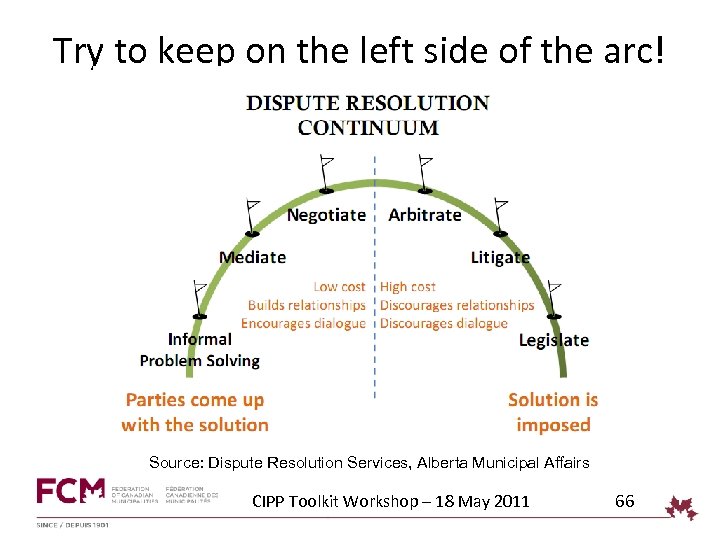 Try to keep on the left side of the arc! Source: Dispute Resolution Services, Alberta Municipal Affairs CIPP Toolkit Workshop – 18 May 2011 66
 Working on strong communications • Know each other’s governance structures - make sure you are talking to the right person • Distinguish the political from the technical – Political concerns include the nature of political relationships, historical tensions, governance (relationships between the four levels of government), jurisdiction, and policy. – Technical concerns include management of joint facilities, service agreement negotiation, financing models, engineering standards, community health and safety needs, regulations, and requirements. • Attend as many events/meetings as possible CIPP Toolkit Workshop – 18 May 2011 67
 Exercise: What areas of each other’s governance and business practices do you need more information or clarity on? 68
 Positive Communications Be respectful Be flexible Communicate openly Practice equality Create value for both parties Think long term Have realistic expectations Clarify decision making processes and responsibilities Establish systems for dispute resolution Use bottom-up approaches Practice integrity Use resources and experts CIPP Toolkit Workshop – 18 May 2011 69
 Tip 1: Show respect • It is important to not just talk to each other when you need something — get to know them as individuals. • Take time to learn about community history, achievements, and challenges. • Accept hospitality offered by your partner. • Communicate in person rather than by e-mail or telephone. • Share information, even if may not be needed. CIPP Toolkit Workshop – 18 May 2011 70
 Tip 2: Communicate effectively • Let people finish what they are saying and respect silences after someone has finished speaking. • Be prepared to work in a potentially passionate environment when discussing some issues and be prepared to listen and not take an issue personally. • Never refer to First Nations partners as stakeholders or use the term “institutionalize”; both can be negative. • Some individuals avoid direct eye contact as a sign of respect; do not interpret this value as shyness or being untrustworthy. • Remember, keep things light! Humour is important. CIPP Toolkit Workshop – 18 May 2011 71
 Tip 3: Effective decision making • Plan a sufficient amount of time for meetings, especially if decisions need to be made. . . don’t rush • Try to avoid situations with authoritative decision making or imposed solutions; always seek to build consensus in the group, and decisions will be more legitimate and have “buy-in”. • Individuals can become uncomfortable if asked to make decisions for the group. Often, community consultation, collective decision making, and permission to make decisions must occur. CIPP Toolkit Workshop – 18 May 2011 72
 Elements of Protocol Agreements 1. Purpose 2. Principles of Cooperation (regular meetings, information sharing, mutual respect, etc. 3. Shared values (Recognition of what you value and share in common) 4. Interests (What you will work together on) 5. Communications and contact persons 6. Terms and conditions for the agreement CIPP Toolkit Workshop – 18 May 2011 73
 Questions? CIPP Toolkit Workshop – 18 May 2011 74
 Exercise: Protocol/Communication Agreements • Appoint a recorder/spokesperson • Identify what agreements are you currently using in your communities • Look at examples from other communities, identify what makes them effective • Prepare a sample protocol, e. g. , what’s needed to work with a neighbour community • Report back on your key agreement points CIPP Toolkit Workshop – 18 May 2011 75
 LUNCH TIME! Please be back in an hour.
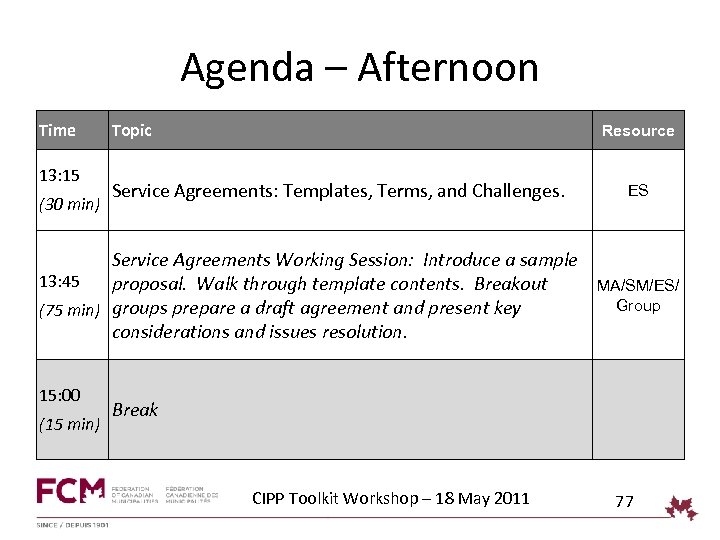 Agenda – Afternoon Time 13: 15 (30 min) Topic Resource Service Agreements: Templates, Terms, and Challenges. Service Agreements Working Session: Introduce a sample 13: 45 proposal. Walk through template contents. Breakout (75 min) groups prepare a draft agreement and present key considerations and issues resolution. 15: 00 (15 min) ES MA/SM/ES/ Group Break CIPP Toolkit Workshop – 18 May 2011 77
 Scoping Opportunities for Service Agreements CIPP Toolkit Workshop – 18 May 2011 78
 Scoping… • The kids are getting into trouble and some of our seniors and elders are feeling isolated… • We have a lot of waste wood and we need a new… 79
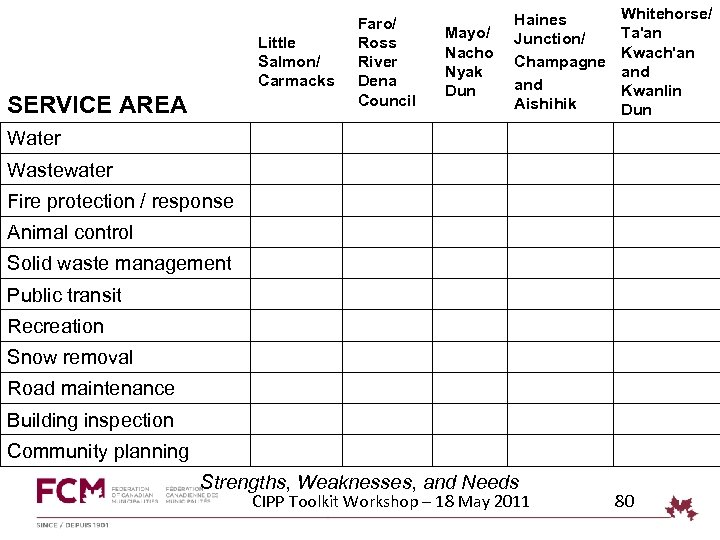 Little Salmon/ Carmacks SERVICE AREA Faro/ Ross River Dena Council Mayo/ Nacho Nyak Dun Haines Junction/ Champagne and Aishihik Whitehorse/ Ta'an Kwach'an and Kwanlin Dun Water Wastewater Fire protection / response Animal control Solid waste management Public transit Recreation Snow removal Road maintenance Building inspection Community planning Strengths, Weaknesses, and Needs CIPP Toolkit Workshop – 18 May 2011 80
 Feasibility First step in determining whether: • A service agreement is an appropriate method for service provision • The areas of cooperation identified during preliminary conversations make sense economically and operationally Also one of the relationship’s first opportunities to collaborate! CIPP Toolkit Workshop – 18 May 2011 81
 Feasibility A feasibility study should consider the following: • How services are currently being provided in each community; • Identify strengths and weaknesses of the status quo in a quantifiable manner; • Assess current costs to perform the services individually; • Examine how the level and quality of service could improve or costs could be reduced over 5 -10 years if communities shared resources and equipment or communities invested jointly in improved infrastructure, facilities, or equipment; • Long-term life cycle analysis; • Identify the cost of a service agreement compared to that of the status quo; • Compare the situation to other cases for similar services. CIPP Toolkit Workshop – 18 May 2011 82
 Feasibility A feasibility study should produce the following outcomes: • To what extent financial savings and economies of scale can be achieved by the service agreement; • The possible service level improvements for either the Municipality or the First Nation; • The infrastructure, equipment, and financial resource that will be required from both parties; • Which legal considerations will need to be taken into account during the negotiation of the service agreements (e. g. , water quality guidelines, infrastructure/land ownership model); • Ways in which infrastructure and services could be organized; • Identify any risks or potential negative impacts to either party; • Identify benefits. CIPP Toolkit Workshop – 18 May 2011 83
 Exercise: Anything else that you would want to know before moving forward with a partnership on a project? 84
 Questions? CIPP Toolkit Workshop – 18 May 2011 85
 CIPP Toolkit: Template Service Agreements CIPP Toolkit Workshop – 18 May 2011 86
 Background and Objective • Cost of engaging lawyers and project managers is high! …can be a barrier to service agreements • Regardless of the service area, similar considerations and discussions need to take place before an agreement can be completed • Templates were created in collaboration with lawyers who specialize in service agreements • Good starting point but would need to tailored to meet individual needs CIPP Toolkit Workshop – 18 May 2011 87
 Part 1 A Guide to Service Agreement Provisions CIPP Toolkit Workshop – 18 May 2011 88
 Essential Contract Elements • Elements which set the foundation for the rest of the agreement • Found in most contractual agreements • Effective date, parties to the agreement, authority to enter into agreement, preamble, definitions, term, applicable law CIPP Toolkit Workshop – 18 May 2011 89
 Description of Services Elements • Most difficult section of the service agreement to negotiate - Deals with the terms of the services • Substantial variation from templates here because services, charges for services, payment, etc. will be dependent on a variety of unique factors • Items in this category include: description of services, level of service, charges for services, user fees, bill payment, penalties, construction, ownership, repair, access, liability • Key is to deal with the issues as transparently as possible • Always include extra information as schedules to the agreement – particularly for determining prices and payment guidelines CIPP Toolkit Workshop – 18 May 2011 90
 Customary Elements Customary elements of the service agreement help ensure that the contract is: • Interpreted correctly - Entire agreement and headings • Valid through political turnover - Assignment, enurement*, and waiver of breach • Able to operate effectively giving outside circumstances - Notice, amendment, and severance * To take, or have effect or serve to the use, benefit, or advantage of an organization. CIPP Toolkit Workshop – 18 May 2011 91
 Recommended Elements • Recommended provisions are not essential to the structure of the service agreement but can offer value added for the communities • Examples of recommended elements include: dispute resolution, bylaw compatibility, consultation clause, and other forms of regional integration and planning CIPP Toolkit Workshop – 18 May 2011 92
 Part 2 Review of the Template Agreements CIPP Toolkit Workshop – 18 May 2011 93
 Service Agreement Templates • Clauses which fall under the essential and customary elements of the service agreement can be used in almost any contract and remain the same • Clauses relating to service provision will need to be negotiated and tailored to fit your individual needs, although they can help you get a sense of necessary considerations CIPP Toolkit Workshop – 18 May 2011 94
 Questions? CIPP Toolkit Workshop – 18 May 2011 95
 Working Session: Let’s give the Toolkit a test drive! Three scenarios: 1. Solid Waste Management 2. Recreation Centre 3. Water and Wastewater Treatment CIPP Toolkit Workshop – 18 May 2011 96
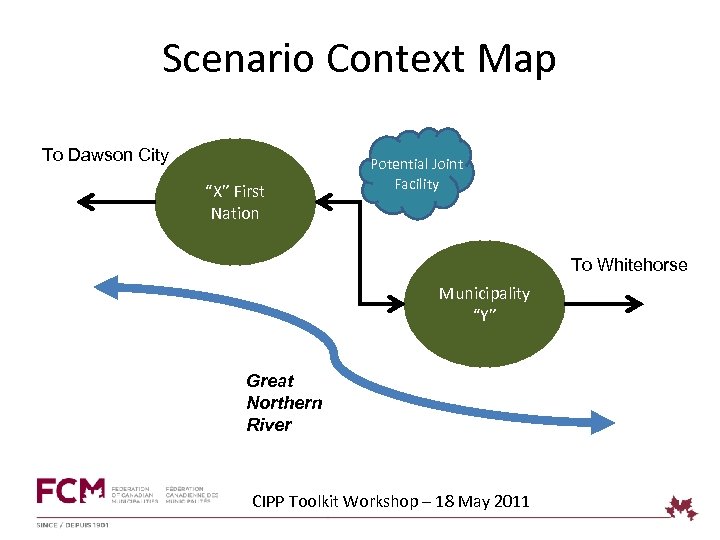 Scenario Context Map To Dawson City “X” First Nation Potential Joint Facility To Whitehorse Municipality “Y” Great Northern River CIPP Toolkit Workshop – 18 May 2011
 Exercise: Toolkit Working Session • Select teams based on interests, try for a balance, people from different communities • It’s okay to work on a real-world problem • Appoint a recorder and a presenter • Discuss the scenario and proposed service • Refer to the Toolkit guides and templates • Identify what you should do to move forward, using the worksheet to record the consensus • Present your findings to the large group CIPP Toolkit Workshop – 18 May 2011 98
 Time for a break! Please be back in 15 minutes
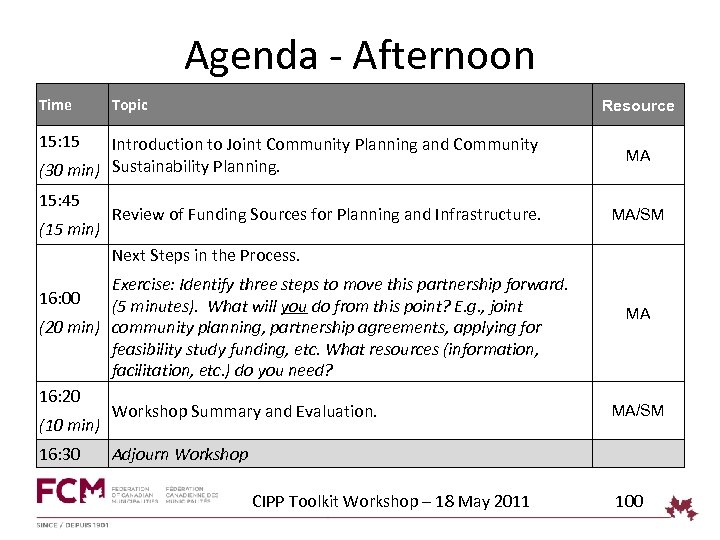 Agenda - Afternoon Time Topic Resource 15: 15 Introduction to Joint Community Planning and Community (30 min) Sustainability Planning. 15: 45 (15 min) Review of Funding Sources for Planning and Infrastructure. MA MA/SM Next Steps in the Process. Exercise: Identify three steps to move this partnership forward. 16: 00 (5 minutes). What will you do from this point? E. g. , joint (20 min) community planning, partnership agreements, applying for feasibility study funding, etc. What resources (information, facilitation, etc. ) do you need? 16: 20 Workshop Summary and Evaluation. (10 min) 16: 30 MA MA/SM Adjourn Workshop CIPP Toolkit Workshop – 18 May 2011 100
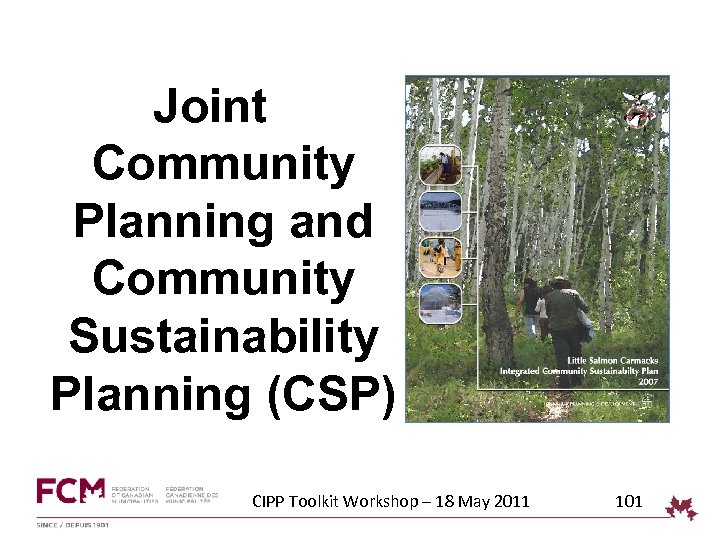 Joint Community Planning and Community Sustainability Planning (CSP) CIPP Toolkit Workshop – 18 May 2011 101
 What is Joint Community Planning? • Identifying common areas of interest • Being proactive, not reactive • Sharing information and engaging all partners in developing a coordinated community plan • Can apply to many areas… land use, economic development, transportation, community facilities or infrastructure services. • Sharing resources to achieve common goals CIPP Toolkit Workshop – 18 May 2011 102
 Why is Joint Planning Important? • Relationships can be strengthened and trust enhanced through the process to create a common vision and coordinated plans. • Improvements in quality of life for residents can be achieved, particularly where demand for services is high and resources are limited • Finding opportunities to collaborate and share costs of infrastructure and service provision. CIPP Toolkit Workshop – 18 May 2011 103
 Planning District Commission A planning district commission board can be established between a municipality and a First Nation to outline common social and economic interests and values, and common community planning concerns. The parties can adopt a planning district commission approach by formalizing an agreement — either in the service agreement or separately — to establish a planning commission. This commission may address issues such as: land use and development, environmental concerns, infrastructure planning, or economic development. If the planning commission is enacted outside of the service agreement, both communities will need to enact bylaws to accept the plan. Source: Toolkit Booklet 3 CIPP Toolkit Workshop – 18 May 2011 104
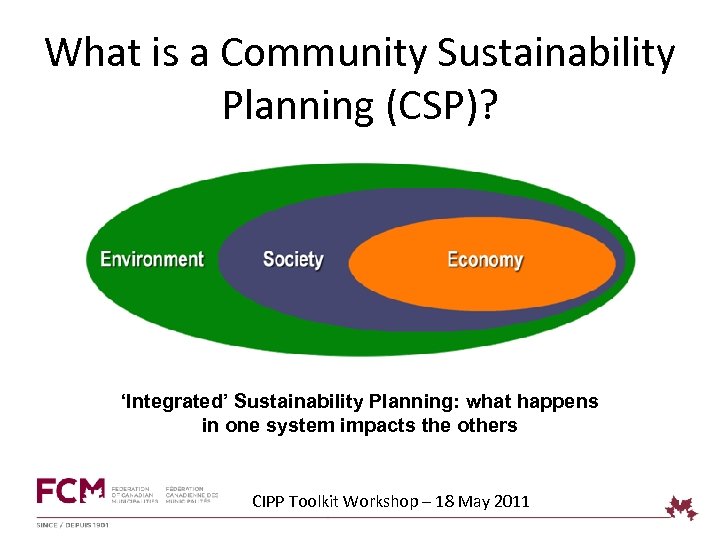 What is a Community Sustainability Planning (CSP)? ‘Integrated’ Sustainability Planning: what happens in one system impacts the others CIPP Toolkit Workshop – 18 May 2011
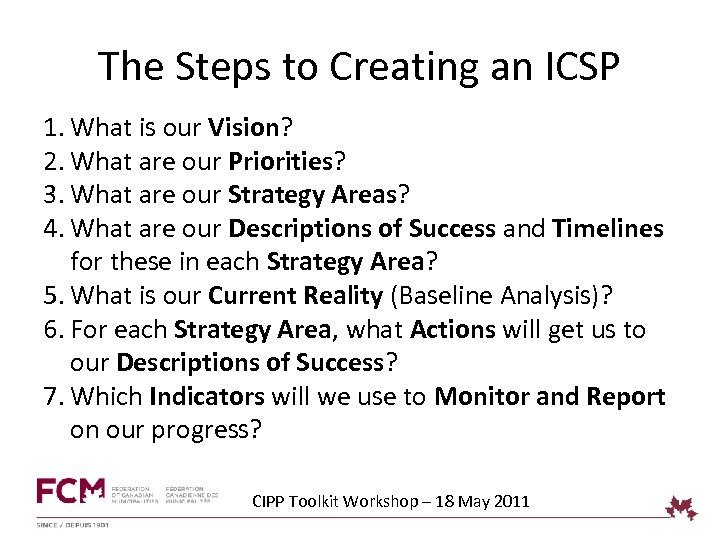 The Steps to Creating an ICSP 1. What is our Vision? 2. What are our Priorities? 3. What are our Strategy Areas? 4. What are our Descriptions of Success and Timelines for these in each Strategy Area? 5. What is our Current Reality (Baseline Analysis)? 6. For each Strategy Area, what Actions will get us to our Descriptions of Success? 7. Which Indicators will we use to Monitor and Report on our progress? CIPP Toolkit Workshop – 18 May 2011
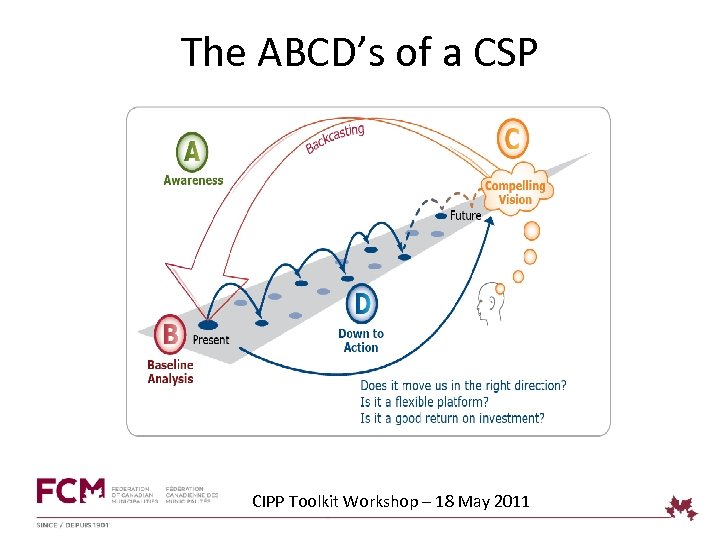 The ABCD’s of a CSP CIPP Toolkit Workshop – 18 May 2011
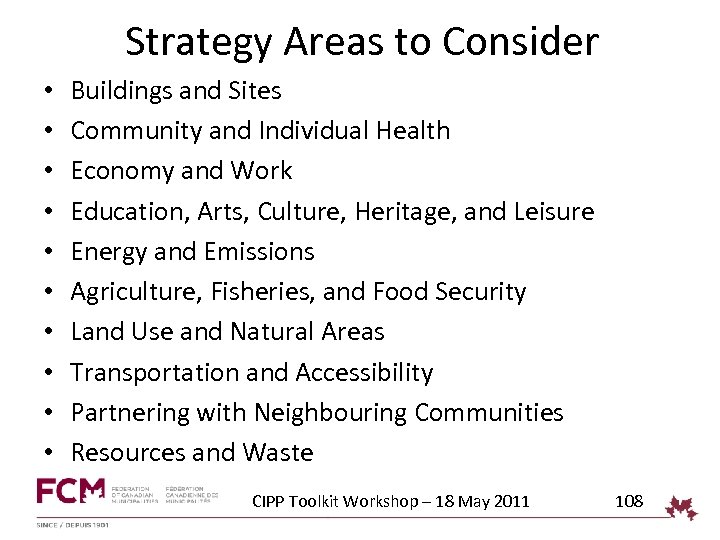 Strategy Areas to Consider • • • Buildings and Sites Community and Individual Health Economy and Work Education, Arts, Culture, Heritage, and Leisure Energy and Emissions Agriculture, Fisheries, and Food Security Land Use and Natural Areas Transportation and Accessibility Partnering with Neighbouring Communities Resources and Waste CIPP Toolkit Workshop – 18 May 2011 108
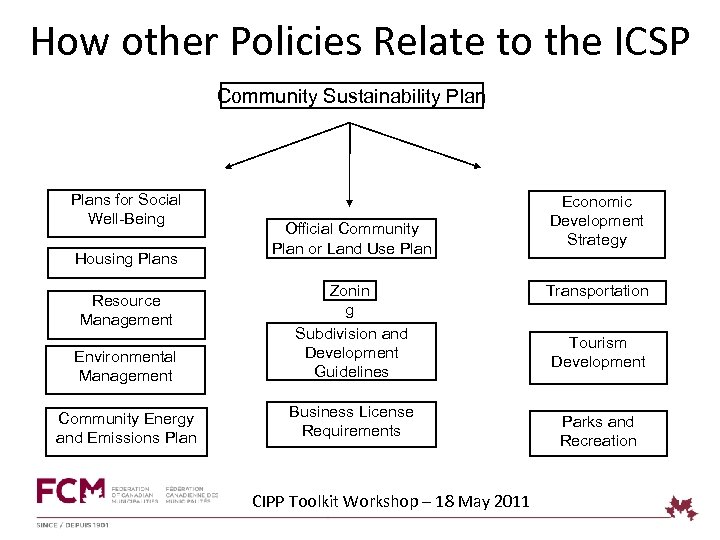 How other Policies Relate to the ICSP Community Sustainability Plans for Social Well-Being Housing Plans Official Community Plan or Land Use Plan Environmental Management Zonin g Subdivision and Development Guidelines Community Energy and Emissions Plan Business License Requirements Resource Management CIPP Toolkit Workshop – 18 May 2011 Economic Development Strategy Transportation Tourism Development Parks and Recreation
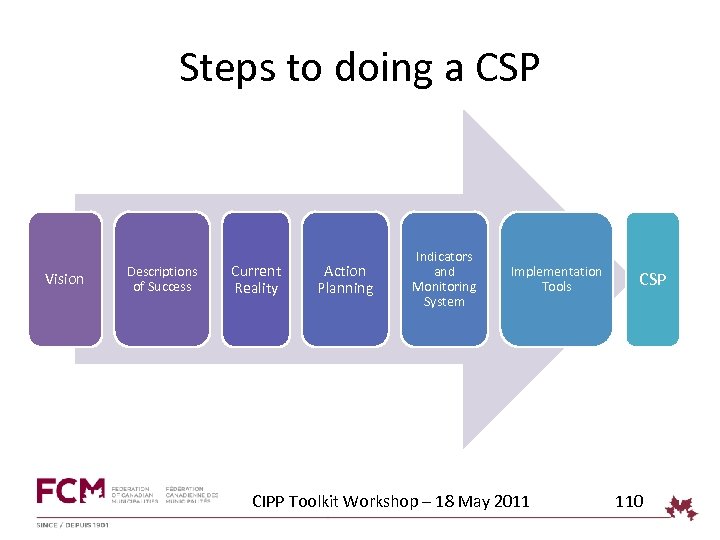 Steps to doing a CSP Vision Descriptions of Success Current Reality Action Planning Indicators and Monitoring System Implementation Tools CIPP Toolkit Workshop – 18 May 2011 CSP 110
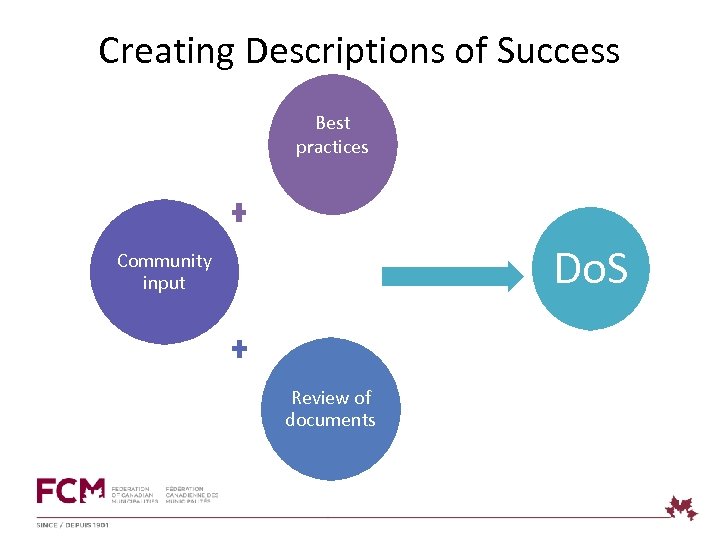 Creating Descriptions of Success Best practices Do. S Community input Review of documents
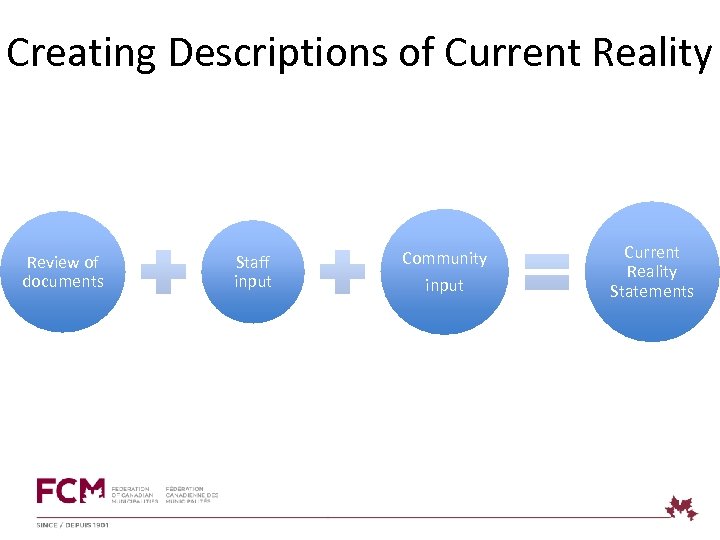 Creating Descriptions of Current Reality Review of documents Staff input Community input Current Reality Statements
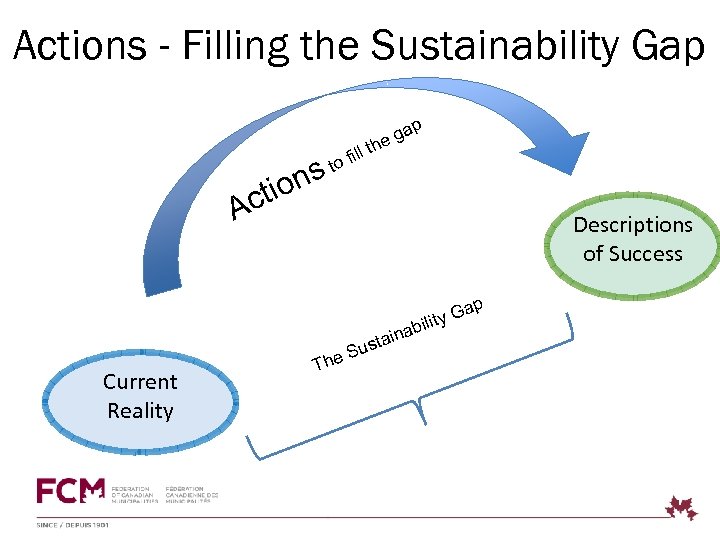 Actions - Filling the Sustainability Gap ns tio ll i to f g the ap Ac Descriptions of Success Gap ity u il inab sta Current Reality he S T
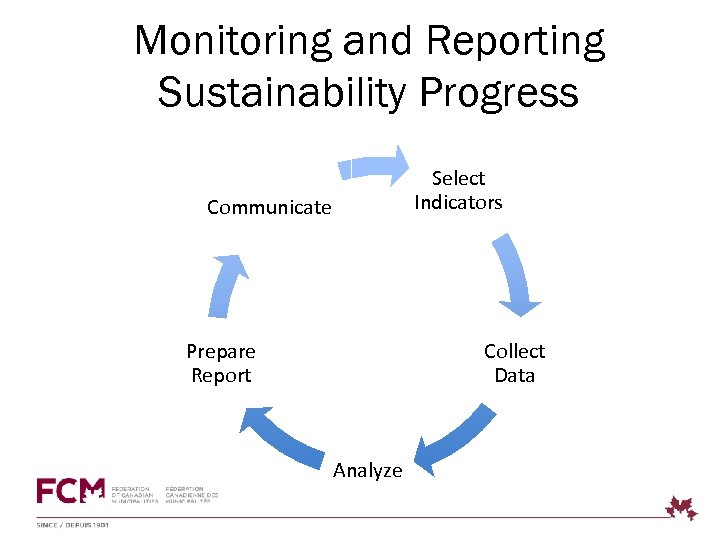 Monitoring and Reporting Sustainability Progress Select Indicators Communicate Prepare Report Collect Data Analyze
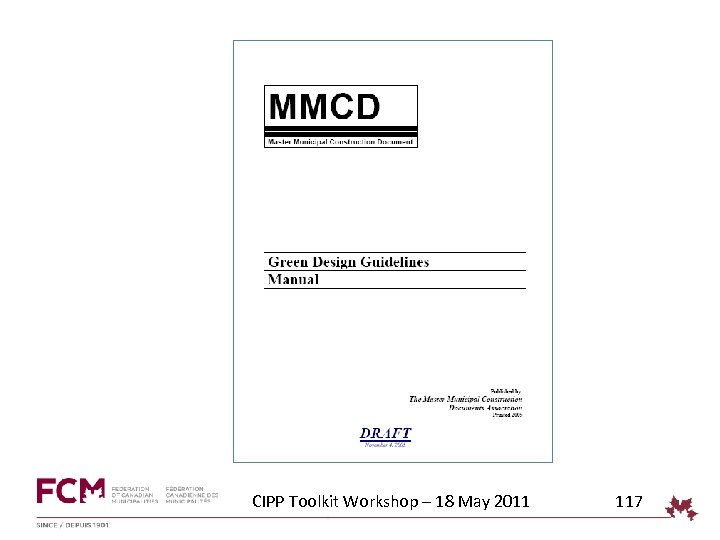
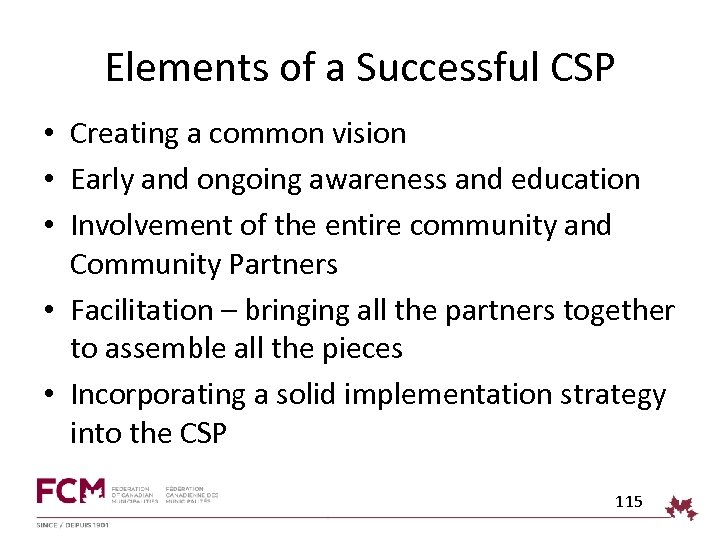 Elements of a Successful CSP • Creating a common vision • Early and ongoing awareness and education • Involvement of the entire community and Community Partners • Facilitation – bringing all the partners together to assemble all the pieces • Incorporating a solid implementation strategy into the CSP 115
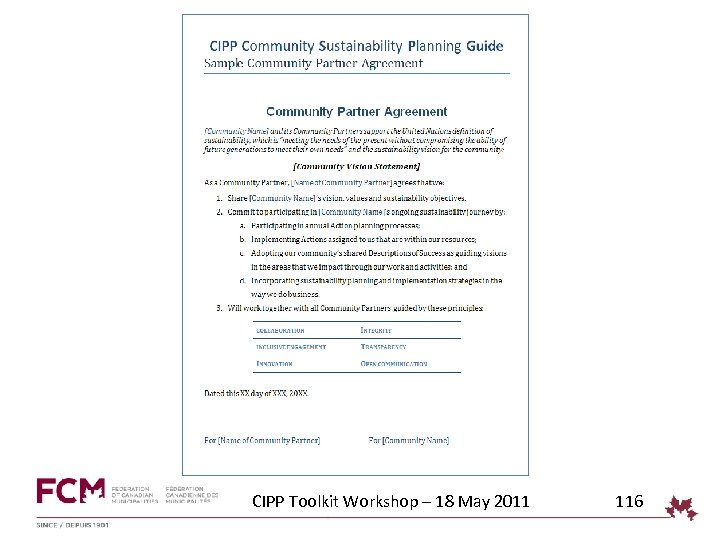 CIPP Toolkit Workshop – 18 May 2011 116
 CIPP Toolkit Workshop – 18 May 2011 117
 Questions? CIPP Toolkit Workshop – 18 May 2011 118
 Funding and Resources CIPP Toolkit Workshop – 18 May 2011 119
 Next Steps • Next steps for CIPP • Next steps for relationship building • Next steps for service agreements • Next steps for joint planning • We will send out a summary of workshop • Exercise: What is your next step? CIPP Toolkit Workshop – 18 May 2011 120
 Summary and Evaluation • What worked? • What didn’t work? • Things to improve, drop, add? CIPP Toolkit Workshop – 18 May 2011 121
 If you had one word… 122
 Thank you! Contact Information: Suzanne Moccia, CIPP Program Manager smoccia@fcm. ca Emily Savage, CIPP Program Assistant esavage@fcm. ca Mark Allison, Facilitator mallison@whistler. ca CIPP Toolkit Workshop – 18 May 2011 123