


 Скачать презентацию FAUST Fail-Aware Untrusted Storage Alex Shraer Technion Israel
741a957ab182813d7b1ee06fd845b6e1.ppt
- Количество слайдов: 21
 FAUST: Fail-Aware Untrusted Storage Alex Shraer, Technion, Israel Joint work with: Christian Cachin IBM Zurich Idit Keidar Technion
 Agenda • Motivation • Defining a Fail-Aware Untrusted Service • FAUST: Fail-Aware Untrusted STorage • Conclusions
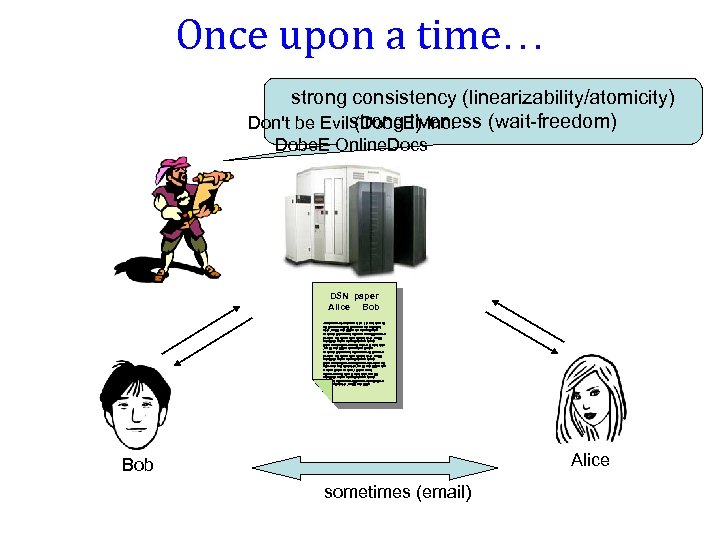 Once upon a time… strong consistency (linearizability/atomicity) Don't be Evilstrong liveness (wait-freedom) (Dobe. E) Inc. Dobe. E Online. Docs DSN paper Alice Bob Jlduiy baios kjshh jcouhc lj ljxc jcjjzxkcj hyah dg dgf gh hnbbv hjy v fg djjiaj djsjd , lmcgg nhycgygb cnjik d ji khcgtu jnn mckpkk, c jjkpackm kj ihgdiash hasdg gdsihasd jdsihjhd dfg dgtrsd hjy v fg djjiaj djsjd , lmcgg nhycgygb cnjik d mjikhcgtujnn mckpkk, c jjkpackm kj ihgdiashhasdg hays v fg djjiaj djsjd , lmcgg nhycgygb cnjik d mjikhcg tujnn mckpkk, c jjkpackm kj ihgdiashhasdg gdsihasd jdsihjhd dfg dgtrsd hjy v fg djjiaj djsjd , lmcgg nhycgygb cnjik d mjikhcgtujnn mckpkk, c jjkpackm kj ihgdiashhasdg dsihasd jdsihjhd dfg dgtrsd hjy v fg djjiaj djsjd , lmcgg nhycgygb cnjik d mjikhcgtujnn mckpkk, c jjkp ackm kj ihgdiashhasdg hjy v fg djjiaj djsjd , lm cgg nhycgygb cnjik d mjikhcgtujnn mckpkk, c packm kj ihgdiashhasdg gdsihasd jddfg dgtrsd hjy v fg djjiaj djsjd , lmcgg nhycgygb Alice Bob sometimes (email)
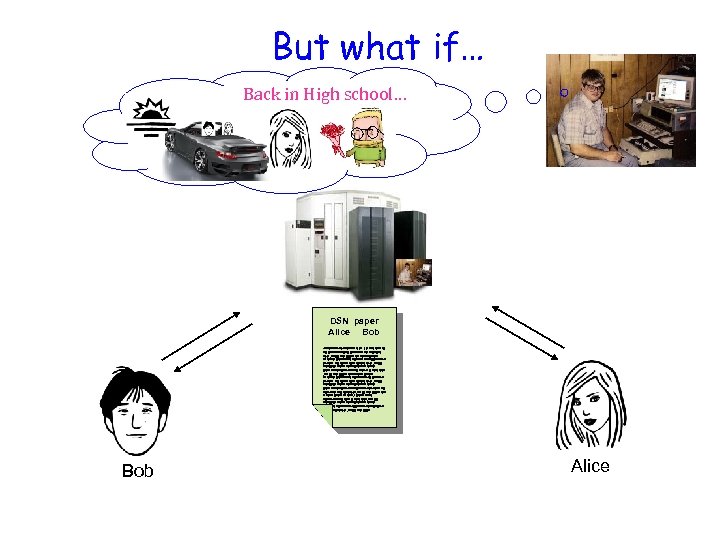 But what if… Back in High school… DSN paper Alice Bob Jlduiy baios kjshh jcouhc lj ljxc jcjjzxkcj hyah dg dgf gh hnbbv hjy v fg djjiaj djsjd , lmcgg nhycgygb cnjik d ji khcgtu jnn mckpkk, c jjkpackm kj ihgdiash hasdg gdsihasd jdsihjhd dfg dgtrsd hjy v fg djjiaj djsjd , lmcgg nhycgygb cnjik d mjikhcgtujnn mckpkk, c jjkpackm kj ihgdiashhasdg hays v fg djjiaj djsjd , lmcgg nhycgygb cnjik d mjikhcg tujnn mckpkk, c jjkpackm kj ihgdiashhasdg gdsihasd jdsihjhd dfg dgtrsd hjy v fg djjiaj djsjd , lmcgg nhycgygb cnjik d mjikhcgtujnn mckpkk, c jjkpackm kj ihgdiashhasdg dsihasd jdsihjhd dfg dgtrsd hjy v fg djjiaj djsjd , lmcgg nhycgygb cnjik d mjikhcgtujnn mckpkk, c jjkp ackm kj ihgdiashhasdg hjy v fg djjiaj djsjd , lm cgg nhycgygb cnjik d mjikhcgtujnn mckpkk, c packm kj ihgdiashhasdg gdsihasd jddfg dgtrsd hjy v fg djjiaj djsjd , lmcgg nhycgygb Bob Alice
 What would we like to achieve? • No bogus data – Still, inconsistencies are possible • Alice and Bob to detect inconsistencies – Rollback to consistent state • When server is correct (the common case) clients should have strong consistency and liveness for their operations – Linearizability and wait-freedom
 Agenda • Motivation • Defining a Fail-Aware Untrusted Service • FAUST: Fail-Aware Untrusted STorage • Conclusions
 Eventual Consistency • Client’s operations can complete even though they are only “weakly” consistent • Client is notified when its operations become “strongly” consistent – May invoke other operations without waiting for notifications • Eventual consistency is widely accepted and used – Starting with Bayou (SOSP 95) – Today in commercial systems, e. g. , Amazon’s Dynamo (SOSP 07)
![Fail-Awareness [Fetzer & Cristian 96] • Provide notifications when the service does not guarantee](https://present5.com/presentation/741a957ab182813d7b1ee06fd845b6e1/image-8.jpg "Fail-Awareness [Fetzer & Cristian 96] • Provide notifications when the service does not guarantee") Fail-Awareness [Fetzer & Cristian 96] • Provide notifications when the service does not guarantee its specified semantics – means that the service shouldn’t be used • Allows clients to take appropriate recovery actions
Fail-Awareness [Fetzer & Cristian 96] • Provide notifications when the service does not guarantee its specified semantics – means that the service shouldn’t be used • Allows clients to take appropriate recovery actions
 Fail-Aware Untrusted Service • When the server is correct – strong consistency and strong liveness • Execution is always “weakly” consistent – at least causal consistency • Stability notifications (next slide) • Accurate failure notifications • Detection completeness: All operations eventually become stable unless failure is detected
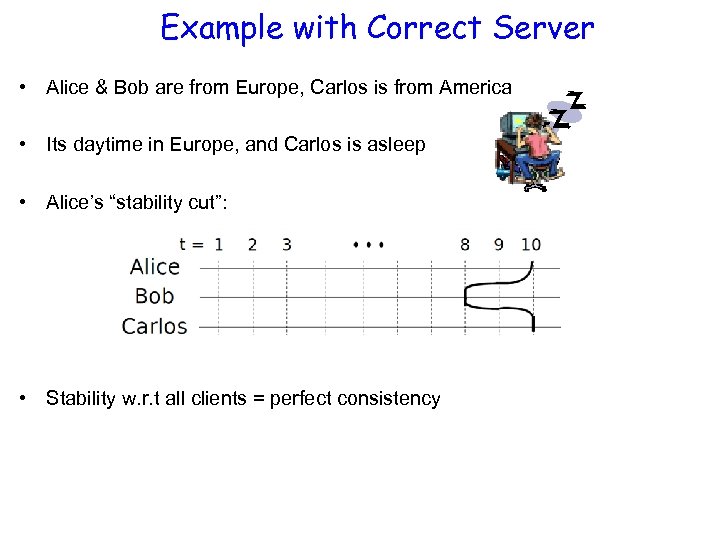 Example with Correct Server • Alice & Bob are from Europe, Carlos is from America • Its daytime in Europe, and Carlos is asleep • Alice’s “stability cut”: • Stability w. r. t all clients = perfect consistency
 Agenda • Motivation • Defining a Fail-Aware Untrusted Service • FAUST: Fail-Aware Untrusted STorage • Conclusions
![Fork consistency Server may present different views to clients [Mazières&Shasha, PODC 02] “Fork” their](https://present5.com/presentation/741a957ab182813d7b1ee06fd845b6e1/image-12.jpg "Fork consistency Server may present different views to clients [Mazières&Shasha, PODC 02] “Fork” their") Fork consistency Server may present different views to clients [Mazières&Shasha, PODC 02] “Fork” their views of the history In such case, their views are forked ever after (never again see each others new updates) or else, server is exposed as faulty
Fork consistency Server may present different views to clients [Mazières&Shasha, PODC 02] “Fork” their views of the history In such case, their views are forked ever after (never again see each others new updates) or else, server is exposed as faulty
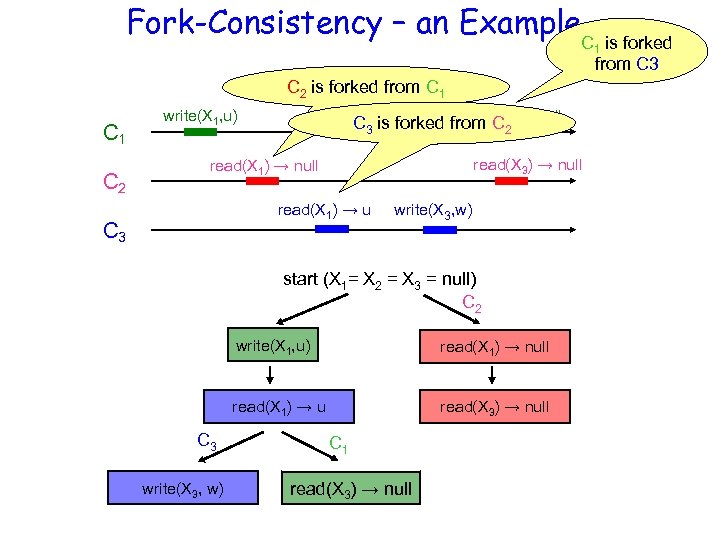 Fork-Consistency – an Example C 1 is forked from C 3 C 2 is forked from C 1 C 1 C 2 write(X 1, u) read(X 3) C 3 is forked from C 2 → null read(X 3) → null read(X 1) → u C 3 write(X 3, w) start (X 1= X 2 = X 3 = null) C 2 write(X 1, u) read(X 1) → u C 3 write(X 3, w) read(X 1) → null read(X 3) → null C 1 read(X 3) → null
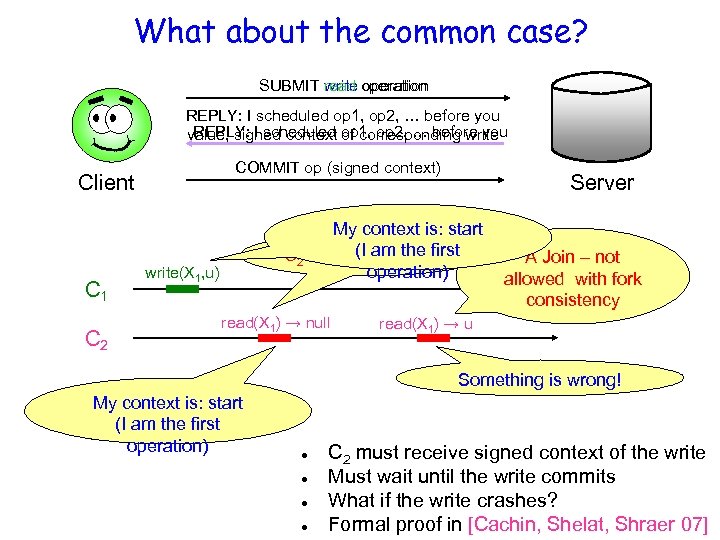 What about the common case? SUBMIT write operation read operation REPLY: I scheduled op 1, op 2, … before you REPLY: I scheduled of corresponding write value, signed context op 1, op 2, … before you COMMIT op (signed context) Client C 1 C 2 Server My context is: start (I am the first C 2 is forked from C 1 operation) write(X 1, u) read(X 1) → null A Join – not allowed with fork consistency read(X 1) → u Something is wrong! My context is: start (I am the first operation) C 2 must receive signed context of the write Must wait until the write commits What if the write crashes? Formal proof in [Cachin, Shelat, Shraer 07]
 We need a weaker consistency notion Two weaker conditions have been defined recently: Fork-* [Li & Mazieres, NSDI 2007] Fork-sequential-consistency [Oprea & Reiter, DISC 2006] We show: both require blocking, in executions with 1 correct server C 2
 Weak fork At-most one join: If server forks the views of two clients, they may see at most one more common operation Trust server about last operations by other clients in context Same as in Fork-* No checks needed Weaker than Fork-* Causally consistent views Stronger than Fork-* C 2 No blocking needed - allows wait-free protocols. In fact, suffices to achieve all properties of FAUST
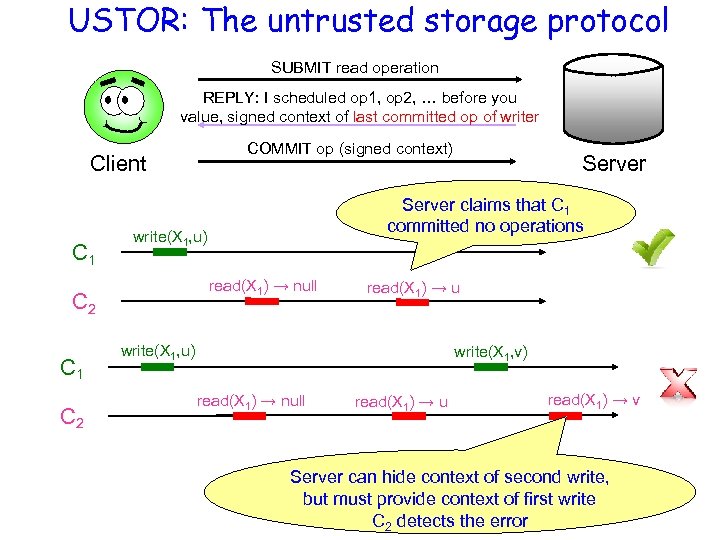 USTOR: The untrusted storage protocol SUBMIT read operation REPLY: I scheduled op 1, op 2, … before you value, signed context of last committed op of writer COMMIT op (signed context) Client C 1 C 1 C 2 Server claims that C 1 committed no operations write(X 1, u) read(X 1) → null C 2 Server read(X 1) → u write(X 1, u) write(X 1, v) read(X 1) → null read(X 1) → u read(X 1) → v Server can hide context of second write, but must provide context of first write C 2 detects the error
 Some properties of USTOR • Linearizable executions with correct server – A correct server schedules & processes the ops in order of receipt • Wait-free with correct server – A read does not need to wait till some write COMMITs – COMMIT info can arrive with SUBMIT of next operation • All executions are causally consistent – From properties of Weak-fork • Detects server failure, if server returns inconsistent context information • What’s missing for FAUST? – Accurate notifications to clients: operation stability, server failure – Completeness: for every op, eventually one of the following happens: • op indicated as stable with respect to other clients • server failure detected
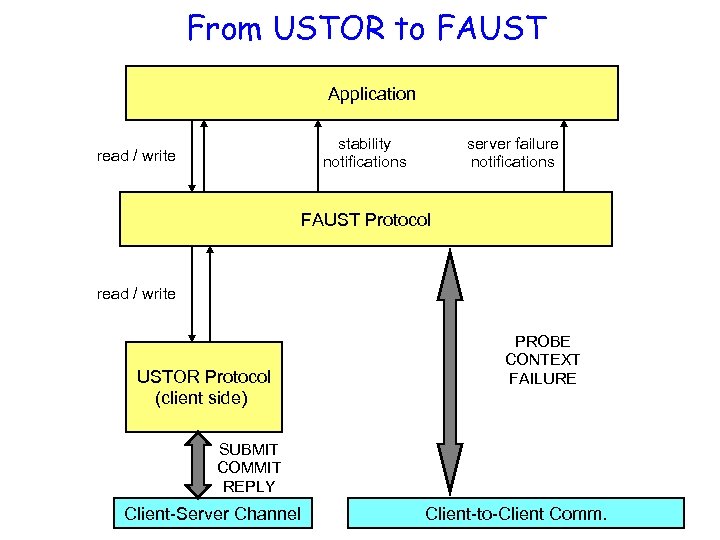 From USTOR to FAUST Application stability notifications read / write server failure notifications FAUST Protocol read / write USTOR Protocol (client side) PROBE CONTEXT FAILURE SUBMIT COMMIT REPLY Client-Server Channel Client-to-Client Comm.
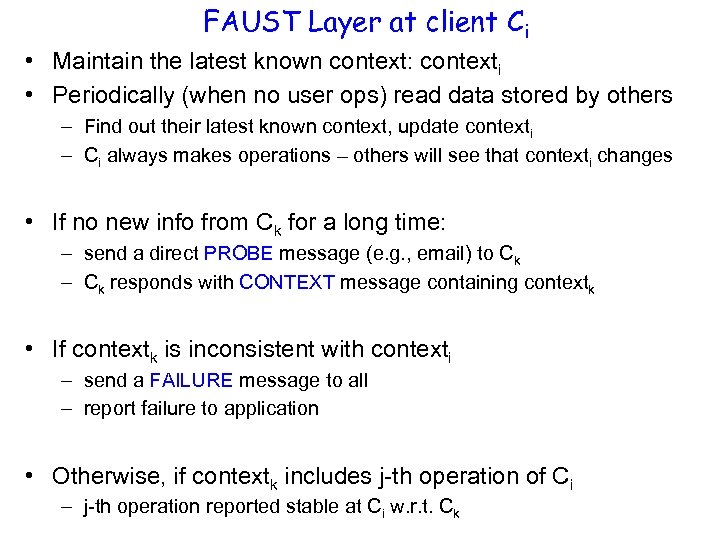 FAUST Layer at client Ci • Maintain the latest known context: contexti • Periodically (when no user ops) read data stored by others – Find out their latest known context, update contexti – Ci always makes operations – others will see that contexti changes • If no new info from Ck for a long time: – send a direct PROBE message (e. g. , email) to Ck – Ck responds with CONTEXT message containing contextk • If contextk is inconsistent with contexti – send a FAILURE message to all – report failure to application • Otherwise, if contextk includes j-th operation of Ci – j-th operation reported stable at Ci w. r. t. Ck
 Conclusion • Need for semantics and client-side tools for services provided by “clouds” – Clients should be able to detect if semantics are violated – ACM SIGACT News Column 34, Distributed Computing in the Clouds; http: //www. ee. technion. ac. il/~idish/sigact. News • Our suggestion: Fail-Aware Untrusted Service – FAUST provides such semantics for simple storage • When a read/write operation completes causal consistency (at least) is guaranteed • Eventually, more information is obtained. Then: – Indicate to client that his operation preserves stronger semantics OR: report server failure • Common case: when server is correct, each operation completes independently of others + perfect consistency