


 Скачать презентацию Fault-Tolerant Computing Software Design Methods Nov 2007 Software
10783fb89e30009bf1ec0e87cf8b3f03.ppt
- Количество слайдов: 24
 Fault-Tolerant Computing Software Design Methods Nov. 2007 Software Reliability and Redundancy 1
 About This Presentation This presentation has been prepared for the graduate course ECE 257 A (Fault-Tolerant Computing) by Behrooz Parhami, Professor of Electrical and Computer Engineering at University of California, Santa Barbara. The material contained herein can be used freely in classroom teaching or any other educational setting. Unauthorized uses are prohibited. © Behrooz Parhami Edition Revised First Nov. 2007 Released Nov. 2006 Nov. 2007 Software Reliability and Redundancy Revised 2
 Software Reliability and Redundancy Nov. 2007 Software Reliability and Redundancy 3
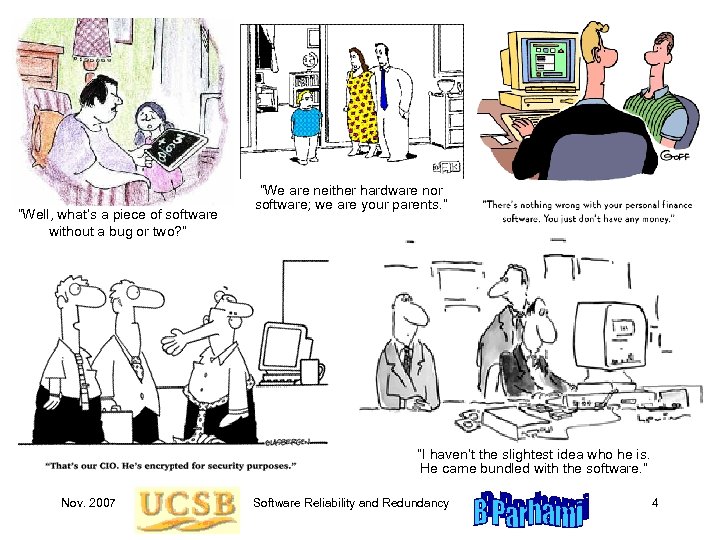 “Well, what’s a piece of software without a bug or two? ” “We are neither hardware nor software; we are your parents. ” “I haven’t the slightest idea who he is. He came bundled with the software. ” Nov. 2007 Software Reliability and Redundancy 4
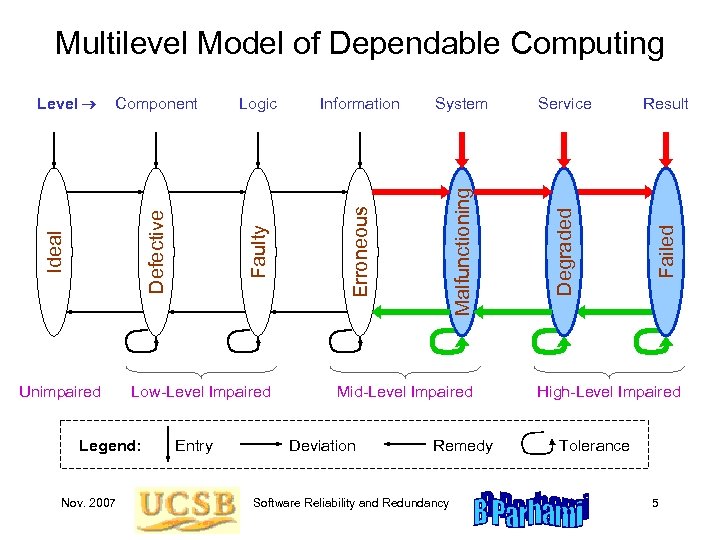 Unimpaired Low-Level Impaired Legend: Nov. 2007 Entry Malfunctioning Mid-Level Impaired Deviation Remedy Software Reliability and Redundancy Service Result Failed System Degraded Information Erroneous Logic Ideal Component Defective Level Faulty Multilevel Model of Dependable Computing High-Level Impaired Tolerance 5
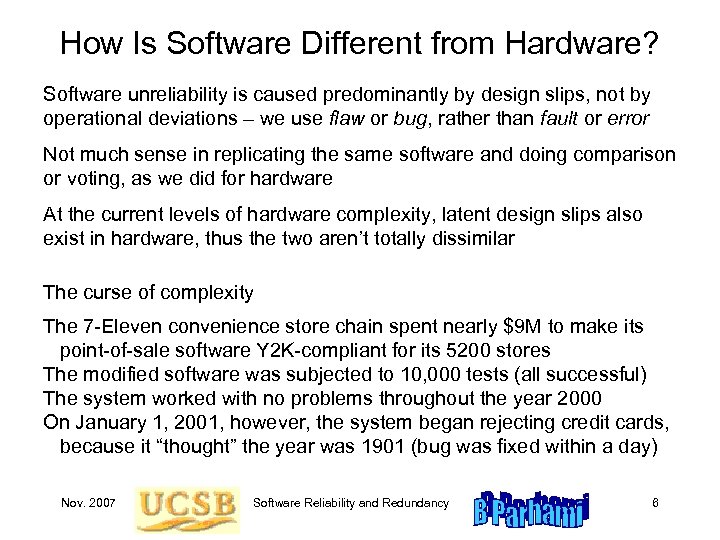 How Is Software Different from Hardware? Software unreliability is caused predominantly by design slips, not by operational deviations – we use flaw or bug, rather than fault or error Not much sense in replicating the same software and doing comparison or voting, as we did for hardware At the current levels of hardware complexity, latent design slips also exist in hardware, thus the two aren’t totally dissimilar The curse of complexity The 7 -Eleven convenience store chain spent nearly $9 M to make its point-of-sale software Y 2 K-compliant for its 5200 stores The modified software was subjected to 10, 000 tests (all successful) The system worked with no problems throughout the year 2000 On January 1, 2001, however, the system began rejecting credit cards, because it “thought” the year was 1901 (bug was fixed within a day) Nov. 2007 Software Reliability and Redundancy 6
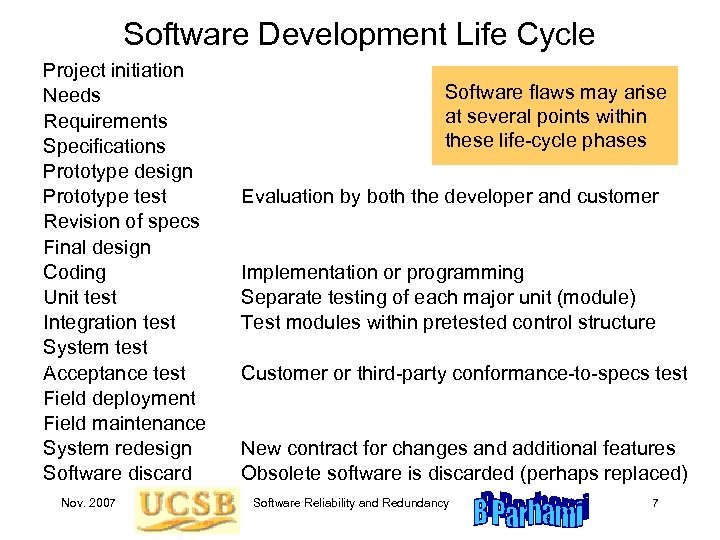 Software Development Life Cycle Project initiation Needs Requirements Specifications Prototype design Prototype test Revision of specs Final design Coding Unit test Integration test System test Acceptance test Field deployment Field maintenance System redesign Software discard Nov. 2007 Software flaws may arise at several points within these life-cycle phases Evaluation by both the developer and customer Implementation or programming Separate testing of each major unit (module) Test modules within pretested control structure Customer or third-party conformance-to-specs test New contract for changes and additional features Obsolete software is discarded (perhaps replaced) Software Reliability and Redundancy 7
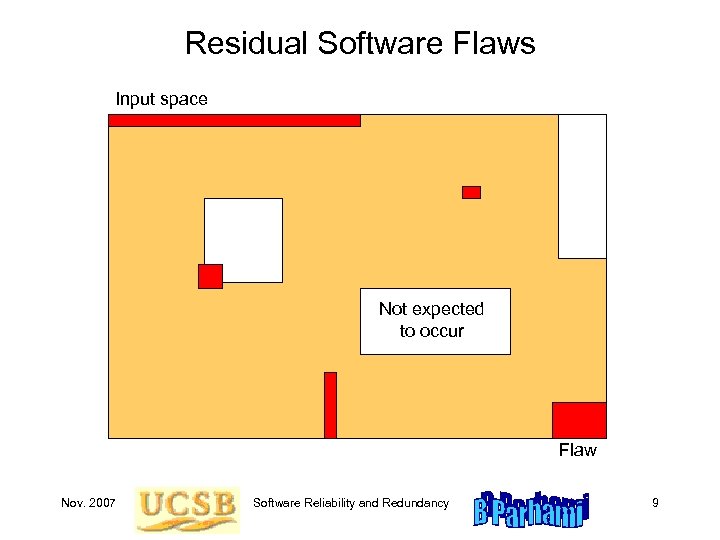
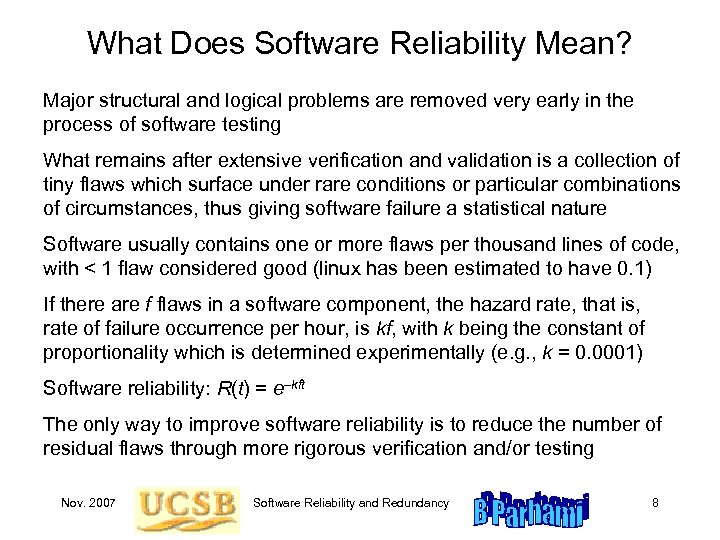 What Does Software Reliability Mean? Major structural and logical problems are removed very early in the process of software testing What remains after extensive verification and validation is a collection of tiny flaws which surface under rare conditions or particular combinations of circumstances, thus giving software failure a statistical nature Software usually contains one or more flaws per thousand lines of code, with < 1 flaw considered good (linux has been estimated to have 0. 1) If there are f flaws in a software component, the hazard rate, that is, rate of failure occurrence per hour, is kf, with k being the constant of proportionality which is determined experimentally (e. g. , k = 0. 0001) Software reliability: R(t) = e–kft The only way to improve software reliability is to reduce the number of residual flaws through more rigorous verification and/or testing Nov. 2007 Software Reliability and Redundancy 8
 Residual Software Flaws Input space Not expected to occur Flaw Nov. 2007 Software Reliability and Redundancy 9
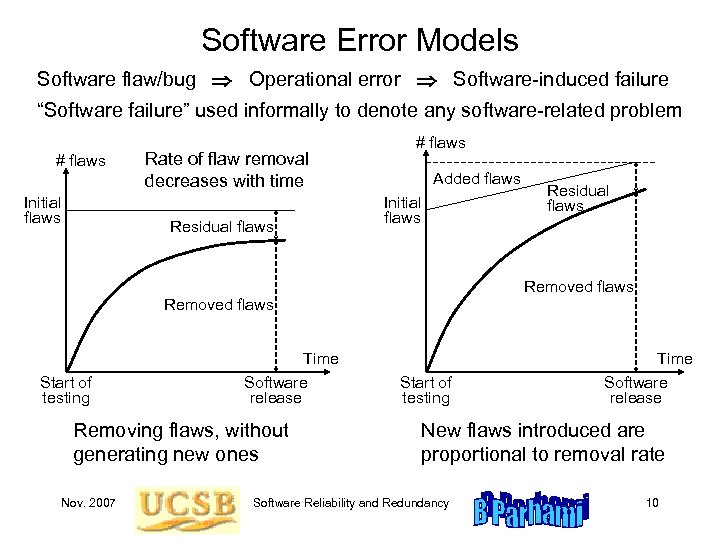 Software Error Models Software flaw/bug Operational error Software-induced failure “Software failure” used informally to denote any software-related problem # flaws Initial flaws Rate of flaw removal decreases with time Residual flaws # flaws Added flaws Initial flaws Residual flaws Removed flaws Start of testing Time Software release Removing flaws, without generating new ones Nov. 2007 Start of testing Time Software release New flaws introduced are proportional to removal rate Software Reliability and Redundancy 10
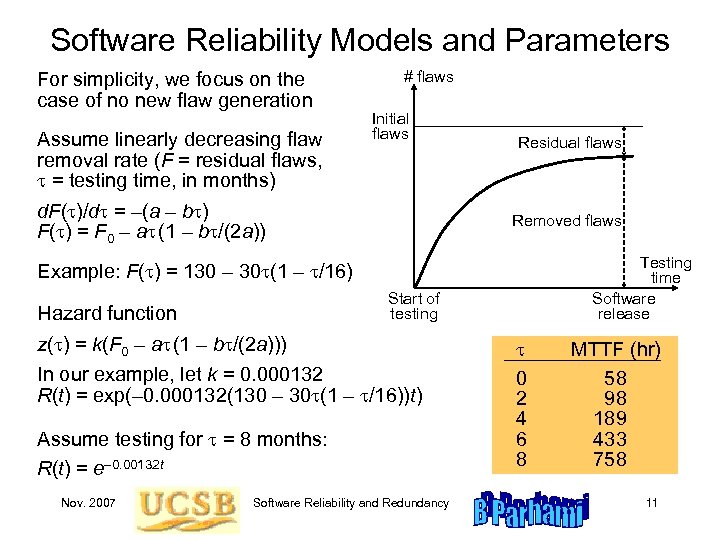 Software Reliability Models and Parameters For simplicity, we focus on the case of no new flaw generation Assume linearly decreasing flaw removal rate (F = residual flaws, t = testing time, in months) # flaws Initial flaws d. F(t)/dt = –(a – bt) F(t) = F 0 – at (1 – bt/(2 a)) Residual flaws Removed flaws Testing time Software release Example: F(t) = 130 – 30 t(1 – t/16) Start of testing Hazard function z(t) = k(F 0 – at (1 – bt/(2 a))) In our example, let k = 0. 000132 R(t) = exp(– 0. 000132(130 – 30 t(1 – t/16))t) Assume testing for t = 8 months: R(t) = e– 0. 00132 t Nov. 2007 Software Reliability and Redundancy t 0 2 4 6 8 MTTF (hr) 58 98 189 433 758 11
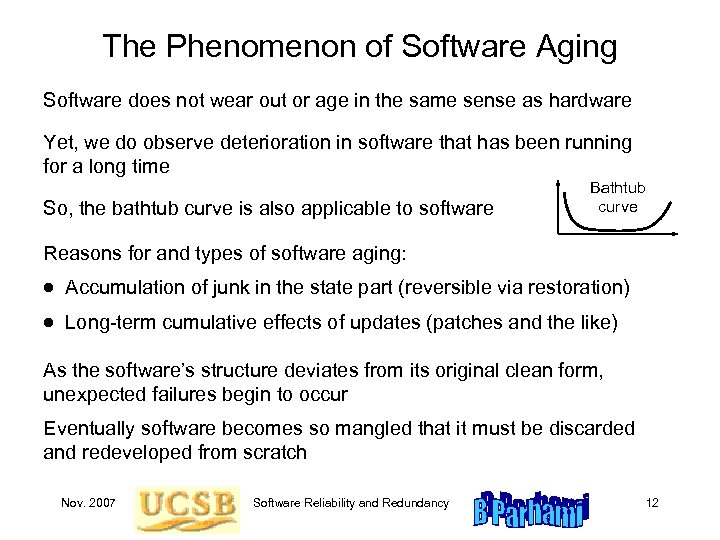 The Phenomenon of Software Aging Software does not wear out or age in the same sense as hardware Yet, we do observe deterioration in software that has been running for a long time So, the bathtub curve is also applicable to software Bathtub curve Reasons for and types of software aging: Accumulation of junk in the state part (reversible via restoration) Long-term cumulative effects of updates (patches and the like) As the software’s structure deviates from its original clean form, unexpected failures begin to occur Eventually software becomes so mangled that it must be discarded and redeveloped from scratch Nov. 2007 Software Reliability and Redundancy 12
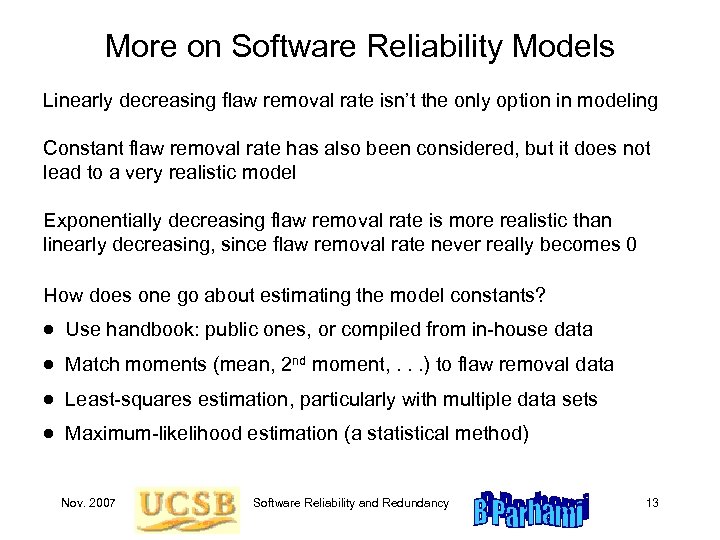 More on Software Reliability Models Linearly decreasing flaw removal rate isn’t the only option in modeling Constant flaw removal rate has also been considered, but it does not lead to a very realistic model Exponentially decreasing flaw removal rate is more realistic than linearly decreasing, since flaw removal rate never really becomes 0 How does one go about estimating the model constants? Use handbook: public ones, or compiled from in-house data Match moments (mean, 2 nd moment, . . . ) to flaw removal data Least-squares estimation, particularly with multiple data sets Maximum-likelihood estimation (a statistical method) Nov. 2007 Software Reliability and Redundancy 13
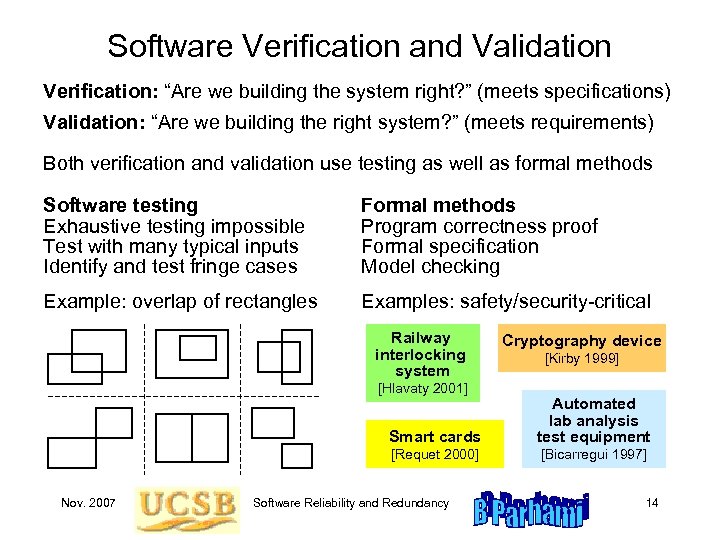 Software Verification and Validation Verification: “Are we building the system right? ” (meets specifications) Validation: “Are we building the right system? ” (meets requirements) Both verification and validation use testing as well as formal methods Software testing Exhaustive testing impossible Test with many typical inputs Identify and test fringe cases Formal methods Program correctness proof Formal specification Model checking Example: overlap of rectangles Examples: safety/security-critical Railway interlocking system [Hlavaty 2001] Cryptography device [Kirby 1999] Smart cards [Requet 2000] Nov. 2007 Automated lab analysis test equipment [Bicarregui 1997] Software Reliability and Redundancy 14
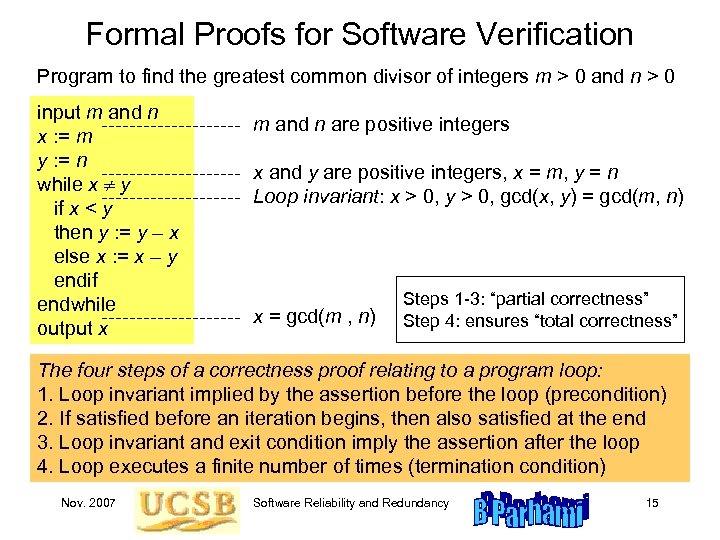 Formal Proofs for Software Verification Program to find the greatest common divisor of integers m > 0 and n > 0 input m and n x : = m y : = n while x y if x < y then y : = y – x else x : = x – y endif endwhile output x m and n are positive integers x and y are positive integers, x = m, y = n Loop invariant: x > 0, y > 0, gcd(x, y) = gcd(m, n) x = gcd(m , n) Steps 1 -3: “partial correctness” Step 4: ensures “total correctness” The four steps of a correctness proof relating to a program loop: 1. Loop invariant implied by the assertion before the loop (precondition) 2. If satisfied before an iteration begins, then also satisfied at the end 3. Loop invariant and exit condition imply the assertion after the loop 4. Loop executes a finite number of times (termination condition) Nov. 2007 Software Reliability and Redundancy 15
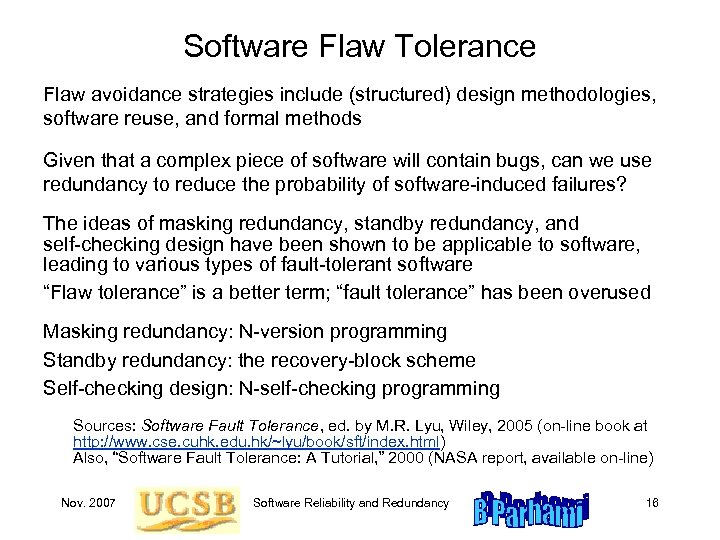 Software Flaw Tolerance Flaw avoidance strategies include (structured) design methodologies, software reuse, and formal methods Given that a complex piece of software will contain bugs, can we use redundancy to reduce the probability of software-induced failures? The ideas of masking redundancy, standby redundancy, and self-checking design have been shown to be applicable to software, leading to various types of fault-tolerant software “Flaw tolerance” is a better term; “fault tolerance” has been overused Masking redundancy: N-version programming Standby redundancy: the recovery-block scheme Self-checking design: N-self-checking programming Sources: Software Fault Tolerance, ed. by M. R. Lyu, Wiley, 2005 (on-line book at http: //www. cse. cuhk. edu. hk/~lyu/book/sft/index. html) Also, “Software Fault Tolerance: A Tutorial, ” 2000 (NASA report, available on-line) Nov. 2007 Software Reliability and Redundancy 16
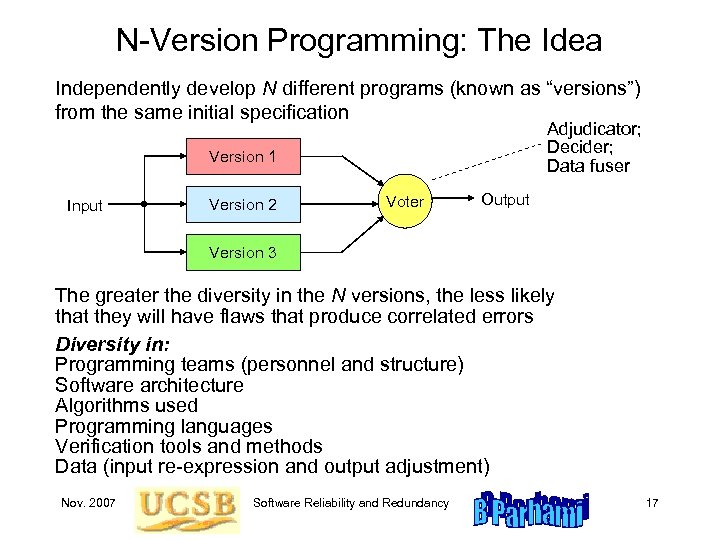 N-Version Programming: The Idea Independently develop N different programs (known as “versions”) from the same initial specification Adjudicator; Decider; Data fuser Version 1 Input Version 2 Voter Output Version 3 The greater the diversity in the N versions, the less likely that they will have flaws that produce correlated errors Diversity in: Programming teams (personnel and structure) Software architecture Algorithms used Programming languages Verification tools and methods Data (input re-expression and output adjustment) Nov. 2007 Software Reliability and Redundancy 17
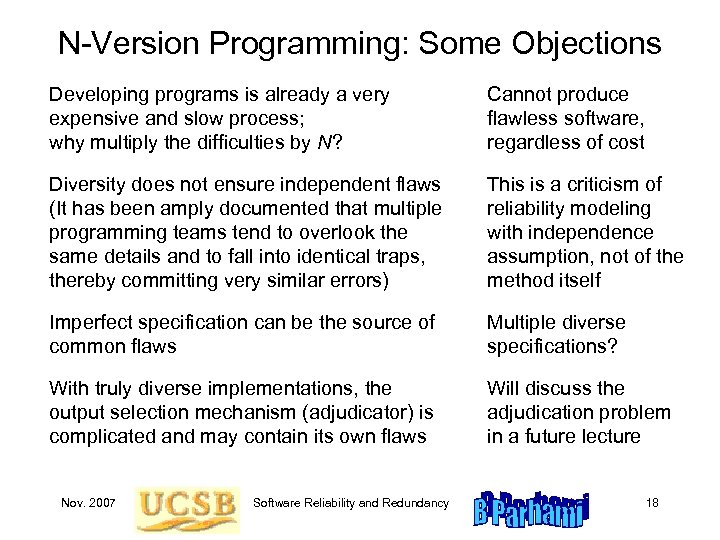 N-Version Programming: Some Objections Developing programs is already a very expensive and slow process; why multiply the difficulties by N? Diversity does not ensure independent flaws (It has been amply documented that multiple programming teams tend to overlook the same details and to fall into identical traps, thereby committing very similar errors) This is a criticism of reliability modeling with independence assumption, not of the method itself Imperfect specification can be the source of common flaws Multiple diverse specifications? With truly diverse implementations, the output selection mechanism (adjudicator) is complicated and may contain its own flaws Cannot produce flawless software, regardless of cost Will discuss the adjudication problem in a future lecture Nov. 2007 Software Reliability and Redundancy 18
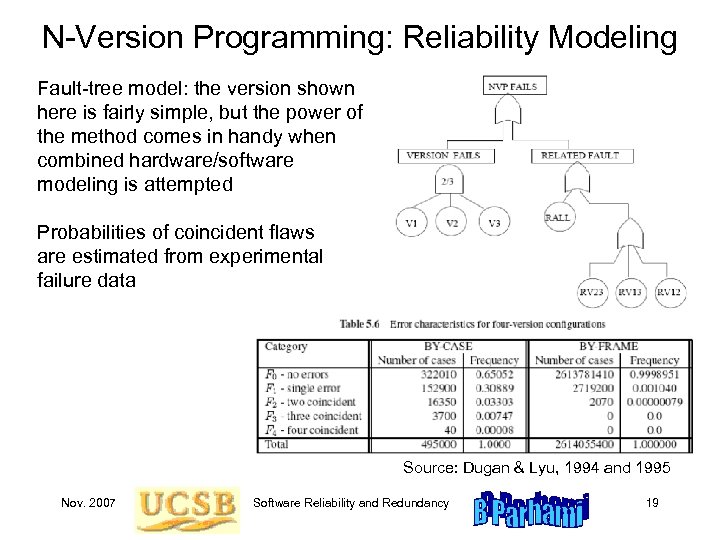 N-Version Programming: Reliability Modeling Fault-tree model: the version shown here is fairly simple, but the power of the method comes in handy when combined hardware/software modeling is attempted Probabilities of coincident flaws are estimated from experimental failure data Source: Dugan & Lyu, 1994 and 1995 Nov. 2007 Software Reliability and Redundancy 19
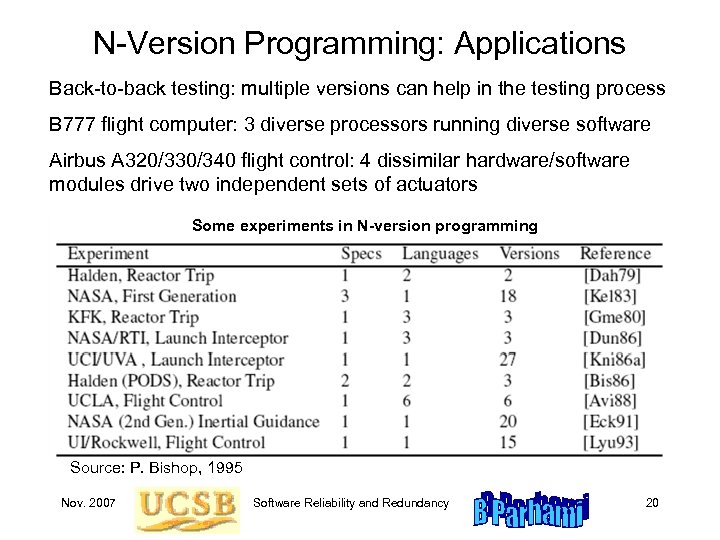 N-Version Programming: Applications Back-to-back testing: multiple versions can help in the testing process B 777 flight computer: 3 diverse processors running diverse software Airbus A 320/330/340 flight control: 4 dissimilar hardware/software modules drive two independent sets of actuators Some experiments in N-version programming Source: P. Bishop, 1995 Nov. 2007 Software Reliability and Redundancy 20
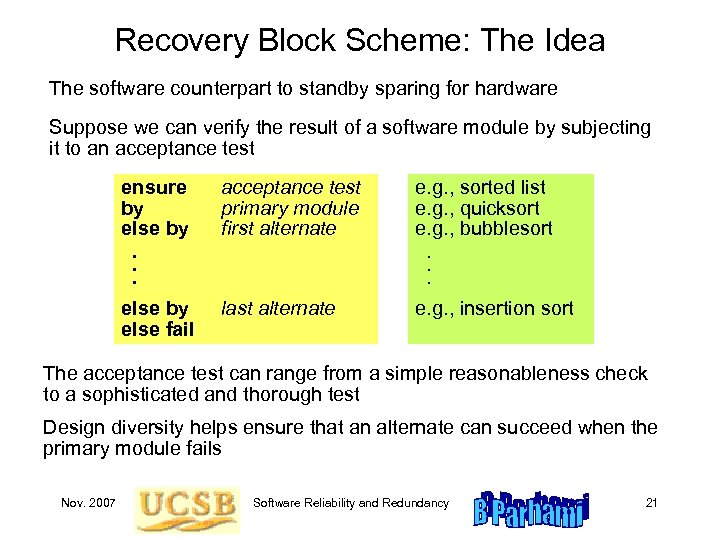 Recovery Block Scheme: The Idea The software counterpart to standby sparing for hardware Suppose we can verify the result of a software module by subjecting it to an acceptance test ensure by else by. . . acceptance test primary module first alternate e. g. , sorted list e. g. , quicksort e. g. , bubblesort. . . else by else fail last alternate e. g. , insertion sort The acceptance test can range from a simple reasonableness check to a sophisticated and thorough test Design diversity helps ensure that an alternate can succeed when the primary module fails Nov. 2007 Software Reliability and Redundancy 21
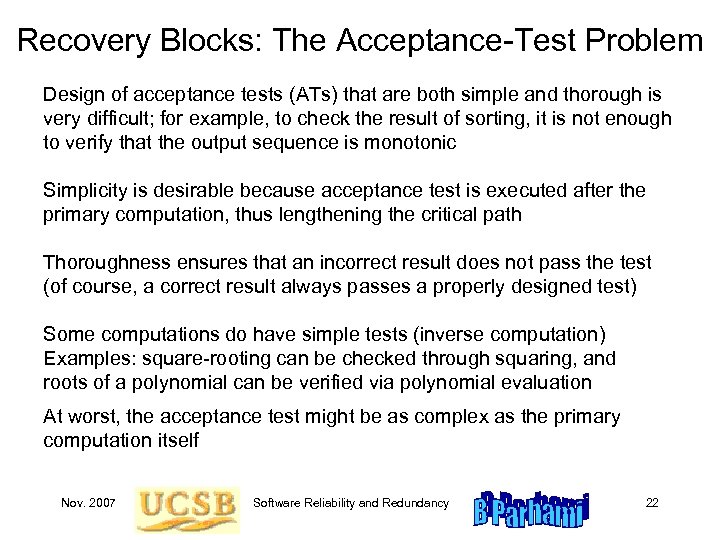 Recovery Blocks: The Acceptance-Test Problem Design of acceptance tests (ATs) that are both simple and thorough is very difficult; for example, to check the result of sorting, it is not enough to verify that the output sequence is monotonic Simplicity is desirable because acceptance test is executed after the primary computation, thus lengthening the critical path Thoroughness ensures that an incorrect result does not pass the test (of course, a correct result always passes a properly designed test) Some computations do have simple tests (inverse computation) Examples: square-rooting can be checked through squaring, and roots of a polynomial can be verified via polynomial evaluation At worst, the acceptance test might be as complex as the primary computation itself Nov. 2007 Software Reliability and Redundancy 22
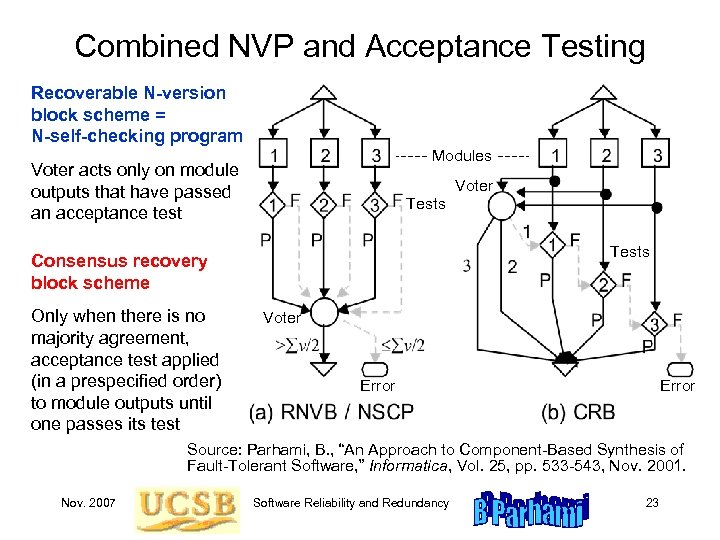 Combined NVP and Acceptance Testing Recoverable N-version block scheme = N-self-checking program Modules Voter acts only on module outputs that have passed an acceptance test Voter Tests Consensus recovery block scheme Only when there is no majority agreement, acceptance test applied (in a prespecified order) to module outputs until one passes its test Voter Error Source: Parhami, B. , “An Approach to Component-Based Synthesis of Fault-Tolerant Software, ” Informatica, Vol. 25, pp. 533 -543, Nov. 2001. Nov. 2007 Software Reliability and Redundancy 23
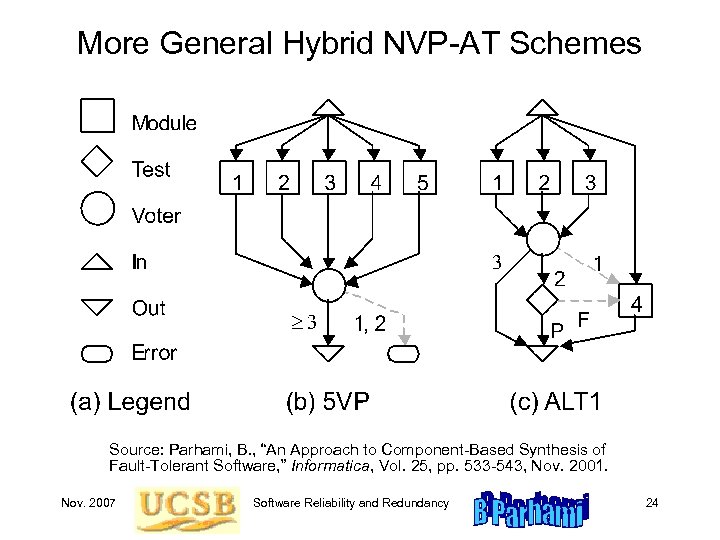 More General Hybrid NVP-AT Schemes Source: Parhami, B. , “An Approach to Component-Based Synthesis of Fault-Tolerant Software, ” Informatica, Vol. 25, pp. 533 -543, Nov. 2001. Nov. 2007 Software Reliability and Redundancy 24