


 Скачать презентацию Fault Prioritisation Telecom Wholesale Industry Consultation Seminar Telecom
000d03fdfa8205fab319c4a3005fe2e4.ppt
- Количество слайдов: 20
 Fault Prioritisation Telecom Wholesale Industry Consultation Seminar Telecom, Auckland 30 th October 2007 Telecom Unclassified
 Agenda o Welcome and Introduction o The Overview: o Proposed Fault Framework – Gary Jamieson o The Detailed Bit: o Walkthrough how it works in practice – Derek Twort o Questions & Answers Telecom Unclassified
 The Overview: Proposed Fault Framework Gary Jamieson Operational Capability Telecom Wholesale Telecom Unclassified
 Why we are here o In the UCLL/Colo Standard Terms conference it was agreed that the most important aspects of faults were o Equivalence o Transparency and o Information to enable updates to end customers o Telecom proposed that this outcome could be reached with some minor modifications to the way faults are done today o The following information will describe how Telecom will achieve this Telecom Unclassified
 Allowing the Faults proposal to work o The proposal is based on Telecom’s current practices and existing systems. o Telecom performs the fault tasks across all Access Seekers and Telecom business units in the same manner. o Telecom to manage the process, setting the priority and restore times as Telecom will have the widest view of the fault situation. o The proposal will use a defined list of priorities as the basis to determine the priority assigned to each fault. o The priority will determine the overall focus given to resolving the fault. Restoration time will be determined by the circumstances of each individual fault. Telecom Unclassified
 A run through of the Fault process A UCLL MPF example o Access Seeker performs initial diagnosis to filter out problems such as: o o o Access Seeker or End User Equipment User error Existing network events o The Access Seeker refers fault to Telecom, service level clock starts for returning priority and fault restoration time o Telecom assigns the fault to service company and next available technician based on initial assessment from the information provided by the Access Seeker o Technician commences fault identification activities. These activities include: o o o travel to exchange to commence field diagnosis, checking MDF jumper and placing a short circuit on the HDP to enable testing. travel to cabinet, check jumper and continuity tests to exchange travel to end user location, checks terminal connection, isolates customer wiring and tests continuity to exchange. o Restore time and priority identified and information returned to the Access Seeker, service level clock starts for restore time. o After service has been restored, service level clock stops o Repair action carried out on any defect found. o o o If cable fault found temporary service provided where possible by transposal to spare pair. Fault referred to cable faults for permanent underground fix. Technician advises Service Given, but fault not closed NB. Telecom does not have centralised diagnosis or line test capability on an unbundled circuit so every fault activity requires a truck roll and manual test procedures in the field. Telecom Unclassified
 The detailed bit: Walkthrough how it works in practice Derek Twort Field Services Telecom Wholesale Telecom Unclassified
 What this section will cover o What the priorities are o How the priorities are determined o How the restoration times are determined o Can they change? o Detailed processes o How we know it is working Telecom Unclassified
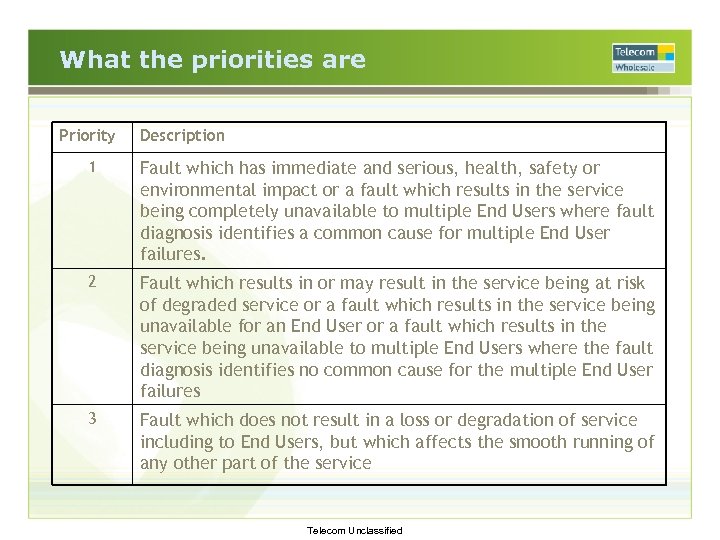 What the priorities are Priority Description 1 Fault which has immediate and serious, health, safety or environmental impact or a fault which results in the service being completely unavailable to multiple End Users where fault diagnosis identifies a common cause for multiple End User failures. 2 Fault which results in or may result in the service being at risk of degraded service or a fault which results in the service being unavailable for an End User or a fault which results in the service being unavailable to multiple End Users where the fault diagnosis identifies no common cause for the multiple End User failures 3 Fault which does not result in a loss or degradation of service including to End Users, but which affects the smooth running of any other part of the service Telecom Unclassified
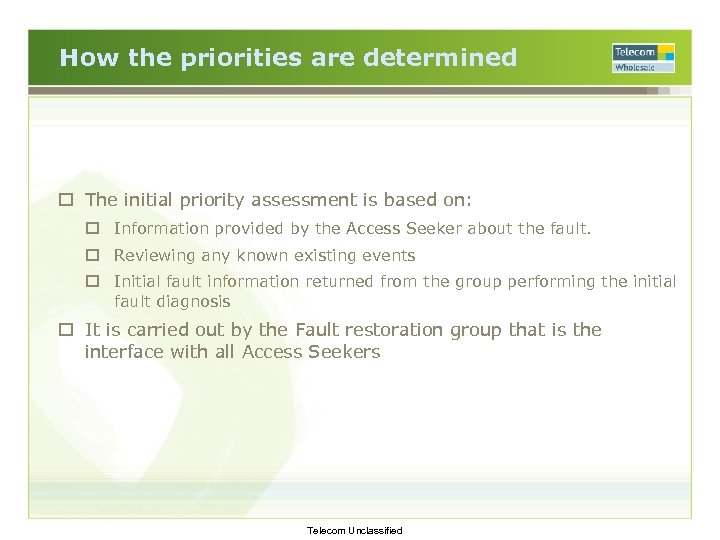 How the priorities are determined o The initial priority assessment is based on: o Information provided by the Access Seeker about the fault. o Reviewing any known existing events o Initial fault information returned from the group performing the initial fault diagnosis o It is carried out by the Fault restoration group that is the interface with all Access Seekers Telecom Unclassified
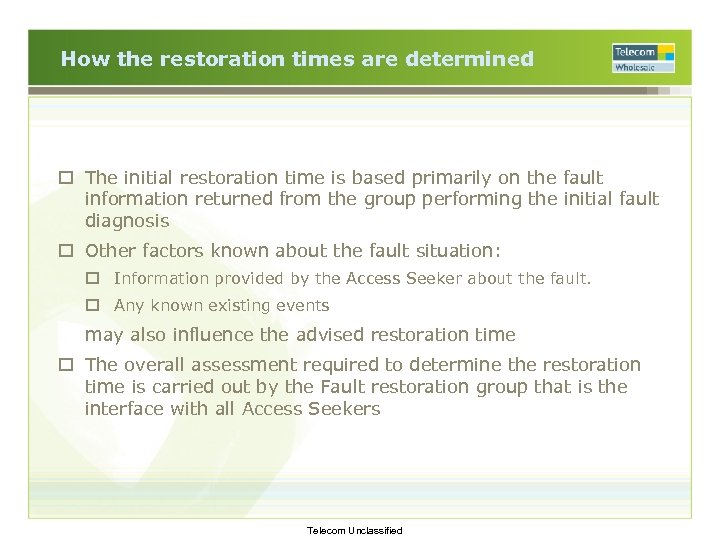 How the restoration times are determined o The initial restoration time is based primarily on the fault information returned from the group performing the initial fault diagnosis o Other factors known about the fault situation: o Information provided by the Access Seeker about the fault. o Any known existing events may also influence the advised restoration time o The overall assessment required to determine the restoration time is carried out by the Fault restoration group that is the interface with all Access Seekers Telecom Unclassified
 Can they change? o Yes the initially advised priority and restoration time can change o Changes are based on additional information relating to the fault being discovered during the restoration work. Telecom Unclassified
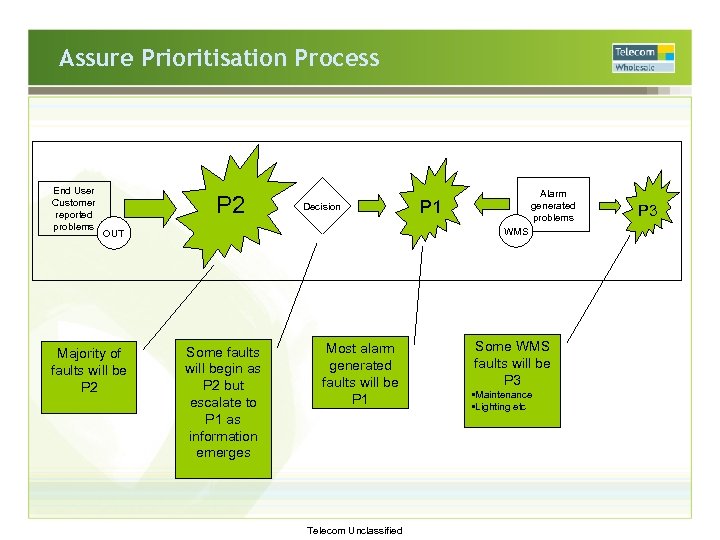 Assure Prioritisation Process End User Customer reported problems P 2 Decision P 1 WMS OUT Majority of faults will be P 2 Alarm generated problems Some faults will begin as P 2 but escalate to P 1 as information emerges Most alarm generated faults will be P 1 Telecom Unclassified Some WMS faults will be P 3 • Maintenance • Lighting etc P 3
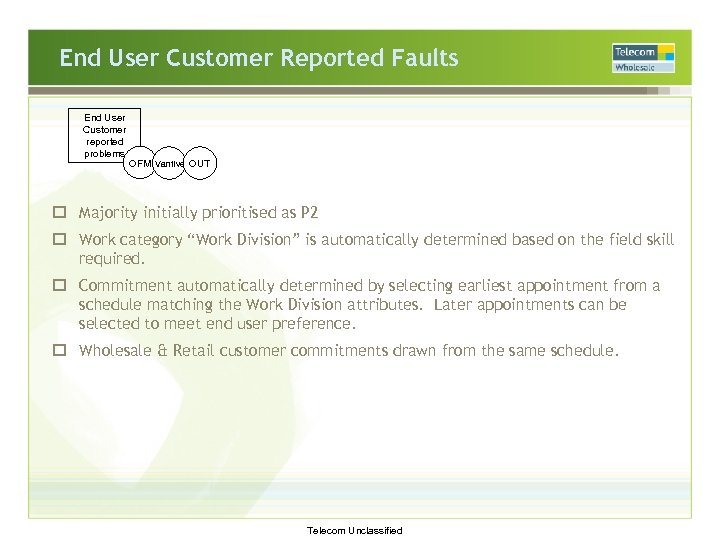 End User Customer Reported Faults End User Customer reported problems OFM Vantive OUT o Majority initially prioritised as P 2 o Work category “Work Division” is automatically determined based on the field skill required. o Commitment automatically determined by selecting earliest appointment from a schedule matching the Work Division attributes. Later appointments can be selected to meet end user preference. o Wholesale & Retail customer commitments drawn from the same schedule. Telecom Unclassified
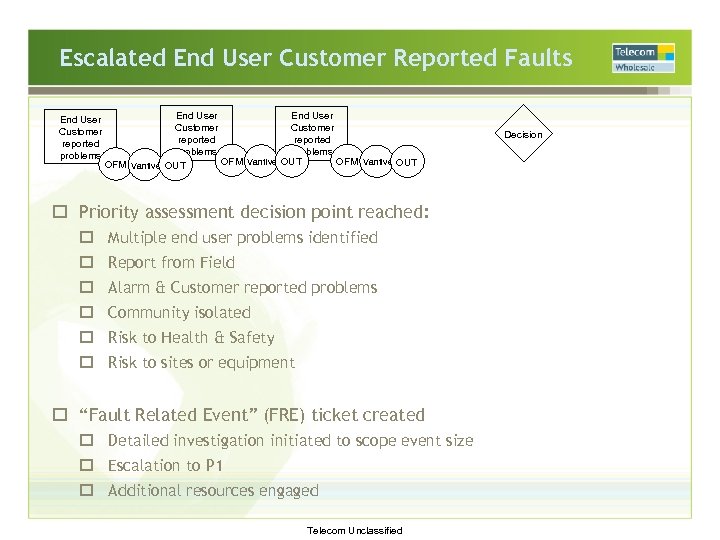 Escalated End User Customer Reported Faults End User Customer reported problems OFM Vantive OUT o Priority assessment decision point reached: o Multiple end user problems identified o Report from Field o Alarm & Customer reported problems o Community isolated o Risk to Health & Safety o Risk to sites or equipment o “Fault Related Event” (FRE) ticket created o Detailed investigation initiated to scope event size o Escalation to P 1 o Additional resources engaged Telecom Unclassified Decision
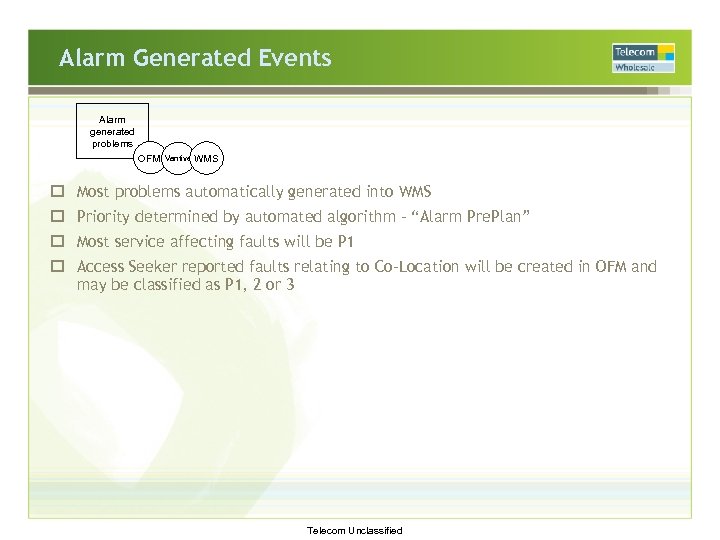 Alarm Generated Events Alarm generated problems OFM Vantive WMS o Most problems automatically generated into WMS o Priority determined by automated algorithm – “Alarm Pre. Plan” o Most service affecting faults will be P 1 o Access Seeker reported faults relating to Co-Location will be created in OFM and may be classified as P 1, 2 or 3 Telecom Unclassified
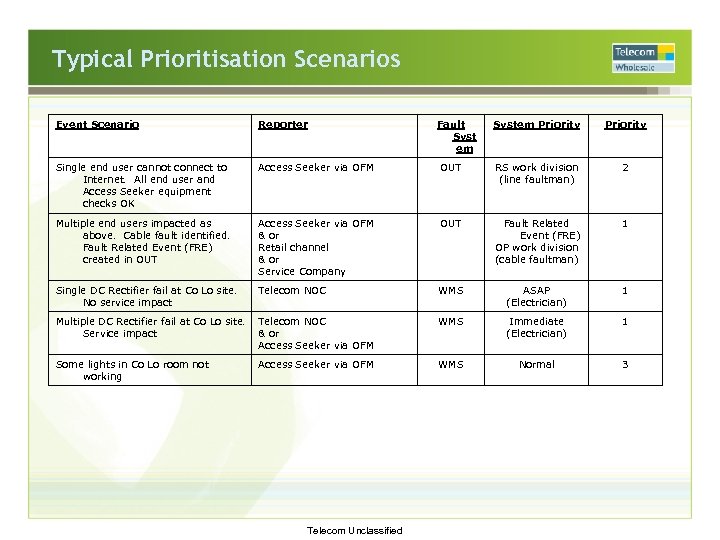 Typical Prioritisation Scenarios Event Scenario Reporter Single end user cannot connect to Internet. All end user and Access Seeker equipment checks OK Access Seeker via OFM Multiple end users impacted as above. Cable fault identified. Fault Related Event (FRE) created in OUT System Priority OUT RS work division (line faultman) 2 Access Seeker via OFM & or Retail channel & or Service Company OUT Fault Related Event (FRE) OP work division (cable faultman) 1 Single DC Rectifier fail at Co Lo site. No service impact Telecom NOC WMS ASAP (Electrician) 1 Multiple DC Rectifier fail at Co Lo site. Service impact Telecom NOC & or Access Seeker via OFM WMS Immediate (Electrician) 1 Some lights in Co Lo room not working Access Seeker via OFM WMS Normal 3 Telecom Unclassified Fault Syst em
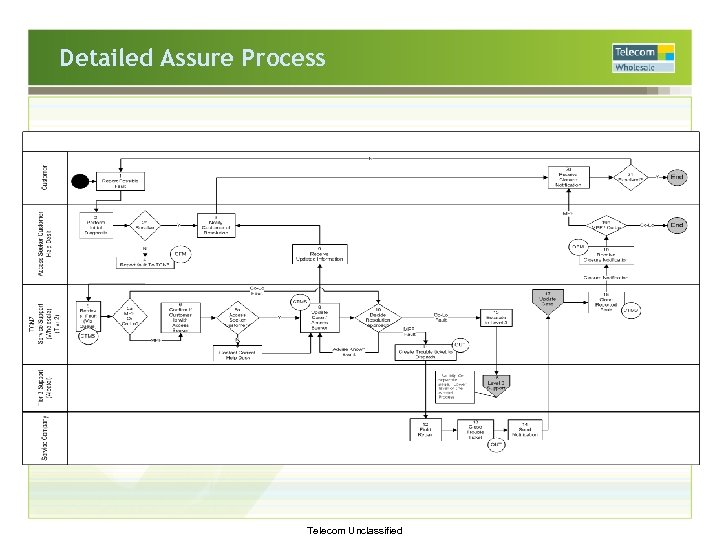 Detailed Assure Process Telecom Unclassified
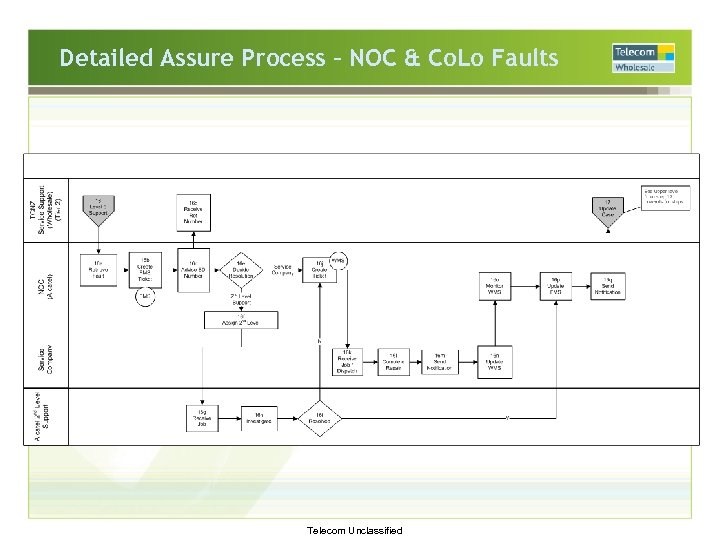 Detailed Assure Process – NOC & Co. Lo Faults Telecom Unclassified
 How we know it is working o Service Level default reporting o Independant Oversight Group (IOG) reporting Telecom Unclassified