 Скачать презентацию FAU conference CBS 14 -15 May 2008 Crop
37ceeb0708baa3176aaaeb8a8cf26925.ppt
- Количество слайдов: 33



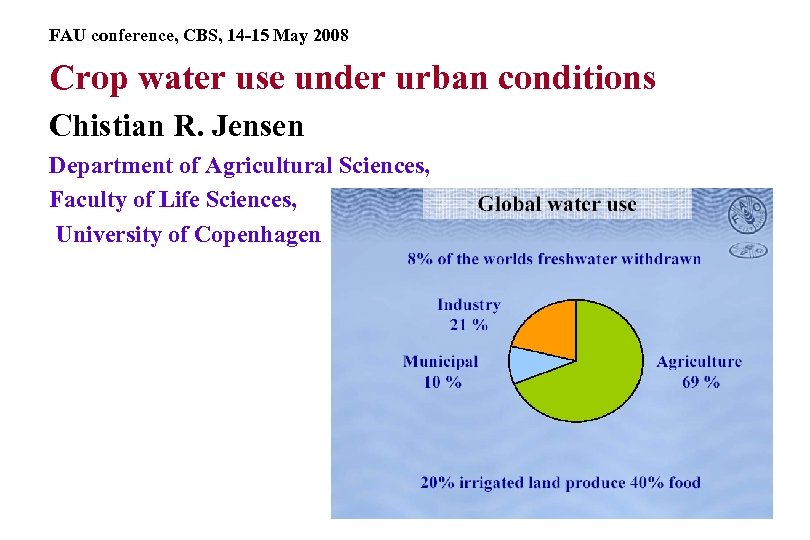
FAU conference, CBS, 14 -15 May 2008 Crop water use under urban conditions Chistian R. Jensen Department of Agricultural Sciences, Faculty of Life Sciences, University of Copenhagen
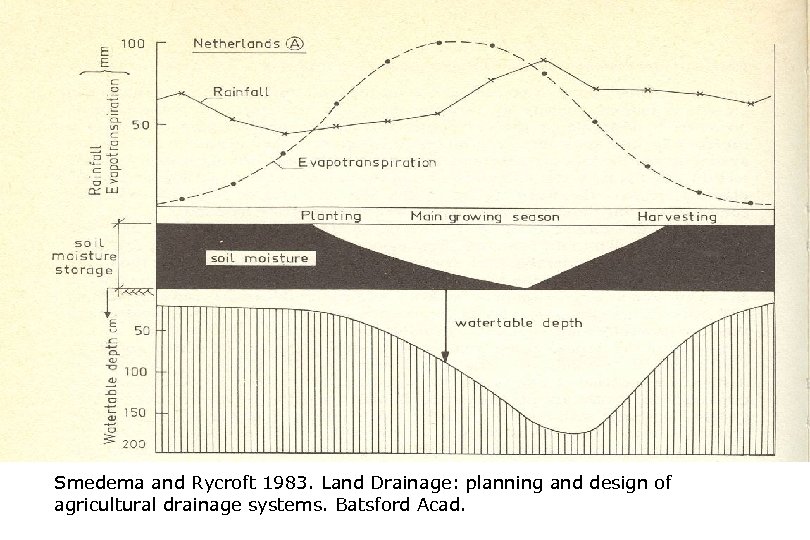
Smedema and Rycroft 1983. Land Drainage: planning and design of agricultural drainage systems. Batsford Acad.
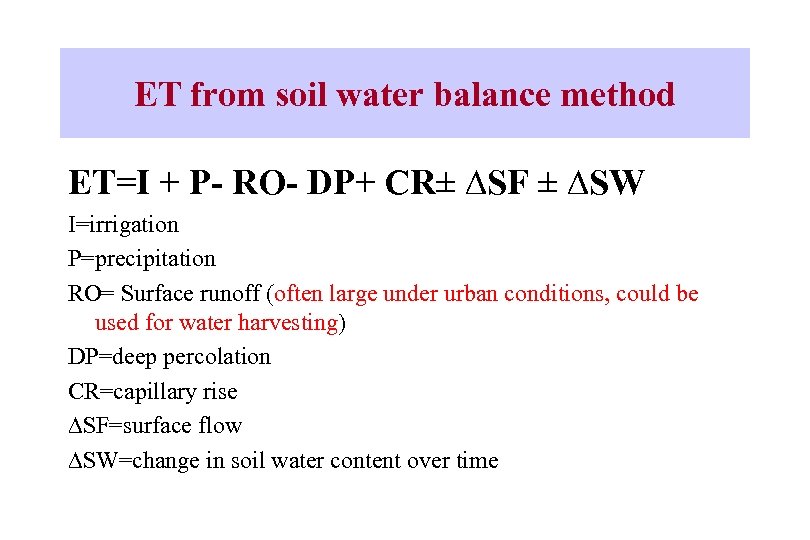
ET from soil water balance method ET=I + P- RO- DP+ CR± ∆SF ± ∆SW I=irrigation P=precipitation RO= Surface runoff (often large under urban conditions, could be used for water harvesting) DP=deep percolation CR=capillary rise ∆SF=surface flow ∆SW=change in soil water content over time
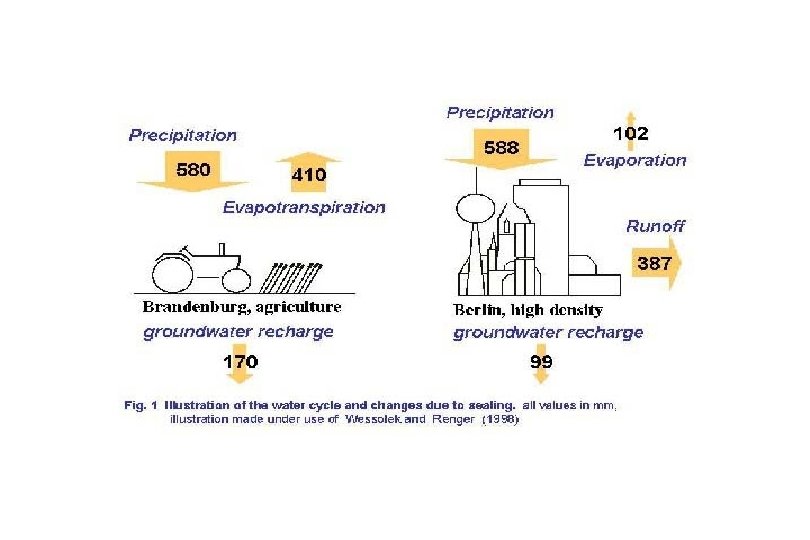
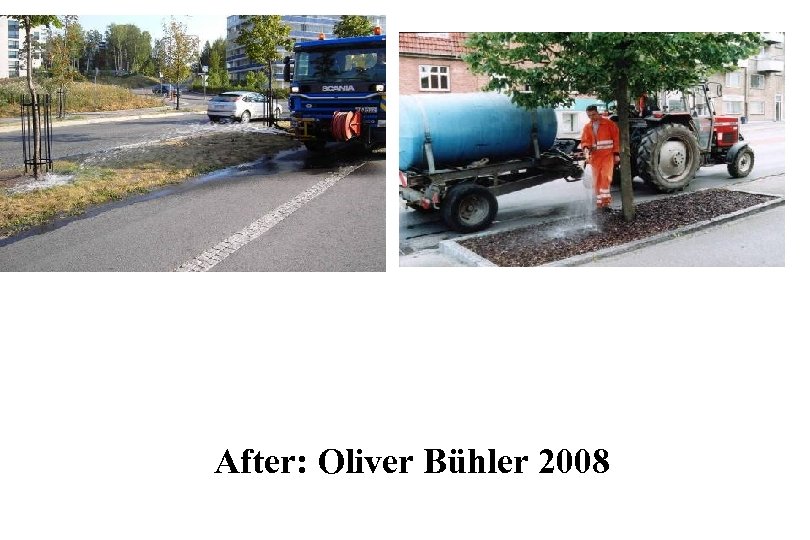
After: Oliver Bühler 2008
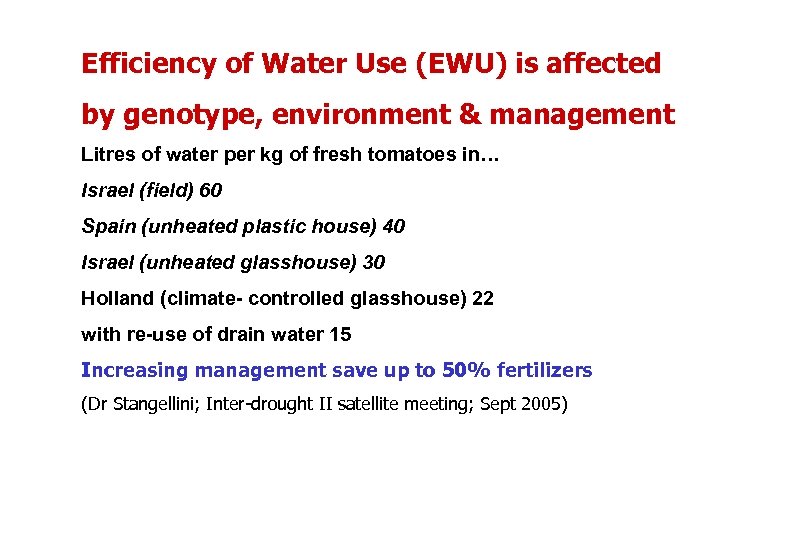
Efficiency of Water Use (EWU) is affected by genotype, environment & management Litres of water per kg of fresh tomatoes in… Israel (field) 60 Spain (unheated plastic house) 40 Israel (unheated glasshouse) 30 Holland (climate- controlled glasshouse) 22 with re-use of drain water 15 Increasing management save up to 50% fertilizers (Dr Stangellini; Inter-drought II satellite meeting; Sept 2005)
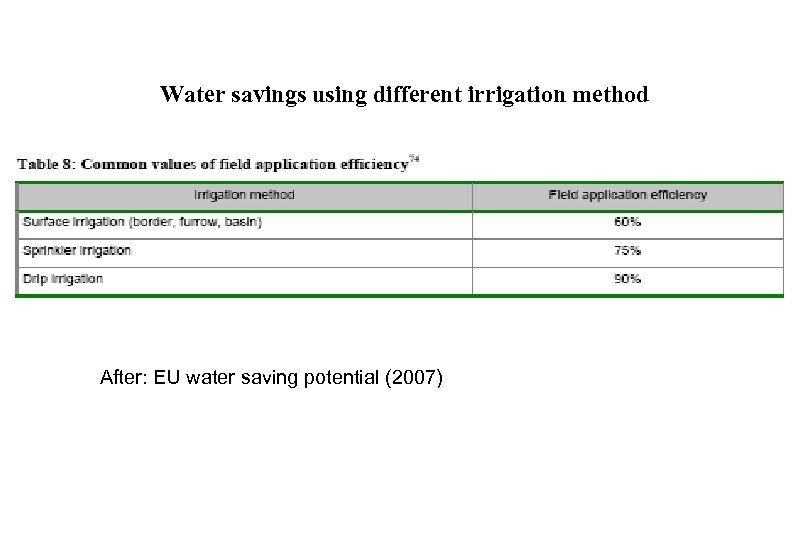
Water savings using different irrigation method After: EU water saving potential (2007)
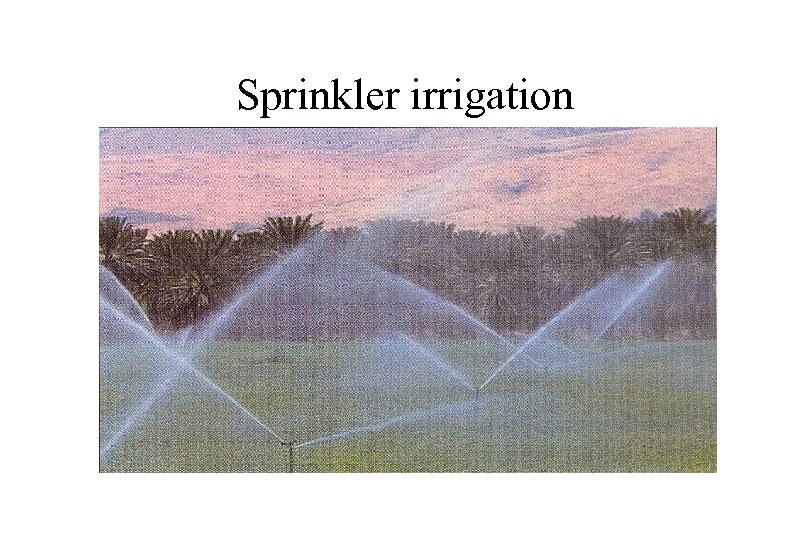
Sprinkler irrigation
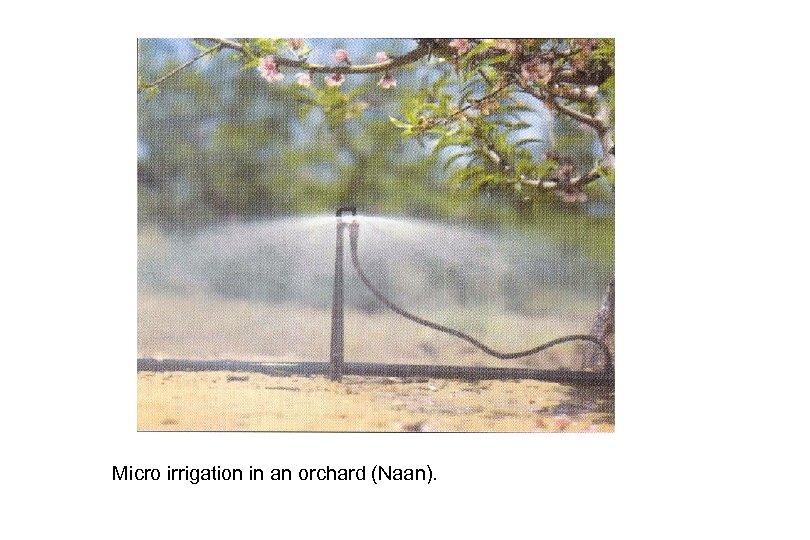
Micro irrigation in an orchard (Naan).
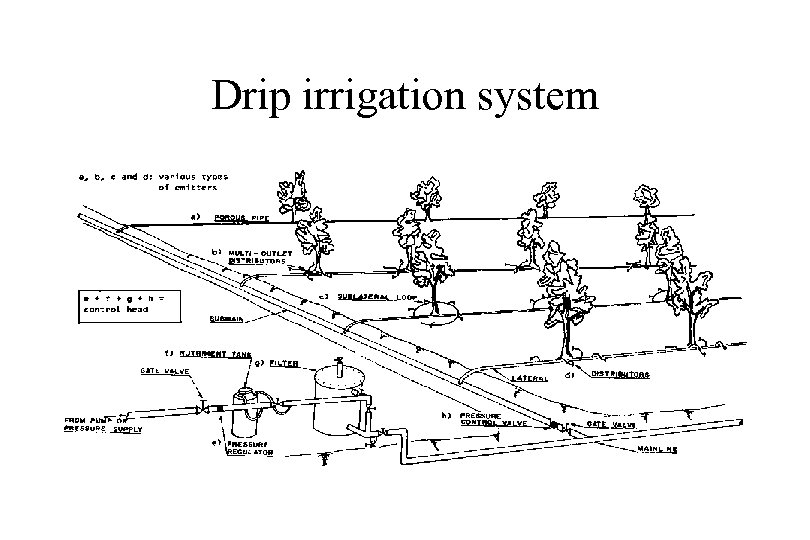
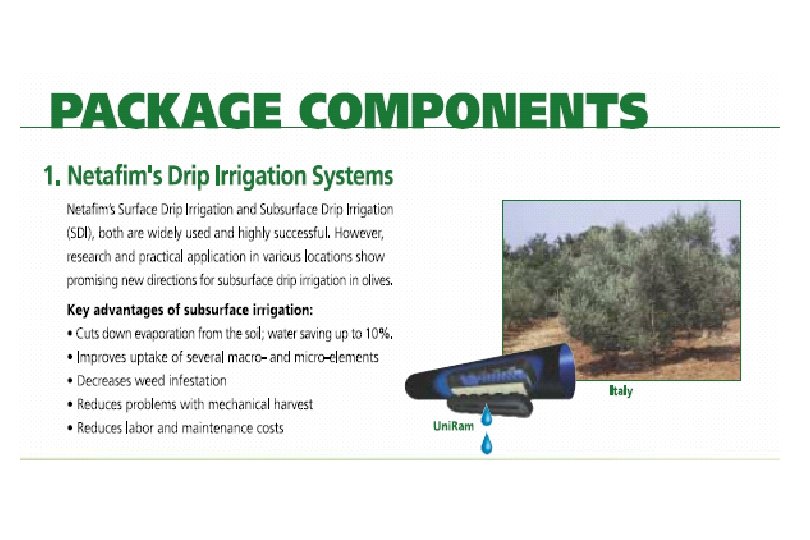
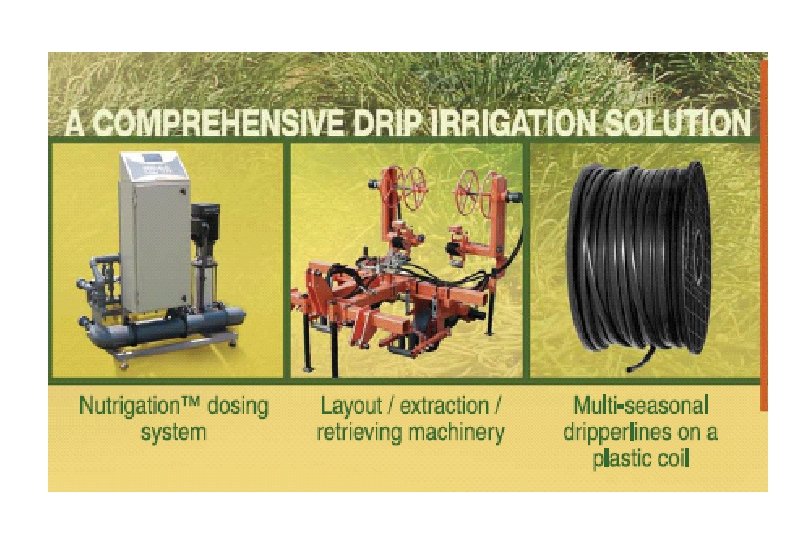
Drip irrigation system
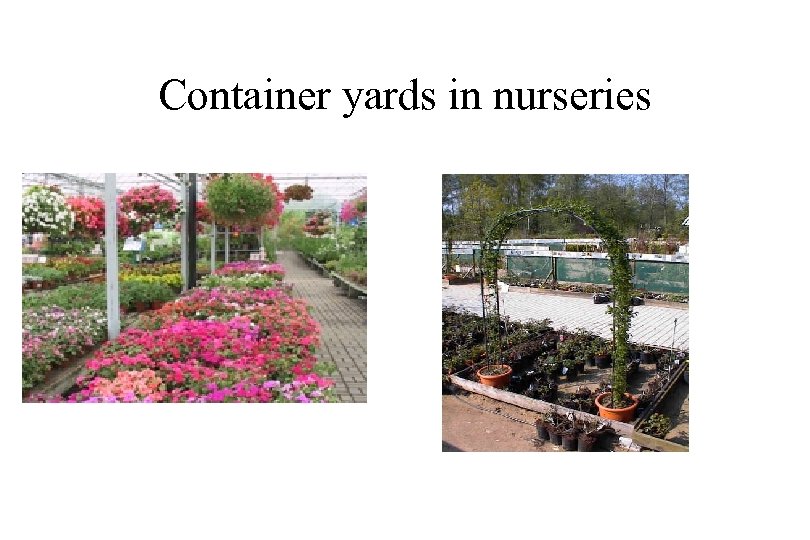
Container yards in nurseries
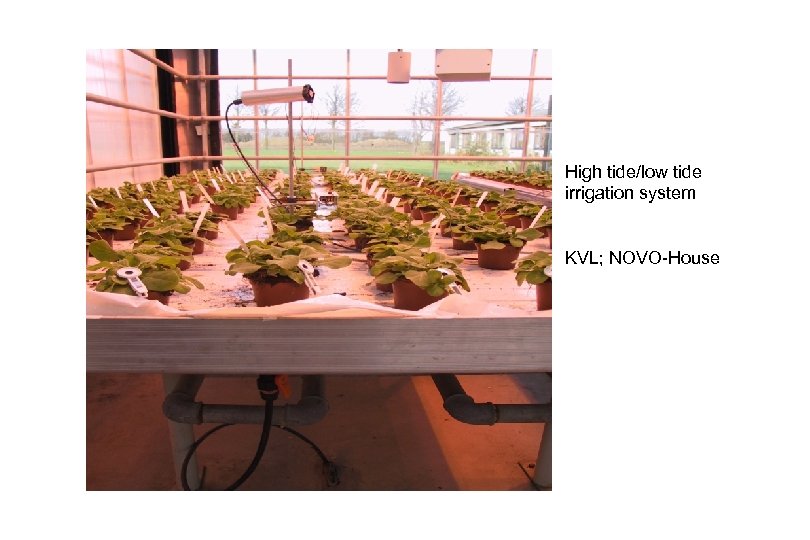
High tide/low tide irrigation system KVL; NOVO-House
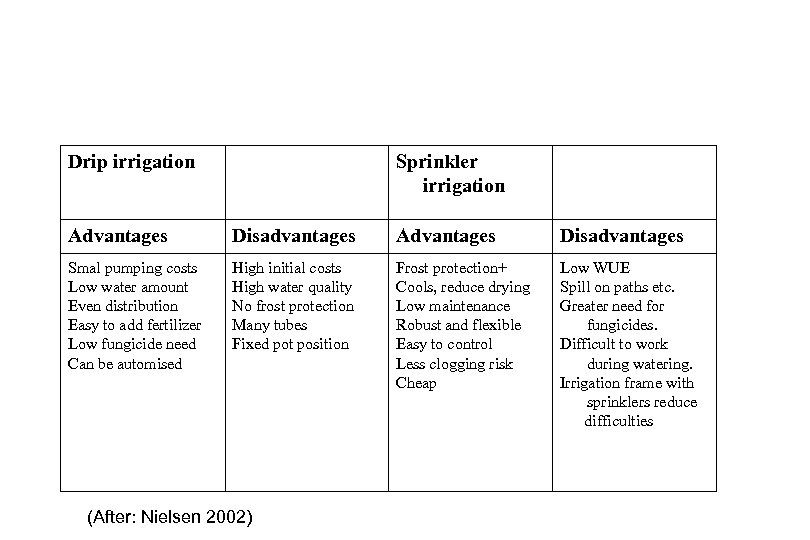
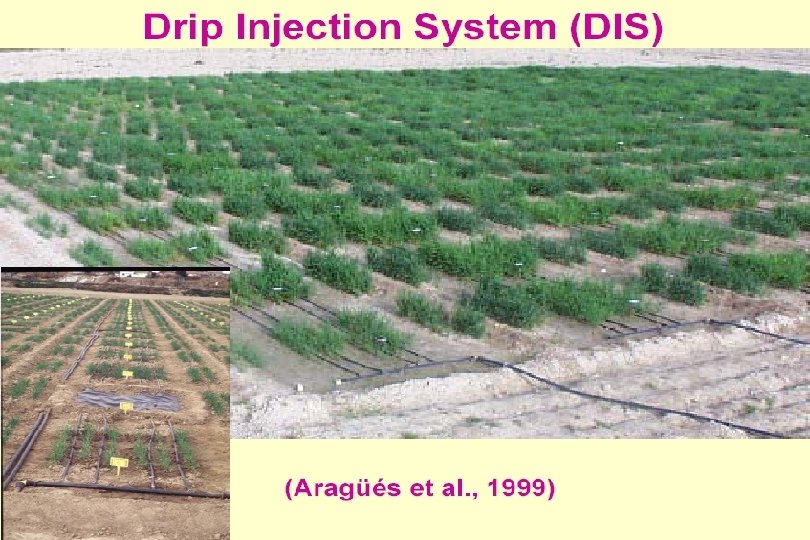
Drip irrigation Sprinkler irrigation Advantages Disadvantages Smal pumping costs Low water amount Even distribution Easy to add fertilizer Low fungicide need Can be automised High initial costs High water quality No frost protection Many tubes Fixed pot position Frost protection+ Cools, reduce drying Low maintenance Robust and flexible Easy to control Less clogging risk Cheap Low WUE Spill on paths etc. Greater need for fungicides. Difficult to work during watering. Irrigation frame with sprinklers reduce difficulties (After: Nielsen 2002)
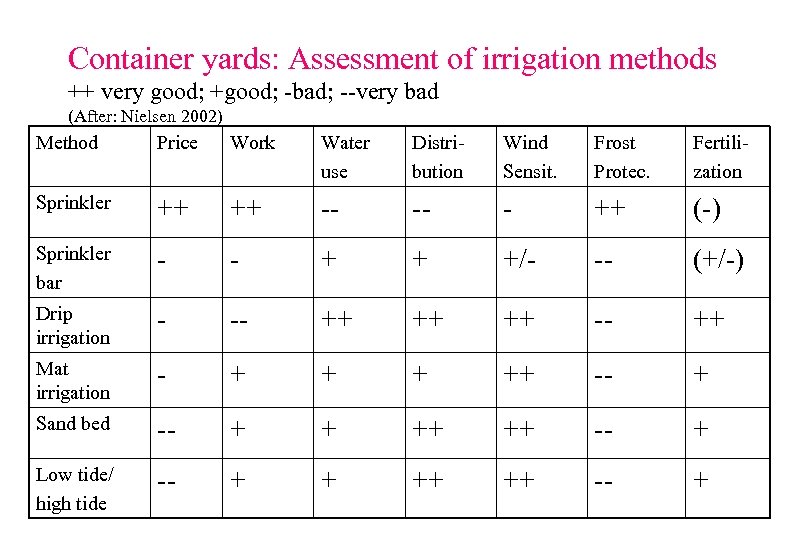
Container yards: Assessment of irrigation methods ++ very good; +good; -bad; --very bad (After: Nielsen 2002) Method Price Work Water use Distribution Wind Sensit. Frost Protec. Fertilization Sprinkler ++ ++ -- -- - ++ (-) Sprinkler bar - - + + +/- -- (+/-) Drip irrigation - -- ++ ++ ++ -- ++ Mat irrigation - + ++ -- + Sand bed -- + + ++ ++ -- + Low tide/ high tide -- + + ++ ++ -- +
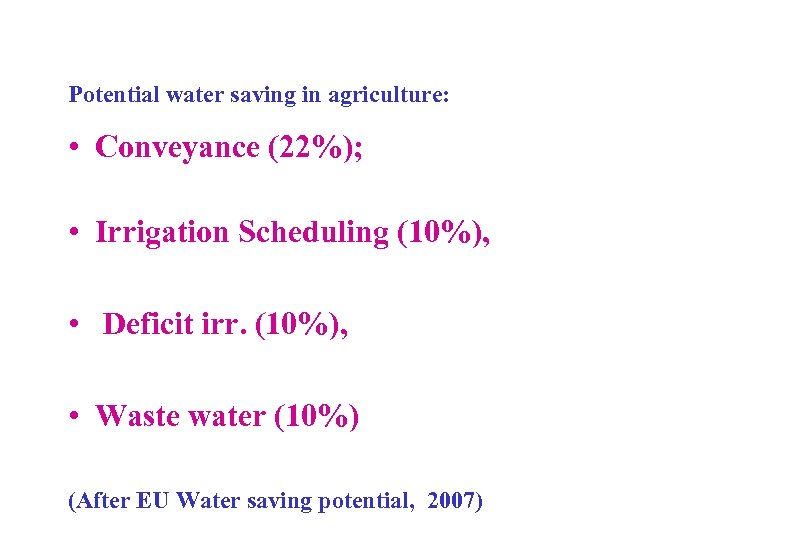
Potential water saving in agriculture: • Conveyance (22%); • Irrigation Scheduling (10%), • Deficit irr. (10%), • Waste water (10%) (After EU Water saving potential, 2007)
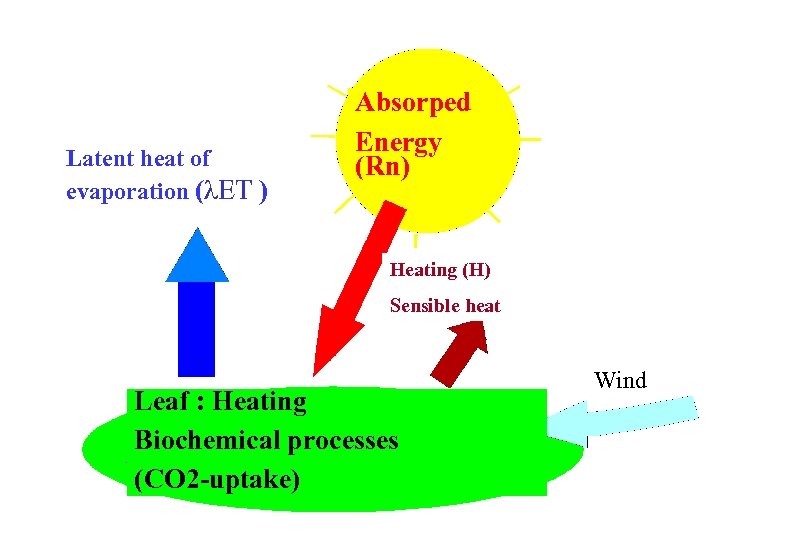
Latent heat of evaporation (λET ) Absorped Energy (Rn) Heating (H) Sensible heat Leaf : Heating Biochemical processes (CO 2 -uptake) Wind
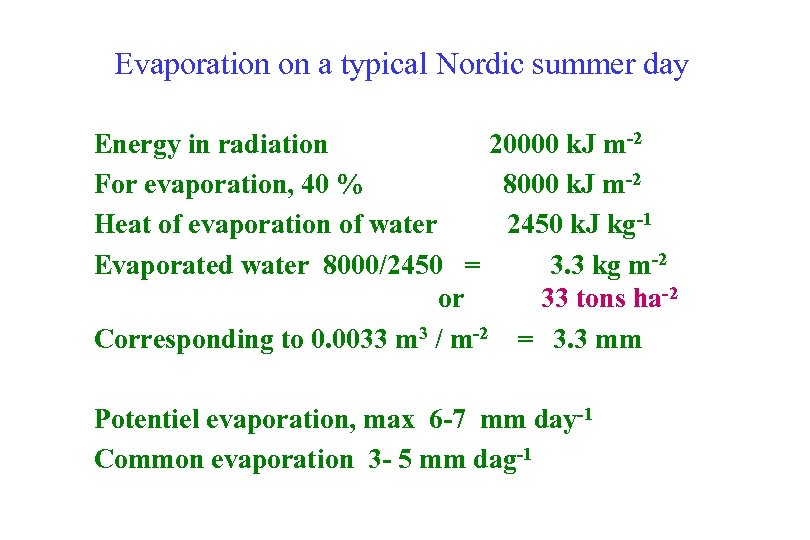
Evaporation on a typical Nordic summer day Energy in radiation 20000 k. J m-2 For evaporation, 40 % 8000 k. J m-2 Heat of evaporation of water 2450 k. J kg-1 Evaporated water 8000/2450 = 3. 3 kg m-2 or 33 tons ha-2 Corresponding to 0. 0033 m 3 / m-2 = 3. 3 mm Potentiel evaporation, max 6 -7 mm day-1 Common evaporation 3 - 5 mm dag-1
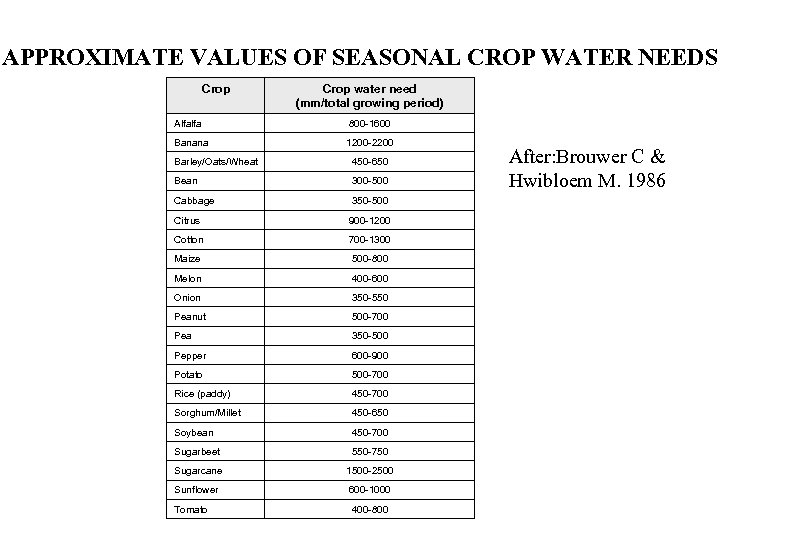
APPROXIMATE VALUES OF SEASONAL CROP WATER NEEDS Crop water need (mm/total growing period) Alfalfa 800 -1600 Banana 1200 -2200 Barley/Oats/Wheat 450 -650 Bean 300 -500 Cabbage 350 -500 Citrus 900 -1200 Cotton 700 -1300 Maize 500 -800 Melon 400 -600 Onion 350 -550 Peanut 500 -700 Pea 350 -500 Pepper 600 -900 Potato 500 -700 Rice (paddy) 450 -700 Sorghum/Millet 450 -650 Soybean 450 -700 Sugarbeet 550 -750 Sugarcane 1500 -2500 Sunflower 600 -1000 Tomato 400 -800 After: Brouwer C & Hwibloem M. 1986
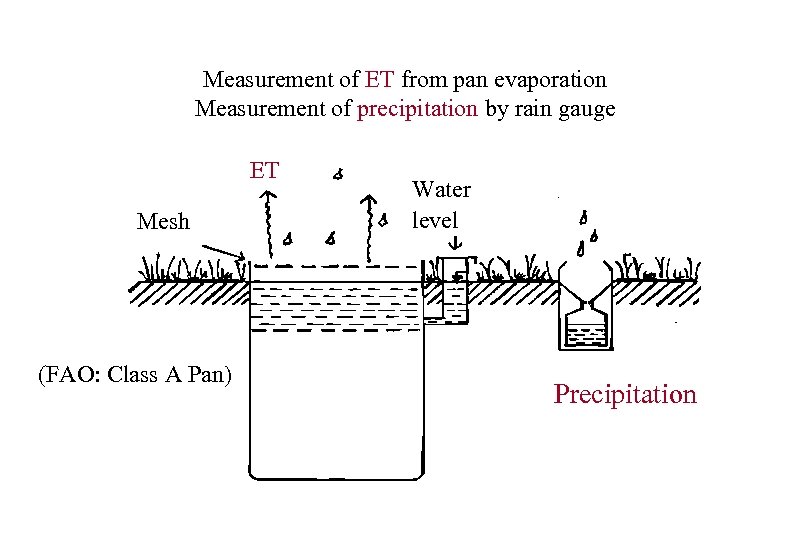
Measurement of ET from pan evaporation Measurement of precipitation by rain gauge ET Mesh (FAO: Class A Pan) Water level Precipitation
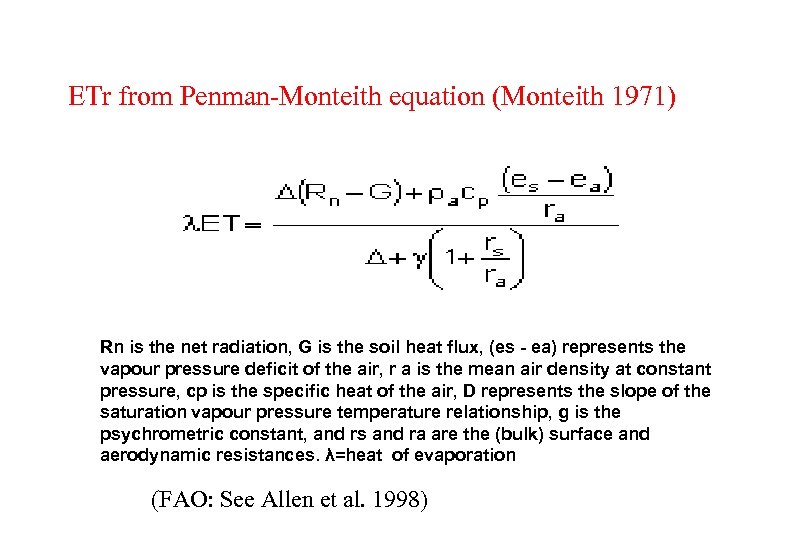
ETr from Penman-Monteith equation (Monteith 1971) Rn is the net radiation, G is the soil heat flux, (es - ea) represents the vapour pressure deficit of the air, r a is the mean air density at constant pressure, cp is the specific heat of the air, D represents the slope of the saturation vapour pressure temperature relationship, g is the psychrometric constant, and rs and ra are the (bulk) surface and aerodynamic resistances. λ=heat of evaporation (FAO: See Allen et al. 1998)
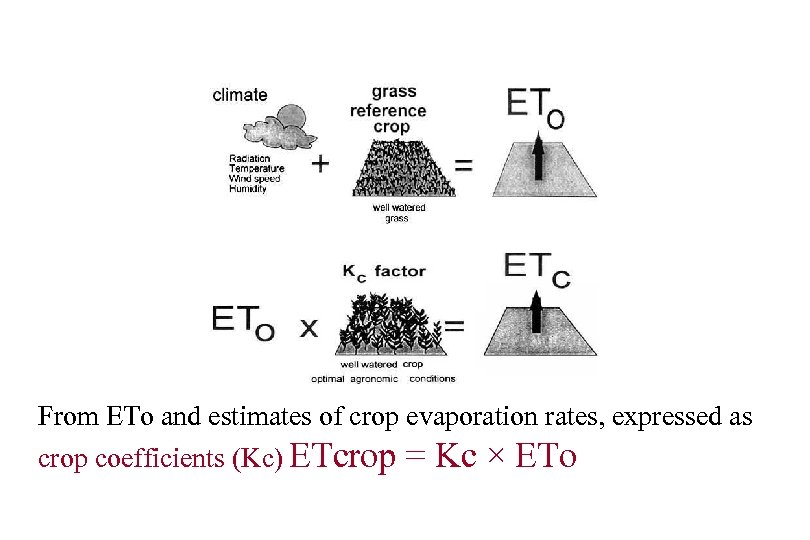
From ETo and estimates of crop evaporation rates, expressed as crop coefficients (Kc) ETcrop = Kc × ETo
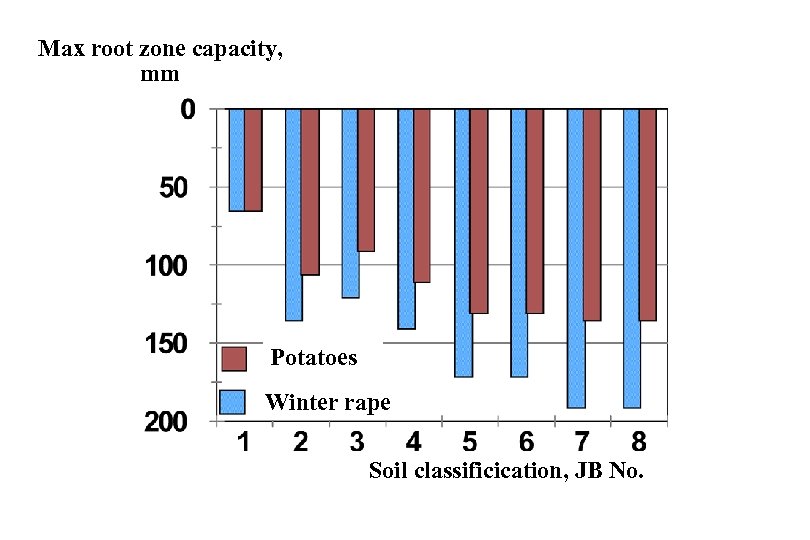
Max root zone capacity, mm Potatoes Winter rape Soil classificication, JB No. Fra tabel 2. 5
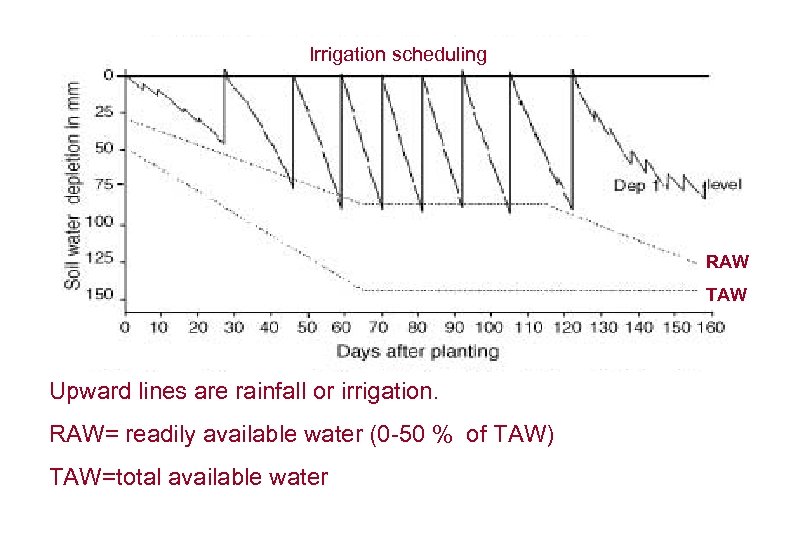
Irrigation scheduling RAW TAW Upward lines are rainfall or irrigation. RAW= readily available water (0 -50 % of TAW) TAW=total available water
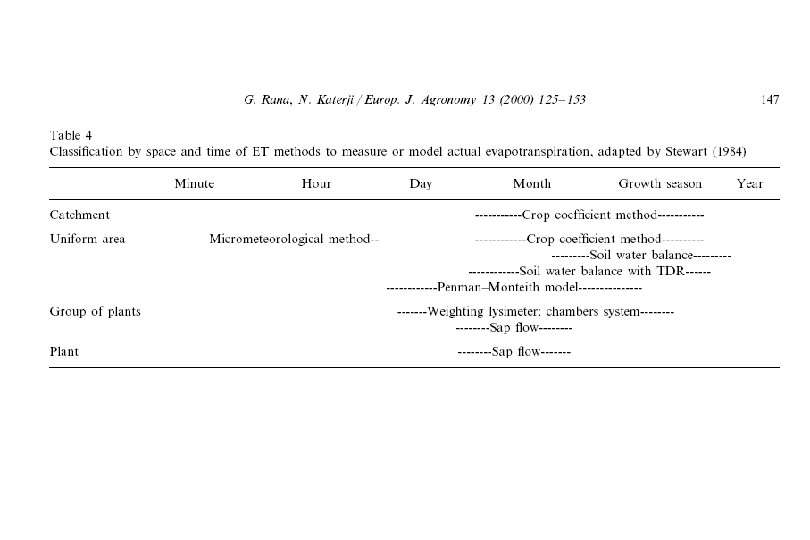
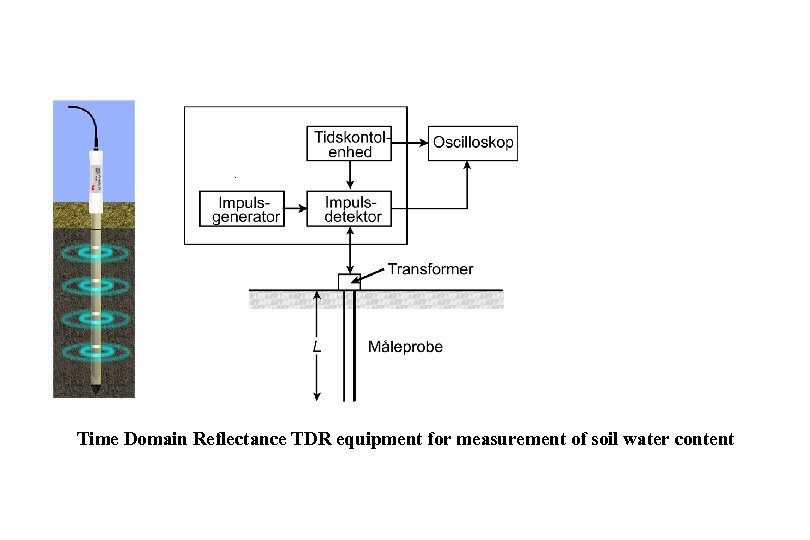
. Time Domain Reflectance TDR equipment for measurement of soil water content
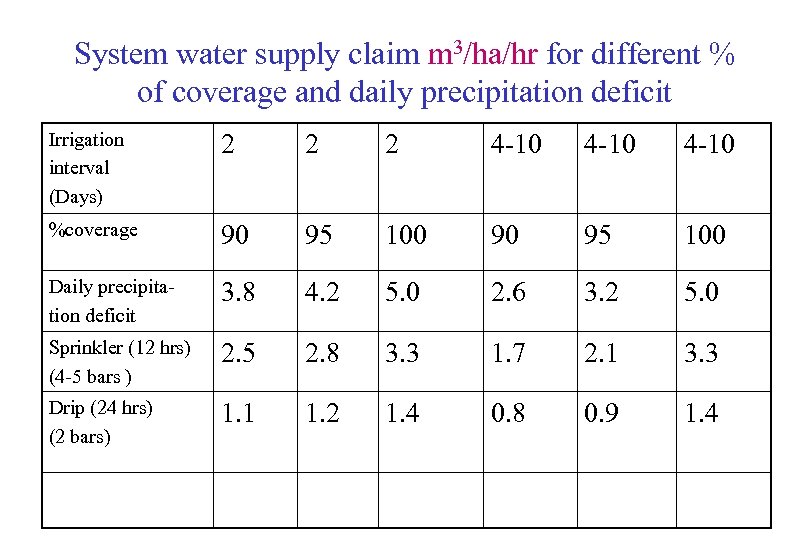
System water supply claim m 3/ha/hr for different % of coverage and daily precipitation deficit Irrigation interval (Days) 2 2 2 4 -10 %coverage 90 95 100 90 95 100 Daily precipitation deficit 3. 8 4. 2 5. 0 2. 6 3. 2 5. 0 Sprinkler (12 hrs) (4 -5 bars ) 2. 5 2. 8 3. 3 1. 7 2. 1 3. 3 Drip (24 hrs) (2 bars) 1. 1 1. 2 1. 4 0. 8 0. 9 1. 4
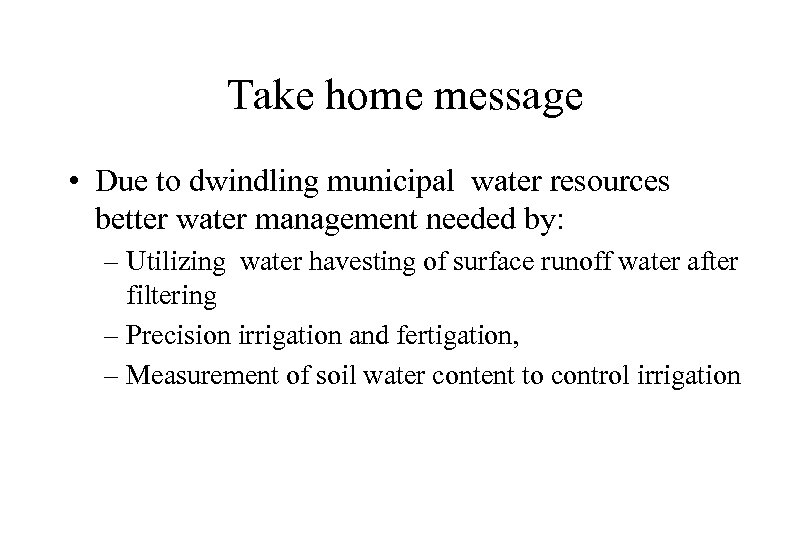
Take home message • Due to dwindling municipal water resources better water management needed by: – Utilizing water havesting of surface runoff water after filtering – Precision irrigation and fertigation, – Measurement of soil water content to control irrigation
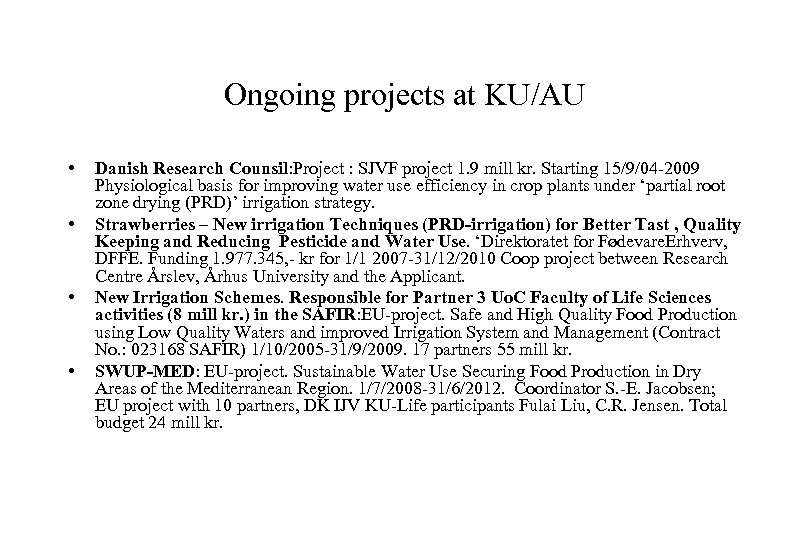
Ongoing projects at KU/AU • • Danish Research Counsil: Project : SJVF project 1. 9 mill kr. Starting 15/9/04 -2009 Physiological basis for improving water use efficiency in crop plants under ‘partial root zone drying (PRD)’ irrigation strategy. Strawberries – New irrigation Techniques (PRD-irrigation) for Better Tast , Quality Keeping and Reducing Pesticide and Water Use. ‘Direktoratet for Fødevare. Erhverv, DFFE. Funding 1. 977. 345, - kr for 1/1 2007 -31/12/2010 Coop project between Research Centre Årslev, Århus University and the Applicant. New Irrigation Schemes. Responsible for Partner 3 Uo. C Faculty of Life Sciences activities (8 mill kr. ) in the SAFIR: EU-project. Safe and High Quality Food Production using Low Quality Waters and improved Irrigation System and Management (Contract No. : 023168 SAFIR) 1/10/2005 -31/9/2009. 17 partners 55 mill kr. SWUP-MED: EU-project. Sustainable Water Use Securing Food Production in Dry Areas of the Mediterranean Region. 1/7/2008 -31/6/2012. Coordinator S. -E. Jacobsen; EU project with 10 partners, DK IJV KU-Life participants Fulai Liu, C. R. Jensen. Total budget 24 mill kr.
Sources: • Brouwer C et al. 1985. Irrigation water management: Training manual No. 1 - Introduction to Irrigation. http: www. fao. org • Brouwer C & Hwibloem M. 1986. Irrigation water mangement: Irrigation water needs. Training manual No. 3. http: www. fao. org • Allen et al. 1998. Crop evapotranspiration - Guidelines for computing crop water requirements - FAO Irrigation and drainage paper 56 • Hagin et al. 2004. Fertigation. Fertilization through Irrigation. IPI Research Topics No. 23. International Potash Institute. CH-4001 Basel • Mogensen V. O. 1990. Markvandingssystemer. DSR-forlag • Mogensen V. O. , Jensen C. R. , 2002 Markafgrøder, Klima og Vandforsyning. KVL, . • • Samfundslitteratur KVL-Bogladen. 376 sider Mogensen V. O. , Jensen C. R 2004 Mekaniske Vandingssystemer. Kompendie Nielsen HK 2002. Vandingsystemer til containerpladser. Høyskoleforlaget. Norge. P. 127 Nakayama FS, Bucks DA 1986. Trickle irrigation for crop production. Design, opration, mangemant. Development in Agricultural Engineering 9 Stewaret et al. (Co. editors) 1990. Irrigation of agricultural crops. Agronomy No. 30. ASA
Скачать презентацию FAU conference CBS 14 -15 May 2008 Crop
37ceeb0708baa3176aaaeb8a8cf26925.ppt