


 Скачать презентацию Farm Security and Rural Investment Act of 2002
182d398f3e501f89740972f21aa1b542.ppt
- Количество слайдов: 36
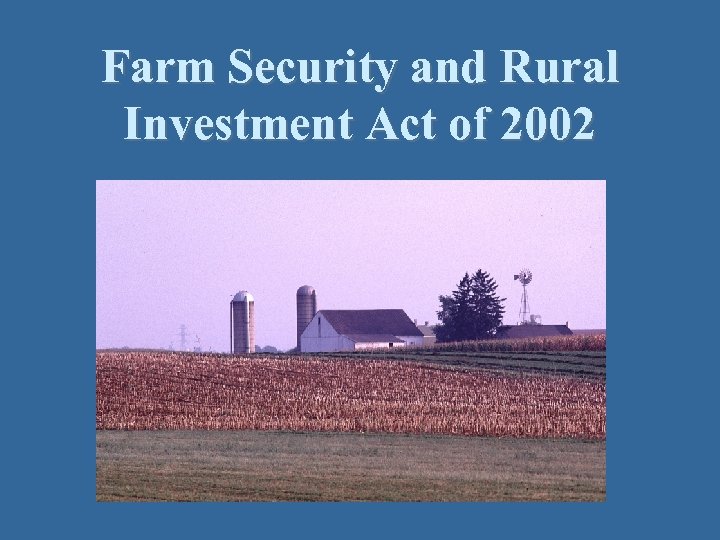 Farm Security and Rural Investment Act of 2002
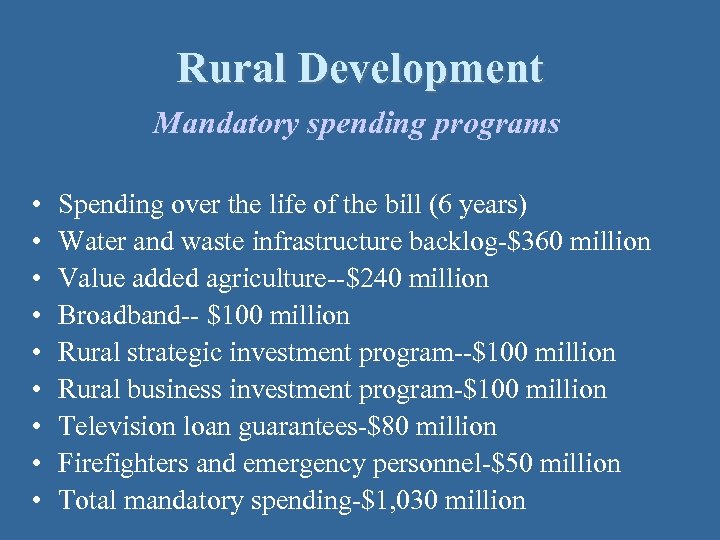 Rural Development Mandatory spending programs • • • Spending over the life of the bill (6 years) Water and waste infrastructure backlog-$360 million Value added agriculture--$240 million Broadband-- $100 million Rural strategic investment program--$100 million Rural business investment program-$100 million Television loan guarantees-$80 million Firefighters and emergency personnel-$50 million Total mandatory spending-$1, 030 million
 Rural Development Loans and Guarantees • To be used to fund pending projects: – Water and wastewater grants – Emergency community water grants – Total: $360 million (mandatory)
 Value Added Agriculture Product Market Development Grants • Defines value added agriculture • Renewable energy is an eligible purpose (energy cooperatives) • Grants to producers and producer groups up to $500, 000 • $40 million per year • Total $240 million (mandatory)
 Rural Broadband Access • Loan and Loan Guarantee for rural broadband service • Providers of broad band telecommunication services, as well as, state and local governments are eligible • $20 million per year for 4 years , $10 million for each of last 2 years in budget authority • Total $100 million (mandatory)
 Rural Strategic Investment Program • National Board on Rural America – 14 members – $100 million one-time funding (mandatory) – $8 million for planning grants to Regional Boards (at least 80) – $87 million for innovation grants to Regional Boards
 Rural Strategic Investment Program Regional Investment Boards – Regional areas must show outmigration – More than one county less than a state – Develops Regional Plans – Infrastructure, human capital services, financing – Innovation grants to carry out regional plans – Up to $3 million per region
 Rural Strategic Investment Program National Conference on Rural America – Telecommunications, health, transportation, human capital, diversification, financing, etc. – $2 million one-time funding (mandatory)
 Rural Business Investment Program • To create and provide grants to rural business investment companies • Grants of 10 percent of private capital up to $1 million • $280 million in loan guarantees • $44 million one-time authorization for grants and administrative costs • Cost is $100 million (mandatory)
 Local Television Loan Guarantees • $80 million one-time mandatory allocation • Unused funds are shifted to Rural Broadband Access Program
 Rural Firefighters and Emergency Personnel Grant Fund • Scholarships and support of training centers for emergency personnel • $10 million per year mandatory allocation
 Intergovernmental Rural Policy Working Group Sense of Congress Proposal that the President should: – Appoint a special assistant for rural policy – Designate senior officers in each agency to provide rural policy leadership – Create a rural policy working group comprised of special assistant to the President and agency designees
 Rural Economic Development Loan and Grant (REDL&D) Program • Creates a new source of funding to be used by rural electric and telephone cooperative to fund rural development projects • New guarantees will allow bonds to be used lower interest rate, decreasing the cost of elect improvements
 Business and Industry (B&I) Loan Guarantee Program • Guarantees funds to buy stock in all types of existing farmer cooperatives • Simplifies paperwork for loan applications
 Establishes Northern Great Plains Regional Authority • The authority is expected to develop a series of comprehensive coordinated plans for the economic development of the region (Iowa, Minnesota, Nebraska, north Dakota, and south Dakota) • Authorization appropriations of $30 million per year
 Why Did Chairman Harkin Want an Energy Title in the Farm Bill? • • • To increase farm income To support rural economic development To bolster energy security and independence Reduce energy price spikes To benefit the environment and public health
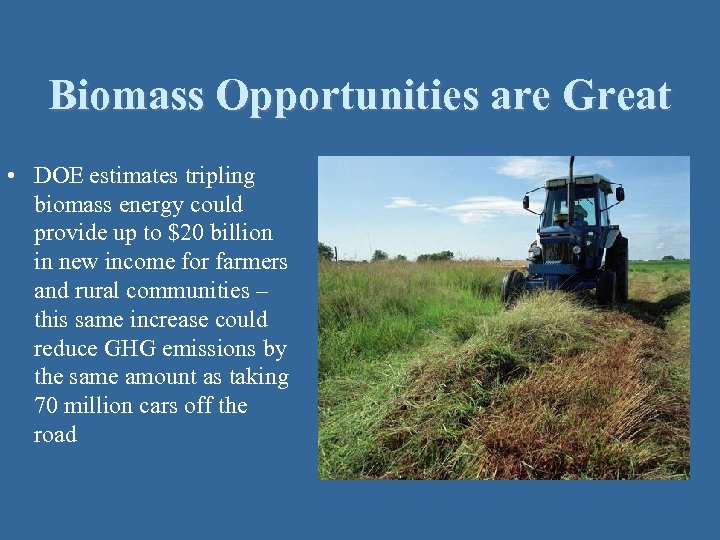 Biomass Opportunities are Great • DOE estimates tripling biomass energy could provide up to $20 billion in new income for farmers and rural communities – this same increase could reduce GHG emissions by the same amount as taking 70 million cars off the road
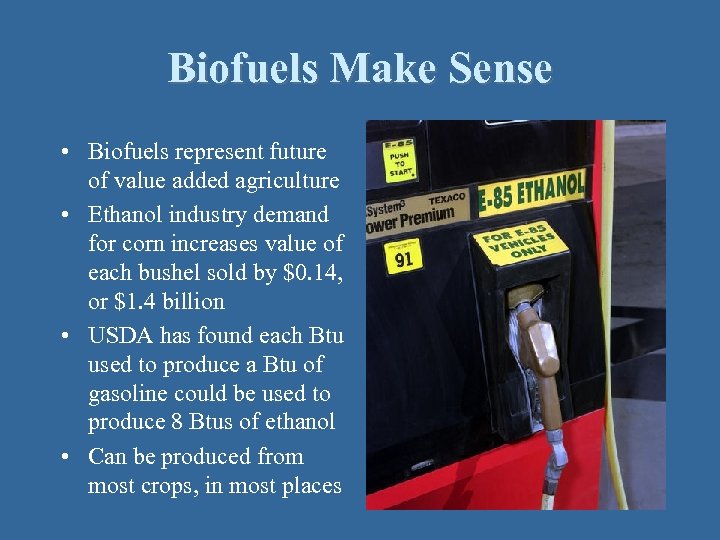 Biofuels Make Sense • Biofuels represent future of value added agriculture • Ethanol industry demand for corn increases value of each bushel sold by $0. 14, or $1. 4 billion • USDA has found each Btu used to produce a Btu of gasoline could be used to produce 8 Btus of ethanol • Can be produced from most crops, in most places
 On-Farm Energy Efficiency Opportunities • Efficiency savings of 10% to 30% readily achievable through farm audits and related programs (ACEEE) • Hogging the Light: Iowa State researchers showed that 1000 hog farms could save energy with efficient lighting while simultaneously benefiting piglet development • Dairy: Dairy farm energy audits in NY helped reduce consumption by 25% to 50% by increasing milk pumping efficiency
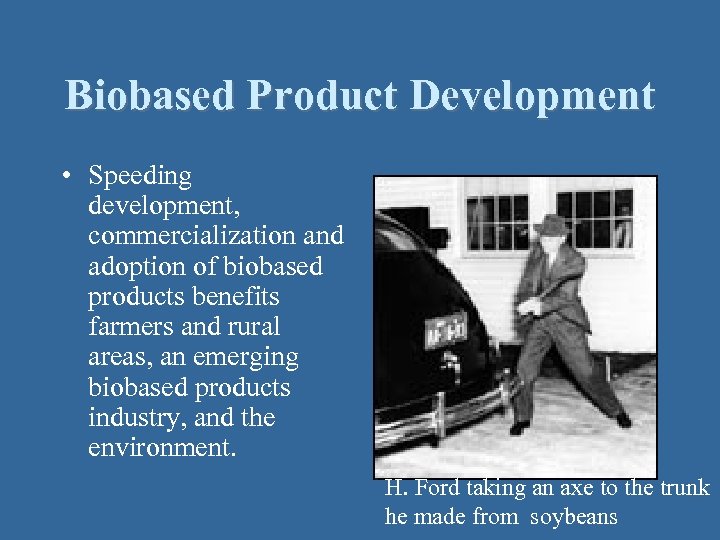 Biobased Product Development • Speeding development, commercialization and adoption of biobased products benefits farmers and rural areas, an emerging biobased products industry, and the environment. H. Ford taking an axe to the trunk he made from soybeans
 Summary of Farm Bill Energy Provisions • First ever energy title IX: $405 million over 6 years • Conservation title II: Wind and biomass energy development allowed on Conservation Reserve Program lands • Rural Development Title VI: Renewable Energy eligible for grant and loan programs • Research Title VII: Energy efficiency supported
 Energy Title Highlights • Sec. 9002 – Federal Procurement of Biobased Products • Federal agencies must: • give preference to products on biobased products list (created by USDA); • Incorporate preference in agency guidelines and establish a preferential procurement program; • Require use of biobased products to maximum extent (price, performance, availability)
 Eleven Biobased Categories • Adhesives • Construction composites • Fuel additives • Landscaping products/compost • Lubricants/functional fluids • Materials/Fibers/Paper /Packing • Paints and coatings • Plastics • Solvents/Cleaners/Ag Chemicals • Sorbents • Vegetable Oil Inks
 Voluntary USDA Label • Manufacturers can receive a USDA certified biobased product label if they meet certain criteria established by agency • Concept similar to DOE/EPA Energy Star program, but for biobased products only • Intended to further support agricultural producers and biobased products industry
 Biorefinery Development Grants • Supports commercialization of new and emerging technologies for converting biomass into fuels, chemicals and electricity from renewable resources • Consultation role for DOE • USDA grants available on a competitive basis up to 30% of development/construction costs of projects • Authorized, funding subject to appropriations
 Biodiesel Fuel Program • USDA grants for public education on benefits of biodiesel fuel use by gov’t and private entities operating vehicle fleets and others • Consultation role for DOE • Eligibility limited to non-profits and institutions of higher education with expertise in this area • $1 million/yr in 03 -07
 Energy Audit and Renewable Energy Development • New competitive grant program for organizations to assist farmers, ranchers by conducting energy efficiency audits and renewable energy assessments linked in part to financing in 9006 • Consultation role for DOE • Recipients must pay 25%+ of the cost of the audit • Eligible grantees to carry out program include regional energy centers, State energy office, REC/utility etc • Authorized and funding subject to appropriations
 RE Systems & Energy Efficiency Improvements • USDA to make low-interest loans, loan guarantees, and grants to farmers, ranchers, rural small businesses to purchase RE systems, and make energy efficiency improvements • Consultation role for DOE • Cost-share capped at 50% • Considerations include: type of system, quantity of energy likely to be generated, expected environmental benefits, payback period etc • $23 m/yr for 03 -07
 Biomass R&D • Extends authority of the Biomass R&D Act of 2000 through September 2007 • Act’s goal is to find breakthroughs for biomass conversion into sustainable fuels, chemicals, and power • Funding at $5 m in 2002, $14 m/yr in 03 -07 • Additional $49 m authorized in 02 -07
 Bioenergy Program • Continues CCC payment support program for producers of ethanol and biodiesel (“bioenergy”) derived from various commodities, and cellulosic commodities (such as hybrid poplars and switchgrass) • Payments higher to smaller producers • Cap of 5% for any one producer on total funds available • Up to $150 m/yr from 03 to 06 is available from the CCC to carry out the program
 Conservation • Increases conservation funding 80% above current level. The biggest increase in conservation spending in a farm bill EVER. • $17. 1 billion in new funding for a total of $38. 5 billion over the next 10 years. • Strong new investment in existing conservation programs and creates new programs.
 Conservation Security Program • A voluntary, locally-driven, flexible program that provides incentive payments to all participating farmers. • Rewards farmers for adopting new conservation practices and for maintaining already adopted practices. • Payments rise with greater conservation.
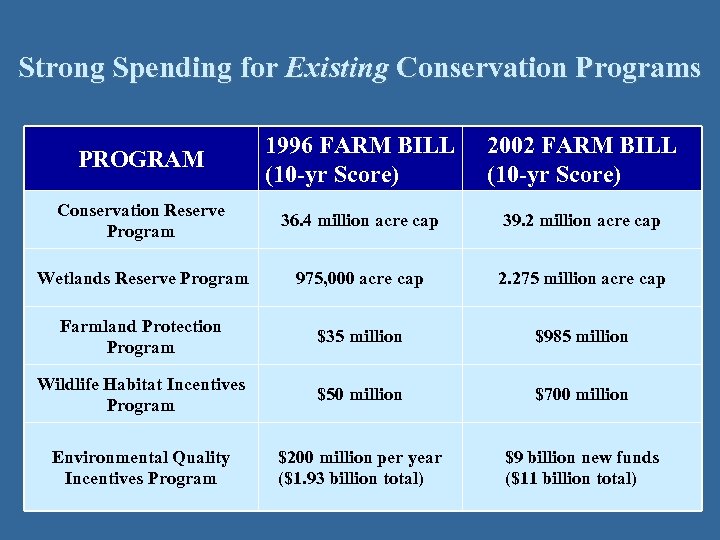 Strong Spending for Existing Conservation Programs PROGRAM 1996 FARM BILL (10 -yr Score) 2002 FARM BILL (10 -yr Score) Conservation Reserve Program 36. 4 million acre cap 39. 2 million acre cap Wetlands Reserve Program 975, 000 acre cap 2. 275 million acre cap Farmland Protection Program $35 million $985 million Wildlife Habitat Incentives Program $50 million $700 million Environmental Quality Incentives Program $200 million per year ($1. 93 billion total) $9 billion new funds ($11 billion total)
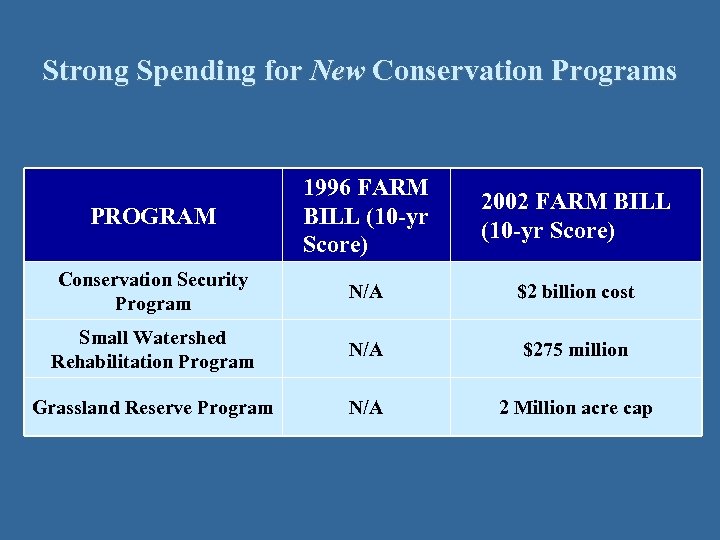 Strong Spending for New Conservation Programs PROGRAM 1996 FARM BILL (10 -yr Score) 2002 FARM BILL (10 -yr Score) Conservation Security Program N/A $2 billion cost Small Watershed Rehabilitation Program N/A $275 million Grassland Reserve Program N/A 2 Million acre cap
 Contacts for Senator Harkin Des Moines Office Washington DC Office 210 Walnut Street Rm. 733 Federal Building Des Moines, Iowa 50309 (515) 284 -4574 731 Hart Senate Office Bldg. Washington, D. C. 20510 (202) 224 -3254 Senate Agriculture Committee 328 -A Russell Senate Office Bldg. Washington, D. C. 20510 (202) 224 -2035
 Further contacts Websites: http: //harkin. senate. gov http: //agriculture. senate. gov http: //www. usda. gov/farmbill/index. html Email contacts: tom_harkin@senate. gov ellen_huntoon@harkin. senate. gov bob_soukup@harkin. senate. gov