


 Скачать презентацию FARGIS Seminar og Work Shop 16 17
e4f363f1fa26f96bd960317e37490788.ppt
- Количество слайдов: 36
 FARGIS Seminar og Work Shop 16. – 17. mars 2004 Ved Reidar Kjennbakken
 History • 1993 : the 93/75 “Hazmat” Directive • 1995 : the MOU-Hazmat (6 MS – EDIFACT / X 400) • 2002 : • June 2002 : adoption of ERIKA-II measures • the 2002/59 “Traffic Monitoring” Directive • the 1406/2002 “EMSA” Regulation • January 2002 : launching of the Safe. Sea. Net Project • January 2002 - April 2003 : Feasibility Phase • May/June 2003 ongoing : Development Phase
 Objective • Short-term objective : To set-up an electronic network between the maritime administrations of Member States in order to facilitate the implementation of EC maritime safety legislation • Longer-term objective : To set up a European platform for maritime data exchange making available to a large number of maritime users all relevant information concerning ships, their movements and their cargoes
 What is the purpose of Safe. Sea. Net? • General Objective: • provide the Member States and the Commission with technical assistance for implementing EC maritime safety legislation • Specific objective : • to develop and operate any information system necessary for attaining the objectives of the Directive
 EU legislation involved: 1. Directive 2002/59/EC “Traffic Monitoring” 2. Directive 2000/59/EC “Port Reception Facilities” 3. Directive 1999/35/EC “Ro-Ro surveys” 4. Directive 95/21/EC “Port State Control” 5. Regulation 1406/2002 “European Maritime Safety Agency” (6. Future EU Security Regulation)
 Directive 2002/59/EC “Traffic Monitoring” Requires ships to notify in advance various information (identity/voyage/DG on board/incidents. . . ) • Requires Member States to set-up appropriate shorebased infrastructure by the end of 2007 and to interconnect their national communication systems (as from February 2004) • Requires Member States and the Commission to cooperate: • to develop specifications for the data exchange, • to develop telematic links between ports/coastal stations • to improve links between coastal stations • to extend/improve ships’ identification and monitoring by MRS, VTS and routing systems
 I - Clarification on Safe. Sea. Net functions • A clear distinction must be done between the information transmitted by the ships to the shore (Ship to Shore notification) • and the information transmitted by the shore to the "European Index Server" (Member States to E. I. S).
 II - Notification functions (Shore to SSN) Member States shall notify to the E. I. S: • Port Notifications • Hazmat Notifications • Ship reports AIS and VTS • Alert messages (waste, polrep, sitrep) received or emitted by their operational services
 III - Request functions • Ship Search • Port search • and Area search • will give the possibility to obtain all the information transmitted by the vessels / operational services in the reporting and notification process (Port notification, VTS/AIS reports, and Hazmat notification) that have been notified by the MS.
 Safe. Sea. Net Functional Services Overview • Safe. Sea. Net will provide two different interfaces to help the Member States communicate with the central Safe. Sea. Net system: • A default browser-based web interface • An XML message-based interface
 Safe. Sea. Net Functional Services • Safe. Sea. Net will provide a default browserbased web interface • Manually send notifications to Safe. Sea. Net (by filling in web forms) – the Member State acting as Data Provider • Manually request detailed information about previously sent notifications (by filling in web forms and viewing results) – the Member State acting as Data Requester • Nevertheless, this browser based web interface will internally use the XML message-based interface.
 Safe. Sea. Net XML Message-based Interface • Safe. Sea. Net will also provide an XML message-based interface to enable the NCA applications of the Member States to communicate programmatically with the Safe. Sea. Net system. • The Member States are responsible for developing their NCA application in a way that it provides implementation for the sending, receiving and processing of the messages
 Definition of a Data Provider • In Safe. Sea. Net, a Data Provider is a Member State owning some information about vessels and incidents, and making it available to Data Requesters by sending notifications to Safe. Sea. Net and responding to requests for detailed information.
 The responsibility of a Data Provider • The Data Provider have to: • Send notifications to Safe. Sea. Net about vessels and incidents, indicating that the Provider owns some detailed information about these notifications, which is made available on request. • Respond to Safe. Sea. Net’s requests (on behalf of Data Requesters) for detailed information about notifications.
 Notifications can be of 5 different types: • Port • Used to notify Safe. Sea. Net that a given vessel is bound for a particular port with an estimated time of arrival and with a number of persons aboard. Note that the destination port can be ‘unknown’ (then canceling a previous port notification).
 Notifications can be of 5 different types: • Ship • Used to notify Safe. Sea. Net about a ship’s voyage and cargo information. A ship notification is essentially based on MRS or AIS message.
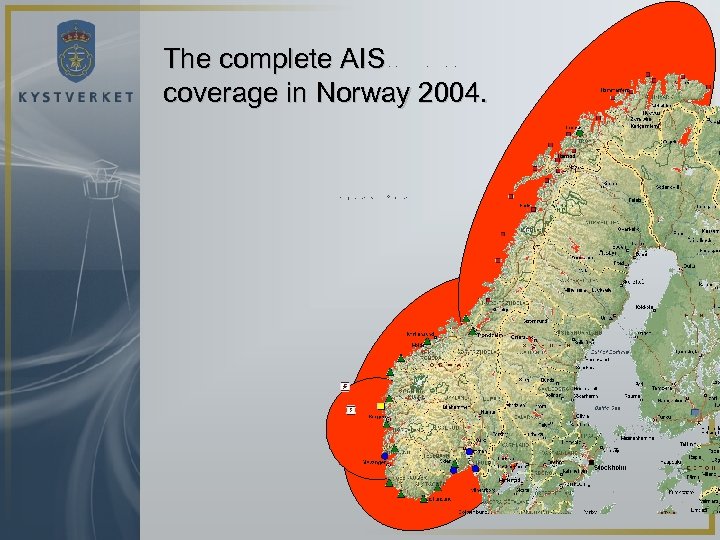 The complete AIS coverage in Norway 2004. 20 04 20 0 3
 Notifications can be of 5 different types: • HAZMAT • Used to notify Safe. Sea. Net that a given vessel carries dangerous goods and that the sender owns some detailed information about these dangerous goods.
 Notifications can be of 5 different types: • Security • Used to notify Safe. Sea. Net that the sender holds some security information about a given vessel.
 Notifications can be of 5 different types: • ALERT • Used to notify Safe. Sea. Net that the sender holds some information about specific incidents like SITREP, POLREP, Waste, lost/found containers. • An alert can be linked or not to a particular vessel.
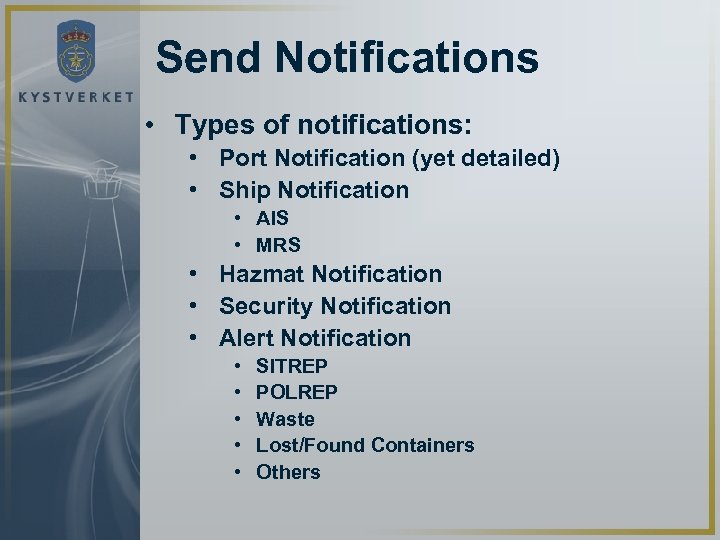 Send Notifications • Types of notifications: • Port Notification (yet detailed) • Ship Notification • AIS • MRS • Hazmat Notification • Security Notification • Alert Notification • • • SITREP POLREP Waste Lost/Found Containers Others
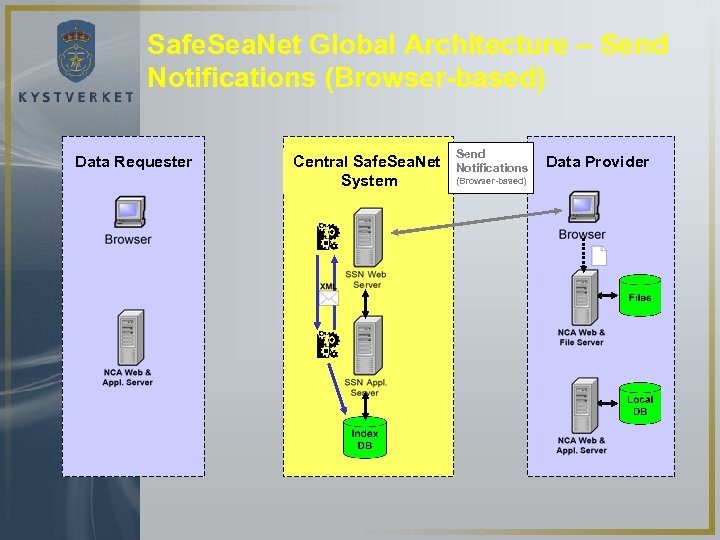 Safe. Sea. Net Global Architecture – Send Notifications (Browser-based) Data Requester Central Safe. Sea. Net System Send Notifications (Browser-based) Data Provider
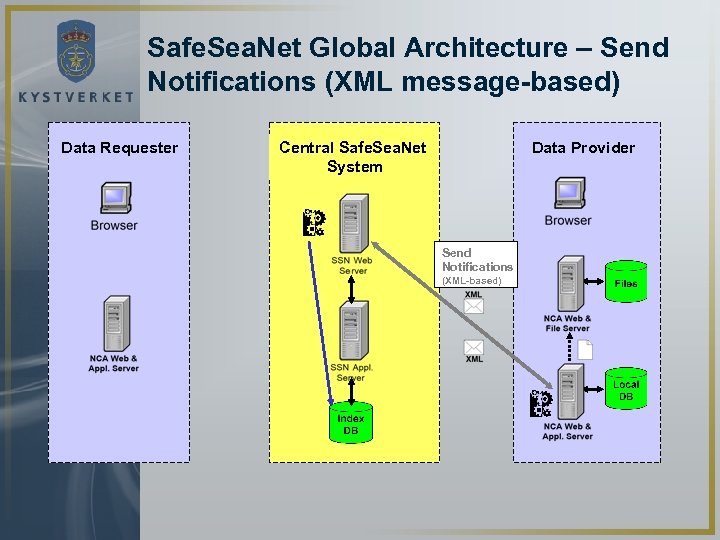 Safe. Sea. Net Global Architecture – Send Notifications (XML message-based) Data Requester Central Safe. Sea. Net System Data Provider Send Notifications (XML-based)
 Information Request Types • Port • Used to get detailed information about a given port notification. As Safe. Sea. Net holds the complete information of a port notification, there’s no need to ask more information to the Member State (data provider) having originally sent the port notification. Therefore, Safe. Sea. Net will also act as data provider for the port notification information request.
 Information Request Types • Ship • Used to get detailed information about a given ship notification. As Safe. Sea. Net holds the complete information of a ship notification, there’s no need to ask more information to the Member State (data provider) having originally sent the ship notification. Therefore, Safe. Sea. Net will also act as data provider for the ship notification information request.
 Information Request Types • HAZMAT • Used to get detailed information about a given Hazmat notification. Upon receiving such request, Safe. Sea. Net will ask the actual data provider to send him the detailed information. Safe. Sea. Net will then send it back to the data requester.
 Information Request Types • Security • Used to get detailed information about a given Security notification. Upon receiving such request, Safe. Sea. Net will ask the actual data provider to send him the detailed information. Safe. Sea. Net will then send it back to the data requester.
 Information Request Types • Alert • Used to get detailed information about a given Alert notification. Upon receiving such request, Safe. Sea. Net will ask the actual data provider to send him the detailed information. Safe. Sea. Net will then send it back to the data requester.
 Information Request Types • Cargo Manifest • Used to get detailed information about the cargo manifest of a given vessel. Upon receiving such request, Safe. Sea. Net will ask the actual data provider to send him the detailed information. Safe. Sea. Net will then send it back to the data requester.
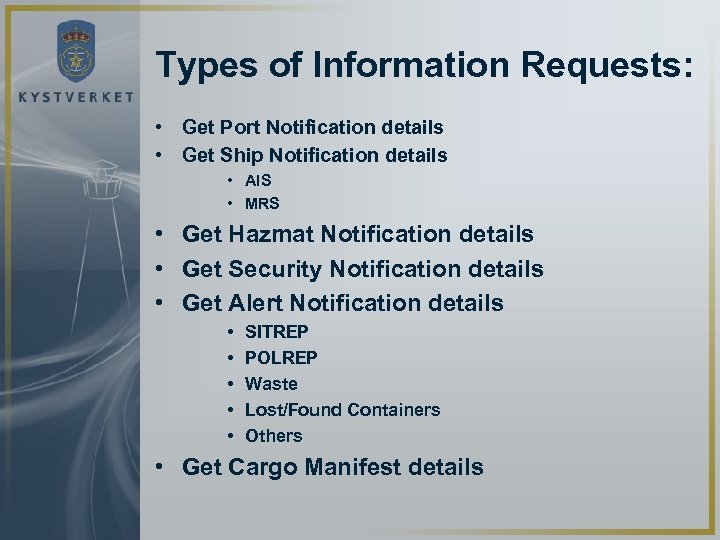 Types of Information Requests: • Get Port Notification details • Get Ship Notification details • AIS • MRS • Get Hazmat Notification details • Get Security Notification details • Get Alert Notification details • • • SITREP POLREP Waste Lost/Found Containers Others • Get Cargo Manifest details
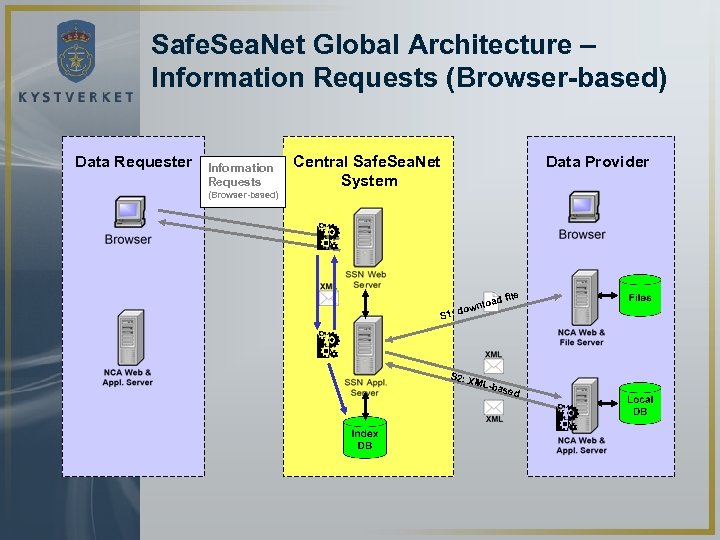 Safe. Sea. Net Global Architecture – Information Requests (Browser-based) Data Requester Information Requests (Browser-based) Central Safe. Sea. Net System Data Provider le ad fi S 1: nlo dow S 2: X ML-b ased
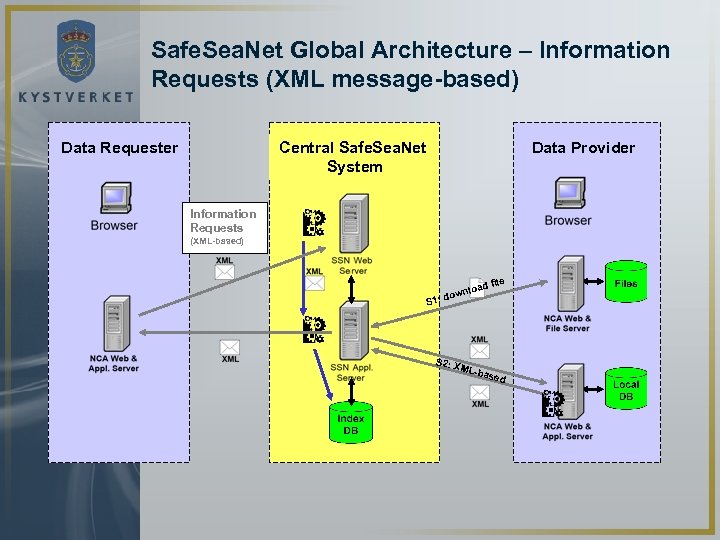 Safe. Sea. Net Global Architecture – Information Requests (XML message-based) Data Requester Central Safe. Sea. Net System Data Provider Information Requests (XML-based) S wn 1: do load S 2: X ML-b file ased
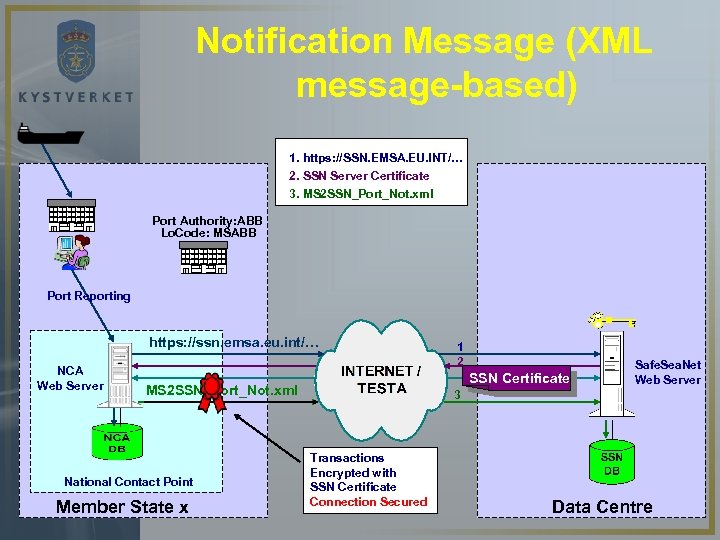 Notification Message (XML message-based) 1. https: //SSN. EMSA. EU. INT/… 2. SSN Server Certificate 3. MS 2 SSN_Port_Not. xml Port Authority: ABB Lo. Code: MSABB Port Reporting https: //ssn. emsa. eu. int/… NCA Web Server SSN Certificate MS 2 SSN_Port_Not. xml National Contact Point Member State x 1 2 Safe. Sea. Net Web Server 3 Transactions Encrypted with SSN Certificate Connection Secured Data Centre
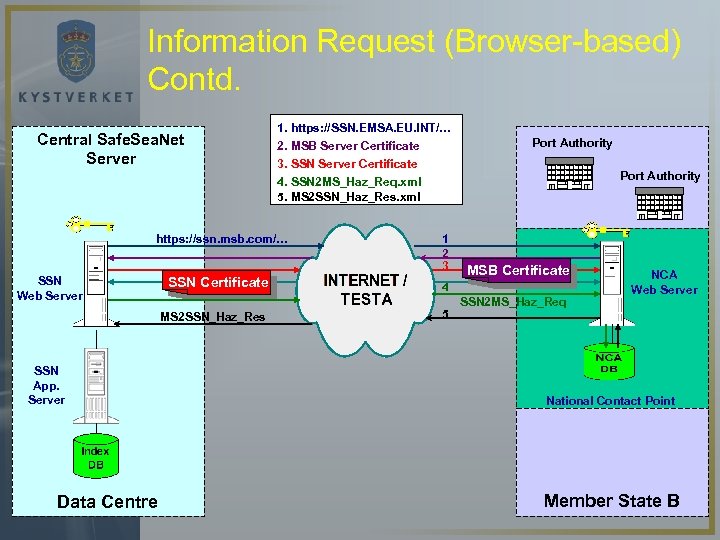 Information Request (Browser-based) Contd. Central Safe. Sea. Net Server 1. https: //SSN. EMSA. EU. INT/… https: //ssn. msb. com/… SSN Web Server Port Authority 2. MSB Server Certificate 3. SSN Server Certificate 4. SSN 2 MS_Haz_Req. xml 5. MS 2 SSN_Haz_Res. xml Port Authority 1 2 3 Data Centre 5 MSB Certificate 4 MS 2 SSN_Haz_Res SSN App. Server SSN Certificate SSN 2 MS_Haz_Req NCA Web Server National Contact Point Member State B
 Safe. Sea. Net should aim at: • a better detection of potential risk situations • a better reaction in case of threat to maritime safety and the environment • improved emergency response in case of incidents or pollution at sea • improve controls of vessels in ports • increased efficiency of port logistics (accurate ETAs, waste handling…) • produce statistics for EMSA, Member States and the Commission