 Скачать презентацию FAMOUS PEOPLE OF GREAT BRITAIN There
3e5b98d50612ede81f1f7e236a57d6b5 (3).ppt
- Количество слайдов: 29



FAMOUS PEOPLE OF GREAT BRITAIN
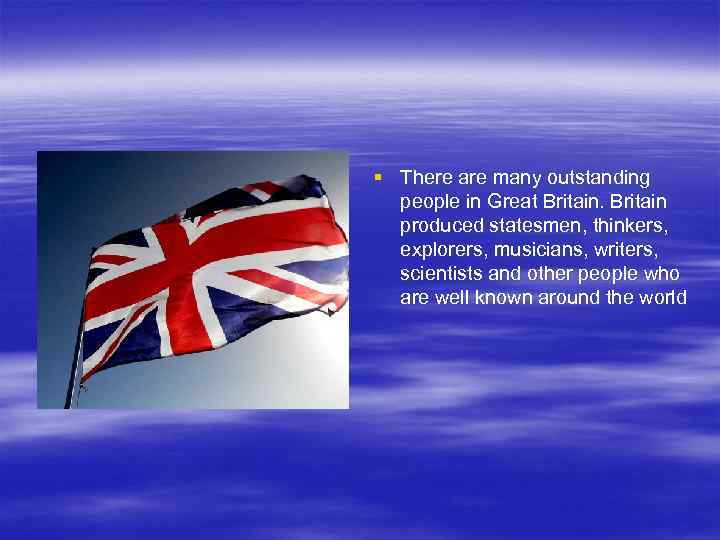
§ There are many outstanding people in Great Britain produced statesmen, thinkers, explorers, musicians, writers, scientists and other people who are well known around the world
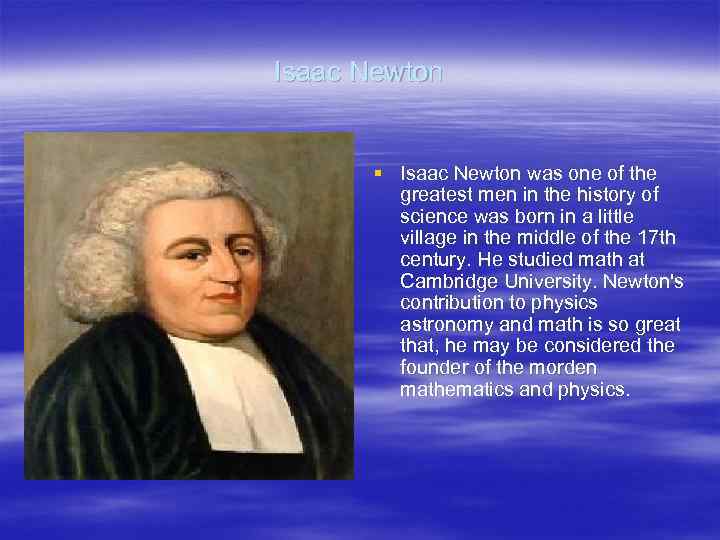
Isaac Newton § Isaac Newton was one of the greatest men in the history of science was born in a little village in the middle of the 17 th century. He studied math at Cambridge University. Newton's contribution to physics astronomy and math is so great that, he may be considered the founder of the morden mathematics and physics.
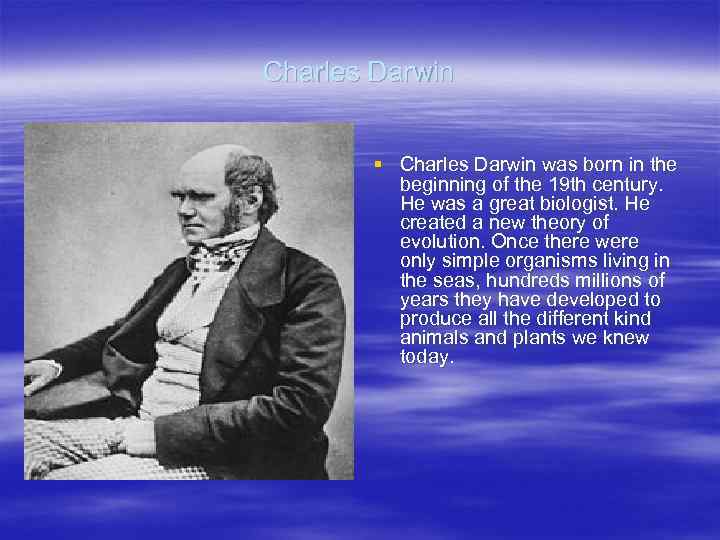
Charles Darwin § Charles Darwin was born in the beginning of the 19 th century. He was a great biologist. He created a new theory of evolution. Once there were only simple organisms living in the seas, hundreds millions of years they have developed to produce all the different kind animals and plants we knew today.
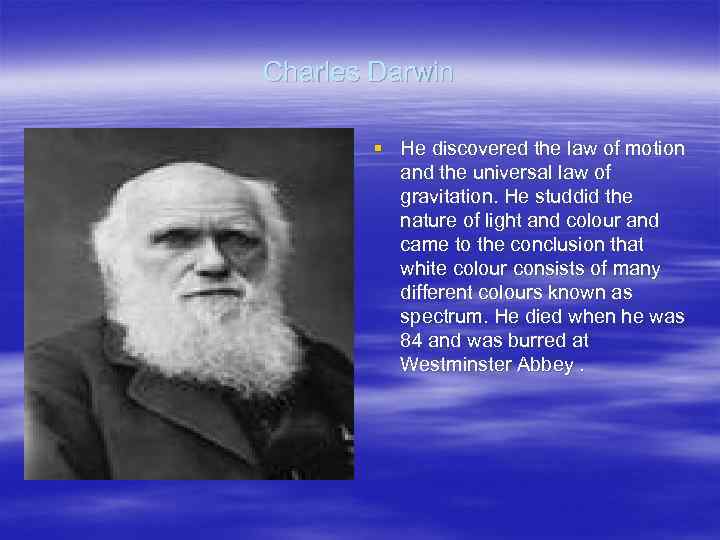
Charles Darwin § He discovered the law of motion and the universal law of gravitation. He studdid the nature of light and colour and came to the conclusion that white colour consists of many different colours known as spectrum. He died when he was 84 and was burred at Westminster Abbey.
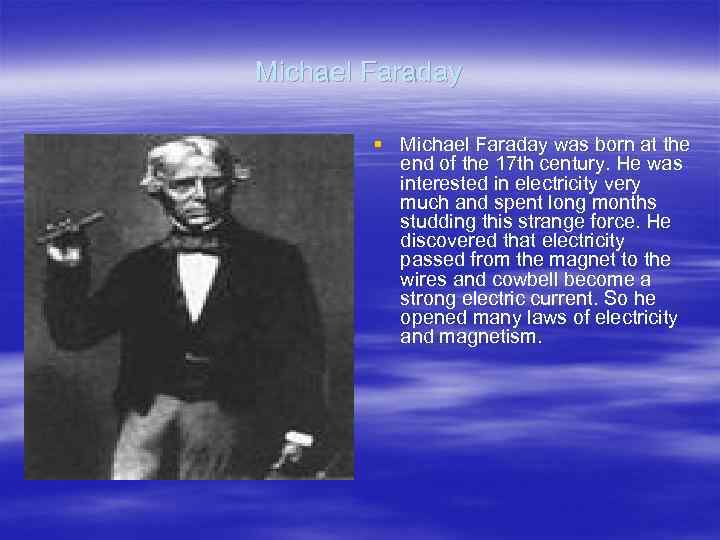
Michael Faraday § Michael Faraday was born at the end of the 17 th century. He was interested in electricity very much and spent long months studding this strange force. He discovered that electricity passed from the magnet to the wires and cowbell become a strong electric current. So he opened many laws of electricity and magnetism.
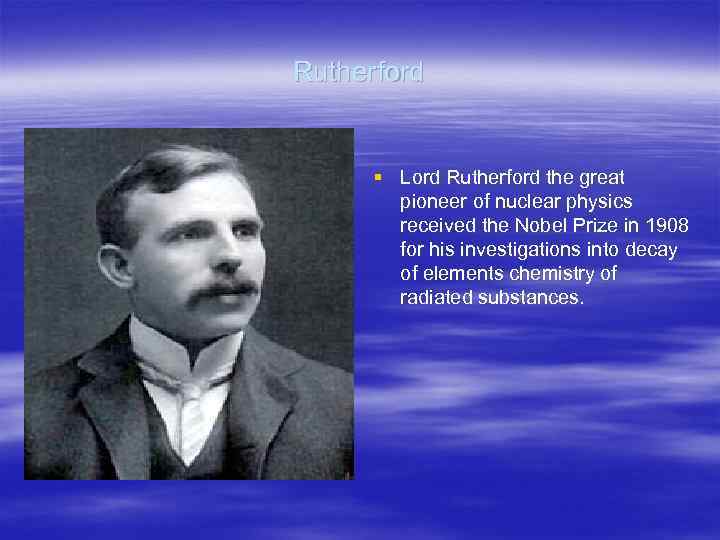
Rutherford § Lord Rutherford the great pioneer of nuclear physics received the Nobel Prize in 1908 for his investigations into decay of elements chemistry of radiated substances.
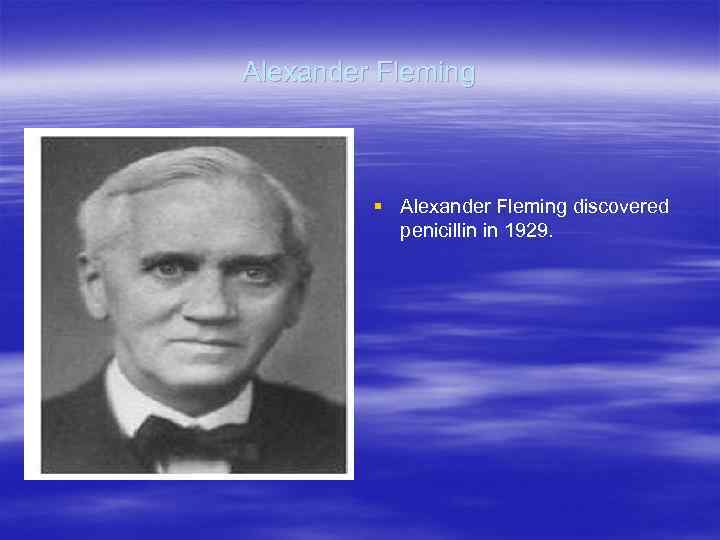
Alexander Fleming § Alexander Fleming discovered penicillin in 1929.
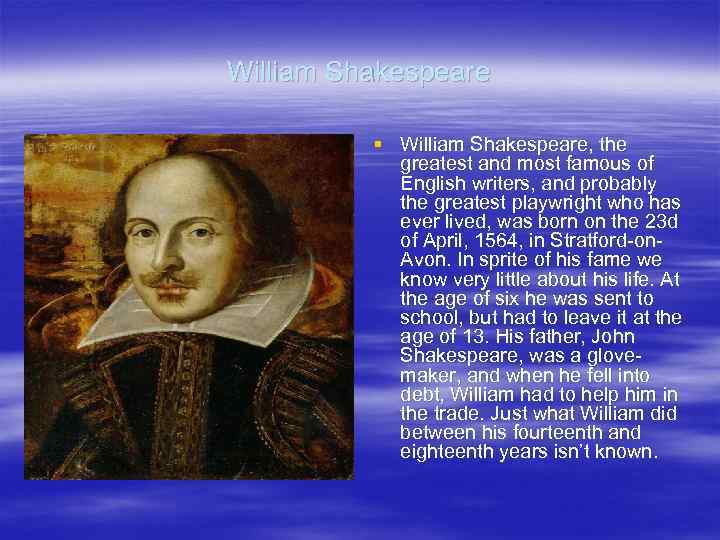
William Shakespeare § William Shakespeare, the greatest and most famous of English writers, and probably the greatest playwright who has ever lived, was born on the 23 d of April, 1564, in Stratford-on. Avon. In sprite of his fame we know very little about his life. At the age of six he was sent to school, but had to leave it at the age of 13. His father, John Shakespeare, was a glovemaker, and when he fell into debt, William had to help him in the trade. Just what William did between his fourteenth and eighteenth years isn’t known.
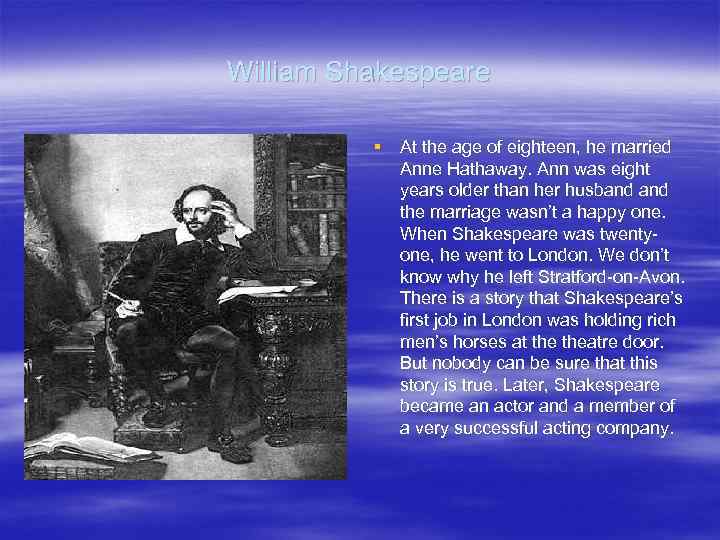
William Shakespeare § At the age of eighteen, he married Anne Hathaway. Ann was eight years older than her husband the marriage wasn’t a happy one. When Shakespeare was twentyone, he went to London. We don’t know why he left Stratford-on-Avon. There is a story that Shakespeare’s first job in London was holding rich men’s horses at theatre door. But nobody can be sure that this story is true. Later, Shakespeare became an actor and a member of a very successful acting company.
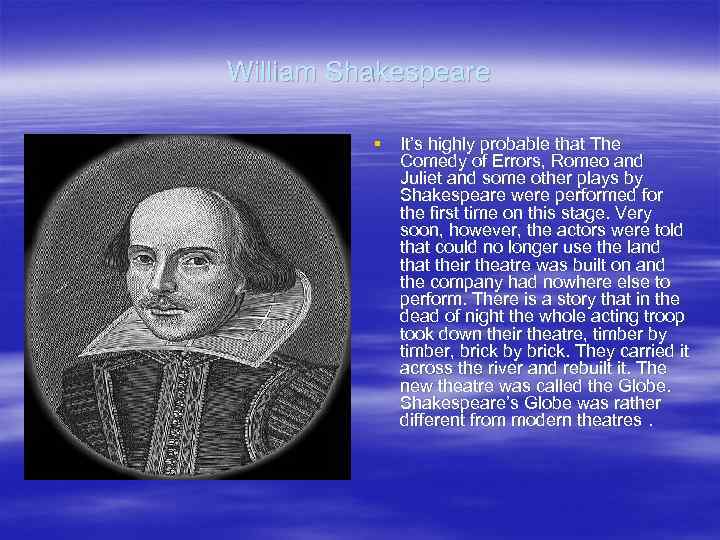
William Shakespeare § It’s highly probable that The Comedy of Errors, Romeo and Juliet and some other plays by Shakespeare were performed for the first time on this stage. Very soon, however, the actors were told that could no longer use the land that their theatre was built on and the company had nowhere else to perform. There is a story that in the dead of night the whole acting troop took down their theatre, timber by timber, brick by brick. They carried it across the river and rebuilt it. The new theatre was called the Globe. Shakespeare’s Globe was rather different from modern theatres.
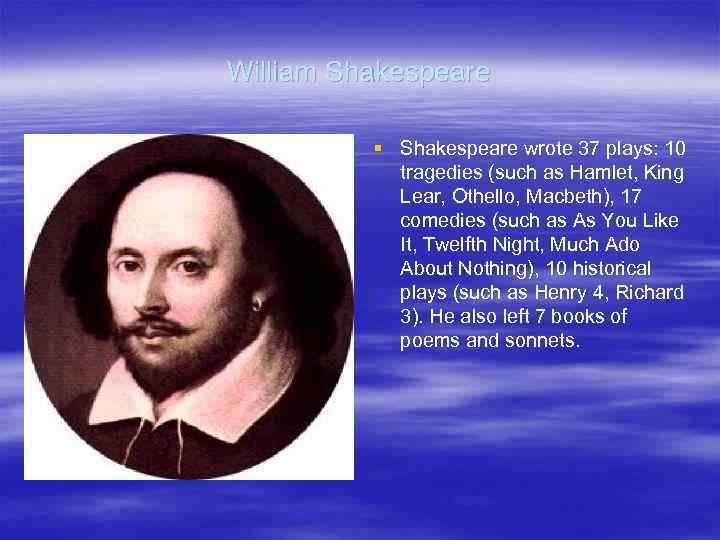
William Shakespeare § Shakespeare wrote 37 plays: 10 tragedies (such as Hamlet, King Lear, Othello, Macbeth), 17 comedies (such as As You Like It, Twelfth Night, Much Ado About Nothing), 10 historical plays (such as Henry 4, Richard 3). He also left 7 books of poems and sonnets.
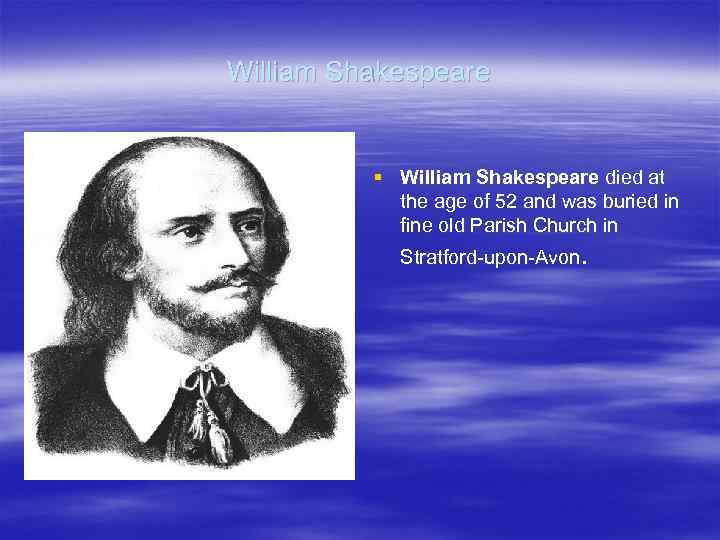
William Shakespeare § William Shakespeare died at the age of 52 and was buried in fine old Parish Church in Stratford-upon-Avon.
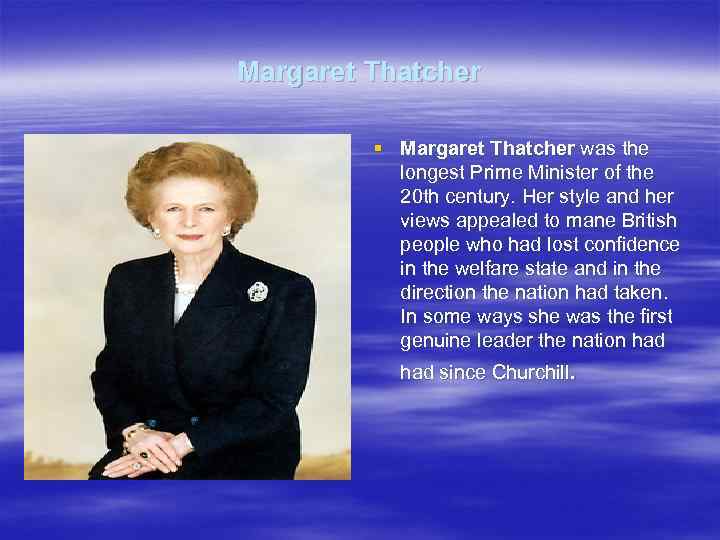
Margaret Thatcher § Margaret Thatcher was the longest Prime Minister of the 20 th century. Her style and her views appealed to mane British people who had lost confidence in the welfare state and in the direction the nation had taken. In some ways she was the first genuine leader the nation had since Churchill.
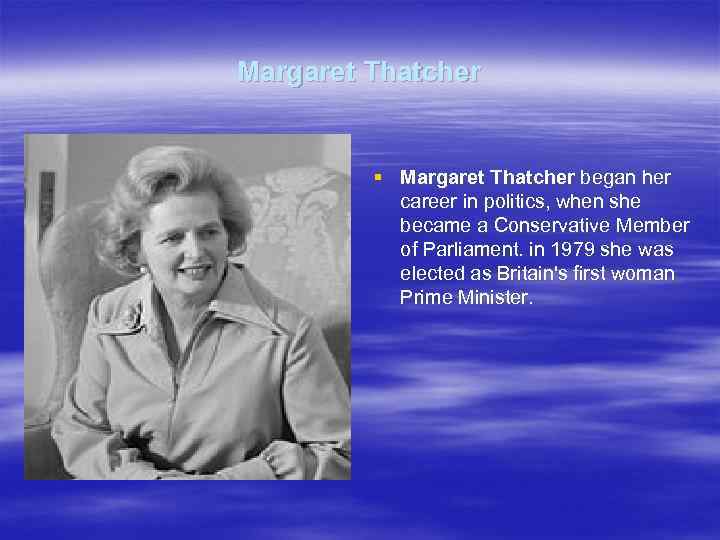
Margaret Thatcher § Margaret Thatcher began her career in politics, when she became a Conservative Member of Parliament. in 1979 she was elected as Britain's first woman Prime Minister.
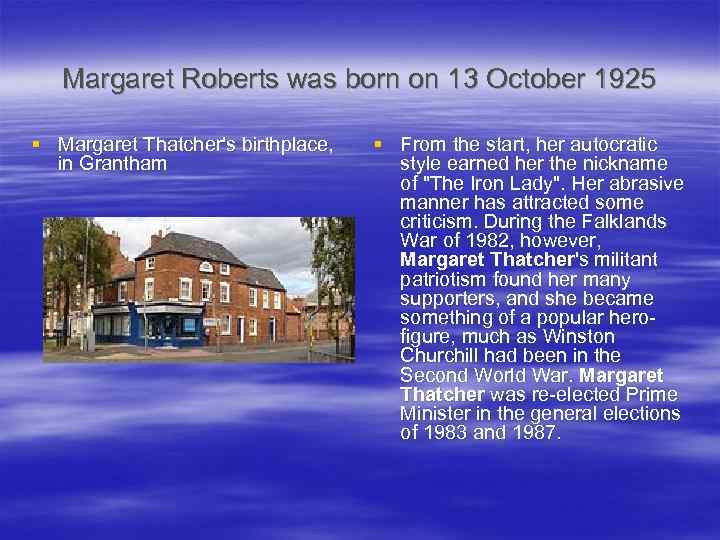
Margaret Roberts was born on 13 October 1925 § Margaret Thatcher's birthplace, in Grantham § From the start, her autocratic style earned her the nickname of "The Iron Lady". Her abrasive manner has attracted some criticism. During the Falklands War of 1982, however, Margaret Thatcher's militant patriotism found her many supporters, and she became something of a popular herofigure, much as Winston Churchill had been in the Second World War. Margaret Thatcher was re-elected Prime Minister in the general elections of 1983 and 1987.
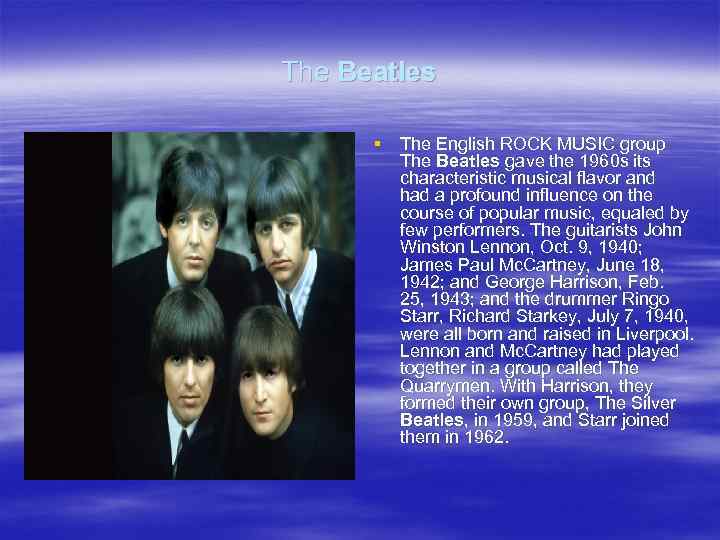
The Beatles § The English ROCK MUSIC group The Beatles gave the 1960 s its characteristic musical flavor and had a profound influence on the course of popular music, equaled by few performers. The guitarists John Winston Lennon, Oct. 9, 1940; James Paul Mc. Cartney, June 18, 1942; and George Harrison, Feb. 25, 1943; and the drummer Ringo Starr, Richard Starkey, July 7, 1940, were all born and raised in Liverpool. Lennon and Mc. Cartney had played together in a group called The Quarrymen. With Harrison, they formed their own group, The Silver Beatles, in 1959, and Starr joined them in 1962.
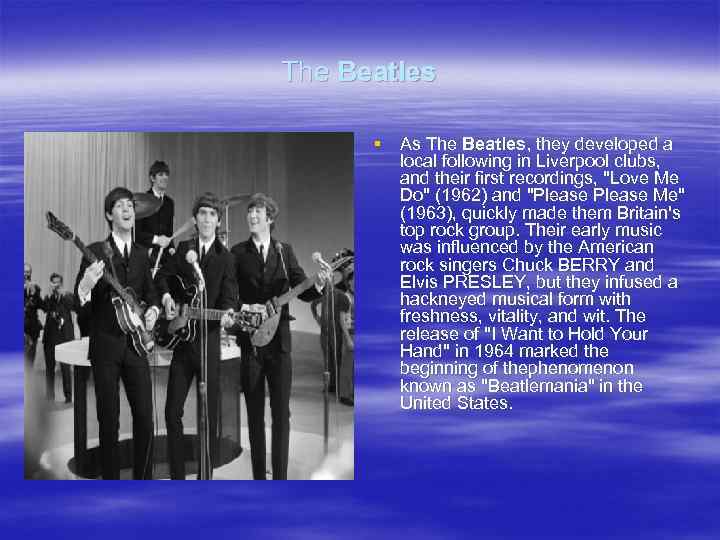
The Beatles § As The Beatles, they developed a local following in Liverpool clubs, and their first recordings, "Love Me Do" (1962) and "Please Me" (1963), quickly made them Britain's top rock group. Their early music was influenced by the American rock singers Chuck BERRY and Elvis PRESLEY, but they infused a hackneyed musical form with freshness, vitality, and wit. The release of "I Want to Hold Your Hand" in 1964 marked the beginning of thephenomenon known as "Beatlemania" in the United States.
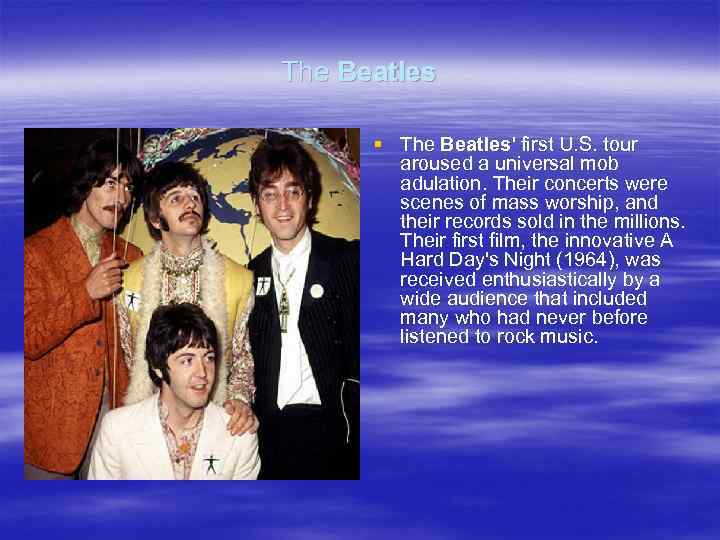
The Beatles § The Beatles' first U. S. tour aroused a universal mob adulation. Their concerts were scenes of mass worship, and their records sold in the millions. Their first film, the innovative A Hard Day's Night (1964), was received enthusiastically by a wide audience that included many who had never before listened to rock music.
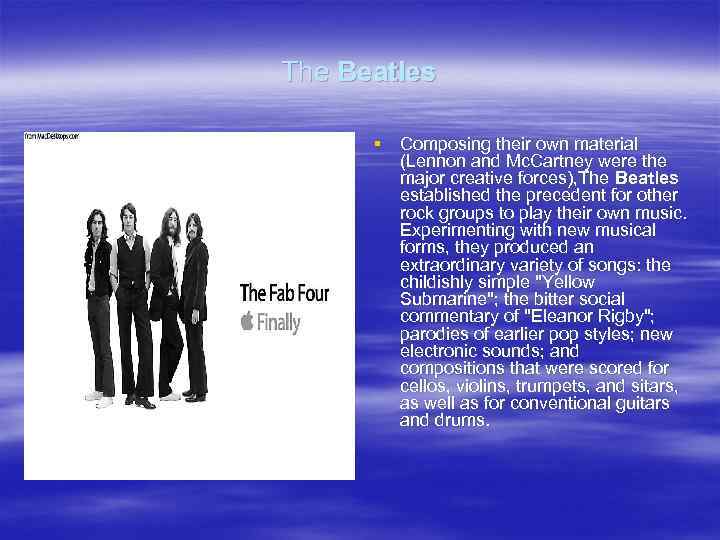
The Beatles § Composing their own material (Lennon and Mc. Cartney were the major creative forces), The Beatles established the precedent for other rock groups to play their own music. Experimenting with new musical forms, they produced an extraordinary variety of songs: the childishly simple "Yellow Submarine"; the bitter social commentary of "Eleanor Rigby"; parodies of earlier pop styles; new electronic sounds; and compositions that were scored for cellos, violins, trumpets, and sitars, as well as for conventional guitars and drums.
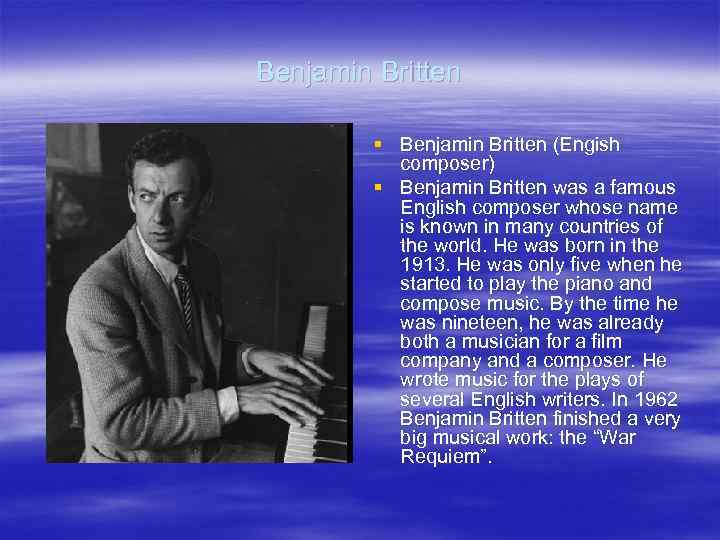
Benjamin Britten § Benjamin Britten (Engish composer) § Benjamin Britten was a famous English composer whose name is known in many countries of the world. He was born in the 1913. He was only five when he started to play the piano and compose music. By the time he was nineteen, he was already both a musician for a film company and a composer. He wrote music for the plays of several English writers. In 1962 Benjamin Britten finished a very big musical work: the “War Requiem”.
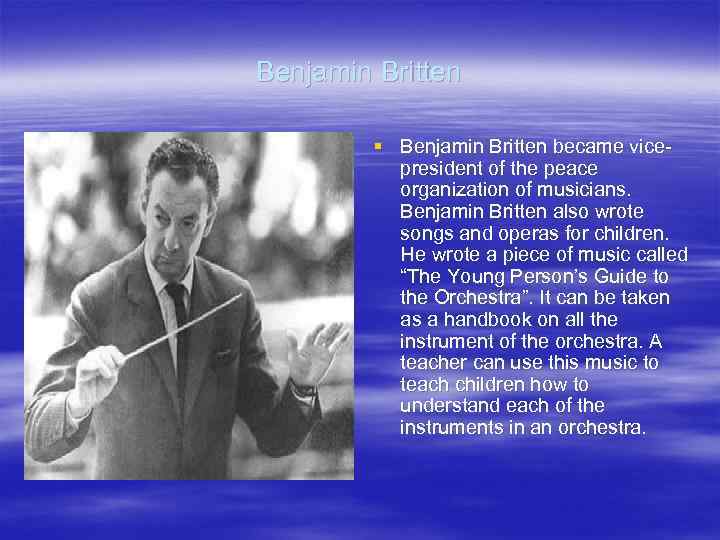
Benjamin Britten § Benjamin Britten became vicepresident of the peace organization of musicians. Benjamin Britten also wrote songs and operas for children. He wrote a piece of music called “The Young Person’s Guide to the Orchestra”. It can be taken as a handbook on all the instrument of the orchestra. A teacher can use this music to teach children how to understand each of the instruments in an orchestra.
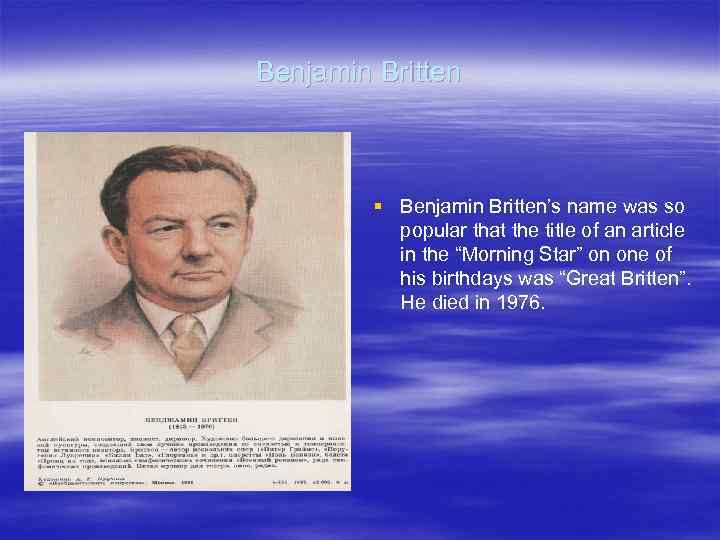
Benjamin Britten § Benjamin Britten’s name was so popular that the title of an article in the “Morning Star” on one of his birthdays was “Great Britten”. He died in 1976.
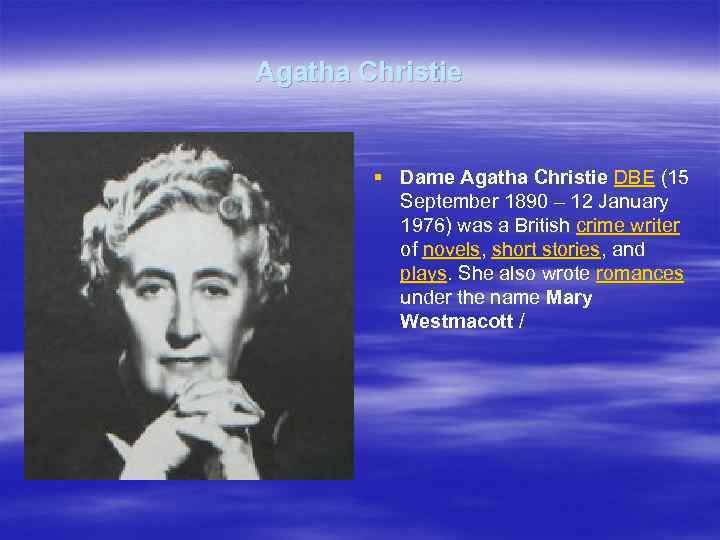
Agatha Christie § Dame Agatha Christie DBE (15 September 1890 – 12 January 1976) was a British crime writer of novels, short stories, and plays. She also wrote romances under the name Mary Westmacott /
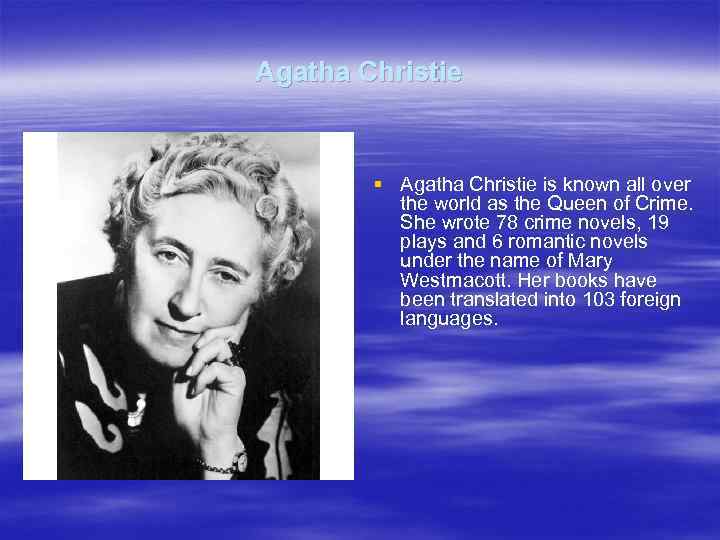
Agatha Christie § Agatha Christie is known all over the world as the Queen of Crime. She wrote 78 crime novels, 19 plays and 6 romantic novels under the name of Mary Westmacott. Her books have been translated into 103 foreign languages.
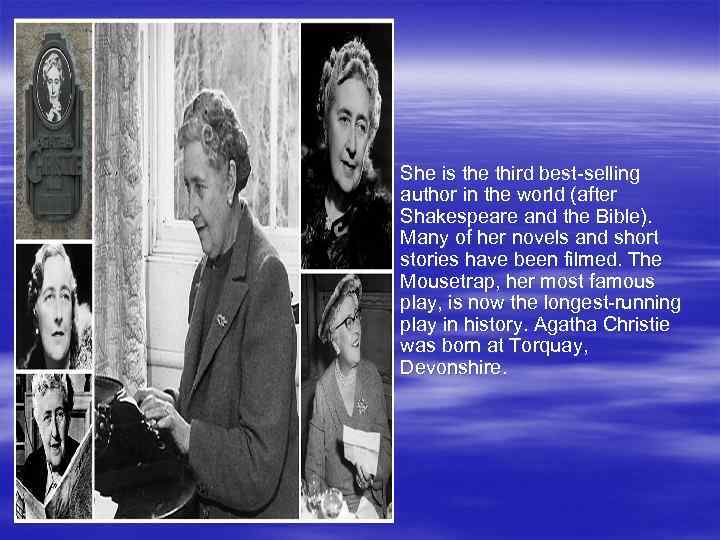
§ She is the third best-selling author in the world (after Shakespeare and the Bible). Many of her novels and short stories have been filmed. The Mousetrap, her most famous play, is now the longest-running play in history. Agatha Christie was born at Torquay, Devonshire.
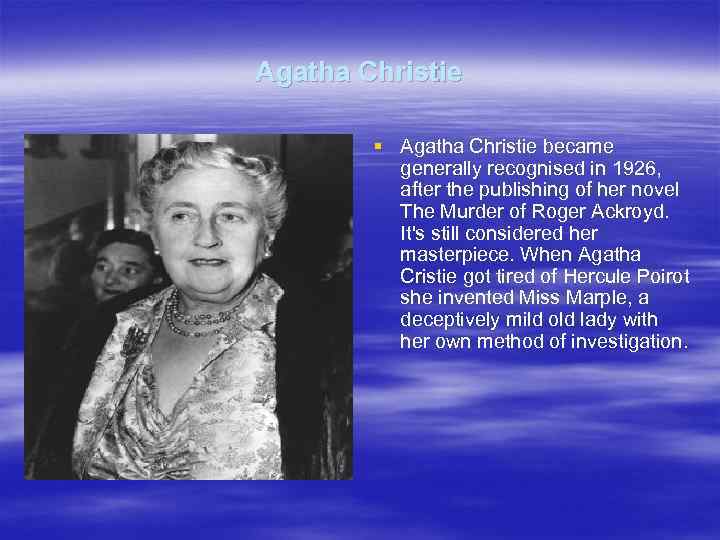
Agatha Christie § Agatha Christie became generally recognised in 1926, after the publishing of her novel The Murder of Roger Ackroyd. It's still considered her masterpiece. When Agatha Cristie got tired of Hercule Poirot she invented Miss Marple, a deceptively mild old lady with her own method of investigation.
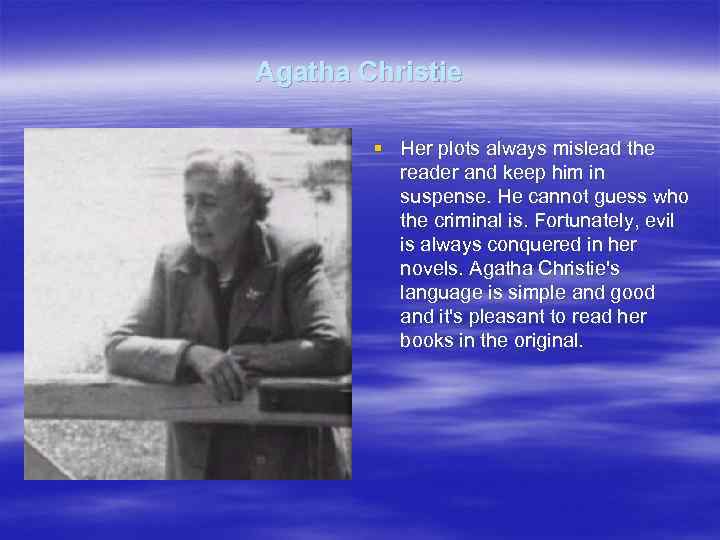
Agatha Christie § Her plots always mislead the reader and keep him in suspense. He cannot guess who the criminal is. Fortunately, evil is always conquered in her novels. Agatha Christie's language is simple and good and it's pleasant to read her books in the original.
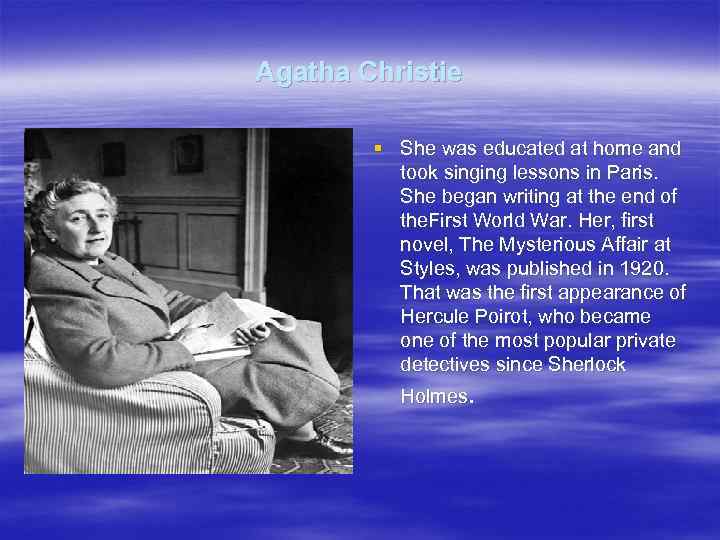
Agatha Christie § She was educated at home and took singing lessons in Paris. She began writing at the end of the. First World War. Her, first novel, The Mysterious Affair at Styles, was published in 1920. That was the first appearance of Hercule Poirot, who became one of the most popular private detectives since Sherlock Holmes.
Скачать презентацию FAMOUS PEOPLE OF GREAT BRITAIN There
3e5b98d50612ede81f1f7e236a57d6b5 (3).ppt