


 Скачать презентацию Falsework Definition Any temporary structure used
afd6e3e83bc78184dfcd983c68d8319e.ppt
- Количество слайдов: 37
 Falsework • Definition • Any temporary structure used to support a permanent structure during its erection until it becomes self supporting • Code of Practice • BS 5975: 1982 Code of Practice for Falsework BSI 1
 Falsework Solutions • Standard Solution • Used for the support of floors and beams where the loading is of normal type in commercial and residential concrete construction and where the height of support is within the range of standard telescopic props 2
 Falsework Solutions • Designed Solutions • All situations where standard solutions deemed as inappropriate require design specific to the circumstance • Competent person to design & supervise 3
 Falsework Solutions • BS 5975 provides all necessary details and information for the design in respect of recommended practices, workmanship, checking and the setting out of individual party responsibilities 4
 Common Types of Falsework • Birdcage Scaffold Falsework (to support soffit form) • Mobile Scaffold Tower (an elevated working platform) 5
 Common Types of Falsework • Table Form (originated in UK), now “Flying Form” (USA term) -soffit & its supporting structure to be struck, re-erected as one unit - combined soffit form and falsework, could be hydraulically operated; - wider leg spacing hence heavier leg load 6
 Considerations for safe erection of falsework • Design considerations • 1. Design of falsework is recommended to follow BS 5975. • 2. Make sure that the falsework has been designed with due regard to: 7
 Considerations for safe erection of falsework • · the type of and extent of loading • · having adequate foundations • · correct choice and use of materials • · having provision for lateral stability 8
 Considerations for safe erection of falsework • Construction considerations 1. Construction of falsework is recommended to follow BS 5975 • 2. Check carefully by competent personnel that the falsework construction follow exactly that shown on the drawings and in the specification produced by the designer prior to loading the falsework. Throughout the loading period a careful watch is kept to identify any distress and take any necessary remedial action. 9
 Considerations for safe erection of falsework • 3. No alteration whatsoever should be made without consultation with and approval of the designer. • 4. Materials to be inspected before use. • 5. Only load-bearing couplers to be used for scaffolding components. 10
 Considerations for safe erection of falsework • 6. he area under sole plates to be compacted well and preferably provided with a rigid concrete foundation. Vertical falsework members to be located centrally. • 7. Use high-tensile pin and never use a makeshift pin at the forkheads. 11
 Considerations for safe erection of falsework • 8. Props not to be bent and erected plumb. • 9. Do not overextend the screw jacks at the top and base of the adjustable props. • 10. Provide adequate horizontal and diagonal bracing elements. • 11. Do not overload the deck (when stocking materials or plants) supported 12 by falsework.
 Considerations for safe erection of falsework • 12. BS 5975 recommends a temporary works coordinator to be appointed: a)to coordinate all falsework activities b)to implement inspection and advise actions, and c) to issue formal permission to strike falsework when the permanent works had attained adequate strength to be self-supporting. 13
 Falsework Design Procedures • Design Standard: • British Standard 5975 (1982). Code of Practice for Falsework • Code of Practice on Wind Effects Hong Kong - 1983 14
 Falsework Design Procedures • Loading • Self-weight - scaffolding, formwork (Check when final arrangement is known) • Imposed Loads - concrete, construction operations • Environmental Loads - wind loading 15
 Falsework Design Procedures . . Teaching_NotesTEMP_WKmultimediaScaffold-Design. jpg 16
 Falsework Design Procedures • Layout of Falsework • Vertical members • Design should meet the overhead formwork requirements • Check capacity of standard tubes (BS 1139) or proprietary metal frame 17
 Falsework Design Procedures • Horizontal members (lacing) • · Increase applied vertical load by 10 • % to allow for the effect of continuity of the primary beam on support reactions. · Increase applied vertical load by 2 % to allow for the vertical loads induced by horizontal loads. 18
 Falsework Design Procedures • · Check the effective length for used/new standard tubes allowed by BS. • · Check the self-weight of scaffold vs the assumed value. 19
 Falsework Design Procedures • Wind Loading • Consider the falsework height, basic wind • • speed, site topography, and other relevant factors. Determine the design wind speed and the dynamic wind pressure. Determine the maximum wind force acting on the whole falsework (formwork + 20 scaffolding) by:
 Falsework Design Procedures • Determine the maximum wind force acting on the whole falsework (formwork + scaffolding) by: a)Establish the wind force diagram. b)Determine the maximum wind force Wm. c)Determine the moment of maximum wind force MWm. 21
 Falsework Design Procedures • Calculate the distribution of applied vertical loads • Determine the horizontal forces. • I. horizontal force equivalent to 2. 5 % of applied vertical loads, the smallest allowable horizontal force Hv (applied at soffit level). Moment MHv 22
 Falsework Design Procedures • II. horizontal force resulting from the erection tolerances, impulsive forces, sloping soffits. . etc. 1. 0 % of applied vertical load Ht (applied at soffit level). Moment MHt • III. wind forces MWm • Use the greater of (I) or (II) or [(II) + (III)]/1. 25 23
 Falsework Design Procedures • Combine applied and induced vertical • • • loads and compare actual and estimated maximum loads on standards/proprietary scaffold frame. Induced vertical loads (VHv, VHt, VWm), applied vertical loads (V) and the combined vertical loads (max. of V=VHv, V+VHt, [V+VHt+VWm]/1. 25 are calculated. Allow 10 % for continuity overload. Check the estimated max. load per standard/scaffold frame. 24
 Falsework Design Procedures • Diagonal bracing • Determine the maximum of HV, Ht, & • • [Ht+Wm]/1. 25 Use the least of (I) coupler capacity (II) safe load of diagonal as a strut. (which depends on the number of fixing at various levels of the scaffolding) Design numbers of traverse diagonal bracing required. 25
 Falsework Design Procedures • Design numbers of longitudinal diagonal bracing required. • Check overall stability of the complete falsework under various combinations of vertical and horizontal loads. Factor of safety (Fo. S) should be at least 1. 2. • Provide kentledge or other form of holding down if the Fo. S is below the minimum requirement. 26
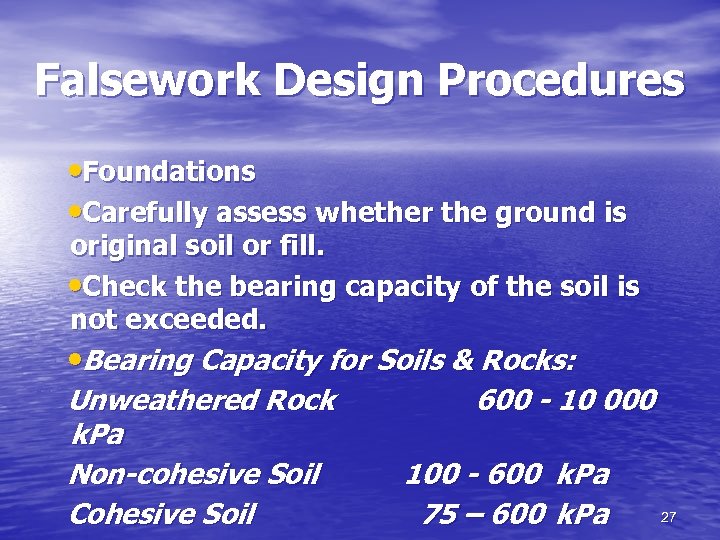 Falsework Design Procedures • Foundations • Carefully assess whether the ground is original soil or fill. • Check the bearing capacity of the soil is not exceeded. • Bearing Capacity for Soils & Rocks: Unweathered Rock k. Pa Non-cohesive Soil Cohesive Soil 600 - 10 000 100 - 600 k. Pa 75 – 600 k. Pa 27
 Checklist for Mobile Scaffold Tower. . Teaching_NotesTEMP_WKmultimediaScaffold-Mobile. Tower. jpg 28
 Checklist for Mobile Scaffold Tower • Dimensions • Height between lifts not to exceed standard spacing • Loading • No overloading working platform nor the scaffold structure 29
 Checklist for Mobile Scaffold Tower • Vertical Standards and Joints made with Couplers • Standards must be vertical and stable • Joints to be staggered • Correct fittings used 30
 Checklist for Mobile Scaffold Tower • Bracing Members • tower braced on all sides and in plan at each alternate lift starting at the base lift and also under deck level to keep the structure stable against lateral forces and toppling failure. • Plan brace at base, every alternate lift and under working platform 31
 Checklist for Mobile Scaffold Tower • Ladders • to be lashed top and bottom on each stile, and fixed to the narrow side of the tower so as to provide vertical access by the operatives 32
 Checklist for Mobile Scaffold Tower • Working platforms • close boarded • timber decking in good conditions and evenly • • supported with correct overhang gap for access to the platform closed with swivelling bar. Security of any stacked materials Least base to height ratio external 3: 1, internal 3. 5: 1 Size within base dimension 33
 Checklist for Mobile Scaffold Tower • Guardrails and toeboards • To avoid objects and persons falling from elevation. • Castor Wheels with Safety Locks • ensure they cannot fall off if out of contact with • • • the ground check brakes are fitted and in working conditions castors are greased regularly and rotate freely Foot ties as close to wheels as practicable 34
 Checklist for Birdcage Scaffold • Sole board and foundation condition • Line of standards and ledgers • Line & spacing of transoms • Diagonals in both directions • Ties • Security of boards, toeboards, and guardrails. Maximum gap at wall. 35
 Checklist for Birdcage Scaffold • Security and correct use of couplers and fittings • Condition of tubes & fittings • Even spread of load on platform • Means of access • Overloading • Security of stacked materials 36
 Falsework on Sloping Ground • . . Teaching_NotesTEMP_WKmultimediaSoffit Form Sloping Details 003. jpg 37