


 Скачать презентацию False-Name-Proof Mechanisms for hiring a team Mahyar Salek
80c4f11d2fb4ca1d832172b28a62e98f.ppt
- Количество слайдов: 28
 False-Name-Proof Mechanisms for hiring a team Mahyar Salek Joint work with Atsushi Iwasaki, David Kempe, Yasumasa Saito and Makoto Yokoo CS/SS 241 a presentation California Institute of Technology 1
 Problem n n n Hire a team to perform a task Each agent incurs a cost by performing her sub-task Know which teams are capable of performing the task n n n Feasible Sets Don’t know how much cost a member of a team (an Agent) incurs to get her sub-task done Agents are selfish and opportunistic. Might lie about the required cost! n Mechanism Design 2
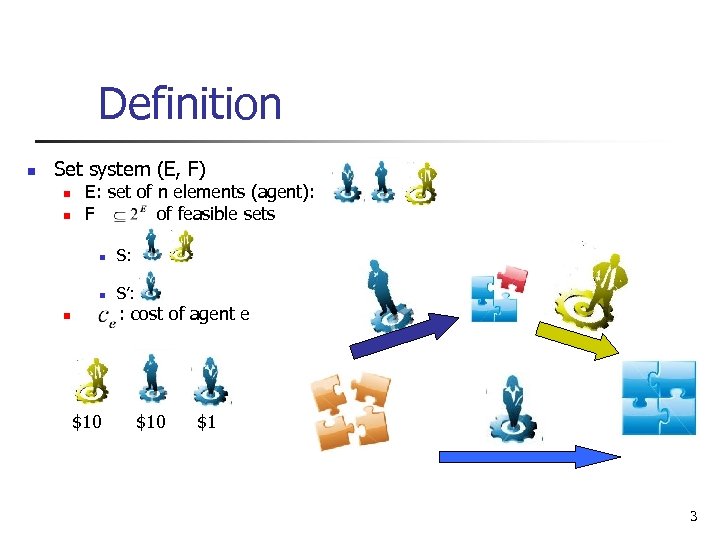 Definition n Set system (E, F) n n E: set of n elements (agent): F of feasible sets n S: n S’: : cost of agent e n $10 $1 3
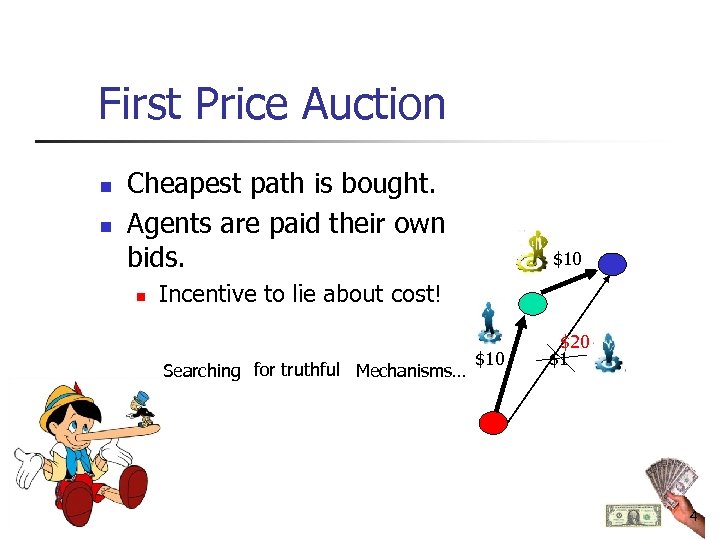 First Price Auction n n Cheapest path is bought. Agents are paid their own bids. n $10 Incentive to lie about cost! Searching for truthful Mechanisms… $10 $20 $1 4
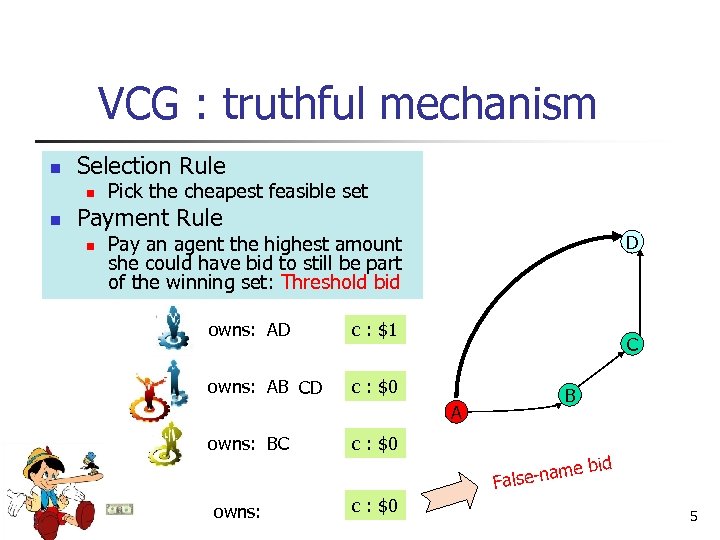 VCG : truthful mechanism n Selection Rule n n Pick the cheapest feasible set Payment Rule n D Pay an agent the highest amount she could have bid to still be part of the winning set: Threshold bid owns: AD c : $1 owns: AB CD c : $0 C A owns: BC owns: c : $0 B bid e-name Fals 5
![False-name manipulations [Yokoo, Sakurai, Matsubara-00] Self Division Identifier Splitting 1, b 2, b 0,](https://present5.com/presentation/80c4f11d2fb4ca1d832172b28a62e98f/image-6.jpg "False-name manipulations [Yokoo, Sakurai, Matsubara-00] Self Division Identifier Splitting 1, b 2, b 0,") False-name manipulations [Yokoo, Sakurai, Matsubara-00] Self Division Identifier Splitting 1, b 2, b 0, a 1, a Auctioneer uncertain about the graph structure 1, b 0, a 2, b 0, a’ 2, a’’ False-name-proof mechanisms : Agents’ best interest to reveal true ownership and cost 6
False-name manipulations [Yokoo, Sakurai, Matsubara-00] Self Division Identifier Splitting 1, b 2, b 0, a 1, a Auctioneer uncertain about the graph structure 1, b 0, a 2, b 0, a’ 2, a’’ False-name-proof mechanisms : Agents’ best interest to reveal true ownership and cost 6
 Impossibility Result n There is no false-name proof mechanism for hiring a team that is individually rational and Pareto efficient. [Du, Sami, Shi 06, YSM 00] n A winning path selection is Pareto-Efficient if the mechanism selects a path with minimum cost. 7
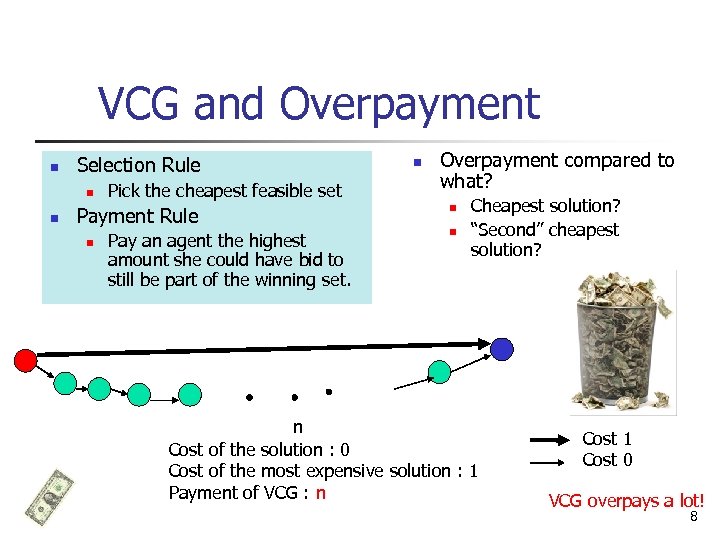 VCG and Overpayment n Selection Rule n n Pick the cheapest feasible set Payment Rule n Pay an agent the highest amount she could have bid to still be part of the winning set. n Overpayment compared to what? n n Cheapest solution? “Second” cheapest solution? n Cost of the solution : 0 Cost of the most expensive solution : 1 Payment of VCG : n Cost 1 Cost 0 VCG overpays a lot! 8
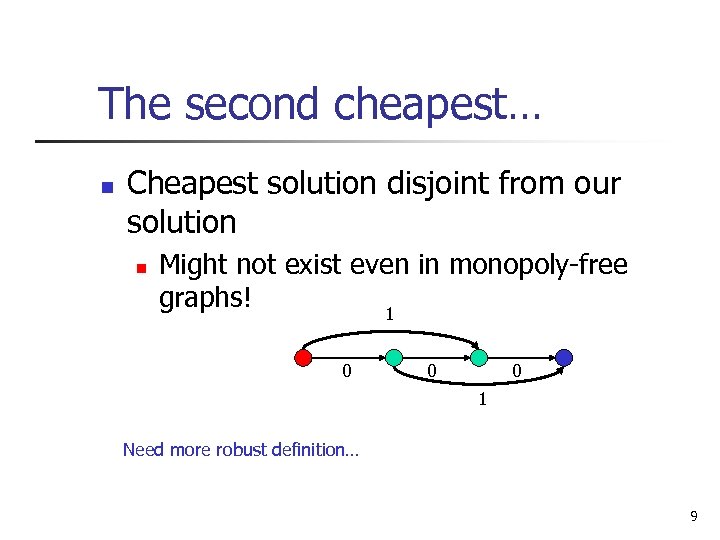 The second cheapest… n Cheapest solution disjoint from our solution n Might not exist even in monopoly-free graphs! 1 0 0 0 1 Need more robust definition… 9
![Frugality Ratio [Karlin et. Al. 05]: Intuition : cheapest total payment in a first](https://present5.com/presentation/80c4f11d2fb4ca1d832172b28a62e98f/image-10.jpg "Frugality Ratio [Karlin et. Al. 05]: Intuition : cheapest total payment in a first") Frugality Ratio [Karlin et. Al. 05]: Intuition : cheapest total payment in a first price auction Let S be cheapest feasible set with respect to cost is value minimizing : Subject to : for all e for all For every there is a such that: and Frugality Ratio : : Total payment of M when the true cost is c 10
Frugality Ratio [Karlin et. Al. 05]: Intuition : cheapest total payment in a first price auction Let S be cheapest feasible set with respect to cost is value minimizing : Subject to : for all e for all For every there is a such that: and Frugality Ratio : : Total payment of M when the true cost is c 10
![Previous Work n n [Archer, Tardos 02, ESS 04] For two nodedisjoint s-t paths](https://present5.com/presentation/80c4f11d2fb4ca1d832172b28a62e98f/image-11.jpg "Previous Work n n [Archer, Tardos 02, ESS 04] For two nodedisjoint s-t paths") Previous Work n n [Archer, Tardos 02, ESS 04] For two nodedisjoint s-t paths of length n/2 each, no truthful mechanism with [Karlin, Kempe, Tamir 05] introduce mechanism, within constant factor of best frugality ratio n Idea : Penalize paths with many edges 11
Previous Work n n [Archer, Tardos 02, ESS 04] For two nodedisjoint s-t paths of length n/2 each, no truthful mechanism with [Karlin, Kempe, Tamir 05] introduce mechanism, within constant factor of best frugality ratio n Idea : Penalize paths with many edges 11
 Finding frugal false-nameproof mechanisms for hiring a team 12
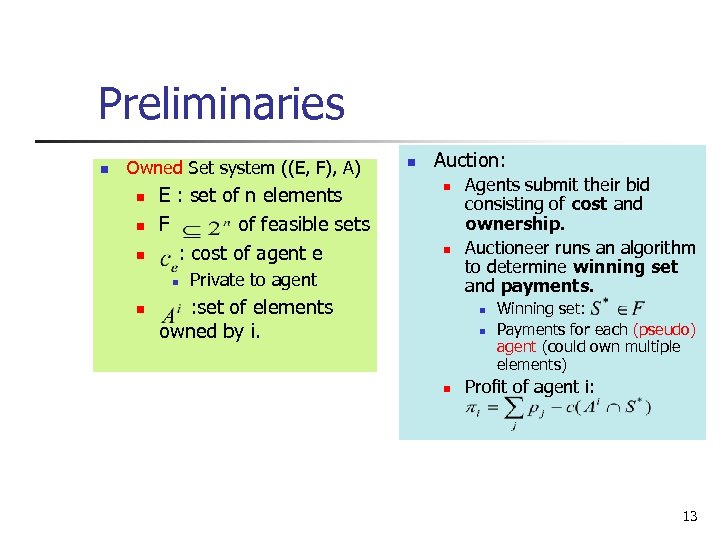 Preliminaries n Owned Set system ((E, F), A) n n n E : set of n elements F of feasible sets : cost of agent e n n n Auction: n n Private to agent : set of elements owned by i. Agents submit their bid consisting of cost and ownership. Auctioneer runs an algorithm to determine winning set and payments. n n n Winning set: Payments for each (pseudo) agent (could own multiple elements) Profit of agent i: 13
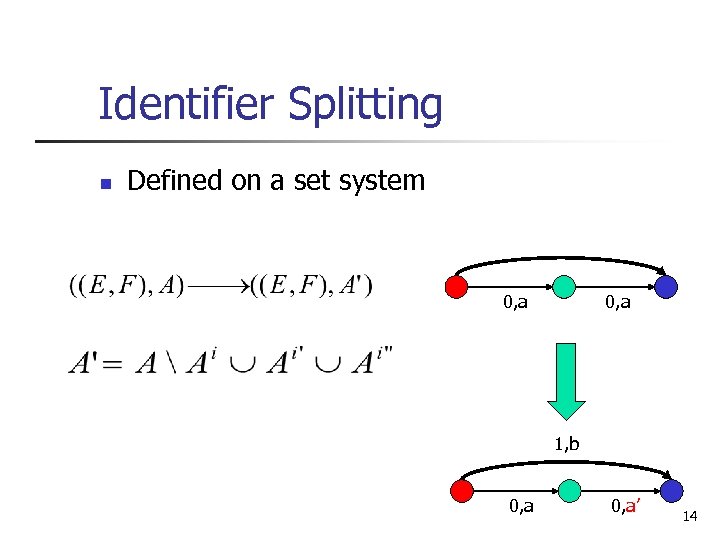 Identifier Splitting n Defined on a set system 0, a 1, b 0, a’ 14
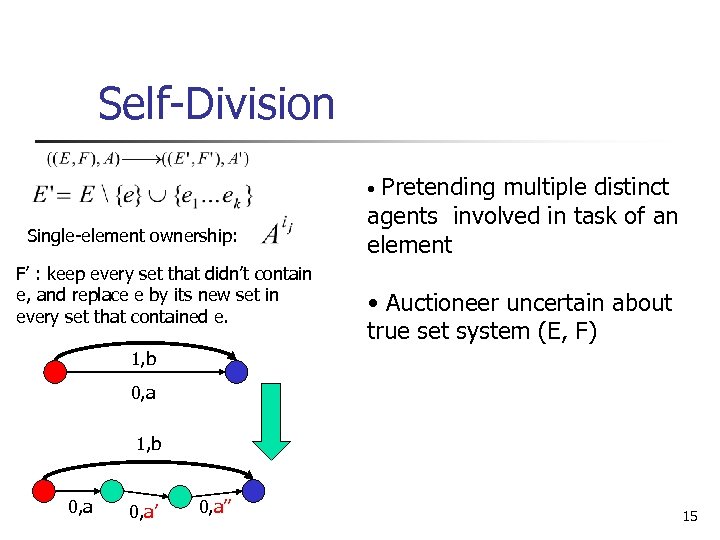 Self-Division Pretending multiple distinct agents involved in task of an element • Single-element ownership: F’ : keep every set that didn’t contain e, and replace e by its new set in every set that contained e. • Auctioneer uncertain about true set system (E, F) 1, b 0, a’’ 15
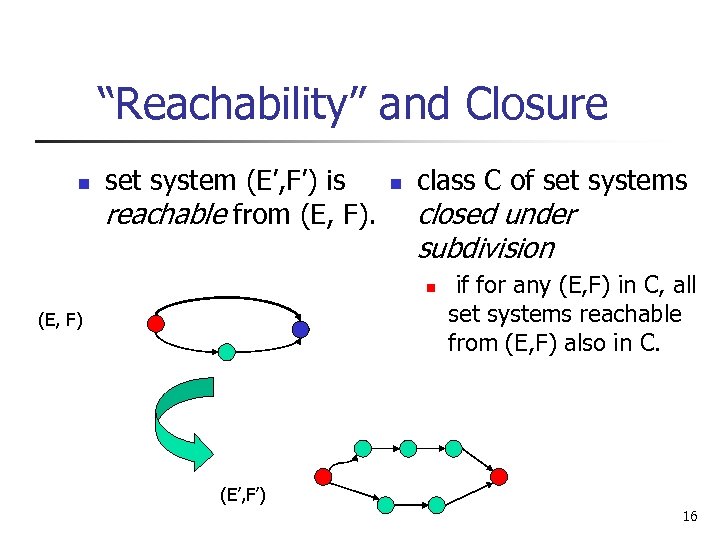 “Reachability” and Closure n set system (E’, F’) is reachable from (E, F). n class C of set systems closed under subdivision n (E, F) if for any (E, F) in C, all set systems reachable from (E, F) also in C. (E’, F’) 16
 The Multiplicative Penalty (MP) Mechanism n Assumption: n Each agent only owns one element n n Identify elements with agents Idea: n Penalize long paths n n Agents lose interest to subdivide Lose efficiency (honest economic long paths might not be winning anymore) 17
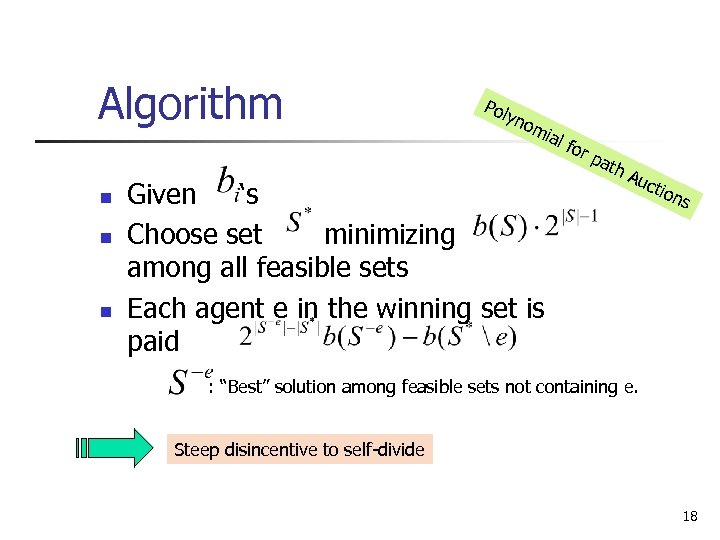 Algorithm n n n Pol yno mia Given ‘s Choose set minimizing among all feasible sets Each agent e in the winning set is paid l fo rp ath Au ctio ns : “Best” solution among feasible sets not containing e. Steep disincentive to self-divide 18
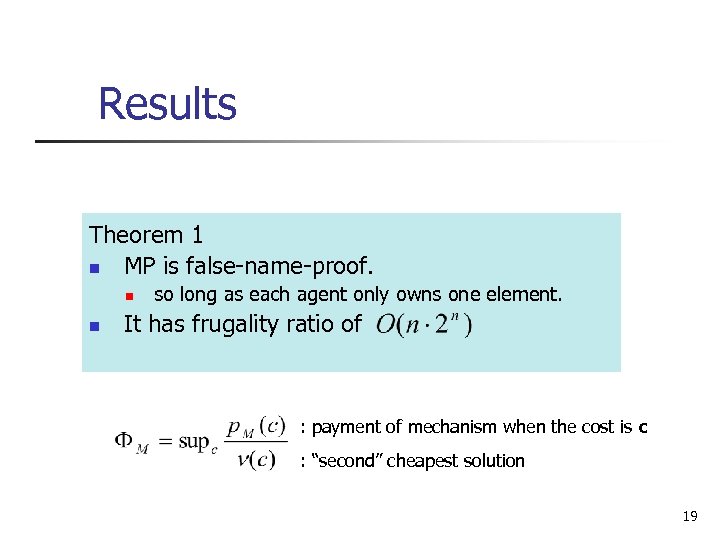 Results Theorem 1 n MP is false-name-proof. n n so long as each agent only owns one element. It has frugality ratio of : payment of mechanism when the cost is c : “second” cheapest solution 19
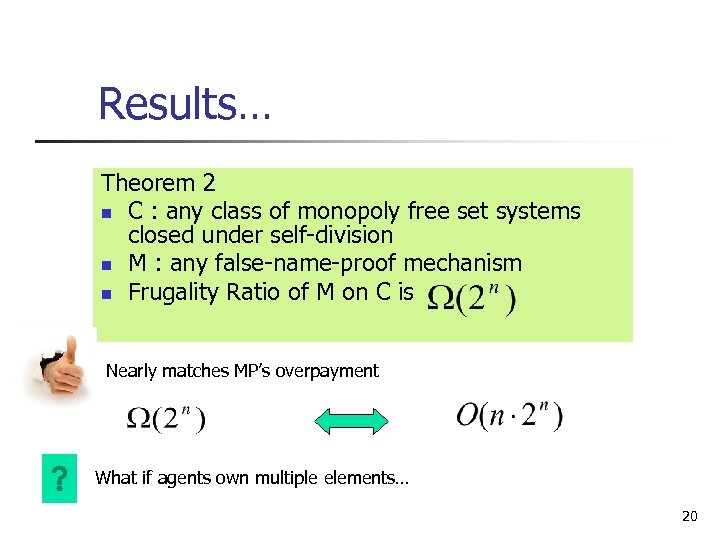 Results… Theorem 2 n C : any class of monopoly free set systems closed under self-division n M : any false-name-proof mechanism n Frugality Ratio of M on C is Nearly matches MP’s overpayment What if agents own multiple elements… 20
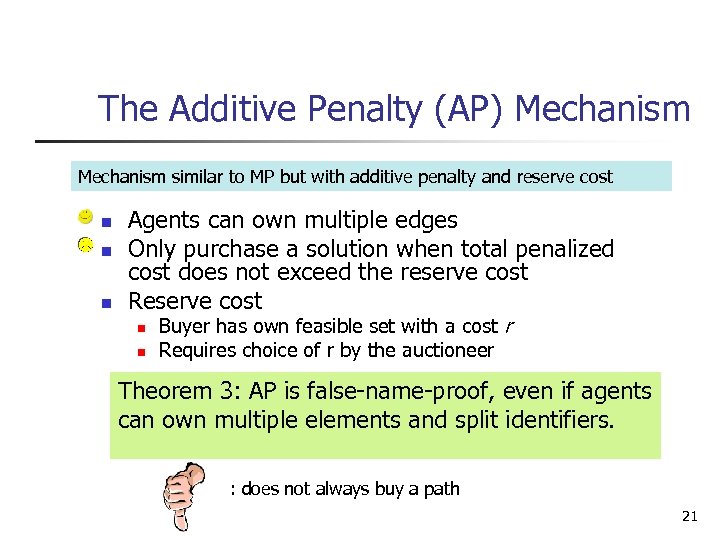 The Additive Penalty (AP) Mechanism similar to MP but with additive penalty and reserve cost n n n Agents can own multiple edges Only purchase a solution when total penalized cost does not exceed the reserve cost Reserve cost n n Buyer has own feasible set with a cost r Requires choice of r by the auctioneer Theorem 3: AP is false-name-proof, even if agents can own multiple elements and split identifiers. : does not always buy a path 21
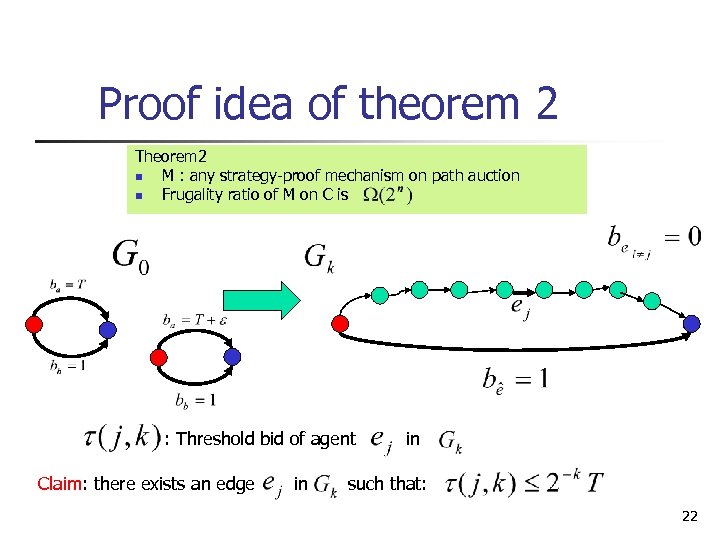 Proof idea of theorem 2 Theorem 2 n M : any strategy-proof mechanism on path auction n Frugality ratio of M on C is : Threshold bid of agent Claim: there exists an edge in in such that: 22
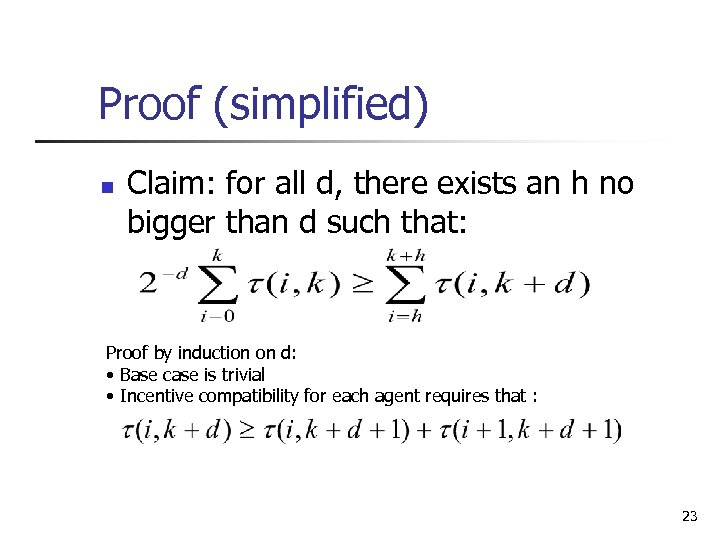 Proof (simplified) n Claim: for all d, there exists an h no bigger than d such that: Proof by induction on d: • Base case is trivial • Incentive compatibility for each agent requires that : 23
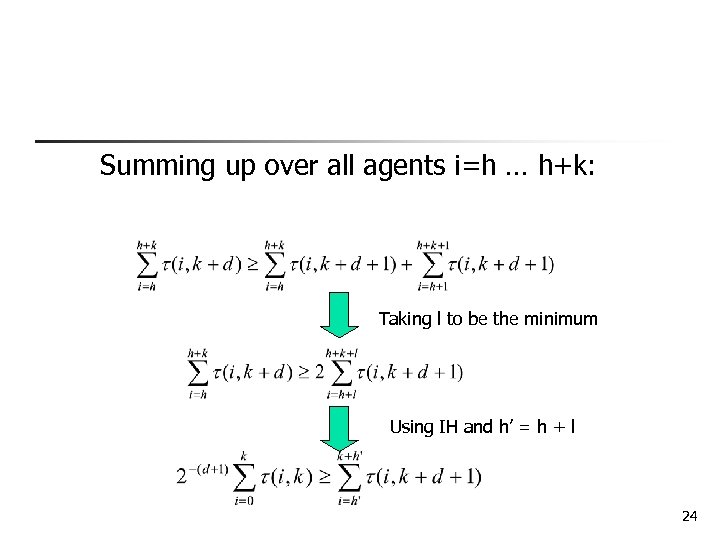 Summing up over all agents i=h … h+k: Taking l to be the minimum Using IH and h’ = h + l 24
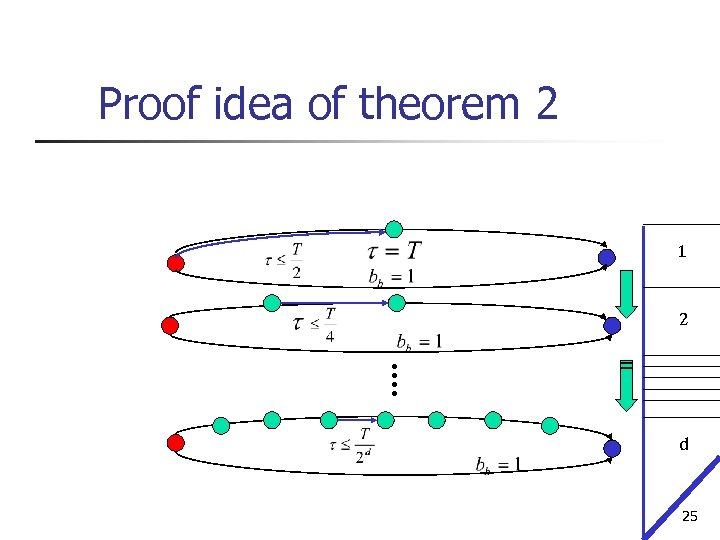 Proof idea of theorem 2 1 2 d 25
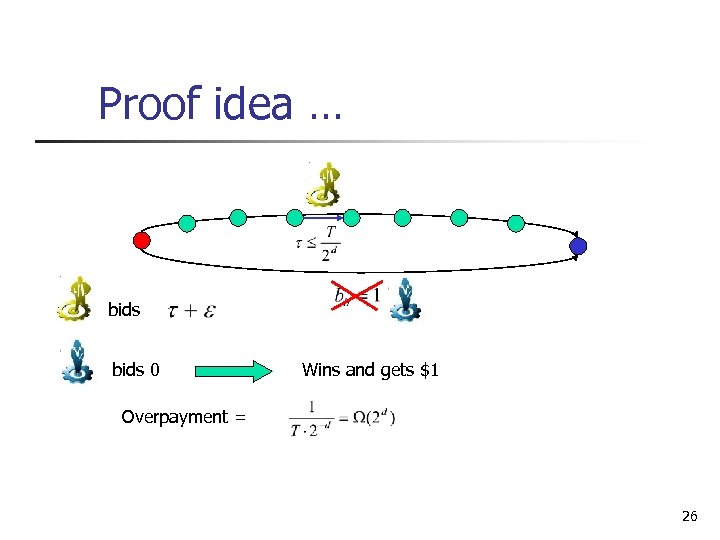 Proof idea … bids 0 Wins and gets $1 Overpayment = 26
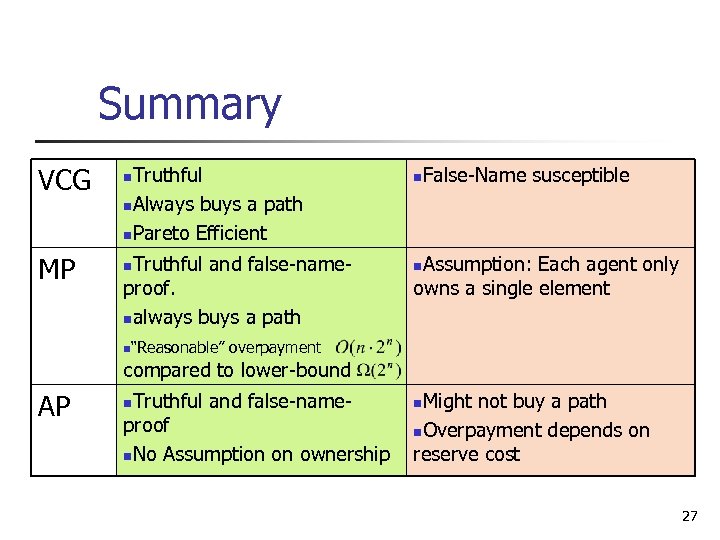 Summary VCG n MP n Truthful n. Always buys a path n. Pareto Efficient Truthful and false-nameproof. nalways buys a path n“Reasonable” n False-Name susceptible Assumption: Each agent only owns a single element n overpayment compared to lower-bound AP Truthful and false-nameproof n. No Assumption on ownership n Might not buy a path n. Overpayment depends on reserve cost n 27
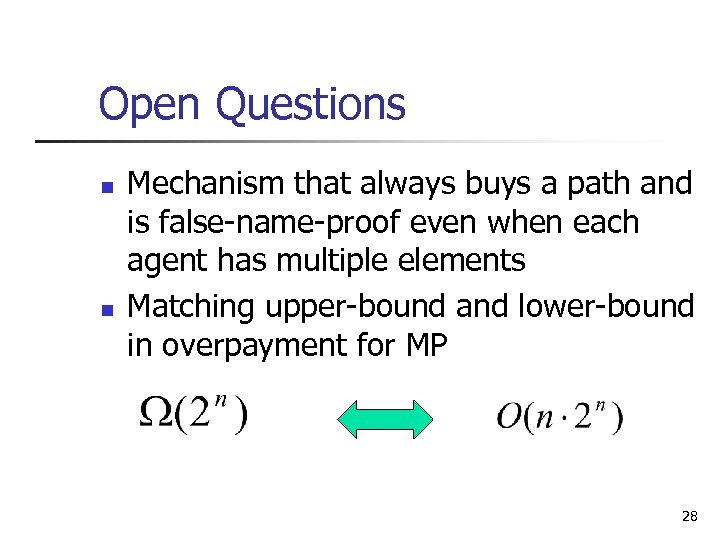 Open Questions n n Mechanism that always buys a path and is false-name-proof even when each agent has multiple elements Matching upper-bound and lower-bound in overpayment for MP 28