 Скачать презентацию Falls Sara Bradley and Christine Chang MD Brookdale
065e1241f4e29f71619567773b2fd46e.ppt
- Количество слайдов: 41



Falls Sara Bradley and Christine Chang, MD Brookdale Dept of Geriatrics and Adult Development March 4. 2008 10: 00 -10: 40
Objectives By the conclusion, learner will be able to: 1. List 5 potentially modifiable risk factors for falls in older community dwelling adults. 2. Conduct a physical exam specific to falls, including a gait assessment. 3. Discuss 5 evidenced-based interventions that can reduce future falls.
Falls Definition: Unintentional change in position, coming to rest at a lower position Not due to an overwhelming intrinsic or environmental cause No loss of consciousness
Epidemiology of Falls • 30% of ambulatory + 50% institutionalized elderly fall each yr 1, 2 • ½ falls result in injury (10 -15% in fractures)3 • ¼ of all fallers limit their activities and lifestyle due to fear of falling 4 1. Tinetti, ME et al. NEJM 1988; 319: 1701. 2. Thapa, PB, et al. JAGS 1996; 44: 273. 3. Nevitt, MC, et al. J Gerontol 1991; 46: M 164. 4. Tinetti, ME et al. J of Gerontol A bio Sci Med Sci 1998; 53: M 112
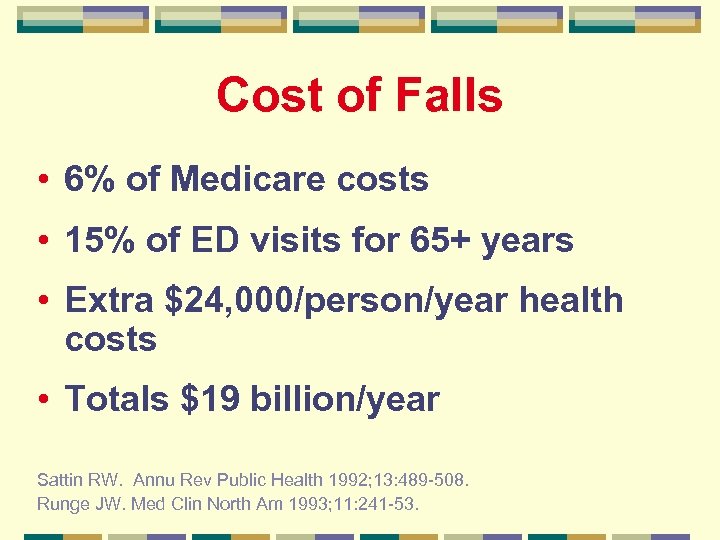
Cost of Falls • 6% of Medicare costs • 15% of ED visits for 65+ years • Extra $24, 000/person/year health costs • Totals $19 billion/year Sattin RW. Annu Rev Public Health 1992; 13: 489 -508. Runge JW. Med Clin North Am 1993; 11: 241 -53.
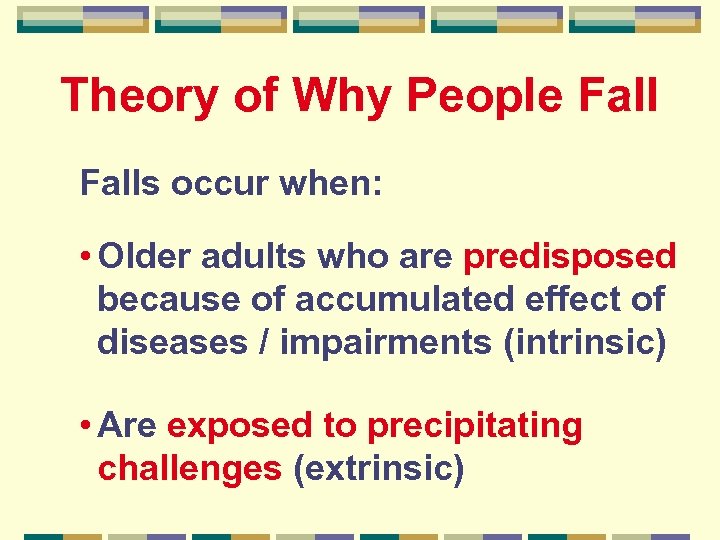
Theory of Why People Falls occur when: • Older adults who are predisposed because of accumulated effect of diseases / impairments (intrinsic) • Are exposed to precipitating challenges (extrinsic)
Case Part 1
Question What questions do you want to ask Sally Johnson about the fall?
Evaluation of Falls: History • Describe fall • Ask questions to R/O syncope • Use systematic method to look into etiology of falls
Details of the Fall 1. Sally Johnson lives alone in her 2 story house 2. Patient fell 2 days earlier while rushing to answer the phone as she was putting away the groceries 3. Felt unsteady just prior to the fall as she tripped on kitchen mat. Was wearing shoes. Adequate lighting. Was able to get up right way. Uses no assistive walking devices at baseline 4. Reports new left arm pain immediately after the fall. Scattered bruising and swelling of Left forearm. Warm compresses and Tylenol prn has been helping
Details of the Fall • No Head trauma, LOC, syncope or presyncope, vertigo, visual changes, bowel or bladder incontinence, eating and drinking as usual, no medication changes. • Prior fall was 1 year ago while rushing down the stairs. No injury was incurred. • Had many near falls while running barefooted on waxed, wooden floors.
Details of Chronic Diseases: DM with peripheral neuropathy • Has had no hypoglycemic episodes • BS running around 120 -180’s • Last hb. A 1 c=7% • Last eye exam was 1 year ago. No retinopathy but does wear bifocals HTN has been well-controlled recently Atrial fibrillation has had no sxs. INR was 2. 1 a week ago
Details of Chronic Diseases: R hip OA • Has R hip ache with overexertion and with cold, rainy weather • Heating pad and Tylenol prn has been helpful Depression + insomnia • Controlled with use of citalopram 10 mg and zolpidem 10 mg nightly • Does not drink alcohol
Case Part 2
Question Are there any other physical exam maneuvers you would want to perform on Sally Johnson?
Evaluation of Falls: Physical 1. 2. 3. 4. Check orthostatics Perform a visual exam Evaluate cognition Gait Assessment: Motor + Balance + Coordination
Evaluation of Falls: Physical Motor Assessment: Quad strength: Can rise from chair without using arms
Evaluation of Falls: Physical Balance Assessment: 3 Stances One leg stand
Evaluation of Falls: Physical Coordination Assessment: Abnormal if: Hesitant start Broad-based gait Path deviates Heels do not clear toes of other foot Extended arms
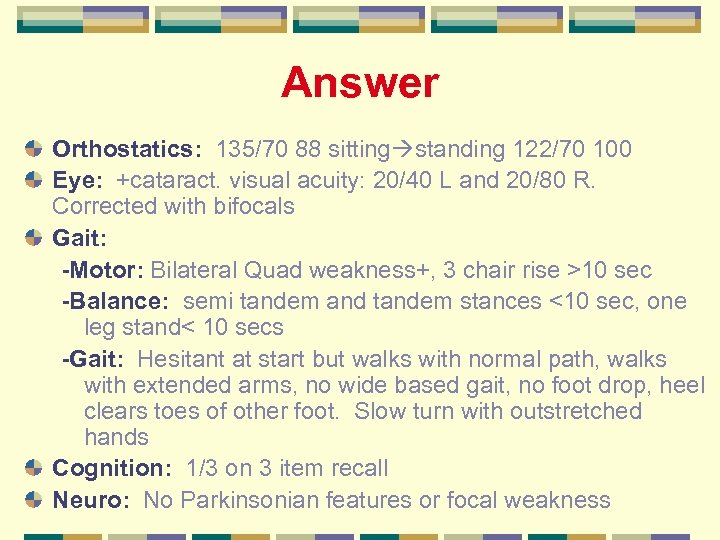
Answer Orthostatics: 135/70 88 sitting standing 122/70 100 Eye: +cataract. visual acuity: 20/40 L and 20/80 R. Corrected with bifocals Gait: -Motor: Bilateral Quad weakness+, 3 chair rise >10 sec -Balance: semi tandem and tandem stances <10 sec, one leg stand< 10 secs -Gait: Hesitant at start but walks with normal path, walks with extended arms, no wide based gait, no foot drop, heel clears toes of other foot. Slow turn with outstretched hands Cognition: 1/3 on 3 item recall Neuro: No Parkinsonian features or focal weakness
Question What are the possible predisposing ‘intrinsic’ risk factors and ‘extrinsic’ precipitants of Sally Johnson’s fall?
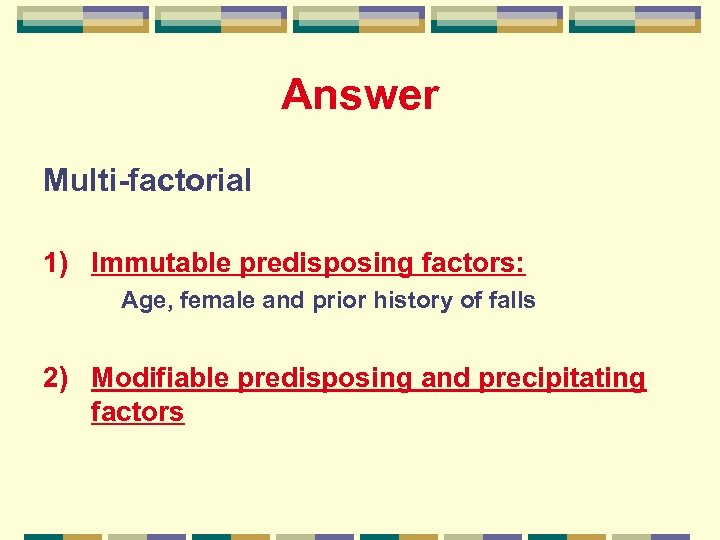
Answer Multi-factorial 1) Immutable predisposing factors: Age, female and prior history of falls 2) Modifiable predisposing and precipitating factors
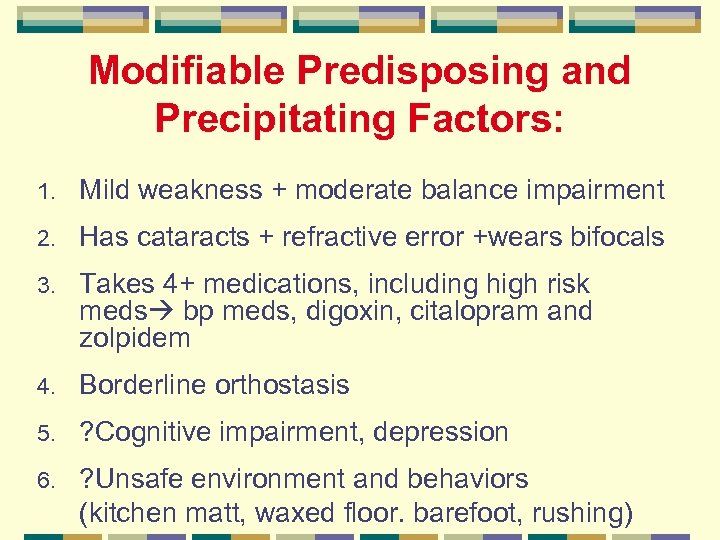
Modifiable Predisposing and Precipitating Factors: 1. Mild weakness + moderate balance impairment 2. Has cataracts + refractive error +wears bifocals 3. Takes 4+ medications, including high risk meds bp meds, digoxin, citalopram and zolpidem 4. Borderline orthostasis 5. ? Cognitive impairment, depression 6. ? Unsafe environment and behaviors (kitchen matt, waxed floor. barefoot, rushing)
Question What evidenced-based interventions can you recommend to prevent future falls for this patient?
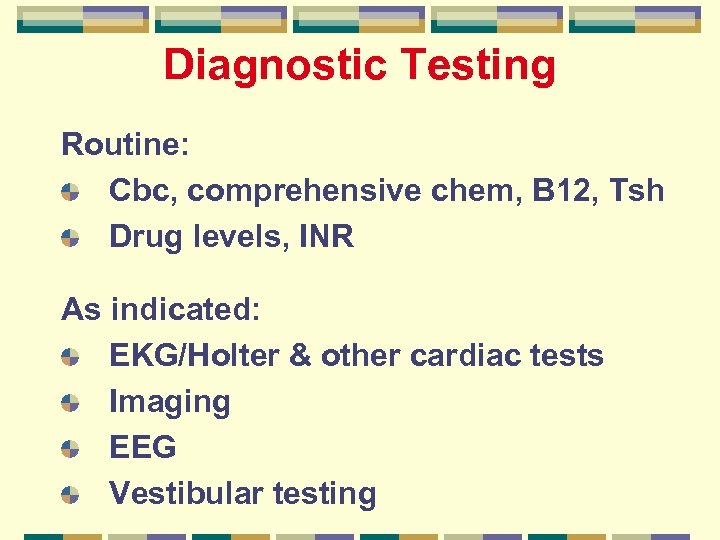
Diagnostic Testing Routine: Cbc, comprehensive chem, B 12, Tsh Drug levels, INR As indicated: EKG/Holter & other cardiac tests Imaging EEG Vestibular testing
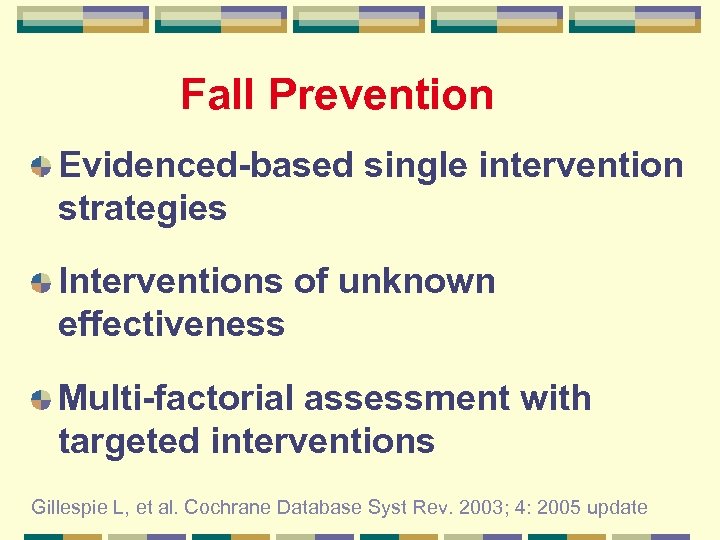
Fall Prevention Evidenced-based single intervention strategies Interventions of unknown effectiveness Multi-factorial assessment with targeted interventions Gillespie L, et al. Cochrane Database Syst Rev. 2003; 4: 2005 update
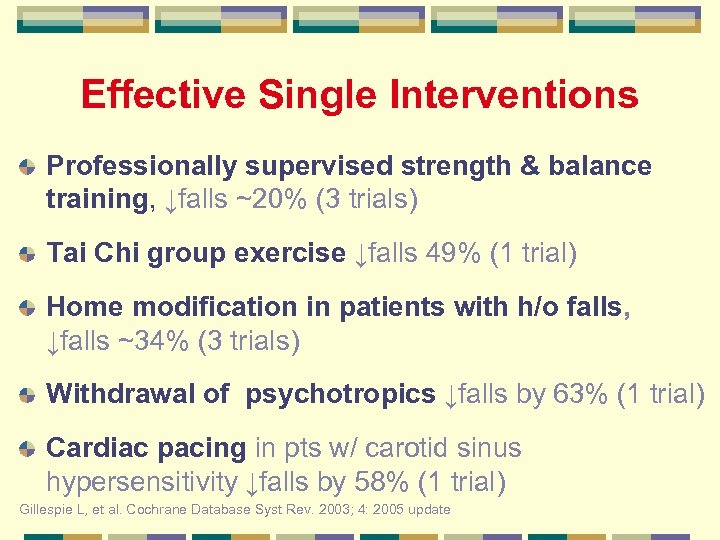
Effective Single Interventions Professionally supervised strength & balance training, ↓falls ~20% (3 trials) Tai Chi group exercise ↓falls 49% (1 trial) Home modification in patients with h/o falls, ↓falls ~34% (3 trials) Withdrawal of psychotropics ↓falls by 63% (1 trial) Cardiac pacing in pts w/ carotid sinus hypersensitivity ↓falls by 58% (1 trial) Gillespie L, et al. Cochrane Database Syst Rev. 2003; 4: 2005 update
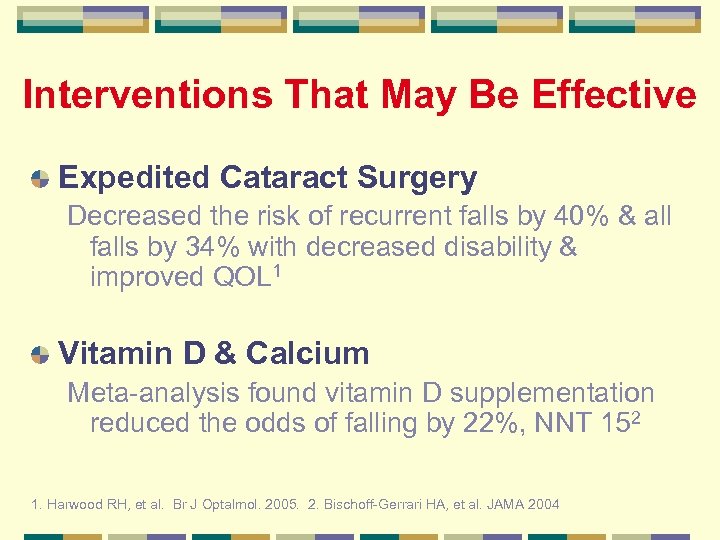
Interventions That May Be Effective Expedited Cataract Surgery Decreased the risk of recurrent falls by 40% & all falls by 34% with decreased disability & improved QOL 1 Vitamin D & Calcium Meta-analysis found vitamin D supplementation reduced the odds of falling by 22%, NNT 152 1. Harwood RH, et al. Br J Optalmol. 2005. 2. Bischoff-Gerrari HA, et al. JAMA 2004
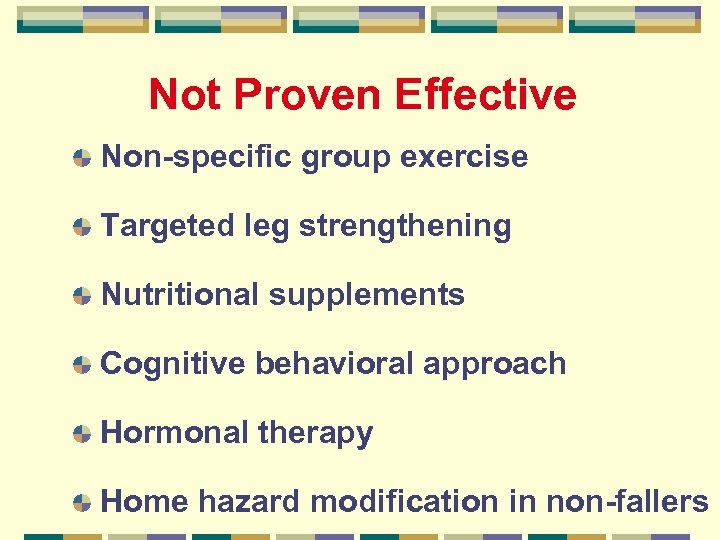
Not Proven Effective Non-specific group exercise Targeted leg strengthening Nutritional supplements Cognitive behavioral approach Hormonal therapy Home hazard modification in non-fallers
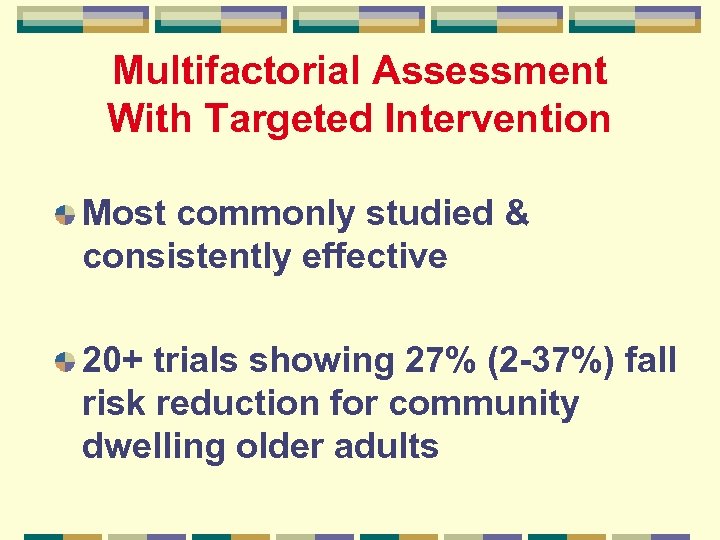
Multifactorial Assessment With Targeted Intervention Most commonly studied & consistently effective 20+ trials showing 27% (2 -37%) fall risk reduction for community dwelling older adults
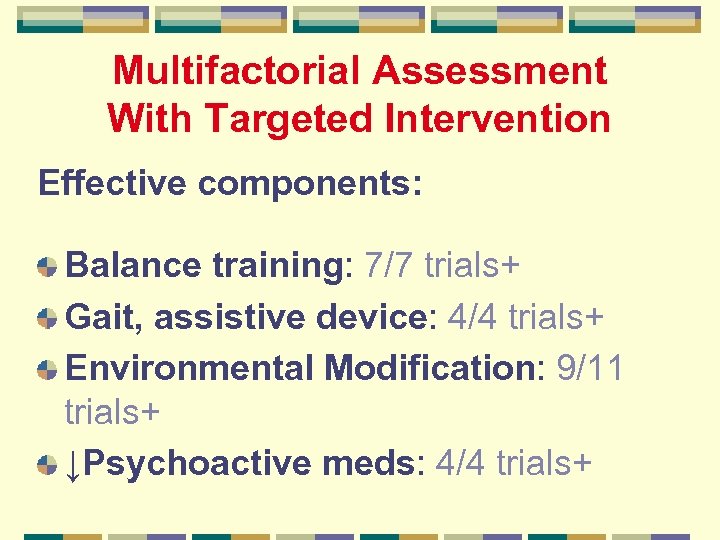
Multifactorial Assessment With Targeted Intervention Effective components: Balance training: 7/7 trials+ Gait, assistive device: 4/4 trials+ Environmental Modification: 9/11 trials+ ↓Psychoactive meds: 4/4 trials+
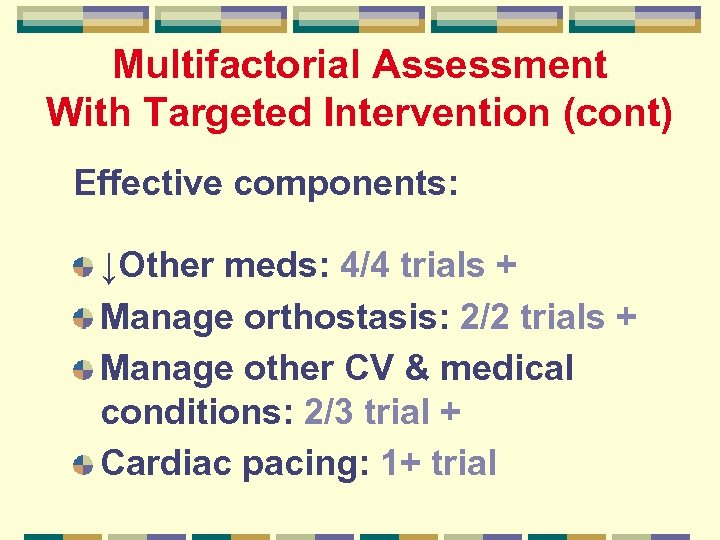
Multifactorial Assessment With Targeted Intervention (cont) Effective components: ↓Other meds: 4/4 trials + Manage orthostasis: 2/2 trials + Manage other CV & medical conditions: 2/3 trial + Cardiac pacing: 1+ trial
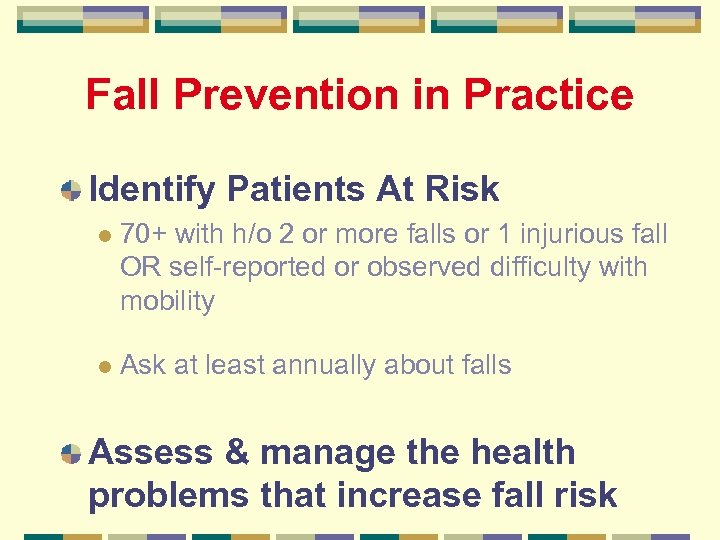
Fall Prevention in Practice Identify Patients At Risk l 70+ with h/o 2 or more falls or 1 injurious fall OR self-reported or observed difficulty with mobility l Ask at least annually about falls Assess & manage the health problems that increase fall risk
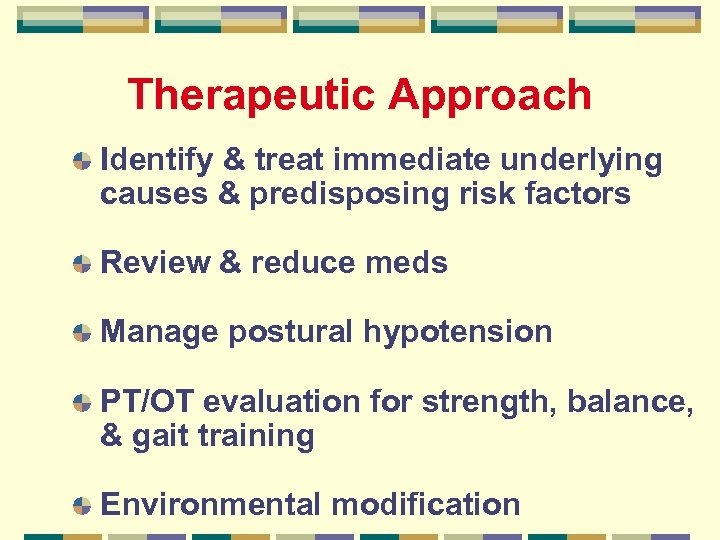
Therapeutic Approach Identify & treat immediate underlying causes & predisposing risk factors Review & reduce meds Manage postural hypotension PT/OT evaluation for strength, balance, & gait training Environmental modification
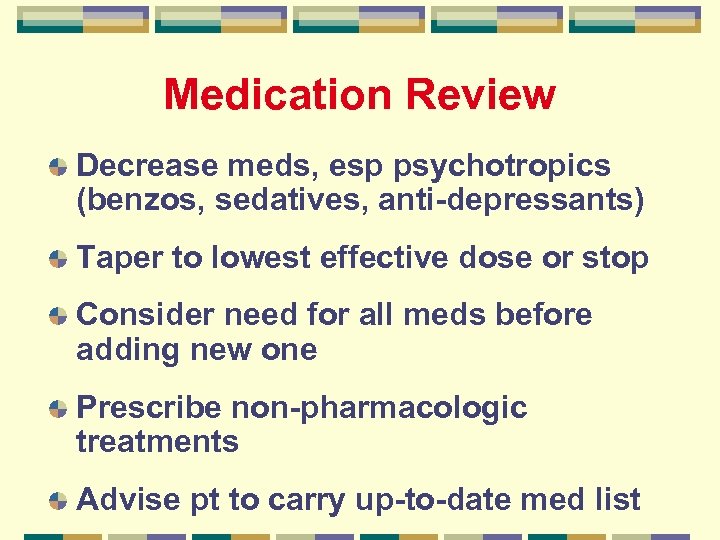
Medication Review Decrease meds, esp psychotropics (benzos, sedatives, anti-depressants) Taper to lowest effective dose or stop Consider need for all meds before adding new one Prescribe non-pharmacologic treatments Advise pt to carry up-to-date med list
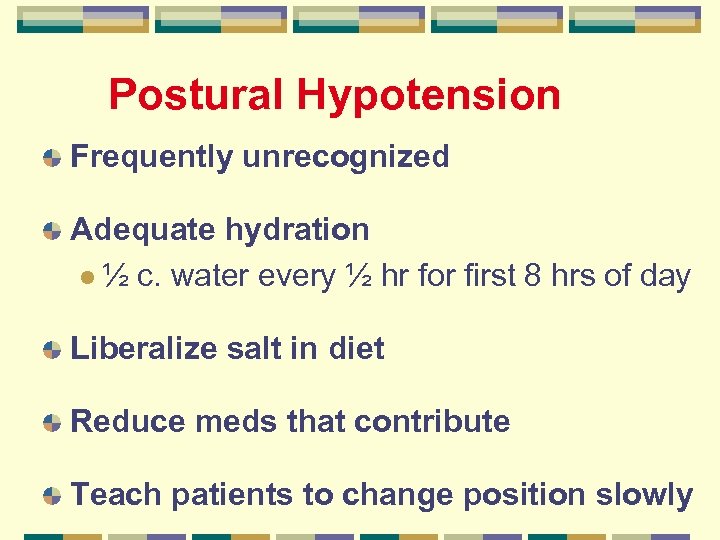
Postural Hypotension Frequently unrecognized Adequate hydration l ½ c. water every ½ hr for first 8 hrs of day Liberalize salt in diet Reduce meds that contribute Teach patients to change position slowly
PT/OT Evaluation Gait & strength assessment & training Balance training Exercises that challenge stability yet are safe l Tai chi l Assistive devices l Recommendations for & regular inspection Appropriate footwear l High box, low heel, thin sole
Environmental Modification Home safety assessment l By pt or caregiver using checklist, MD at home visit, or visiting nurse Hazards include: Clutter l Electric cords l Slippery throw rugs & loose carpet l Poor lighting l
Optimize Disease Management Vision Test acuity, eval for cataracts, ophthalmology referral l Patient education l Allow time for eyes to accommodate to changing level of light l Do not walk using bifocals or reading glasses l Osteoporosis l Consider vitamin D, bisphonates
Clinical Pearls Screen all pts >70 yrs for falls at least yearly Evaluate the circumstances of the fall Systematically evaluate for modifiable predisposing factors and precipitants • • • Motor/balance/gait Environment Medications Vision Disease management, including cognition
Acknowledgment Thanks to Dr. Helen Fernandez
Скачать презентацию Falls Sara Bradley and Christine Chang MD Brookdale
065e1241f4e29f71619567773b2fd46e.ppt