


 Скачать презентацию Falls and Fall Prevention in the Elderly DORON
66024a53e248a18299b87cccb8d076ea.ppt
- Количество слайдов: 68
 Falls and Fall Prevention in the Elderly DORON GARFINKEL, M. D. HEAD, GERIATRIC PALIATIVE DEPARTMENT SHOHAM GERIATRIC MEDICAL CENTER PARDES – HANA, ISRAEL
 Falls in the Elderly Overview • Prevalence • Clinical Importance • Risk Factors & Etiology • Evaluation • Prevention & Management • Falls & restraint use • Summary
 Prevalence • 30% of those over 65 fall annually • Half are repeat fallers • Falls go up with each decade of life • Over half of those in nursing homes and hospitals will fall each year
 FALLS - INCIDENCE • The incidence of falls increase with age • Each year 30 - 40% of community-dwelling persons > 65 years old have a fall. • The annual incidence of falls among people who experienced a fall in the previous year, is almost 60%. Ø 25% - AGE 65 – 74, 33% - AGE > 75 Ø 120% AGE > 80 ( > ONE FALL / Year)
 Clinical Importance Impact of Hip Fractures • 1% of falls result in hip fracture • $2 billion + in medical costs annually • 25% die within 6 months • 60% have restricted mobility • 25% remain functionally more dependent
 Falls Cause Morbidity & Mortality • Mortality: indirect effects • Fractures: 6% of falls • Soft tissue injury, head injury, subdural hematoma • Fear of falling can result in decreased activity, isolation, and further functional decline • Nursing home placement & loss of independence
 FALLS - A LEADING CAUSE OF MORBIDITY, DISABILITY & DEATH • Complications resulting from falls are the leading cause of death from injury in adults aged 65 and older. • Fear, Loss of Confidence • Decreased Functioning • Dependency • Physical Trauma - 10% • FRACTURES - 5%- 15%
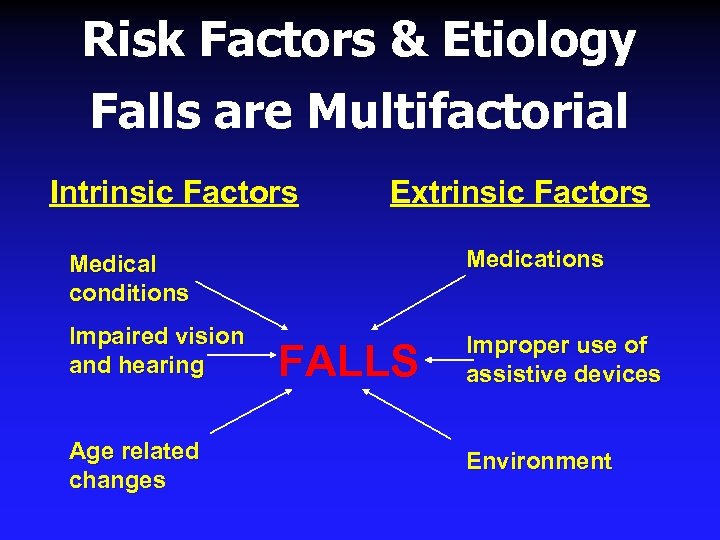 Risk Factors & Etiology Falls are Multifactorial Intrinsic Factors Extrinsic Factors Medical conditions Medications Impaired vision and hearing Improper use of assistive devices Age related changes FALLS Environment
 Age - Related Changes • Neurologic – Increased reaction time – Decreased righting reflexes – Decreased proprioception • Vision Changes – Decreased accommodation & dark adaptation • Decreased muscle mass
 Age - Related Changes GAIT • Slower gait • Decreased stride length & arm swing • Forward flexion at head and torso • Increased flexion at shoulders and knees • Increased lateral sway
 Dysmobility • Dysmobility and falling closely related • 15% of those over 65 have trouble walking • 1/4 men and 1/3 women over age 85 have difficulty with walking • 2/3 of people in hospital or NH unable to ambulate without assistance
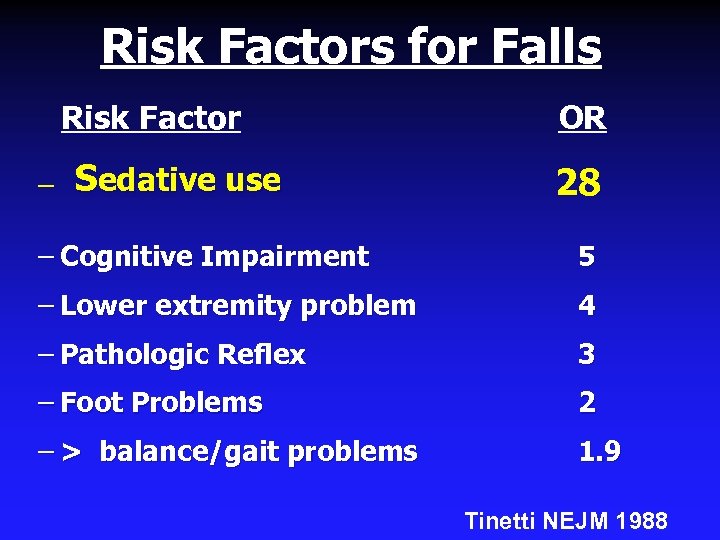 Risk Factors for Falls Risk Factor – Sedative use OR 28 – Cognitive Impairment 5 – Lower extremity problem 4 – Pathologic Reflex 3 – Foot Problems 2 – > balance/gait problems 1. 9 Tinetti NEJM 1988
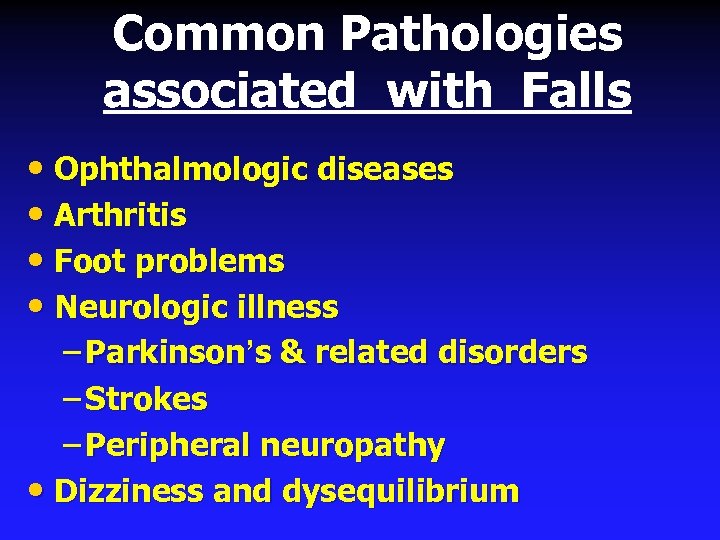 Common Pathologies associated with Falls • Ophthalmologic diseases • Arthritis • Foot problems • Neurologic illness – Parkinson’s & related disorders – Strokes – Peripheral neuropathy • Dizziness and dysequilibrium
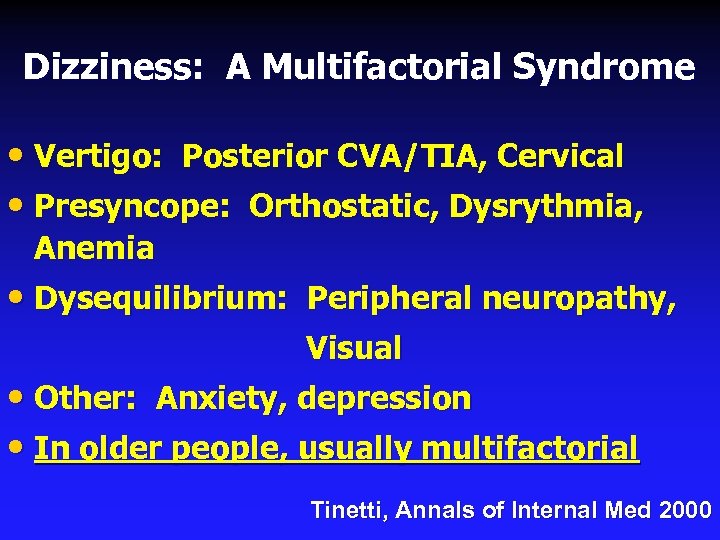 Dizziness: A Multifactorial Syndrome • Vertigo: Posterior CVA/TIA, Cervical • Presyncope: Orthostatic, Dysrythmia, Anemia • Dysequilibrium: Peripheral neuropathy, Visual • Other: Anxiety, depression • In older people, usually multifactorial Tinetti, Annals of Internal Med 2000
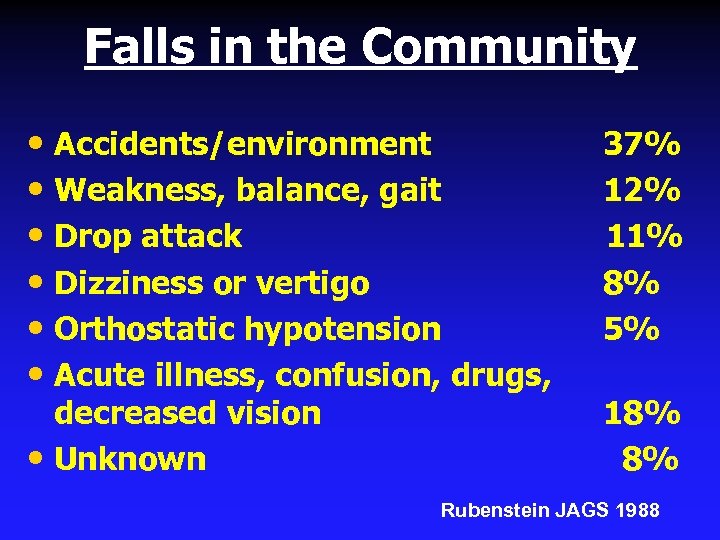 Falls in the Community • Accidents/environment • Weakness, balance, gait • Drop attack • Dizziness or vertigo • Orthostatic hypotension • Acute illness, confusion, drugs, decreased vision • Unknown 37% 12% 11% 8% 5% 18% 8% Rubenstein JAGS 1988
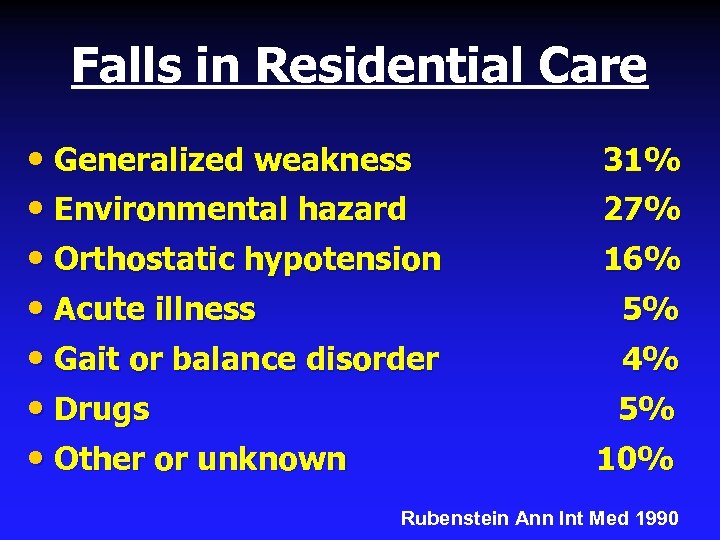 Falls in Residential Care • Generalized weakness • Environmental hazard • Orthostatic hypotension • Acute illness • Gait or balance disorder • Drugs • Other or unknown 31% 27% 16% 5% 4% 5% 10% Rubenstein Ann Int Med 1990
 Medications and Falls • Sedative-hypnotics, especially long acting benzodiazepines, • Small association between most psychotropics and falls • SSRIs and TCAs both increase falls • Weak association between Type 1 A antiarrythmics, digoxin, diuretics, and falls Leipzig JAGS 1999 Thapa NEJM 1998
 Evaluation of Falls in the Elderly Medical History • Location & circumstances of Fall • Associated symptoms • Other falls or near falls • Medications (including nonprescription) and alcohol • Injury & ability to get up
 Evaluation of Falls in the Elderly Physical Examination • Supine and standing BP - always • Routine physical examination Focus on cardiovascular, MS, neuro, feet • Vision and hearing evaluation • Consider acute medical illness & delirium • Formal gait and balance assessment
 Evaluation of Falls: Home Evaluation • Can be performed by nurse, OT, PT, others • Stairs • Lighting • Bathroom • Specific hazards: cords, throw rugs
 Evaluation of Falls: Risk Factors for Injury • Osteoporosis assessment • Anticoagulation: Usual benefits outweigh risks unless repeat or high risk faller • Can the person get up from fall? • Is there a way to notify others in case of falling?
 Formal Gait Evaluation Get up and Go Test Tinetti Gait & Balance Evaluation (POMA) POMA: Balance Component Sitting (in hard, armless chair) Arising Standing balance (immediate and delayed) Balance with Nudge Balance with Eyes closed Balance with 360 degree turn Tinetti JAGS 1986
 POMA: Gait Component Initiation Step length and height Step symmetry & continuity Path Stance Ability to pick up speed Tinetti JAGS 1986
 Prevention & Treatment • Treat acute injury & underlying medical conditions • Remove unnecessary medications • Rehab, exercises, assistive devices • Correct sensory impairments • Environmental modifications & safety • Evaluate for osteoporosis treatment
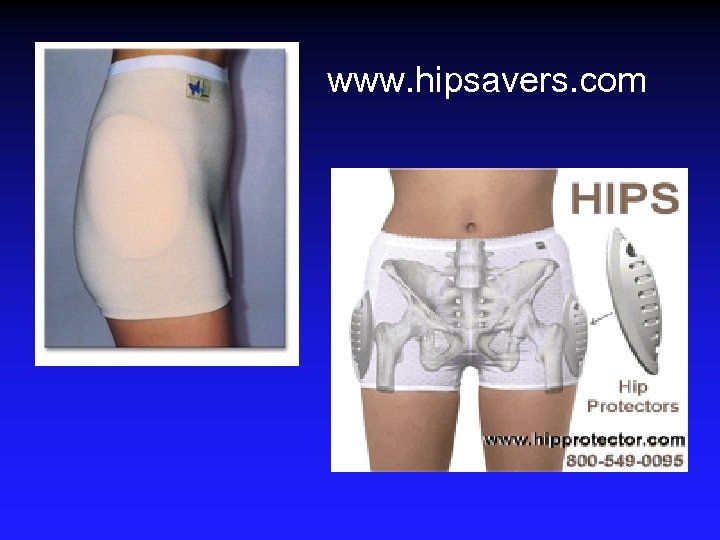
 Osteoporosis • Calcium and vitamin D for most elders at risk • Dawson-Hughes, NEJM, 1997 • Osteoporosis evaluation and treatment • Thiazides may help slightly • Statins? • Hip protectors appear to protect from hip fractures in those who wear them • Kannus, NEJM, 2000
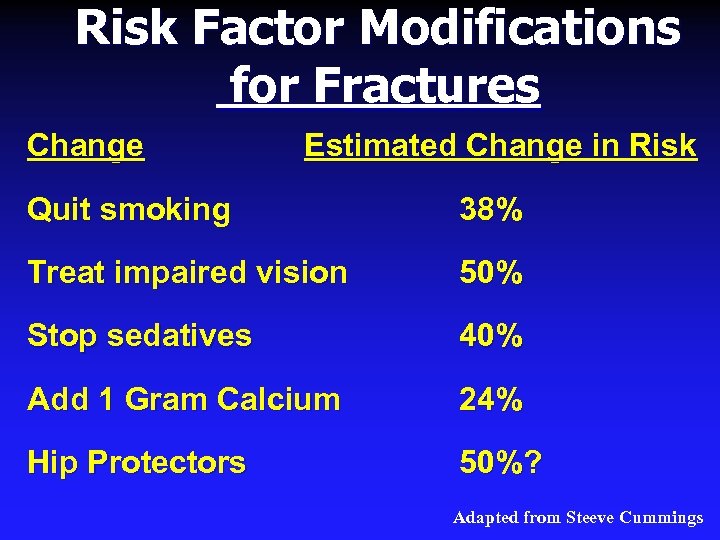 Risk Factor Modifications for Fractures Change Estimated Change in Risk Quit smoking 38% Treat impaired vision 50% Stop sedatives 40% Add 1 Gram Calcium 24% Hip Protectors 50%? Adapted from Steeve Cummings
 Falls: Primary Prevention • 301 community dwelling elders with 1+ risk factors for falling • Intervention: adjustment in medications, behavioral instructions, exercise programs aimed at modifying risk factors • One year follow up Tinetti et al. 1994 NEJM
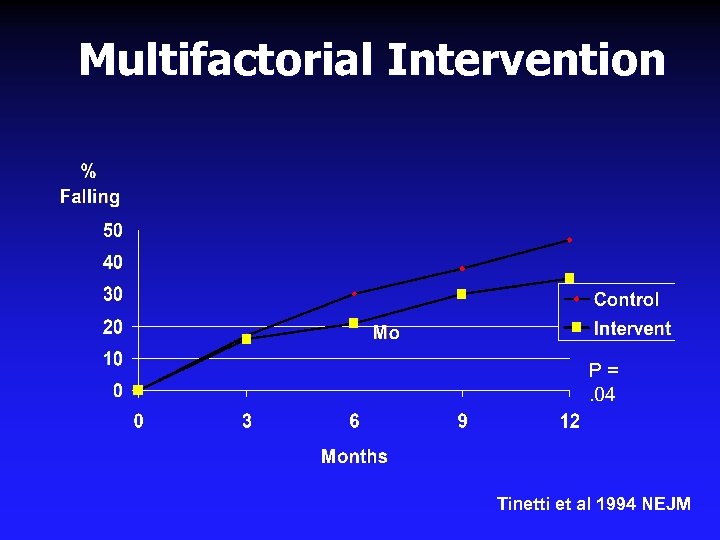 Multifactorial Intervention P=. 04 Tinetti et al 1994 NEJM
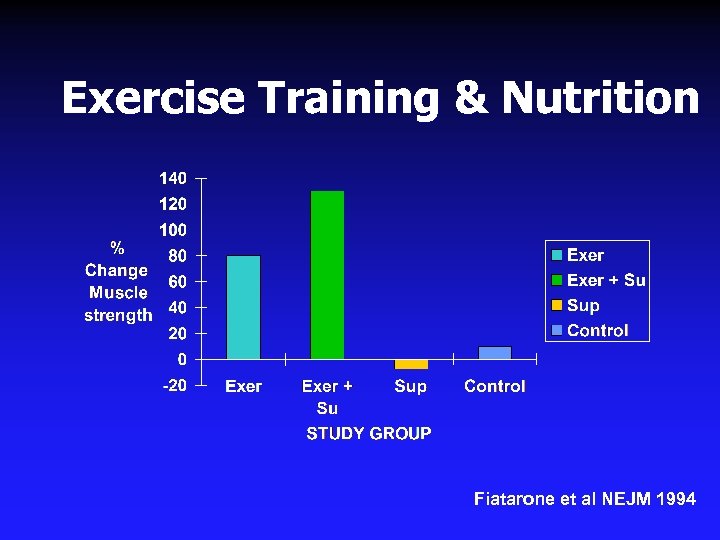 Exercise Training & Nutrition Fiatarone et al NEJM 1994
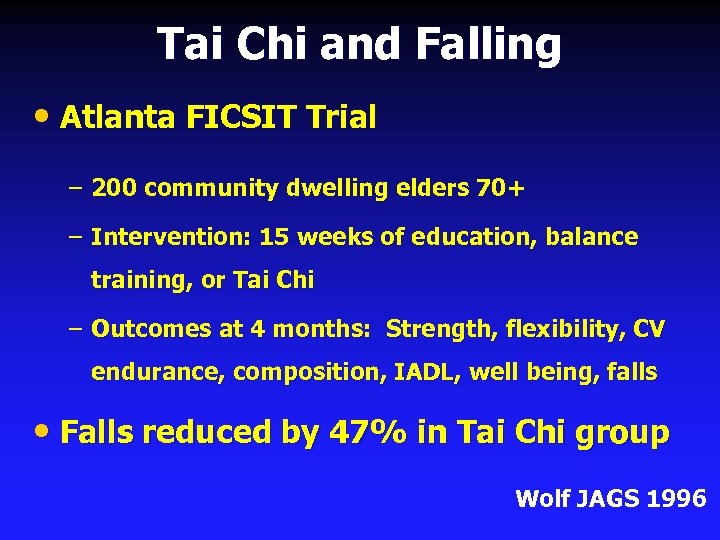 Tai Chi and Falling • Atlanta FICSIT Trial – 200 community dwelling elders 70+ – Intervention: 15 weeks of education, balance training, or Tai Chi – Outcomes at 4 months: Strength, flexibility, CV endurance, composition, IADL, well being, falls • Falls reduced by 47% in Tai Chi group Wolf JAGS 1996
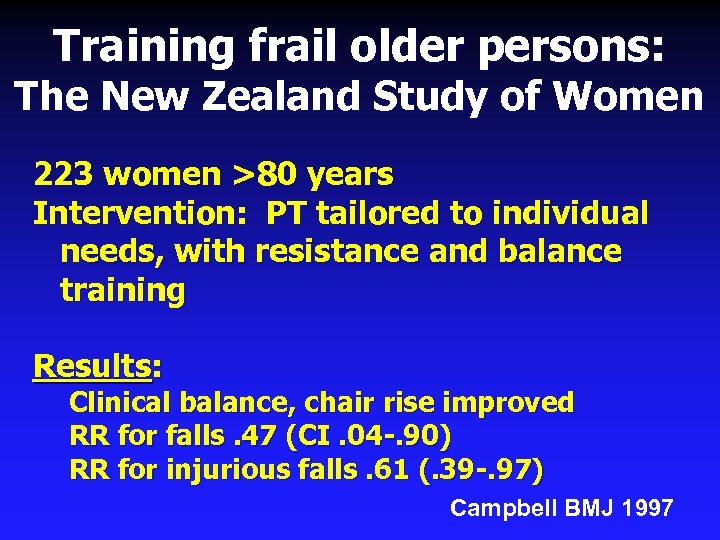 Training frail older persons: The New Zealand Study of Women 223 women >80 years Intervention: PT tailored to individual needs, with resistance and balance training Results: Clinical balance, chair rise improved RR for falls. 47 (CI. 04 -. 90) RR for injurious falls. 61 (. 39 -. 97) Campbell BMJ 1997
 Summary • Falls are common in the elderly & may lead to injuries and decline in function • Evaluation should included risk factor assessment, gait assessment, and home assessment • Exercise can improve outcomes • We have no evidence that restraints reduce fall related injuries
 EFFICACY OF HIP PROTECTORS IN THE PREVENTION OF HIP FRACTURES IN PATIENTS WITH DEMENTIA Doron Garfinkel Shoham Geriatric Medical Center Pardes – Hana, Israel
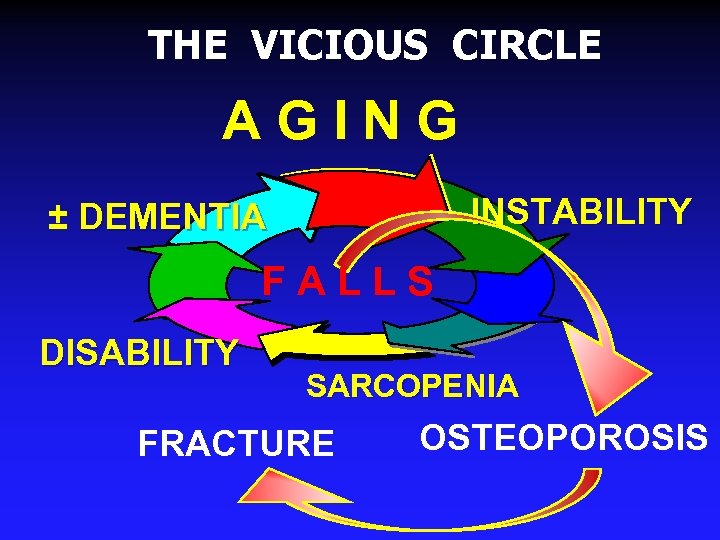 THE VICIOUS CIRCLE AGING INSTABILITY ± DEMENTIA FALLS DISABILITY SARCOPENIA FRACTURE OSTEOPOROSIS
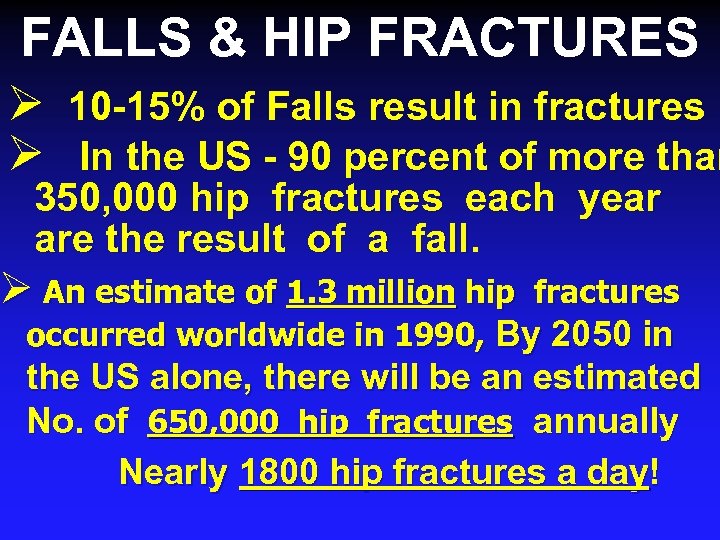 FALLS & HIP FRACTURES Ø 10 -15% of Falls result in fractures Ø In the US - 90 percent of more than 350, 000 hip fractures each year are the result of a fall Ø An estimate of 1. 3 million hip fractures occurred worldwide in 1990, By 2050 in the US alone, there will be an estimated No. of 650, 000 hip fractures annually Nearly 1800 hip fractures a day!
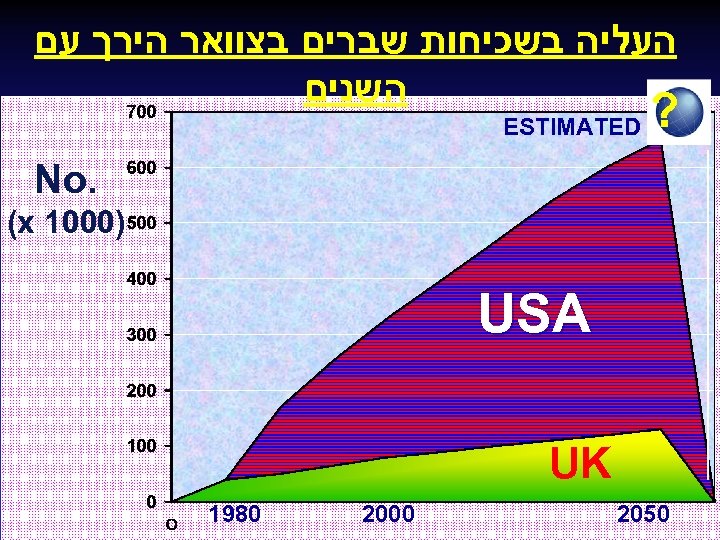 העליה בשכיחות שברים בצוואר הירך עם השנים ? ESTIMATED . No )0001 (x USA UK 0502 0002 0891
 HIP FRACTURES - OUTCOMES The death rate attributed to falls also increase with age, reaching at age > 85 – 180 deaths per 100, 000 population Hip fractures is the commonest reason for admission of elderly people to an acute orthopedic ward Johnell & Kanis, Osteopor Int 2004; 15: 897 – 902.
 HIP FRACTURES - OUTCOMES Ø Each year, 8% of people > 70 years old reach the Emergancy Room, as a result of Fall - related injuries Ø Those admitted are hospitalized for an average of 8 days. Ø These hip fractures may result in permanent disability accounting for a significant portion of the Global Burden of Disease .
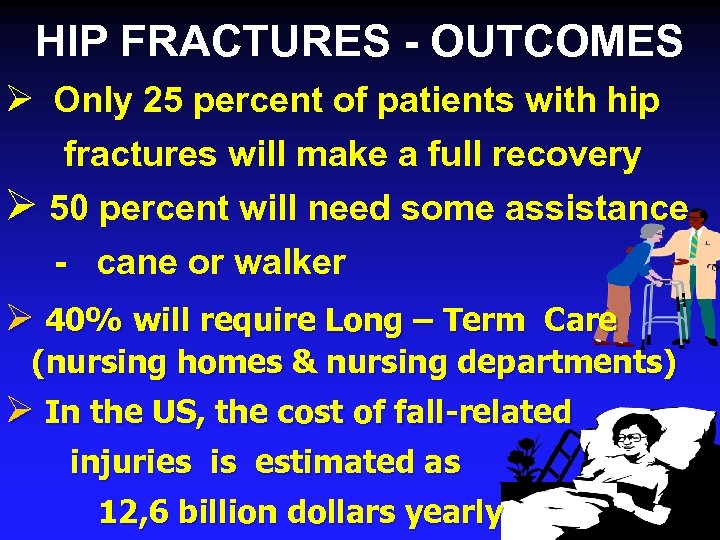 HIP FRACTURES - OUTCOMES Ø Only 25 percent of patients with hip fractures will make a full recovery Ø 50 percent will need some assistance - cane or walker Ø 40% will require Long – Term Care (nursing homes & nursing departments) Ø In the US, the cost of fall-related injuries is estimated as 12, 6 billion dollars yearly

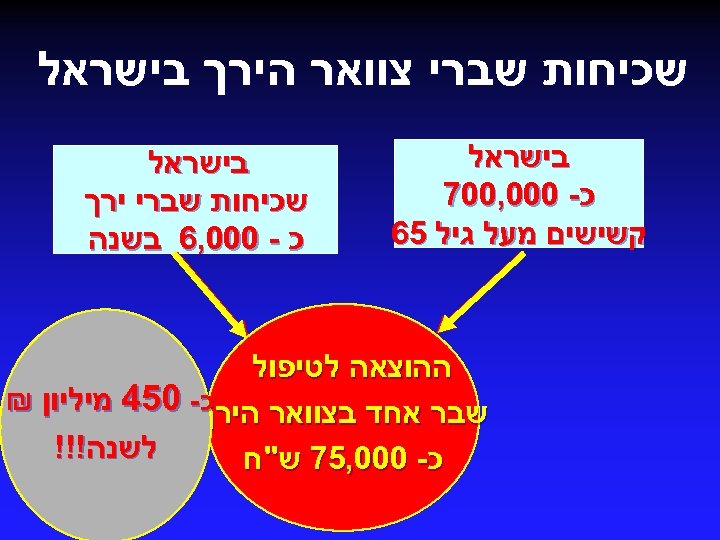 שכיחות שברי צוואר הירך בישראל כ- 000, 007 קשישים מעל גיל 56 בישראל שכיחות שברי ירך כ - 000, 6 בשנה ההוצאה לטיפול שבר אחד בצוואר הירך- 054 מיליון ₪ כ לשנה!!! כ- 000, 57 ש"ח
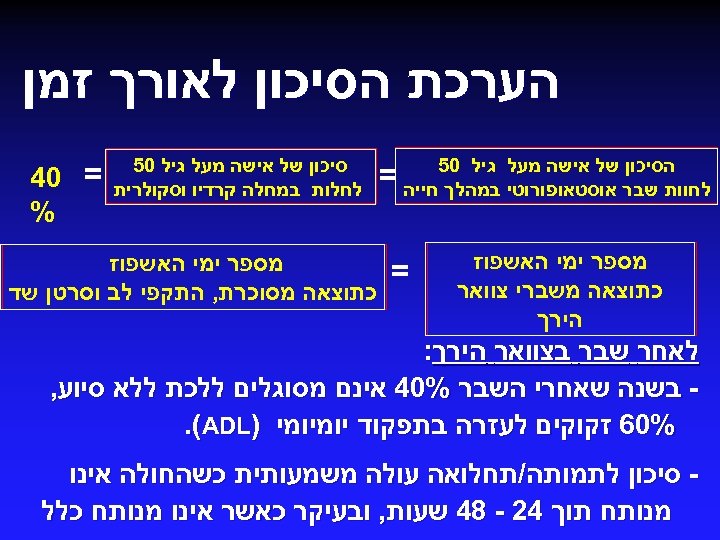 הערכת הסיכון לאורך זמן הסיכון של אישה מעל גיל 05 לחוות שבר אוסטאופורוטי במהלך חייה מספר ימי האשפוז כתוצאה משברי צוואר הירך = = סיכון של אישה מעל גיל 05 לחלות במחלה קרדיו וסקולרית = 04 % מספר ימי האשפוז כתוצאה מסוכרת, התקפי לב וסרטן שד לאחר שבר בצוואר הירך: בשנה שאחרי השבר %04 אינם מסוגלים ללכת ללא סיוע, %06 זקוקים לעזרה בתפקוד יומיומי ). (ADL סיכון לתמותה/תחלואה עולה משמעותית כשהחולה אינו מנותח תוך 42 - 84 שעות, ובעיקר כאשר אינו מנותח כלל
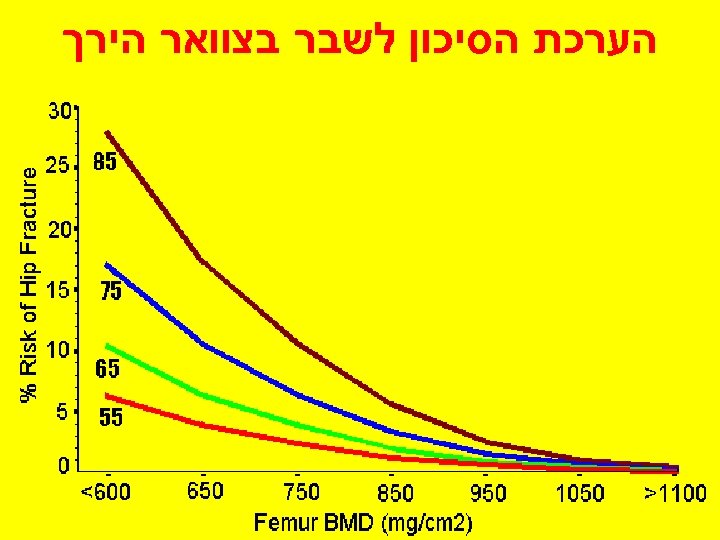 הערכת הסיכון לשבר בצוואר הירך
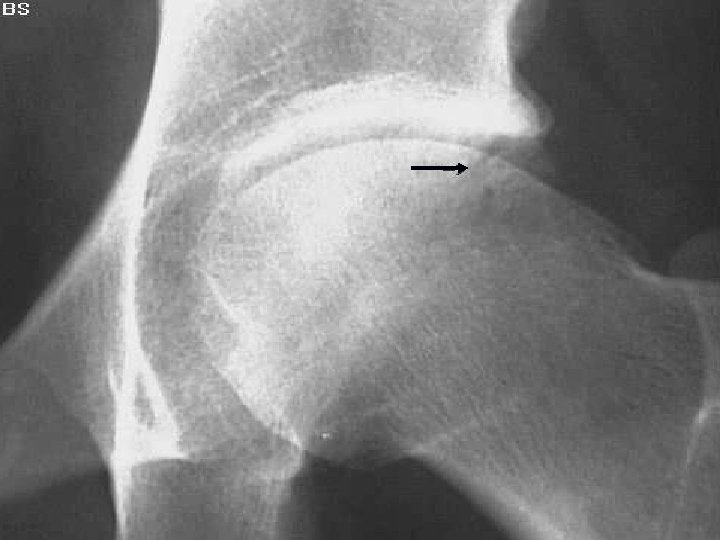
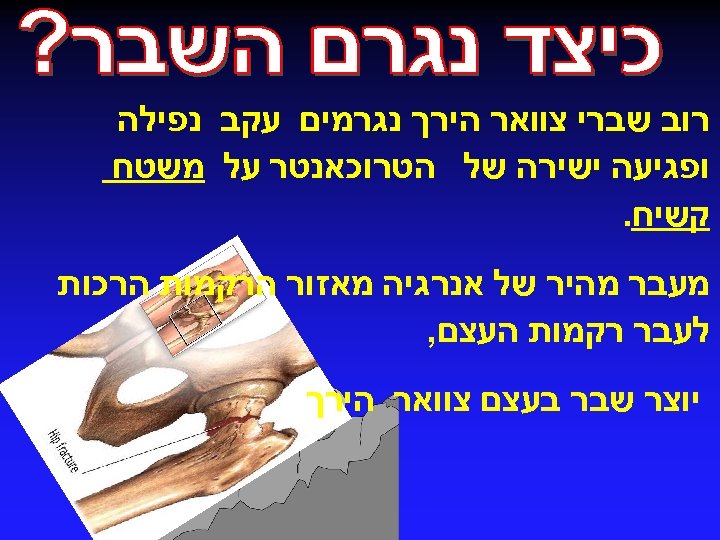 רוב שברי צוואר הירך נגרמים עקב נפילה ופגיעה ישירה של הטרוכאנטר על משטח קשיח. מעבר מהיר של אנרגיה מאזור הרקמות הרכות לעבר רקמות העצם, יוצר שבר בעצם צוואר הירך
 מגן הירכיים - מאפשר שכבת הגנה מכאנית, השומרת על אזור עצמות הירכיים. המגן בולם ומשכך את עוצמת המכה הנגרמת מנפילה ופגיעה ישירה.
 מבחן ביו-מכאני במעבדות אוניברסיטת הרוארד תוצאות
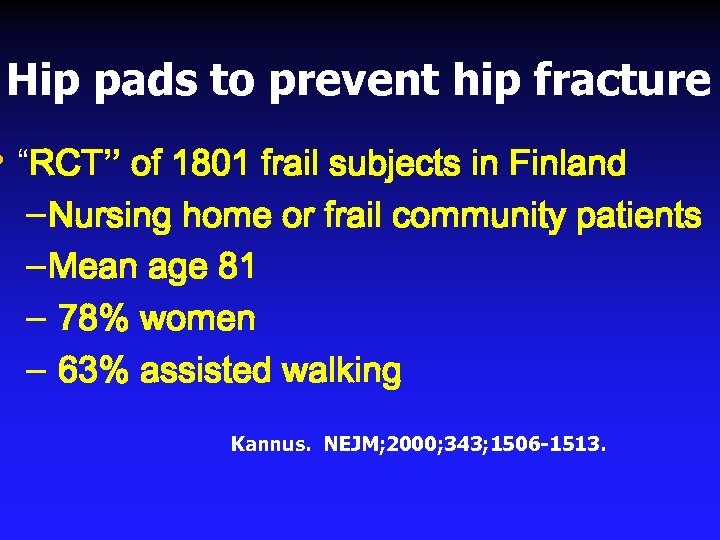 Hip pads to prevent hip fracture • “RCT” of 1801 frail subjects in Finland – Nursing home or frail community patients – Mean age 81 – 78% women – 63% assisted walking Kannus. NEJM; 2000; 343; 1506 -1513.
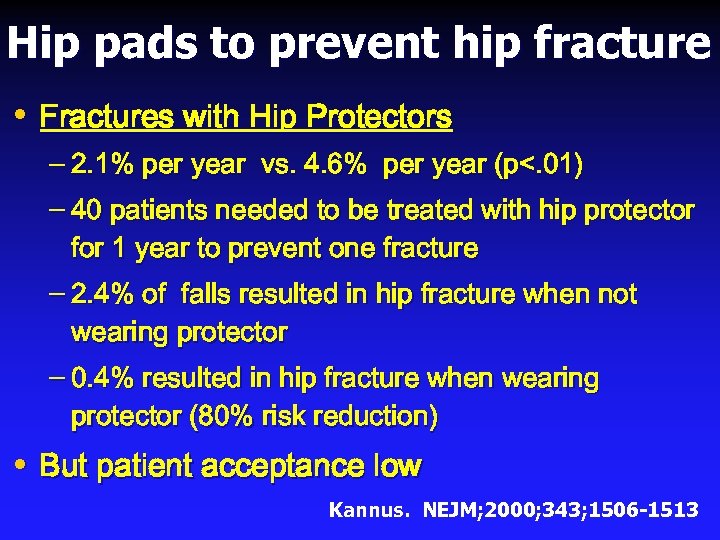 Hip pads to prevent hip fracture • Fractures with Hip Protectors – 2. 1% per year vs. 4. 6% per year (p<. 01) – 40 patients needed to be treated with hip protector for 1 year to prevent one fracture – 2. 4% of falls resulted in hip fracture when not wearing protector – 0. 4% resulted in hip fracture when wearing protector (80% risk reduction) • But patient acceptance low Kannus. NEJM; 2000; 343; 1506 -1513
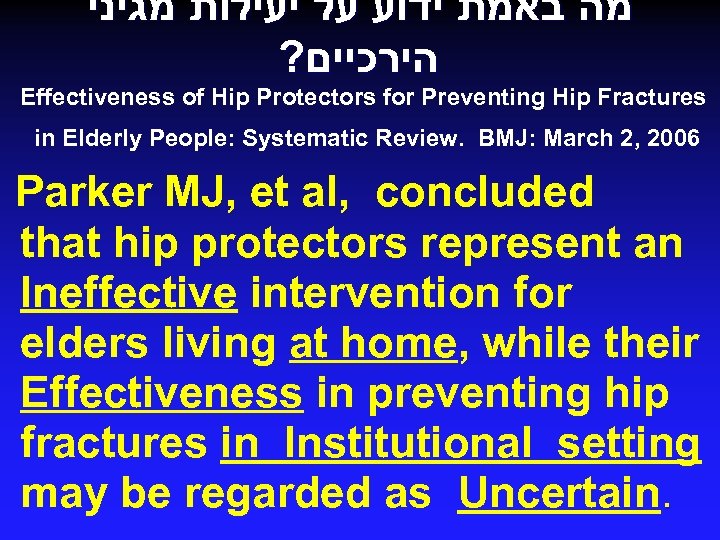 מה באמת ידוע על יעילות מגיני ? הירכיים Effectiveness of Hip Protectors for Preventing Hip Fractures in Elderly People: Systematic Review. BMJ: March 2, 2006 Parker MJ, et al, concluded that hip protectors represent an Ineffective intervention for elders living at home, while their Effectiveness in preventing hip fractures in Institutional setting may be regarded as Uncertain.
 יעילות מגיני ירכיים במניעת שברי ירך בקשישים עם שיטיון שהם ד. גרפינקל, ז. רדומיסלסקי, ס. ג'מאל , י. בן ישראל המרכז המשולב לרפואה גריאטרית פרדס-חנה
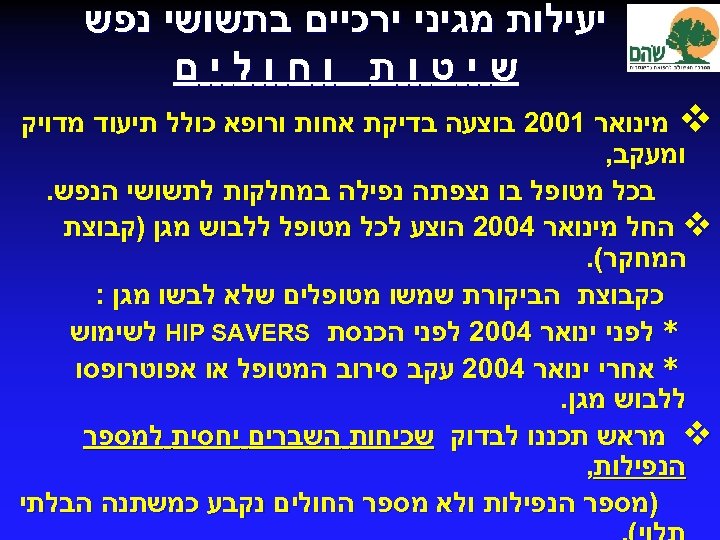 יעילות מגיני ירכיים בתשושי נפש שיטות וחולים v מינואר 1002 בוצעה בדיקת אחות ורופא כולל תיעוד מדויק ומעקב, בכל מטופל בו נצפתה נפילה במחלקות לתשושי הנפש. v החל מינואר 4002 הוצע לכל מטופל ללבוש מגן )קבוצת המחקר(. כקבוצת הביקורת שמשו מטופלים שלא לבשו מגן : * לפני ינואר 4002 לפני הכנסת HIP SAVERS לשימוש * אחרי ינואר 4002 עקב סירוב המטופל או אפוטרופסו ללבוש מגן. v מראש תכננו לבדוק שכיחות השברים יחסית למספר הנפילות, )מספר הנפילות ולא מספר החולים נקבע כמשתנה הבלתי
 יעילות מגיני ירכיים בתשושי נפש שיטות וחולים EXCLUSION CRITERIA v מטופלים שתוחלת חייהם הצפויה פחות מששה חודשים. v מטופלים הצפויים להפוך סיעודיים תוך ששה חודשים. v בניתוח התוצאות לא נכללו חולים שנפטרו תוך שישה חודשים מתחילת המעקב )בקבוצות המחקר והביקורת(. v בניתוח התוצאות, לא נכללו בקבוצת המחקר מטופלים
 www. hipsavers. com
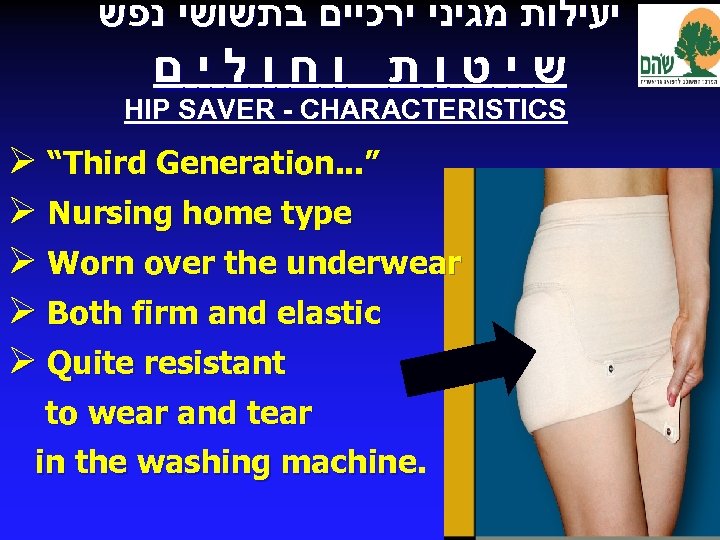 יעילות מגיני ירכיים בתשושי נפש שיטות וחולים HIP SAVER - CHARACTERISTICS Ø “Third Generation. . . ” Ø Nursing home type Ø Worn over the underwear Ø Both firm and elastic Ø Quite resistant to wear and tear in the washing machine
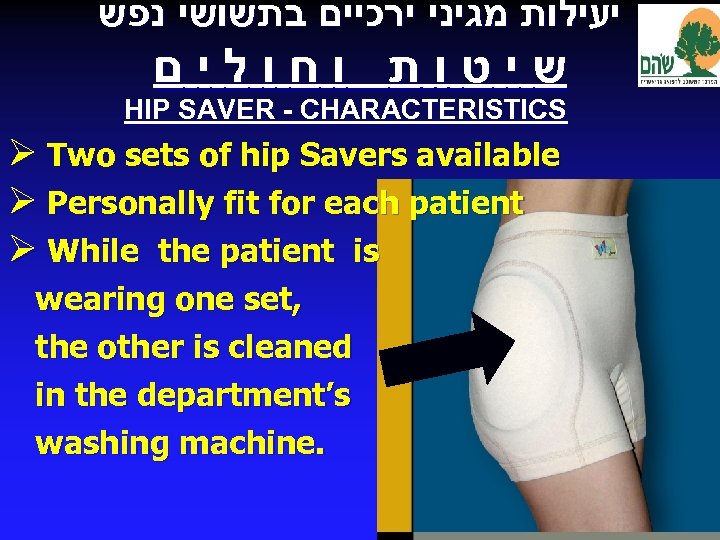 יעילות מגיני ירכיים בתשושי נפש שיטות וחולים HIP SAVER - CHARACTERISTICS Ø Two sets of hip Savers available Ø Personally fit for each patient Ø While the patient is wearing one set, the other is cleaned in the department’s washing machine.
 יעילות מגיני ירכיים בתשושי נפש תוצאות v חוסר היענות נקבע כסירוב מתמשך של המטופל ללבוש את מגן הירכיים למרות ניסיונות חוזרים של הצוות משך שבוע ימים. v היענות תשושי הנפש ללבישת מגיני ירכיים נעה בין 55 ל - 08 אחוז. v היענות זו הייתה תלויה במוטיבציה של הצוות.
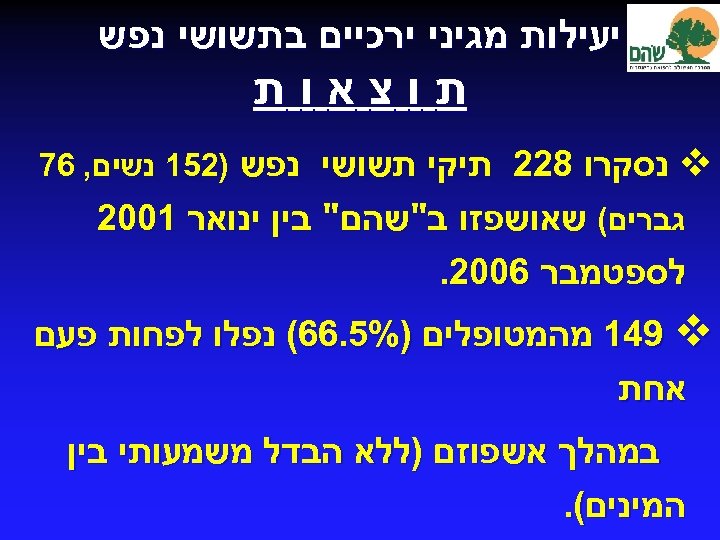 יעילות מגיני ירכיים בתשושי נפש תוצאות v נסקרו 822 תיקי תשושי נפש )251 נשים, 67 גברים( שאושפזו ב"שהם" בין ינואר 1002 לספטמבר 6002. 149 v מהמטופלים )%5. 66( נפלו לפחות פעם אחת במהלך אשפוזם )ללא הבדל משמעותי בין המינים(.
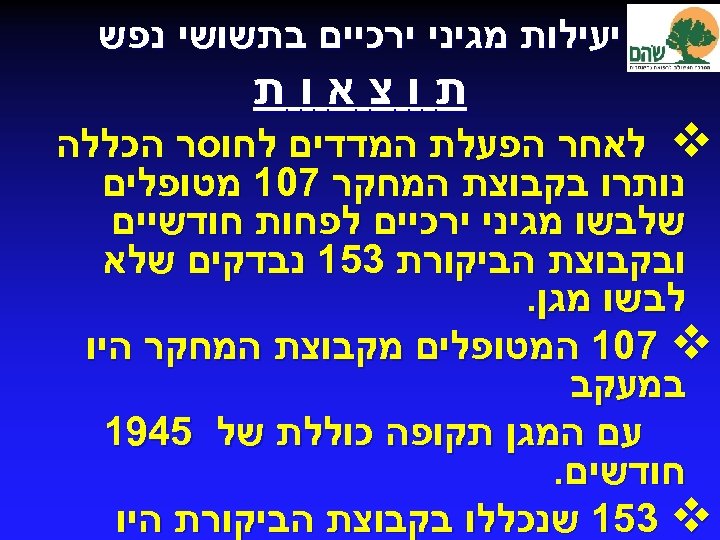 יעילות מגיני ירכיים בתשושי נפש תוצאות v לאחר הפעלת המדדים לחוסר הכללה נותרו בקבוצת המחקר 701 מטופלים שלבשו מגיני ירכיים לפחות חודשיים ובקבוצת הביקורת 351 נבדקים שלא לבשו מגן. 107 v המטופלים מקבוצת המחקר היו במעקב עם המגן תקופה כוללת של 5491 חודשים. 153 v שנכללו בקבוצת הביקורת היו
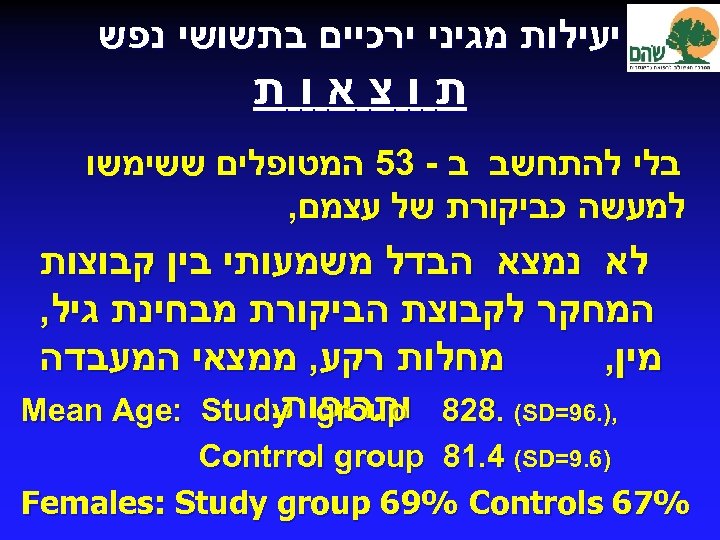 יעילות מגיני ירכיים בתשושי נפש תוצאות בלי להתחשב ב - 35 המטופלים ששימשו למעשה כביקורת של עצמם, לא נמצא הבדל משמעותי בין קבוצות המחקר לקבוצת הביקורת מבחינת גיל, מחלות רקע, ממצאי המעבדה מין, ותרופות. , ). 69= Mean Age: Study group 828. (SD )6. 9= Contrrol group 81. 4 (SD %76 Females: Study group 69% Controls
 יעילות מגיני ירכיים בתשושי נפש תוצאות מחלות רקע לגביהן לא נמצא הבדל משמעותי בין הקבוצות: אירוע מוחי, כפיון, מחלת פרקינסון, יתר לחץ דם פרפור פרוזדורים, הפרעת קצב או אי ספיקת לב משמעותיות, מחלת לב כלילית, סוכרת, מחלה כרונית משמעותית של הריאה או הכליה, עיוורון, חירשות, סכיזופרניה, שבר בצוואר הירך.
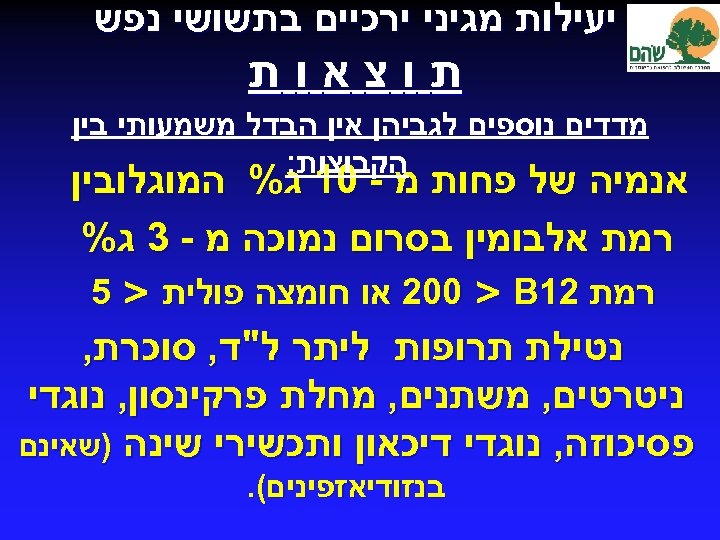 יעילות מגיני ירכיים בתשושי נפש תוצאות מדדים נוספים לגביהן אין הבדל משמעותי בין הקבוצות: אנמיה של פחות מ - 01 ג% המוגלובין רמת אלבומין בסרום נמוכה מ - 3 ג% רמת 21 200 > B או חומצה פולית > 5 נטילת תרופות ליתר ל"ד, סוכרת, ניטרטים, משתנים, מחלת פרקינסון, נוגדי פסיכוזה, נוגדי דיכאון ותכשירי שינה )שאינם בנזודיאזפינים(.
 יעילות מגיני ירכיים בתשושי נפש תוצאות עיקריות לא נמצא הבדל מבחינת שכיחות הנפילות בין מטופלים שלבשו מגיני הירכיים לקבוצת הביקורת. מאידך, נמצאה ירידה משמעותית בשכיחות השברים יחסית לנפילות בקבוצת המחקר שלבשו מגן. ההבדל מובהק )700. 0< p 61. 7=)1(2. ( χ הסיכוי לשבר קטן פי 661. 0 עם מגן בהשוואה לסיכוי לשבר ללא מגן, )637. 0 -730. 0(59 CI
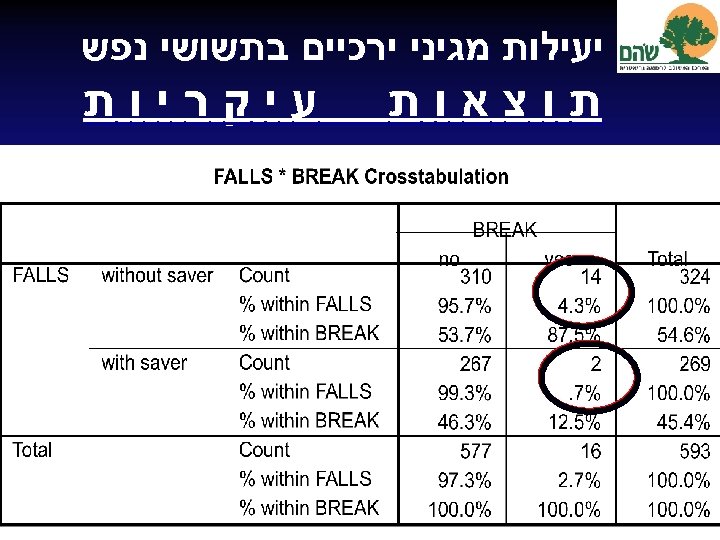 יעילות מגיני ירכיים בתשושי נפש תוצאות עיקריות
 יעילות מגיני ירכיים בתשושי נפש מסקנות בחולי שיטיון עם תפקוד תקין במחלקות תשושי נפש: היענות ללבישת מגיני ירכיים נעה בין 55 ל - 08 אחוז ותלויה בעיקר במוטיבציה של הצוות. מגיני ירכיים אינם מגבירים שכיחות הנפילות
 יעילות מגיני ירכיים בתשושי נפש מסקנות במחלקות לתשושי נפש -לבישה קבועה של מגיני ירכיים מהווה אמצעי יעיל להפחתת השברים בצוואר הירך. שימוש גובר באמצעי מניעתי זה יתורגם בסופו של דבר לסיכון מופחת לתמותה, תחלואה קשה וסבל למטופל ומשפחתו, במקביל להקלה משמעותית בנטל הכלכלי. כדאי להמליץ על מגיני ירכיים לחולי
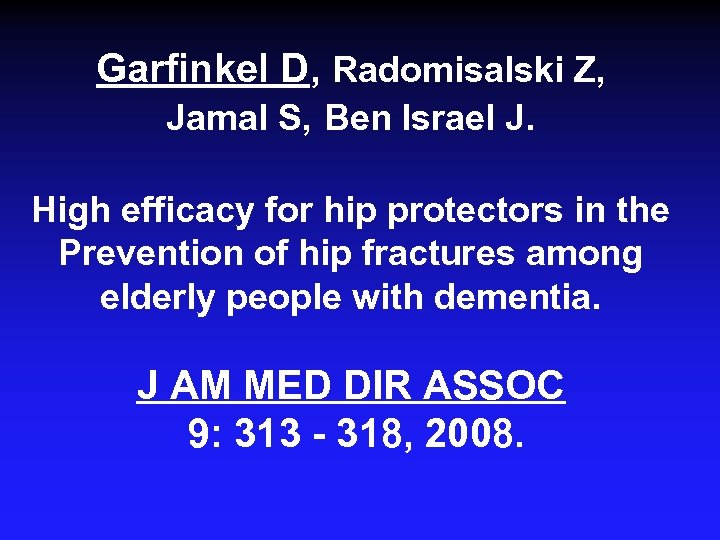 Garfinkel D, Radomisalski Z, Jamal S, Ben Israel J. High efficacy for hip protectors in the Prevention of hip fractures among elderly people with dementia. J AM MED DIR ASSOC 9: 313 - 318, 2008.
 יעילות מגיני ירכיים בתשושי נפש