 Скачать презентацию FALL PARTNERS IN BUSINESS Ypsilanti Michigan September 10
f694f27f8f7f6fd83316755090aed199.ppt
- Количество слайдов: 95



FALL PARTNERS IN BUSINESS Ypsilanti, Michigan September 10, 2009
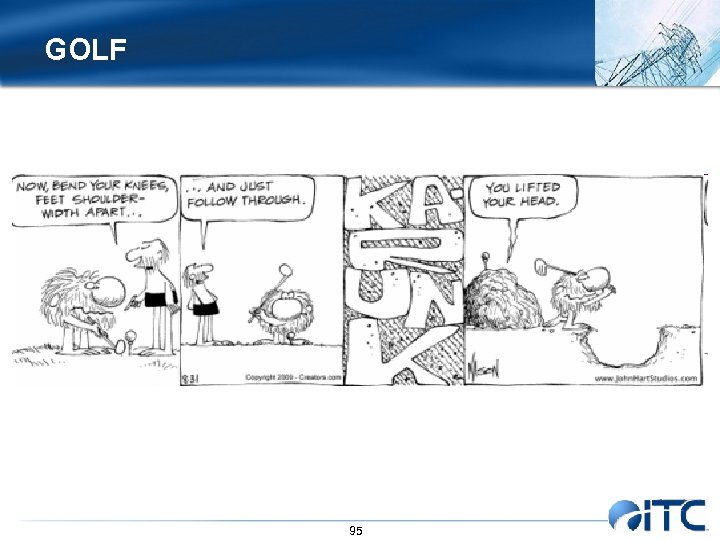
Welcome Restroom Locations: Cell Phones: Please set to Vibrate Golf: Sign in Sheet Eagle Crest pushed back start time to 4: 00 Price Discount to $25. 00 / 9 holes with cart Free Range Balls before tee time 2
AGENDA Introduction / David Nagy Wind Zone Transmission Study Update / Carlo Capra Regulatory Update / Purvi Patel Load Forecast / Mike Taylor ITC Transmission & METC Capital Project Review / John Andree Guest Speakers: Automotive Power Policy, Technology & Myths/ Brett Smith, CARS Stakeholder Relations Survey Review / Karen Hilton, Scott Madden Closing Remarks / Jeff Dorr, ITC, Manager Stakeholder Relations 3
Carlo Capra Manager, Regional Planning Michigan Wind Zones Transmission Study Update
Background n PA 295 of 2008 created Wind Energy Resource Zone Board n Board is an 11 member panel charged with issuing a report: u Identifies regions in the state with the highest level of wind energy harvest potential; u A description of the estimated maximum and minimum wind generating capacity in MW that can be installed in each identified region of the state; u An estimate of the annual maximum and minimum energy production potential for each identified region of the state; and u An estimate of the maximum wind generation capacity already in service in each identified region of the state. n Board’s preliminary report was issued on June 2 nd and identified 4 potential zones. n Board has held two public hearings to discuss their findings; one on August 24 th and one on August 31 st. n Final Board report is to be issued no later than October 15 th. n Following issuance of the Board’s Final Report, transmission entities within or adjacent to regions of the state identified in the Board’s report shall identify existing or new transmission infrastructure necessary to deliver the maximum and minimum wind energy production potential for each of the regions identified and shall submit this information to the Board for its review. No action by the Board is called for in the statute. n Based on the Board’s findings, the Commission through a Final Order shall designate the area of the state likely to be the most productive of wind energy as the primary wind energy resource zone; Commission may designate additional wind energy resource zones. 5
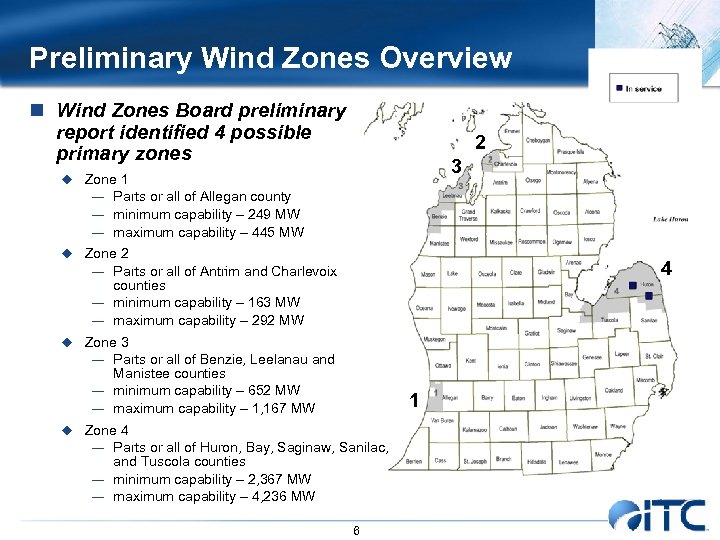
Preliminary Wind Zones Overview n Wind Zones Board preliminary report identified 4 possible primary zones 2 3 u Zone 1 — Parts or all of Allegan county — minimum capability – 249 MW — maximum capability – 445 MW u Zone 2 4 — Parts or all of Antrim and Charlevoix counties — minimum capability – 163 MW — maximum capability – 292 MW u Zone 3 — Parts or all of Benzie, Leelanau and Manistee counties — minimum capability – 652 MW — maximum capability – 1, 167 MW 1 u Zone 4 — Parts or all of Huron, Bay, Saginaw, Sanilac, and Tuscola counties — minimum capability – 2, 367 MW — maximum capability – 4, 236 MW 6
Purvi Patel Regulatory Affairs Analyst Regulatory Update
Regulatory Update u The Midwest ISO Transmission Owners, with the exception of ITC and ATC, filed jointly with MISO to modify the cost allocation methodology for network upgrades on generator interconnections established in Attachment FF (ER 09 -1431). — u The ITC filed comments against the filing. MISO made a filing to revise Section 22. 3 of the MISO Tariff to eliminate the practice of market participants redirecting firm transmission service from other interfaces to PJM sinks to reduce their transmission charges (ER 091543). — MISO amended its filing seeking to charge the higher of the original rate for the firm service or the redirected rate. 8
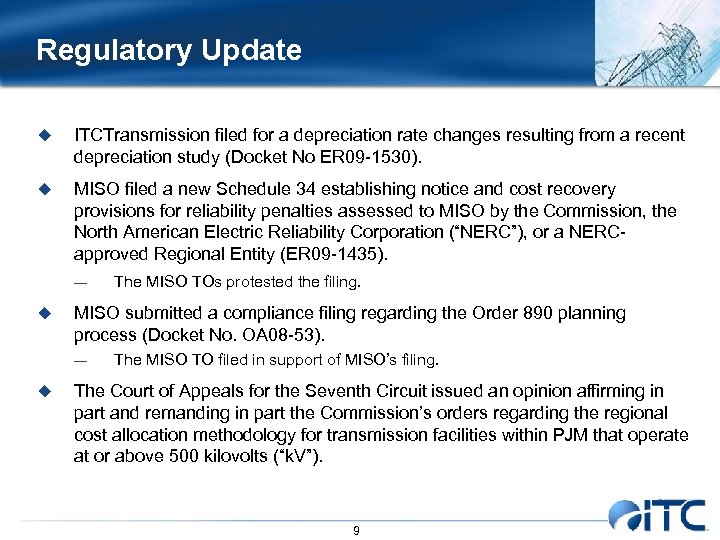
Regulatory Update u ITCTransmission filed for a depreciation rate changes resulting from a recent depreciation study (Docket No ER 09 -1530). u MISO filed a new Schedule 34 establishing notice and cost recovery provisions for reliability penalties assessed to MISO by the Commission, the North American Electric Reliability Corporation (“NERC”), or a NERCapproved Regional Entity (ER 09 -1435). — The MISO TOs protested the filing. u MISO submitted a compliance filing regarding the Order 890 planning process (Docket No. OA 08 -53). — u The MISO TO filed in support of MISO’s filing. The Court of Appeals for the Seventh Circuit issued an opinion affirming in part and remanding in part the Commission’s orders regarding the regional cost allocation methodology for transmission facilities within PJM that operate at or above 500 kilovolts (“k. V”). 9
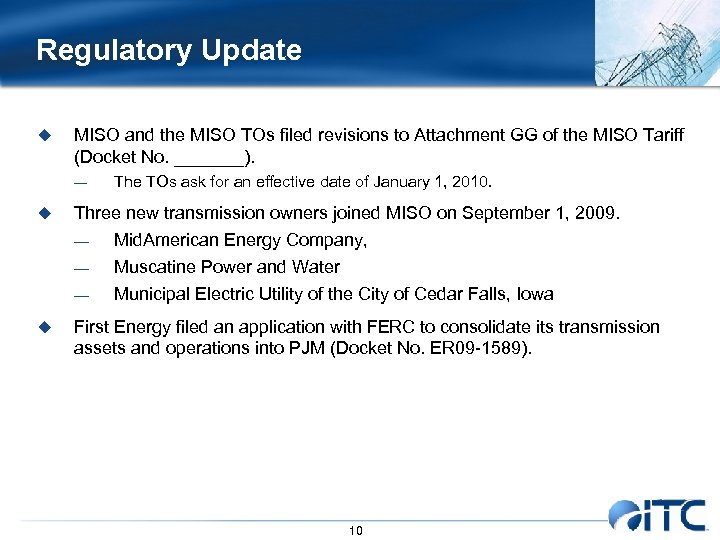
Regulatory Update u MISO and the MISO TOs filed revisions to Attachment GG of the MISO Tariff (Docket No. _______). — u Three new transmission owners joined MISO on September 1, 2009. — — — u The TOs ask for an effective date of January 1, 2010. Mid. American Energy Company, Muscatine Power and Water Municipal Electric Utility of the City of Cedar Falls, Iowa First Energy filed an application with FERC to consolidate its transmission assets and operations into PJM (Docket No. ER 09 -1589). 10
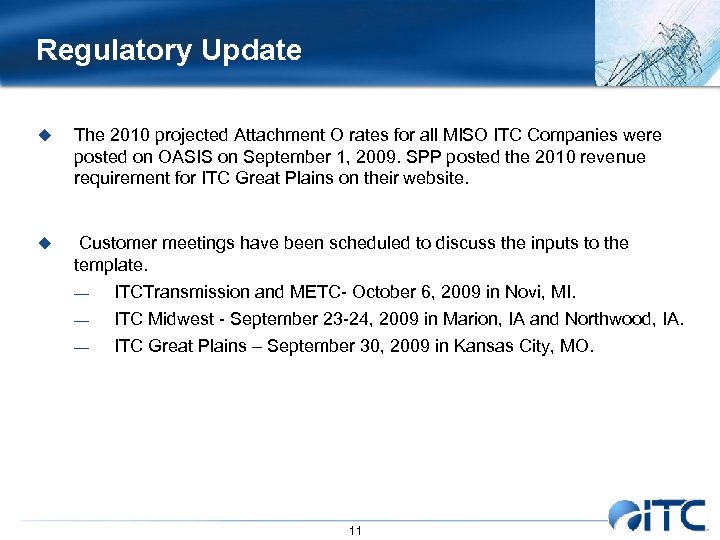
Regulatory Update u The 2010 projected Attachment O rates for all MISO ITC Companies were posted on OASIS on September 1, 2009. SPP posted the 2010 revenue requirement for ITC Great Plains on their website. u Customer meetings have been scheduled to discuss the inputs to the template. — ITCTransmission and METC- October 6, 2009 in Novi, MI. — ITC Midwest - September 23 -24, 2009 in Marion, IA and Northwood, IA. — ITC Great Plains – September 30, 2009 in Kansas City, MO. 11
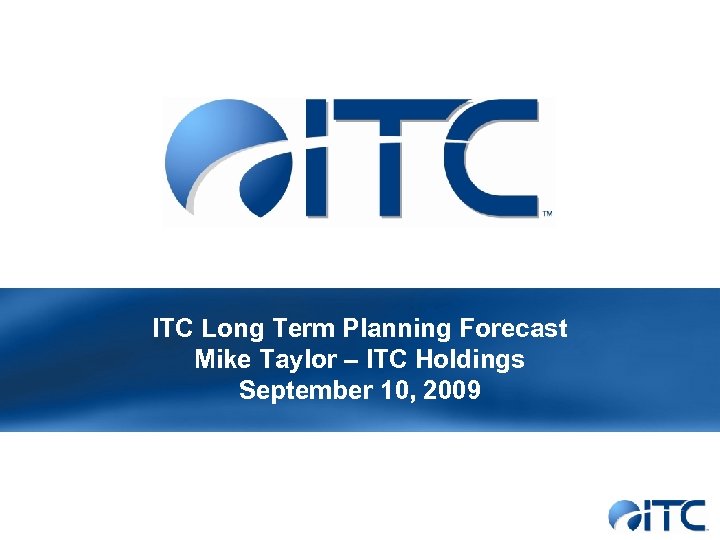
ITC Long Term Planning Forecast Mike Taylor – ITC Holdings September 10, 2009
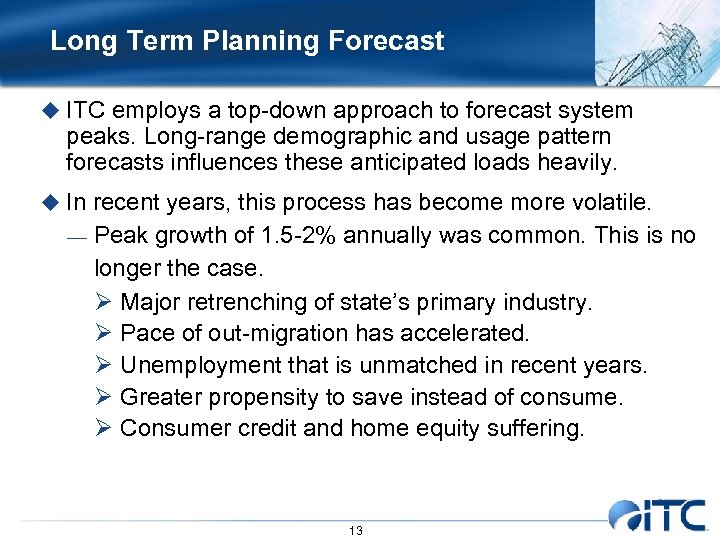
Long Term Planning Forecast u ITC employs a top-down approach to forecast system peaks. Long-range demographic and usage pattern forecasts influences these anticipated loads heavily. u In recent years, this process has become more volatile. — Peak growth of 1. 5 -2% annually was common. This is no longer the case. Ø Major retrenching of state’s primary industry. Ø Pace of out-migration has accelerated. Ø Unemployment that is unmatched in recent years. Ø Greater propensity to save instead of consume. Ø Consumer credit and home equity suffering. 13
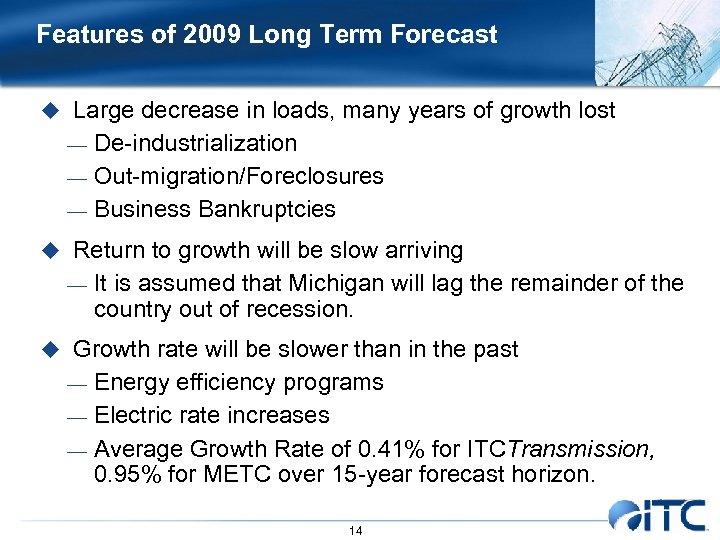
Features of 2009 Long Term Forecast u Large decrease in loads, many years of growth lost De-industrialization — Out-migration/Foreclosures — Business Bankruptcies — u Return to growth will be slow arriving — It is assumed that Michigan will lag the remainder of the country out of recession. u Growth rate will be slower than in the past Energy efficiency programs — Electric rate increases — Average Growth Rate of 0. 41% for ITCTransmission, 0. 95% for METC over 15 -year forecast horizon. — 14
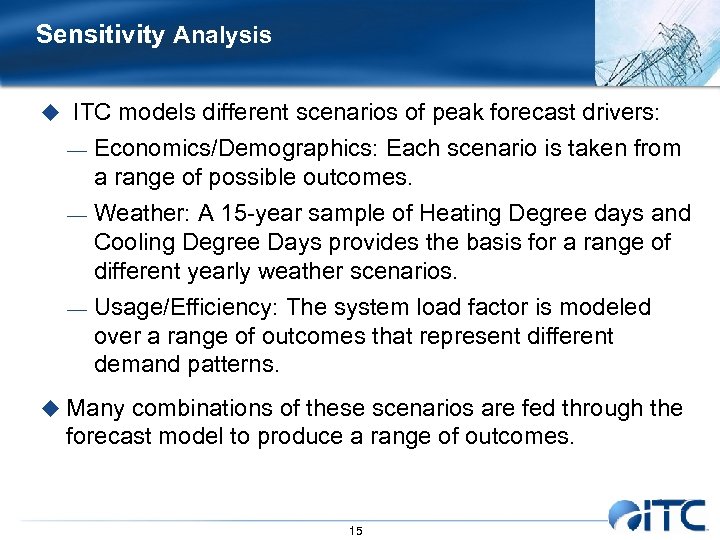
Sensitivity Analysis u ITC models different scenarios of peak forecast drivers: Economics/Demographics: Each scenario is taken from a range of possible outcomes. — Weather: A 15 -year sample of Heating Degree days and Cooling Degree Days provides the basis for a range of different yearly weather scenarios. — Usage/Efficiency: The system load factor is modeled over a range of outcomes that represent different demand patterns. — u Many combinations of these scenarios are fed through the forecast model to produce a range of outcomes. 15
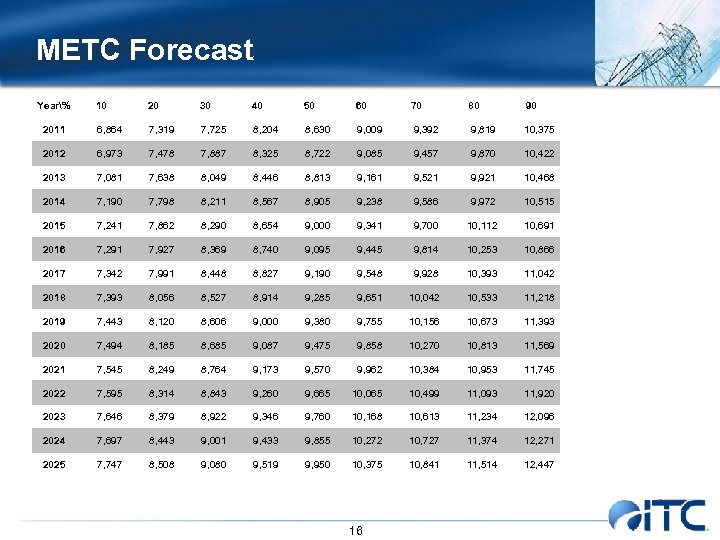
METC Forecast Year% 10 20 30 40 50 60 70 80 90 2011 6, 864 7, 319 7, 725 8, 204 8, 630 9, 009 9, 392 9, 819 10, 375 2012 6, 973 7, 478 7, 887 8, 325 8, 722 9, 085 9, 457 9, 870 10, 422 2013 7, 081 7, 638 8, 049 8, 446 8, 813 9, 161 9, 521 9, 921 10, 468 2014 7, 190 7, 798 8, 211 8, 567 8, 905 9, 238 9, 586 9, 972 10, 515 2015 7, 241 7, 862 8, 290 8, 654 9, 000 9, 341 9, 700 10, 112 10, 691 2016 7, 291 7, 927 8, 369 8, 740 9, 095 9, 445 9, 814 10, 253 10, 866 2017 7, 342 7, 991 8, 448 8, 827 9, 190 9, 548 9, 928 10, 393 11, 042 2018 7, 393 8, 056 8, 527 8, 914 9, 285 9, 651 10, 042 10, 533 11, 218 2019 7, 443 8, 120 8, 606 9, 000 9, 380 9, 755 10, 156 10, 673 11, 393 2020 7, 494 8, 185 8, 685 9, 087 9, 475 9, 858 10, 270 10, 813 11, 569 2021 7, 545 8, 249 8, 764 9, 173 9, 570 9, 962 10, 384 10, 953 11, 745 2022 7, 595 8, 314 8, 843 9, 260 9, 665 10, 065 10, 499 11, 093 11, 920 2023 7, 646 8, 379 8, 922 9, 346 9, 760 10, 168 10, 613 11, 234 12, 096 2024 7, 697 8, 443 9, 001 9, 433 9, 855 10, 272 10, 727 11, 374 12, 271 2025 7, 747 8, 508 9, 080 9, 519 9, 950 10, 375 10, 841 11, 514 12, 447 16
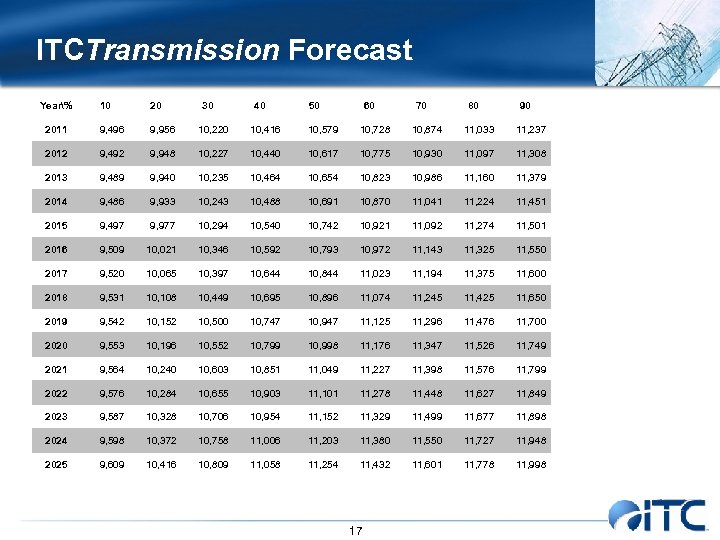
ITCTransmission Forecast Year% 10 20 30 40 50 60 70 80 90 2011 9, 496 9, 956 10, 220 10, 416 10, 579 10, 728 10, 874 11, 033 11, 237 2012 9, 492 9, 948 10, 227 10, 440 10, 617 10, 775 10, 930 11, 097 11, 308 2013 9, 489 9, 940 10, 235 10, 464 10, 654 10, 823 10, 986 11, 160 11, 379 2014 9, 486 9, 933 10, 243 10, 488 10, 691 10, 870 11, 041 11, 224 11, 451 2015 9, 497 9, 977 10, 294 10, 540 10, 742 10, 921 11, 092 11, 274 11, 501 2016 9, 509 10, 021 10, 346 10, 592 10, 793 10, 972 11, 143 11, 325 11, 550 2017 9, 520 10, 065 10, 397 10, 644 10, 844 11, 023 11, 194 11, 375 11, 600 2018 9, 531 10, 108 10, 449 10, 695 10, 896 11, 074 11, 245 11, 425 11, 650 2019 9, 542 10, 152 10, 500 10, 747 10, 947 11, 125 11, 296 11, 476 11, 700 2020 9, 553 10, 196 10, 552 10, 799 10, 998 11, 176 11, 347 11, 526 11, 749 2021 9, 564 10, 240 10, 603 10, 851 11, 049 11, 227 11, 398 11, 576 11, 799 2022 9, 576 10, 284 10, 655 10, 903 11, 101 11, 278 11, 448 11, 627 11, 849 2023 9, 587 10, 328 10, 706 10, 954 11, 152 11, 329 11, 499 11, 677 11, 898 2024 9, 598 10, 372 10, 758 11, 006 11, 203 11, 380 11, 550 11, 727 11, 948 2025 9, 609 10, 416 10, 809 11, 058 11, 254 11, 432 11, 601 11, 778 11, 998 17
Planning Update John Andree Manager, ITCT/METC Planning
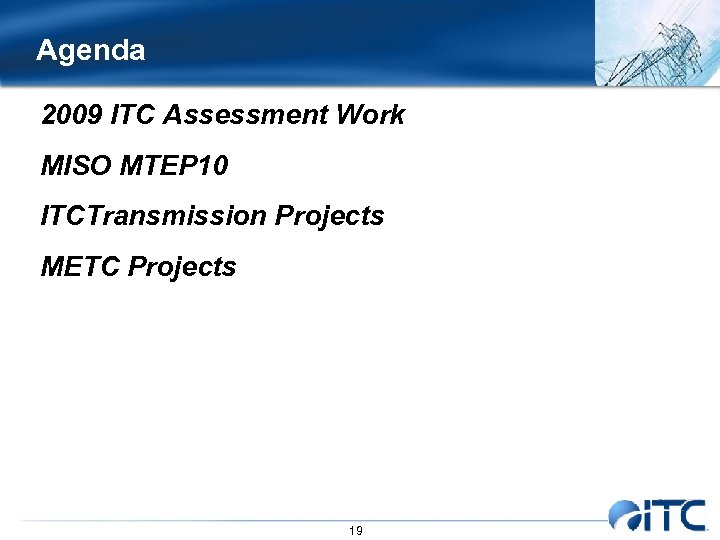
Agenda 2009 ITC Assessment Work MISO MTEP 10 ITCTransmission Projects METC Projects 19
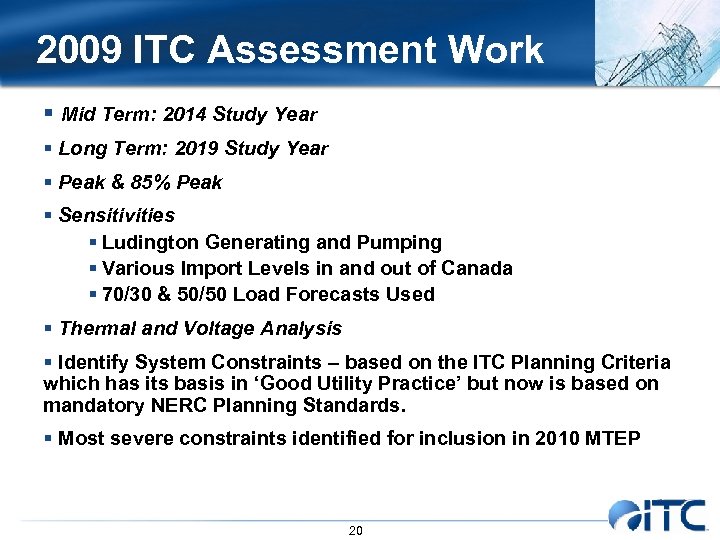
2009 ITC Assessment Work § Mid Term: 2014 Study Year § Long Term: 2019 Study Year § Peak & 85% Peak § Sensitivities § Ludington Generating and Pumping § Various Import Levels in and out of Canada § 70/30 & 50/50 Load Forecasts Used § Thermal and Voltage Analysis § Identify System Constraints – based on the ITC Planning Criteria which has its basis in ‘Good Utility Practice’ but now is based on mandatory NERC Planning Standards. § Most severe constraints identified for inclusion in 2010 MTEP 20
MISO MTEP 10 Cases MISO will be using to analyze the systems § 2 Year Out Model Peak and Shoulder Peak § 5 year Out Model Peak and Shoulder Peak § 10 Year Out Model § Light Load Model § MISO will also be setting up and studying sensitivity cases as appropriate for different study areas to evaluate projects for MTEP 10 §Set Schedule for project review in SPM and Technical Task Force meetings for Michigan 21
Where ITC is at u Planning – Has identified potential issues on the grid using the current forecasts and identified potential proposals to solve the issues. u Engineering – Has identified infrastructure issues with the system and programs to resolve these issues. u Proposed projects within the appropriate time horizon will be submitted to MISO for consideration to be moved to Appendix A in MTEP 10. 22
ITCTransmission Distribution Connections § Holland - 120/13. 2 k. V Substation in Troy § Phoenix - 120/13. 2 k. V Substation in Ann Arbor § Upper Rouge – 120/13. 2 k. V Substation in Dearborn Heights § Distribution Interconnection Blanket for smaller scale interconnection projects yet to be identified 23
ITCTransmission Capacity/System Reinforcement § Cut Belle River – Greenwood – Pontiac 345 k. V into Jewell § Adams-Spokane / Burns-Jewell 120 k. V Rebuild § St. Antoine – Essex 120 k. V Underground Cable § Superior – Wayne 120 k. V Rebuild § Bismarck – Troy 345 k. V Cable Project: To be withdrawn from MTEP database § Goodison 345/120 k. V project: Plan to withdraw project pending successful MTEP Appendix A approval of the Adams-Spokane / Burns-Jewell 120 k. V Rebuild & Cut Belle River – Greenwood – Pontiac 345 k. V into Jewell projects 24
ITCTransmission Infrastructure Improvement § Breaker Replacement Program § Capacitor Bank Replacement Program § NERC Relay Loadability Compliance § Potential Device Replacement Program § Relay Betterment Program § Wood Pole Replacement Program 25
METC Distribution Connections § Alma – Relay changes for 138 k. V Circuit Switcher at Alma § Faussett – Tap Pole and switches for 138/24. 9 k. V Substation in Deerfield § Pearline - Tap Pole and switch for 138/12. 47 k. V Substation in Allendale § Ryno - Tap Pole and switch for 138/24. 9 k. V Substation in Big Creek § Chums Corner - Tap Pole and switch for 138/12. 47 k. V Substation in Blair § Egan - Relay changes for 138/12. 47 k. V Substation in Caledonia § Distribution Interconnection Blanket for smaller scale interconnection projects yet to be identified 26
METC Transmission Interconnections § Clinton: 138 k. V Tap Pole and Switch for a Wolverine Power 138/69 k. V Interconnection Station 27
METC Capacity/System Reinforcement § David Jct. – Bingham 138 k. V Sag Limit Remediation § Livingston – Riggsville 138 k. V Rebuild § 138 k. V Sag Clearance Program 28
METC Infrastructure Improvement § Battery Replacement Program § Breaker Replacement Program § NERC Relay Loadability Compliance § Potential Device Replacement Program § Power Plant Controls Relocation Program § Relay Betterment Program § Wood Pole Replacement Program 29
Next Steps § MTEP 2010 Schedule posted by the Midwest ISO for rest of 2009 § The list of projects and project justification documentation will be submitted to the Midwest ISO by tomorrow (Sept 11) § Preliminary plans to be posted by the Midwest ISO by Sept 15 § Initial comments by stakeholders due Nov 1 § 1 st SPM Meeting no later than Dec 30 § ITC Assessments will be completed by Oct 31 § Focused Area Studies ongoing for Northern Michigan and Troy Area 30
Lunch Break
Automotive Power Policy, Technology & Myths September 10, 2009 By Brett Smith Director, Automotive Analysis Group The Center for Automotive Research The Center For Automotive Research 32
Section I POWERTRAIN POLICY The Center For Automotive Research 33
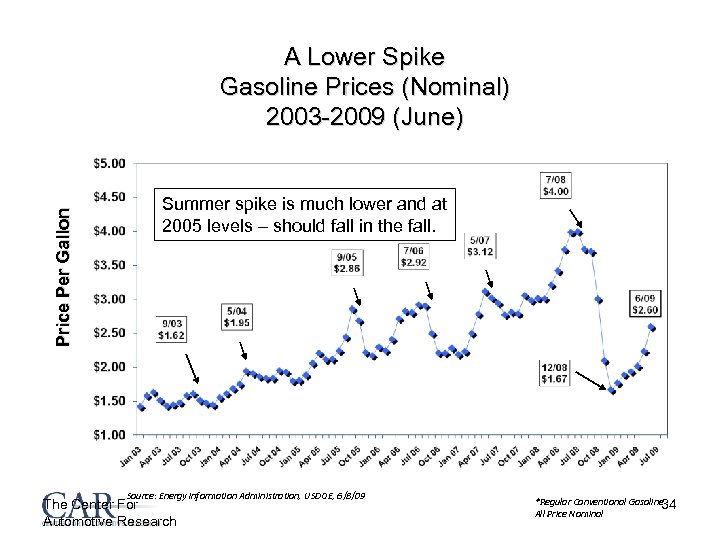
Price Per Gallon A Lower Spike Gasoline Prices (Nominal) 2003 -2009 (June) Summer spike is much lower and at 2005 levels – should fall in the fall. Source: Energy Information Administration, USDOE, 6/8/09 The Center For Automotive Research *Regular Conventional Gasoline 34 All Price Nominal
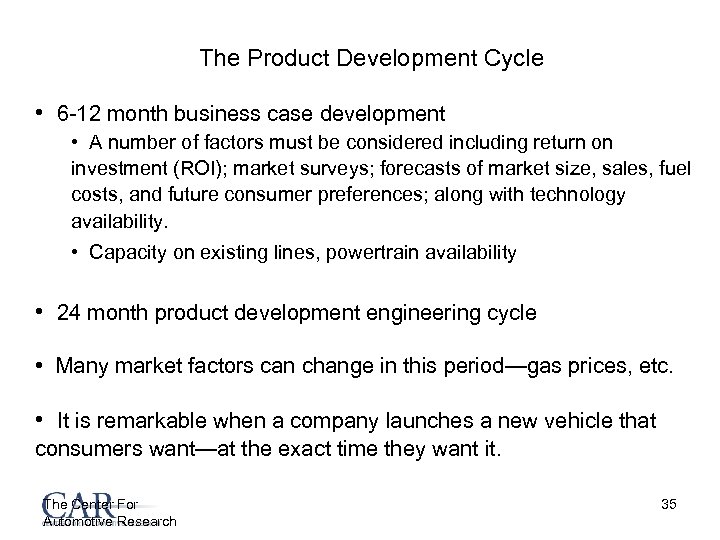
The Product Development Cycle • 6 -12 month business case development • A number of factors must be considered including return on investment (ROI); market surveys; forecasts of market size, sales, fuel costs, and future consumer preferences; along with technology availability. • Capacity on existing lines, powertrain availability • 24 month product development engineering cycle • Many market factors can change in this period—gas prices, etc. • It is remarkable when a company launches a new vehicle that consumers want—at the exact time they want it. The Center For Automotive Research 35
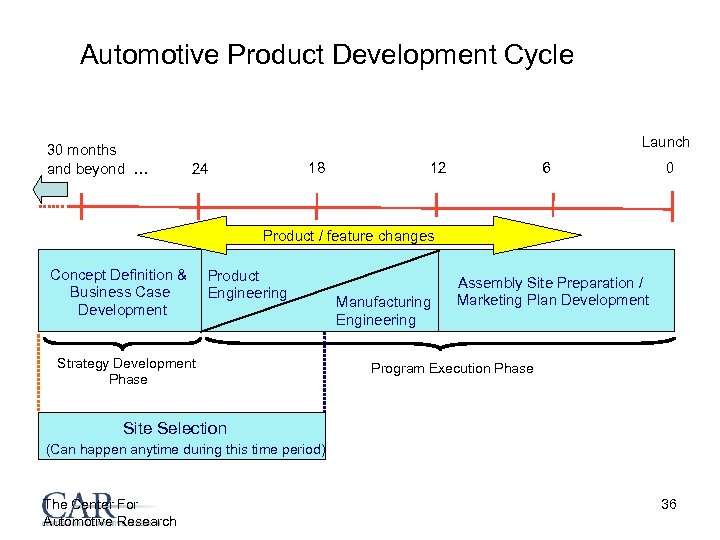
Automotive Product Development Cycle 30 months and beyond … Launch 18 24 6 12 0 Product / feature changes Concept Definition & Business Case Development Product Engineering Strategy Development Phase Manufacturing Engineering Assembly Site Preparation / Marketing Plan Development Program Execution Phase Site Selection (Can happen anytime during this time period) The Center For Automotive Research 36
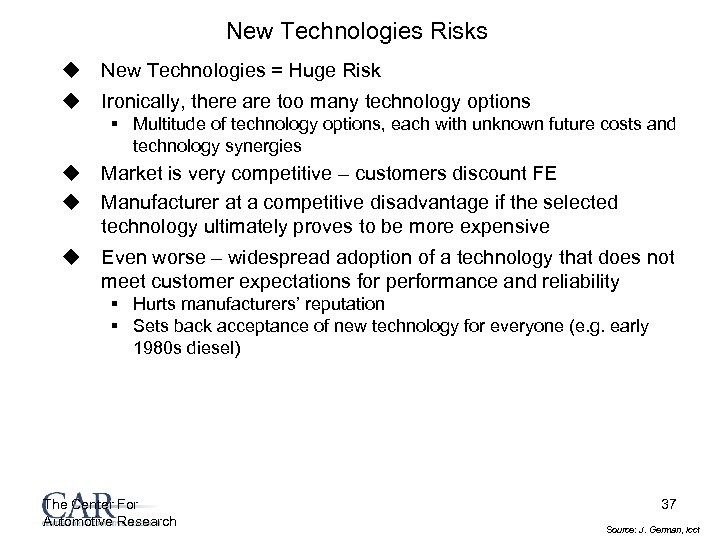
New Technologies Risks u New Technologies = Huge Risk u Ironically, there are too many technology options § Multitude of technology options, each with unknown future costs and technology synergies u Market is very competitive – customers discount FE u Manufacturer at a competitive disadvantage if the selected technology ultimately proves to be more expensive u Even worse – widespread adoption of a technology that does not meet customer expectations for performance and reliability § Hurts manufacturers’ reputation § Sets back acceptance of new technology for everyone (e. g. early 1980 s diesel) The Center For Automotive Research 37 Source: J. German, icct
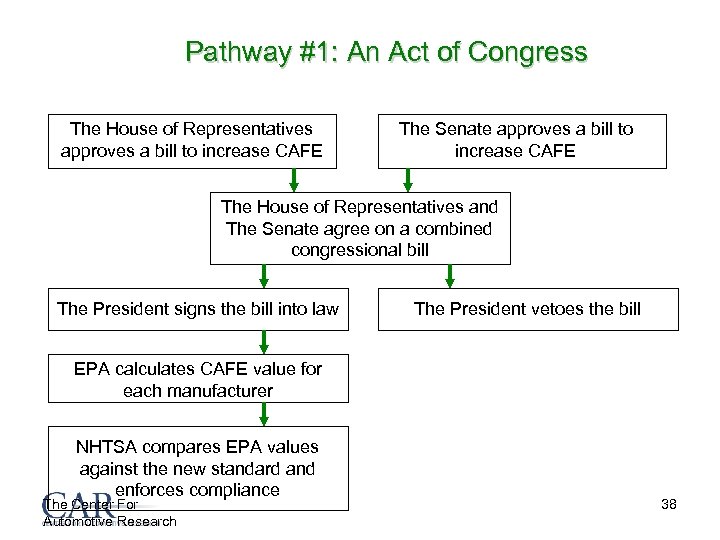
Pathway #1: An Act of Congress The House of Representatives approves a bill to increase CAFE The Senate approves a bill to increase CAFE The House of Representatives and The Senate agree on a combined congressional bill The President signs the bill into law The President vetoes the bill EPA calculates CAFE value for each manufacturer NHTSA compares EPA values against the new standard and enforces compliance The Center For Automotive Research 38
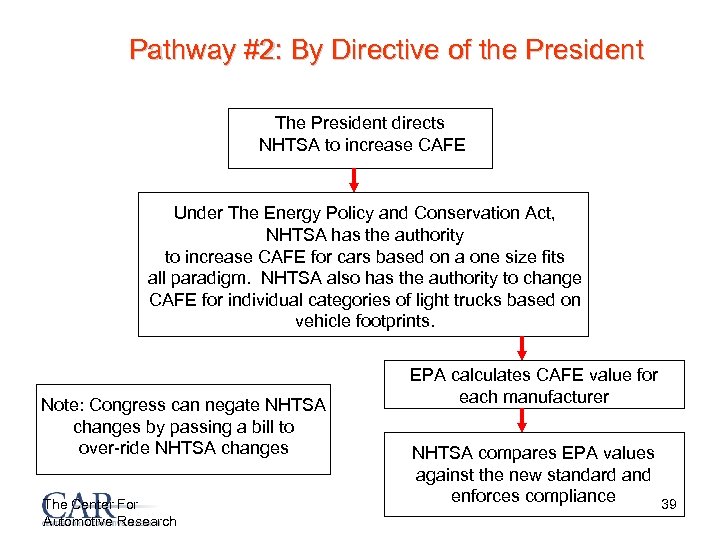
Pathway #2: By Directive of the President The President directs NHTSA to increase CAFE Under The Energy Policy and Conservation Act, NHTSA has the authority to increase CAFE for cars based on a one size fits all paradigm. NHTSA also has the authority to change CAFE for individual categories of light trucks based on vehicle footprints. Note: Congress can negate NHTSA changes by passing a bill to over-ride NHTSA changes The Center For Automotive Research EPA calculates CAFE value for each manufacturer NHTSA compares EPA values against the new standard and enforces compliance 39
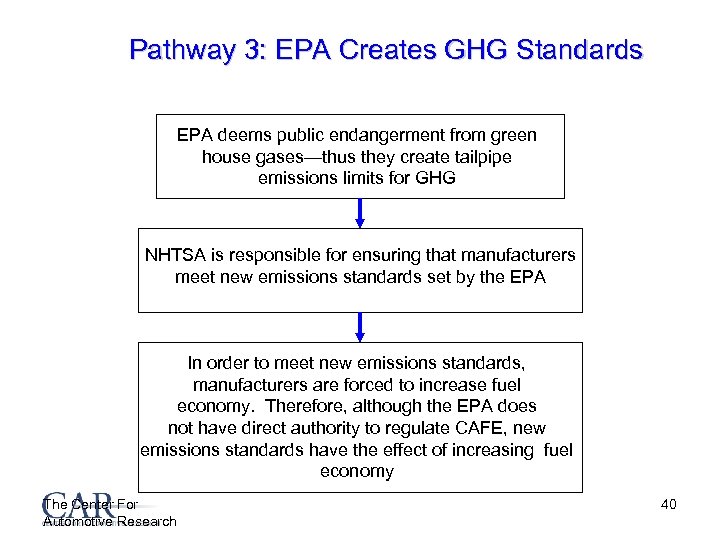
Pathway 3: EPA Creates GHG Standards EPA deems public endangerment from green house gases—thus they create tailpipe emissions limits for GHG NHTSA is responsible for ensuring that manufacturers meet new emissions standards set by the EPA In order to meet new emissions standards, manufacturers are forced to increase fuel economy. Therefore, although the EPA does not have direct authority to regulate CAFE, new emissions standards have the effect of increasing fuel economy The Center For Automotive Research 40
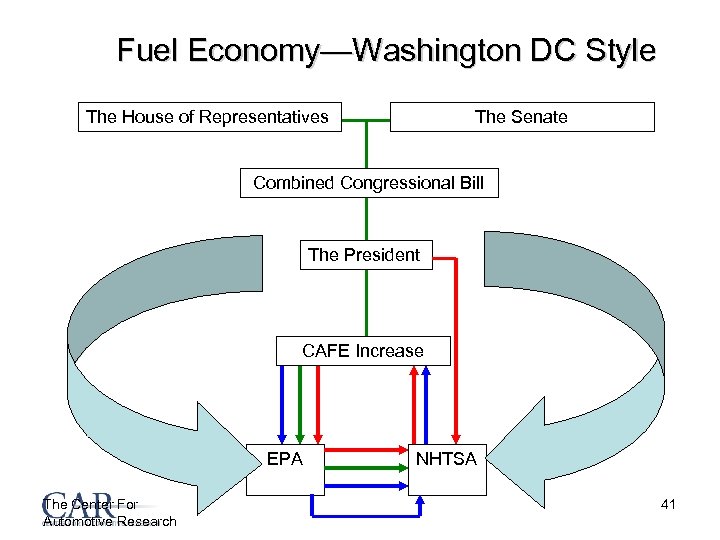
Fuel Economy—Washington DC Style The House of Representatives The Senate Combined Congressional Bill The President CAFE Increase EPA The Center For Automotive Research NHTSA 41
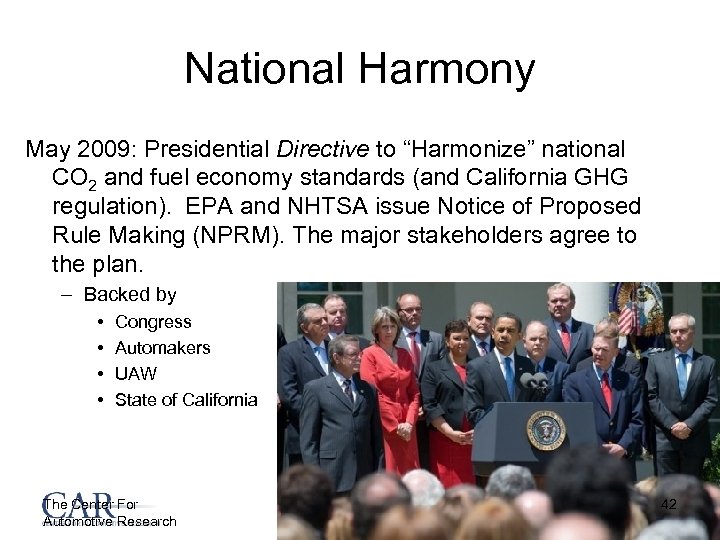
National Harmony May 2009: Presidential Directive to “Harmonize” national CO 2 and fuel economy standards (and California GHG regulation). EPA and NHTSA issue Notice of Proposed Rule Making (NPRM). The major stakeholders agree to the plan. – Backed by • • Congress Automakers UAW State of California The Center For Automotive Research 42
Harmonized Corporate Average Fuel Economy Currently (or before harmonization) • Corporate Average Fuel Economy (CAFE)—Re-defined by EISA of 2007, NHTSA sets the standard, EPA calculates each manufacturers’ averages National CO 2 Regulation via the Clean Air Act—CO 2 is now a harmful emission—measures have not yet been set. California greenhouse gas; a. k. a. the Pavley Rule • • • California granted permission to regulate emissions, agrees to defer to federal rules through 2016, but can set its own rules after 2016 if a future president should back off the national standards The Center For Automotive Research 43
NHTSA CAFE and EPA CO 2 The Same but Different The goal of the Presidential Directive is to provide regulatory compatibility that allows automakers the ability to build a single, national fleet that would comply with both EPA GHG standard and NHTSA CAFE – The two standards will not be identical—but are intended to be compatible. Both include: • Attribute based – Generally using the attribute curves as defined for the 2011 model year measures • Individual fleet averages (for CO 2 and CAFE) – Each automaker would have its own targets based on a sales weighted average of emissions /fuel economy from each model in its fleet—calculated at the end of the year. And, include a passenger car and light truck fleet. • Each Automaker has a CO 2 and CAFE requirement unique to its fleet. – Automakers with fleets comprised of larger vehicles would have a less stringent standard than automakers with a fleet of smaller vehicles. The Center For 44 Automotive Research
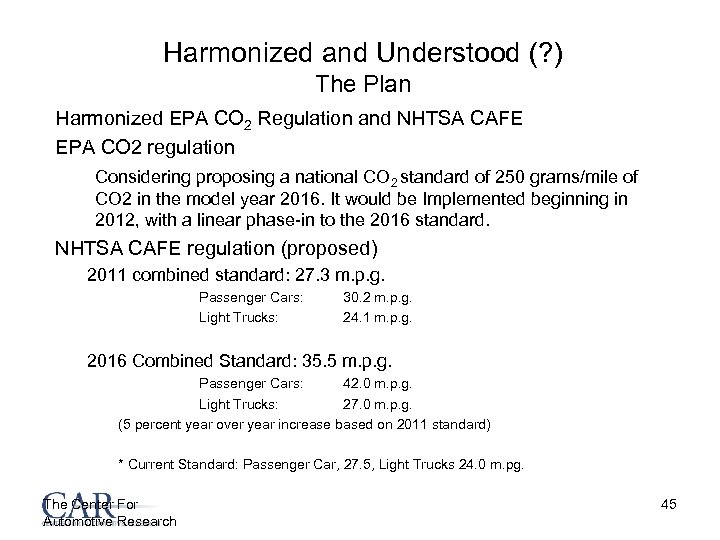
Harmonized and Understood (? ) The Plan Harmonized EPA CO 2 Regulation and NHTSA CAFE EPA CO 2 regulation Considering proposing a national CO 2 standard of 250 grams/mile of CO 2 in the model year 2016. It would be Implemented beginning in 2012, with a linear phase-in to the 2016 standard. NHTSA CAFE regulation (proposed) 2011 combined standard: 27. 3 m. p. g. Passenger Cars: Light Trucks: 30. 2 m. p. g. 24. 1 m. p. g. 2016 Combined Standard: 35. 5 m. p. g. Passenger Cars: 42. 0 m. p. g. Light Trucks: 27. 0 m. p. g. (5 percent year over year increase based on 2011 standard) * Current Standard: Passenger Car, 27. 5, Light Trucks 24. 0 m. pg. The Center For Automotive Research 45
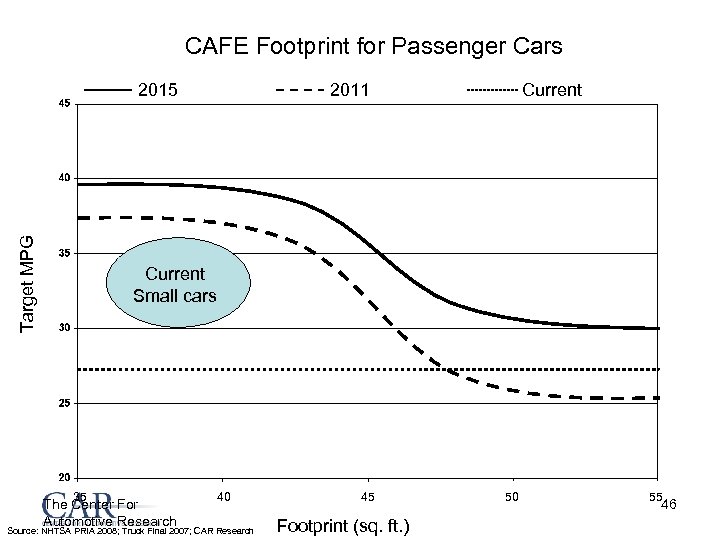
CAFE Footprint for Passenger Cars Target MPG 2015 2011 Current Small cars 35 The Center For Automotive Research 40 Source: NHTSA PRIA 2008; Truck Final 2007; CAR Research 45 Footprint (sq. ft. ) 50 55 46
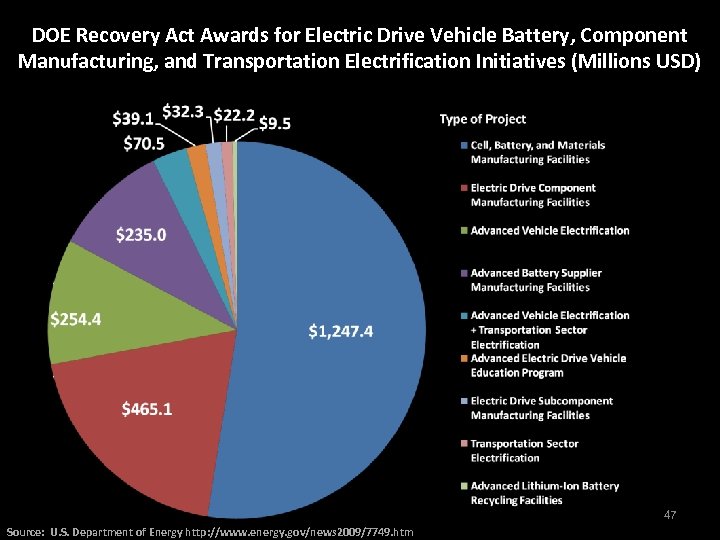
DOE Recovery Act Awards for Electric Drive Vehicle Battery, Component Manufacturing, and Transportation Electrification Initiatives (Millions USD) 47 Source: U. S. Department of Energy http: //www. energy. gov/news 2009/7749. htm
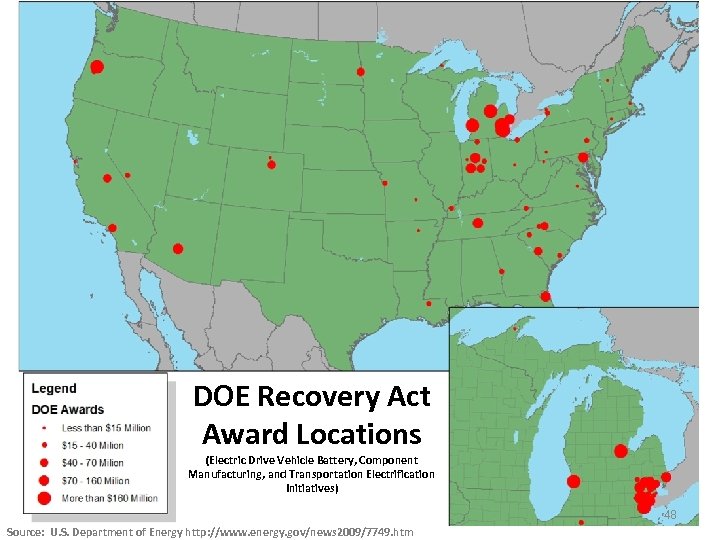
DOE Recovery Act Award Locations (Electric Drive Vehicle Battery, Component Manufacturing, and Transportation Electrification Initiatives) 48 Source: U. S. Department of Energy http: //www. energy. gov/news 2009/7749. htm
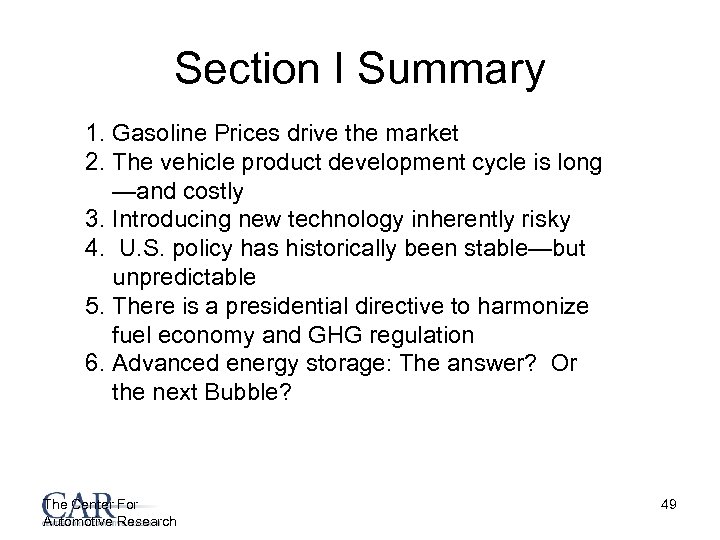
Section I Summary 1. Gasoline Prices drive the market 2. The vehicle product development cycle is long —and costly 3. Introducing new technology inherently risky 4. U. S. policy has historically been stable—but unpredictable 5. There is a presidential directive to harmonize fuel economy and GHG regulation 6. Advanced energy storage: The answer? Or the next Bubble? The Center For Automotive Research 49
Section II POWERTRAIN FORECAST The Center For Automotive Research 50
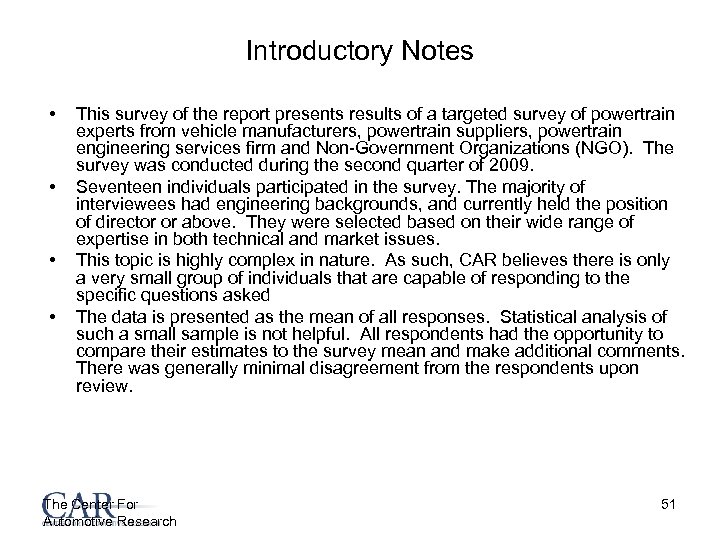
Introductory Notes • • This survey of the report presents results of a targeted survey of powertrain experts from vehicle manufacturers, powertrain suppliers, powertrain engineering services firm and Non-Government Organizations (NGO). The survey was conducted during the second quarter of 2009. Seventeen individuals participated in the survey. The majority of interviewees had engineering backgrounds, and currently held the position of director or above. They were selected based on their wide range of expertise in both technical and market issues. This topic is highly complex in nature. As such, CAR believes there is only a very small group of individuals that are capable of responding to the specific questions asked The data is presented as the mean of all responses. Statistical analysis of such a small sample is not helpful. All respondents had the opportunity to compare their estimates to the survey mean and make additional comments. There was generally minimal disagreement from the respondents upon review. The Center For Automotive Research 51
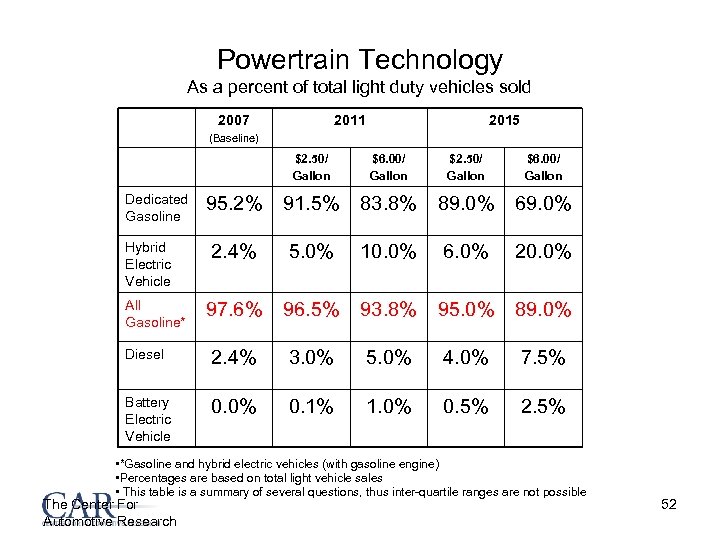
Powertrain Technology As a percent of total light duty vehicles sold 2007 2011 2015 (Baseline) $2. 50/ Gallon $6. 00/ Gallon 95. 2% 91. 5% 83. 8% 89. 0% 69. 0% 2. 4% 5. 0% 10. 0% 6. 0% 20. 0% 97. 6% 96. 5% 93. 8% 95. 0% 89. 0% Diesel 2. 4% 3. 0% 5. 0% 4. 0% 7. 5% Battery Electric Vehicle 0. 0% 0. 1% 1. 0% 0. 5% 2. 5% Dedicated Gasoline Hybrid Electric Vehicle All Gasoline* • *Gasoline and hybrid electric vehicles (with gasoline engine) • Percentages are based on total light vehicle sales • This table is a summary of several questions, thus inter-quartile ranges are not possible The Center For Automotive Research 52
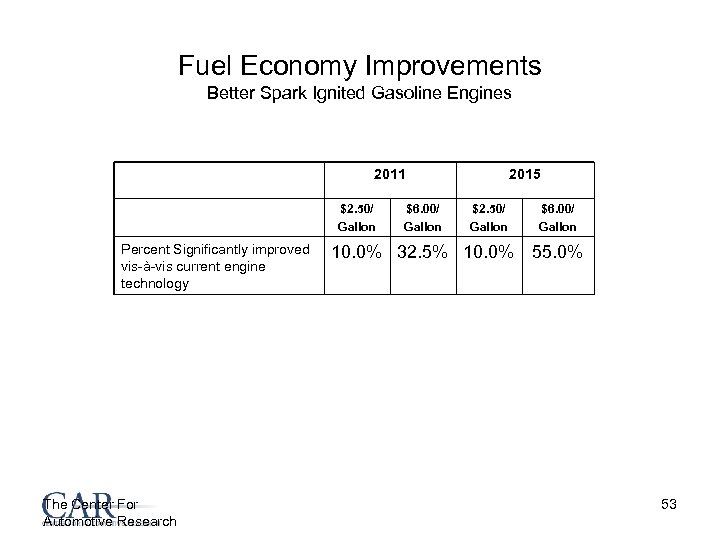
Fuel Economy Improvements Better Spark Ignited Gasoline Engines 2011 $2. 50/ Gallon Percent Significantly improved vis-à-vis current engine technology The Center For Automotive Research $6. 00/ Gallon 2015 $2. 50/ Gallon $6. 00/ Gallon 10. 0% 32. 5% 10. 0% 55. 0% 53
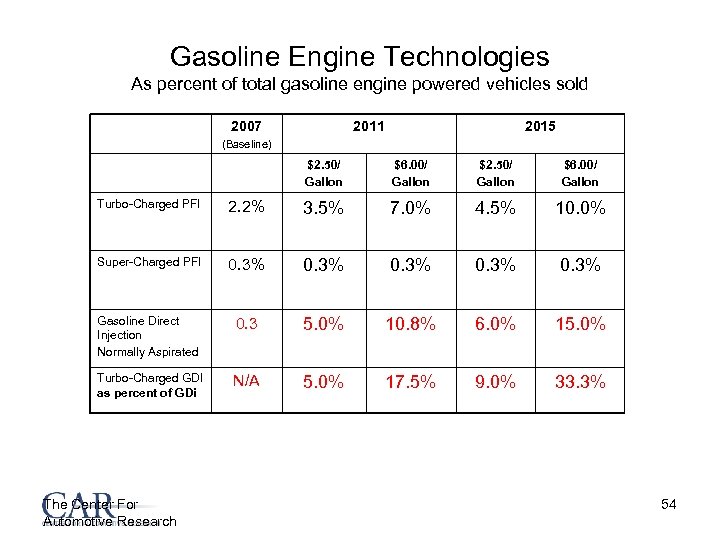
Gasoline Engine Technologies As percent of total gasoline engine powered vehicles sold 2007 2011 2015 (Baseline) $2. 50/ Gallon $6. 00/ Gallon Turbo-Charged PFI 2. 2% 3. 5% 7. 0% 4. 5% 10. 0% Super-Charged PFI 0. 3% Gasoline Direct Injection Normally Aspirated 0. 3 5. 0% 10. 8% 6. 0% 15. 0% Turbo-Charged GDI as percent of GDi N/A 5. 0% 17. 5% 9. 0% 33. 3% The Center For Automotive Research 54
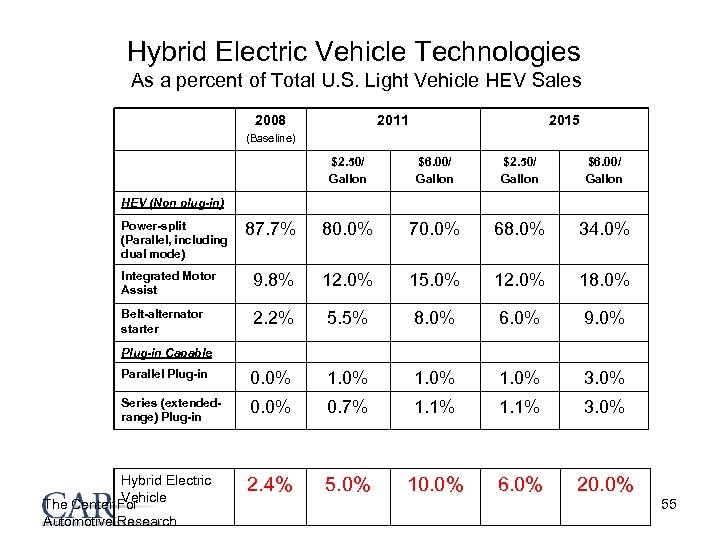
Hybrid Electric Vehicle Technologies As a percent of Total U. S. Light Vehicle HEV Sales 2008 2011 2015 (Baseline) $2. 50/ Gallon $6. 00/ Gallon HEV (Non plug-in) Power-split (Parallel, including dual mode) 87. 7% 80. 0% 70. 0% 68. 0% 34. 0% Integrated Motor Assist 9. 8% 12. 0% 15. 0% 12. 0% 18. 0% Belt-alternator starter 2. 2% 5. 5% 8. 0% 6. 0% 9. 0% Parallel Plug-in 0. 0% 1. 0% 3. 0% Series (extendedrange) Plug-in 0. 0% 0. 7% 1. 1% 3. 0% 2. 4% 5. 0% 10. 0% 6. 0% 20. 0% Plug-in Capable Hybrid Electric Vehicle The Center For Automotive Research 55
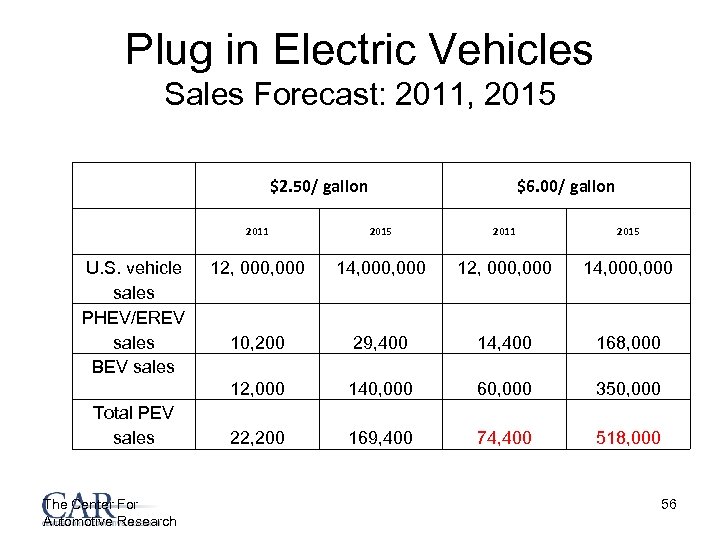
Plug in Electric Vehicles Sales Forecast: 2011, 2015 $2. 50/ gallon $6. 00/ gallon 2011 Total PEV sales The Center For Automotive Research 2011 2015 12, 000, 000 14, 000, 000 10, 200 29, 400 14, 400 168, 000 12, 000 U. S. vehicle sales PHEV/EREV sales BEV sales 2015 140, 000 60, 000 350, 000 22, 200 169, 400 74, 400 518, 000 56
PEV Manufacturing Models • 1) The traditional vehicle manufacturers • 2) The new automotive manufacturers, • 3) The U. S. -based venture capital startups • 4) the international independent start-ups. The Center For Automotive Research 57
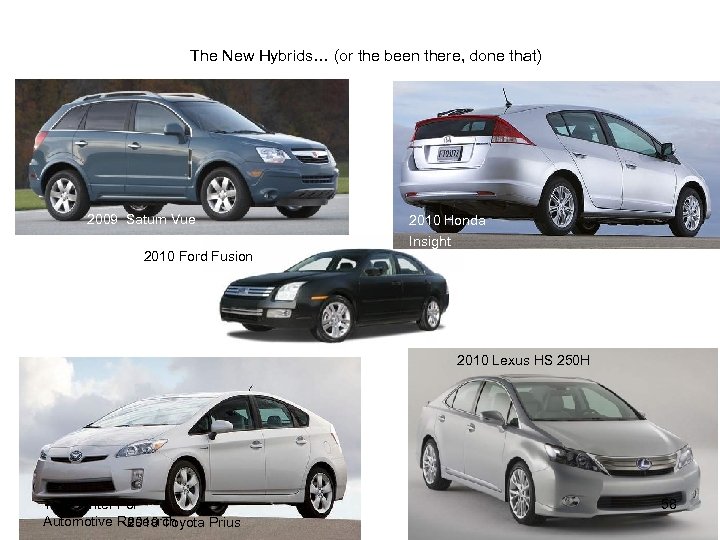
The New Hybrids… (or the been there, done that) 2009 Saturn Vue 2010 Ford Fusion 2010 Honda Insight 2010 Lexus HS 250 H 58 The Center For BYD F 3 DM PHEV Automotive Research 2010 Toyota Prius 58
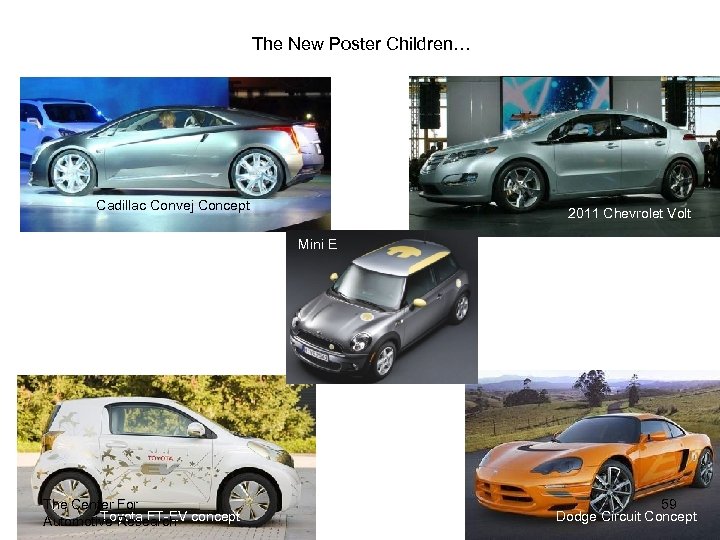
The New Poster Children… Cadillac Convej Concept 2011 Chevrolet Volt Mini E 59 The Center For Toyota FT-EV concept Automotive Research 59 Dodge Circuit Concept
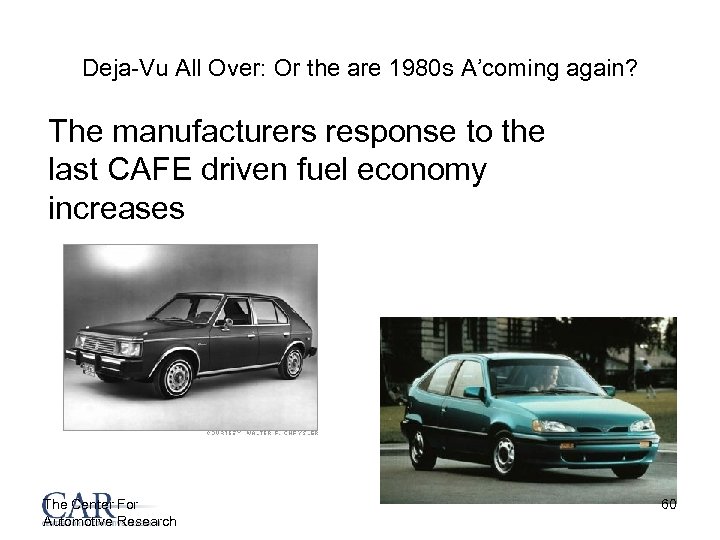
Deja-Vu All Over: Or the are 1980 s A’coming again? The manufacturers response to the last CAFE driven fuel economy increases The Center For Automotive Research 60
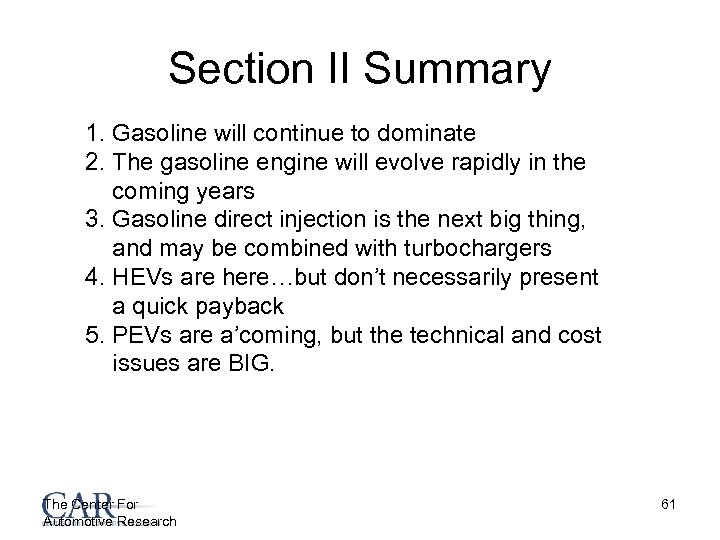
Section II Summary 1. Gasoline will continue to dominate 2. The gasoline engine will evolve rapidly in the coming years 3. Gasoline direct injection is the next big thing, and may be combined with turbochargers 4. HEVs are here…but don’t necessarily present a quick payback 5. PEVs are a’coming, but the technical and cost issues are BIG. The Center For Automotive Research 61
Automotive Powertrain Forecast: What is Coming, and What are the Implications Thank you! The Center For Automotive Research 62
2009 Stakeholder Relations Customer Survey Results ITC Partners in Business Meeting September 10, 2009 Copyright © 2009 by Scott. Madden. All rights reserved.
Scott. Madden Introduction About Scott. Madden is a general management consulting firm that specializes in the energy industry and has served more than 150 energy companies across the country and around the world. Scott. Madden’s clients include integrated utilities, competitive energy suppliers, retail energy suppliers, energy delivery specialists, trading and marketing firms, RTOs/ISOs/ITCs, gas pipelines, LCDs, global IPPs, regulators, and government agencies. Apart from its energy industry focus, Scott. Madden has practices focused on Sustainability, Shared Services, and the Federal Government. For more than 25 years, clients have trusted Scott. Madden to provide guidance as they face the challenges associated with growing, consolidating, acquiring or just aspiring to do what they do better. They trust Scott. Madden’s people, methods, and solutions; and to see them through, start to finish. Karen Hilton Bio Karen is a Director at Scott. Madden and has twelve years of consulting experience with the firm. She has focused on customer satisfaction surveys, process improvement, organizational design and restructuring, and cost reduction analysis in both shared services and energy. Karen manages Scott. Madden’s survey business focused on internal customer satisfaction and engagement of employees in the service delivery process. Karen has an undergraduate business degree from Wake Forest and an M. B. A. from the University of North Carolina at Chapel Hill. Copyright © 2008 by Scott. Madden. All rights reserved. 64
Contents u u Introduction Summary Findings Survey Results Conclusions 65
Introduction Survey Objectives u Understand stakeholder satisfaction with ITC Stakeholder Relations and ITC overall u Establish a baseline of performance to enable measurement of performance over time u Learn about communication preferences and desired frequency of interaction u Solicit ideas for how ITC can add value for its customers 66
Introduction (Cont’d) About the Survey u The survey was administered using Inquisite, a web -based survey tool used by Scott. Madden u The survey was launched on Monday, May 18 th and was closed on Friday, June 19 th u Survey invitations were sent to 182 stakeholder contacts in various organizations u Reminder messages, phone calls, and a gift card drawing were used to encourage participation u At the end of the survey period, a total of 80 responses were collected, representing a 44% response rate 67
Summary Findings u Overall, survey respondents show high levels of satisfaction with 78% providing favorable ratings on overall satisfaction with ITC — All questions have mean scores on the positive end of the rating scale (means greater than 3. 0, where 5. 0 is best) u The questions with the three highest mean scores are: — ‘ITC Stakeholder Relations department is pleasant, accommodating, and treats me with respect’ — ‘When dealing with ITC, I am treated with consideration and respect’ — ‘ITC provides reliable power to its customers’ 68
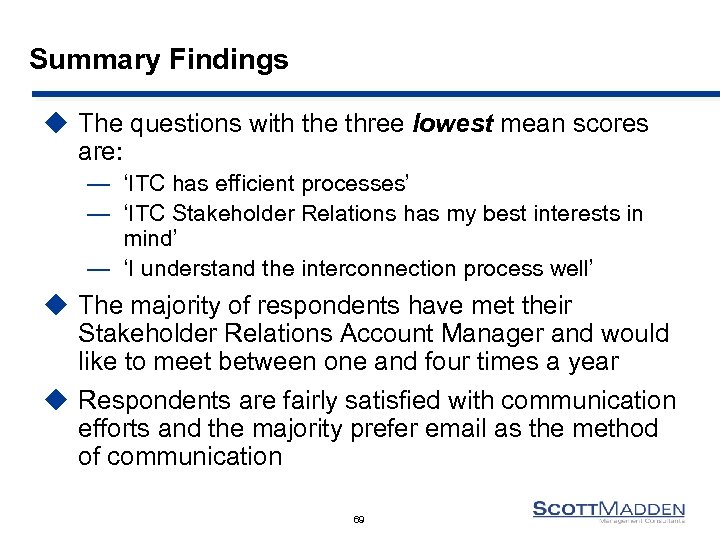
Summary Findings u The questions with the three lowest mean scores are: — ‘ITC has efficient processes’ — ‘ITC Stakeholder Relations has my best interests in mind’ — ‘I understand the interconnection process well’ u The majority of respondents have met their Stakeholder Relations Account Manager and would like to meet between one and four times a year u Respondents are fairly satisfied with communication efforts and the majority prefer email as the method of communication 69
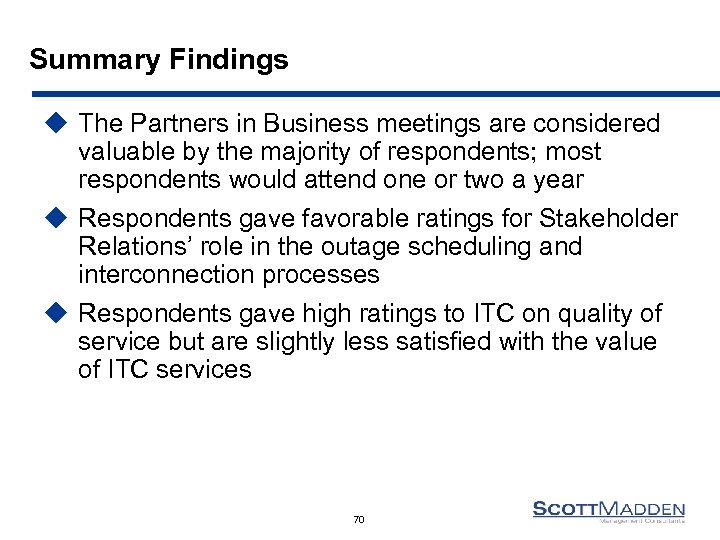
Summary Findings u The Partners in Business meetings are considered valuable by the majority of respondents; most respondents would attend one or two a year u Respondents gave favorable ratings for Stakeholder Relations’ role in the outage scheduling and interconnection processes u Respondents gave high ratings to ITC on quality of service but are slightly less satisfied with the value of ITC services 70
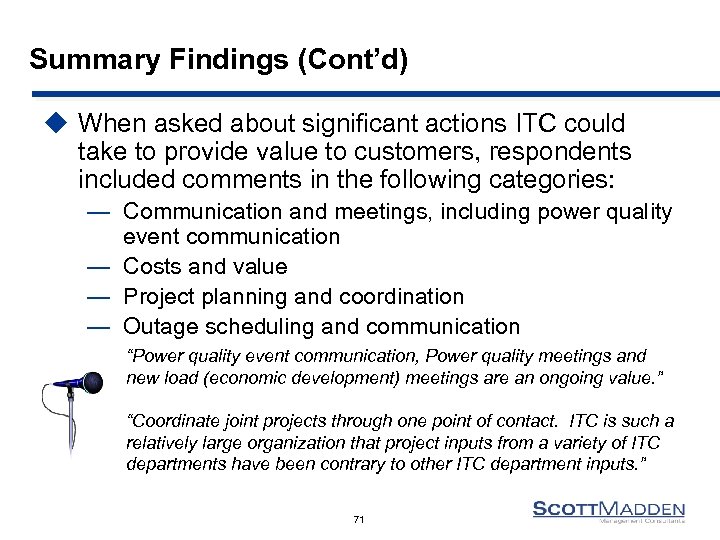
Summary Findings (Cont’d) u When asked about significant actions ITC could take to provide value to customers, respondents included comments in the following categories: — Communication and meetings, including power quality event communication — Costs and value — Project planning and coordination — Outage scheduling and communication “Power quality event communication, Power quality meetings and new load (economic development) meetings are an ongoing value. ” “Coordinate joint projects through one point of contact. ITC is such a relatively large organization that project inputs from a variety of ITC departments have been contrary to other ITC department inputs. ” 71
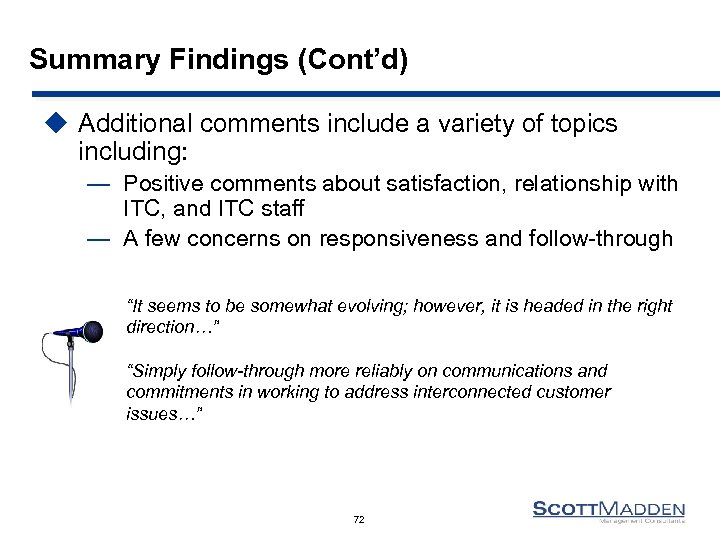
Summary Findings (Cont’d) u Additional comments include a variety of topics including: — Positive comments about satisfaction, relationship with ITC, and ITC staff — A few concerns on responsiveness and follow-through “It seems to be somewhat evolving; however, it is headed in the right direction…” “Simply follow-through more reliably on communications and commitments in working to address interconnected customer issues…” 72
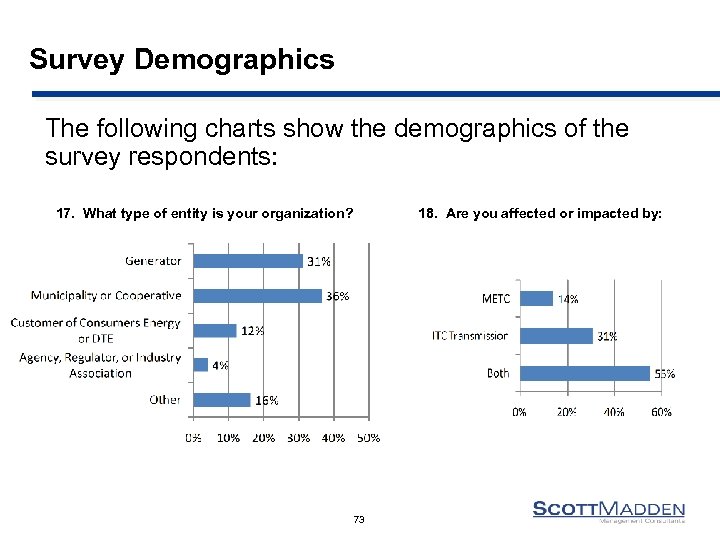
Survey Demographics The following charts show the demographics of the survey respondents: 17. What type of entity is your organization? 18. Are you affected or impacted by: 73
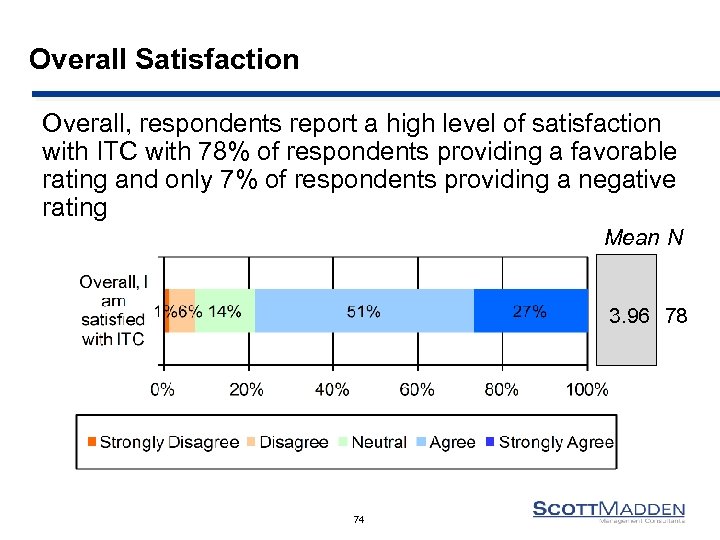
Overall Satisfaction Overall, respondents report a high level of satisfaction with ITC with 78% of respondents providing a favorable rating and only 7% of respondents providing a negative rating Mean N 3. 96 78 74
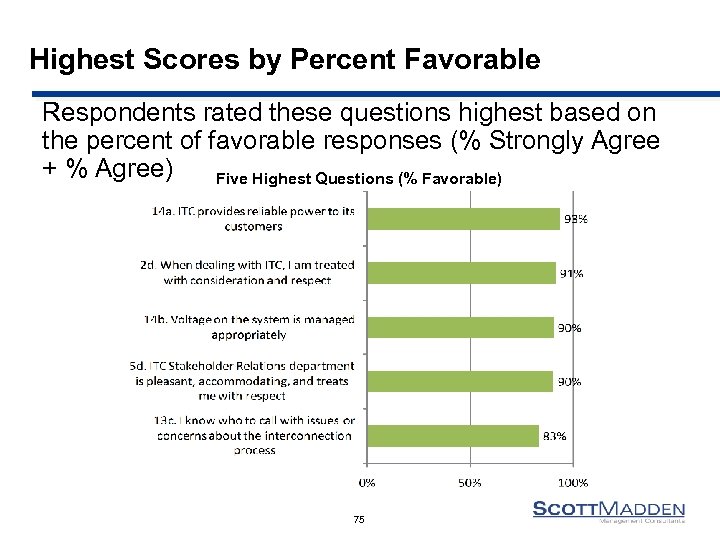
Highest Scores by Percent Favorable Respondents rated these questions highest based on the percent of favorable responses (% Strongly Agree + % Agree) Five Highest Questions (% Favorable) 75
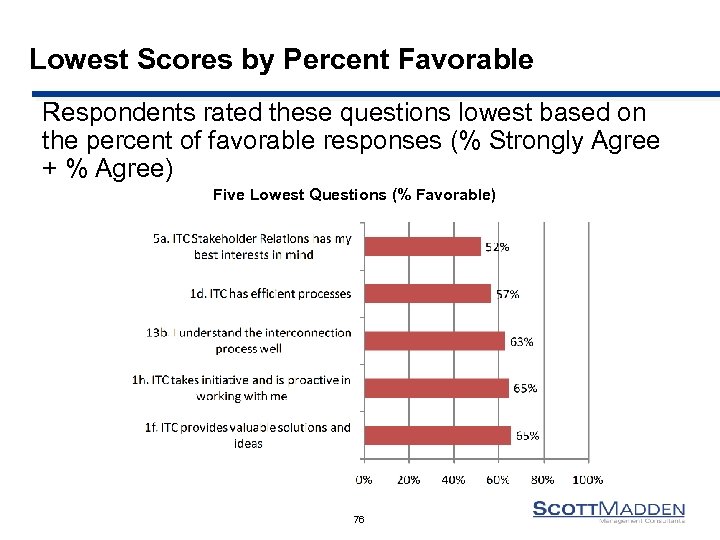
Lowest Scores by Percent Favorable Respondents rated these questions lowest based on the percent of favorable responses (% Strongly Agree + % Agree) Five Lowest Questions (% Favorable) 76
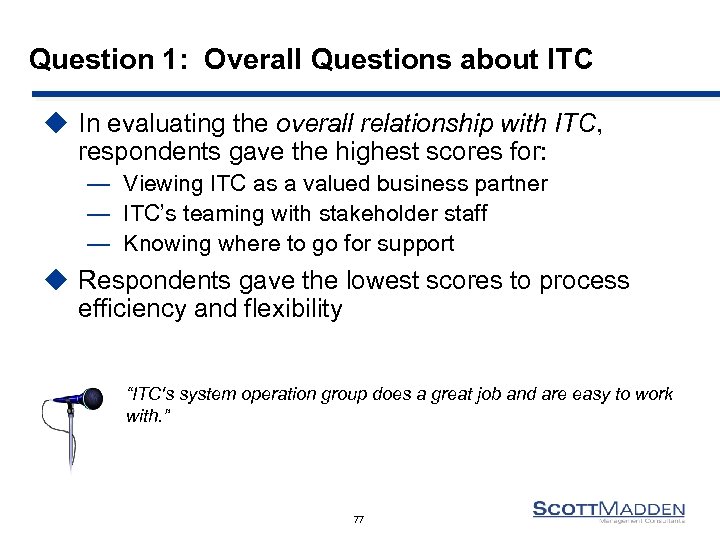
Question 1: Overall Questions about ITC u In evaluating the overall relationship with ITC, respondents gave the highest scores for: — Viewing ITC as a valued business partner — ITC’s teaming with stakeholder staff — Knowing where to go for support u Respondents gave the lowest scores to process efficiency and flexibility “ITC's system operation group does a great job and are easy to work with. ” 77
Question 2: Satisfaction with Interactions with or Support from ITC u Respondents are very satisfied with the way they are treated by ITC and management’s availability to address problems u While still generally positive, respondents gave lower ratings for ITC’s timeliness 78
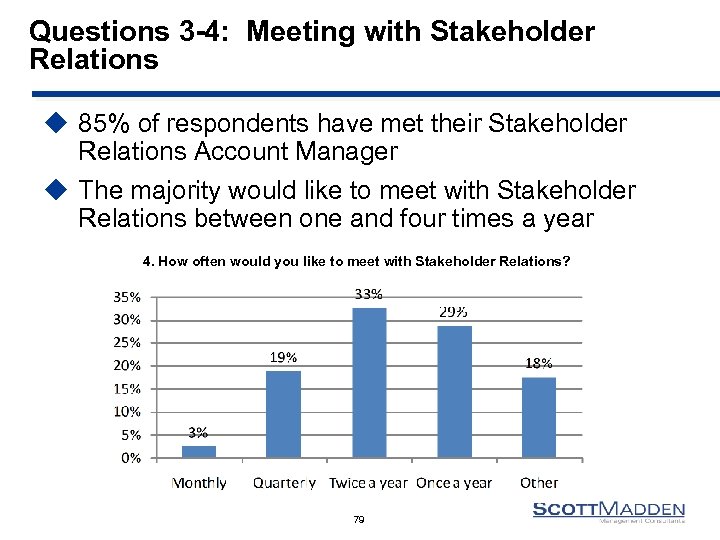
Questions 3 -4: Meeting with Stakeholder Relations u 85% of respondents have met their Stakeholder Relations Account Manager u The majority would like to meet with Stakeholder Relations between one and four times a year 4. How often would you like to meet with Stakeholder Relations? 79
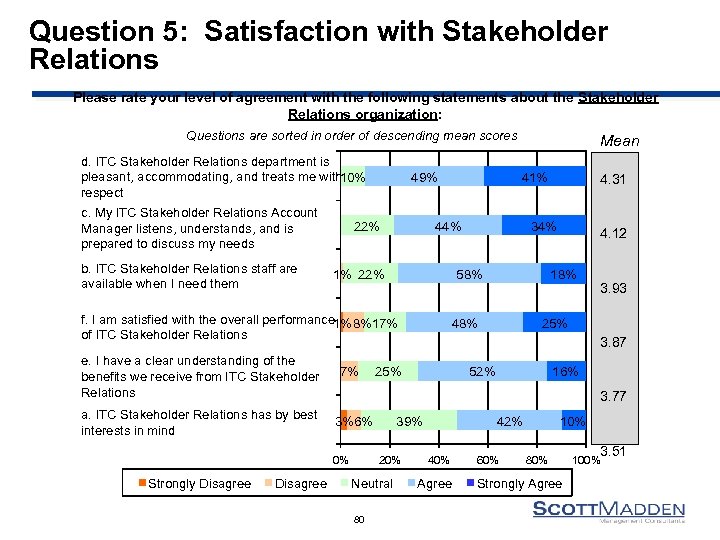
Question 5: Satisfaction with Stakeholder Relations Please rate your level of agreement with the following statements about the Stakeholder Relations organization: Questions are sorted in order of descending mean scores d. ITC Stakeholder Relations department is pleasant, accommodating, and treats me with 10% respect c. My ITC Stakeholder Relations Account Manager listens, understands, and is prepared to discuss my needs b. ITC Stakeholder Relations staff are available when I need them 49% 22% a. ITC Stakeholder Relations has by best interests in mind 1% 22% 7% Disagree 4. 31 34% 58% 4. 12 18% 48% 3. 93 25% 3. 87 25% 52% 16% 3. 77 3% 6% 0% Strongly Disagree 41% 44% f. I am satisfied with the overall performance 8%17% 1% of ITC Stakeholder Relations e. I have a clear understanding of the benefits we receive from ITC Stakeholder Relations Mean 39% 20% Neutral 80 42% 40% Agree 60% 10% 80% Strongly Agree 3. 51 100%
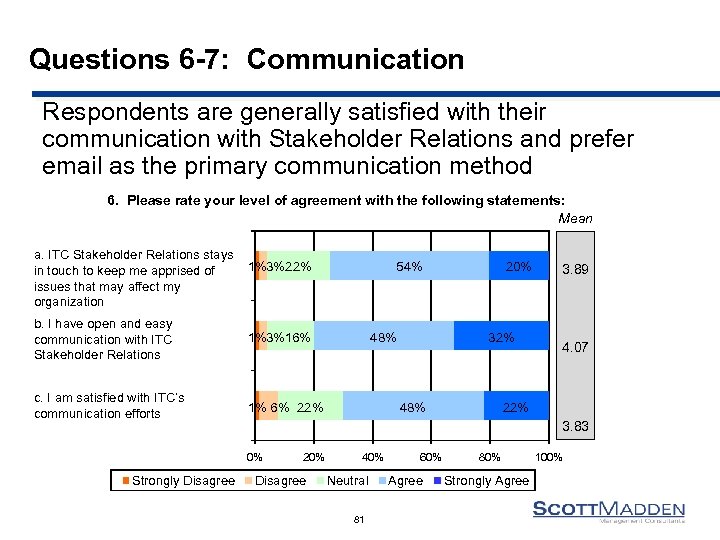
Questions 6 -7: Communication Respondents are generally satisfied with their communication with Stakeholder Relations and prefer email as the primary communication method 6. Please rate your level of agreement with the following statements: Mean a. ITC Stakeholder Relations stays 1%3% 22% in touch to keep me apprised of issues that may affect my organization b. I have open and easy communication with ITC Stakeholder Relations 1%3% 16% c. I am satisfied with ITC’s communication efforts 54% 1% 6% 22% 32% 48% 3. 89 4. 07 22% 3. 83 0% Strongly Disagree 48% 20% Disagree 40% Neutral 81 60% Agree 80% Strongly Agree 100%
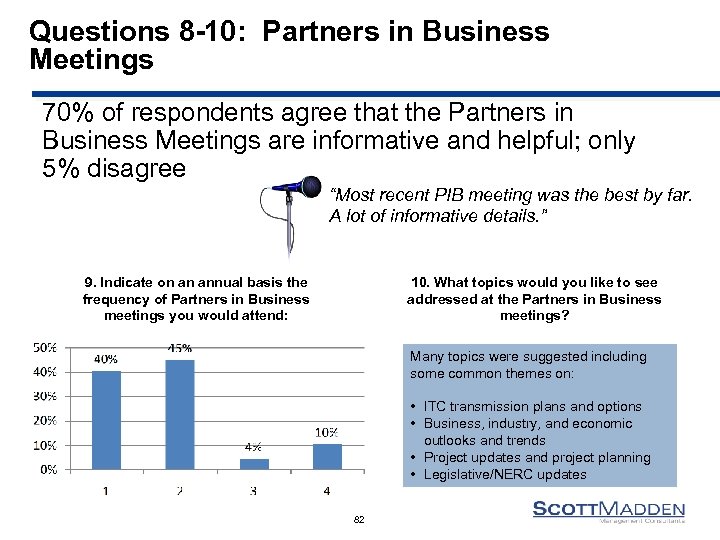
Questions 8 -10: Partners in Business Meetings 70% of respondents agree that the Partners in Business Meetings are informative and helpful; only 5% disagree “Most recent PIB meeting was the best by far. A lot of informative details. ” 9. Indicate on an annual basis the frequency of Partners in Business meetings you would attend: 10. What topics would you like to see addressed at the Partners in Business meetings? Many topics were suggested including some common themes on: • ITC transmission plans and options • Business, industry, and economic outlooks and trends • Project updates and project planning • Legislative/NERC updates 82
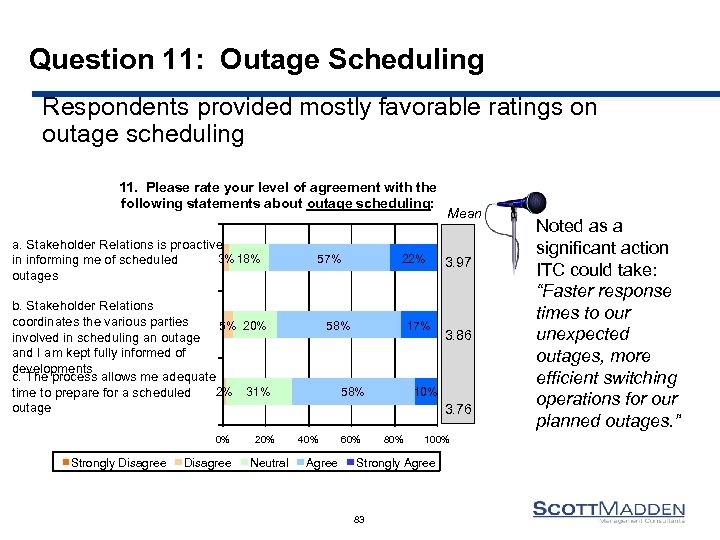
Question 11: Outage Scheduling Respondents provided mostly favorable ratings on outage scheduling 11. Please rate your level of agreement with the following statements about outage scheduling: a. Stakeholder Relations is proactive 3% 18% in informing me of scheduled outages 57% b. Stakeholder Relations coordinates the various parties 5% 20% involved in scheduling an outage and I am kept fully informed of developments c. The process allows me adequate 2% 31% time to prepare for a scheduled outage 0% Strongly Disagree 20% Neutral 22% 58% 17% 58% Mean 3. 97 3. 86 10% 3. 76 40% Agree 60% 80% 100% Strongly Agree 83 Noted as a significant action ITC could take: “Faster response times to our unexpected outages, more efficient switching operations for our planned outages. ”
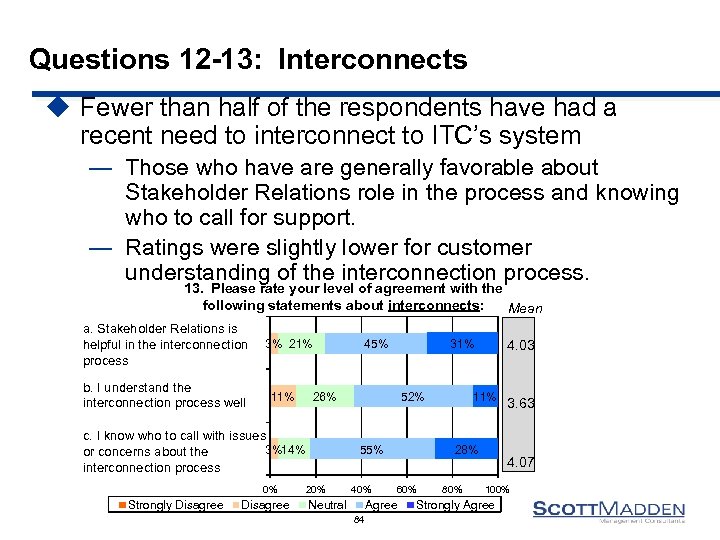
Questions 12 -13: Interconnects u Fewer than half of the respondents have had a recent need to interconnect to ITC’s system — Those who have are generally favorable about Stakeholder Relations role in the process and knowing who to call for support. — Ratings were slightly lower for customer understanding of the interconnection process. 13. Please rate your level of agreement with the following statements about interconnects: Mean a. Stakeholder Relations is helpful in the interconnection process b. I understand the interconnection process well 3% 21% 11% Strongly Disagree 52% 55% 20% 40% Neutral 11% 28% 60% Agree 84 4. 03 31% 26% c. I know who to call with issues 3%14% or concerns about the interconnection process 0% 45% 80% 3. 63 4. 07 100% Strongly Agree
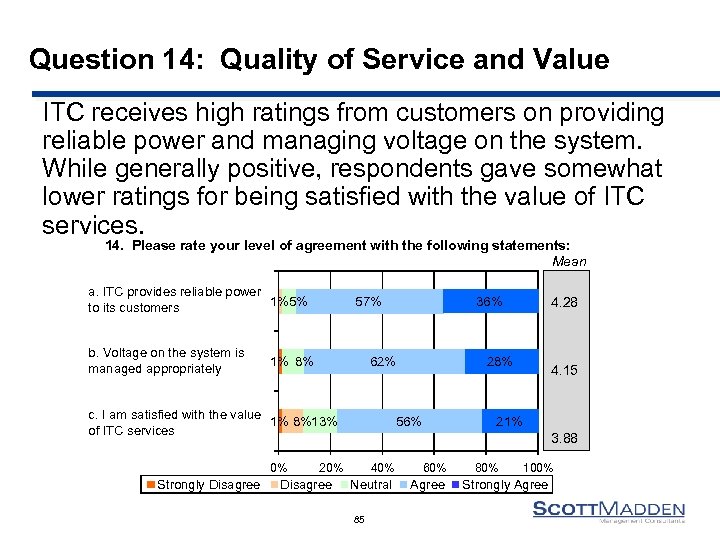
Question 14: Quality of Service and Value ITC receives high ratings from customers on providing reliable power and managing voltage on the system. While generally positive, respondents gave somewhat lower ratings for being satisfied with the value of ITC services. 14. Please rate your level of agreement with the following statements: Mean a. ITC provides reliable power 1%5% to its customers b. Voltage on the system is managed appropriately 57% 1% 8% 62% c. I am satisfied with the value 1% 8%13% of ITC services 0% Strongly Disagree 36% 28% 56% 4. 15 21% 3. 88 20% Disagree 4. 28 40% 60% Neutral Agree 85 80% 100% Strongly Agree
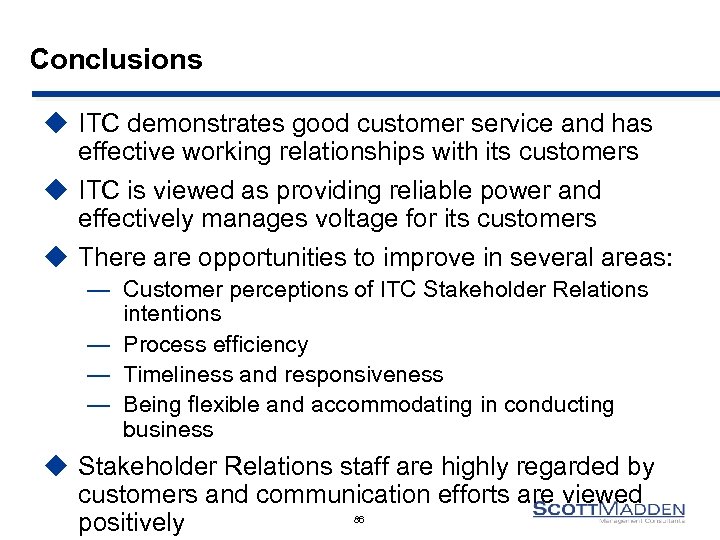
Conclusions u ITC demonstrates good customer service and has effective working relationships with its customers u ITC is viewed as providing reliable power and effectively manages voltage for its customers u There are opportunities to improve in several areas: — Customer perceptions of ITC Stakeholder Relations intentions — Process efficiency — Timeliness and responsiveness — Being flexible and accommodating in conducting business u Stakeholder Relations staff are highly regarded by customers and communication efforts are viewed positively 86
Karen Hilton Director Scott. Madden, Inc. 2626 Glenwood Ave Suite 480 Raleigh, NC 27608 Phone: 919 -781 -4191 Mobile: 919 -423 -8399 karenhilton@scottmadden. c om 87
ITC Response to Survey Results Jeff Dorr Manager, Stakeholder Relations
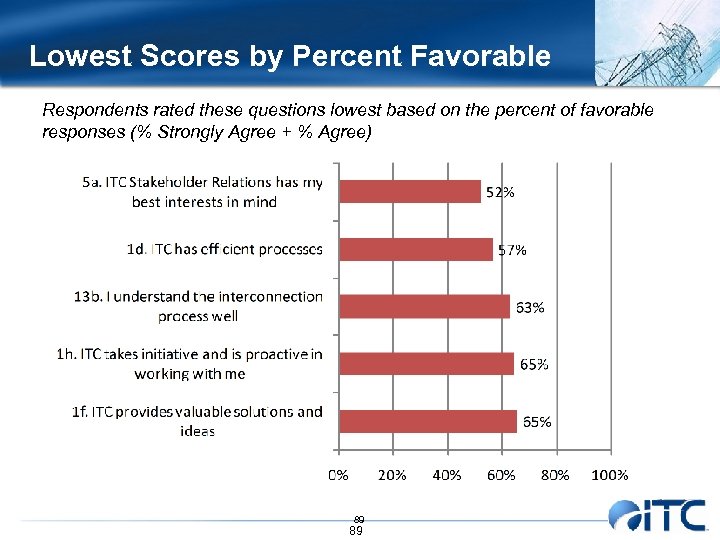
Lowest Scores by Percent Favorable Respondents rated these questions lowest based on the percent of favorable responses (% Strongly Agree + % Agree) Five Lowest Questions (% Favorable) 89 89
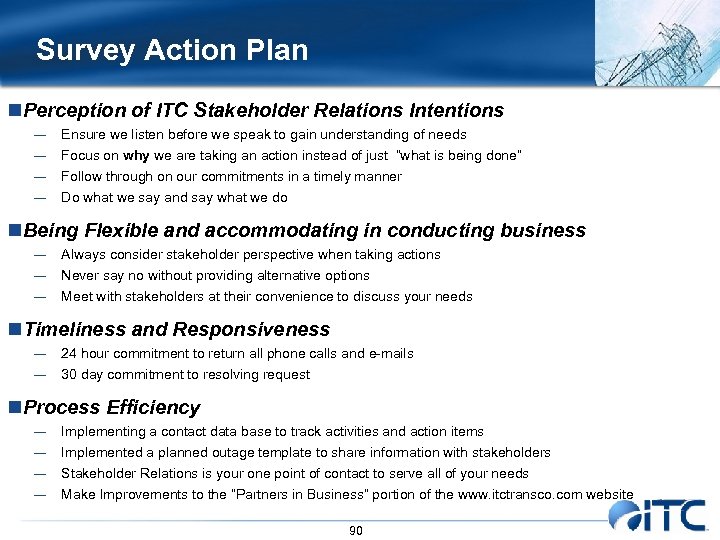
Survey Action Plan n. Perception of ITC Stakeholder Relations Intentions — Ensure we listen before we speak to gain understanding of needs — Focus on why we are taking an action instead of just “what is being done” — Follow through on our commitments in a timely manner Do what we say and say what we do — n. Being Flexible and accommodating in conducting business — — — Always consider stakeholder perspective when taking actions Never say no without providing alternative options Meet with stakeholders at their convenience to discuss your needs n. Timeliness and Responsiveness — — 24 hour commitment to return all phone calls and e-mails 30 day commitment to resolving request n. Process Efficiency — — Implementing a contact data base to track activities and action items Implemented a planned outage template to share information with stakeholders Stakeholder Relations is your one point of contact to serve all of your needs Make Improvements to the “Partners in Business” portion of the www. itctransco. com website 90
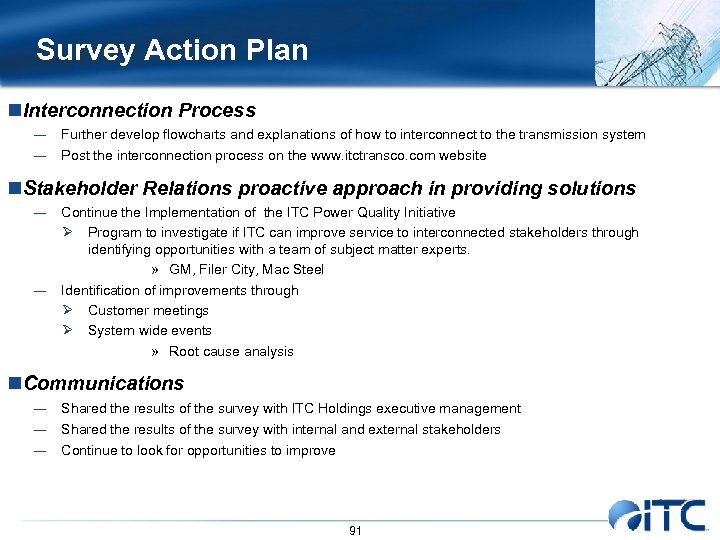
Survey Action Plan n. Interconnection Process — Further develop flowcharts and explanations of how to interconnect to the transmission system — Post the interconnection process on the www. itctransco. com website n. Stakeholder Relations proactive approach in providing solutions — — Continue the Implementation of the ITC Power Quality Initiative Ø Program to investigate if ITC can improve service to interconnected stakeholders through identifying opportunities with a team of subject matter experts. » GM, Filer City, Mac Steel Identification of improvements through Ø Customer meetings Ø System wide events » Root cause analysis n. Communications — — — Shared the results of the survey with ITC Holdings executive management Shared the results of the survey with internal and external stakeholders Continue to look for opportunities to improve 91
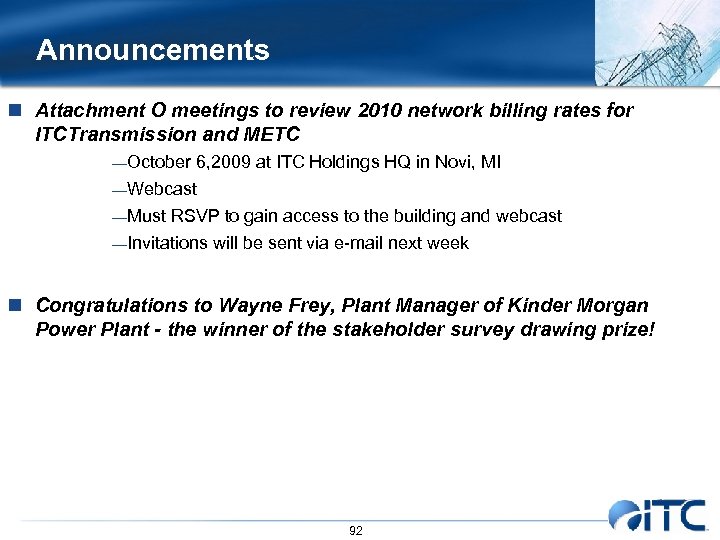
Announcements n Attachment O meetings to review 2010 network billing rates for ITCTransmission and METC —October 6, 2009 at ITC Holdings HQ in Novi, MI —Webcast —Must RSVP to gain access to the building and webcast —Invitations will be sent via e-mail next week n Congratulations to Wayne Frey, Plant Manager of Kinder Morgan Power Plant - the winner of the stakeholder survey drawing prize! 92
THANK YOU !!!!! For electronic copies of ITC presentations please visit the Partners in Business tab found on our web-site at: www. itctransco. com Drive home safely 93
Contact information u Jeff Dorr ITC Holdings Manager, Stakeholder Relations 248. 946. 3482 Office 248. 660. 7109 Cell jdorr@itctransco. com u Dave Nagy ITC Holdings Account Manager 248. 946. 3480 Office 248. 881. 9208 Cell dnagy@itctransco. com 94
GOLF 95
Скачать презентацию FALL PARTNERS IN BUSINESS Ypsilanti Michigan September 10
f694f27f8f7f6fd83316755090aed199.ppt