


 Скачать презентацию Fall Agricultural Education Professional Development Conference Developing a
65988558daaf5520e3d48932011a1b33.ppt
- Количество слайдов: 23
 Fall Agricultural Education Professional Development Conference Developing a Program of Study September 30, 2011
 CTE Program Is guided by a strong advisory committee that helps support and sustain the program of study; Consists of a coherent sequence of three or more CTE courses, and includes strong academic and career and technical courses; Incorporates opportunities to participate in structured learning experiences and career and technical student organizations (CTSO); Incorporates applied, contextual, cross curricular and interdisciplinary instructional strategies into the curricula.
 CTE Program of Study Contains all of the elements of a CTE program to prepare students for postsecondary education and career success but also provides students with opportunities to earn college credit for successfully completing one or more courses in a CTE program.
 CTE Program of Study Leads to an industry-recognized credential, certificate in postsecondary education, apprenticeship, an associate or baccalaureate degree; Incorporates and aligns secondary and postsecondary elements; and, Ensures that students have a seamless transition from secondary into postsecondary education through the development of an articulation agreement or memorandum of understanding.
 ØAll activities are coordinated by two levels of education resulting in a partnership. Ø For example, a CTE Program of Study: – Aligns secondary and postsecondary curricula to increase rigor, and establish course equivalency; – Aligns high school standards with postsecondary and workplace expectations (Standard 9. 4); – Aligns secondary and postsecondary assessments.
 Rules For Selecting A Postsecondary Program Ø Do not select A. A. (Associate of Arts) programs Ø Do not select General Studies or Liberal Arts degree programs; and, Ø Do not select Continuing Education programs (i. e. non-credit bearing programs).
 Rules For Selecting A Postsecondary Program Ø Select Certificate of Achievement, or Certificate programs that include at least 12 college credits that promote technical/skill proficiency; Ø Select A. S. (Associate of Science) degree programs that include at least 15 college credits that promote technical/skill proficiency; Ø Select any A. A. S degree program. (Applied Associate of Science)
 Selecting Postsecondary Courses Select ONLY 100 series credit-bearing courses offered by the community college, or first year courses offered by four-year postsecondary institutions that are program requirements; Do not select general education courses (e. g. , psychology, sociology etc. );
 Getting Started Determine the type of POS you want to develop. ◦ Specialized program of study: a program that prepares students for one specialized area (e. g. , landscaping designer, floral designer); or, ◦ General program of study: a program leading to multiple career options at the community college or four-year university (e. g. , Agribusiness, and Landscape Management & Design)
 General Program of Study DO THE RESEARCH Download all programs requirements of programs offered by the community college in the Agriculture, Food & Natural Resources Career Cluster; Identify 100 series courses that are common to all programs (i. e. , common core of courses); Select one or more courses that you would like to offer to students for college credit that are required CTE courses.
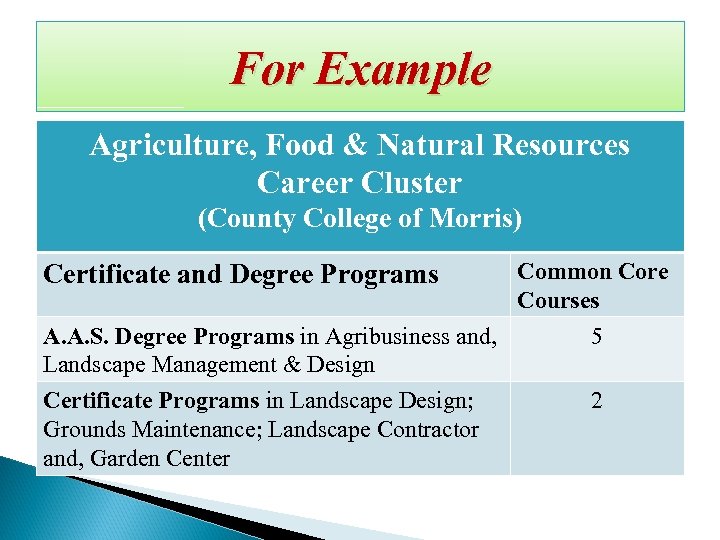 For Example Agriculture, Food & Natural Resources Career Cluster (County College of Morris) Common Core Courses A. A. S. Degree Programs in Agribusiness and, 5 Landscape Management & Design Certificate and Degree Programs Certificate Programs in Landscape Design; Grounds Maintenance; Landscape Contractor and, Garden Center 2
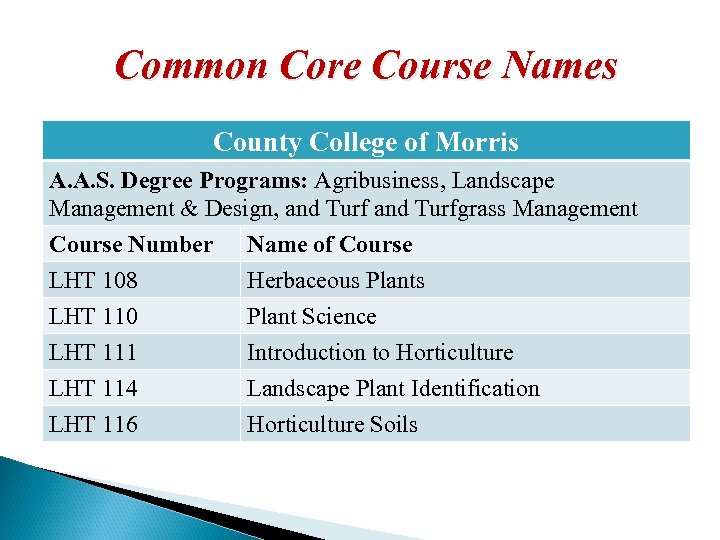 Common Core Course Names County College of Morris A. A. S. Degree Programs: Agribusiness, Landscape Management & Design, and Turfgrass Management Course Number Name of Course LHT 108 LHT 110 LHT 111 LHT 114 LHT 116 Herbaceous Plant Science Introduction to Horticulture Landscape Plant Identification Horticulture Soils
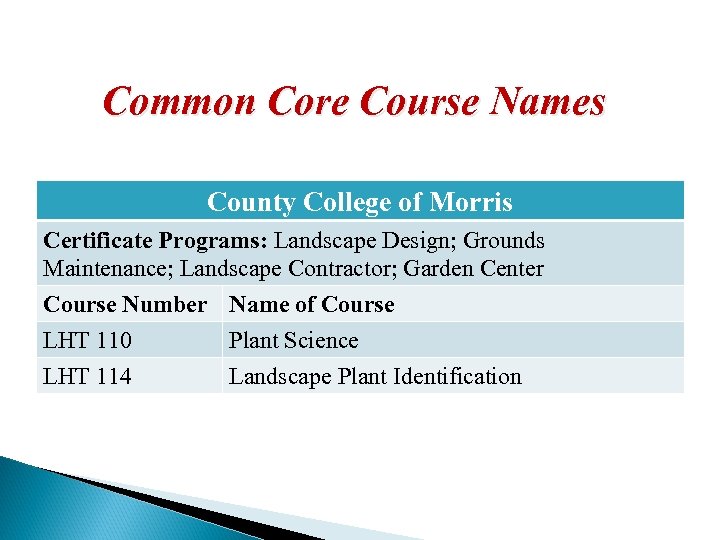 Common Core Course Names County College of Morris Certificate Programs: Landscape Design; Grounds Maintenance; Landscape Contractor; Garden Center Course Number Name of Course LHT 110 Plant Science LHT 114 Landscape Plant Identification
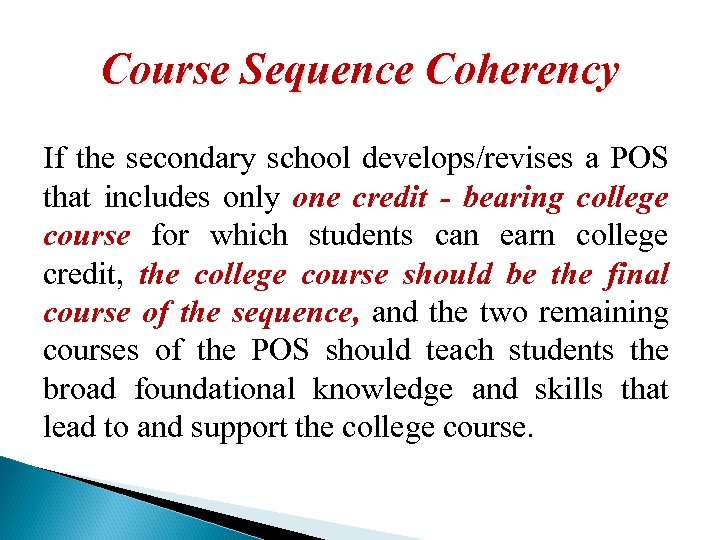 Course Sequence Coherency If the secondary school develops/revises a POS that includes only one credit - bearing college course for which students can earn college credit, the college course should be the final course of the sequence, and the two remaining courses of the POS should teach students the broad foundational knowledge and skills that lead to and support the college course.
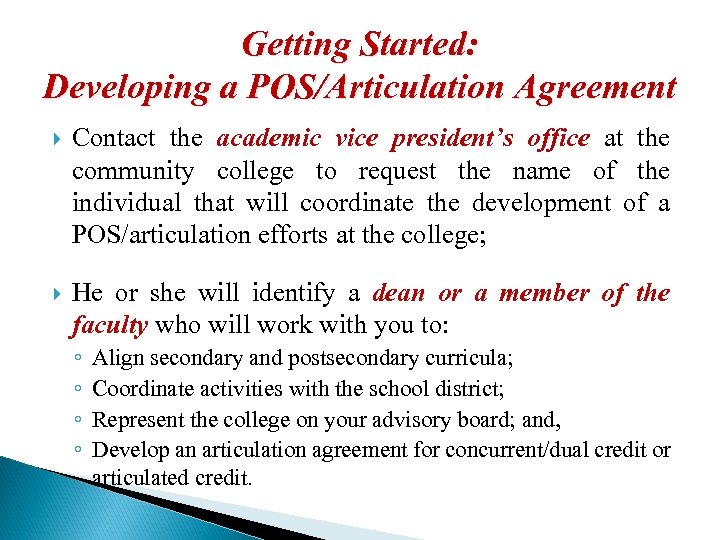 Getting Started: Developing a POS/Articulation Agreement Contact the academic vice president’s office at the community college to request the name of the individual that will coordinate the development of a POS/articulation efforts at the college; He or she will identify a dean or a member of the faculty who will work with you to: ◦ ◦ Align secondary and postsecondary curricula; Coordinate activities with the school district; Represent the college on your advisory board; and, Develop an articulation agreement for concurrent/dual credit or articulated credit.
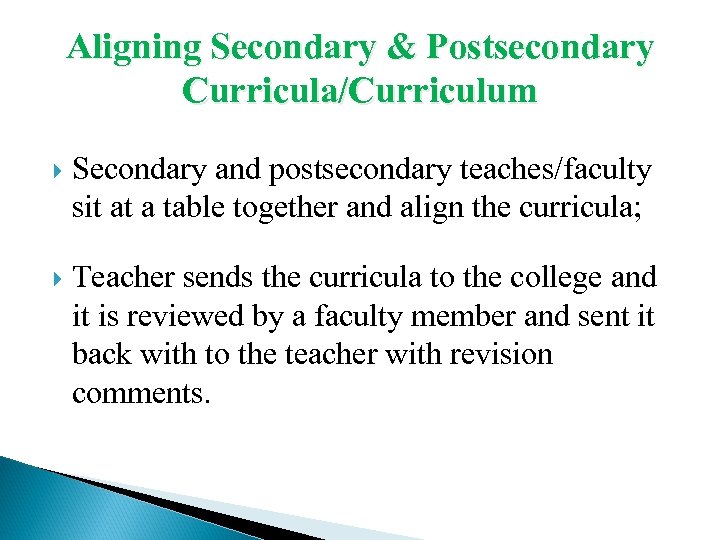 Aligning Secondary & Postsecondary Curricula/Curriculum Secondary and postsecondary teaches/faculty sit at a table together and align the curricula; Teacher sends the curricula to the college and it is reviewed by a faculty member and sent it back with to the teacher with revision comments.
 Who Will Teach the Courses/Courses Ø High school teachers may teach the college courses in the high school if they meet the requirements of the partnering postsecondary institution: § Master’s degree in content area for dual credit. § Bachelors degree in content area for articulated credit. and, the certification requirements of the NJDOE. See Licensure & Credentials: http: //www. state. nj. us/education/educators/license/
 Articulation Facts Most colleges have developed an articulation agreement template. If they do not have an established template, use the template developed by OCTE. An articulation agreement will not be signed by chief school administrators until the curriculum for a course or curricula for a course sequence is aligned with college curricula. Articulation agreements must be signed and dated on a yearly basis by secondary school district superintendents and college presidents
 Articulation Facts “ 12 th Grade Option” program articulation agreements cannot be submitted to OCTE in support of your program unless the courses are required courses for the CTE POS you developed. If you currently have an approved CTE program and have recently developed an articulation agreement, notify your program officer and send the signed and dated articulation agreement to him or her.
 Articulation Definitions – Concurrent / Dual Credit: Students simultaneously earn both credits towards high school graduation requirements, and college credits for successfully completing a college course. – Articulated Credit: College credits students earn for successfully completing a college course are “banked” at the community college until the student enrolls in a program at the community college. After students complete additional college requirements, students receive the college credit.
 Articulation Agreement for General Program of Study Ensure that: All college courses for which students earn college credit are listed on the articulation agreement; All certificate and/or degree programs that students can transition into if successfully completing the college courses are listed on the articulation agreement.
 Lastly ØSecondary school districts developing a new CTE POS must apply for program approval before operating the POS at the school district, and submit data on a yearly basis. Approval of New or Re-approval of CTE Programs of Study: http: //www. state. nj. us/education/voc/occprapp. htm
 CONTACT INFORMATION For any questions or concerns, please contact Dr. Connie Walde Office of Career and Technical Education cwalde@doe. state. nj. us 609 -777 -4659