


 Скачать презентацию Fakultät Informatik Institut für Systemarchitektur Professur
3a57c2e446e1247c20fe959f1840edbb.ppt
- Количество слайдов: 30
 Fakultät Informatik – Institut für Systemarchitektur – Professur Rechnernetze Sensor Medium Access Control (S-MAC) Robin Dunn Supervisor: Dr. Waltenegus Dargie
 Outline • Motivation • Protocol design – – • • 9 Jan. 06 Periodic Listen & Sleep Adaptive Listening Overhearing Avoidance Message Passing Protocol Implementations Experimentation Summary References Sensor MAC 2 Of 32
![Motivation In a WSN: “energy conservation and self-configuration are primary goals. . . ”[1]](https://present5.com/presentation/3a57c2e446e1247c20fe959f1840edbb/image-3.jpg "Motivation In a WSN: “energy conservation and self-configuration are primary goals. . . ”[1]") Motivation In a WSN: “energy conservation and self-configuration are primary goals. . . ”[1] 9 Jan. 06 Sensor MAC 3 Of 32
Motivation In a WSN: “energy conservation and self-configuration are primary goals. . . ”[1] 9 Jan. 06 Sensor MAC 3 Of 32
 Motivation Need to reduce energy waste from: • • Collision Overhearing Control overhead Idle Listening Need to have a robust topology to: • Account for lost nodes • New joining nodes 9 Jan. 06 Sensor MAC 4 Of 32
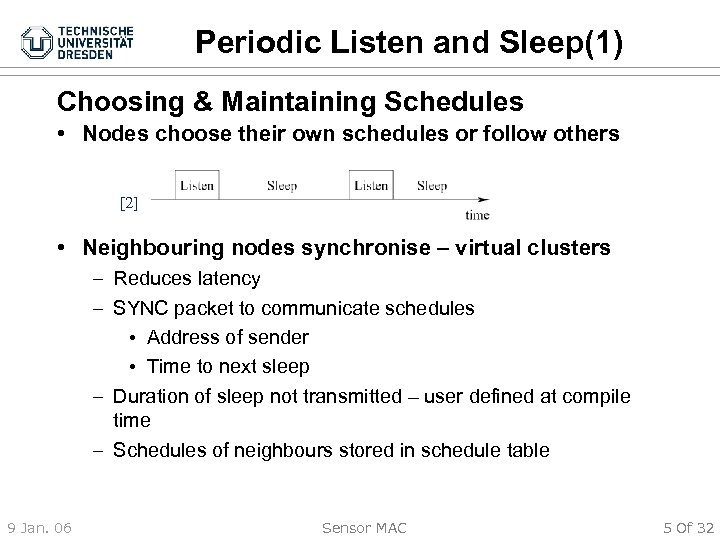 Periodic Listen and Sleep(1) Choosing & Maintaining Schedules • Nodes choose their own schedules or follow others [2] • Neighbouring nodes synchronise – virtual clusters – Reduces latency – SYNC packet to communicate schedules • Address of sender • Time to next sleep – Duration of sleep not transmitted – user defined at compile time – Schedules of neighbours stored in schedule table 9 Jan. 06 Sensor MAC 5 Of 32
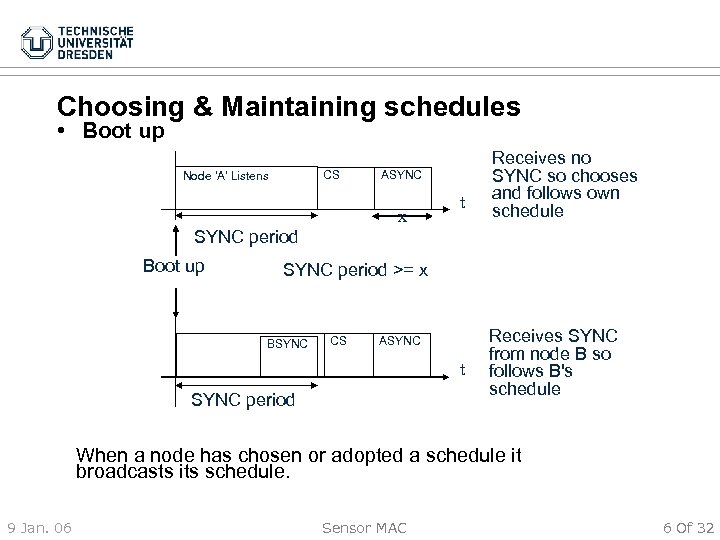 Choosing & Maintaining schedules • Boot up CS Node 'A' Listens ASYNC x t Receives no SYNC so chooses and follows own schedule SYNC period Boot up SYNC period >= x BSYNC CS ASYNC t SYNC period Receives SYNC from node B so follows B's schedule When a node has chosen or adopted a schedule it broadcasts its schedule. 9 Jan. 06 Sensor MAC 6 Of 32
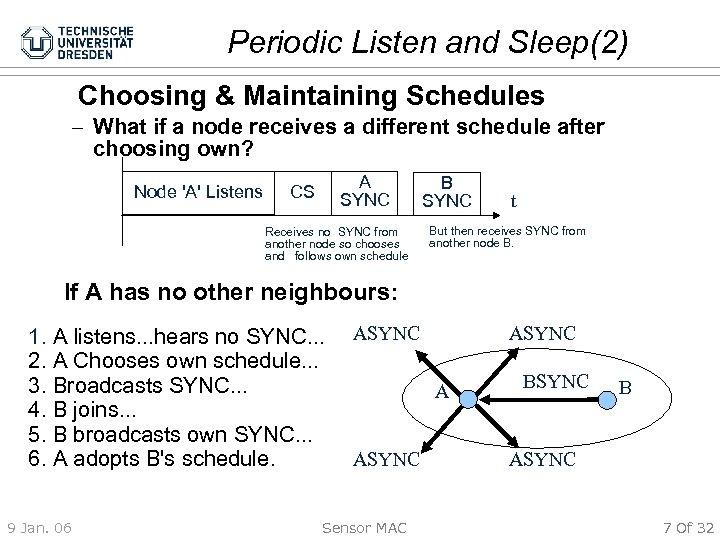 Periodic Listen and Sleep(2) Choosing & Maintaining Schedules – What if a node receives a different schedule after choosing own? Node 'A' Listens A SYNC CS Receives no SYNC from another node so chooses and follows own schedule B SYNC t But then receives SYNC from another node B. If A has no other neighbours: 1. A listens. . . hears no SYNC. . . 2. A Chooses own schedule. . . 3. Broadcasts SYNC. . . 4. B joins. . . 5. B broadcasts own SYNC. . . 6. A adopts B's schedule. 9 Jan. 06 ASYNC A ASYNC Sensor MAC BSYNC B ASYNC 7 Of 32
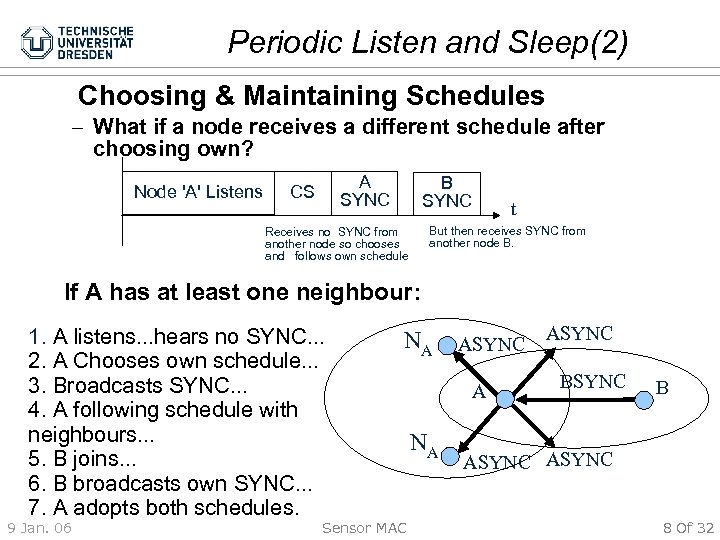 Periodic Listen and Sleep(2) Choosing & Maintaining Schedules – What if a node receives a different schedule after choosing own? Node 'A' Listens A SYNC CS B SYNC t But then receives SYNC from another node B. Receives no SYNC from another node so chooses and follows own schedule If A has at least one neighbour: 1. A listens. . . hears no SYNC. . . 2. A Chooses own schedule. . . 3. Broadcasts SYNC. . . 4. A following schedule with neighbours. . . 5. B joins. . . 6. B broadcasts own SYNC. . . 7. A adopts both schedules. 9 Jan. 06 NA Sensor MAC ASYNC A NA ASYNC B ASYNC 8 Of 32
![Periodic Listen and Sleep(3) Choosing & Maintaining Schedules [2] One neighbour so only follows](https://present5.com/presentation/3a57c2e446e1247c20fe959f1840edbb/image-9.jpg "Periodic Listen and Sleep(3) Choosing & Maintaining Schedules [2] One neighbour so only follows") Periodic Listen and Sleep(3) Choosing & Maintaining Schedules [2] One neighbour so only follows one schedule. • • 9 Jan. 06 Boarder nodes adopt both schedules. One neighbour so only follows one schedule. Form virtual clusters but communicate with peers No Cluster head. Border nodes have less time to sleep. Periodic neighbour discovery • nodes periodically listen for the whole SYNC period Sensor MAC 9 Of 32
Periodic Listen and Sleep(3) Choosing & Maintaining Schedules [2] One neighbour so only follows one schedule. • • 9 Jan. 06 Boarder nodes adopt both schedules. One neighbour so only follows one schedule. Form virtual clusters but communicate with peers No Cluster head. Border nodes have less time to sleep. Periodic neighbour discovery • nodes periodically listen for the whole SYNC period Sensor MAC 9 Of 32
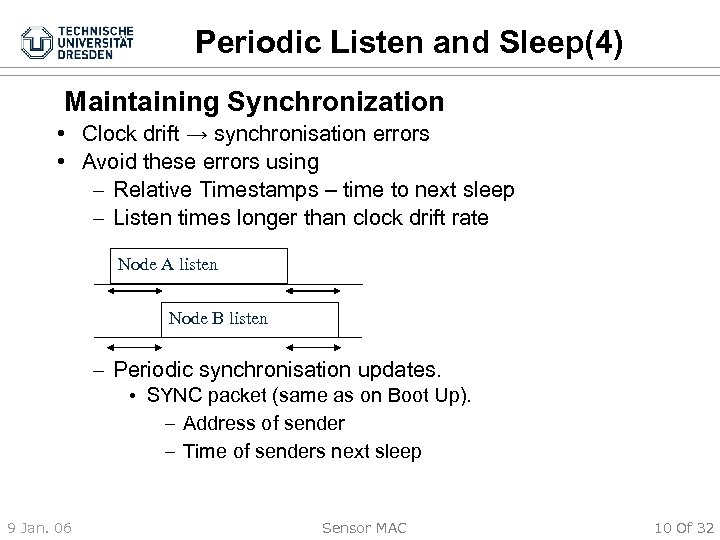 Periodic Listen and Sleep(4) Maintaining Synchronization • Clock drift → synchronisation errors • Avoid these errors using – Relative Timestamps – time to next sleep – Listen times longer than clock drift rate Node A listen Node B listen – Periodic synchronisation updates. • SYNC packet (same as on Boot Up). – Address of sender – Time of senders next sleep 9 Jan. 06 Sensor MAC 10 Of 32
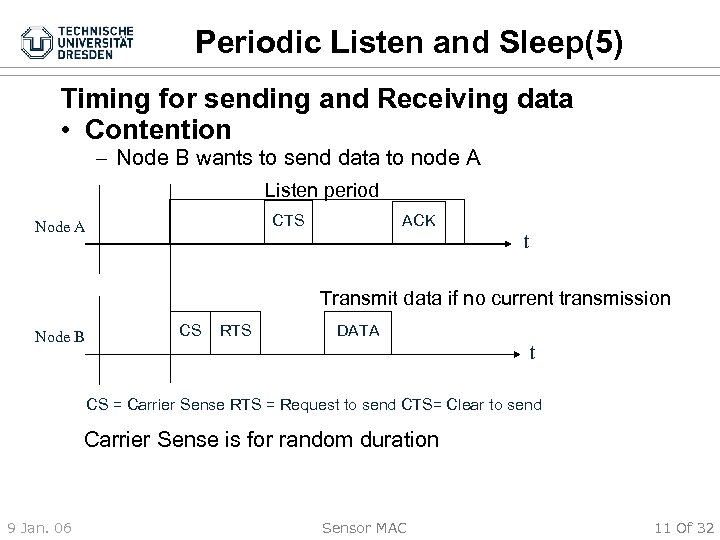 Periodic Listen and Sleep(5) Timing for sending and Receiving data • Contention – Node B wants to send data to node A Listen period CTS Node A ACK t Transmit data if no current transmission Node B CS RTS DATA t CS = Carrier Sense RTS = Request to send CTS= Clear to send Carrier Sense is for random duration 9 Jan. 06 Sensor MAC 11 Of 32
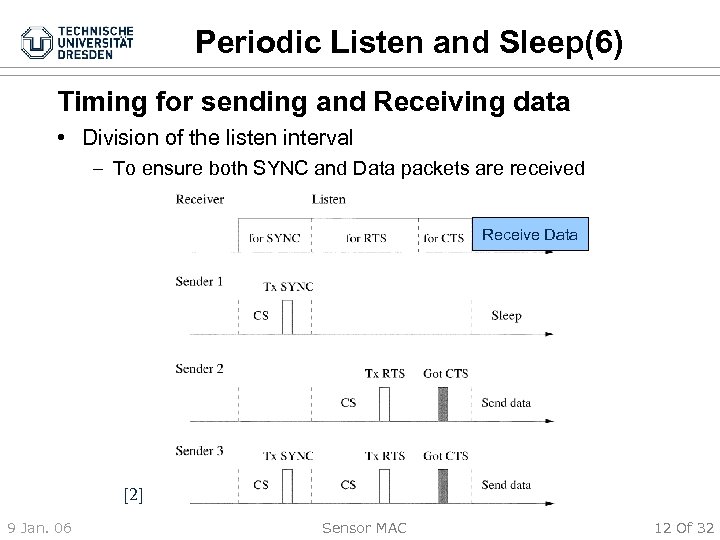 Periodic Listen and Sleep(6) Timing for sending and Receiving data • Division of the listen interval – To ensure both SYNC and Data packets are received Receive Data [2] 9 Jan. 06 Sensor MAC 12 Of 32
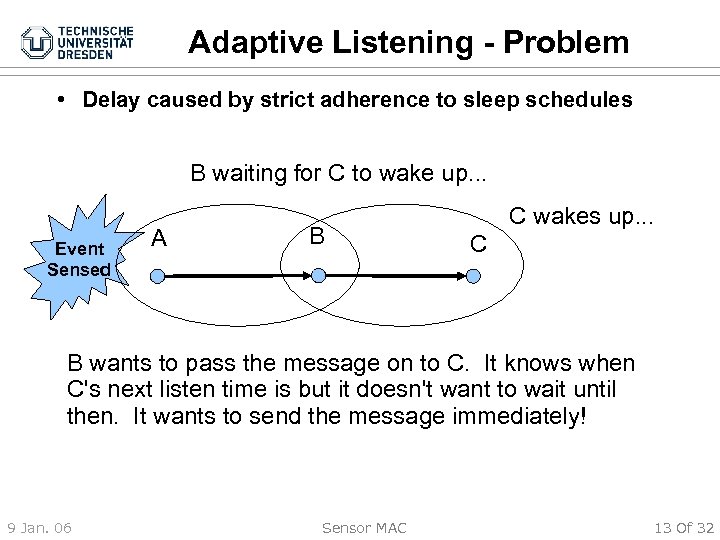 Adaptive Listening - Problem • Delay caused by strict adherence to sleep schedules B waiting for C to wake up. . . Event Sensed A B C wakes up. . . C B wants to pass the message on to C. It knows when C's next listen time is but it doesn't want to wait until then. It wants to send the message immediately! 9 Jan. 06 Sensor MAC 13 Of 32
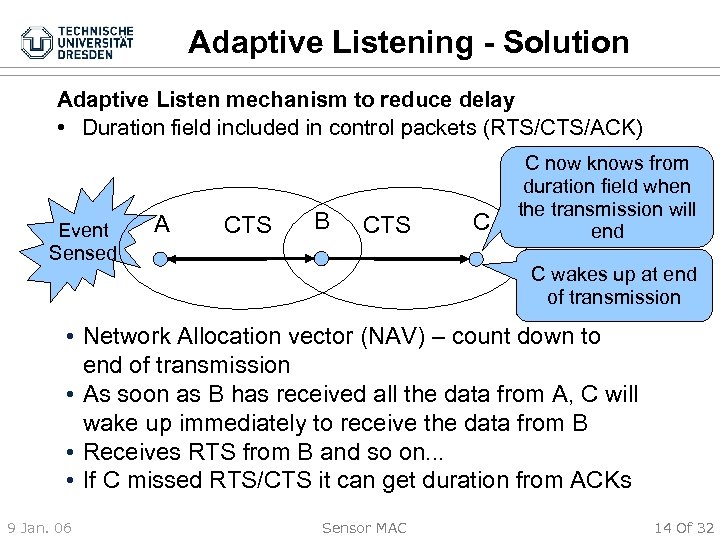 Adaptive Listening - Solution Adaptive Listen mechanism to reduce delay • Duration field included in control packets (RTS/CTS/ACK) Event Sensed A CTS B CTS C C now knows from duration field when the transmission will end C wakes up at end of transmission • Network Allocation vector (NAV) – count down to end of transmission • As soon as B has received all the data from A, C will wake up immediately to receive the data from B • Receives RTS from B and so on. . . • If C missed RTS/CTS it can get duration from ACKs 9 Jan. 06 Sensor MAC 14 Of 32
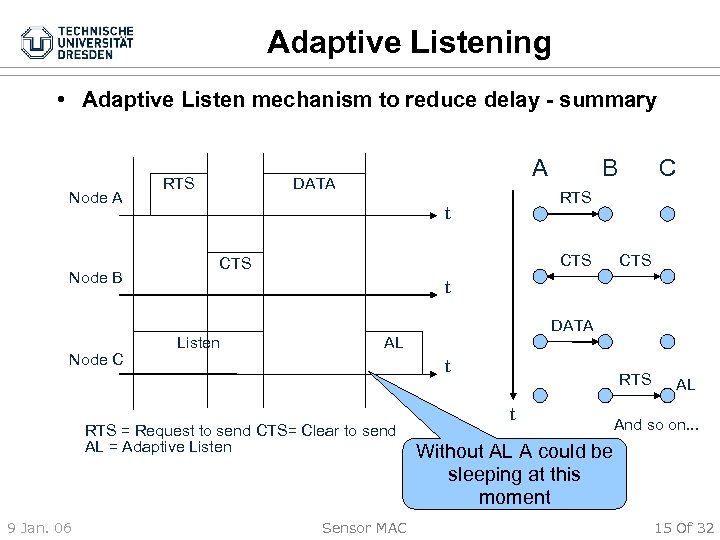 Adaptive Listening • Adaptive Listen mechanism to reduce delay - summary Node A Node B Node C RTS A DATA C RTS t CTS CTS t Listen DATA AL t RTS = Request to send CTS= Clear to send AL = Adaptive Listen 9 Jan. 06 B Sensor MAC RTS t AL And so on. . . Without AL A could be sleeping at this moment 15 Of 32
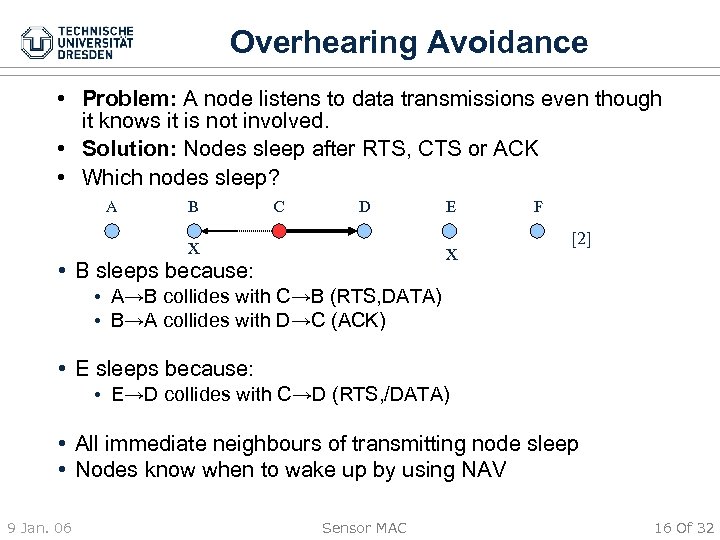 Overhearing Avoidance • Problem: A node listens to data transmissions even though it knows it is not involved. • Solution: Nodes sleep after RTS, CTS or ACK • Which nodes sleep? A B C D x E x • B sleeps because: F [2] • A→B collides with C→B (RTS, DATA) • B→A collides with D→C (ACK) • E sleeps because: • E→D collides with C→D (RTS, /DATA) • All immediate neighbours of transmitting node sleep • Nodes know when to wake up by using NAV 9 Jan. 06 Sensor MAC 16 Of 32
 Message Passing(1) Efficient transmission of long messages. • Other Approaches: – One long packet. Corruption of part means resending all. – Many small packets with RTS, CTS, DATA, ACK for each. Large control overhead and delay though contention for each. 9 Jan. 06 Sensor MAC 17 Of 32
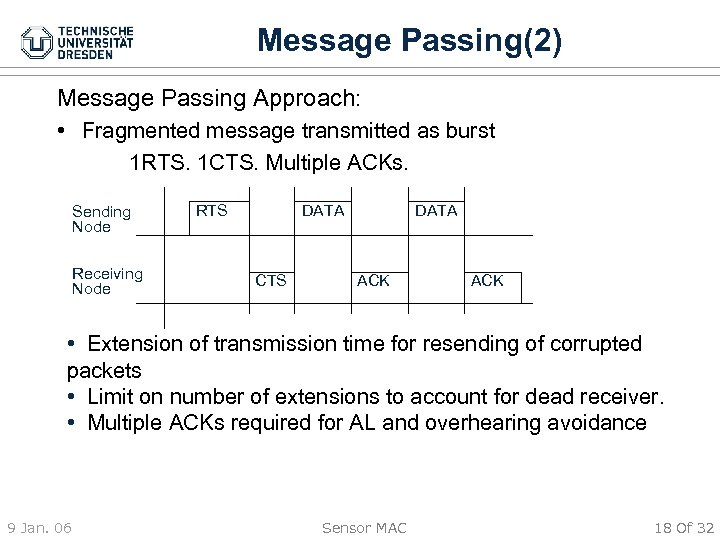 Message Passing(2) Message Passing Approach: • Fragmented message transmitted as burst 1 RTS. 1 CTS. Multiple ACKs. Sending Node Receiving Node RTS DATA CTS DATA ACK • Extension of transmission time for resending of corrupted packets • Limit on number of extensions to account for dead receiver. • Multiple ACKs required for AL and overhearing avoidance 9 Jan. 06 Sensor MAC 18 Of 32
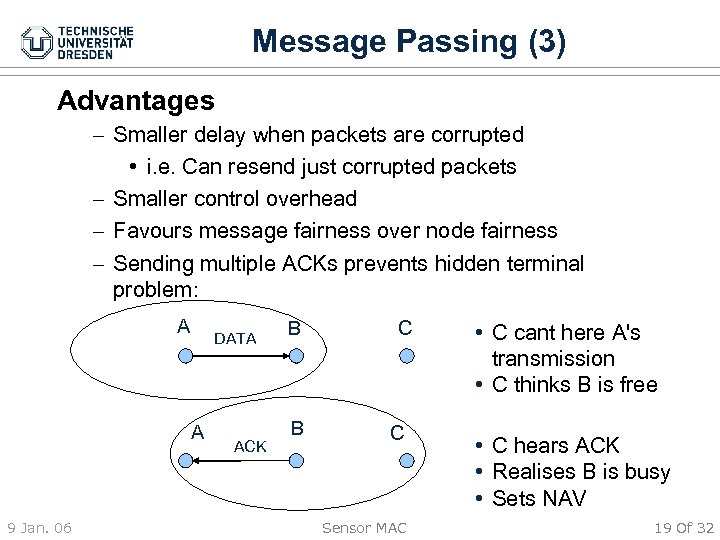 Message Passing (3) Advantages – Smaller delay when packets are corrupted • i. e. Can resend just corrupted packets – Smaller control overhead – Favours message fairness over node fairness – Sending multiple ACKs prevents hidden terminal problem: A DATA A 9 Jan. 06 ACK B B C C Sensor MAC • C cant here A's transmission • C thinks B is free • C hears ACK • Realises B is busy • Sets NAV 19 Of 32
 Implementation • 2 Implementations carried out: – 1 st Rene Motes (No Adaptive Listening). 2 hop network. [1] – 2 nd Mica Motes (Adaptive Listening Option) 10 hop network. [2] – Both using Tiny. OS • User can configure options when compiling: – Duty Cycle selection (1%-99%) – Fully Active Mode (periodic sleep disabled) – Disable adaptive listen • Current Implementations coordinate radio sleeping. • Further work required to put other hardware to sleep (e. g. CPU). – Further energy savings 9 Jan. 06 Sensor MAC 20 Of 32
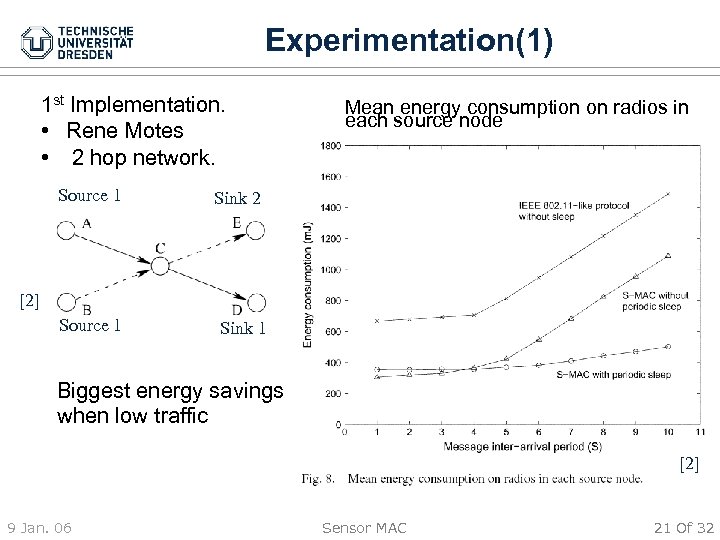 Experimentation(1) 1 st Implementation. • Rene Motes • 2 hop network. Source 1 Mean energy consumption on radios in each source node Sink 2 [2] Source 1 Sink 1 Biggest energy savings when low traffic [2] 9 Jan. 06 Sensor MAC 21 Of 32
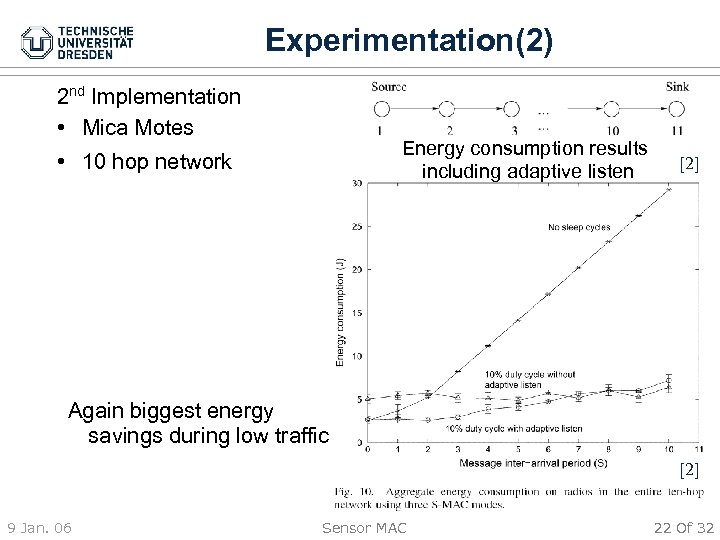 Experimentation(2) 2 nd Implementation • Mica Motes Energy consumption results including adaptive listen • 10 hop network [2] Again biggest energy savings during low traffic [2] 9 Jan. 06 Sensor MAC 22 Of 32
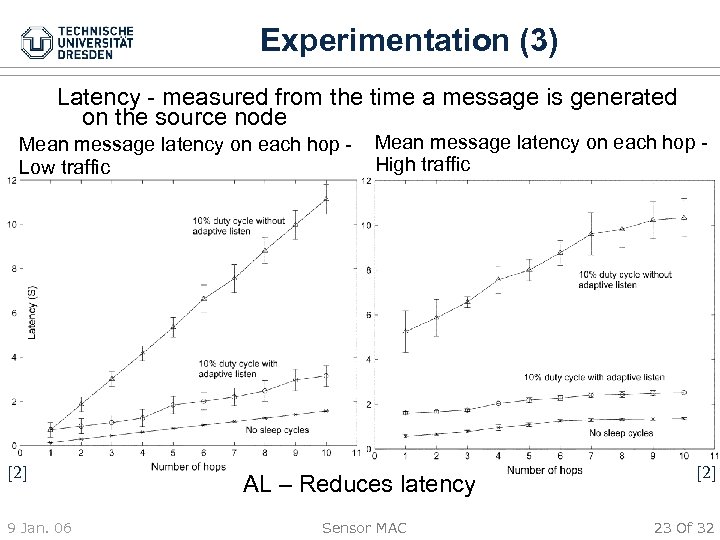 Experimentation (3) Latency - measured from the time a message is generated on the source node Mean message latency on each hop Low traffic [2] 9 Jan. 06 Mean message latency on each hop High traffic AL – Reduces latency Sensor MAC [2] 23 Of 32
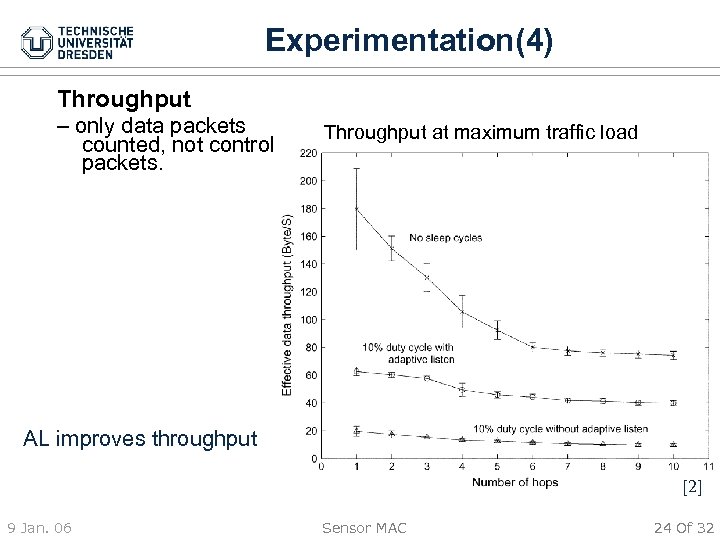 Experimentation(4) Throughput – only data packets counted, not control packets. Throughput at maximum traffic load AL improves throughput [2] 9 Jan. 06 Sensor MAC 24 Of 32
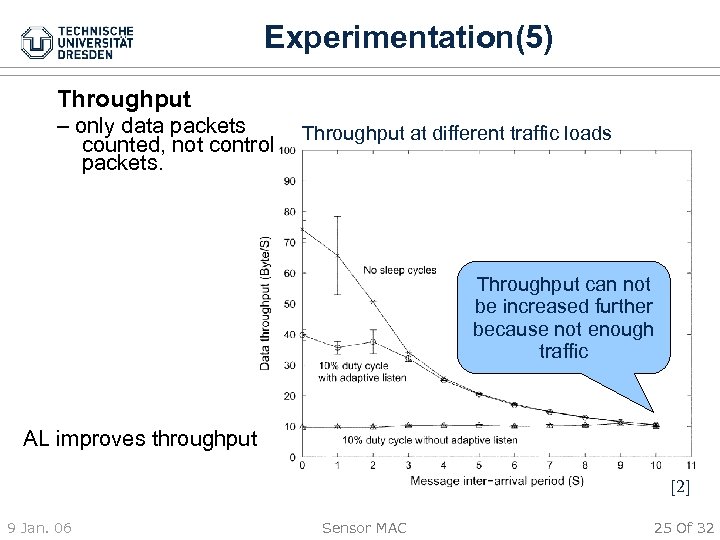 Experimentation(5) Throughput – only data packets counted, not control packets. Throughput at different traffic loads Throughput can not be increased further because not enough traffic AL improves throughput [2] 9 Jan. 06 Sensor MAC 25 Of 32
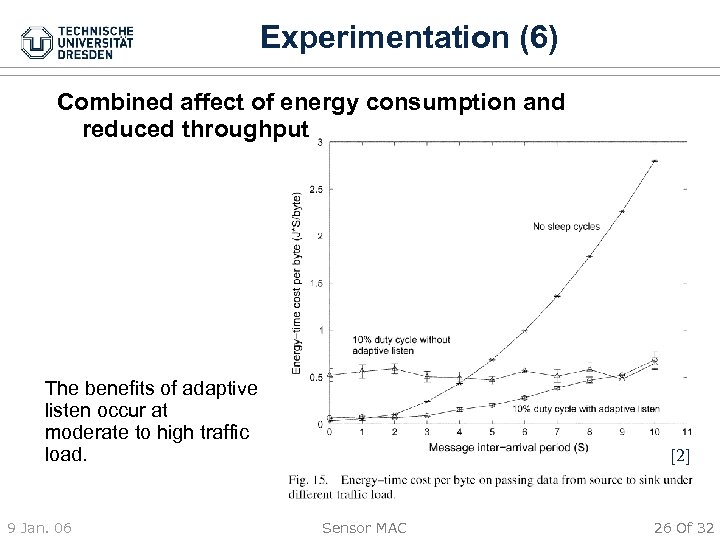 Experimentation (6) Combined affect of energy consumption and reduced throughput The benefits of adaptive listen occur at moderate to high traffic load. 9 Jan. 06 [2] Sensor MAC 26 Of 32
 Summary SMAC makes energy savings by periodically putting nodes to sleep. This can result in higher latency and reduced throughput But these problems are mitigated by the use of Adaptive Listening 9 Jan. 06 Sensor MAC 27 Of 32
 Summary Motivation Protocol design Periodic Listen & Sleep Adaptive Listening Overhearing Avoidance Message Passing Implementations Experimentation Summary References 9 Jan. 06 Sensor MAC 28 Of 32
![References(1) • Main references: [1] An Energy-Efficient MAC Protocol for Wireless. Sensor Networks. Wei](https://present5.com/presentation/3a57c2e446e1247c20fe959f1840edbb/image-29.jpg "References(1) • Main references: [1] An Energy-Efficient MAC Protocol for Wireless. Sensor Networks. Wei") References(1) • Main references: [1] An Energy-Efficient MAC Protocol for Wireless. Sensor Networks. Wei Ye, John Heidemann, Deborah Estrin. In Proceedings of the 21 st International Annual Joint Conference of the IEEE Computer and Communications Societies (INFOCOM), Vol. 3, pp. 1567 -1576, New York, NY, USA, June, 2002. • [2] Medium Access Control With Coordinated Adaptive Sleeping for Wireless Sensor Networks. Wei Ye, John Heidemann and Deborah Estrin IEEE/ACM Transactions on Networking, Vol. 12, No. 3, pp. 493 -506, June 2004. • SMAC Source code available to download at http: //www. isi. edu/ilense/software/smac/download. html 9 Jan. 06 Sensor MAC 29 Of 32
References(1) • Main references: [1] An Energy-Efficient MAC Protocol for Wireless. Sensor Networks. Wei Ye, John Heidemann, Deborah Estrin. In Proceedings of the 21 st International Annual Joint Conference of the IEEE Computer and Communications Societies (INFOCOM), Vol. 3, pp. 1567 -1576, New York, NY, USA, June, 2002. • [2] Medium Access Control With Coordinated Adaptive Sleeping for Wireless Sensor Networks. Wei Ye, John Heidemann and Deborah Estrin IEEE/ACM Transactions on Networking, Vol. 12, No. 3, pp. 493 -506, June 2004. • SMAC Source code available to download at http: //www. isi. edu/ilense/software/smac/download. html 9 Jan. 06 Sensor MAC 29 Of 32
 References(2) Related Work: • Energy and Latency Control in Low Duty Cycle MAC Protocols. Yuan Li, Wei Ye, John Heidemann. IEEE Wireless Communications and Networking Conference (WCNC), March 2005, New Orleans, LA. • Implementation of the Sensor-MAC protocol for the Ji. ST/SWANS simulator. Dissertation. Tippanagoudar, Veerendra. FLORIDA ATLANTIC UNIVERSITY. 2006. http: //wwwlib. umi. com/dissertations/preview/1436493 Have to pay to get full access! • SMAC Implementation for ETRI SSN-based Sensor Networks. Kiran Tatapudi and Chansu Yu Department of Electrical and Computer Engineering Cleveland State University. http: //www. csuohio. edu/ece/tech. Report/2006/tr 03. pdf • Adaptive Forwarding Error Correction Code Control: An Adaptive FEC Code Control Algorithm for Mobile Wireless Sensor Networks. JOURNAL OF COMMUNICATIONS AND NETWORKS, VOL. 7, NO. 4, DECEMBER 2005. http: //network. dongguk. ac. kr/ 9 Jan. 06 Sensor MAC 30 Of 32