


 Скачать презентацию Fair Use Software Reverse Engineering Prof Marie-Christine
f074035cc25cfb36aa966d262b941fd8.ppt
- Количество слайдов: 23
 Fair Use & Software Reverse Engineering Prof. Marie-Christine Janssens Centre for Intellectual Property Rights Catholic University Leuven - Belgium WIPO-UNIDO National Seminar on Managing Intellectual Property of SMEs Minsk, 23 -25 January 2007
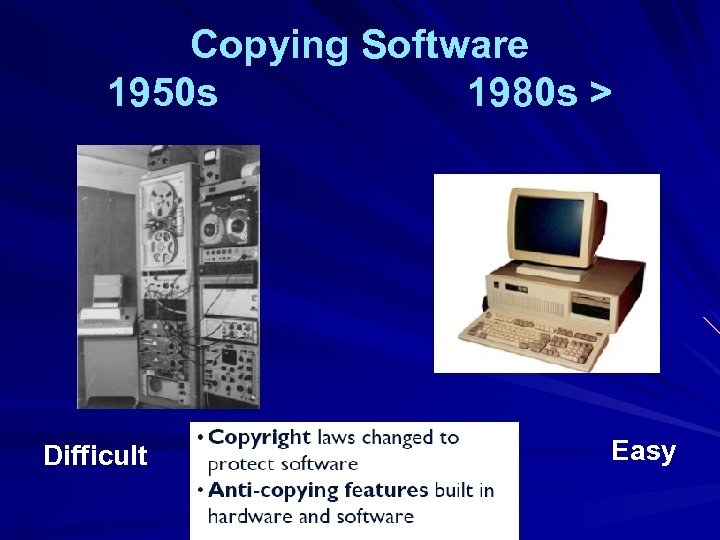 Copying Software 1950 s 1980 s > Difficult Easy
 Overview regulatory framework u 1980 s Us adopts copyright protection u 1991 EU software directive ü + Implementation by Member States u International norms u 1994 TRIPS (art. 10. 1) u 1996 WCT (art. 4)
 Fair use WHAT ? Copyrighted subject matter
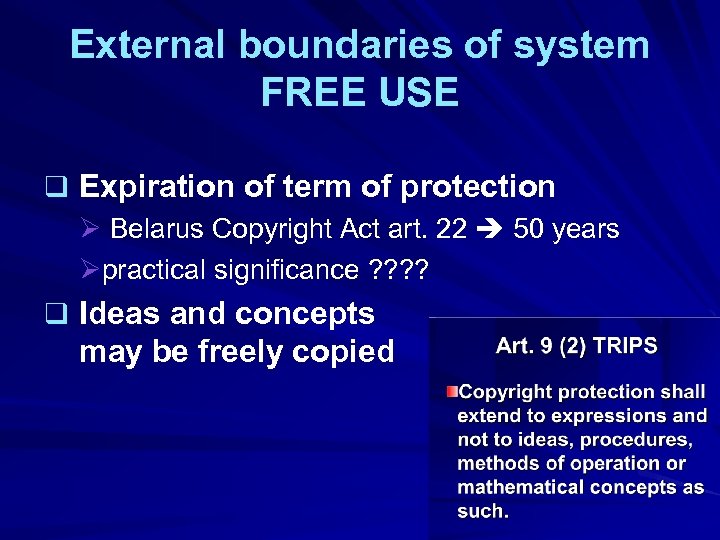 External boundaries of system FREE USE q Expiration of term of protection Ø Belarus Copyright Act art. 22 50 years Øpractical significance ? ? q Ideas and concepts may be freely copied
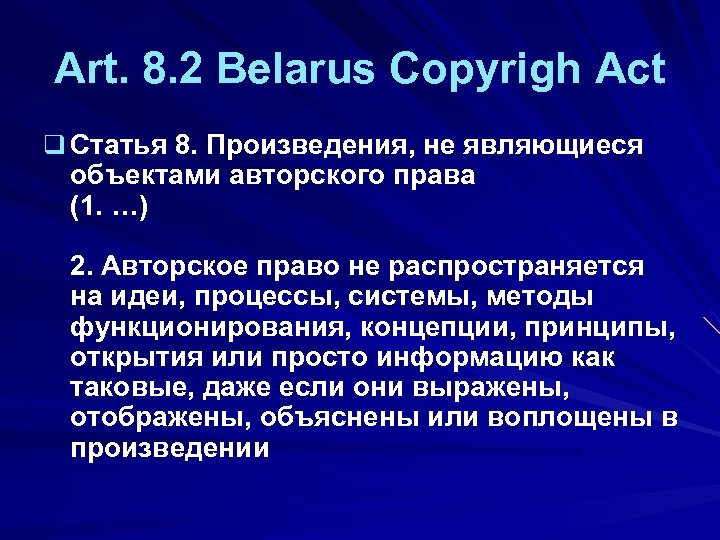 Art. 8. 2 Belarus Copyrigh Act q Статья 8. Произведения, не являющиеся объектами авторского права (1. …) 2. Авторское право не распространяется на идеи, процессы, системы, методы функционирования, концепции, принципы, открытия или просто информацию как таковые, даже если они выражены, отображены, объяснены или воплощены в произведении
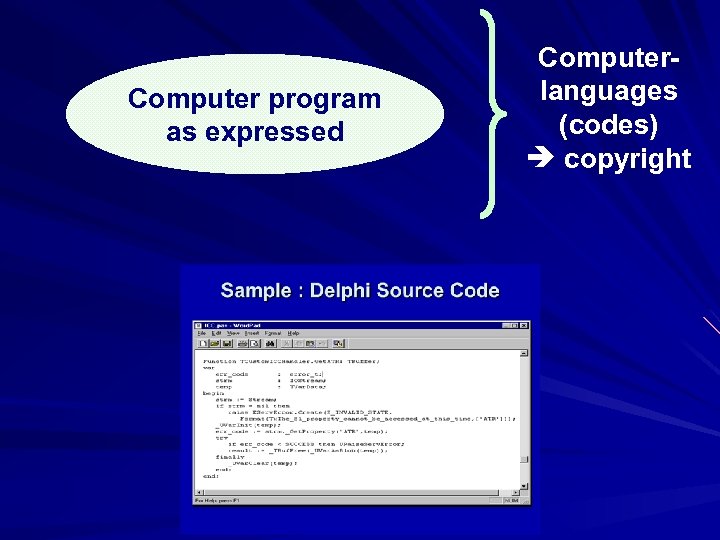 Computer program as expressed Computerlanguages (codes) copyright
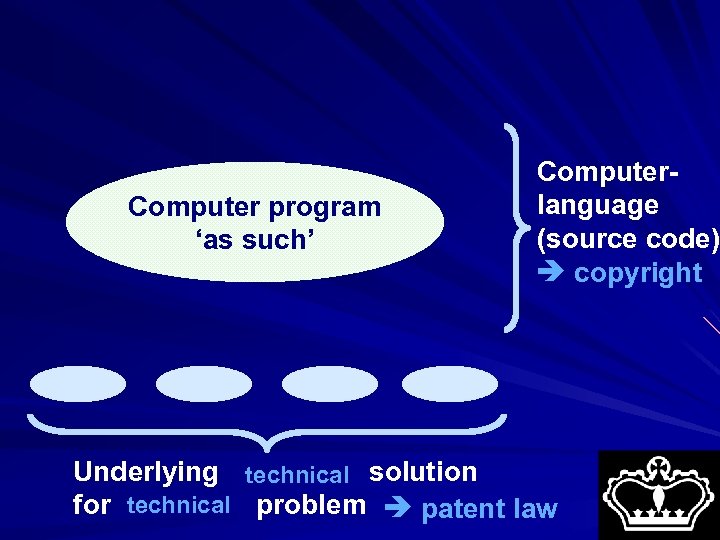 Computer program ‘as such’ Computerlanguage (source code) copyright Underlying technical solution for technical problem patent law
 External boundaries of system FREE USE q Expiration of term of protection q Ideas and concepts may be copied ü two programs may have similar features, comparable functions, be based on the same concept Ø their implementation may not be copied ü e. g. copying (even a few) lines of the code q Non-original features may be copied ü features dictated by technical needs & efficiency norms ü features taken from public domain (basic techniques, trivial combinations)
 Internal boundaries of system PERMITTED USE q By contract (license) Ø written agreement ? Shrink Wrap ? Clickwrap Ø cf. article 27 Belarus Copyright Act ü “If conditions of using the program are set out in a suitable manner on the copy of the program” Ø Статья 27. Форма авторского договора 1. Авторский договор должен быть заключен в письменной форме (…) 2. При продаже экземпляров компьютерных программ и баз данных договор считается заключенным в письменной форме, если его условия (условия использования программы и базы данных) изложены соответствующим образом на экземплярах программы или базы данных
 Internal boundaries of system PERMITTED USE q By contract (license) q Software code is released as open source Ø license conditions ü Free to use in organization ü Free to use in products ü Free to distribute and sell ü Free to modify and extend q Software is released under a Creative Commons license
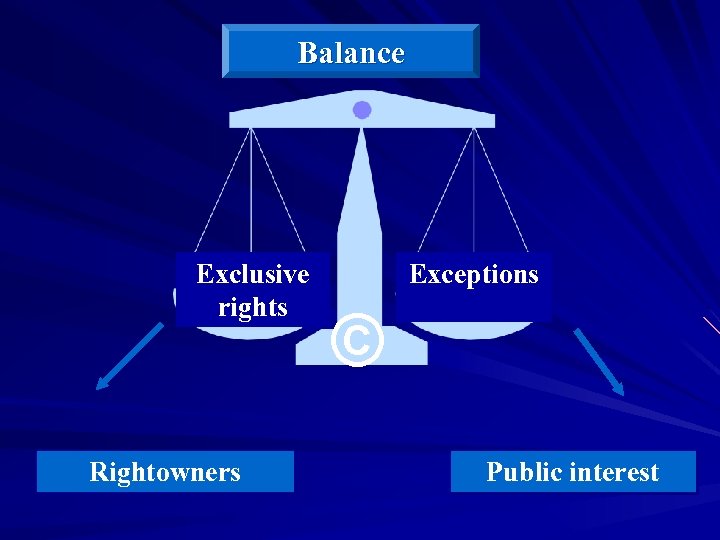
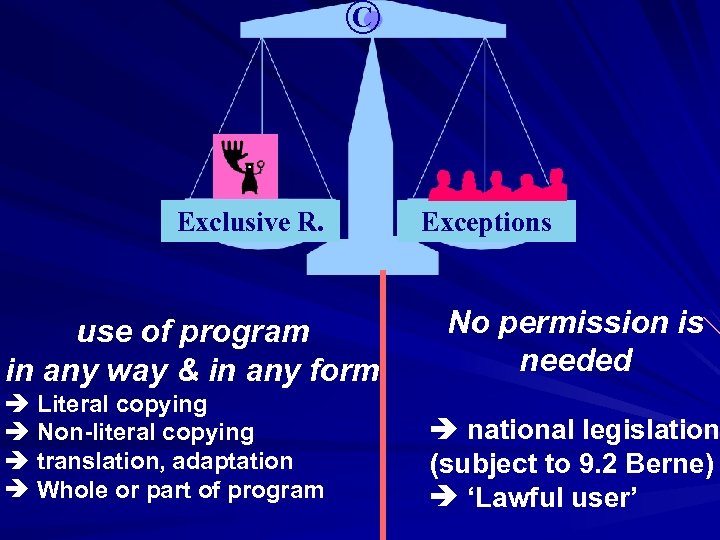
 Fair use Internal boundaries exception to exclusive right
 Balance Exclusive rights Rightowners Exceptions © Public interest
 © Exclusive R. use of program in any way & in any form Literal copying Non-literal copying translation, adaptation Whole or part of program Exceptions No permission is needed national legislation (subject to 9. 2 Berne) ‘Lawful user’
 Exceptions to economic rights q Acts necessary for the use ü e. g. reproduction while loading the program ü includes error correction q The making of a back-up copy ü a single copy (if no back-up is provided) ü Belarus article 21 ‘intended solely for archiving or for the replacement in the event the copy was lost or destroyed’ Лицо, правомерно владеющее экземпляром компьютерной программы, вправе изготовить копию компьютерной программы при условии, что эта копия предназначена только для архивных целей или для замены правомерно приобретенного экземпляра в случаях, когда оригинал компьютерной программы утерян, уничтожен или стал непригодным для использования
 Exceptions to economic rights q Acts necessary for the use q The making of a back-up copy q Observation, study, testing to determine underlying ideas and principles if … q The so-called ‘decompilation right’ Øright to reverse engineer to convert object code into source code (= copying)
 Uses of decompilation q To develop a competitive product q To develop a complementary or attaching program or device (e. g. printer) q Other uses than developing a product ü ü ü to maintain a program to recover lost code to fix bugs to find viruses to examine a competitor’s program (infringement? )
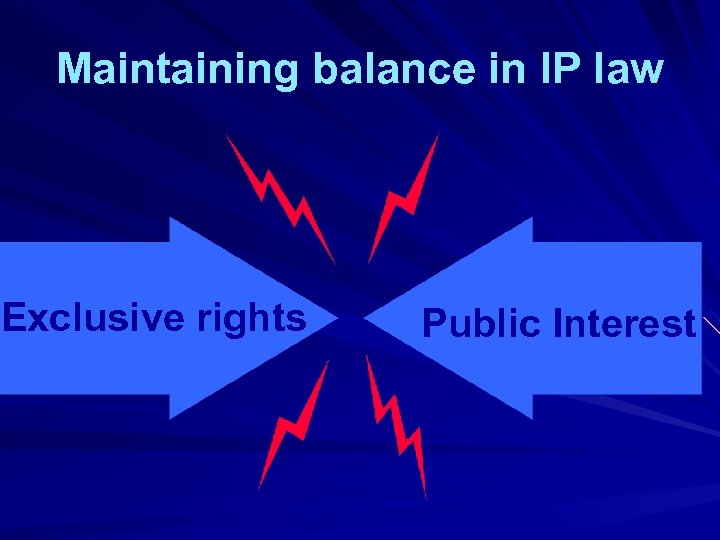 Maintaining balance in IP law Exclusive rights Public Interest
 Decompilation right (EU) q It is lawful to decompile a program Ø to create a new independent program Ø that is interoperable with it ü e. g. to run a program on an operating system the source code of which is kept secret q Under stringent conditions Ø information is not readily available Ø information obtained may ü only be used for ensuring interoperability ü Not be given to third parties (unless necessary for this purpose) ü Not be used for development of substantially similar CP or any other act which infringes copyright q use exception with extreme caution !
 Decompilation right (Belarus) q Article 21 (2) Лицо, правомерно владеющее экземпляром компьютерной программы, вправе адаптировать компьютерную программу для обеспечения совместной работы с другими программами при условии, что полученная при адаптации информация не будет использоваться для создания других компьютерных программ, аналогичных адаптируемой, или для осуществления любого действия, нарушающего авторское право
 Apply ‘clean room’ restrictions q Room where computers are not connected to internet/intranet q Only specially assigned personnel is allowed to room q No data (in electronic form or on paper) is allowed to leave room q End report will only detail information necessary for interoperability q Shred all paper documents related to the decompilation / wipe disks and computer memories
 Famous cases q Sega Enterprises v. Accolade (9 th Cir 1993) q Atari v. Nintendo (Fed Cir 1992) q Sony v. Connectix (9 th Cir 2000) ü“The intermediate copies made and used by Connectix during the course of its reverse engineering of the Sony BIOS were protected fair use, necessary to permit Connectix to make its non -infringing Virtual Game Station function with Play. Station games”.
 The decompilation exception in practice Difficult … but not impossible + take legal advice in advance