 Скачать презентацию Factors influencing decision-making on pricing Prepared by Ataeva
Golden Coins Graph_0.pptx
- Количество слайдов: 16



Factors influencing decision-making on pricing Prepared by Ataeva s, Bakhtybayeva N, Bekenova A, Salyhova E, Alipova A,
Content: Introduction Definition of pricing III Internal factors of pricing External factors of pricing Conclusion
Introduction Every entrepreneur has their own set price for their product. There are two approaches to market-based pricing: the establishment of individual prices or uniform prices. -The first is formed on a contractual basis as a result of negotiations between the buyer and seller, providing coordination of the interests of the parties. -The second is characterized by the fact that all buyers purchase goods at the same price. The introduction of uniform prices for all consumers usually associated with the peculiarities of the market a particular product or technical complexity and the large costs for price differentiation. Uniform Price is important, where the entrepreneur offers the market a standardized product of mass production.
Pricing - the process of formation, the formation of prices for goods and services, primarily characterized by the methods of pricing methods in general, related to all products. There are two basic pricing: market-based pricing based on the interaction of supply and demand pricing, centralized state, based on the pricing of public bodies. With expensive pricing based pricing placed the cost of production and circulation.
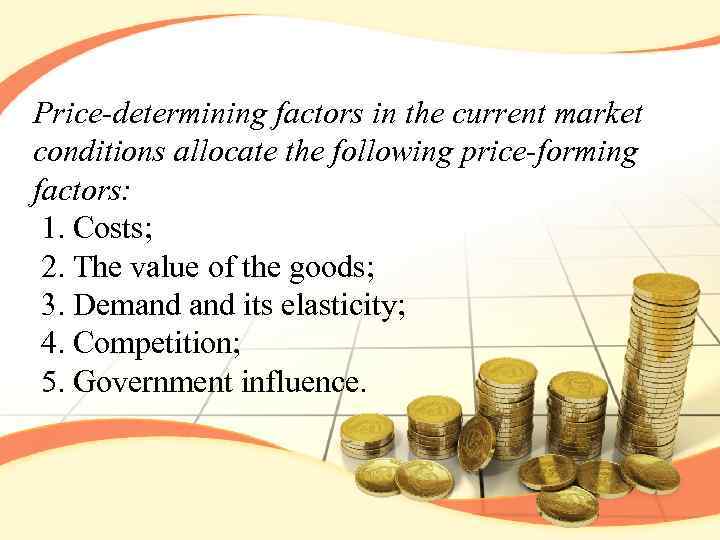
Price-determining factors in the current market conditions allocate the following price-forming factors: 1. Costs; 2. The value of the goods; 3. Demand its elasticity; 4. Competition; 5. Government influence.
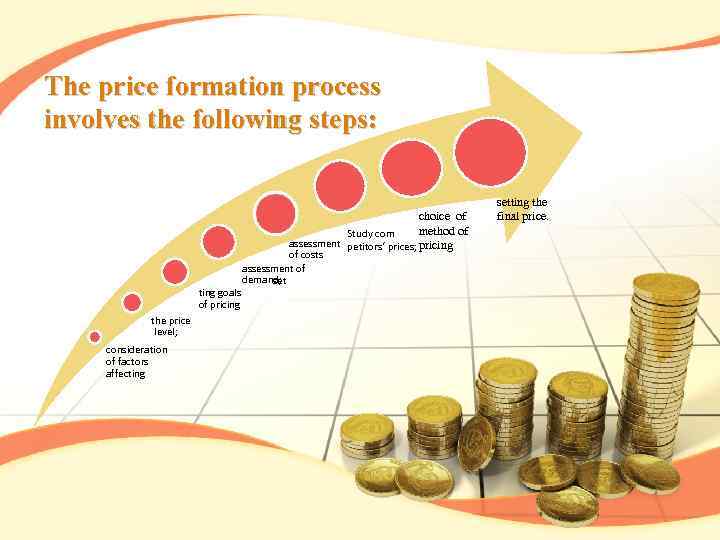
The price formation process involves the following steps: choice of method of Study com assessment petitors‘ prices; pricing of costs assessment of demand; set ting goals of pricing the price level; consideration of factors affecting setting the final price.
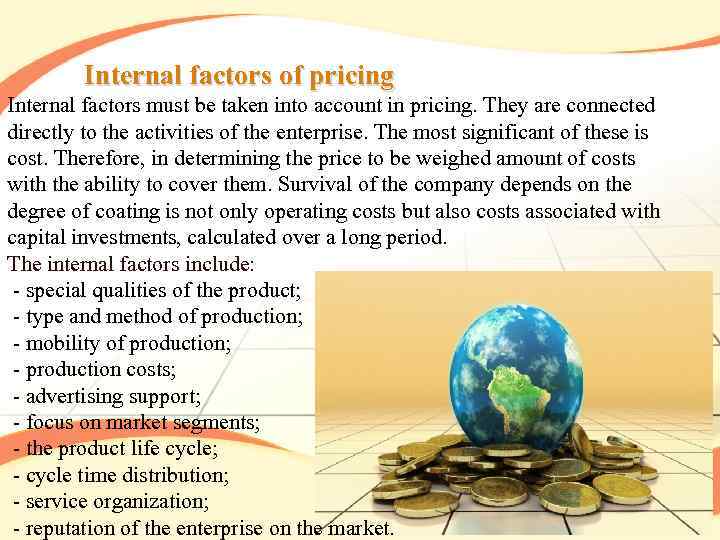
Internal factors of pricing Internal factors must be taken into account in pricing. They are connected directly to the activities of the enterprise. The most significant of these is cost. Therefore, in determining the price to be weighed amount of costs with the ability to cover them. Survival of the company depends on the degree of coating is not only operating costs but also costs associated with capital investments, calculated over a long period. The internal factors include: - special qualities of the product; - type and method of production; - mobility of production; - production costs; - advertising support; - focus on market segments; - the product life cycle; - cycle time distribution; - service organization; - reputation of the enterprise on the market.
Must take into account that the product with specific properties, unique properties, will have a higher price that reflects its quality. Thus, the price of a commodity depends on the scale. The type and mode of production determine the serial production. As a rule, small-scale production, and even more unique, the unit has a higher cost and price. The cost of production of goods of mass production, usually minor, so they are set relatively low prices. The development of the company of several market segments makes price differentiation in order to meet the needs of different categories of buyers with different incomes.
Duration and stage of product life cycle also affect the price level. Usually products have higher prices in the short life cycle and relatively low - with long-term. The growing number of intermediaries in the chain "producer - consumer" leads to a significant increase in final goods prices. Company image, well-oiled service and after sales service can charge higher prices.
External factors of pricing External factors do not depend on the company's activities and take account of changes in general economic processes, conditions in the country and abroad. External factors are determined by the market, the running company. If the market is strong competition, there a large number of goods of similar quality, then the firm for its conquest usually set lower prices, sometimes even less than the total cost. If the company begins production of a completely new and somewhat unique products, when setting the price, it may not take into account market competition, but it should be borne in mind that the buyer should get used to the new product, so it becomes the task of shaping consumer demand. And in this case, the prices charged for products should be sufficiently flexible. Thus, for a final decision on the establishment of prices should be familiar with the situation on the market, i. e. the buyer's needs.
The structure of the external factors can be represented as follows: • political stability in the country; , • availability of key resources; • extent of government regulation of the economy and, consequently, prices; • general rate of inflation; • foreign policy of the state; • perfection of the tax laws; • nature of demand for products.
Environmental factors that influence the price formation process in the enterprise can be represented in the form of four major groups: consumers, market environment, the participants channels of commodity circulation, the state. I. By consumers. They significantly affect the activities of companies in pricing. In order to properly respond to and take into account the behavior of consumers, the company needs to have some knowledge of general laws and customs of their behavior in the market. First, you need to pay attention to psychological aspects of consumer behavior: needs, demands, motivation in choosing a product or service, consumption patterns, attitudes toward products and the emergence of new proposals, the sensitivity to prices and quality of goods or services.
II. The market environment. This concept is II. The market environment very complex and multifaceted, as the market environment is influenced by a large number of economic, political and cultural factors. Usually there are four basic models of the market: pure competition, monopolistic competition, oligopoly, pure monopoly.
III. Participants channels of commodity circulation. Merchandising - a process that ensures the delivery of goods to the final consumer. It is known that there are three main types of its channels: - direct (goods and services are delivered to the final consumer without intermediaries); - indirect (goods and services delivered to end users by means of one or more intermediaries); - mixed (especially when combined the first two types of channels). IV. The state. We can distinguish three forms of state influence on pricing: price fixing, price regulation by establishing their limits, regulation of the system of free pricing.


Thank you for your attention!!!
Скачать презентацию Factors influencing decision-making on pricing Prepared by Ataeva
Golden Coins Graph_0.pptx