


 Скачать презентацию Factor Markets aka Resource Markets aka Input Markets
1888687fb666ba21c93729ee8149177f.ppt
- Количество слайдов: 43
 Factor Markets aka Resource Markets… aka Input Markets
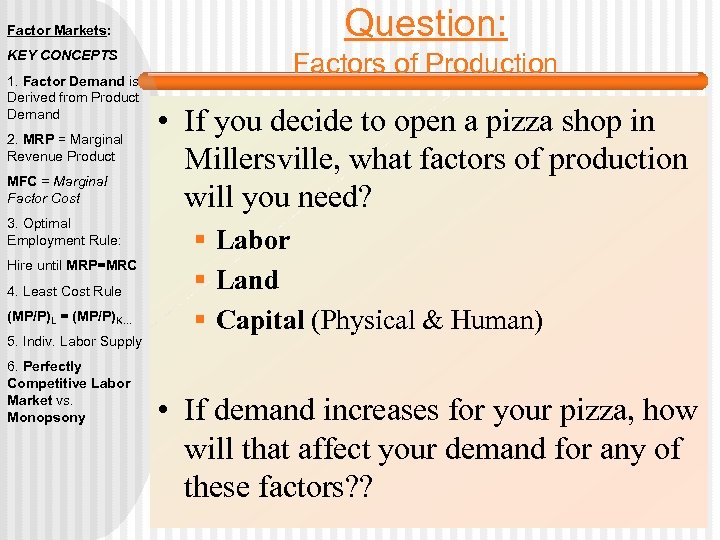 Factor Markets: KEY CONCEPTS 1. Factor Demand is Derived from Product Demand 2. MRP = Marginal Revenue Product MFC = Marginal Factor Cost 3. Optimal Employment Rule: Hire until MRP=MRC 4. Least Cost Rule (MP/P)L = (MP/P)K… 5. Indiv. Labor Supply 6. Perfectly Competitive Labor Market vs. Monopsony Question: Factors of Production • If you decide to open a pizza shop in Millersville, what factors of production will you need? § Labor § Land § Capital (Physical & Human) • If demand increases for your pizza, how will that affect your demand for any of these factors? ?
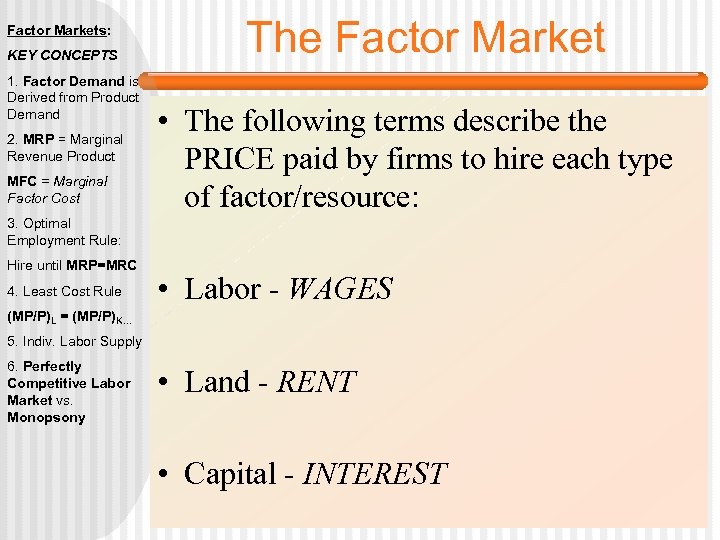 Factor Markets: KEY CONCEPTS 1. Factor Demand is Derived from Product Demand 2. MRP = Marginal Revenue Product MFC = Marginal Factor Cost The Factor Market • The following terms describe the PRICE paid by firms to hire each type of factor/resource: 3. Optimal Employment Rule: Hire until MRP=MRC 4. Least Cost Rule • Labor - WAGES (MP/P)L = (MP/P)K… 5. Indiv. Labor Supply 6. Perfectly Competitive Labor Market vs. Monopsony • Land - RENT • Capital - INTEREST
 Factor Markets: KEY CONCEPTS 1. Factor Demand is Derived from Product Demand 2. MRP = Marginal Revenue Product MFC = Marginal Factor Cost 3. Optimal Employment Rule: Hire until MRP=MRC 4. Least Cost Rule (MP/P)L = (MP/P)K… 5. Indiv. Labor Supply 6. Perfectly Competitive Labor Market vs. Monopsony The Labor Market • **The AP Exam will usually use Labor in their examples, so we will often use labor as well. But know that these ideas would be the same for hiring Capital or Land as well.
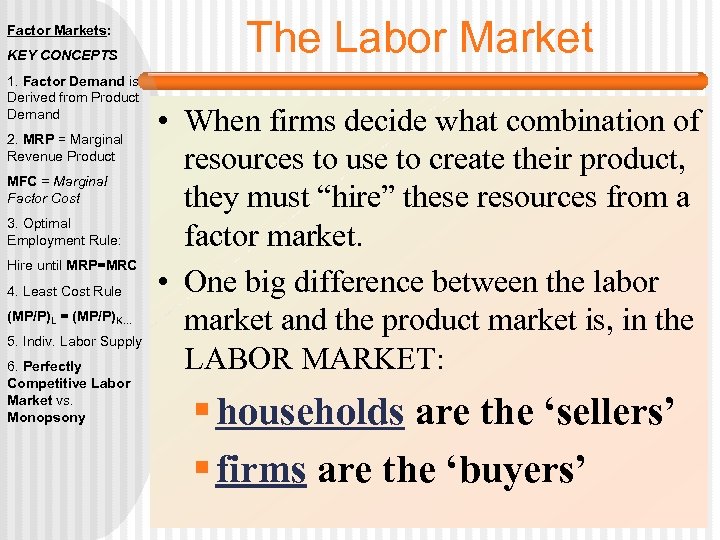 Factor Markets: KEY CONCEPTS 1. Factor Demand is Derived from Product Demand 2. MRP = Marginal Revenue Product MFC = Marginal Factor Cost 3. Optimal Employment Rule: Hire until MRP=MRC 4. Least Cost Rule (MP/P)L = (MP/P)K… 5. Indiv. Labor Supply 6. Perfectly Competitive Labor Market vs. Monopsony The Labor Market • When firms decide what combination of resources to use to create their product, they must “hire” these resources from a factor market. • One big difference between the labor market and the product market is, in the LABOR MARKET: § households are the ‘sellers’ § firms are the ‘buyers’
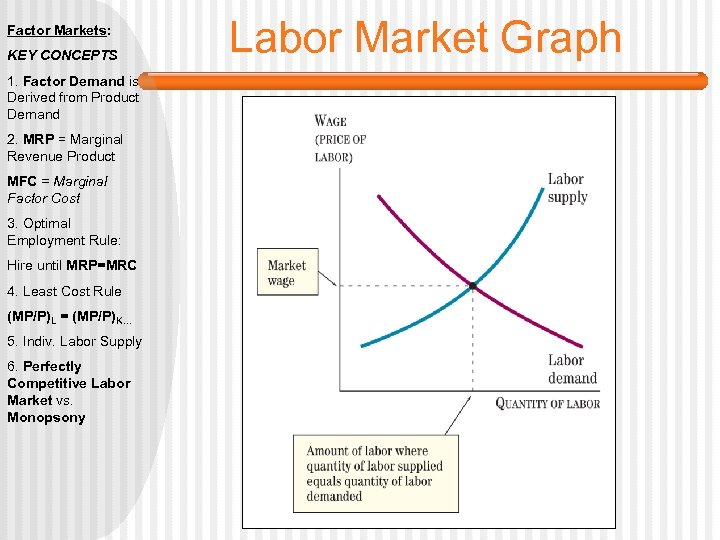 Factor Markets: KEY CONCEPTS 1. Factor Demand is Derived from Product Demand 2. MRP = Marginal Revenue Product MFC = Marginal Factor Cost 3. Optimal Employment Rule: Hire until MRP=MRC 4. Least Cost Rule (MP/P)L = (MP/P)K… 5. Indiv. Labor Supply 6. Perfectly Competitive Labor Market vs. Monopsony Labor Market Graph
 Factor Markets: KEY CONCEPTS 1. Factor Demand is Derived from Product Demand 2. MRP = Marginal Revenue Product MFC = Marginal Factor Cost 3. Optimal Employment Rule: Hire until MRP=MRC 4. Least Cost Rule (MP/P)L = (MP/P)K… 5. Indiv. Labor Supply 6. Perfectly Competitive Labor Market vs. Monopsony Adjusting for Inflation • Wage – The price of labor defined as currency per unit of labor worked. § NOMINAL Wage – The price of labor not adjusted for inflation. § REAL wage – The price of labor adjusted for inflation; Economists use the CPI to adjust numbers from prices/wages from different times into a consistent unit of measure (ie. “ 2010 dollars”)
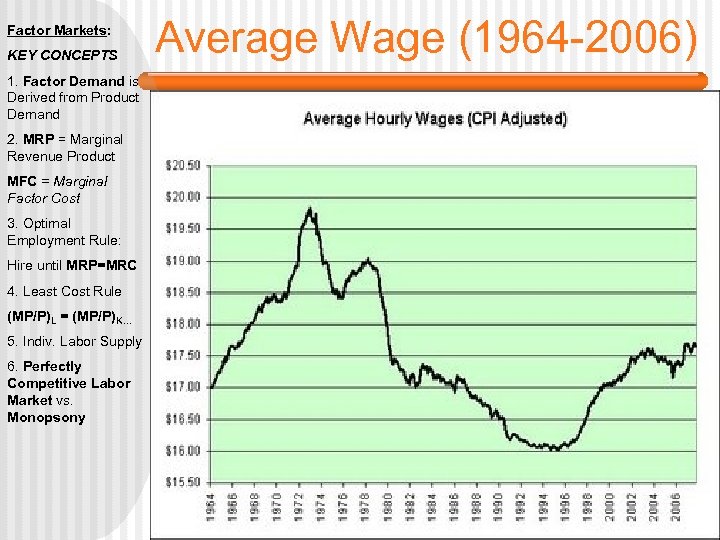 Factor Markets: KEY CONCEPTS 1. Factor Demand is Derived from Product Demand 2. MRP = Marginal Revenue Product MFC = Marginal Factor Cost 3. Optimal Employment Rule: Hire until MRP=MRC 4. Least Cost Rule (MP/P)L = (MP/P)K… 5. Indiv. Labor Supply 6. Perfectly Competitive Labor Market vs. Monopsony Average Wage (1964 -2006)
 Factor Markets: KEY CONCEPTS 1. Factor Demand is Derived from Product Demand 2. MRP = Marginal Revenue Product MFC = Marginal Factor Cost 3. Optimal Employment Rule: Hire until MRP=MRC 4. Least Cost Rule (MP/P)L = (MP/P)K… 5. Indiv. Labor Supply 6. Perfectly Competitive Labor Market vs. Monopsony Wage Trends Other US labor market trends: 1) Workers with higher skills are paid more than unskilled workers. This gap is increasing. 2) College graduates earn more than high school graduates and the gap has been increasing. 3) Women, on average, are paid lower than men, although the gap has become more narrow over the years.
 Factor Markets: KEY CONCEPTS 1. Factor Demand is Derived from Product Demand 2. MRP = Marginal Revenue Product MFC = Marginal Factor Cost 3. Optimal Employment Rule: Hire until MRP=MRC 4. Least Cost Rule (MP/P)L = (MP/P)K… 5. Indiv. Labor Supply 6. Perfectly Competitive Labor Market vs. Monopsony Derived Factor Demand • The factor market is a DERIVED MARKET. This means that the demand for the product determines the demand for the factor (ie. labor). • For example: If consumers demand more pizza, firms will demand more labor, ovens, etc. to produce the pizza. • However, if consumers demand less pizza, firms will demand less labor, ovens, etc. to produce the pizza.
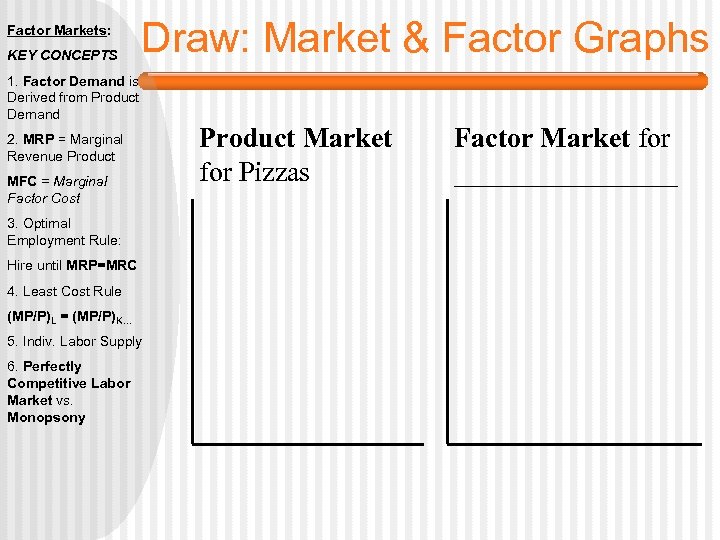 Factor Markets: KEY CONCEPTS Draw: Market & Factor Graphs 1. Factor Demand is Derived from Product Demand 2. MRP = Marginal Revenue Product MFC = Marginal Factor Cost 3. Optimal Employment Rule: Hire until MRP=MRC 4. Least Cost Rule (MP/P)L = (MP/P)K… 5. Indiv. Labor Supply 6. Perfectly Competitive Labor Market vs. Monopsony Product Market for Pizzas Factor Market for ________
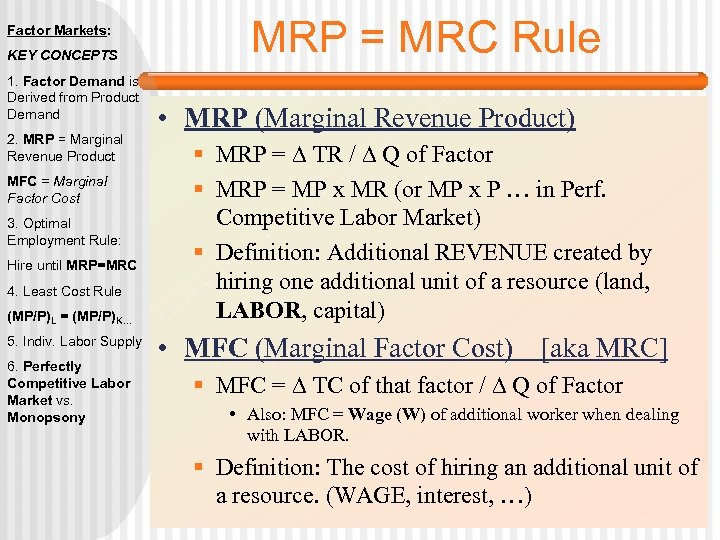 Factor Markets: KEY CONCEPTS 1. Factor Demand is Derived from Product Demand 2. MRP = Marginal Revenue Product MFC = Marginal Factor Cost 3. Optimal Employment Rule: Hire until MRP=MRC 4. Least Cost Rule (MP/P)L = (MP/P)K… 5. Indiv. Labor Supply 6. Perfectly Competitive Labor Market vs. Monopsony MRP = MRC Rule • MRP (Marginal Revenue Product) § MRP = ∆ TR / ∆ Q of Factor § MRP = MP x MR (or MP x P … in Perf. Competitive Labor Market) § Definition: Additional REVENUE created by hiring one additional unit of a resource (land, LABOR, capital) • MFC (Marginal Factor Cost) [aka MRC] § MFC = ∆ TC of that factor / ∆ Q of Factor • Also: MFC = Wage (W) of additional worker when dealing with LABOR. § Definition: The cost of hiring an additional unit of a resource. (WAGE, interest, …)
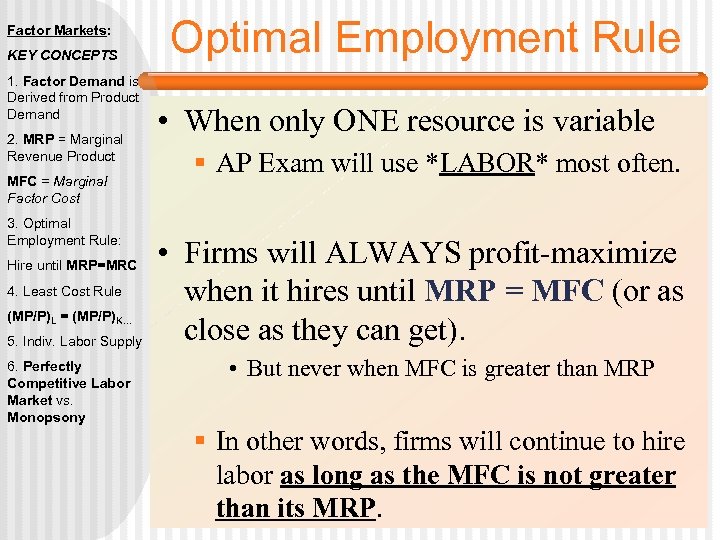 Factor Markets: KEY CONCEPTS 1. Factor Demand is Derived from Product Demand 2. MRP = Marginal Revenue Product MFC = Marginal Factor Cost 3. Optimal Employment Rule: Hire until MRP=MRC 4. Least Cost Rule (MP/P)L = (MP/P)K… 5. Indiv. Labor Supply 6. Perfectly Competitive Labor Market vs. Monopsony Optimal Employment Rule • When only ONE resource is variable § AP Exam will use *LABOR* most often. • Firms will ALWAYS profit-maximize when it hires until MRP = MFC (or as close as they can get). • But never when MFC is greater than MRP § In other words, firms will continue to hire labor as long as the MFC is not greater than its MRP.
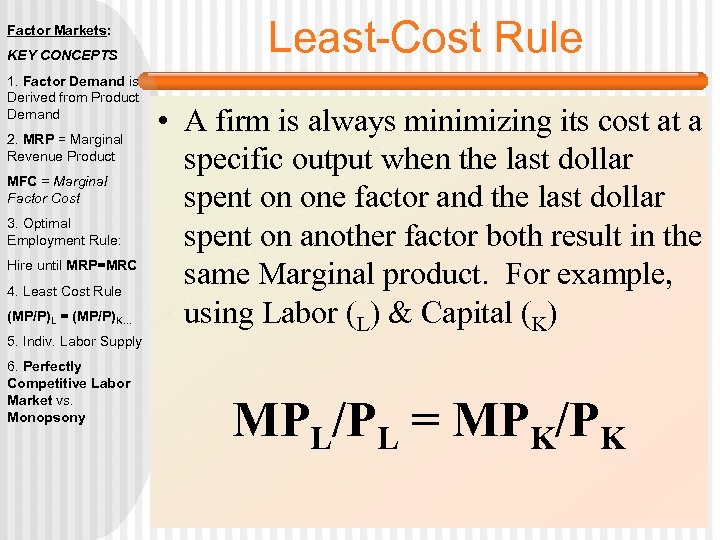 Factor Markets: KEY CONCEPTS 1. Factor Demand is Derived from Product Demand 2. MRP = Marginal Revenue Product MFC = Marginal Factor Cost 3. Optimal Employment Rule: Hire until MRP=MRC 4. Least Cost Rule (MP/P)L = (MP/P)K… 5. Indiv. Labor Supply 6. Perfectly Competitive Labor Market vs. Monopsony Least-Cost Rule • A firm is always minimizing its cost at a specific output when the last dollar spent on one factor and the last dollar spent on another factor both result in the same Marginal product. For example, using Labor (L) & Capital (K) MPL/PL = MPK/PK
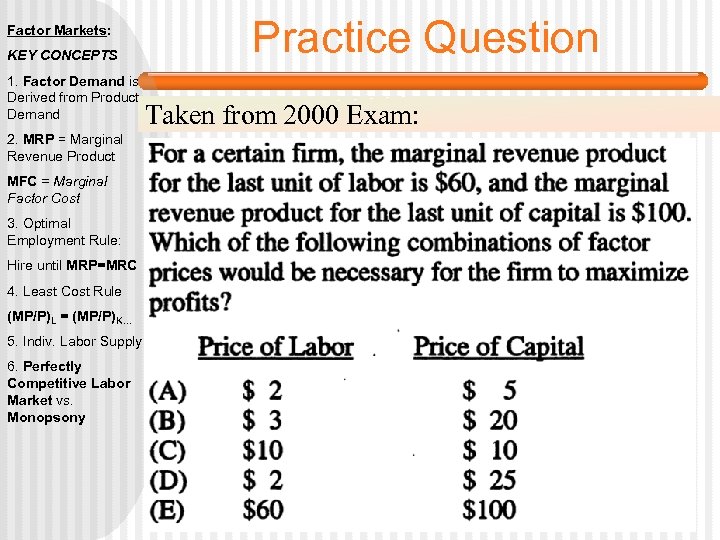 Factor Markets: KEY CONCEPTS 1. Factor Demand is Derived from Product Demand 2. MRP = Marginal Revenue Product MFC = Marginal Factor Cost 3. Optimal Employment Rule: Hire until MRP=MRC 4. Least Cost Rule (MP/P)L = (MP/P)K… 5. Indiv. Labor Supply 6. Perfectly Competitive Labor Market vs. Monopsony Practice Question Taken from 2000 Exam:
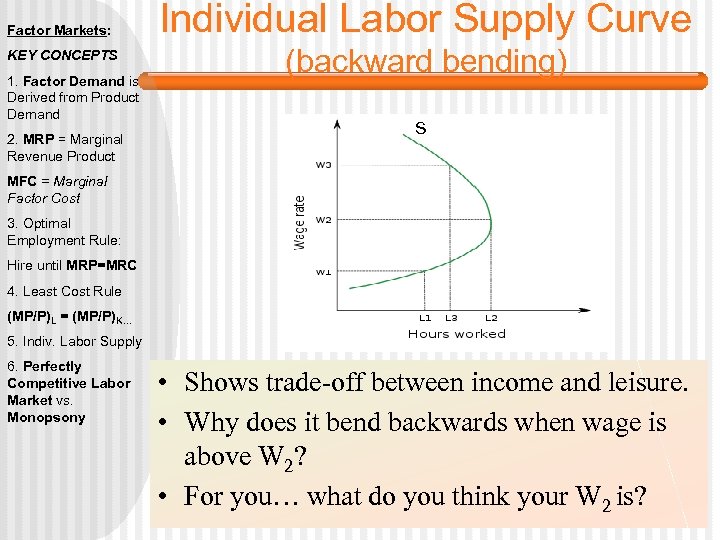 Factor Markets: KEY CONCEPTS 1. Factor Demand is Derived from Product Demand 2. MRP = Marginal Revenue Product Individual Labor Supply Curve (backward bending) S MFC = Marginal Factor Cost 3. Optimal Employment Rule: Hire until MRP=MRC 4. Least Cost Rule (MP/P)L = (MP/P)K… 5. Indiv. Labor Supply 6. Perfectly Competitive Labor Market vs. Monopsony • Shows trade-off between income and leisure. • Why does it bend backwards when wage is above W 2? • For you… what do you think your W 2 is?
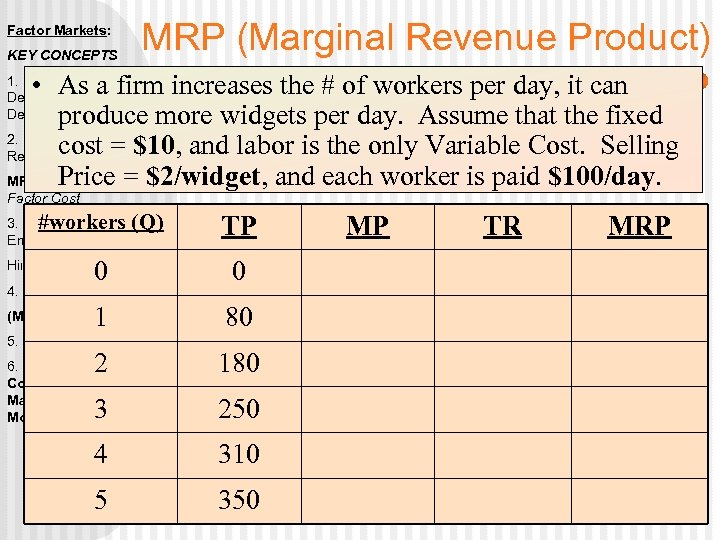 MRP (Marginal Revenue Product) Factor Markets: KEY CONCEPTS • As a firm increases the # of workers per day, it can produce more widgets per day. Assume that the fixed 2. MRP = Marginal cost = Revenue Product $10, and labor is the only Variable Cost. Selling Price MFC = Marginal = $2/widget, and each worker is paid $100/day. 1. Factor Demand is Derived from Product Demand Factor Cost 3. Optimal #workers Employment Rule: (Q) TP 0 0 1 80 Hire until MRP=MRC 4. Least Cost Rule (MP/P)L = (MP/P)K… 5. Indiv. Labor Supply 2 180 3 250 4 310 5 350 6. Perfectly Competitive Labor Market vs. Monopsony MP TR MRP
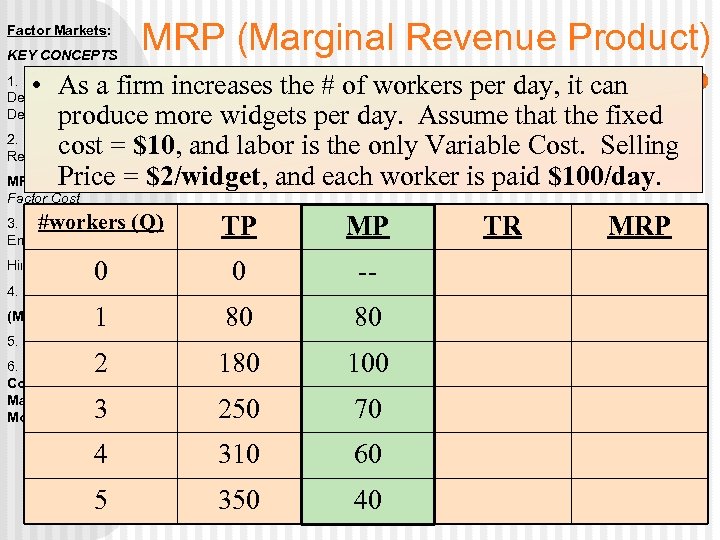 MRP (Marginal Revenue Product) Factor Markets: KEY CONCEPTS • As a firm increases the # of workers per day, it can produce more widgets per day. Assume that the fixed 2. MRP = Marginal cost = Revenue Product $10, and labor is the only Variable Cost. Selling Price MFC = Marginal = $2/widget, and each worker is paid $100/day. 1. Factor Demand is Derived from Product Demand Factor Cost 3. Optimal #workers Employment Rule: (Q) TP MP 0 0 -- 1 80 80 2 180 100 3 250 70 4 310 60 5 350 40 Hire until MRP=MRC 4. Least Cost Rule (MP/P)L = (MP/P)K… 5. Indiv. Labor Supply 6. Perfectly Competitive Labor Market vs. Monopsony TR MRP
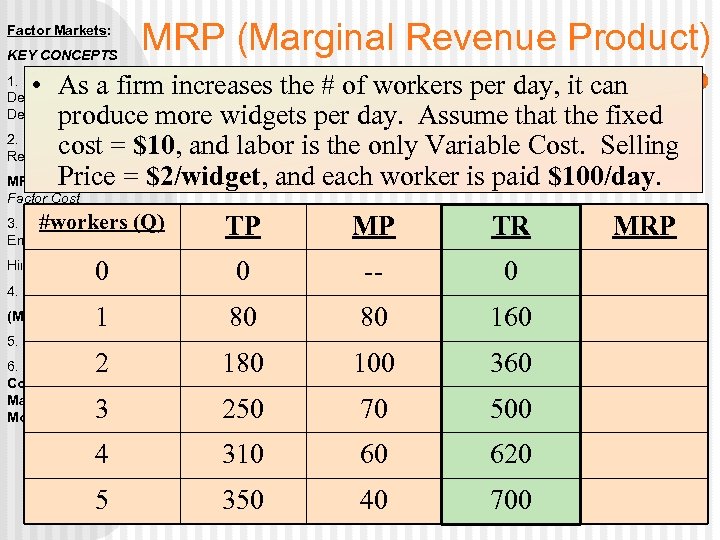 MRP (Marginal Revenue Product) Factor Markets: KEY CONCEPTS • As a firm increases the # of workers per day, it can produce more widgets per day. Assume that the fixed 2. MRP = Marginal cost = Revenue Product $10, and labor is the only Variable Cost. Selling Price MFC = Marginal = $2/widget, and each worker is paid $100/day. 1. Factor Demand is Derived from Product Demand Factor Cost 3. Optimal #workers Employment Rule: (Q) TP MP TR 0 0 -- 0 1 80 80 160 2 180 100 360 3 250 70 500 4 310 60 620 5 350 40 700 Hire until MRP=MRC 4. Least Cost Rule (MP/P)L = (MP/P)K… 5. Indiv. Labor Supply 6. Perfectly Competitive Labor Market vs. Monopsony MRP
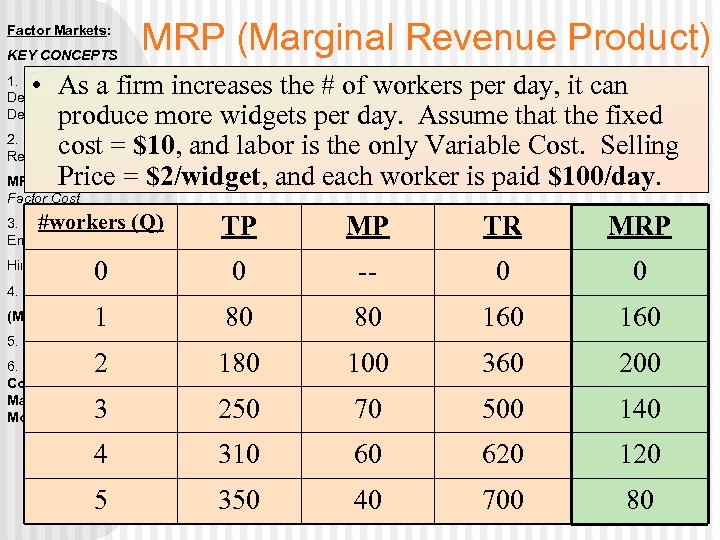 MRP (Marginal Revenue Product) Factor Markets: KEY CONCEPTS • As a firm increases the # of workers per day, it can produce more widgets per day. Assume that the fixed 2. MRP = Marginal cost = Revenue Product $10, and labor is the only Variable Cost. Selling Price MFC = Marginal = $2/widget, and each worker is paid $100/day. 1. Factor Demand is Derived from Product Demand Factor Cost 3. Optimal #workers Employment Rule: (Q) TP MP TR MRP 0 0 -- 0 0 1 80 80 160 2 180 100 360 200 3 250 70 500 140 4 310 60 620 120 5 350 40 700 80 Hire until MRP=MRC 4. Least Cost Rule (MP/P)L = (MP/P)K… 5. Indiv. Labor Supply 6. Perfectly Competitive Labor Market vs. Monopsony
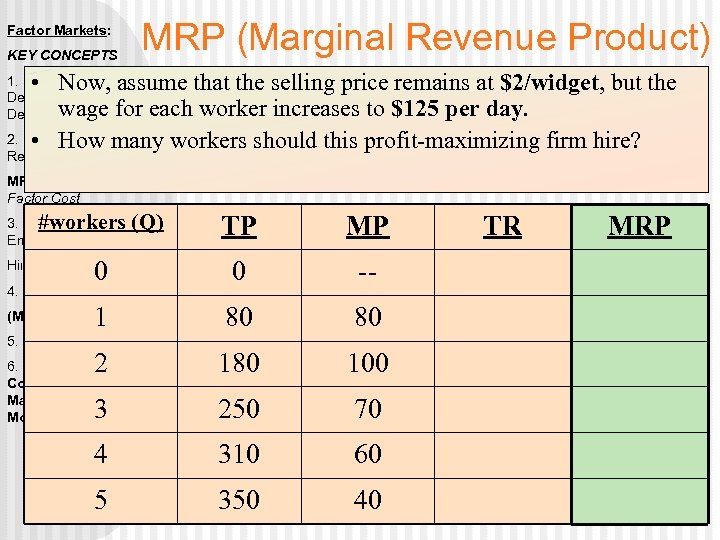 MRP (Marginal Revenue Product) Factor Markets: KEY CONCEPTS • Now, assume that the selling price remains at $2/widget, but the wage for each worker increases to $125 per day. 2. MRP = Marginal • How many workers should this profit-maximizing firm hire? 1. Factor Demand is Derived from Product Demand Revenue Product MFC = Marginal Factor Cost 3. Optimal #workers Employment Rule: (Q) TP MP 0 0 -- 1 80 80 2 180 100 3 250 70 4 310 60 5 350 40 Hire until MRP=MRC 4. Least Cost Rule (MP/P)L = (MP/P)K… 5. Indiv. Labor Supply 6. Perfectly Competitive Labor Market vs. Monopsony TR MRP
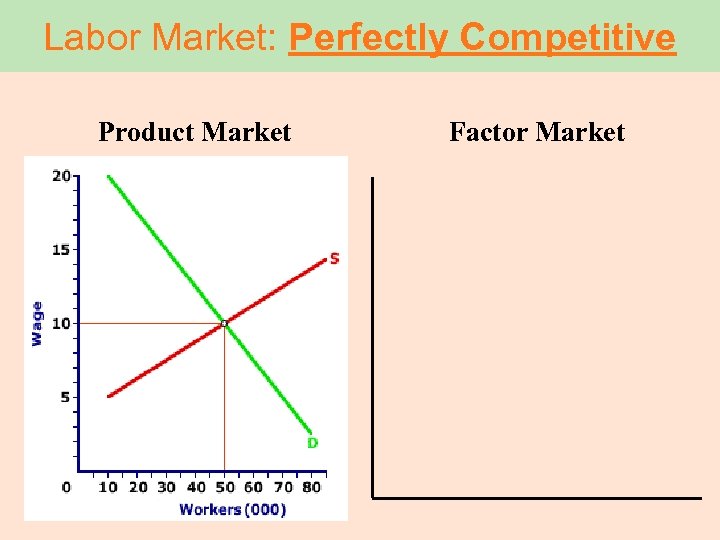 Labor Market: Perfectly Competitive Factor Markets: KEY CONCEPTS 1. Factor Demand is Derived from Product Demand Product Market 2. MRP = Marginal Revenue Product MFC = Marginal Factor Cost 3. Optimal Employment Rule: Hire until MRP=MRC 4. Least Cost Rule (MP/P)L = (MP/P)K… 5. Indiv. Labor Supply 6. Perfectly Competitive Labor Market vs. Monopsony Factor Market
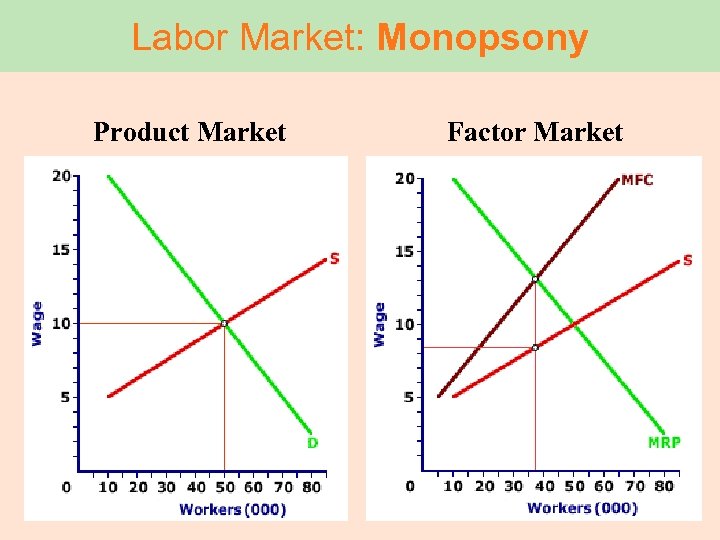 Factor Markets: KEY CONCEPTS Labor Market: Monopsony 1. Factor Demand is Derived from Product Demand Product Market 2. MRP = Marginal Revenue Product MFC = Marginal Factor Cost 3. Optimal Employment Rule: Hire until MRP=MRC 4. Least Cost Rule (MP/P)L = (MP/P)K… 5. Indiv. Labor Supply 6. Perfectly Competitive Labor Market vs. Monopsony Factor Market
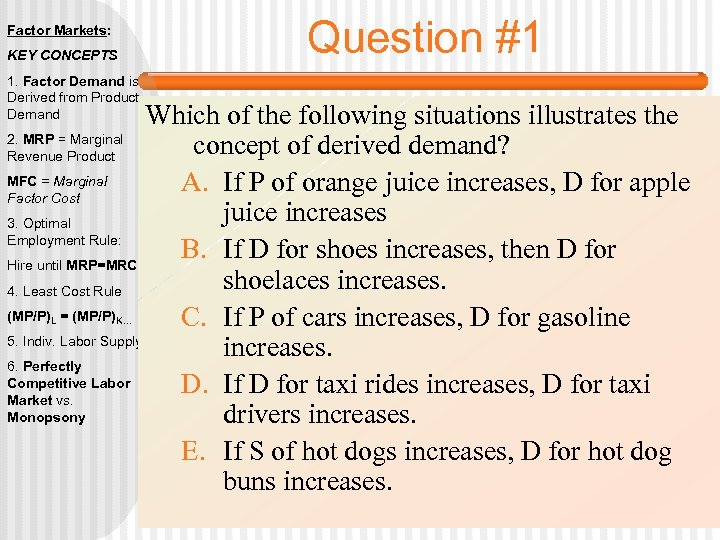 Factor Markets: KEY CONCEPTS 1. Factor Demand is Derived from Product Demand Question #1 Which of the following situations illustrates the 2. MRP = Marginal concept of derived demand? Revenue Product MFC = Marginal A. If P of orange juice increases, D for apple Factor Cost juice increases 3. Optimal Employment Rule: B. If D for shoes increases, then D for Hire until MRP=MRC shoelaces increases. 4. Least Cost Rule (MP/P) = (MP/P) C. If P of cars increases, D for gasoline 5. Indiv. Labor Supply increases. 6. Perfectly Competitive Labor D. If D for taxi rides increases, D for taxi Market vs. Monopsony drivers increases. E. If S of hot dogs increases, D for hot dog buns increases. L K…
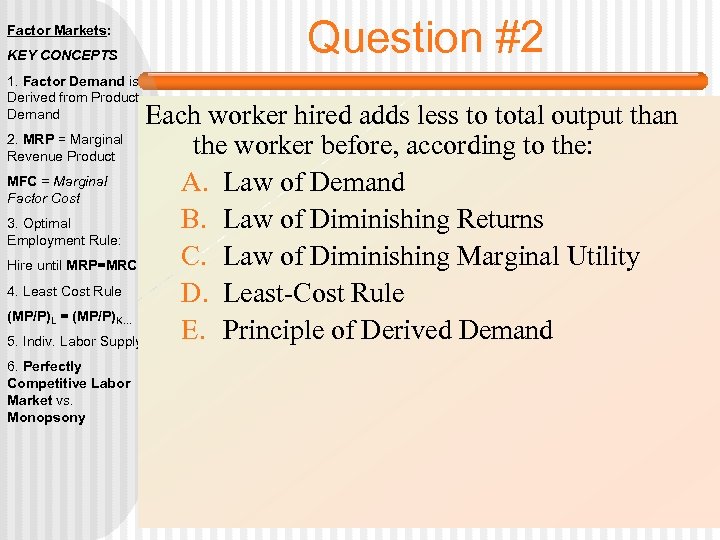 Factor Markets: KEY CONCEPTS 1. Factor Demand is Derived from Product Demand Question #2 Each worker hired adds less to total output than 2. MRP = Marginal the worker before, according to the: Revenue Product MFC = Marginal A. Law of Demand Factor Cost B. Law of Diminishing Returns 3. Optimal Employment Rule: C. Law of Diminishing Marginal Utility Hire until MRP=MRC 4. Least Cost Rule D. Least-Cost Rule (MP/P) = (MP/P) E. Principle of Derived Demand 5. Indiv. Labor Supply L K… 6. Perfectly Competitive Labor Market vs. Monopsony
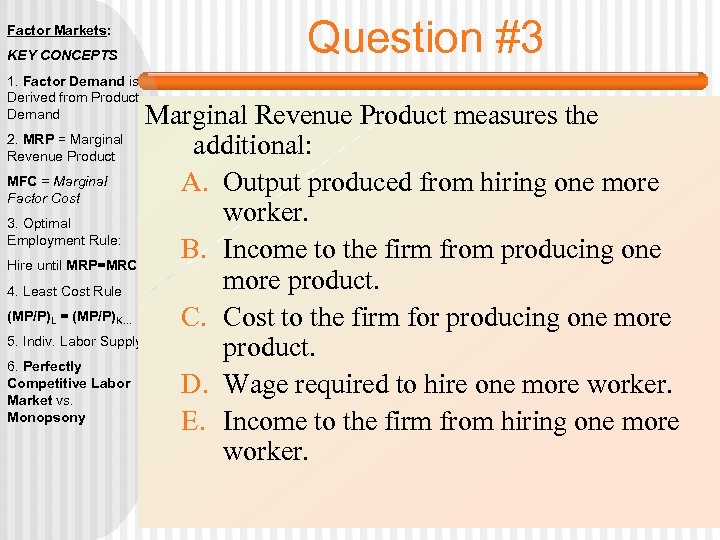 Factor Markets: KEY CONCEPTS 1. Factor Demand is Derived from Product Demand Question #3 Marginal Revenue Product measures the 2. MRP = Marginal additional: Revenue Product MFC = Marginal A. Output produced from hiring one more Factor Cost worker. 3. Optimal Employment Rule: B. Income to the firm from producing one Hire until MRP=MRC more product. 4. Least Cost Rule (MP/P) = (MP/P) C. Cost to the firm for producing one more 5. Indiv. Labor Supply product. 6. Perfectly Competitive Labor D. Wage required to hire one more worker. Market vs. Monopsony E. Income to the firm from hiring one more worker. L K…
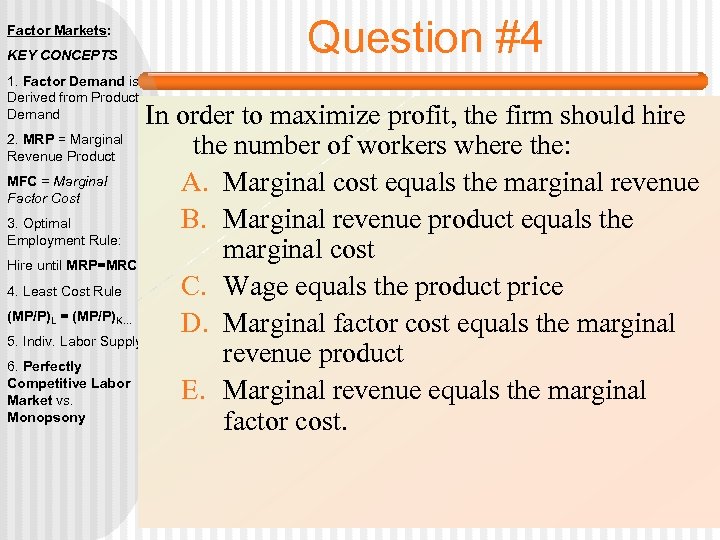 Factor Markets: KEY CONCEPTS 1. Factor Demand is Derived from Product Demand Question #4 In order to maximize profit, the firm should hire 2. MRP = Marginal the number of workers where the: Revenue Product MFC = Marginal A. Marginal cost equals the marginal revenue Factor Cost B. Marginal revenue product equals the 3. Optimal Employment Rule: marginal cost Hire until MRP=MRC C. Wage equals the product price 4. Least Cost Rule (MP/P) = (MP/P) D. Marginal factor cost equals the marginal 5. Indiv. Labor Supply revenue product 6. Perfectly Competitive Labor E. Marginal revenue equals the marginal Market vs. Monopsony factor cost. L K…
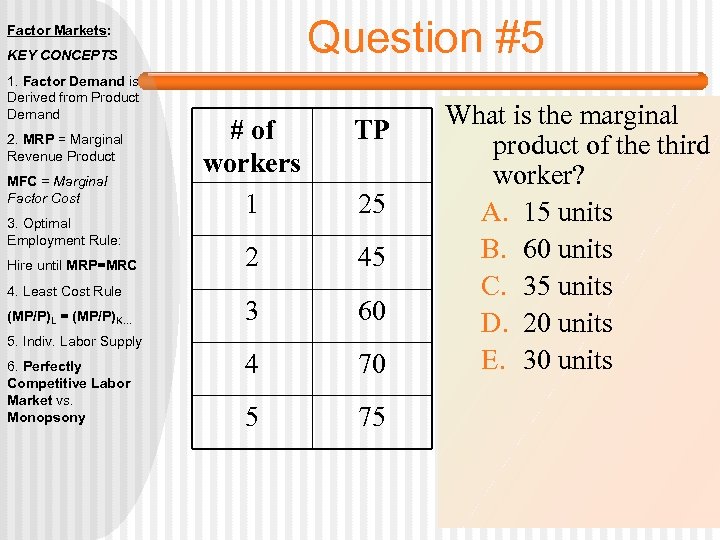 Question #5 Factor Markets: KEY CONCEPTS 1. Factor Demand is Derived from Product Demand 2. MRP = Marginal Revenue Product MFC = Marginal Factor Cost 3. Optimal Employment Rule: Hire until MRP=MRC 4. Least Cost Rule (MP/P)L = (MP/P)K… 5. Indiv. Labor Supply 6. Perfectly Competitive Labor Market vs. Monopsony # of workers 1 TP 2 45 3 60 4 70 5 75 25 What is the marginal product of the third worker? A. 15 units B. 60 units C. 35 units D. 20 units E. 30 units
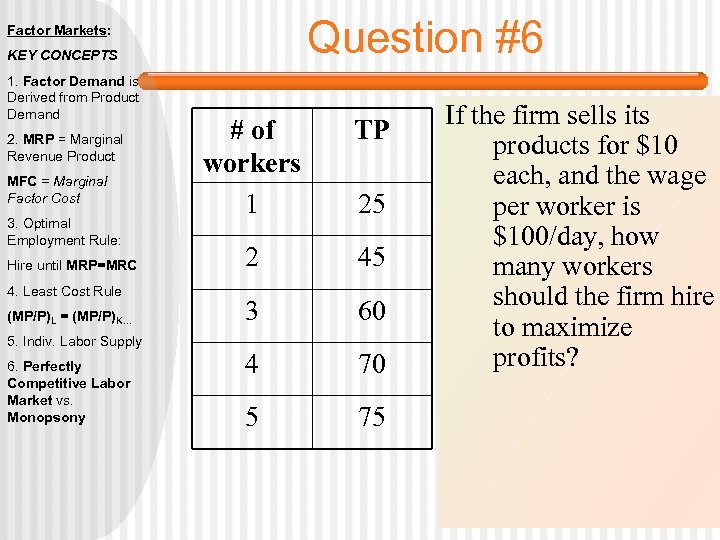 Question #6 Factor Markets: KEY CONCEPTS 1. Factor Demand is Derived from Product Demand 2. MRP = Marginal Revenue Product MFC = Marginal Factor Cost 3. Optimal Employment Rule: Hire until MRP=MRC 4. Least Cost Rule (MP/P)L = (MP/P)K… 5. Indiv. Labor Supply 6. Perfectly Competitive Labor Market vs. Monopsony # of workers 1 TP 2 45 3 60 4 70 5 75 25 If the firm sells its products for $10 each, and the wage per worker is $100/day, how many workers should the firm hire to maximize profits?
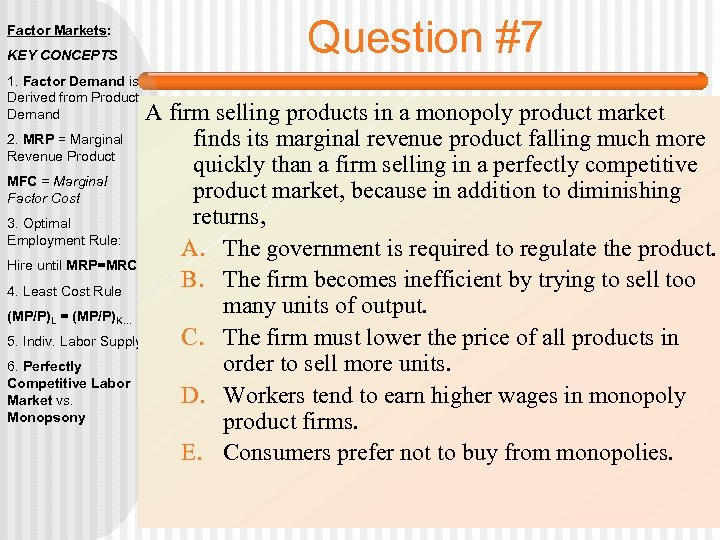 Factor Markets: KEY CONCEPTS 1. Factor Demand is Derived from Product Demand Question #7 A firm selling products in a monopoly product market 2. MRP = Marginal finds its marginal revenue product falling much more Revenue Product quickly than a firm selling in a perfectly competitive MFC = Marginal product market, because in addition to diminishing Factor Cost returns, 3. Optimal Employment Rule: A. The government is required to regulate the product. Hire until MRP=MRC B. The firm becomes inefficient by trying to sell too 4. Least Cost Rule many units of output. (MP/P) = (MP/P) C. The firm must lower the price of all products in 5. Indiv. Labor Supply order to sell more units. 6. Perfectly Competitive Labor D. Workers tend to earn higher wages in monopoly Market vs. Monopsony product firms. E. Consumers prefer not to buy from monopolies. L K…
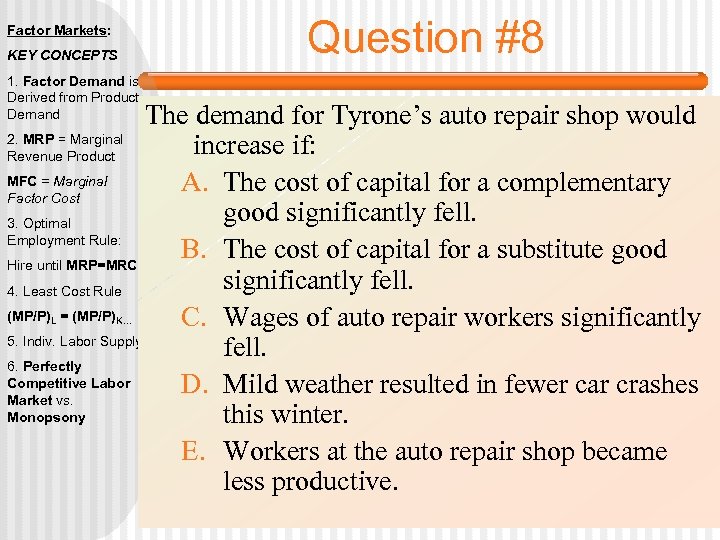 Factor Markets: KEY CONCEPTS 1. Factor Demand is Derived from Product Demand Question #8 The demand for Tyrone’s auto repair shop would 2. MRP = Marginal increase if: Revenue Product MFC = Marginal A. The cost of capital for a complementary Factor Cost good significantly fell. 3. Optimal Employment Rule: B. The cost of capital for a substitute good Hire until MRP=MRC significantly fell. 4. Least Cost Rule (MP/P) = (MP/P) C. Wages of auto repair workers significantly 5. Indiv. Labor Supply fell. 6. Perfectly Competitive Labor D. Mild weather resulted in fewer car crashes Market vs. Monopsony this winter. E. Workers at the auto repair shop became less productive. L K…
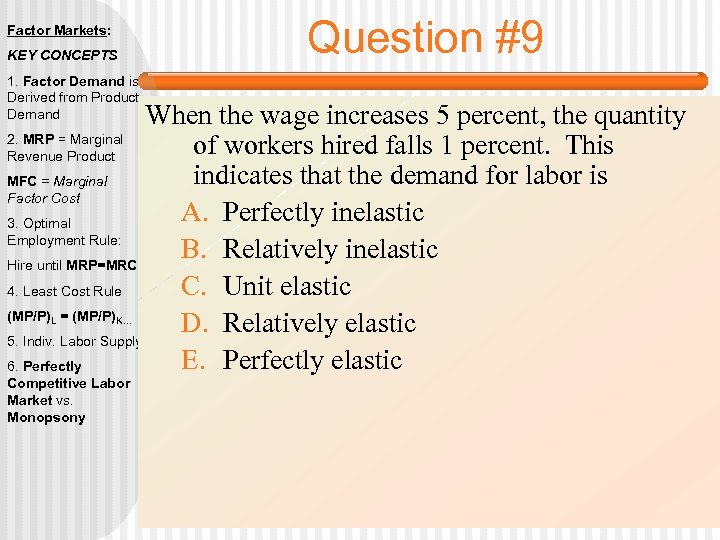 Factor Markets: KEY CONCEPTS 1. Factor Demand is Derived from Product Demand Question #9 When the wage increases 5 percent, the quantity 2. MRP = Marginal of workers hired falls 1 percent. This Revenue Product indicates that the demand for labor is MFC = Marginal Factor Cost A. Perfectly inelastic 3. Optimal Employment Rule: B. Relatively inelastic Hire until MRP=MRC C. Unit elastic 4. Least Cost Rule (MP/P) = (MP/P) D. Relatively elastic 5. Indiv. Labor Supply E. Perfectly elastic 6. Perfectly L K… Competitive Labor Market vs. Monopsony
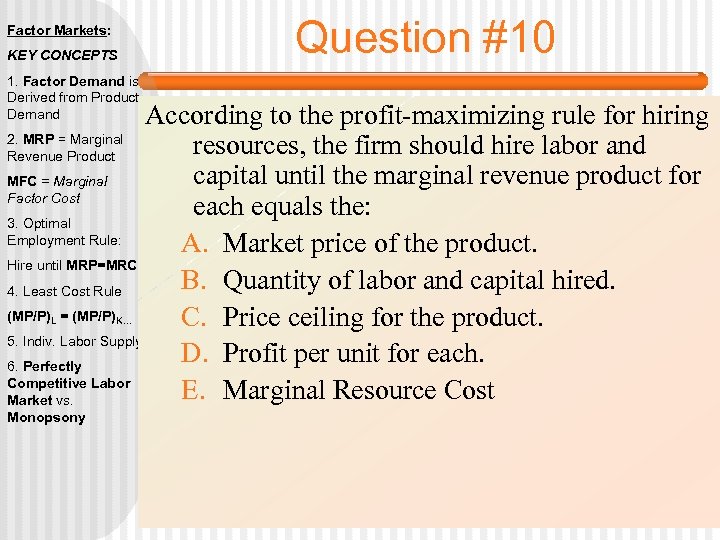 Factor Markets: KEY CONCEPTS 1. Factor Demand is Derived from Product Demand Question #10 According to the profit-maximizing rule for hiring 2. MRP = Marginal resources, the firm should hire labor and Revenue Product capital until the marginal revenue product for MFC = Marginal Factor Cost each equals the: 3. Optimal Employment Rule: A. Market price of the product. Hire until MRP=MRC B. Quantity of labor and capital hired. 4. Least Cost Rule (MP/P) = (MP/P) C. Price ceiling for the product. 5. Indiv. Labor Supply D. Profit per unit for each. 6. Perfectly Competitive Labor E. Marginal Resource Cost Market vs. L Monopsony K…
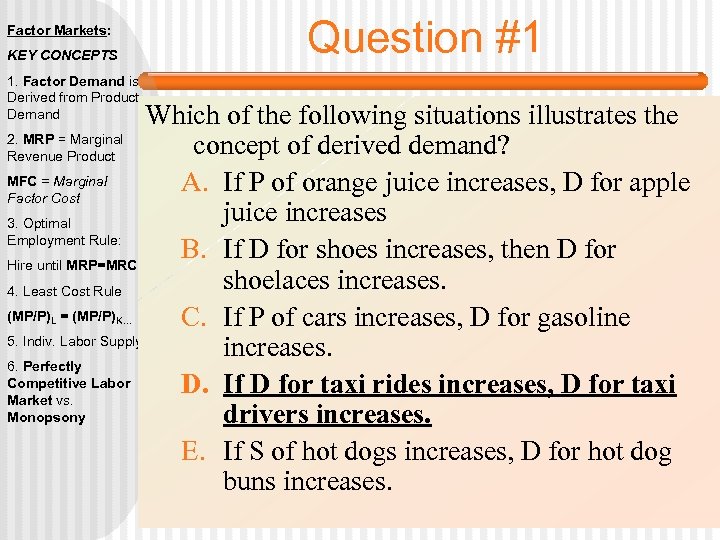 Factor Markets: KEY CONCEPTS 1. Factor Demand is Derived from Product Demand Question #1 Which of the following situations illustrates the 2. MRP = Marginal concept of derived demand? Revenue Product MFC = Marginal A. If P of orange juice increases, D for apple Factor Cost juice increases 3. Optimal Employment Rule: B. If D for shoes increases, then D for Hire until MRP=MRC shoelaces increases. 4. Least Cost Rule (MP/P) = (MP/P) C. If P of cars increases, D for gasoline 5. Indiv. Labor Supply increases. 6. Perfectly Competitive Labor D. If D for taxi rides increases, D for taxi Market vs. Monopsony drivers increases. E. If S of hot dogs increases, D for hot dog buns increases. L K…
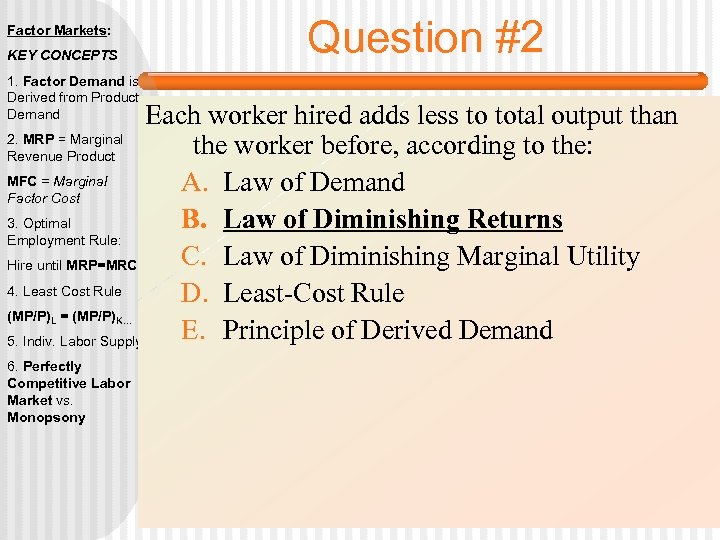 Factor Markets: KEY CONCEPTS 1. Factor Demand is Derived from Product Demand Question #2 Each worker hired adds less to total output than 2. MRP = Marginal the worker before, according to the: Revenue Product MFC = Marginal A. Law of Demand Factor Cost B. Law of Diminishing Returns 3. Optimal Employment Rule: C. Law of Diminishing Marginal Utility Hire until MRP=MRC 4. Least Cost Rule D. Least-Cost Rule (MP/P) = (MP/P) E. Principle of Derived Demand 5. Indiv. Labor Supply L K… 6. Perfectly Competitive Labor Market vs. Monopsony
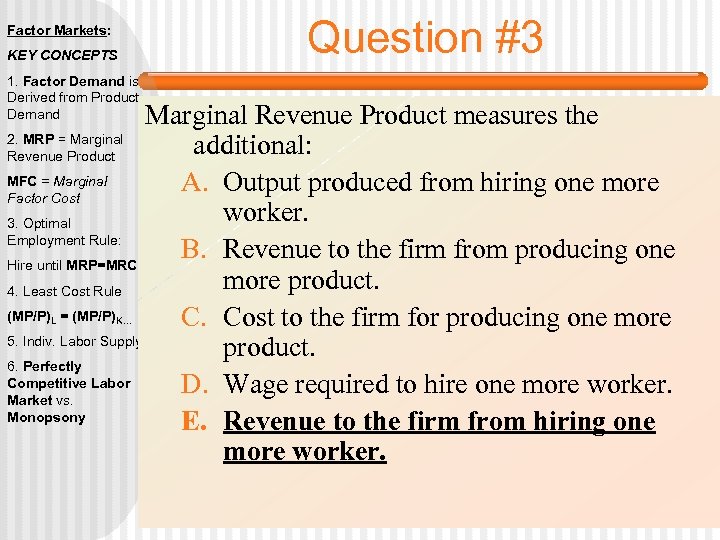 Factor Markets: KEY CONCEPTS 1. Factor Demand is Derived from Product Demand Question #3 Marginal Revenue Product measures the 2. MRP = Marginal additional: Revenue Product MFC = Marginal A. Output produced from hiring one more Factor Cost worker. 3. Optimal Employment Rule: B. Revenue to the firm from producing one Hire until MRP=MRC more product. 4. Least Cost Rule (MP/P) = (MP/P) C. Cost to the firm for producing one more 5. Indiv. Labor Supply product. 6. Perfectly Competitive Labor D. Wage required to hire one more worker. Market vs. Monopsony E. Revenue to the firm from hiring one more worker. L K…
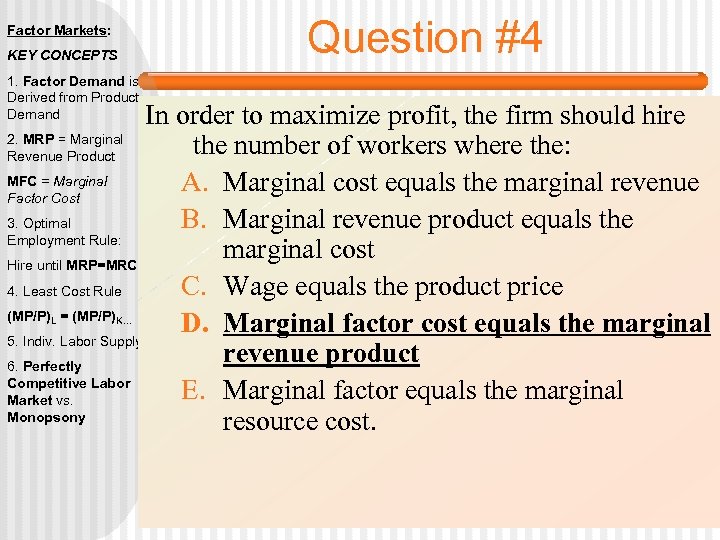 Factor Markets: KEY CONCEPTS 1. Factor Demand is Derived from Product Demand Question #4 In order to maximize profit, the firm should hire 2. MRP = Marginal the number of workers where the: Revenue Product MFC = Marginal A. Marginal cost equals the marginal revenue Factor Cost B. Marginal revenue product equals the 3. Optimal Employment Rule: marginal cost Hire until MRP=MRC C. Wage equals the product price 4. Least Cost Rule (MP/P) = (MP/P) D. Marginal factor cost equals the marginal 5. Indiv. Labor Supply revenue product 6. Perfectly Competitive Labor E. Marginal factor equals the marginal Market vs. Monopsony resource cost. L K…
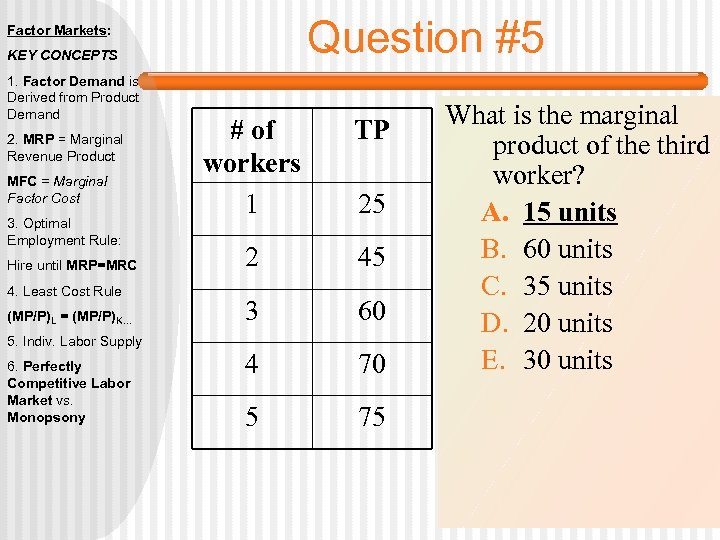 Question #5 Factor Markets: KEY CONCEPTS 1. Factor Demand is Derived from Product Demand 2. MRP = Marginal Revenue Product MFC = Marginal Factor Cost 3. Optimal Employment Rule: Hire until MRP=MRC 4. Least Cost Rule (MP/P)L = (MP/P)K… 5. Indiv. Labor Supply 6. Perfectly Competitive Labor Market vs. Monopsony # of workers 1 TP 2 45 3 60 4 70 5 75 25 What is the marginal product of the third worker? A. 15 units B. 60 units C. 35 units D. 20 units E. 30 units
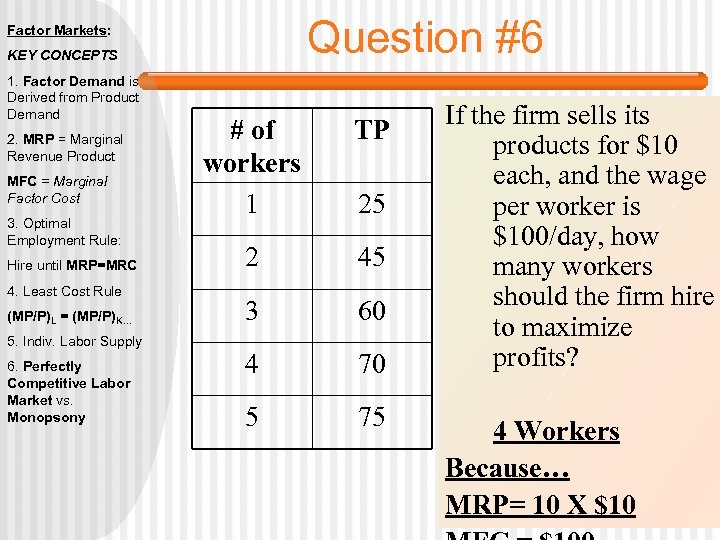 Question #6 Factor Markets: KEY CONCEPTS 1. Factor Demand is Derived from Product Demand 2. MRP = Marginal Revenue Product MFC = Marginal Factor Cost 3. Optimal Employment Rule: Hire until MRP=MRC 4. Least Cost Rule (MP/P)L = (MP/P)K… 5. Indiv. Labor Supply 6. Perfectly Competitive Labor Market vs. Monopsony # of workers 1 TP 2 45 3 60 4 70 5 75 25 If the firm sells its products for $10 each, and the wage per worker is $100/day, how many workers should the firm hire to maximize profits? 4 Workers Because… MRP= 10 X $10
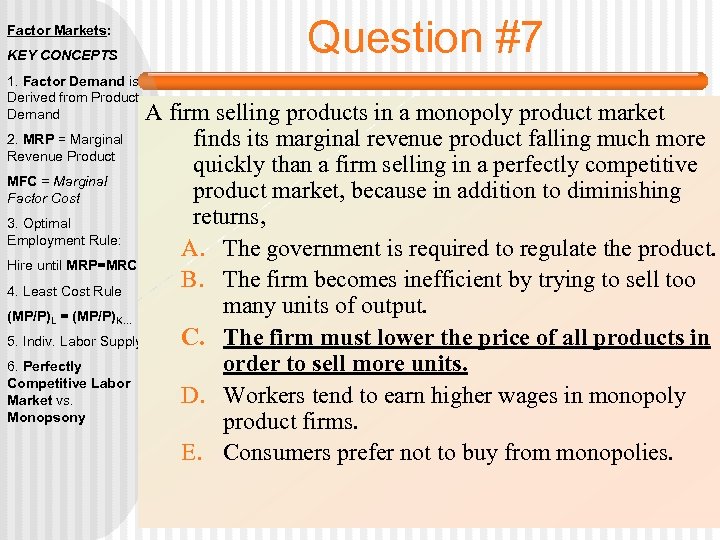 Factor Markets: KEY CONCEPTS 1. Factor Demand is Derived from Product Demand Question #7 A firm selling products in a monopoly product market 2. MRP = Marginal finds its marginal revenue product falling much more Revenue Product quickly than a firm selling in a perfectly competitive MFC = Marginal product market, because in addition to diminishing Factor Cost returns, 3. Optimal Employment Rule: A. The government is required to regulate the product. Hire until MRP=MRC B. The firm becomes inefficient by trying to sell too 4. Least Cost Rule many units of output. (MP/P) = (MP/P) C. The firm must lower the price of all products in 5. Indiv. Labor Supply order to sell more units. 6. Perfectly Competitive Labor D. Workers tend to earn higher wages in monopoly Market vs. Monopsony product firms. E. Consumers prefer not to buy from monopolies. L K…
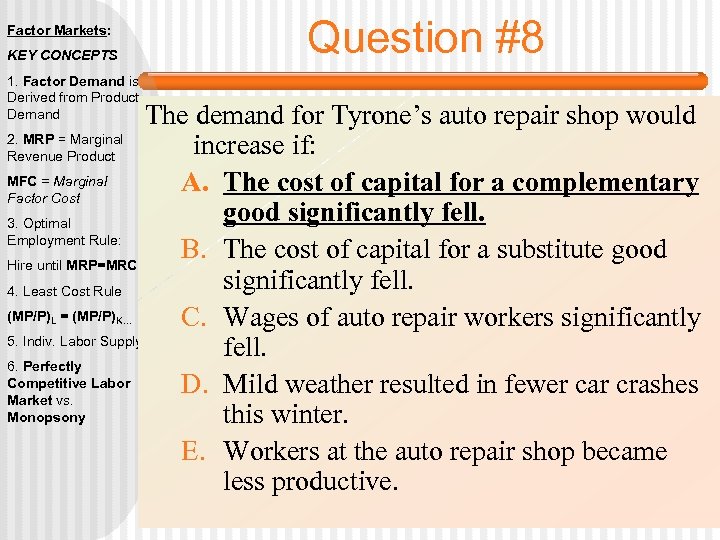 Factor Markets: KEY CONCEPTS 1. Factor Demand is Derived from Product Demand Question #8 The demand for Tyrone’s auto repair shop would 2. MRP = Marginal increase if: Revenue Product MFC = Marginal A. The cost of capital for a complementary Factor Cost good significantly fell. 3. Optimal Employment Rule: B. The cost of capital for a substitute good Hire until MRP=MRC significantly fell. 4. Least Cost Rule (MP/P) = (MP/P) C. Wages of auto repair workers significantly 5. Indiv. Labor Supply fell. 6. Perfectly Competitive Labor D. Mild weather resulted in fewer car crashes Market vs. Monopsony this winter. E. Workers at the auto repair shop became less productive. L K…
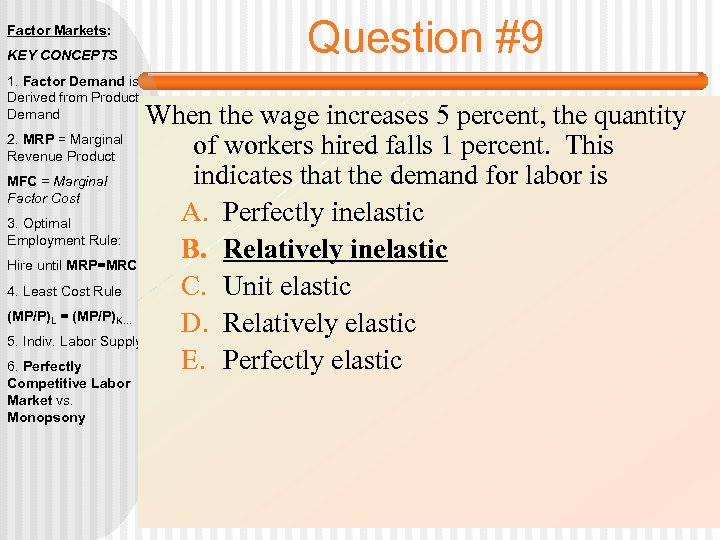 Factor Markets: KEY CONCEPTS 1. Factor Demand is Derived from Product Demand Question #9 When the wage increases 5 percent, the quantity 2. MRP = Marginal of workers hired falls 1 percent. This Revenue Product indicates that the demand for labor is MFC = Marginal Factor Cost A. Perfectly inelastic 3. Optimal Employment Rule: B. Relatively inelastic Hire until MRP=MRC C. Unit elastic 4. Least Cost Rule (MP/P) = (MP/P) D. Relatively elastic 5. Indiv. Labor Supply E. Perfectly elastic 6. Perfectly L K… Competitive Labor Market vs. Monopsony
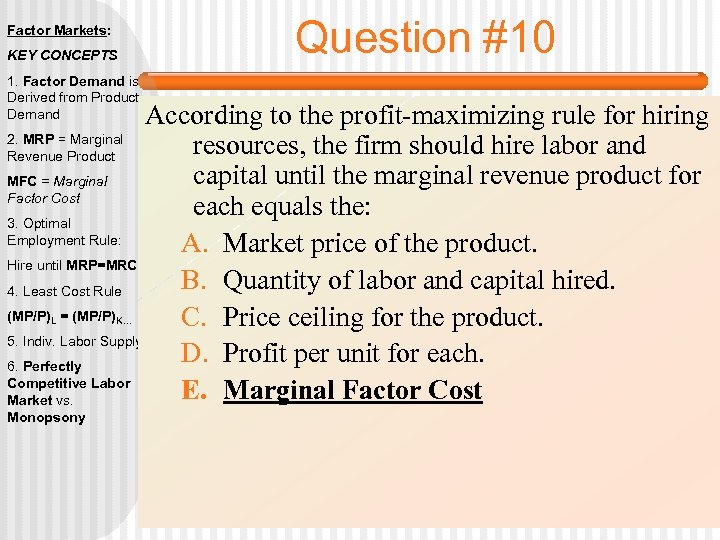 Factor Markets: KEY CONCEPTS 1. Factor Demand is Derived from Product Demand Question #10 According to the profit-maximizing rule for hiring 2. MRP = Marginal resources, the firm should hire labor and Revenue Product capital until the marginal revenue product for MFC = Marginal Factor Cost each equals the: 3. Optimal Employment Rule: A. Market price of the product. Hire until MRP=MRC B. Quantity of labor and capital hired. 4. Least Cost Rule (MP/P) = (MP/P) C. Price ceiling for the product. 5. Indiv. Labor Supply D. Profit per unit for each. 6. Perfectly Competitive Labor E. Marginal Factor Cost Market vs. L Monopsony K…