


 Скачать презентацию Facilitation Skills Meetings Facilitation Coordination Geneva 22
b4e181d9c4f5cc57e2bf3d40d6d31fbf.ppt
- Количество слайдов: 20
 Facilitation Skills (Meetings, Facilitation, Coordination) Geneva – 22 February, 2012 • Trainer: Jérôme L’host
 OVERVIEW Effective group meetings The Meeting's Objective Different Agenda to consider Definition of Terms Characteristics of a Good & Bad Facilitator What is coordination? Meeting Problems
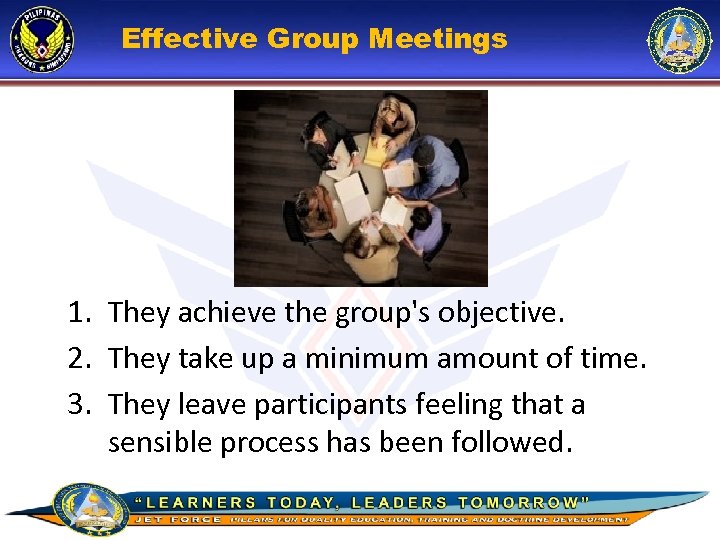 Effective Group Meetings 1. They achieve the group's objective. 2. They take up a minimum amount of time. 3. They leave participants feeling that a sensible process has been followed.
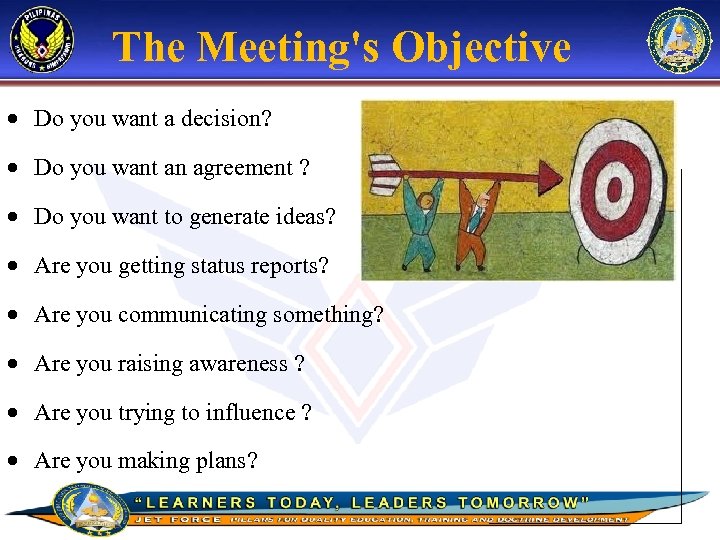 The Meeting's Objective Do you want a decision? Do you want an agreement ? Do you want to generate ideas? Are you getting status reports? Are you communicating something? Are you raising awareness ? Are you trying to influence ? Are you making plans?
 Focus, Focus and…Focus To help you determine what your meeting objective is, complete this sentence: At the close of the meeting/session, I want the group to. . . (Consider your next 2 meetings)
 Different Agenda to consider • Priorities – what absolutely must be covered? • Results – what do we need to accomplish at the meeting? • Participants – who needs to attend the meeting for it to be successful? • Sequence – in what order will you cover the topics? • Timing – how much time will you spend on each topic? • Date and Time – when will the meeting take place? • Place – where will the meeting take place?
 Example: Stages in collective decisions • • • Sharing information Prioritization of issues Constructing proposals Collective action decisions Monitoring/evaluation
 Définitions… • Facilitation means making all group interactions easier; • Facilitation helps groups and organizations identify and resolve difficult issues; • It provides unique solutions to unique needs; • It is based on techniques that are only appropriate or inappropriate, not right or wrong; • Facilitation is based on perception; it is not an exact science.
 Characteristics of a Good Facilitator • • • Work Hard to stay Neutral Carefully access needs of those in the meeting Listen Carefully on different issues Open Minded Using simple and direct language Clear step for the next meeting
 Characteristics of a Bad Facilitator Wants to be the center of attraction • Failed to listen on different ideas • Get People down and get defensive • Poor notes-poor decisions • Push ahead with different Agendas - My Comfort Zone Look at the five intervention modes to see where you feel most comfortable, especially under pressure. Ask a friend or colleague for feedback. Then imagine yourself operating, at your best, in an intervention mode that is « new » for you. Do the exercise many times until you feel at ease. Start practising in your next meeting.
 What is coordination? CO-llectively put things in ORDER Working together towards shared goals A voluntary process Usually without clear vertical authority “Facilitating different people to work together for a goal or effect” • Coordination skills are for everyone involved, not just for “coordinators. ” • • •
 Coordination is a negotiation process • Do we really all have the same objectives? • Usually, each stakeholder has a different agenda • We each engage in coordination only if we think we will achieve more of our own objectives that way than by working alone. • It has costs and benefits
 Put yourself in their shoes – Analyze each group’s interests, positions, objectives. Do we all have common interests? – What can they get out of coordinating with me/us? Can they do better than their expectations? – How can I help them achieve their objectives and get more out of this coordination relationship?
 The coordinator as mediator • Since coordination is negotiation, sometimes a neutral party can help diverse groups find their zone of possible agreement. • A good coordinator encourages participation and buy-in from parties whose absence would obstruct others. • A coordinator helps parties look behind their positions and identify interests that might be shared with others. • A coordinator uses a problem-solving approach to overcome obstacles to agreement.
 Coordination as Facilitation • Sometimes coordination fails to produce results, even when the parties involved have shared objectives and would all benefit from jointly coordinating their efforts. Opportunities are wasted. • Why? • Process problems. – Poor management of the process – Bad meetings, – Wasted time – Pointlessly obstructive behavior…
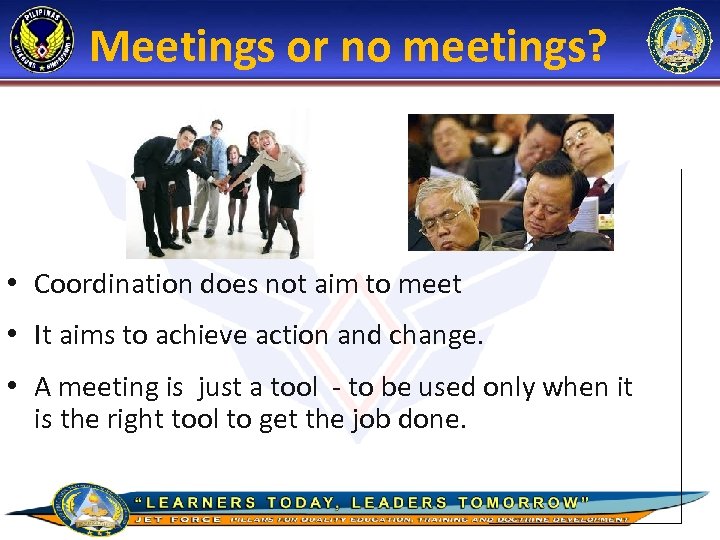 Meetings or no meetings? • Coordination does not aim to meet • It aims to achieve action and change. • A meeting is just a tool - to be used only when it is the right tool to get the job done.
 Problems in coordination • Hierarchy and uneven power relationships • Favoritism or bias • Conflict of interest • Weak participation
 Meeting problems • Unclear objectives • Group size • Agenda size/complexity • Lack of key actors • Disruptive behavior
 Summary Effective group meetings The Meeting's Objective Different Agenda to consider Definition of Terms Characteristics of a Good Facilitator What is coordination? Meeting Problems
 BIBLIOGRAPHY / RESOURCES www. Thiagi. com www. Facilitutor. com The Skilled Facilitator - Roger Schwarz The Art of Facilitation - Dale Hunter, Anne Bailey, Bill Taylor The Facilitator’s Fieldbook - Thomas Justice & David W. Jamieson