 Скачать презентацию FACILITATING THE MOVEMENT OF LEARNERS WITHIN AND BETWEEN
37e3a33174a6826a3fe0de40edfded6a.ppt
- Количество слайдов: 29



FACILITATING THE MOVEMENT OF LEARNERS WITHIN AND BETWEEN HIGHER EDUCATION SYSTEMS THROUGH DUAL DEGREE AND ACCREDITATION 1 2018/3/19 逢甲大學研發長 唐國豪
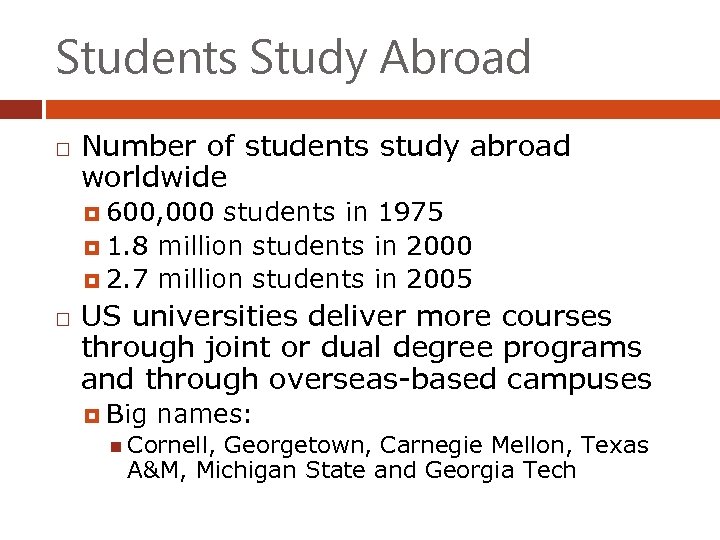
Students Study Abroad Number of students study abroad worldwide 600, 000 students in 1975 1. 8 million students in 2000 2. 7 million students in 2005 US universities deliver more courses through joint or dual degree programs and through overseas-based campuses Big names: Cornell, Georgetown, Carnegie Mellon, Texas A&M, Michigan State and Georgia Tech
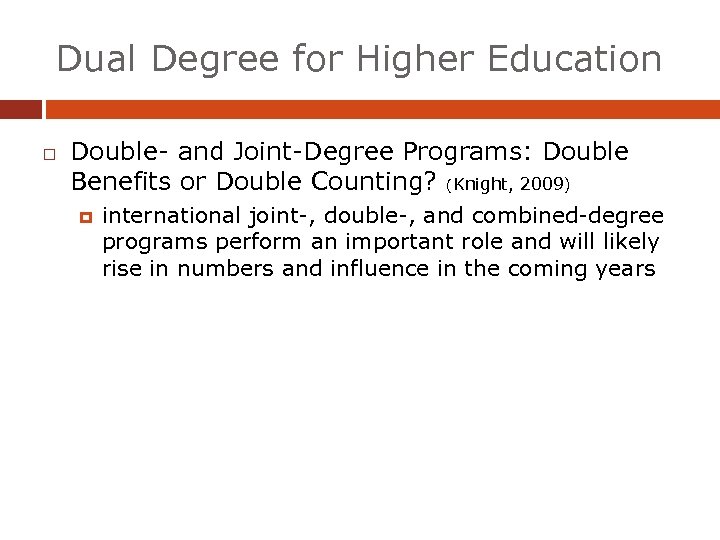
Dual Degree for Higher Education Double- and Joint-Degree Programs: Double Benefits or Double Counting? (Knight, 2009) international joint-, double-, and combined-degree programs perform an important role and will likely rise in numbers and influence in the coming years
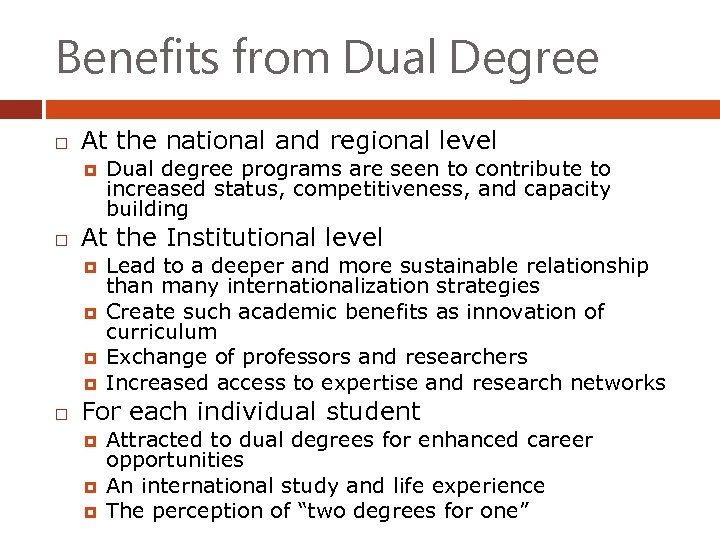
Benefits from Dual Degree At the national and regional level At the Institutional level Dual degree programs are seen to contribute to increased status, competitiveness, and capacity building Lead to a deeper and more sustainable relationship than many internationalization strategies Create such academic benefits as innovation of curriculum Exchange of professors and researchers Increased access to expertise and research networks For each individual student Attracted to dual degrees for enhanced career opportunities An international study and life experience The perception of “two degrees for one”
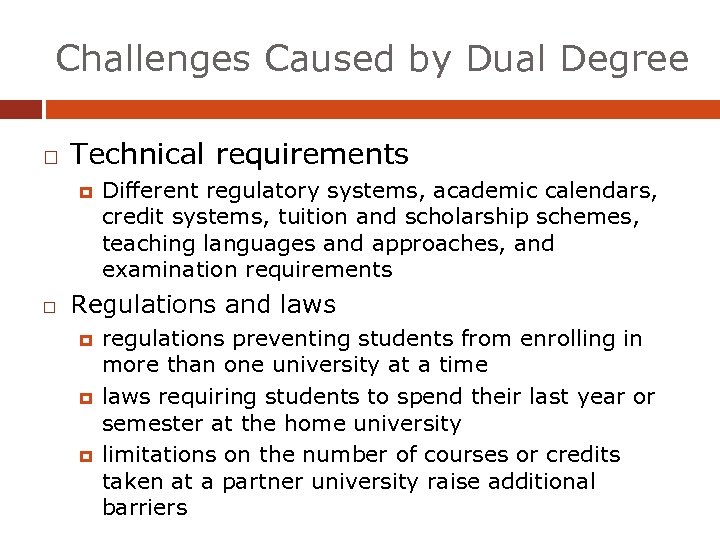
Challenges Caused by Dual Degree Technical requirements Different regulatory systems, academic calendars, credit systems, tuition and scholarship schemes, teaching languages and approaches, and examination requirements Regulations and laws regulations preventing students from enrolling in more than one university at a time laws requiring students to spend their last year or semester at the home university limitations on the number of courses or credits taken at a partner university raise additional barriers
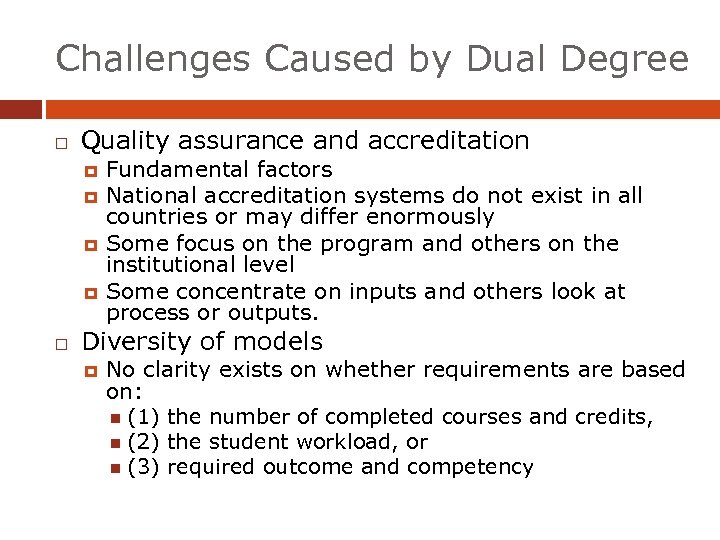
Challenges Caused by Dual Degree Quality assurance and accreditation Fundamental factors National accreditation systems do not exist in all countries or may differ enormously Some focus on the program and others on the institutional level Some concentrate on inputs and others look at process or outputs. Diversity of models No clarity exists on whether requirements are based on: (1) the number of completed courses and credits, (2) the student workload, or (3) required outcome and competency
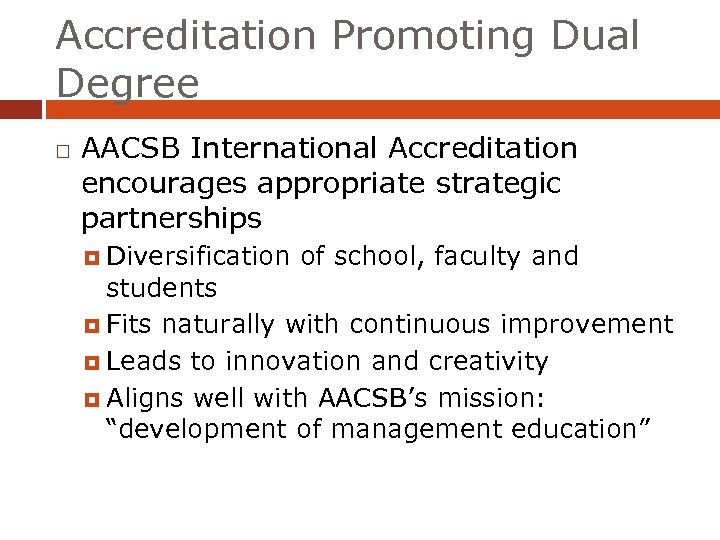
Accreditation Promoting Dual Degree AACSB International Accreditation encourages appropriate strategic partnerships Diversification of school, faculty and students Fits naturally with continuous improvement Leads to innovation and creativity Aligns well with AACSB’s mission: “development of management education”
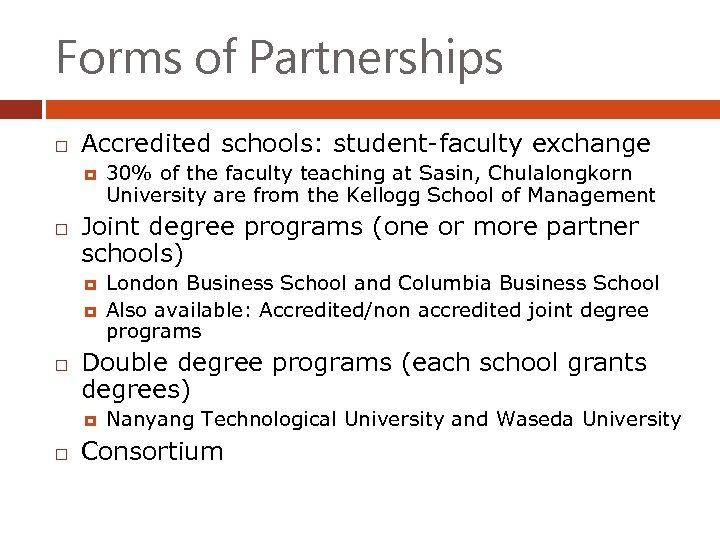
Forms of Partnerships Accredited schools: student-faculty exchange Joint degree programs (one or more partner schools) London Business School and Columbia Business School Also available: Accredited/non accredited joint degree programs Double degree programs (each school grants degrees) 30% of the faculty teaching at Sasin, Chulalongkorn University are from the Kellogg School of Management Nanyang Technological University and Waseda University Consortium
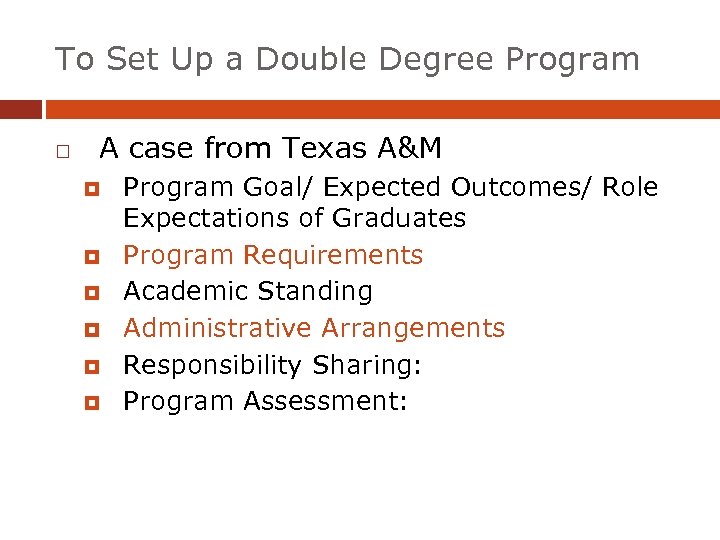
To Set Up a Double Degree Program A case from Texas A&M Program Goal/ Expected Outcomes/ Role Expectations of Graduates Program Requirements Academic Standing Administrative Arrangements Responsibility Sharing: Program Assessment:
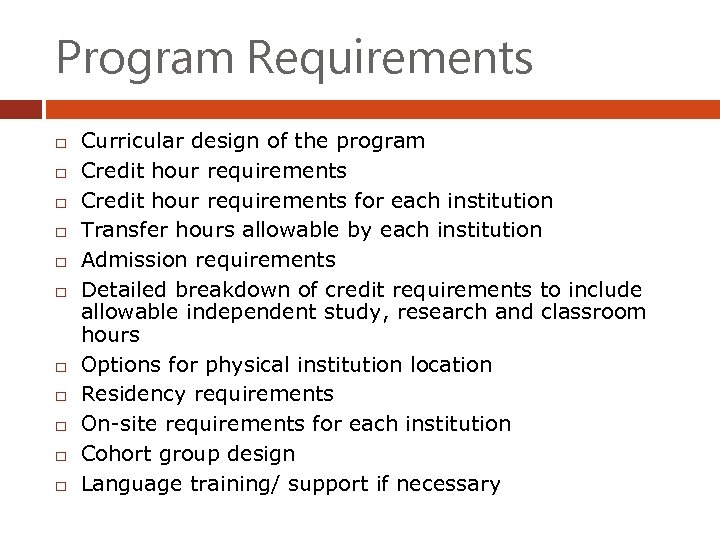
Program Requirements Curricular design of the program Credit hour requirements for each institution Transfer hours allowable by each institution Admission requirements Detailed breakdown of credit requirements to include allowable independent study, research and classroom hours Options for physical institution location Residency requirements On-site requirements for each institution Cohort group design Language training/ support if necessary
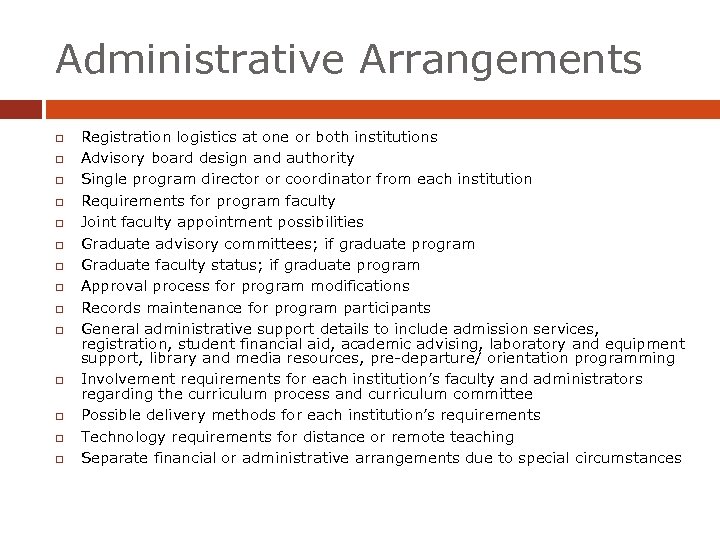
Administrative Arrangements Registration logistics at one or both institutions Advisory board design and authority Single program director or coordinator from each institution Requirements for program faculty Joint faculty appointment possibilities Graduate advisory committees; if graduate program Graduate faculty status; if graduate program Approval process for program modifications Records maintenance for program participants General administrative support details to include admission services, registration, student financial aid, academic advising, laboratory and equipment support, library and media resources, pre-departure/ orientation programming Involvement requirements for each institution’s faculty and administrators regarding the curriculum process and curriculum committee Possible delivery methods for each institution’s requirements Technology requirements for distance or remote teaching Separate financial or administrative arrangements due to special circumstances
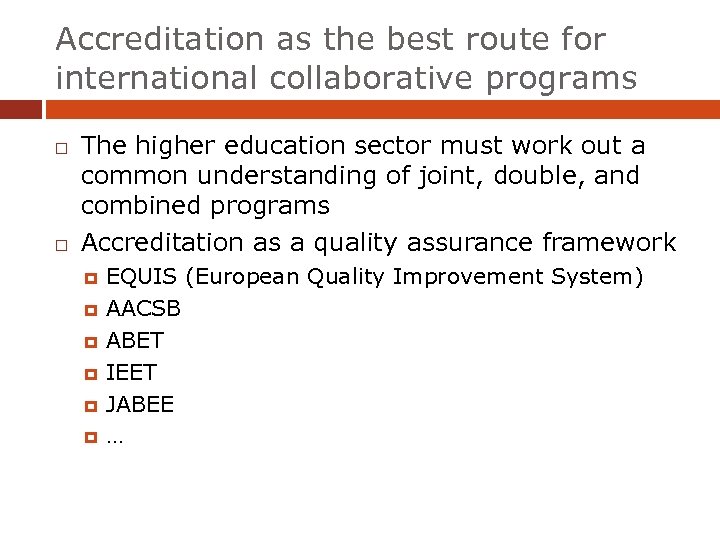
Accreditation as the best route for international collaborative programs The higher education sector must work out a common understanding of joint, double, and combined programs Accreditation as a quality assurance framework EQUIS (European Quality Improvement System) AACSB ABET IEET JABEE …
Accreditation as the best route for international collaborative programs Japan Accreditation Board for Engineering Education (JABEE) Enhancing international mutual recognition of and information exchange in the examination and accreditation of engineering education programs. Accreditation Board for Engineering Education of Korea (ABEEK). To offer a more internationalized education.
European Approach to Higher Education Quality Assurance By 2010, the European Higher Education Area (EHEA) is expected to encompass 16 million students and 4, 000 universities across Europe Encompasses Western, 47 countries in EHEA Central and Eastern Europe (except Belarus) Also Russia, Turkey, Azerbaijan, Armenia The answer to education mobility Bologna Process
15 Why is the Bologna Process Important? Changes in the past 15 years European Economic Community -> European Community Common currency -> € Schengen Agreement -> Open borders Underpinning philosophy Create transparency across Europe. Respect for and celebration of diversity of Europe Bologna Process is part of a larger European agenda Create the European higher education area by making academic degree standards and quality assurance standards more comparable and compatible throughout Europe 產學合作績效激勵 @ FCU 2018/3/19
Elements of the Bologna Process Bologna-compliant degrees No Bologna degrees Tools designed to interpret and convert work in one country to work in another The tools The three-cycle system: Bachelor, Master, Doctorate European Credit Transfer System (ECTS) Diploma Supplement Quality assurance
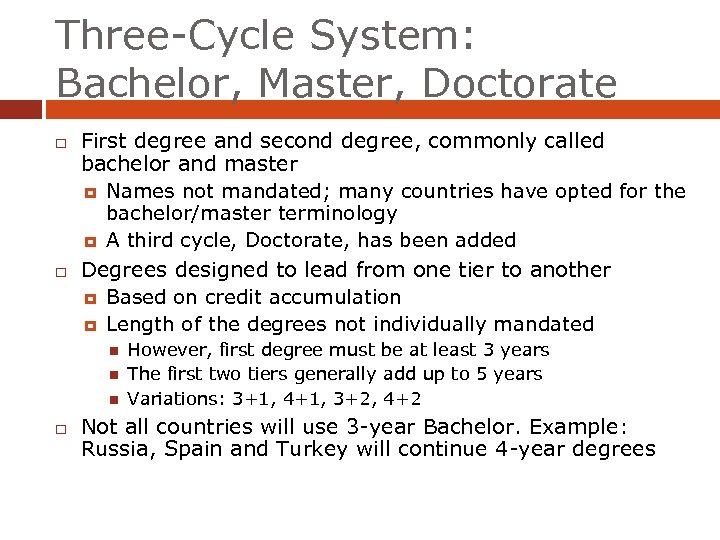
Three-Cycle System: Bachelor, Master, Doctorate First degree and second degree, commonly called bachelor and master Names not mandated; many countries have opted for the bachelor/master terminology A third cycle, Doctorate, has been added Degrees designed to lead from one tier to another Based on credit accumulation Length of the degrees not individually mandated However, first degree must be at least 3 years The first two tiers generally add up to 5 years Variations: 3+1, 4+1, 3+2, 4+2 Not all countries will use 3 -year Bachelor. Example: Russia, Spain and Turkey will continue 4 -year degrees
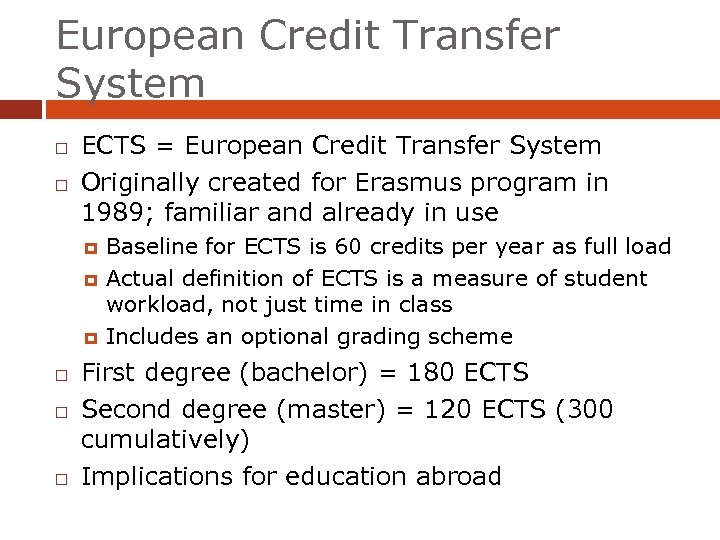
European Credit Transfer System ECTS = European Credit Transfer System Originally created for Erasmus program in 1989; familiar and already in use Baseline for ECTS is 60 credits per year as full load Actual definition of ECTS is a measure of student workload, not just time in class Includes an optional grading scheme First degree (bachelor) = 180 ECTS Second degree (master) = 120 ECTS (300 cumulatively) Implications for education abroad
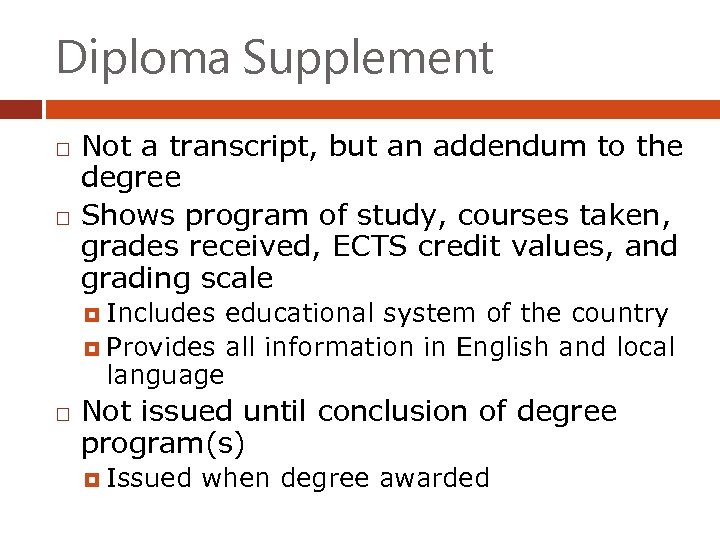
Diploma Supplement Not a transcript, but an addendum to the degree Shows program of study, courses taken, grades received, ECTS credit values, and grading scale Includes educational system of the country Provides all information in English and local language Not issued until conclusion of degree program(s) Issued when degree awarded
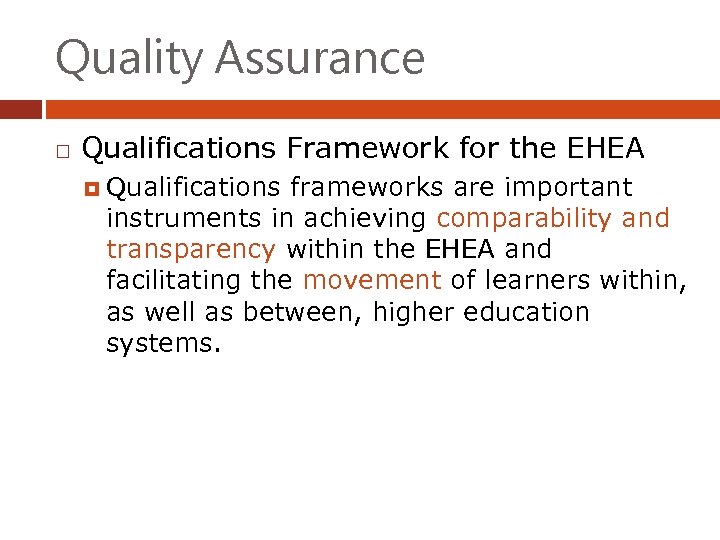
Quality Assurance Qualifications Framework for the EHEA Qualifications frameworks are important instruments in achieving comparability and transparency within the EHEA and facilitating the movement of learners within, as well as between, higher education systems.
Overarching framework of qualifications of the EHEA The overarching framework sets the parameters within which the countries of the EHEA will develop their national qualifications frameworks. This means that national frameworks will have much in common, but not that they will be identical. The overarching framework for qualifications in the EHEA, comprising: three cycles generic descriptors for each cycle based on learning outcomes and competences credit ranges in the first and second cycles
National Qualifications Frameworks All countries of the European Higher Education Area have committed to developing national qualifications frameworks compatible with the overarching framework of the European Higher Education Area by 2010.
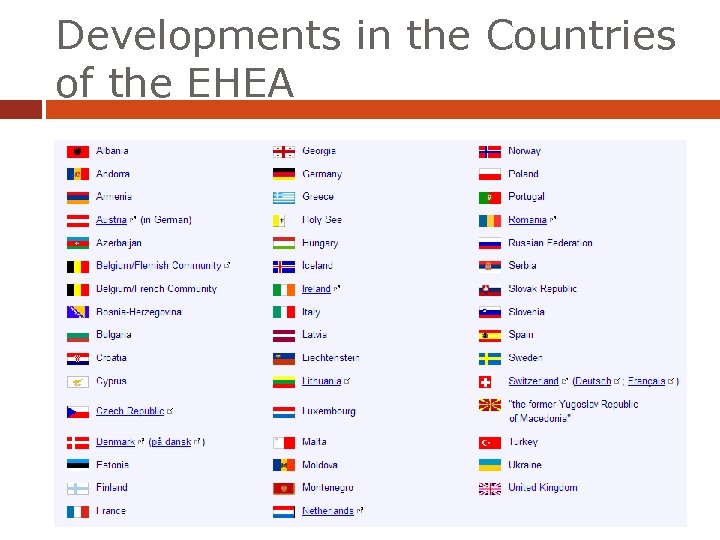
Developments in the Countries of the EHEA
The National Qualifications Frameworks of UK (Revised August 2008) The Framework for Higher Education Qualifications in England, Wales and Northern Ireland (FHEQ) The fundamental premise of the FHEQ is that qualifications should be awarded on the basis of achievement of outcomes and attainment rather than years of study. The qualification descriptors contained in the FHEQ exemplify the outcomes and attributes expected of learning that results in the award of higher education qualifications. The FHEQ is also used as a reference point in institutional audit/review and other forms of external review.
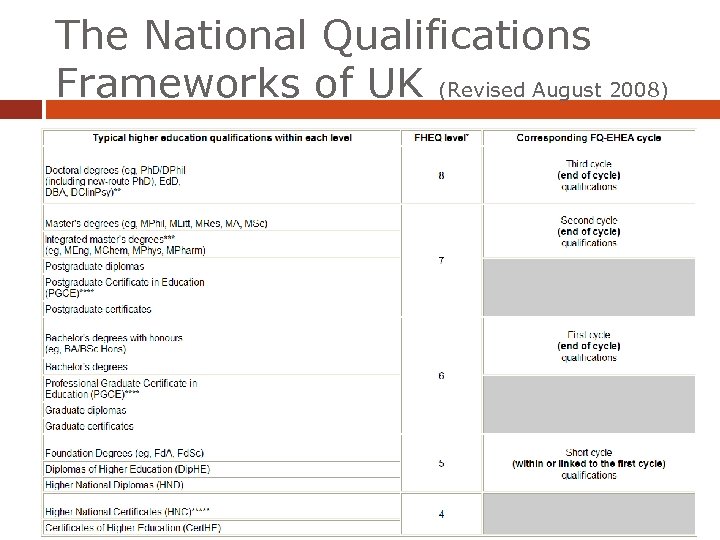
The National Qualifications Frameworks of UK (Revised August 2008)
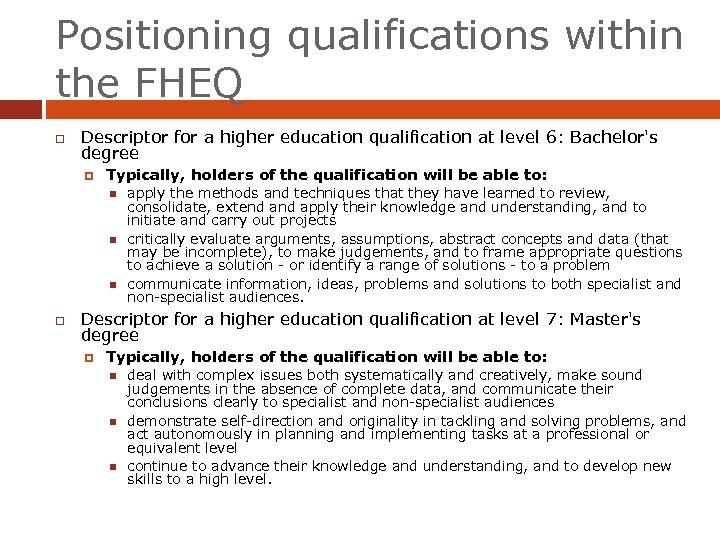
Positioning qualifications within the FHEQ Descriptor for a higher education qualification at level 6: Bachelor's degree Typically, holders of the qualification will be able to: apply the methods and techniques that they have learned to review, consolidate, extend apply their knowledge and understanding, and to initiate and carry out projects critically evaluate arguments, assumptions, abstract concepts and data (that may be incomplete), to make judgements, and to frame appropriate questions to achieve a solution - or identify a range of solutions - to a problem communicate information, ideas, problems and solutions to both specialist and non-specialist audiences. Descriptor for a higher education qualification at level 7: Master's degree Typically, holders of the qualification will be able to: deal with complex issues both systematically and creatively, make sound judgements in the absence of complete data, and communicate their conclusions clearly to specialist and non-specialist audiences demonstrate self-direction and originality in tackling and solving problems, and act autonomously in planning and implementing tasks at a professional or equivalent level continue to advance their knowledge and understanding, and to develop new skills to a high level.
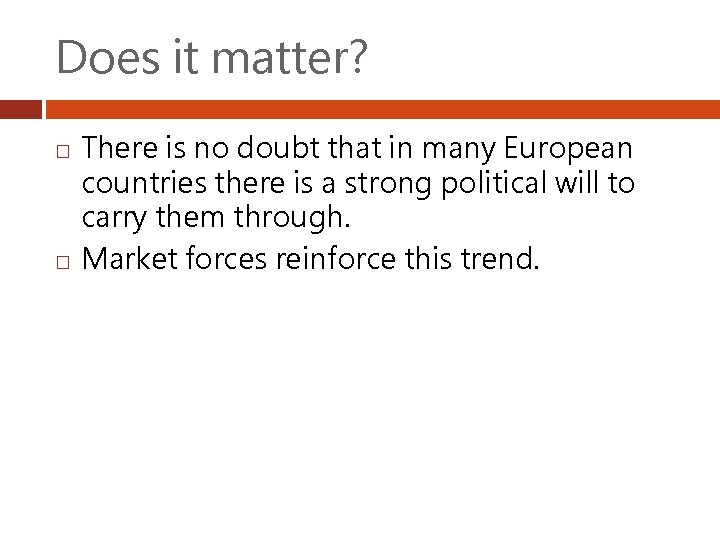
Does it matter? There is no doubt that in many European countries there is a strong political will to carry them through. Market forces reinforce this trend.
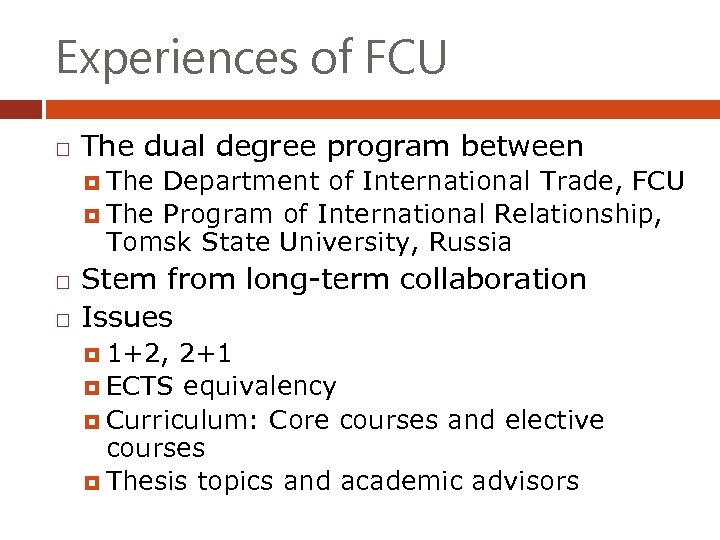
Experiences of FCU The dual degree program between The Department of International Trade, FCU The Program of International Relationship, Tomsk State University, Russia Stem from long-term collaboration Issues 1+2, 2+1 ECTS equivalency Curriculum: Core courses and elective courses Thesis topics and academic advisors
29 Thank You 產學合作績效激勵 @ FCU 2018/3/19
Скачать презентацию FACILITATING THE MOVEMENT OF LEARNERS WITHIN AND BETWEEN
37e3a33174a6826a3fe0de40edfded6a.ppt