


 Скачать презентацию FAA Industry Training Standards FITS Seminar Federal Aviation Administration
93cf6e1e756e8577c60a6d6beb3f7f9b.ppt
- Количество слайдов: 17
 FAA/Industry Training Standards (FITS) Seminar Federal Aviation Administration Presentation in: Anchorage, AK Name: Thomas Glista, FAA, FITS Program Manager Date: September 30, 2006 Federal Aviation Administration
 OVERVIEW • • What is FITS? Why do we need it? Who is involved? What’s Coming http: //www. faa. gov/education_research/training/fits Federal Aviation Administration 1 1
 What is FITS? FITS is a joint government-stakeholder initiative designed to reduce the total number of general aviation accidents. This means using scenario-based training to effectively integrate: “The airport runway is the Most important mainstream In any town. ” -Norm Crabtree Ø Risk Management; Ø Aeronautical Decision Making; Ø Situational Awareness; and Ø Single Pilot Resource Management into Ø EVERY flight operation!! http: //www. faa. gov/education_research/training/fits Federal Aviation Administration 2 2
 FITS Mission Statement and Imperative FITS Mission Statement: Improve pilot learning to safely, competently, and efficiently operate a technically advanced piston or light jet aircraft in the modern National Airspace System (NAS). FITS Imperatives: Implement training that reduces the human error element and accelerates acquisition of higher-level judgment and decisionmaking skills. Bottom Line: Structured way to teach pilot to safely, competently, and efficiently operate aircraft in today’s environment. http: //www. faa. gov/education_research/training/fits Federal Aviation Administration 3 3
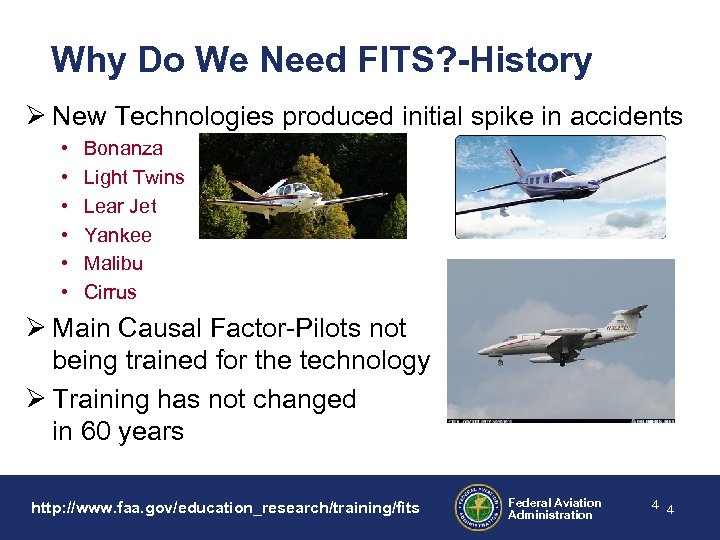 Why Do We Need FITS? -History Ø New Technologies produced initial spike in accidents • • • Bonanza Light Twins Lear Jet Yankee Malibu Cirrus Ø Main Causal Factor-Pilots not being trained for the technology Ø Training has not changed in 60 years http: //www. faa. gov/education_research/training/fits Federal Aviation Administration 4 4
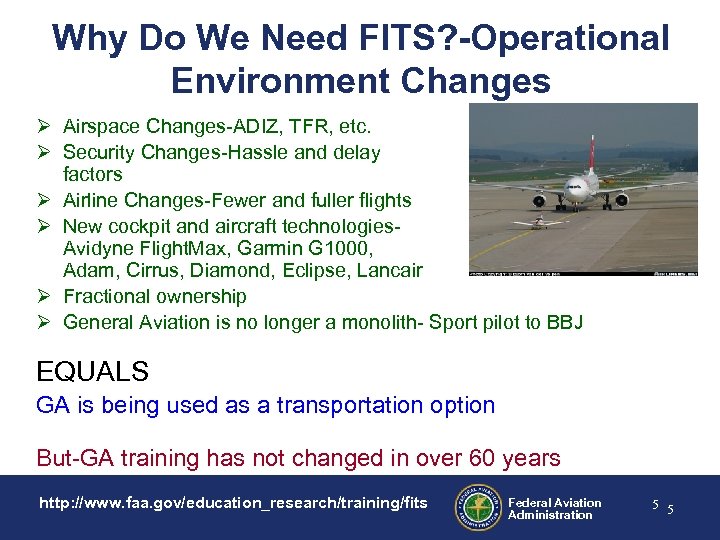 Why Do We Need FITS? -Operational Environment Changes Ø Airspace Changes-ADIZ, TFR, etc. Ø Security Changes-Hassle and delay factors Ø Airline Changes-Fewer and fuller flights Ø New cockpit and aircraft technologies- Avidyne Flight. Max, Garmin G 1000, Adam, Cirrus, Diamond, Eclipse, Lancair Ø Fractional ownership Ø General Aviation is no longer a monolith- Sport pilot to BBJ EQUALS GA is being used as a transportation option But-GA training has not changed in over 60 years http: //www. faa. gov/education_research/training/fits Federal Aviation Administration 5 5
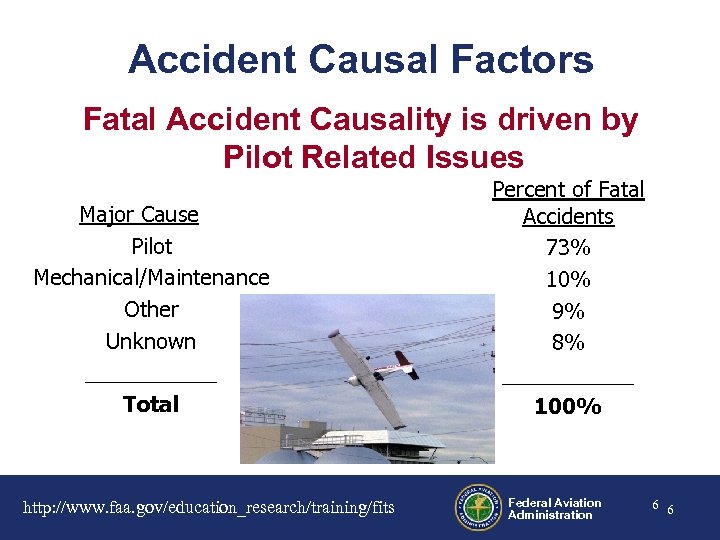 Accident Causal Factors Fatal Accident Causality is driven by Pilot Related Issues Major Cause Pilot Mechanical/Maintenance Other Unknown ______ Total http: //www. faa. gov/education_research/training/fits Percent of Fatal Accidents 73% 10% 9% 8% ______ 100% Federal Aviation Administration 6 6
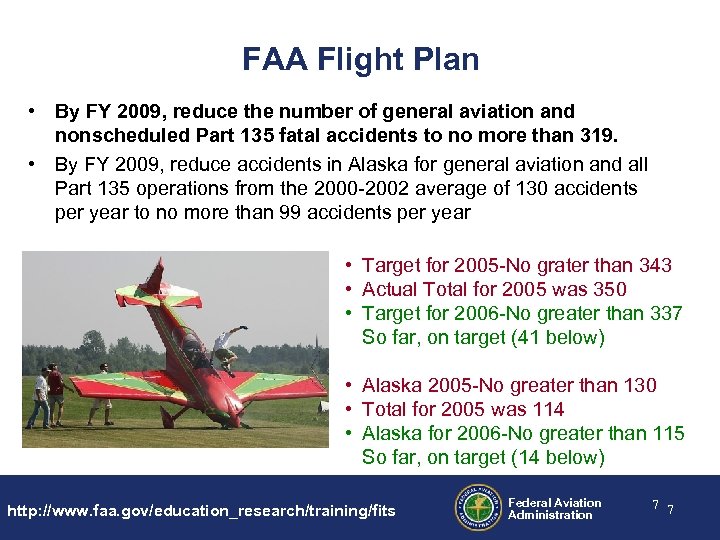 FAA Flight Plan • By FY 2009, reduce the number of general aviation and nonscheduled Part 135 fatal accidents to no more than 319. • By FY 2009, reduce accidents in Alaska for general aviation and all Part 135 operations from the 2000 -2002 average of 130 accidents per year to no more than 99 accidents per year • Target for 2005 -No grater than 343 • Actual Total for 2005 was 350 • Target for 2006 -No greater than 337 So far, on target (41 below) • Alaska 2005 -No greater than 130 • Total for 2005 was 114 • Alaska for 2006 -No greater than 115 So far, on target (14 below) http: //www. faa. gov/education_research/training/fits Federal Aviation Administration 7 7
 WHAT WE ARE DOING WRONG Ø Train to pass the test, rather than practical operations in a modernized NAS Ø Emphasis on training maneuvers, rather than aeronautical decision making/risk management Ø Insufficient emphasis on use of new flight technologies and procedures (GPS, moving maps, multifunction displays, autopilots) “After you get your certificate, you can learn that stuff” Ø Long product cycle times for regulations and related products (AC’s) Measured in years– versus short product cycle time for industry-Measured in months or weeks Ø Obsolete training curricula Ø Inadequate use of new training technologies (Simulation devices) http: //www. faa. gov/education_research/training/fits/ Federal Aviation Administration 8 8
 What else is FITS? Ø Voluntary • Acceptance vs. Approval Ø Incentive based Ø Initiated to address TAAs Ø Tenets apply to all training Ø Real partnership • JSC-TAA Subgroup Ø It’s working • Initial Data Ø Does not remove stick and rudder skills practice http: //www. faa. gov/education_research/training/fits Federal Aviation Administration 9 9
 Who is Involved Ø COE/CGAR • Embry Riddle Aeronautical University • University of North Dakota Ø Initial Partners • Recip-Cirrus • Turbine-Eclipse ØOther Partners • Insurance • Manufacturers • Training Providers • Training Developers • Advocacy Groups • Universities • Pilot and Owners Associations • Fractional http: //www. faa. gov/education_research/training/fits Federal Aviation Administration 10 10
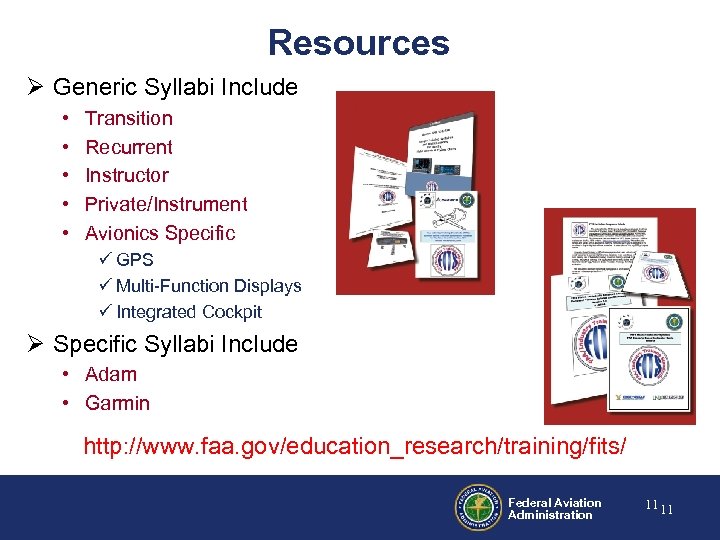 Resources Ø Generic Syllabi Include • • • Transition Recurrent Instructor Private/Instrument Avionics Specific ü GPS ü Multi-Function Displays ü Integrated Cockpit Ø Specific Syllabi Include • Adam • Garmin http: //www. faa. gov/education_research/training/fits/ Federal Aviation Administration 11 11
 Resources Ø Documents Include • • • ØResearch/Studies FITS Criteria DPE Guidance Instructor Guide Inspector Guide Course Developers Guide Personal Minimums Checklist • Personal WX and Risk Assessment Guide • Levels of FITS • MTSU Results • Effectiveness of FITS Training • Safety Study • PTS Maneuvers • SBT to teach SRM http: //www. faa. gov/education_research/training/fits/ Federal Aviation Administration 12 12
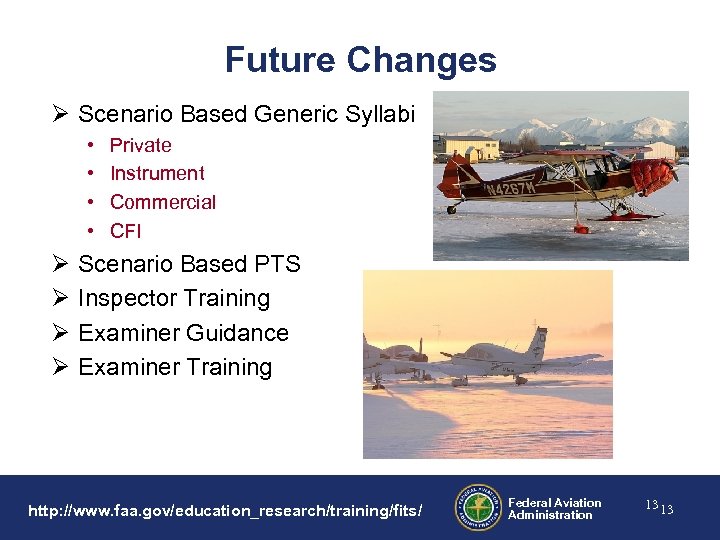 Future Changes Ø Scenario Based Generic Syllabi • • Ø Ø Private Instrument Commercial CFI Scenario Based PTS Inspector Training Examiner Guidance Examiner Training http: //www. faa. gov/education_research/training/fits/ Federal Aviation Administration 13 13
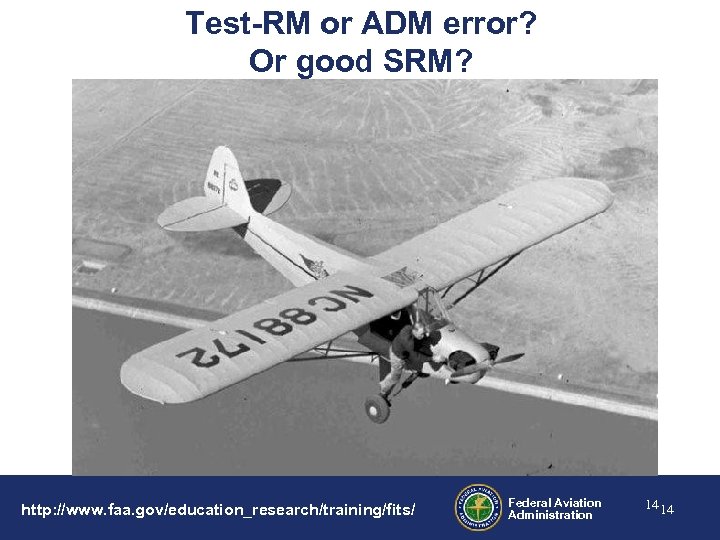 Test-RM or ADM error? Or good SRM? http: //www. faa. gov/education_research/training/fits/ Federal Aviation Administration 14 14
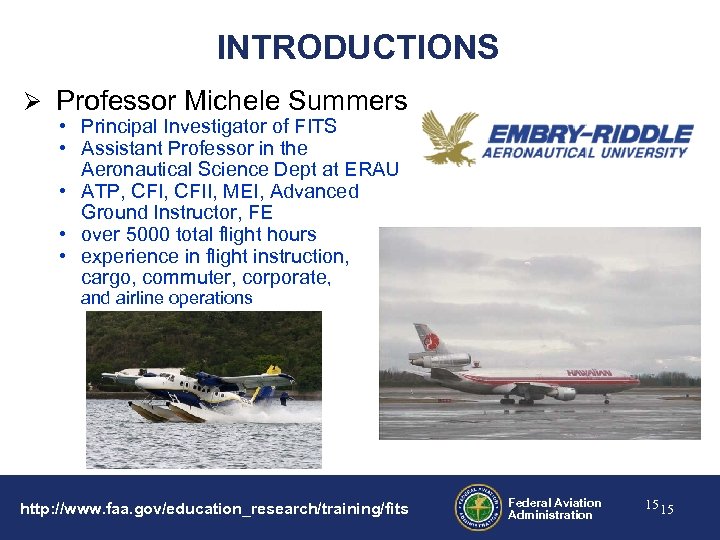 INTRODUCTIONS Ø Professor Michele Summers • Principal Investigator of FITS • Assistant Professor in the Aeronautical Science Dept at ERAU • ATP, CFII, MEI, Advanced Ground Instructor, FE • over 5000 total flight hours • experience in flight instruction, cargo, commuter, corporate, and airline operations http: //www. faa. gov/education_research/training/fits Federal Aviation Administration 15 15
 QUESTIONS? http: //www. faa. gov/education_research/training/fits/ Federal Aviation Administration 16 16