


![[f], [v], [θ], [ð], [s], [z], [ ʃ ], [ʒ], [h]](https://present5.com/presentation/ea4af9941066777a73f52f0f9a978d70/image-1.jpg "[f], [v], [θ], [ð], [s], [z], [ ʃ ], [ʒ], [h]")
[f], [v], [θ], [ð], [s], [z], [ ʃ ], [ʒ], [h]
What is your biggest peeve and why? Think about this question and be prepared to share aloud with the class.
What are the 6 plosives? Be able to provide an example of each.

https: //www. youtube. com/watch? v=EBYp. Wd 0 o. Fj. M
![Cognate labio-dental sounds. [f] is voiceless [v] is voiced Fricative sounds that you](https://present5.com/presentation/ea4af9941066777a73f52f0f9a978d70/image-5.jpg "Cognate labio-dental sounds. [f] is voiceless [v] is voiced Fricative sounds that you")
Cognate labio-dental sounds. [f] is voiceless [v] is voiced Fricative sounds that you produce by forcing the breath stream between your upper teeth and lower lip.
1. 2. 3. Very lightly, rest the cutting edge of your upper front teeth against your lower lip. Let your tongue rest against the floor of your mouth. Start the breath stream moving, and force it between your lower lip and upper teeth. Don’t allow any air to escape through your nose. Make sure you use a light touch. If you press too hard, not enough air comes through.
![1. 2. Follow the same steps you used for [f]. As soon as you](https://present5.com/presentation/ea4af9941066777a73f52f0f9a978d70/image-7.jpg "1. 2. Follow the same steps you used for [f]. As soon as you")
1. 2. Follow the same steps you used for [f]. As soon as you feel your teeth and lip touch, add voice.
![Sample [f]: Four phone calls are enough. Sample [v]: It was very hot,](https://present5.com/presentation/ea4af9941066777a73f52f0f9a978d70/image-8.jpg "Sample [f]: Four phone calls are enough. Sample [v]: It was very hot,")
Sample [f]: Four phone calls are enough. Sample [v]: It was very hot, of course. Spellings [f]: f as in four ff as in affair gh as in enough ph as in phone lf as in half Spellings [v]: v as in very f (only in the word of) ph (only in the name Stephen) vv as in savvy
Level 2 practice words
Level 2 practice words
![[f] feel [v] veal fan van proof prove leaf leave shuffle shovel](https://present5.com/presentation/ea4af9941066777a73f52f0f9a978d70/image-11.jpg "[f] feel [v] veal fan van proof prove leaf leave shuffle shovel")
[f] feel [v] veal fan van proof prove leaf leave shuffle shovel
![Some nonnative speakers mix up [v] and [w] Let’s practice a few to](https://present5.com/presentation/ea4af9941066777a73f52f0f9a978d70/image-12.jpg "Some nonnative speakers mix up [v] and [w] Let’s practice a few to")
Some nonnative speakers mix up [v] and [w] Let’s practice a few to make the distinction clear!
![[v] vine [w] wine verse worse vet wet vest west vile wile](https://present5.com/presentation/ea4af9941066777a73f52f0f9a978d70/image-13.jpg "[v] vine [w] wine verse worse vet wet vest west vile wile")
[v] vine [w] wine verse worse vet wet vest west vile wile
![Some nonnative speakers, especially Spanish speakers mix up [v] and [b] Let’s practice](https://present5.com/presentation/ea4af9941066777a73f52f0f9a978d70/image-14.jpg "Some nonnative speakers, especially Spanish speakers mix up [v] and [b] Let’s practice")
Some nonnative speakers, especially Spanish speakers mix up [v] and [b] Let’s practice a few to make the distinction clear!
![[v] vest [b] best rove robe vote boat vow bow vend bend](https://present5.com/presentation/ea4af9941066777a73f52f0f9a978d70/image-15.jpg "[v] vest [b] best rove robe vote boat vow bow vend bend")
[v] vest [b] best rove robe vote boat vow bow vend bend
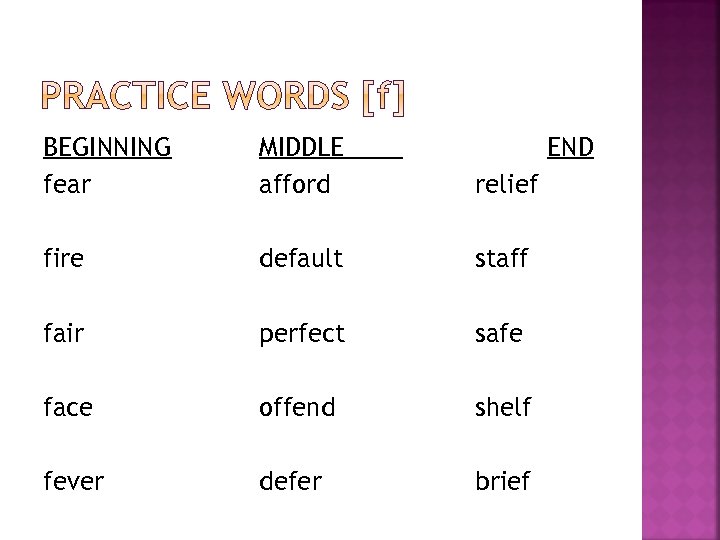
BEGINNING fear MIDDLE afford END relief fire default staff fair perfect safe face offend shelf fever defer brief
![[fl] flush [fr] afraid [fs] chefs [ft] after sniffle frost graphs left floor frenzy](https://present5.com/presentation/ea4af9941066777a73f52f0f9a978d70/image-17.jpg "[fl] flush [fr] afraid [fs] chefs [ft] after sniffle frost graphs left floor frenzy")
[fl] flush [fr] afraid [fs] chefs [ft] after sniffle frost graphs left floor frenzy laughs staffed waffle frog reefs raft flame fruit beliefs safety
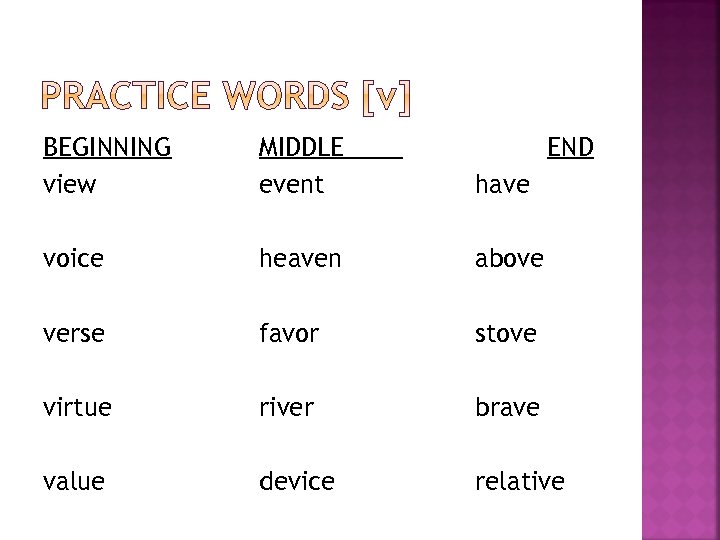
BEGINNING view MIDDLE event END have voice heaven above verse favor stove virtue river brave value device relative
![[vl] gravel [vz] carves [vd] deceived rival shoves moved level slaves lived evil moves](https://present5.com/presentation/ea4af9941066777a73f52f0f9a978d70/image-19.jpg "[vl] gravel [vz] carves [vd] deceived rival shoves moved level slaves lived evil moves")
[vl] gravel [vz] carves [vd] deceived rival shoves moved level slaves lived evil moves saved oval grooves loved
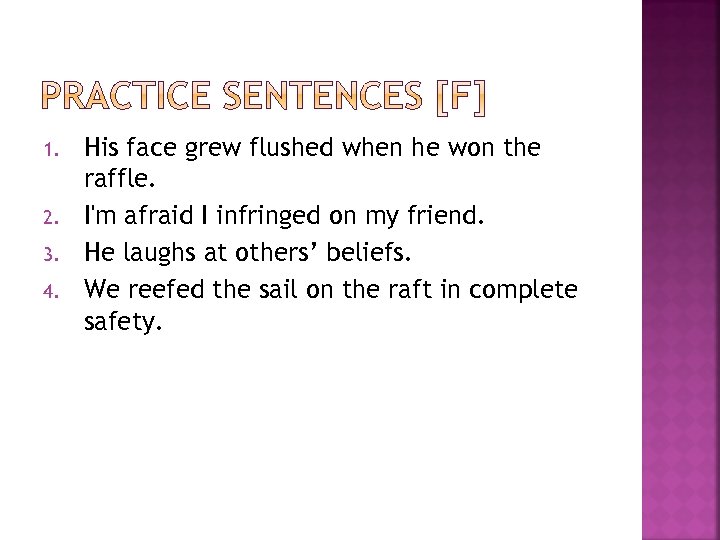
1. 2. 3. 4. His face grew flushed when he won the raffle. I'm afraid I infringed on my friend. He laughs at others’ beliefs. We reefed the sail on the raft in complete safety.
1. 2. 3. 4. Vivian was a vivacious vixen, variously proving herself vindictive and benevolent. The oven from Harvey’s hovel was moved over to the bottom level of the valley house. Heaven help the evil villain who deceives his virtuous wife with visions of vicarious living! Vincent viewed the bevy of lovelies and vowed he would forever be moved.
![Provide 5 words with the [f] sound. Provide 5 words with the [v]](https://present5.com/presentation/ea4af9941066777a73f52f0f9a978d70/image-22.jpg "Provide 5 words with the [f] sound. Provide 5 words with the [v]")
Provide 5 words with the [f] sound. Provide 5 words with the [v] sound.
Continue chapter 7
![[θ], [ð] Meagan Sovine](https://present5.com/presentation/ea4af9941066777a73f52f0f9a978d70/image-24.jpg "[θ], [ð] Meagan Sovine")
[θ], [ð] Meagan Sovine
What actor/actress would play as YOU in a motion picture about your life? Think about this question and be prepared to share aloud with the whole class.
What are the 6 plosives? Provide 1 example word for each plosive. What are the 2 fricatives we have learned so far? Provide 1 example word for each fricative that we have discussed thus far.
Body stretches Face stretches Vocal stretches Page 141 Challenge Material

https: //www. youtube. com/watch? v=Gdtd. TJ k. Rtk. E https: //www. youtube. com/watch? v=Ol-Wd. Ct -d. Pk
![Description: [θ], [ð] are cognate sounds. They are both produced by squeezing a](https://present5.com/presentation/ea4af9941066777a73f52f0f9a978d70/image-29.jpg "Description: [θ], [ð] are cognate sounds. They are both produced by squeezing a")
Description: [θ], [ð] are cognate sounds. They are both produced by squeezing a breath stream between your tongue and teeth. [θ] is voiceless and [ð] is voiced. Sample [θ]: I thought it was a thin slice of birthday cake. (“hhhh”) Sample [ð]: My mother said they were the best. (dead tongue) Spellings: [θ] [ð] th as in bath th as in with tth as in Matthew the as in bathe
1. 2. 3. 4. Open your mouth until your teeth are slightly apart. Round the tip of your tongue; don’t try to point it too sharply. Place your tongue so that it protrudes very slightly between your upper and lower front teeth. Force the breath stream to come out between your tongue and teeth. Don’t press too tightly; you’ll end up forcing the sound. Don’t let any air escape through the nose.
![1. 2. 3. Look in a mirror and say the [θ] sound. Make sure](https://present5.com/presentation/ea4af9941066777a73f52f0f9a978d70/image-31.jpg "1. 2. 3. Look in a mirror and say the [θ] sound. Make sure")
1. 2. 3. Look in a mirror and say the [θ] sound. Make sure you can see the edge of your tongue protruding between the teeth. Say [θ] again. It may feel unusual and uncomfortable, but don’t let that bother you. Say the [θ] sound over again. Don’t move your tongue between sounds. Try the following: [θ]…[θ]…thin [θ]…[θ]…thanks [θ]…[θ]…thought
![1. 2. Follow the steps for [θ]. Add voice as soon as you feel](https://present5.com/presentation/ea4af9941066777a73f52f0f9a978d70/image-32.jpg "1. 2. Follow the steps for [θ]. Add voice as soon as you feel")
1. 2. Follow the steps for [θ]. Add voice as soon as you feel your tongue touch your teeth.
![Review the production notes on [θ] and [ð]. Look in a mirror and say](https://present5.com/presentation/ea4af9941066777a73f52f0f9a978d70/image-33.jpg "Review the production notes on [θ] and [ð]. Look in a mirror and say")
Review the production notes on [θ] and [ð]. Look in a mirror and say the [ð] sound. Make sure you can see the edge of your tongue protruding between the teeth. Say [ð] again. It may feel unusual and uncomfortable, but don’t let that bother you. Say the [ð] sound over again. Don’t move your tongue between sounds. Try the following: 1. 2. 3. 4. 1. 2. 3. [ð]…[ð]…the [ð]…[ð]…those [ð]…[ð]…them
![[t] tin [θ] thin taught thought boat both bath tanks thanks](https://present5.com/presentation/ea4af9941066777a73f52f0f9a978d70/image-34.jpg "[t] tin [θ] thin taught thought boat both bath tanks thanks")
[t] tin [θ] thin taught thought boat both bath tanks thanks
![[f] first [θ] thirst free three reef wreath froze throws fink think](https://present5.com/presentation/ea4af9941066777a73f52f0f9a978d70/image-35.jpg "[f] first [θ] thirst free three reef wreath froze throws fink think")
[f] first [θ] thirst free three reef wreath froze throws fink think
![[s] sick [θ] thick sigh thigh mouse mouth face faith worse worth](https://present5.com/presentation/ea4af9941066777a73f52f0f9a978d70/image-36.jpg "[s] sick [θ] thick sigh thigh mouse mouth face faith worse worth")
[s] sick [θ] thick sigh thigh mouse mouth face faith worse worth
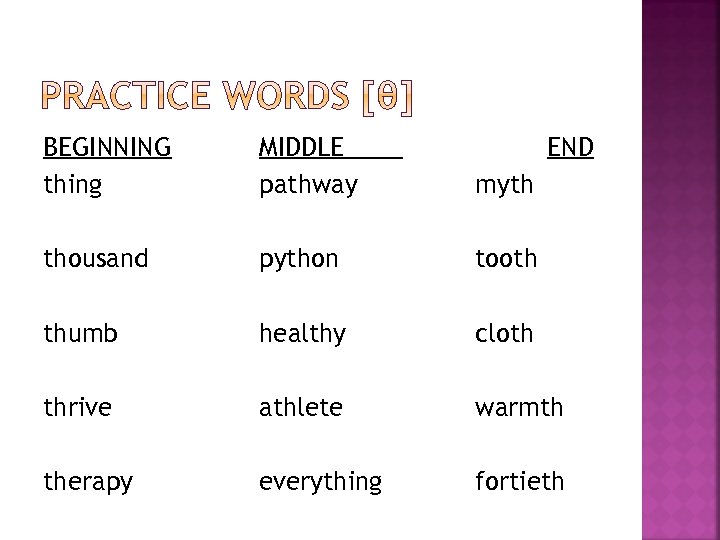
BEGINNING thing MIDDLE pathway END myth thousand python tooth thumb healthy cloth thrive athlete warmth therapy everything fortieth
![[nθ] Tenth [θl] lethal [dθ] width [θs] paths Month faithless breadth myths Synthetic ruthless](https://present5.com/presentation/ea4af9941066777a73f52f0f9a978d70/image-38.jpg "[nθ] Tenth [θl] lethal [dθ] width [θs] paths Month faithless breadth myths Synthetic ruthless")
[nθ] Tenth [θl] lethal [dθ] width [θs] paths Month faithless breadth myths Synthetic ruthless hundredth ninths [ksθ] sixth
![[d] day [ð] they dare there ladder lather dough though doze those](https://present5.com/presentation/ea4af9941066777a73f52f0f9a978d70/image-39.jpg "[d] day [ð] they dare there ladder lather dough though doze those")
[d] day [ð] they dare there ladder lather dough though doze those
![[z] teasing [ð] teething close clothes Zen then seize seethe closing clothing](https://present5.com/presentation/ea4af9941066777a73f52f0f9a978d70/image-40.jpg "[z] teasing [ð] teething close clothes Zen then seize seethe closing clothing")
[z] teasing [ð] teething close clothes Zen then seize seethe closing clothing
Turn to page 135 Level 3 practice words. Let’s practice aloud!
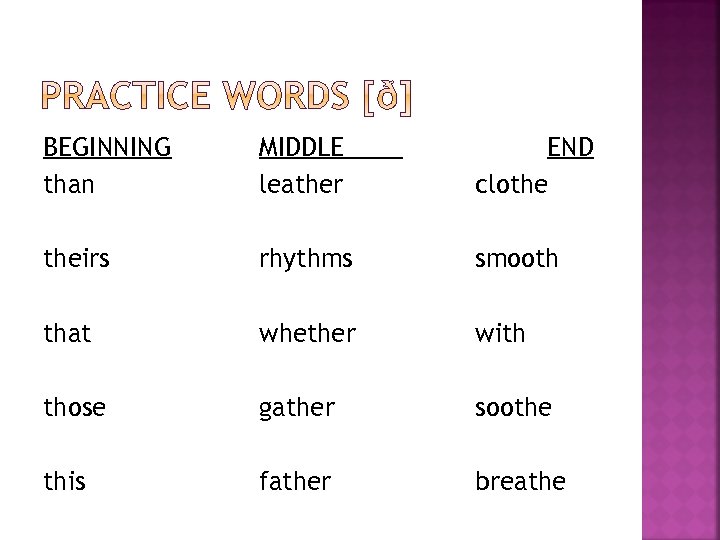
BEGINNING than MIDDLE leather END clothe theirs rhythms smooth that whether with those gather soothe this father breathe
![[ðd] breathed [ðz] soothes [rð] northern writhed loathes earthen smoothed breathes further clothed bathes](https://present5.com/presentation/ea4af9941066777a73f52f0f9a978d70/image-43.jpg "[ðd] breathed [ðz] soothes [rð] northern writhed loathes earthen smoothed breathes further clothed bathes")
[ðd] breathed [ðz] soothes [rð] northern writhed loathes earthen smoothed breathes further clothed bathes worthy seethed smoothes farther
Turn to page 139 Level 3 practice words. Let’s practice aloud!
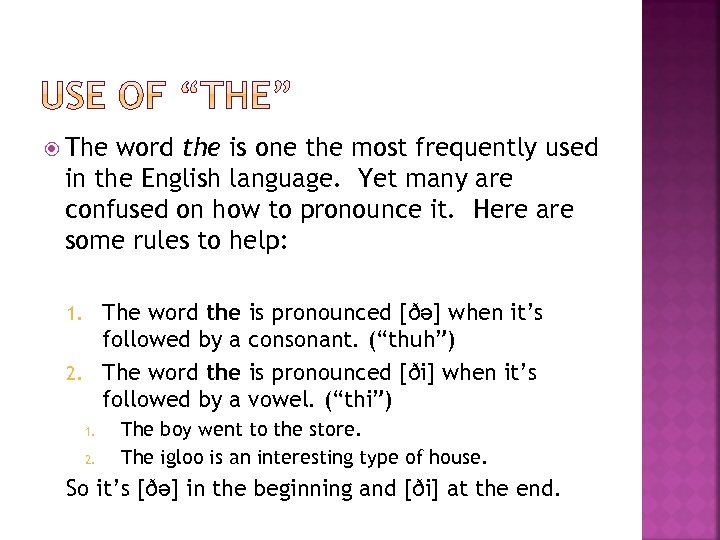
The word the is one the most frequently used in the English language. Yet many are confused on how to pronounce it. Here are some rules to help: The word the is pronounced [ðə] when it’s followed by a consonant. (“thuh”) 2. The word the is pronounced [ði] when it’s followed by a vowel. (“thi”) 1. 2. The boy went to the store. The igloo is an interesting type of house. So it’s [ðə] in the beginning and [ði] at the end.
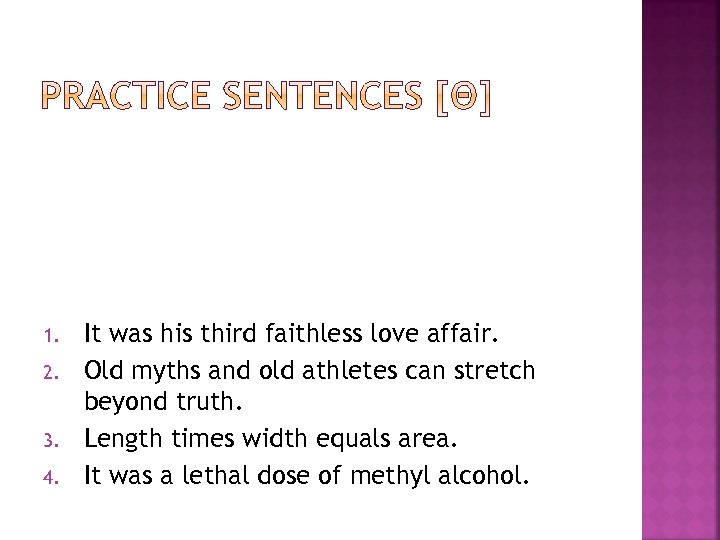
1. 2. 3. 4. It was his third faithless love affair. Old myths and old athletes can stretch beyond truth. Length times width equals area. It was a lethal dose of methyl alcohol.
![[ð] 1. 2. 3. 4. They were within the boundaries. Bathing is cool and](https://present5.com/presentation/ea4af9941066777a73f52f0f9a978d70/image-47.jpg "[ð] 1. 2. 3. 4. They were within the boundaries. Bathing is cool and")
[ð] 1. 2. 3. 4. They were within the boundaries. Bathing is cool and I like soothing waters. My mother loathes snakes. I washed my clothes as I bathed in the river.
![Write 5 words using the [θ] sound. Write 5 words using the [ð]](https://present5.com/presentation/ea4af9941066777a73f52f0f9a978d70/image-48.jpg "Write 5 words using the [θ] sound. Write 5 words using the [ð]")
Write 5 words using the [θ] sound. Write 5 words using the [ð] sound. Be prepared to share your words aloud to the class.
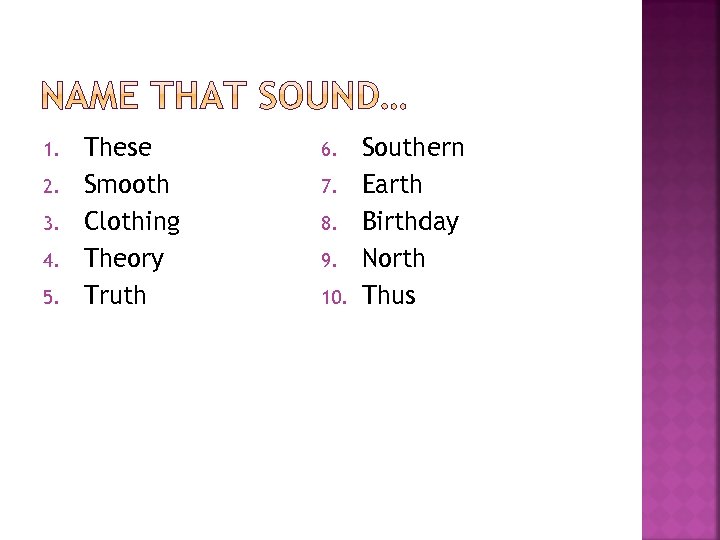
1. 2. 3. 4. 5. These Smooth Clothing Theory Truth 6. 7. 8. 9. 10. Southern Earth Birthday North Thus
![[s] and [z] Meagan Sovine](https://present5.com/presentation/ea4af9941066777a73f52f0f9a978d70/image-50.jpg "[s] and [z] Meagan Sovine")
[s] and [z] Meagan Sovine
If you were stranded on an island, what 2 things would you like to take with you? Think about this question and be prepared to share aloud with the class.
List the 6 plosives. Provide a sample word for each sound. List the 4 fricatives that we have discussed thus far. Provide a sample word for each sound.
Body stretches Face stretches Voice stretches Page 158
Both are cognate lingua-alveolar sounds. They are fricatives that you produce by forcing air between your tongue and the upper or lower front teeth. https: //www. youtube. com/watch? v=s. Pqo. Ej. R h. Om 4 https: //www. youtube. com/watch? v=pj. GIDo wj. W 0 k
![1. 2. 3. 4. Place your tongue in the position to say [t], but](https://present5.com/presentation/ea4af9941066777a73f52f0f9a978d70/image-55.jpg "1. 2. 3. 4. Place your tongue in the position to say [t], but")
1. 2. 3. 4. Place your tongue in the position to say [t], but don’t say it. Drop the tip of your tongue down and slightly back, but keep the sides lightly pressed against the middle and back upper teeth. Your tongue should now be pointing at the cutting edges of your front teeth or toward the gum ridge. Make a shallow grove lengthwise along the midline of your tongue. Keep the sides up. Blow the breath stream at the cutting edge of the teeth; create a “hissing” sound. [s] is voiceless.
![1. 2. 3. Follow the steps for [s]. Start voicing as soon as the](https://present5.com/presentation/ea4af9941066777a73f52f0f9a978d70/image-56.jpg "1. 2. 3. Follow the steps for [s]. Start voicing as soon as the")
1. 2. 3. Follow the steps for [s]. Start voicing as soon as the air begins to move. https: //www. youtube. com/watch? v=7 jh. EY QI 1954
![Sample [s]: The dog lost the scent of the snake in the grass. Sample](https://present5.com/presentation/ea4af9941066777a73f52f0f9a978d70/image-57.jpg "Sample [s]: The dog lost the scent of the snake in the grass. Sample")
Sample [s]: The dog lost the scent of the snake in the grass. Sample [z]: They hosed out the cages at the zoo. Spellings [s]: Spellings [z]: s as in snake tz as in waltz z as in zoo ss as in grass sch as in schism x as in Xerox sc as in scent x as in exit se as in hose c as in cent (with [k]) zz as in blizzard ps as in psychology ss as in scissors s as in music
![[s] sue [z] zoo racer razor loose lose spice spies device devise](https://present5.com/presentation/ea4af9941066777a73f52f0f9a978d70/image-58.jpg "[s] sue [z] zoo racer razor loose lose spice spies device devise")
[s] sue [z] zoo racer razor loose lose spice spies device devise
These sounds require precision actions by the articulators. Accurate movement Fine auditory discrimination Trying to get the “hiss”
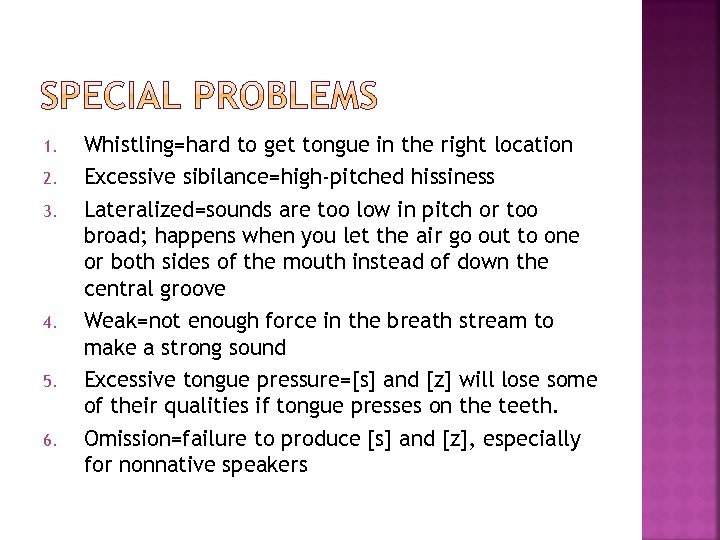
1. 2. 3. 4. 5. 6. Whistling=hard to get tongue in the right location Excessive sibilance=high-pitched hissiness Lateralized=sounds are too low in pitch or too broad; happens when you let the air go out to one or both sides of the mouth instead of down the central groove Weak=not enough force in the breath stream to make a strong sound Excessive tongue pressure=[s] and [z] will lose some of their qualities if tongue presses on the teeth. Omission=failure to produce [s] and [z], especially for nonnative speakers
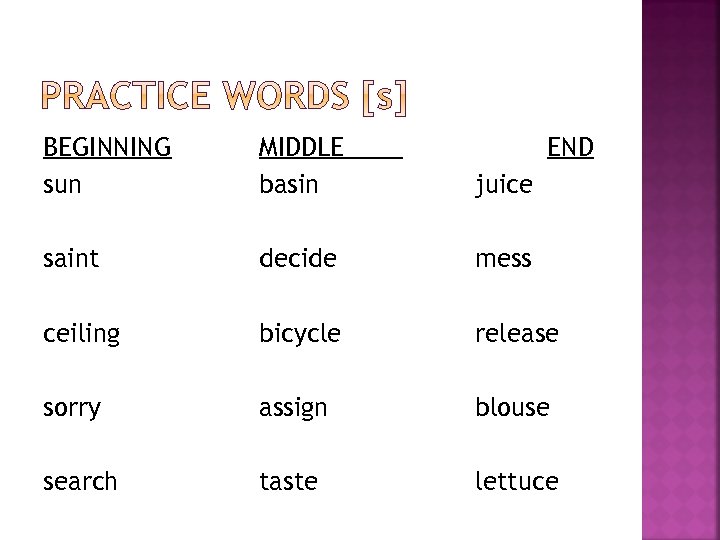
BEGINNING sun MIDDLE basin END juice saint decide mess ceiling bicycle release sorry assign blouse search taste lettuce
Let’s say the level 2 practice words.
![[sw] Swim [sp] spare [str] struck [skr] scrape [sts] boasts Swamp wasp destroy transcribe](https://present5.com/presentation/ea4af9941066777a73f52f0f9a978d70/image-63.jpg "[sw] Swim [sp] spare [str] struck [skr] scrape [sts] boasts Swamp wasp destroy transcribe")
[sw] Swim [sp] spare [str] struck [skr] scrape [sts] boasts Swamp wasp destroy transcribe dusts Swallow inspire stretch scribe tests Suede clasp distract screen bursts Swing span street subscribe rusts
![[sk] mask [ks] max desk decks ask axe dusk ducks task tacks](https://present5.com/presentation/ea4af9941066777a73f52f0f9a978d70/image-64.jpg "[sk] mask [ks] max desk decks ask axe dusk ducks task tacks")
[sk] mask [ks] max desk decks ask axe dusk ducks task tacks
![Identify the [s] sound. 1. The screaming guests had been frightened by the snakes.](https://present5.com/presentation/ea4af9941066777a73f52f0f9a978d70/image-65.jpg "Identify the [s] sound. 1. The screaming guests had been frightened by the snakes.")
Identify the [s] sound. 1. The screaming guests had been frightened by the snakes. 2. The spilled bleach left a streak in the blouse. 3. The instructor spoke respectfully to the students. 4. She asked him if he could swim to Sweden.
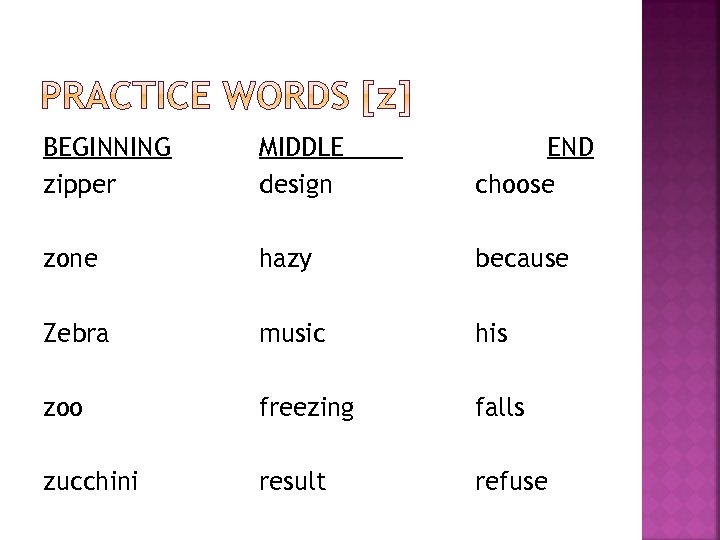
BEGINNING zipper MIDDLE design END choose zone hazy because Zebra music his zoo freezing falls zucchini result refuse
Turn to page 156 and let’s review the level 3 words.
![Identify the [z] sound. 1. She was refusing to wear the violet blazer. 2.](https://present5.com/presentation/ea4af9941066777a73f52f0f9a978d70/image-68.jpg "Identify the [z] sound. 1. She was refusing to wear the violet blazer. 2.")
Identify the [z] sound. 1. She was refusing to wear the violet blazer. 2. The bruise was due to my clumsy move. 3. There a zillion cars in Brazil. 4. Sometimes it’s a disaster when the stock market falls.
![List 5 words for the [s] sound. List 5 words for the [z]](https://present5.com/presentation/ea4af9941066777a73f52f0f9a978d70/image-69.jpg "List 5 words for the [s] sound. List 5 words for the [z]")
List 5 words for the [s] sound. List 5 words for the [z] sound. Be prepared to share aloud.
![Provide 5 sample words for the [s] sound. Provide 5 sample words for](https://present5.com/presentation/ea4af9941066777a73f52f0f9a978d70/image-70.jpg "Provide 5 sample words for the [s] sound. Provide 5 sample words for")
Provide 5 sample words for the [s] sound. Provide 5 sample words for the [z] sound. Be prepared to share aloud.
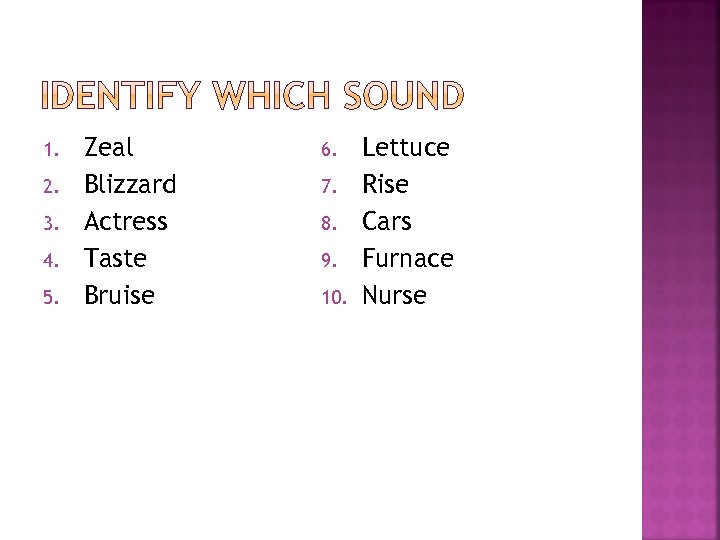
1. 2. 3. 4. 5. Zeal Blizzard Actress Taste Bruise 6. 7. 8. 9. 10. Lettuce Rise Cars Furnace Nurse
Last day to discuss chapter 7. We will have a quiz over chapter 7.
![[ʃ], [ʒ], [h] Meagan Sovine](https://present5.com/presentation/ea4af9941066777a73f52f0f9a978d70/image-73.jpg "[ʃ], [ʒ], [h] Meagan Sovine")
[ʃ], [ʒ], [h] Meagan Sovine
If you could meet any celebrity, who would it be? Think about this question and be prepared to share aloud with the class.

Body Face Voice
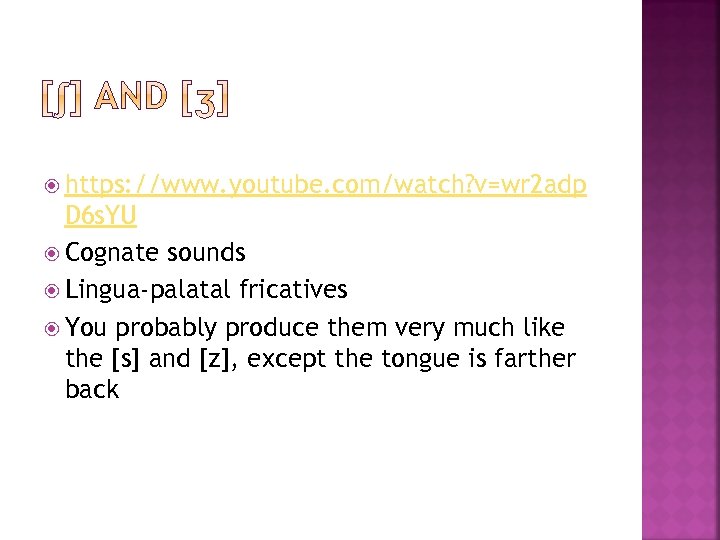
https: //www. youtube. com/watch? v=wr 2 adp D 6 s. YU Cognate sounds Lingua-palatal fricatives You probably produce them very much like the [s] and [z], except the tongue is farther back
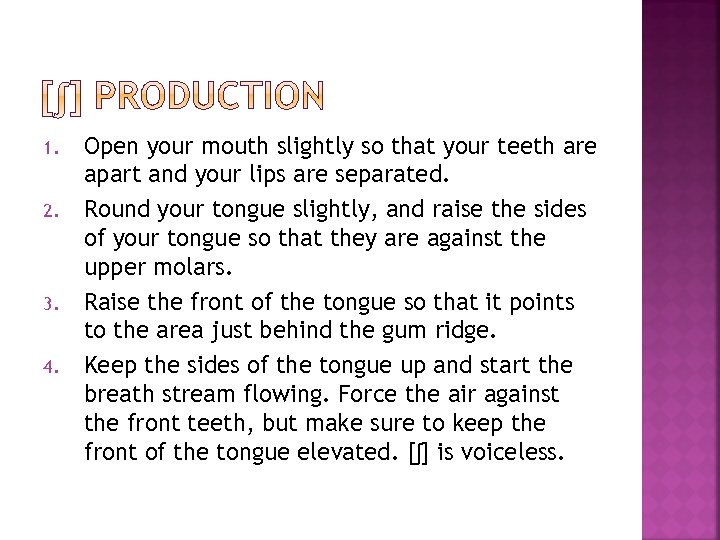
1. 2. 3. 4. Open your mouth slightly so that your teeth are apart and your lips are separated. Round your tongue slightly, and raise the sides of your tongue so that they are against the upper molars. Raise the front of the tongue so that it points to the area just behind the gum ridge. Keep the sides of the tongue up and start the breath stream flowing. Force the air against the front teeth, but make sure to keep the front of the tongue elevated. [ʃ] is voiceless.
![1. 2. Follow the same steps as for [ʃ]. This time add voice at](https://present5.com/presentation/ea4af9941066777a73f52f0f9a978d70/image-78.jpg "1. 2. Follow the same steps as for [ʃ]. This time add voice at")
1. 2. Follow the same steps as for [ʃ]. This time add voice at the same instant that the air starts to move. ***If you don’t press your tongue firmly against the upper side teeth, the air can escape from the sides of your mouth.
![Sample [ʃ]: She dreamed that he lived in a mansion made of sugar near](https://present5.com/presentation/ea4af9941066777a73f52f0f9a978d70/image-79.jpg "Sample [ʃ]: She dreamed that he lived in a mansion made of sugar near")
Sample [ʃ]: She dreamed that he lived in a mansion made of sugar near Chicago’s Russian embassy. Sample [ʒ]: She was vision in beige and azure at the garage. Spellings [ʃ]: t as in nation Spellings [ʒ]: sh as in she sc as in fascist s as in pleasure c as in ocean chs as in fuchsia ge as in beige s as in tension ch as in Chicago z as in azure ss as in fissure j as in bijou sch as in schnapps g as in gendarme
![[ʃ] and [ʒ] are cognate sounds. They are lingua-palatal(tongue-soft palate) fricatives. Same production](https://present5.com/presentation/ea4af9941066777a73f52f0f9a978d70/image-80.jpg "[ʃ] and [ʒ] are cognate sounds. They are lingua-palatal(tongue-soft palate) fricatives. Same production")
[ʃ] and [ʒ] are cognate sounds. They are lingua-palatal(tongue-soft palate) fricatives. Same production as [s] and [z], except the tongue is further back. Contrast [ʃ] and [ʒ]: [ʃ] [ʒ] glacier glazier pressure pleasure fission vision
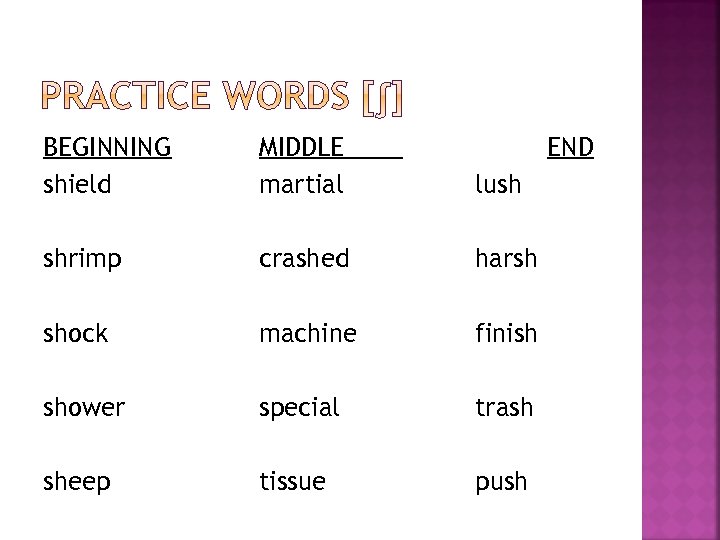
BEGINNING shield MIDDLE martial END lush shrimp crashed harsh shock machine finish shower special trash sheep tissue push
Let’s review level 2 practice words aloud.
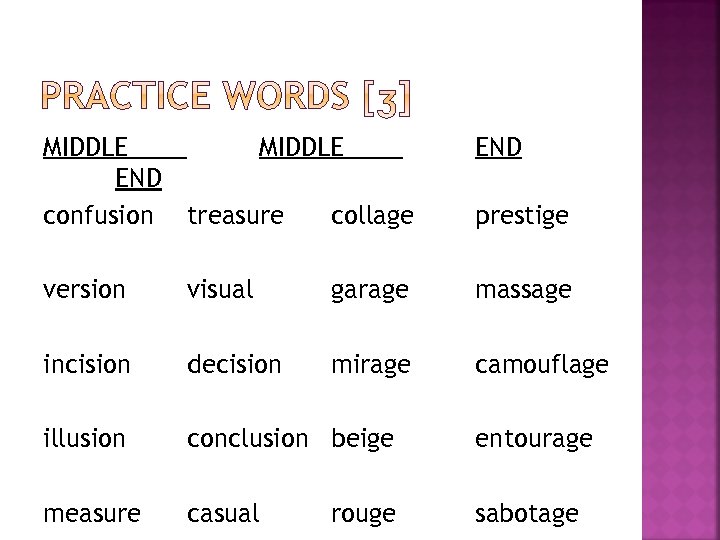
MIDDLE END confusion treasure collage END version visual garage massage incision decision mirage camouflage illusion conclusion beige entourage measure casual sabotage rouge prestige
Let’s review level 1 practice phrases.
![Identify both sounds [ʃ] and [ʒ]. 1. 2. 3. 4. 5. 6. They’re casual](https://present5.com/presentation/ea4af9941066777a73f52f0f9a978d70/image-85.jpg "Identify both sounds [ʃ] and [ʒ]. 1. 2. 3. 4. 5. 6. They’re casual")
Identify both sounds [ʃ] and [ʒ]. 1. 2. 3. 4. 5. 6. They’re casual about relaxation in Chicago. Shoveling sand can be pleasurable. The dog could be vicious on occasion. We measured the beach erosion while on vacation. Always shower after a pleasurable massage. I was assured that the ocean would be azure in color.
Is a voiceless glottal fricative. It is simply a stream of air from the larynx directed throught the open mouth.
![1. 2. 3. There’s no special position or movement for [h]. Start with your](https://present5.com/presentation/ea4af9941066777a73f52f0f9a978d70/image-87.jpg "1. 2. 3. There’s no special position or movement for [h]. Start with your")
1. 2. 3. There’s no special position or movement for [h]. Start with your tongue resting on the bottom of your mouth. Open your mouth, constrict your vocal cords as though you were going to whisper. Force the air out of your mouth. Don’t produce voice, and don’t let any air out of your nose.
![Say the following with me: [h. . h. . ] home him hum](https://present5.com/presentation/ea4af9941066777a73f52f0f9a978d70/image-88.jpg "Say the following with me: [h. . h. . ] home him hum")
Say the following with me: [h. . h. . ] home him hum ham
Sample: Helen heated the whole house until it was too hot. Spellings: h as in hot wh as in whole
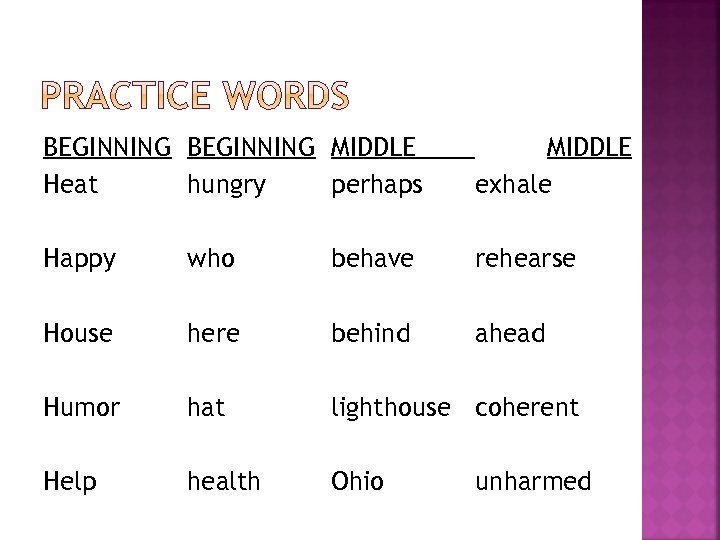
BEGINNING MIDDLE Heat hungry perhaps MIDDLE exhale Happy who behave rehearse House here behind ahead Humor hat lighthouse coherent Help health Ohio unharmed
![Turn to page 167 Challenge material for [h]. Let’s practice aloud together!](https://present5.com/presentation/ea4af9941066777a73f52f0f9a978d70/image-91.jpg "Turn to page 167 Challenge material for [h]. Let’s practice aloud together!")
Turn to page 167 Challenge material for [h]. Let’s practice aloud together!
1. 2. 3. 4. 5. He took a huge inhalation at the end of the hallway. The passengers were unharmed in the highjacking. They were happy, but hungry, after the rehearsal. Incoherent sentences are hard to handle. Harry wrote the play Humor in the White House.
![List 5 words using the [ʃ] sound. List 5 words using the [ʒ]](https://present5.com/presentation/ea4af9941066777a73f52f0f9a978d70/image-93.jpg "List 5 words using the [ʃ] sound. List 5 words using the [ʒ]")
List 5 words using the [ʃ] sound. List 5 words using the [ʒ] sound. List 5 words using the [h] sound. Be prepared to share one of each with the whole class.
What are the 9 fricative sounds? Questions?
