


 Скачать презентацию F-Structures Information Structure and Discourse Structure Tracy H
d1b5a57162f48236b8c88e3dbf3b0630.ppt
- Количество слайдов: 76
 F-Structures, Information Structure, and Discourse Structure Tracy H. King Annie Zaenen PARC LFG Winter school July 2004 PARC
 Talk Outline • Information Structure: Syntax of discourse functions • Applications: Anaphora resolution • Discourse structure • Applications: Summarization and Sentence Condensation • Conclusions LFG Winter school July 2004 PARC
 Information Structure: Syntax of discourse functions • Basic discourse functions • Typology of encoding • LFG approaches LFG Winter school July 2004 PARC
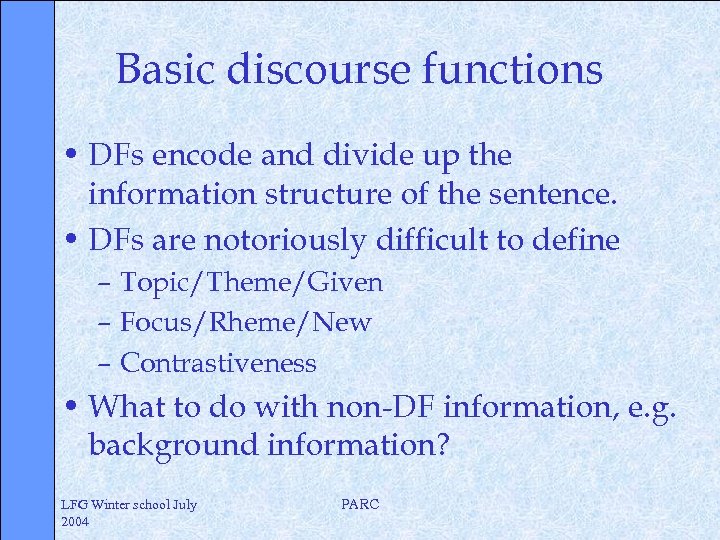 Basic discourse functions • DFs encode and divide up the information structure of the sentence. • DFs are notoriously difficult to define – Topic/Theme/Given – Focus/Rheme/New – Contrastiveness • What to do with non-DF information, e. g. background information? LFG Winter school July 2004 PARC
![Example: Clefts • It is the [box]Focus [that]Topic I opened. • Construction encodes focus](https://present5.com/presentation/d1b5a57162f48236b8c88e3dbf3b0630/image-5.jpg "Example: Clefts • It is the [box]Focus [that]Topic I opened. • Construction encodes focus") Example: Clefts • It is the [box]Focus [that]Topic I opened. • Construction encodes focus of the clefted constituent. • The referent of that constituent is the topic of the subordinate clause. • The ‘relative clause’ material is ‘presupposed’. • Question-answer pairs are often used to determine DFs. – What did you open? It was the box that I opened. LFG Winter school July 2004 PARC
Example: Clefts • It is the [box]Focus [that]Topic I opened. • Construction encodes focus of the clefted constituent. • The referent of that constituent is the topic of the subordinate clause. • The ‘relative clause’ material is ‘presupposed’. • Question-answer pairs are often used to determine DFs. – What did you open? It was the box that I opened. LFG Winter school July 2004 PARC
 Basic discourse functions • Here focus on: – how to encode these – what they can be used for • Choice of relevant DFs depends on what they are needed for. LFG Winter school July 2004 PARC
 Typology of encoding • Structural position – initial – preverbal • Discourse markers/particles • Intonation • Combinations of these LFG Winter school July 2004 PARC
 Structural encoding • Position indicates discourse function. • Language specific – Topics are initial – Focus are pre/post verbal – Background information is postverbal – Constructions: clefts • Subject as default topic • LFG: designated c-structure position LFG Winter school July 2004 PARC
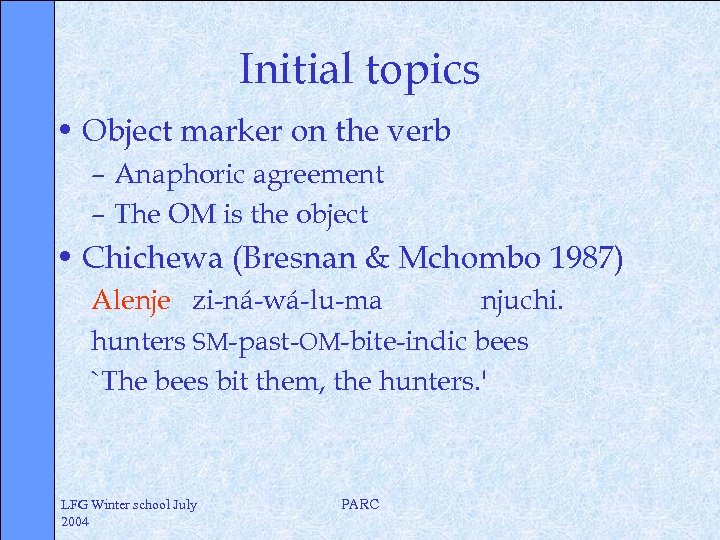 Initial topics • Object marker on the verb – Anaphoric agreement – The OM is the object • Chichewa (Bresnan & Mchombo 1987) Alenje zi-ná-wá-lu-ma njuchi. hunters SM-past-OM-bite-indic bees `The bees bit them, the hunters. ' LFG Winter school July 2004 PARC
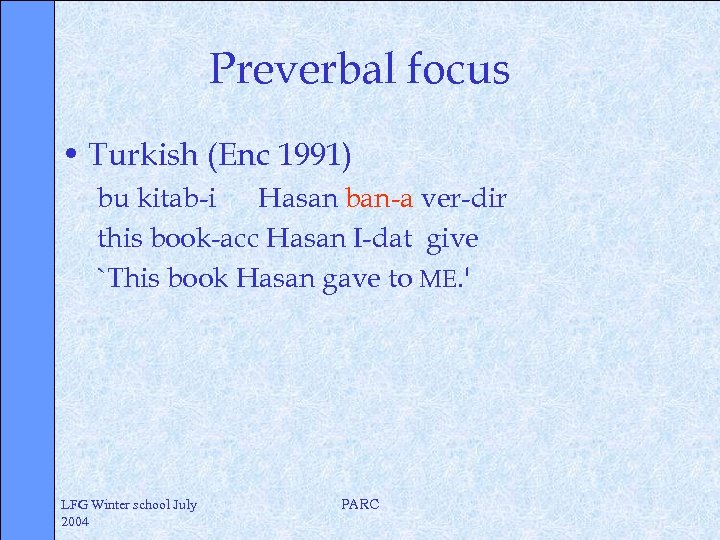 Preverbal focus • Turkish (Enc 1991) bu kitab-i Hasan ban-a ver-dir this book-acc Hasan I-dat give `This book Hasan gave to ME. ' LFG Winter school July 2004 PARC
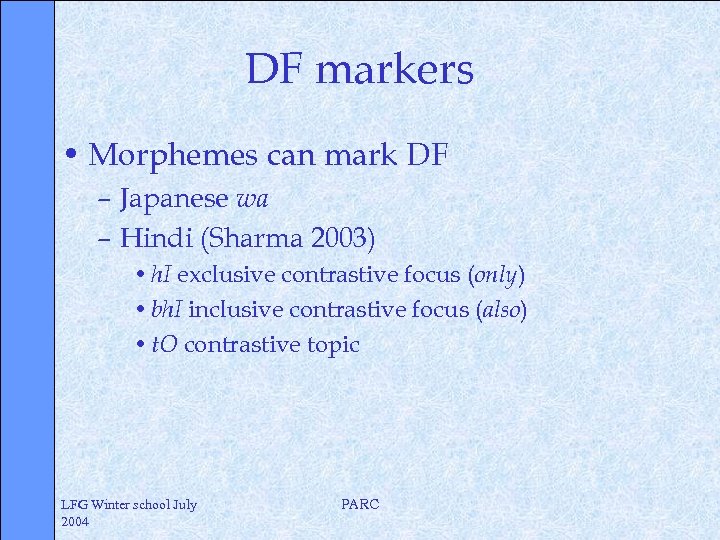 DF markers • Morphemes can mark DF – Japanese wa – Hindi (Sharma 2003) • h. I exclusive contrastive focus (only) • bh. I inclusive contrastive focus (also) • t. O contrastive topic LFG Winter school July 2004 PARC
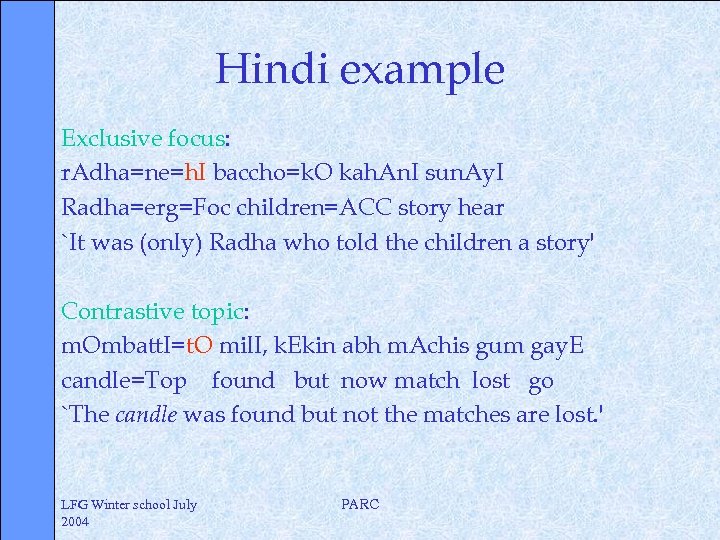 Hindi example Exclusive focus: r. Adha=ne=h. I baccho=k. O kah. An. I sun. Ay. I Radha=erg=Foc children=ACC story hear `It was (only) Radha who told the children a story' Contrastive topic: m. Ombatt. I=t. O mil. I, k. Ekin abh m. Achis gum gay. E candle=Top found but now match lost go `The candle was found but not the matches are lost. ' LFG Winter school July 2004 PARC
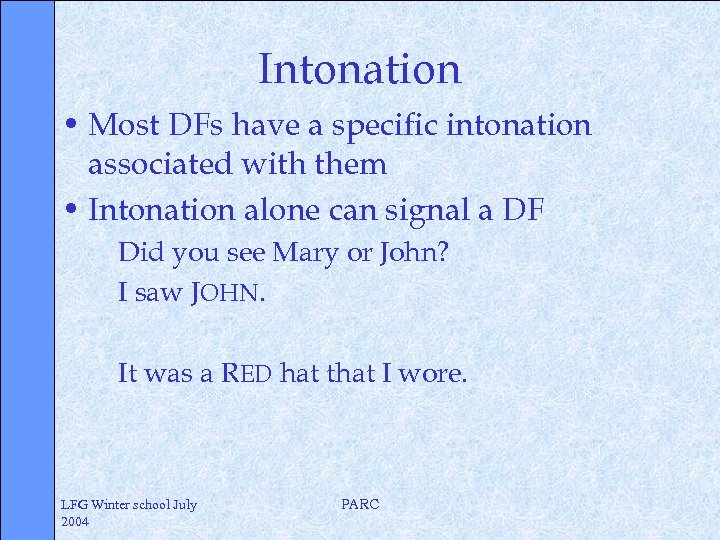 Intonation • Most DFs have a specific intonation associated with them • Intonation alone can signal a DF Did you see Mary or John? I saw JOHN. It was a RED hat that I wore. LFG Winter school July 2004 PARC
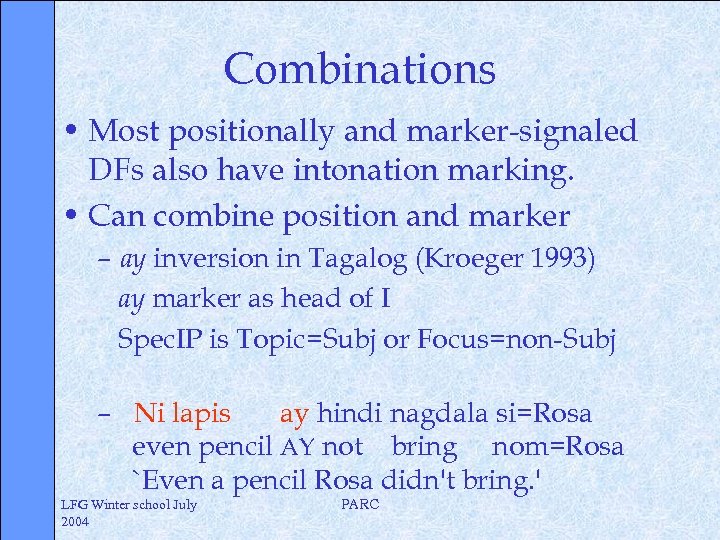 Combinations • Most positionally and marker-signaled DFs also have intonation marking. • Can combine position and marker – ay inversion in Tagalog (Kroeger 1993) ay marker as head of I Spec. IP is Topic=Subj or Focus=non-Subj – Ni lapis ay hindi nagdala si=Rosa even pencil AY not bring nom=Rosa `Even a pencil Rosa didn't bring. ' LFG Winter school July 2004 PARC
 LFG approaches • Syntax-DF interactions • F-structure vs. I-structure • OT-LFG Winter school July 2004 PARC
 Syntax-DF interactions • Subcategorized DFs – Predicates can subcategorize for DFs. • C-structure annotations – C-structure nodes can be associated with DFs, similar to GF assignment in configurational languages. LFG Winter school July 2004 PARC
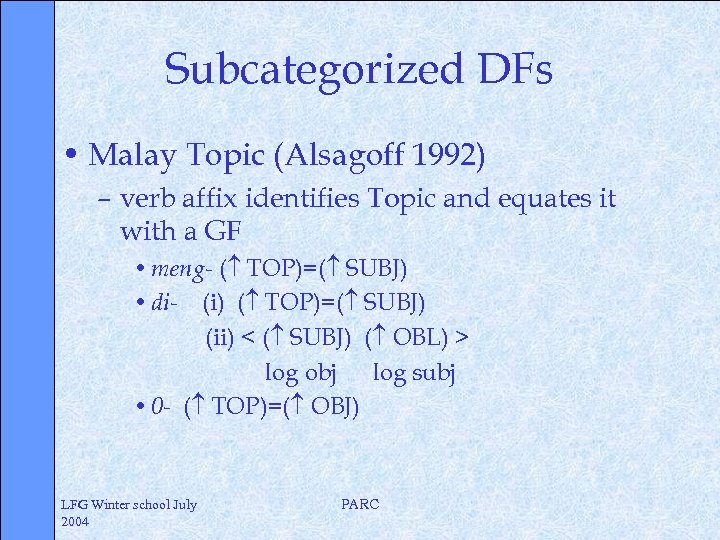 Subcategorized DFs • Malay Topic (Alsagoff 1992) – verb affix identifies Topic and equates it with a GF • meng- ( TOP)=( SUBJ) • di- (i) ( TOP)=( SUBJ) (ii) < ( SUBJ) ( OBL) > log obj log subj • 0 - ( TOP)=( OBJ) LFG Winter school July 2004 PARC
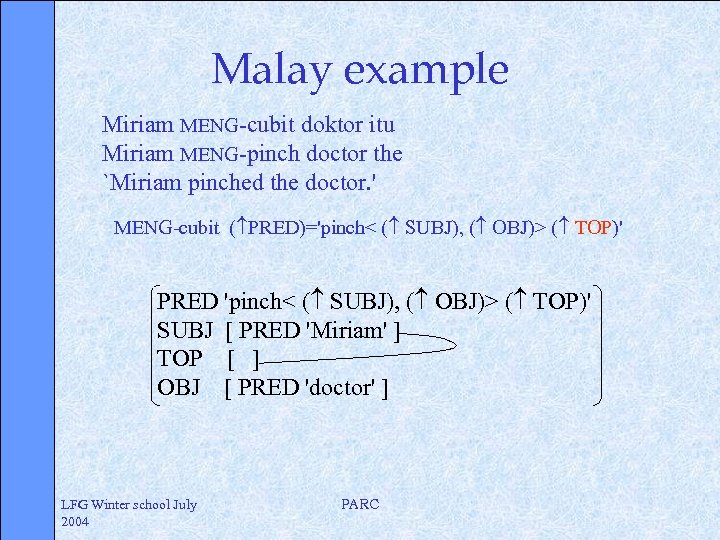 Malay example Miriam MENG-cubit doktor itu Miriam MENG-pinch doctor the `Miriam pinched the doctor. ' MENG-cubit ( PRED)='pinch< ( SUBJ), ( OBJ)> ( TOP)' PRED 'pinch< ( SUBJ), ( OBJ)> ( TOP)' SUBJ [ PRED 'Miriam' ] TOP [ ] OBJ [ PRED 'doctor' ] LFG Winter school July 2004 PARC
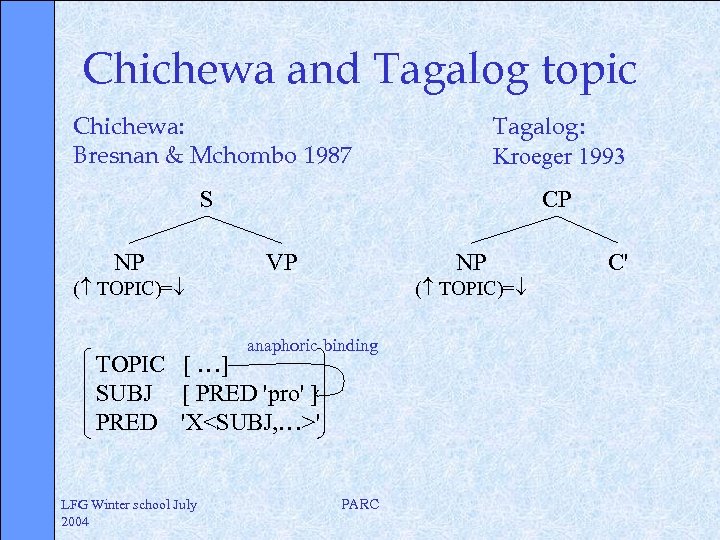 Chichewa and Tagalog topic Chichewa: Bresnan & Mchombo 1987 Tagalog: Kroeger 1993 S CP NP VP NP ( TOPIC)= anaphoric binding TOPIC [ …] SUBJ [ PRED 'pro' ] PRED 'X
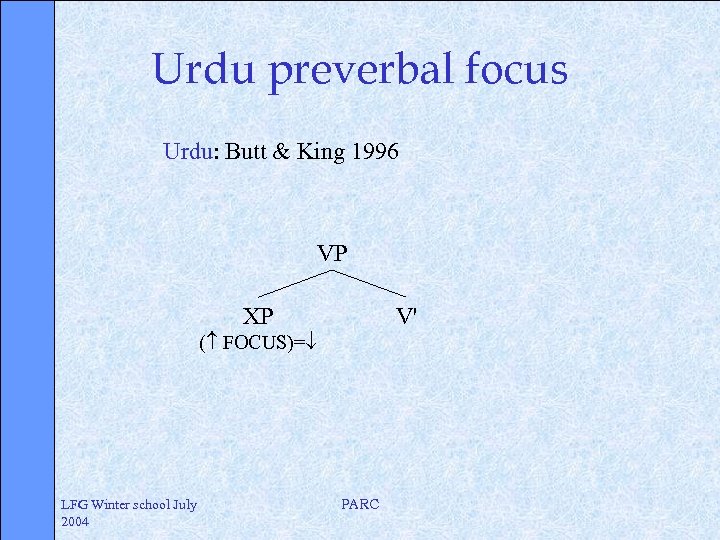 Urdu preverbal focus Urdu: Butt & King 1996 VP V' XP ( FOCUS)= LFG Winter school July 2004 PARC
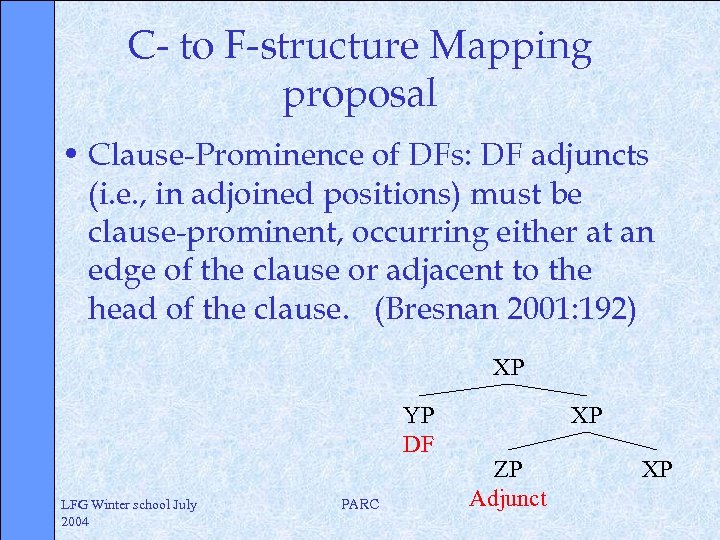 C- to F-structure Mapping proposal • Clause-Prominence of DFs: DF adjuncts (i. e. , in adjoined positions) must be clause-prominent, occurring either at an edge of the clause or adjacent to the head of the clause. (Bresnan 2001: 192) XP YP DF LFG Winter school July 2004 PARC XP ZP Adjunct XP
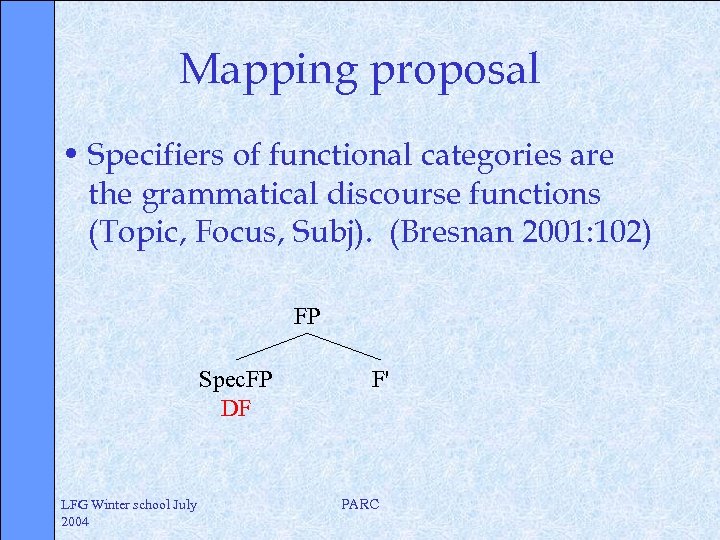 Mapping proposal • Specifiers of functional categories are the grammatical discourse functions (Topic, Focus, Subj). (Bresnan 2001: 102) FP Spec. FP DF LFG Winter school July 2004 F' PARC
 Intonation • Much work is done on this association – Steedman (2000) on Categorial Grammar • Less in LFG – Bengali and the syntax-prosody mapping (Butt and King 1998) – Russian clause-final focus (King 1995) – Integration of prosody into the LFG projection architecture needs more exploration. LFG Winter school July 2004 PARC
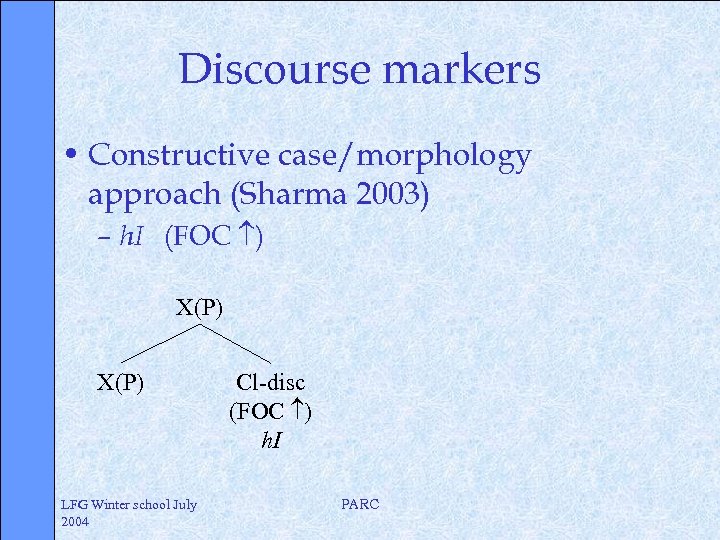 Discourse markers • Constructive case/morphology approach (Sharma 2003) – h. I (FOC ) X(P) LFG Winter school July 2004 Cl-disc (FOC ) h. I PARC
 F-structure vs. I-structure • DFs are often represented in the fstructure. – Malay subcategorizes for Topics – Chichewa incorporated pronouns • Scope of DFs may conflict with that of GFs. – project DFs into an I(nformation)-structure LFG Winter school July 2004 PARC
![DF-GF mismatches VP focus: Mary [F ate the cake]. F-structure PRED SUBJ OBJ TNS](https://present5.com/presentation/d1b5a57162f48236b8c88e3dbf3b0630/image-26.jpg "DF-GF mismatches VP focus: Mary [F ate the cake]. F-structure PRED SUBJ OBJ TNS") DF-GF mismatches VP focus: Mary [F ate the cake]. F-structure PRED SUBJ OBJ TNS 'eat
DF-GF mismatches VP focus: Mary [F ate the cake]. F-structure PRED SUBJ OBJ TNS 'eat
![OT-LFG approaches • OT constraints for encoding of DFs (Choi 1999) – [New]-X: Place](https://present5.com/presentation/d1b5a57162f48236b8c88e3dbf3b0630/image-27.jpg "OT-LFG approaches • OT constraints for encoding of DFs (Choi 1999) – [New]-X: Place") OT-LFG approaches • OT constraints for encoding of DFs (Choi 1999) – [New]-X: Place [+New] in a salient position X – [Prom]-X: Place [+Prom] in a salient position X • Languages – rank these constraints – define possible instantiations of X LFG Winter school July 2004 PARC
OT-LFG approaches • OT constraints for encoding of DFs (Choi 1999) – [New]-X: Place [+New] in a salient position X – [Prom]-X: Place [+Prom] in a salient position X • Languages – rank these constraints – define possible instantiations of X LFG Winter school July 2004 PARC
 Summary: Syntax of DFs • DFs can be encoded by: – structural position – morphological markers – intonation • Linguistic theories need a way to capture these interactions – Much LFG work on structural position and morphological markers – Are F and T the only elements worth distinguishing? – Need more work on integrating generalizations about intonation – Need more work on how syntactic distinctions relate to semantic and pragmatic concepts LFG Winter school July 2004 PARC
 Form and function relation • A radical proposal: – Prince: the relation between syntax and pragmatics is as arbitrary as that between sound and word meaning • Cross language variation: • e. g. functions of Left-dislocation in Yiddish and English are different (Prince) • Functions of clefting and topicalization are different across Germanic languages • Functions of Left-Dislocations (or Contrastive topicalization) and Right dislocations in Romance languages and in Germanic are different (see e. g. Lambrecht 1981 on Spoken French). • Not a one-to-one correspondence between form and function LFG Winter school July 2004 PARC
 Talk Outline • Information Structure: Syntax of discourse functions • Applications: Anaphora resolution • Discourse structure • Applications: Summarization and Sentence Condensation • Conclusions LFG Winter school July 2004 PARC
 Applications for Discourse Functions Anaphora resolution – DFs determine saliency – Saliency partially determines resolution LFG Winter school July 2004 PARC
 Anaphora Resolution • Have a sentence with pronouns or referring NPs (the president) • Want to know what they refer to – some restrictions are purely syntactic: (most) reflexives refer to Subjects – others are heuristic: prefer closer referents prefer high saliency referents LFG Winter school July 2004 PARC
 Role of Discourse Functions • Topic, and topic shift, are relevant for anaphora • Centering theory and its variants – have an ordered list of salient elements – have a referring expression – first salient element to match features is the antecedent – update the list based on this LFG Winter school July 2004 PARC
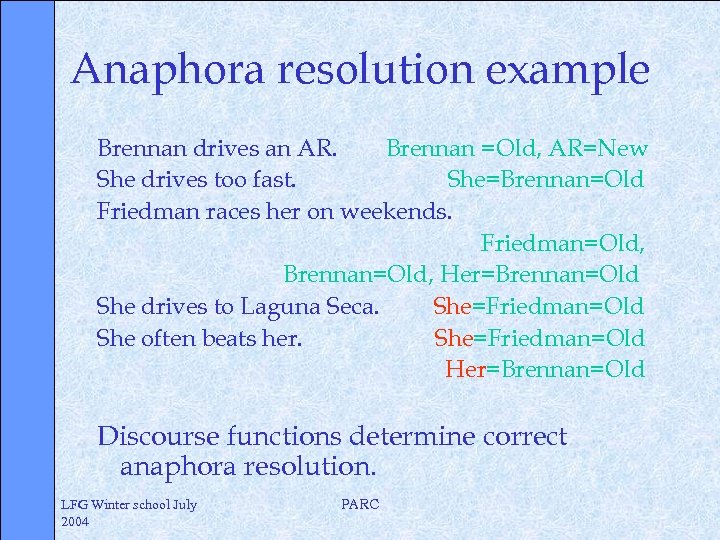 Anaphora resolution example Brennan drives an AR. Brennan =Old, AR=New She drives too fast. She=Brennan=Old Friedman races her on weekends. Friedman=Old, Brennan=Old, Her=Brennan=Old She drives to Laguna Seca. She=Friedman=Old She often beats her. She=Friedman=Old Her=Brennan=Old Discourse functions determine correct anaphora resolution. LFG Winter school July 2004 PARC
 Pro-Drop and Anaphora Resolution • Pro-drop is (partly) licensed by DFs – Already established topics are more likely to be pro-dropped • Centering theory: – Continue and Smooth-shift transition favor null subjects – Chinese (Song 2003) – Yiddish (Prince 1998) LFG Winter school July 2004 PARC
 Summary: Anaphora resolution • DFs are essential for determining anaphora resolution • Pro-drop is licensed in part by IS • But a lot remains to be worked out. LFG Winter school July 2004 PARC
 Talk Outline • Information Structure: Syntax of discourse functions • Applications: Anaphora Resolution • Discourse structure • Applications: Summarization and Sentence Condensation • Conclusions LFG Winter school July 2004 PARC
 Discourse Structure • A simple model • Its relation to syntax LFG Winter school July 2004 PARC
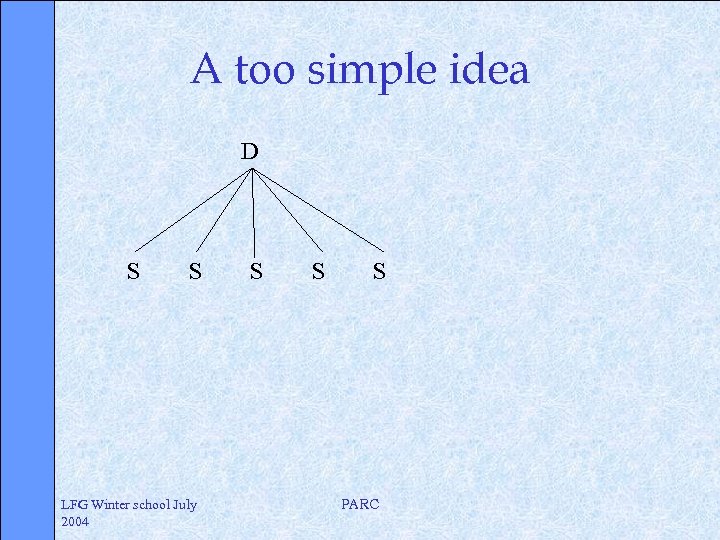 A too simple idea D S S LFG Winter school July 2004 S S S PARC
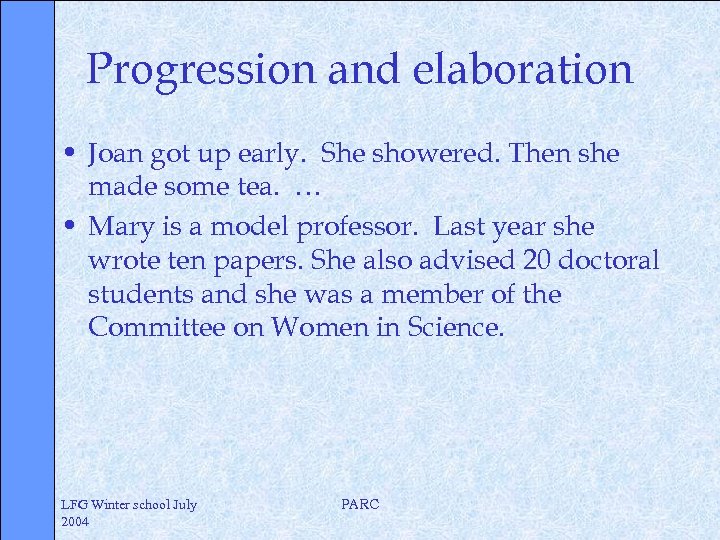 Progression and elaboration • Joan got up early. She showered. Then she made some tea. … • Mary is a model professor. Last year she wrote ten papers. She also advised 20 doctoral students and she was a member of the Committee on Women in Science. LFG Winter school July 2004 PARC
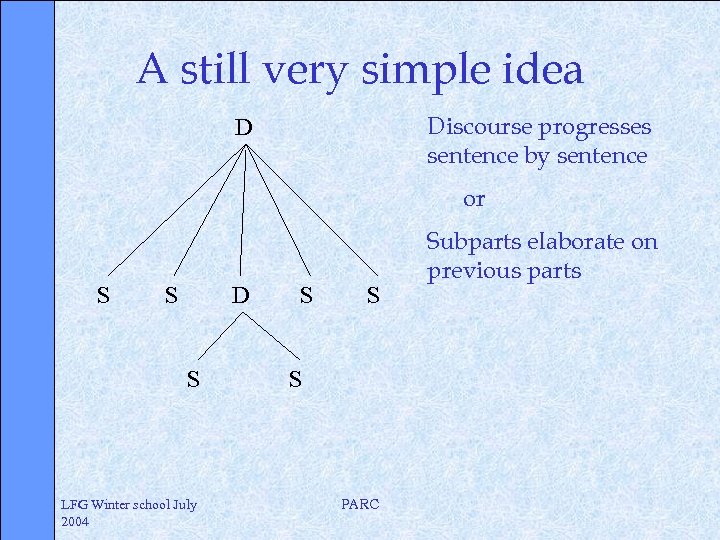 A still very simple idea Discourse progresses sentence by sentence D or S S D S LFG Winter school July 2004 S S S PARC Subparts elaborate on previous parts
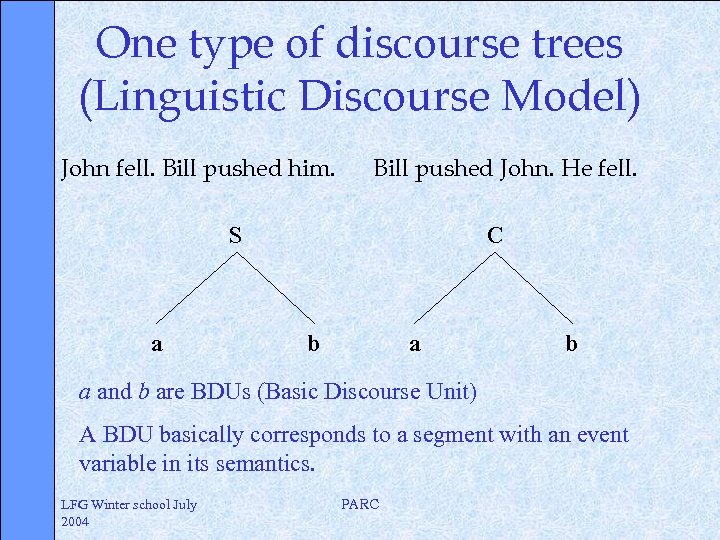 One type of discourse trees (Linguistic Discourse Model) John fell. Bill pushed him. Bill pushed John. He fell. S a C b a and b are BDUs (Basic Discourse Unit) A BDU basically corresponds to a segment with an event variable in its semantics. LFG Winter school July 2004 PARC
 BDU Relations • Not all types of relations can be classified as belonging to the subordinating or the coordinating type. – We will ignore the rest here. • Some elements in a sentence can explicitly indicate what type of relation we have, e. g. ‘because’ is a subordination relation. – They will be called “operator segments. ” LFG Winter school July 2004 PARC
 How do discourse trees relate to sentence syntax trees? • Some textual elements guide the discourse tree construction. • A BDU is not necessarily a complete sentence or vice versa. LFG Winter school July 2004 PARC
![Sentence does NOT equal BDU [The man dove into the pool. ]a [It was](https://present5.com/presentation/d1b5a57162f48236b8c88e3dbf3b0630/image-45.jpg "Sentence does NOT equal BDU [The man dove into the pool. ]a [It was") Sentence does NOT equal BDU [The man dove into the pool. ]a [It was warm and soothing]b and [he decided to remain for a little longer than usual. ]c C S a LFG Winter school July 2004 b PARC c
Sentence does NOT equal BDU [The man dove into the pool. ]a [It was warm and soothing]b and [he decided to remain for a little longer than usual. ]c C S a LFG Winter school July 2004 b PARC c
![ADJUNCT clauses [Joan left]a because [she was tired. ]b Three segments: Two BDUs and](https://present5.com/presentation/d1b5a57162f48236b8c88e3dbf3b0630/image-46.jpg "ADJUNCT clauses [Joan left]a because [she was tired. ]b Three segments: Two BDUs and") ADJUNCT clauses [Joan left]a because [she was tired. ]b Three segments: Two BDUs and 1 operator S a LFG Winter school July 2004 b PARC
ADJUNCT clauses [Joan left]a because [she was tired. ]b Three segments: Two BDUs and 1 operator S a LFG Winter school July 2004 b PARC
 Textual elements that guide the construction of discourse trees • Hypothesis 1: Subordinating conjunctions indicate discourse subordination. – Needs checking: it is often true but is it always true? LFG Winter school July 2004 PARC
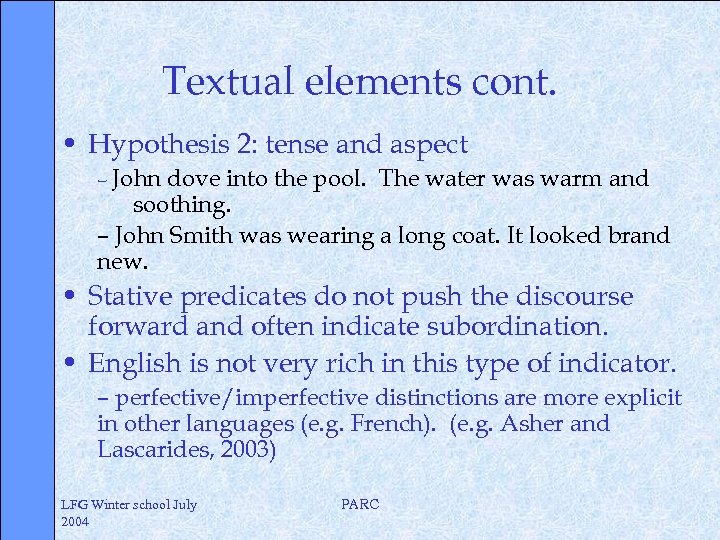 Textual elements cont. • Hypothesis 2: tense and aspect – John dove into the pool. The water was warm and soothing. – John Smith was wearing a long coat. It looked brand new. • Stative predicates do not push the discourse forward and often indicate subordination. • English is not very rich in this type of indicator. – perfective/imperfective distinctions are more explicit in other languages (e. g. French). (e. g. Asher and Lascarides, 2003) LFG Winter school July 2004 PARC
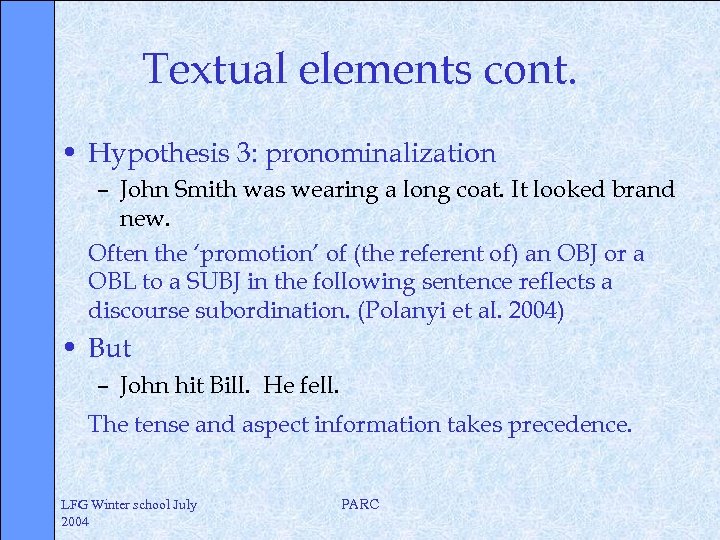 Textual elements cont. • Hypothesis 3: pronominalization – John Smith was wearing a long coat. It looked brand new. Often the ‘promotion’ of (the referent of) an OBJ or a OBL to a SUBJ in the following sentence reflects a discourse subordination. (Polanyi et al. 2004) • But – John hit Bill. He fell. The tense and aspect information takes precedence. LFG Winter school July 2004 PARC
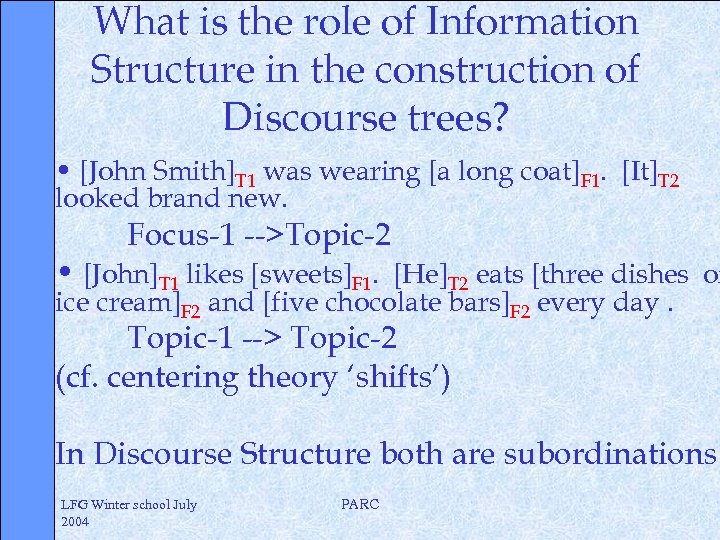 What is the role of Information Structure in the construction of Discourse trees? • [John Smith]T 1 was wearing [a long coat]F 1. [It]T 2 looked brand new. Focus-1 -->Topic-2 • [John]T 1 likes [sweets]F 1. [He]T 2 eats [three dishes of ice cream]F 2 and [five chocolate bars]F 2 every day. Topic-1 --> Topic-2 (cf. centering theory ‘shifts’) In Discourse Structure both are subordinations LFG Winter school July 2004 PARC
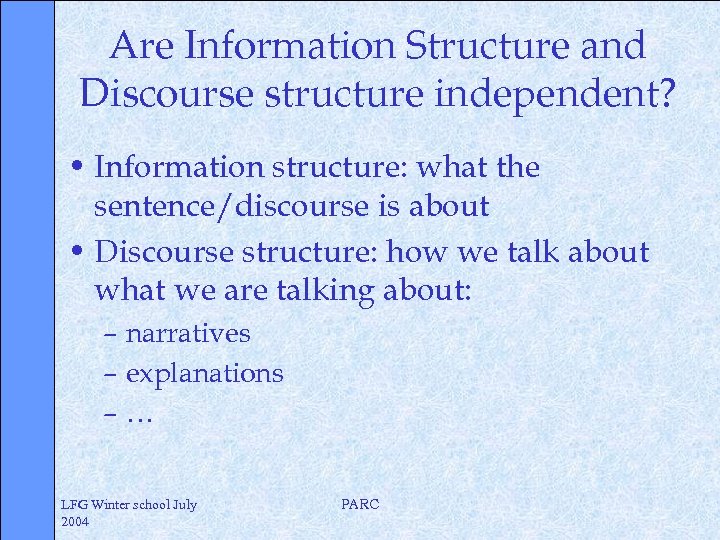 Are Information Structure and Discourse structure independent? • Information structure: what the sentence/discourse is about • Discourse structure: how we talk about what we are talking about: – narratives – explanations –… LFG Winter school July 2004 PARC
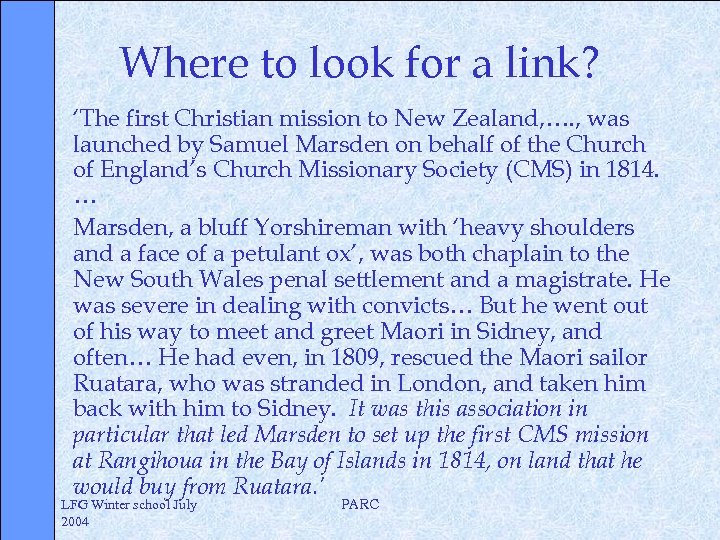 Where to look for a link? ‘The first Christian mission to New Zealand, …. , was launched by Samuel Marsden on behalf of the Church of England’s Church Missionary Society (CMS) in 1814. … Marsden, a bluff Yorshireman with ‘heavy shoulders and a face of a petulant ox’, was both chaplain to the New South Wales penal settlement and a magistrate. He was severe in dealing with convicts… But he went out of his way to meet and greet Maori in Sidney, and often… He had even, in 1809, rescued the Maori sailor Ruatara, who was stranded in London, and taken him back with him to Sidney. It was this association in particular that led Marsden to set up the first CMS mission at Rangihoua in the Bay of Islands in 1814, on land that he would buy from Ruatara. ’ LFG Winter school July 2004 PARC
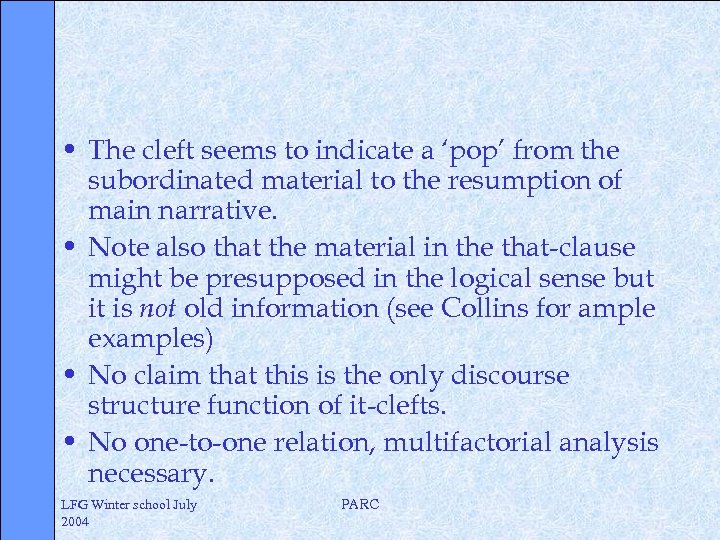 • The cleft seems to indicate a ‘pop’ from the subordinated material to the resumption of main narrative. • Note also that the material in the that-clause might be presupposed in the logical sense but it is not old information (see Collins for ample examples) • No claim that this is the only discourse structure function of it-clefts. • No one-to-one relation, multifactorial analysis necessary. LFG Winter school July 2004 PARC
 Summary: Discourse Structure • Discourse structure looks at how clauses and sentences are related to one another. • Textual elements provide information on how to build up the structure but they do not completely determine it. LFG Winter school July 2004 PARC
 Talk Outline • Information Structure: Syntax of discourse functions • Applications: Anaphora resolution • Discourse structure • Applications: Summarization and Sentence Condensation • Conclusions LFG Winter school July 2004 PARC
 Summarization and sentence condensation • Summarization • Condensation LFG Winter school July 2004 PARC
 Sentence Condensation and Summarization • Have a long text • Want a short "condensed" version – retain most salient features – maintain grammaticality • Choose salient sentences via Discourse structure • Condense those sentences LFG Winter school July 2004 PARC
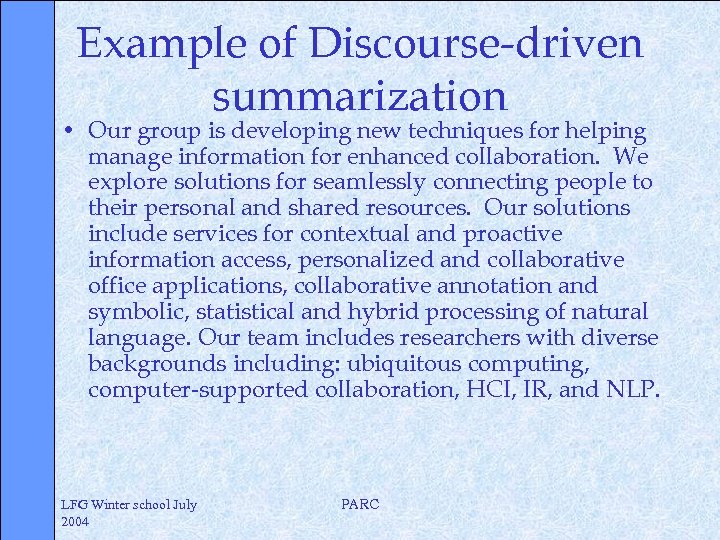 Example of Discourse-driven summarization • Our group is developing new techniques for helping manage information for enhanced collaboration. We explore solutions for seamlessly connecting people to their personal and shared resources. Our solutions include services for contextual and proactive information access, personalized and collaborative office applications, collaborative annotation and symbolic, statistical and hybrid processing of natural language. Our team includes researchers with diverse backgrounds including: ubiquitous computing, computer-supported collaboration, HCI, IR, and NLP. LFG Winter school July 2004 PARC
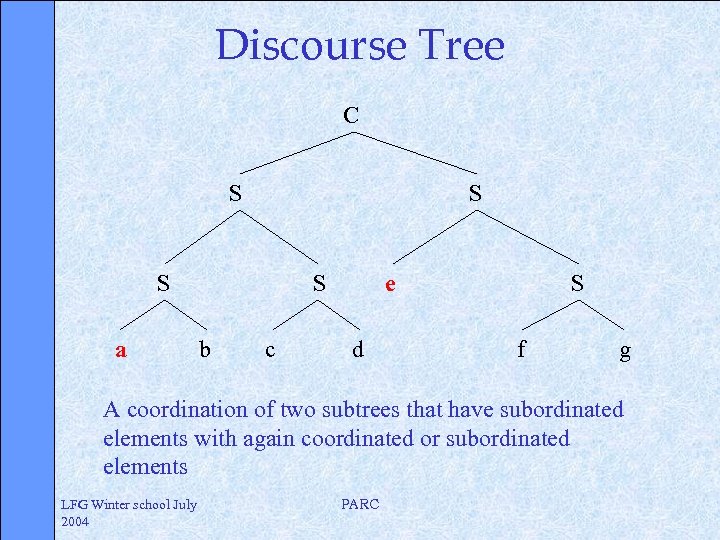 Discourse Tree C S S S a S b c e d S f g A coordination of two subtrees that have subordinated elements with again coordinated or subordinated elements LFG Winter school July 2004 PARC
![Discourse Structure • [Our group is developing new techniques]a for [helping manage information for](https://present5.com/presentation/d1b5a57162f48236b8c88e3dbf3b0630/image-60.jpg "Discourse Structure • [Our group is developing new techniques]a for [helping manage information for") Discourse Structure • [Our group is developing new techniques]a for [helping manage information for enhanced collaboration. ]b [We explore solutions for seamlessly connecting people to their personal and shared resources. ]c [Our solutions include services for contextual and proactive information access, personalized and collaborative office applications, collaborative annotation and symbolic, statistical and hybrid processing of natural language. ]d [Our team includes researchers with diverse backgrounds]e [including: ]f [ubiquitous computing, computersupported collaboration, HCI, IR, and NLP. ]g LFG Winter school July 2004 PARC
Discourse Structure • [Our group is developing new techniques]a for [helping manage information for enhanced collaboration. ]b [We explore solutions for seamlessly connecting people to their personal and shared resources. ]c [Our solutions include services for contextual and proactive information access, personalized and collaborative office applications, collaborative annotation and symbolic, statistical and hybrid processing of natural language. ]d [Our team includes researchers with diverse backgrounds]e [including: ]f [ubiquitous computing, computersupported collaboration, HCI, IR, and NLP. ]g LFG Winter school July 2004 PARC
![Possible condensations • [Our group is developing new techniques]a for [helping manage information for](https://present5.com/presentation/d1b5a57162f48236b8c88e3dbf3b0630/image-61.jpg "Possible condensations • [Our group is developing new techniques]a for [helping manage information for") Possible condensations • [Our group is developing new techniques]a for [helping manage information for enhanced collaboration. ]b [We explore solutions for seamlessly connecting people to their personal and shared resources. ]c [Our team includes researchers with diverse backgrounds]e [including: ]f [ubiquitous computing, computer-supported collaboration, HCI, IR, and NLP. ]g LFG Winter school July 2004 PARC
Possible condensations • [Our group is developing new techniques]a for [helping manage information for enhanced collaboration. ]b [We explore solutions for seamlessly connecting people to their personal and shared resources. ]c [Our team includes researchers with diverse backgrounds]e [including: ]f [ubiquitous computing, computer-supported collaboration, HCI, IR, and NLP. ]g LFG Winter school July 2004 PARC
![Possible condensations • [Our group is developing new techniques]a for [helping manage information for](https://present5.com/presentation/d1b5a57162f48236b8c88e3dbf3b0630/image-62.jpg "Possible condensations • [Our group is developing new techniques]a for [helping manage information for") Possible condensations • [Our group is developing new techniques]a for [helping manage information for enhanced collaboration. ]b [Our team includes researchers with diverse backgrounds]e LFG Winter school July 2004 PARC
Possible condensations • [Our group is developing new techniques]a for [helping manage information for enhanced collaboration. ]b [Our team includes researchers with diverse backgrounds]e LFG Winter school July 2004 PARC
![Possible condensations [Our group is developing new techniques]a [Our team includes researchers with diverse](https://present5.com/presentation/d1b5a57162f48236b8c88e3dbf3b0630/image-63.jpg "Possible condensations [Our group is developing new techniques]a [Our team includes researchers with diverse") Possible condensations [Our group is developing new techniques]a [Our team includes researchers with diverse backgrounds]e LFG Winter school July 2004 PARC
Possible condensations [Our group is developing new techniques]a [Our team includes researchers with diverse backgrounds]e LFG Winter school July 2004 PARC
 Summarization and Discourse structure • Discourse structure allows only ‘big chunks’ to be deleted. • We need also finer-grained structure for sentence condensation. LFG Winter school July 2004 PARC
 Role of information structure in sentence condensation • Salient information will be discourse prominent – retain Focus – retain Topic, possibly in reduced form (e. g. pronoun) – delete background, non-prominent • Salient information tends to correspond to the heads of arguments in main clauses but there a lot of special cases – ADJUNCTs can be deleted but one should keep negations LFG Winter school July 2004 PARC
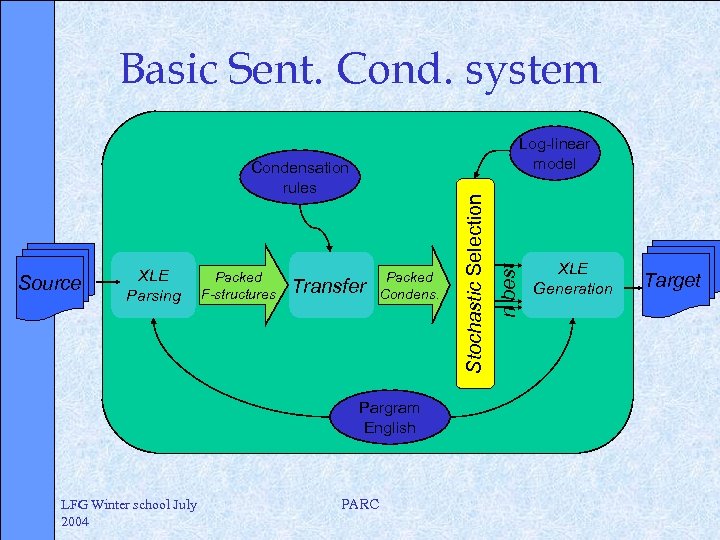
![Sentence condensation • [Our group is developing new techniques]a for [helping manage information for](https://present5.com/presentation/d1b5a57162f48236b8c88e3dbf3b0630/image-66.jpg "Sentence condensation • [Our group is developing new techniques]a for [helping manage information for") Sentence condensation • [Our group is developing new techniques]a for [helping manage information for enhanced collaboration. ]b [We explore solutions for seamlessly connecting people to their personal and shared resources. ]c • Transfer rules dictate which f-structure parts can be deleted X (Y ADJUNCT) & (X ADJ-TYPE) neg: X 0. LFG Winter school July 2004 PARC
Sentence condensation • [Our group is developing new techniques]a for [helping manage information for enhanced collaboration. ]b [We explore solutions for seamlessly connecting people to their personal and shared resources. ]c • Transfer rules dictate which f-structure parts can be deleted X (Y ADJUNCT) & (X ADJ-TYPE) neg: X 0. LFG Winter school July 2004 PARC
 Basic Sent. Cond. system Source XLE Parsing Packed F-structures Transfer Packed Condens. Pargram English LFG Winter school July 2004 PARC n best Condensation rules Stochastic Selection Log-linear model XLE Generation Target
 Summary: Summarization and Condensation • Discourse structure can guide summarization • F-structures are easily manipulated for condensation – F-structure distinctions give broad guidance (ADJUNCT and MOD vs. GFs and DFs) – But there are distinctions that are important for condensation that are very minor in the fstructure, e. g. difference between negative and other ADJUNCTS. – Is it possible to be more systematic or is this just a reflection of the way things are? LFG Winter school July 2004 PARC
 Talk Outline • Information Structure: Syntax of discourse functions • Applications: Anaphora resolution • Discourse structure • Applications: Summarization and Sentence Condensation • Conclusions LFG Winter school July 2004 PARC
 Summary • Information-structure: sentence internal partition of the information according to discourse functions • Discourse-structure: inter-clausal relations between successive utterances • Both are crucial in certain applications – anaphora resolution – summarization/condensation LFG Winter school July 2004 PARC
 Conclusions • For applications it is necessary to get all the modules worked out • This crucially involves many aspects of linguistic theory • The projection architecture of LFG should be helpful but a lot of work remains to be done. LFG Winter school July 2004 PARC
 References • Alsagoff, L. 1992. Topic in Malay: the Other Subject. Ph. D thesis, Stanford University. • Asher, N. and A. Lascarides (2003) Logics of Conversation, Cambrdige University Press. • Bresnan, J. 2001. Lexical-Functional Syntax. Blackwell. • Bresnan, J. and S. Mchombo. 1987. Topic, pronoun, and agreement in Chichewa. Linguistic Inquiry. • Butt, M. and T. H. King. 1998. Interfacing phonology with LFG. In LFG 98 Proceedings. CSLI On-line Publications. • Choi, H. -W. 1999. Optimizing Structure in Context: Scrambling and Information Structure. CSLI Publications. LFG Winter school July 2004 PARC
 References • Collins, Peter. 1991. Cleft and pseudo-cleft constructions in English. London and New York: Routledge. • Enc, M. 1991. The semantics of specificity. Linguistic Inquiry. • King, T. H. 1995. Configuring Topic and Focus in Russian. CSLI Publications. • Kroeger, P. 1993. Phrase Structure and Grammatical Relations in Tagalog. CSLI Publications. • Lambrecht, Knud. 1981. Topic, antitopic and verb agreement in non-standard French. Benjamins • Polanyi, L. et al. 2004. A Rule Based Approach to Discourse Parsing, ACL Workshop • Polanyi, L. et al. 2004. Sentential Structure and Discourse Parsing. ACL Workshop LFG Winter school July 2004 PARC
 References • Prince, Ellen, 1998. On the limits of syntax, with reference to Left-Dislocation and Topicalization. In Culicover, P. and Mc. Nally, L. , eds. The limits of syntax. NY: Academic Press. • Prince, Ellen. 1998. Subject-Prodrop in Yiddish. In Focus: Linguistics, cognitive, and computational perspectives. • Sharma, D. 2003. Discourse clitics and constructive morphology in Hindi. In M. Butt and T. H. King (ed) Nominals: Inside and Out. CSLI Publications. • Song, Zhiyi. 2003. A Comparative Study of Subject Prodrop in Old Chinese and Modern Chinese. NWAVE 32. • Steedman, M. 2000. Information Structure and the Syntax-Phonology Interface. Linguistic Inquiry. PARC LFG Winter school July 2004
 LFG Winter school July 2004 PARC
![Example: Sentential Subjects • [That john is an idiot]top[e-subj is obvious]sentence LFG Winter school](https://present5.com/presentation/d1b5a57162f48236b8c88e3dbf3b0630/image-76.jpg "Example: Sentential Subjects • [That john is an idiot]top[e-subj is obvious]sentence LFG Winter school") Example: Sentential Subjects • [That john is an idiot]top[e-subj is obvious]sentence LFG Winter school July 2004 PARC
Example: Sentential Subjects • [That john is an idiot]top[e-subj is obvious]sentence LFG Winter school July 2004 PARC