



 F i r s t P a g e Issues in the On Line Scheduling of Mobile Workforces Jon Spragg APSolve Sirius House Adastral Park Martlesham Ipswich IP 5 3 RE Tel: +44(0) 1473 605900 Automation for Mobile Workforces © British Telecommunications plc 2001 www. apsolve. com info@apsolve. com Doc Ref: APS(uk)xxxx
 APSolve - A Short History • Involved in Workforce Management since 1987 -which was before my time. • Produced 2 major Work Management Systems which have evolved into the taskforce products we currently market. • APSolve (100+ employees) is being ‘spun out’ via BT’s business incubator early next year. • APSolve aimed primarily at supporting the Telecom and IT Services markets. © British Telecommunications plc 2001
 Workforce Management at BT • APSOLVE’s TASKFORCE currently manages BT’s workforce of Service Technicians. • 25, 000 field technicians perform 150, 000 tasks every day across the United Kingdom. • A high quality service at low operational costs needs to be delivered. © British Telecommunications plc 2001
 Issues • • Complexity of problem Scale The need for a totally automated system. Making it work, and keeping it working © British Telecommunications plc 2001
 Complexity • Ever changing workload with a 1 hour response time. • Complex mixture of target time types/priorities • Wide range in work durations: 8 mins - several days. • Work duration is uncertain. • Work type and Work skill imbalances. • Task inter-dependencies can be complex. • Travel time calculations are subject to change -and how! © British Telecommunications plc 2001
 Scale • 20, 000+ technicians, mostly mobile • Several hundred thousand tasks to be scheduled and dispatched every day. • Distinct workforces and scheduling environments. • Optimised work allocation and sequencing is essential © British Telecommunications plc 2001
 Automation • Automated data flow from order source systems to product dispatch. • Schedule revision must be automatic and robust. • On line Dispatcher must handle corrupted schedules. • The real-time monitoring of the location of mobile technicians and their expected completion times is important. © British Telecommunications plc 2001
 Making it work • Really understanding the scheduling environment, its complexity and desired solution quality. • Getting the correct level of system performance. • Data quality and automatic exception handling. • User training © British Telecommunications plc 2001
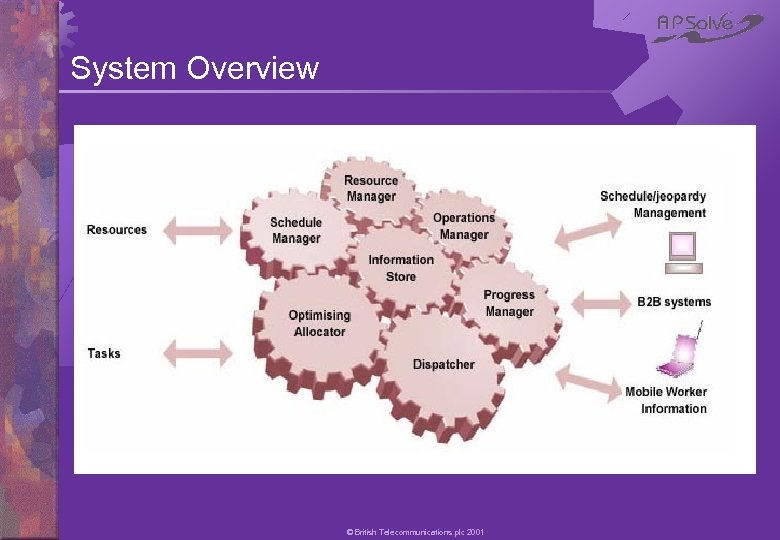 System Overview © British Telecommunications plc 2001
 Scheduling Needs • • Batch scheduling Schedule revision Interrupt scheduling Resource modelling Route optimisation What-if scheduling Schedule execution rules complex, often requiring schedule repair and re optimisation © British Telecommunications plc 2001
 The Taskforce Planning/Scheduling Framework • • Schedule Manager Resource Manager Operations Manager Optimising Allocator © British Telecommunications plc 2001
 Schedule Manager • Delivers work schedules for each technician. • It consists of: • • Batch Scheduler Dynamic Scheduler What-if Scheduler Manual Scheduler © British Telecommunications plc 2001
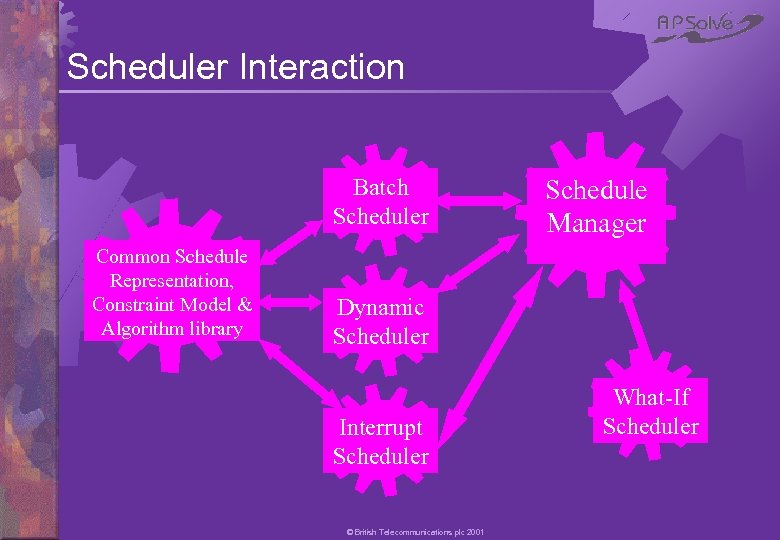 Scheduler Interaction Batch Scheduler Common Schedule Representation, Constraint Model & Algorithm library Schedule Manager Dynamic Scheduler Interrupt Scheduler © British Telecommunications plc 2001 What-If Scheduler
 Batch Scheduler • Run primarily overnight to produce highly optimised schedules for following day: • Employs both constructive and local neighbourhood search algorithms. • Business rules and operational constraints are modelled by a multi-criteria objective function and arc-b consistency procedures. © British Telecommunications plc 2001
 Dynamic Scheduler • Is used for schedule revision and ensuring that the most up to date information is absorbed into the schedule. • It is based on an iterative schedule repair procedure. © British Telecommunications plc 2001
 Interrupt Scheduler • Supports situations where work would otherwise fail: • For example: • In situations where operational priorities change, current work needs to be postponed to free resources for other, higher priority, work. © British Telecommunications plc 2001
 What-if and Manual Schedulers • Are off-line schedulers that support work controllers by providing the visual and analysis tools to try out different scheduling parameters and allocations to discover improvement opportunities without risk. • Changes to scheduling parameters can be applied to current or archived data and the resulting schedule can be examined in an off-line environment. • Changes can then be applied to live sites. © British Telecommunications plc 2001
 Schedule Manager • This is the Planner that transforms customer orders (requests for service) into scheduling variables with their associated constraints. • The Schedule Manager is the system that identifies tasks in jeopardy of becoming tardy. © British Telecommunications plc 2001
 Optimising Allocator • Responds to requests for work from field force in real-time, making alterations to the planned tour as required. • It thereby supports the management of uncertainties associated with travel time calculations, task durations, etc. • It supports the arrival of new high priority work or the cancellation of already scheduled work. © British Telecommunications plc 2001
 Overview of Scheduling Algorithms • All are examples of search supported by constraint propagation. • Constructive search • Chronological backtracking (Dynamic Scheduler, Batch Scheduler) • Beam search (Interrupt Scheduler) • Local neighbourhood search • Simulated annealing (Batch Scheduler, Dynamic Scheduler) © British Telecommunications plc 2001
 Planning and Dispatch Algorithms • Heuristic and Rule Based. • Examples of planning rules are: • Finding work on site for technicians rather than have them travel to new locations. • Spreading the workload evenly across the workforce. • Keeping technicians from travelling outside of their preferred working area. • Identifying tasks that require two or more technicians on site. • Etc. etc. © British Telecommunications plc 2001
 Planned Future Improvements • Optimally configuring these algorithms for handling changing and diverse scheduling environments and problems. • I. e. getting our simulated annealing algorithm to ‘learn’ to recognise unpromising runs and thereby avoid wasting time in local optima. © British Telecommunications plc 2001
 t P a g e Your Schedules – Our Solutions APSolve Sirius House Adastral Park Martlesham Ipswich IP 5 3 RE Automation for Mobile Workforces © British Telecommunications plc 2001 Tel: +44(0) 1473 605900 www. apsolve. com info@apsolve. com