


 Скачать презентацию F Frankel — copyright The Future of NATIONAL
a21d950d30001c433bf40965032e94e4.ppt
- Количество слайдов: 36
 F. Frankel - copyright The Future of NATIONAL NANOTECHNOLOGY INITIATIVE Dr. M. C. Roco Chair, Subcommittee on Nanoscience, Engineering and Technology (NSET), National Science and Technology Council (NSTC), http: //nano. gov Senior Advisor for Nanotechnology, National Science Foundation November 18, 2002
 Nanotechnology l Working at the atomic, molecular and supramolecular levels, in the length scale of approximately 1 – 100 nm range, in order to create materials, device sand systems with fundamentally new properties and functions because of their small structure (see website http: //nano. gov) l NNI definition encourages new contributions that were not possible before. Nanotechnology implies: - novel phenomena, properties and functions at nanoscale, which are nonscalable outside of the nm domain - the ability to manipulate matter at the nanoscale in order to change those properties and functions - integration along length scales M. C. Roco, NSF, 10/18/02
 Why moving into nanoworld ? A. Intellectual drive: l Miniaturization is of interest - Less space, faster, less material, less energy More important: l Novel properties/ phenomena/ processes l Unity and generality - At the building blocks of all natural/artificial things; Systems! l Most efficient length scale for manufacturing l Transcendent effects: at the confluence of steams - New structures and functions; Engineering beyond nature - Less energy than for subatomic or macroscopic - S&T; Living/non-living ; Interdisciplinarity; Relevance areas It requires a grand coalition, cooperative national program M. C. Roco, NSF, 10/18/02
 B. Promise of nanotechnology (examples of societal implications) l l Knowledge base: better comprehension of nature, life A new world of products: ~ $1 trillion / year in 2010 -2015 - Materials beyond chemistry: $340 B/y in 10 years for materials and processing - Electronics in 10 -15 years: $300 B/y for semiconductor industry, > integrated circuits Pharmaceuticals in 10 -15 years: about half of production will depend on nanotechnology, affecting about $180 B/y Chemical plants in 10 -15 years: nanostructured catalysts in petroleum and chemical processing, about $100 B/y Aerospace (about $70 B/y in 10 years) Tools (measurement, simulations) ~ $22 B/y in 10 y Would require worldwide ~ 2 million nanotech workers l Improved healthcare: extend life-span, its quality, human physical l Sustainability: agriculture, food, water, energy (~$45 B/y in 10 years), capabilities (~ $31 B in tools for healthcare in 10 years) materials, environment; ex: lighting energy reduction ~ 10% or $100 B/y M. C. Roco, NSF, 10/18/02
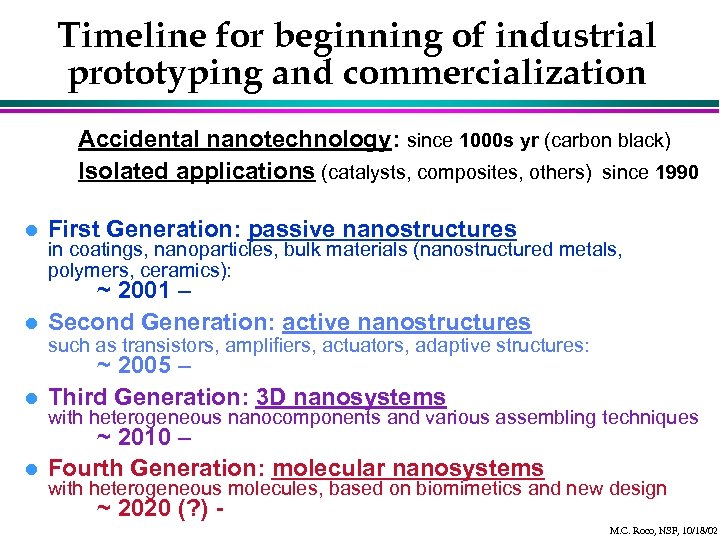 Timeline for beginning of industrial prototyping and commercialization Accidental nanotechnology: since 1000 s yr (carbon black) Isolated applications (catalysts, composites, others) since 1990 l First Generation: passive nanostructures l ~ 2001 – Second Generation: active nanostructures l ~ 2005 – Third Generation: 3 D nanosystems l ~ 2010 – Fourth Generation: molecular nanosystems in coatings, nanoparticles, bulk materials (nanostructured metals, polymers, ceramics): such as transistors, amplifiers, actuators, adaptive structures: with heterogeneous nanocomponents and various assembling techniques with heterogeneous molecules, based on biomimetics and new design ~ 2020 (? ) - M. C. Roco, NSF, 10/18/02
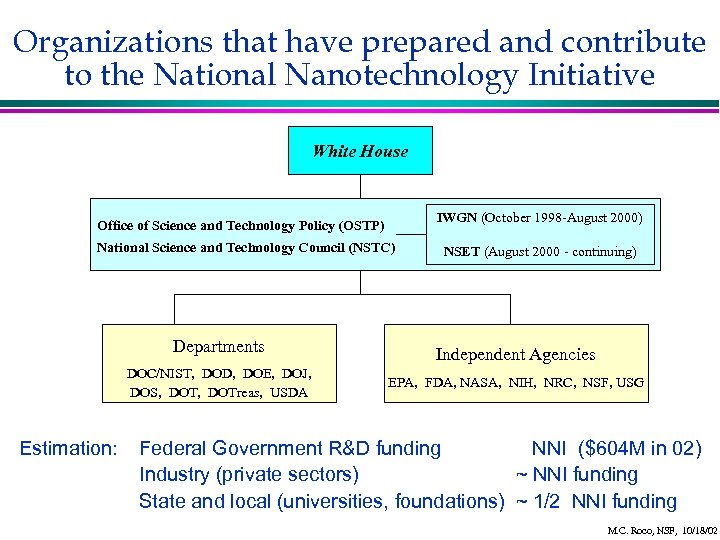 Organizations that have prepared and contribute to the National Nanotechnology Initiative White House IWGN (October 1998 -August 2000) Office of Science and Technology Policy (OSTP) National Science and Technology Council (NSTC) Departments DOC/NIST, DOD, DOE, DOJ, DOS, DOTreas, USDA Estimation: NSET (August 2000 - continuing) Independent Agencies EPA, FDA, NASA, NIH, NRC, NSF, USG Federal Government R&D funding NNI ($604 M in 02) Industry (private sectors) ~ NNI funding State and local (universities, foundations) ~ 1/2 NNI funding M. C. Roco, NSF, 10/18/02
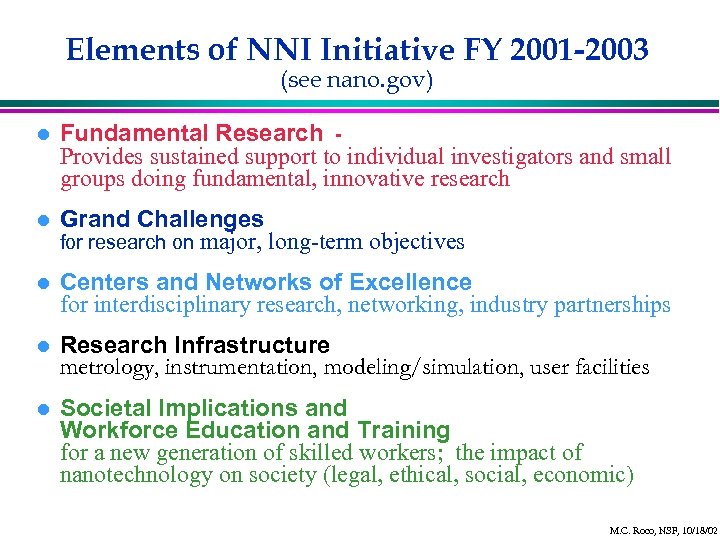 Elements of NNI Initiative FY 2001 -2003 (see nano. gov) l Fundamental Research - Provides sustained support to individual investigators and small groups doing fundamental, innovative research l Grand Challenges for research on major, long-term objectives l Centers and Networks of Excellence for interdisciplinary research, networking, industry partnerships l Research Infrastructure metrology, instrumentation, modeling/simulation, user facilities l Societal Implications and Workforce Education and Training for a new generation of skilled workers; the impact of nanotechnology on society (legal, ethical, social, economic) M. C. Roco, NSF, 10/18/02
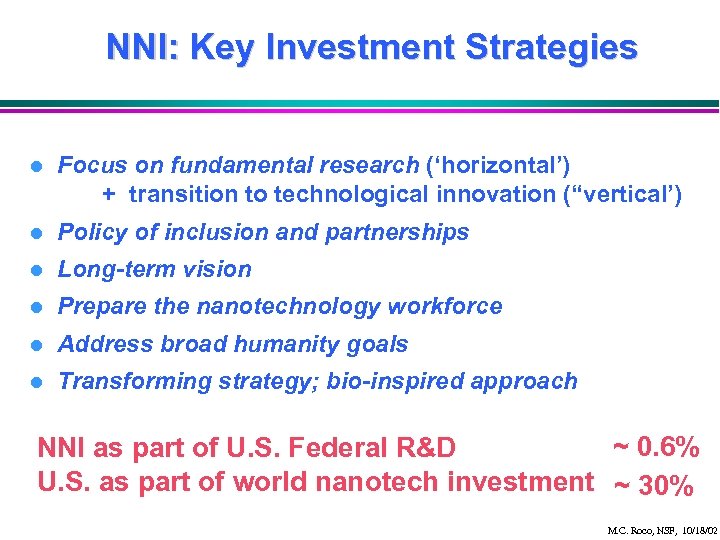 NNI: Key Investment Strategies l Focus on fundamental research (‘horizontal’) + transition to technological innovation (“vertical’) l Policy of inclusion and partnerships l Long-term vision l Prepare the nanotechnology workforce l Address broad humanity goals l Transforming strategy; bio-inspired approach ~ 0. 6% NNI as part of U. S. Federal R&D U. S. as part of world nanotech investment ~ 30% M. C. Roco, NSF, 3/19/02 M. C. Roco, NSF, 10/18/02
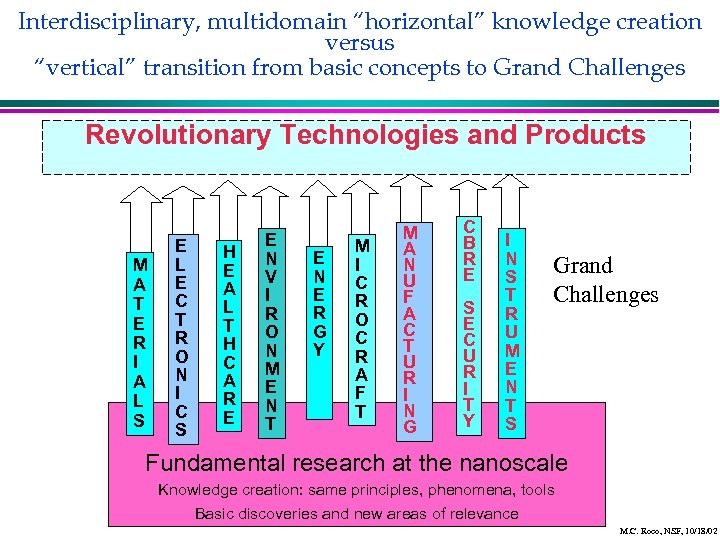 Interdisciplinary, multidomain “horizontal” knowledge creation versus “vertical” transition from basic concepts to Grand Challenges Revolutionary Technologies and Products M A T E R I A L S E L E C T R O N I C S H E A L T H C A R E E N V I R O N M E N T E N E R G Y M I C R O C R A F T M A N U F A C T U R I N G C B R E S E C U R I T Y I N S T R U M E N T S Grand Challenges Fundamental research at the nanoscale Knowledge creation: same principles, phenomena, tools Basic discoveries and new areas of relevance M. C. Roco, NSF, 10/18/02
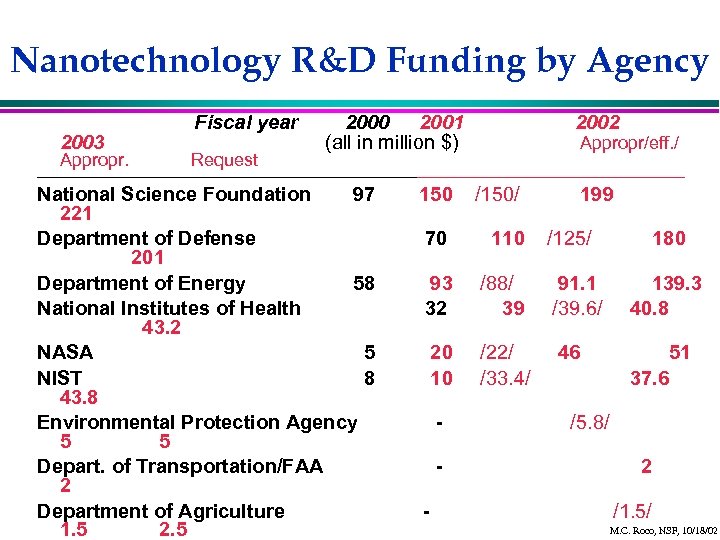 Nanotechnology R&D Funding by Agency Fiscal year 2003 Appropr. Request 2000 2001 2002 (all in million $) Appropr/eff. / _________________________________________________________________________________ National Science Foundation 97 150 /150/ 199 221 Department of Defense 70 110 /125/ 180 201 Department of Energy 58 93 /88/ 91. 1 139. 3 National Institutes of Health 32 39 /39. 6/ 40. 8 43. 2 NASA 5 20 /22/ 46 51 NIST 8 10 /33. 4/ 37. 6 43. 8 Environmental Protection Agency - /5. 8/ 5 Depart. of Transportation/FAA - 2 Department of Agriculture /1. 5/ M. C. Roco, NSF, 10/18/02 1. 5 2. 5
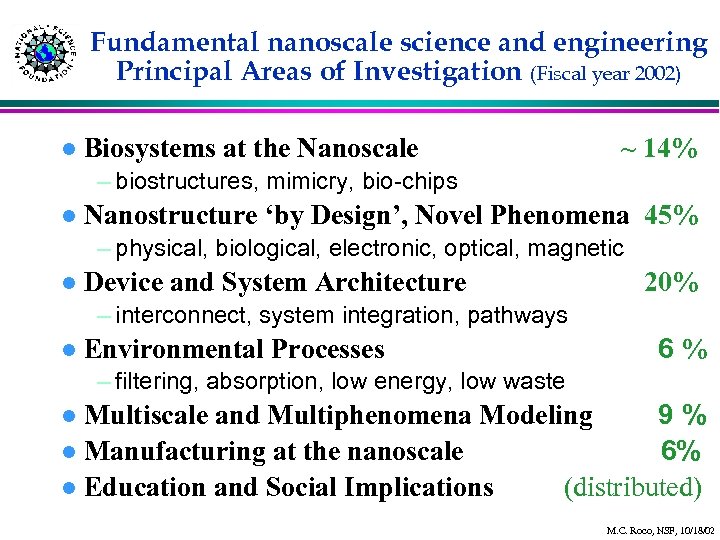 Fundamental nanoscale science and engineering Principal Areas of Investigation (Fiscal year 2002) l Biosystems at the Nanoscale ~ 14% – biostructures, mimicry, bio-chips l Nanostructure ‘by Design’, Novel Phenomena 45% – physical, biological, electronic, optical, magnetic l Device and System Architecture 20% – interconnect, system integration, pathways l Environmental Processes 6% – filtering, absorption, low energy, low waste Multiscale and Multiphenomena Modeling 9 % l Manufacturing at the nanoscale 6% l Education and Social Implications (distributed) l M. C. Roco, NSF, 10/18/02
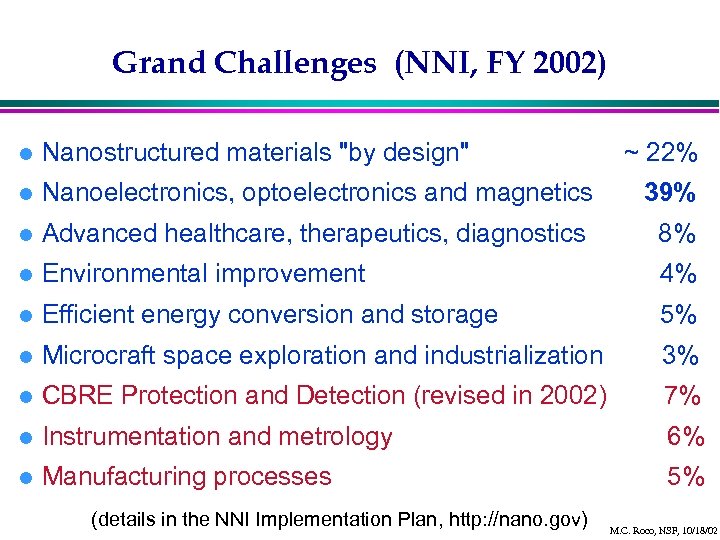 Grand Challenges (NNI, FY 2002) l Nanostructured materials "by design" l Nanoelectronics, optoelectronics and magnetics 39% l Advanced healthcare, therapeutics, diagnostics 8% l Environmental improvement 4% l Efficient energy conversion and storage 5% l Microcraft space exploration and industrialization 3% l CBRE Protection and Detection (revised in 2002) 7% l Instrumentation and metrology 6% l Manufacturing processes 5% (details in the NNI Implementation Plan, http: //nano. gov) ~ 22% M. C. Roco, NSF, 10/18/02
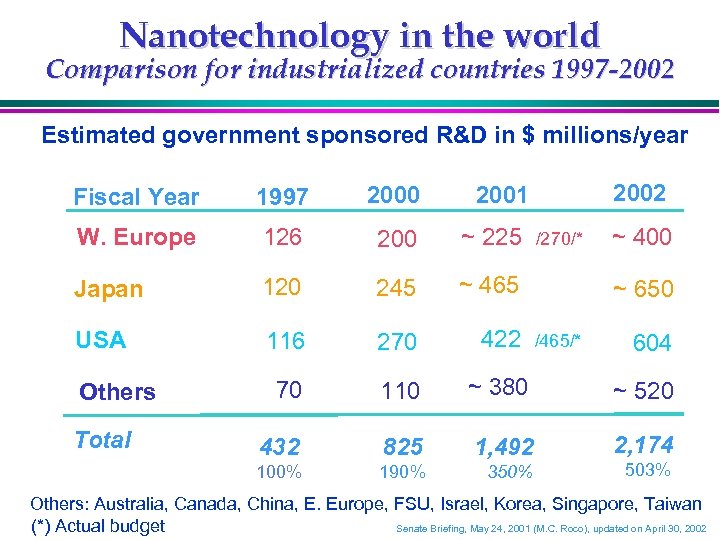 Nanotechnology in the world Comparison for industrialized countries 1997 -2002 Estimated government sponsored R&D in $ millions/year 2001 2002 200 ~ 225 /270/* ~ 400 120 245 ~ 465 ~ 650 116 270 422 /465/* 604 70 110 ~ 380 ~ 520 432 825 1, 492 2, 174 100% 190% 350% Fiscal Year 1997 2000 W. Europe 126 Japan USA Others Total 503% Others: Australia, Canada, China, E. Europe, FSU, Israel, Korea, Singapore, Taiwan Senate Briefing, May 24, 2001 (M. C. Roco), updated on April 30, 2002 (*) Actual budget
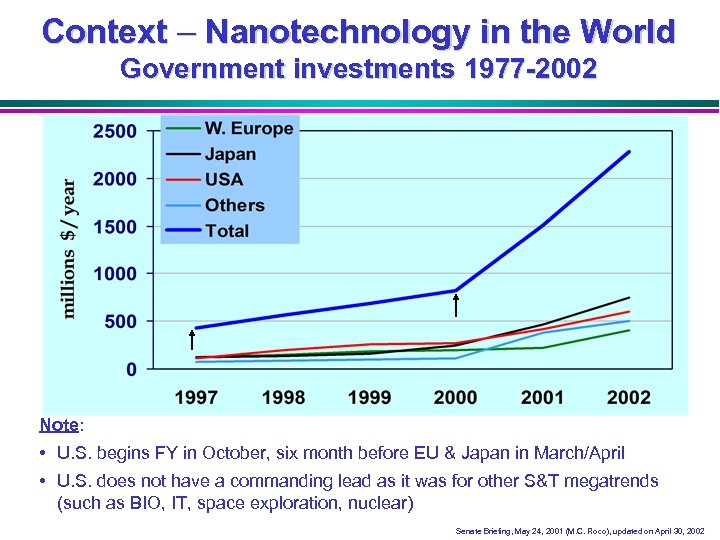 Context – Nanotechnology in the World Government investments 1977 -2002 Note: • U. S. begins FY in October, six month before EU & Japan in March/April • U. S. does not have a commanding lead as it was for other S&T megatrends (such as BIO, IT, space exploration, nuclear) Senate Briefing, May 24, 2001 (M. C. Roco), updated on April 30, 2002
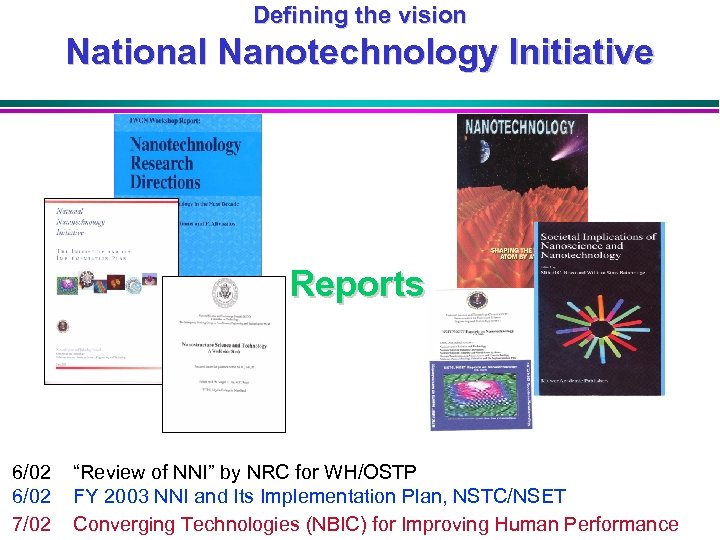 Defining the vision National Nanotechnology Initiative Reports 6/02 “Review of NNI” by NRC for WH/OSTP 6/02 FY 2003 NNI and Its Implementation Plan, NSTC/NSET 7/02 Converging Technologies (NBIC) for Improving Human Performance
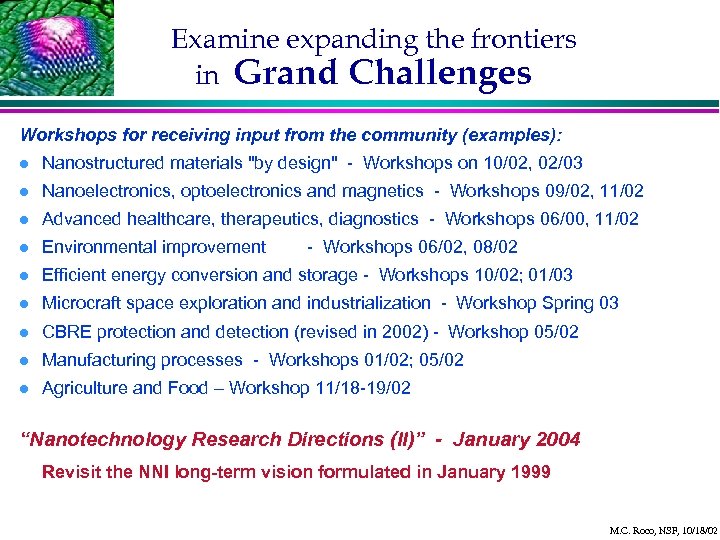 Examine expanding the frontiers in Grand Challenges Workshops for receiving input from the community (examples): l Nanostructured materials "by design" - Workshops on 10/02, 02/03 l Nanoelectronics, optoelectronics and magnetics - Workshops 09/02, 11/02 l Advanced healthcare, therapeutics, diagnostics - Workshops 06/00, 11/02 l Environmental improvement l Efficient energy conversion and storage - Workshops 10/02; 01/03 l Microcraft space exploration and industrialization - Workshop Spring 03 l CBRE protection and detection (revised in 2002) - Workshop 05/02 l Manufacturing processes - Workshops 01/02; 05/02 l Agriculture and Food – Workshop 11/18 -19/02 - Workshops 06/02, 08/02 “Nanotechnology Research Directions (II)” - January 2004 Revisit the NNI long-term vision formulated in January 1999 M. C. Roco, NSF, 10/18/02
 NSTC: NNI in fiscal year 2003 l. Outcomes in FY 2001 l. Plan of activities in FY 2002 l. Priorities and implementation plan in FY 2003 l. The role of each agency l. NNI budgets in FY 2001, 2002 and 2003 (http: //nano. gov)
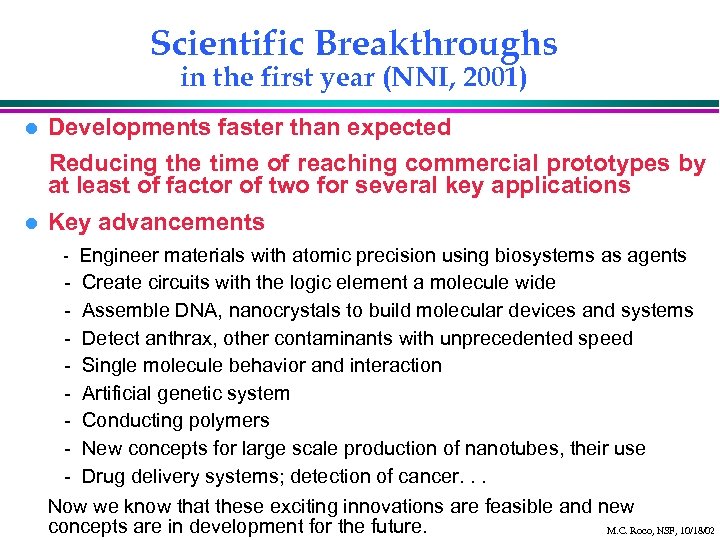 Scientific Breakthroughs in the first year (NNI, 2001) Developments faster than expected Reducing the time of reaching commercial prototypes by at least of factor of two for several key applications l l Key advancements - Engineer materials with atomic precision using biosystems as agents - Create circuits with the logic element a molecule wide - Assemble DNA, nanocrystals to build molecular devices and systems - Detect anthrax, other contaminants with unprecedented speed - Single molecule behavior and interaction - Artificial genetic system - Conducting polymers - New concepts for large scale production of nanotubes, their use - Drug delivery systems; detection of cancer. . . Now we know that these exciting innovations are feasible and new concepts are in development for the future. M. C. Roco, NSF, 10/18/02
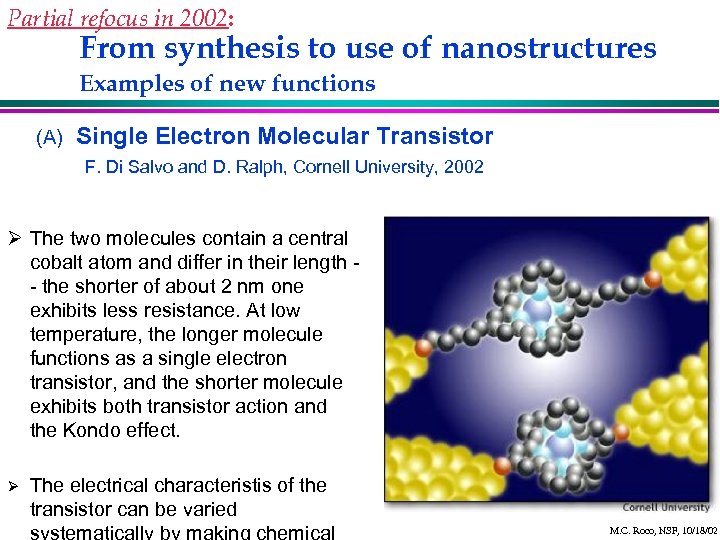 Partial refocus in 2002: From synthesis to use of nanostructures Examples of new functions (A) Single Electron Molecular Transistor F. Di Salvo and D. Ralph, Cornell University, 2002 Ø The two molecules contain a central cobalt atom and differ in their length - the shorter of about 2 nm one exhibits less resistance. At low temperature, the longer molecule functions as a single electron transistor, and the shorter molecule exhibits both transistor action and the Kondo effect. Ø The electrical characteristis of the transistor can be varied M. C. Roco, NSF, 10/18/02
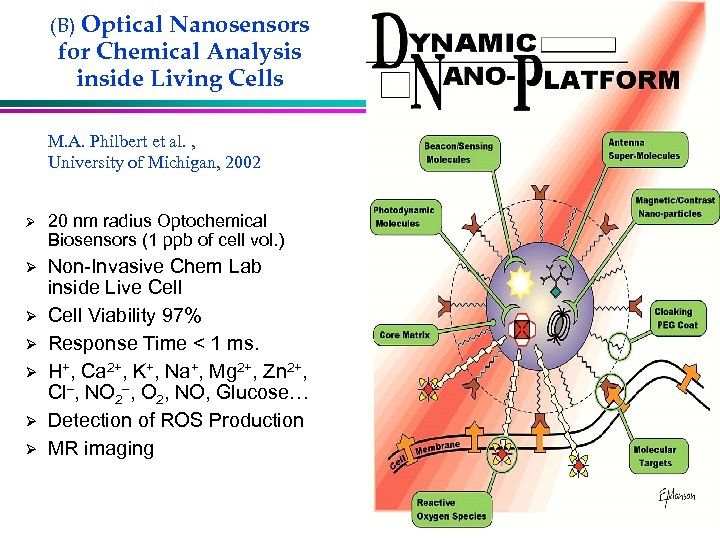 Optical Nanosensors for Chemical Analysis inside Living Cells (B) M. A. Philbert et al. , University of Michigan, 2002 Ø 20 nm radius Optochemical Biosensors (1 ppb of cell vol. ) Ø Non-Invasive Chem Lab inside Live Cell Viability 97% Response Time < 1 ms. H+, Ca 2+, K+, Na+, Mg 2+, Zn 2+, Cl–, NO 2–, O 2, NO, Glucose… Detection of ROS Production MR imaging Ø Ø Ø
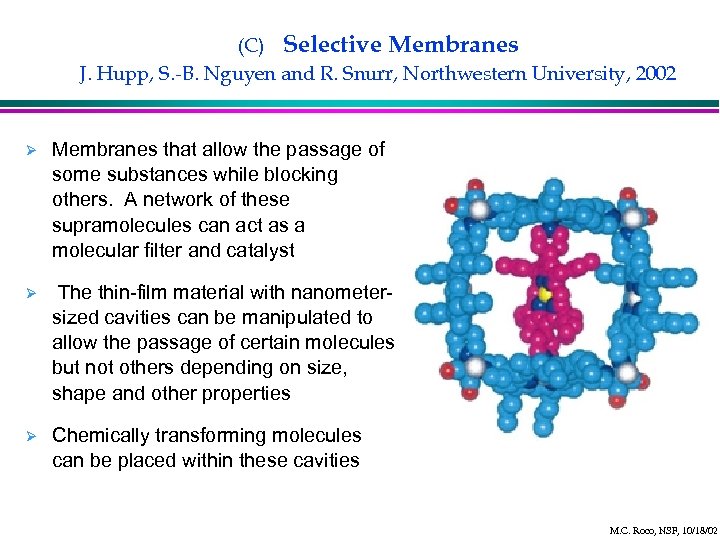 (C) Selective Membranes J. Hupp, S. -B. Nguyen and R. Snurr, Northwestern University, 2002 Ø Membranes that allow the passage of some substances while blocking others. A network of these supramolecules can act as a molecular filter and catalyst Ø The thin-film material with nanometersized cavities can be manipulated to allow the passage of certain molecules but not others depending on size, shape and other properties Ø Chemically transforming molecules can be placed within these cavities M. C. Roco, NSF, 10/18/02
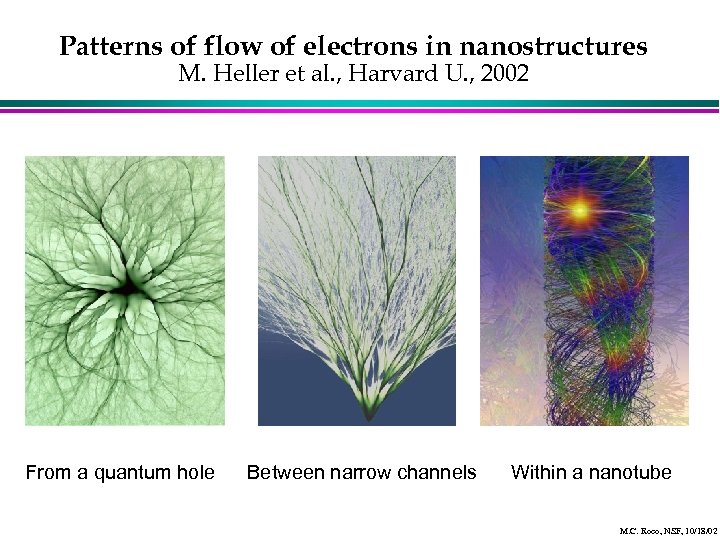 Patterns of flow of electrons in nanostructures M. Heller et al. , Harvard U. , 2002 From a quantum hole Between narrow channels Within a nanotube M. C. Roco, NSF, 10/18/02
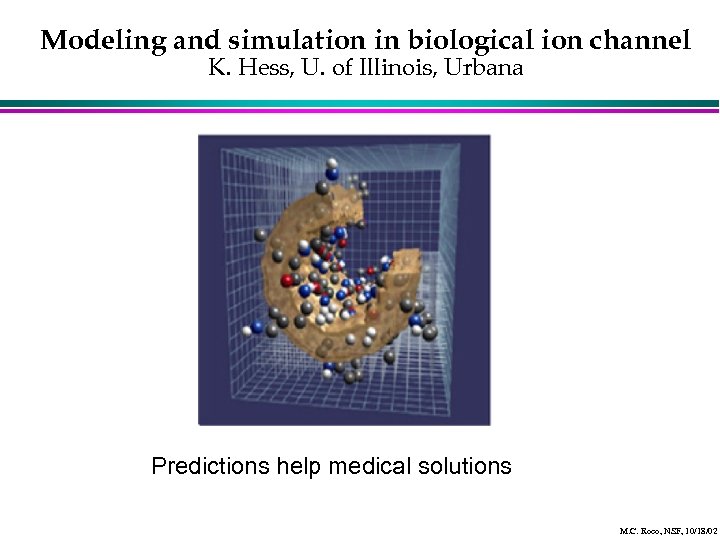 Modeling and simulation in biological ion channel K. Hess, U. of Illinois, Urbana Predictions help medical solutions M. C. Roco, NSF, 10/18/02
 Nanoengineering Issues l l l l l Three dimensional material/device/system spatial/temporal architecture Directed assembling/patterning/templating for heterogeneous nanosystems Hybrid and bio nanosystems for medicine and manufacturing Energy conversion and transfer Multiphenomena, multiprocesses, multiscale design Large scale atomistic modeling and simulation Integration of nanoscale into larger scales: use of intermediary standard components Thermal and chemical stability Operational and environmental safety Reliability and reproductivity at the nanoscale Several NNI centers are focused on nanoengineering. Ex: Cornell, NWU, Sandia, ORNL M. C. Roco, NSF, 10/18/02
 Education and Training l Integrated Research and Education - Make Every Lab a Place of Learning: looking for systemic changes ~ 6, 000 students/2002, technicians, teachers, and faculty l Curriculum development new courses, course modules, summer courses, 7 IGERT l All NSF centers have education and outreach programs from K-12 up ; includes science museums l International education opportunities young researchers to Japan and Europe; REU sites; attend courses abroad; PASI - Latin America, NSF-E. C. ; bi-lateral workshops and exchanges M. C. Roco, NSF, 10/18/02
 Priorities in FY 2003 Priority areas: l Research to enable the nanoscale as the most efficient manufacturing domain l Innovative nanotechnology solutions to biological- chemical-radiological-explosive detection and protection; l Development of instrumentation and standards To continue: l Focus on fundamental research l Education: focus on undergraduate education l Partnerships to enhance industrial participation in the nanotechnology revolution. M. C. Roco, NSF, 10/18/02
 Nanoscale Science and Engineering Program (pending, FY 2003) l FY 2003 NSE request - $221 M (~1400 projects), of which l Seven themes. Several New areas of Emphasis : > $72 M for proposal solicitation > $12 M for National Nanotechnology Infrastructure Network - Research to enable the nanoscale as the most efficient manufacturing domain; - Innovative nanotechnology solutions to biological-chemicalradiological-explosive detection and protection; - Development of instrumentation and standards. - Exploratory on nanobio, energy, converging technologies, others l Four modes of support in FY 2003 solicitation - Interdisciplinary Research Teams - Nanoscale Exploratory Research - Nanoscale Science and Engineering Centers - Nanotechnology Undergraduate Education M. C. Roco, NSF, 10/18/02
 Transition of Fundamental Discoveries into Innovative Technology l Actions – Grand challenges for long term technology base – Infrastructure for instrumentation, tools, physical laboratory – Prepare the workforce at all levels – Various mechanisms for interaction with industry l Metrics – Industry/state investments matching NNI R&D – Number of partnerships between private sector and states, and NNI research and education providers – Scientific, technological, and commercial outcomes with joint support – NNI outreach activities: workshops, continuing education, etc. M. C. Roco, NSF, 10/18/02
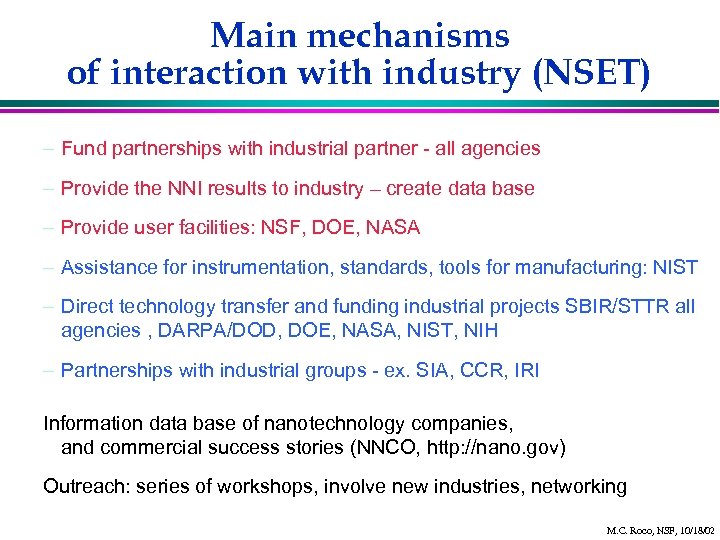 Main mechanisms of interaction with industry (NSET) – Fund partnerships with industrial partner - all agencies – Provide the NNI results to industry – create data base – Provide user facilities: NSF, DOE, NASA – Assistance for instrumentation, standards, tools for manufacturing: NIST – Direct technology transfer and funding industrial projects SBIR/STTR all agencies , DARPA/DOD, DOE, NASA, NIST, NIH – Partnerships with industrial groups - ex. SIA, CCR, IRI Information data base of nanotechnology companies, and commercial success stories (NNCO, http: //nano. gov) Outreach: series of workshops, involve new industries, networking M. C. Roco, NSF, 10/18/02
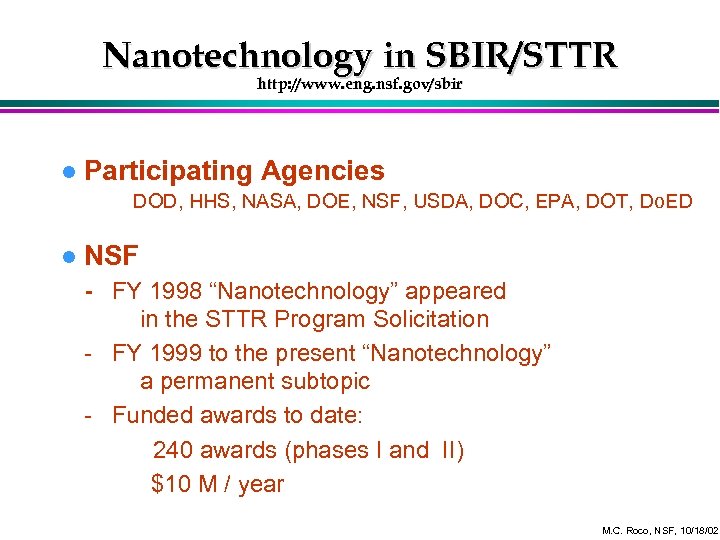 Nanotechnology in SBIR/STTR http: //www. eng. nsf. gov/sbir l Participating Agencies DOD, HHS, NASA, DOE, NSF, USDA, DOC, EPA, DOT, Do. ED l NSF - FY 1998 “Nanotechnology” appeared in the STTR Program Solicitation - FY 1999 to the present “Nanotechnology” a permanent subtopic - Funded awards to date: 240 awards (phases I and II) $10 M / year M. C. Roco, NSF, 10/18/02
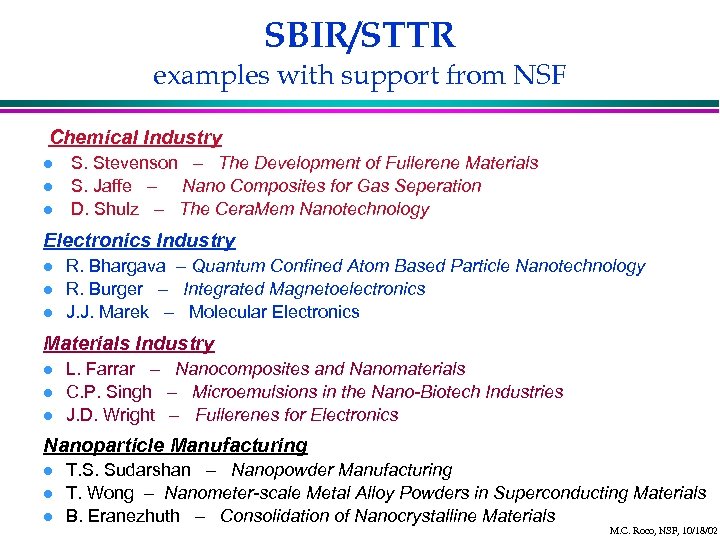 SBIR/STTR examples with support from NSF Chemical Industry l l l S. Stevenson – The Development of Fullerene Materials S. Jaffe – Nano Composites for Gas Seperation D. Shulz – The Cera. Mem Nanotechnology Electronics Industry l l l R. Bhargava – Quantum Confined Atom Based Particle Nanotechnology R. Burger – Integrated Magnetoelectronics J. J. Marek – Molecular Electronics Materials Industry l l l L. Farrar – Nanocomposites and Nanomaterials C. P. Singh – Microemulsions in the Nano-Biotech Industries J. D. Wright – Fullerenes for Electronics Nanoparticle Manufacturing l l l T. S. Sudarshan – Nanopowder Manufacturing T. Wong – Nanometer-scale Metal Alloy Powders in Superconducting Materials B. Eranezhuth – Consolidation of Nanocrystalline Materials M. C. Roco, NSF, 10/18/02
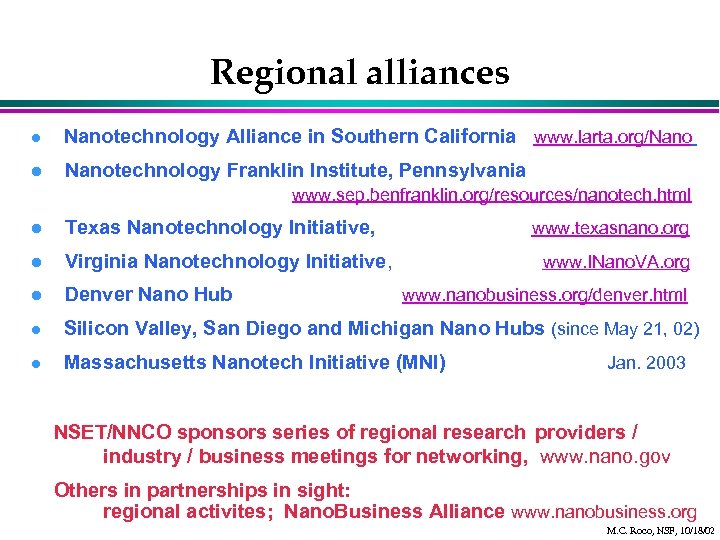 Regional alliances l Nanotechnology Alliance in Southern California www. larta. org/Nano l Nanotechnology Franklin Institute, Pennsylvania www. sep. benfranklin. org/resources/nanotech. html l Texas Nanotechnology Initiative, www. texasnano. org l Virginia Nanotechnology Initiative, www. INano. VA. org l Denver Nano Hub www. nanobusiness. org/denver. html l Silicon Valley, San Diego and Michigan Nano Hubs (since May 21, 02) l Massachusetts Nanotech Initiative (MNI) Jan. 2003 NSET/NNCO sponsors series of regional research providers / industry / business meetings for networking, www. nano. gov Others in partnerships in sight: regional activites; Nano. Business Alliance www. nanobusiness. org M. C. Roco, NSF, 10/18/02
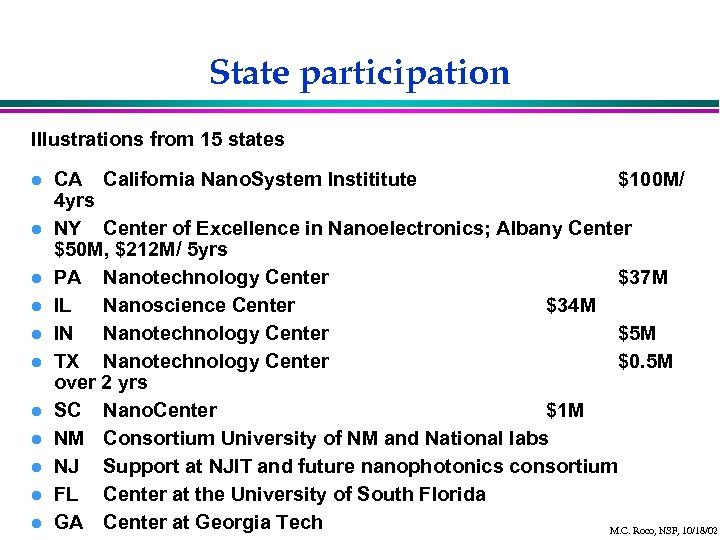 State participation Illustrations from 15 states l l l CA California Nano. System Instititute $100 M/ 4 yrs NY Center of Excellence in Nanoelectronics; Albany Center $50 M, $212 M/ 5 yrs PA Nanotechnology Center $37 M IL Nanoscience Center $34 M IN Nanotechnology Center $5 M TX Nanotechnology Center $0. 5 M over 2 yrs SC Nano. Center $1 M NM Consortium University of NM and National labs NJ Support at NJIT and future nanophotonics consortium FL Center at the University of South Florida GA Center at Georgia Tech M. C. Roco, NSF, 10/18/02
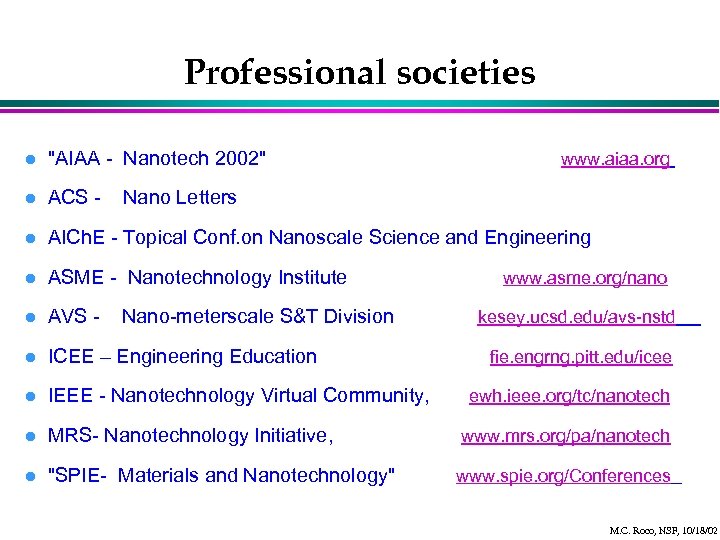 Professional societies l "AIAA - Nanotech 2002" www. aiaa. org l ACS - Nano Letters l AICh. E - Topical Conf. on Nanoscale Science and Engineering l ASME - Nanotechnology Institute www. asme. org/nano l AVS - Nano-meterscale S&T Division kesey. ucsd. edu/avs-nstd l ICEE – Engineering Education l IEEE - Nanotechnology Virtual Community, ewh. ieee. org/tc/nanotech l MRS- Nanotechnology Initiative, www. mrs. org/pa/nanotech l "SPIE- Materials and Nanotechnology" www. spie. org/Conferences fie. engrng. pitt. edu/icee M. C. Roco, NSF, 10/18/02
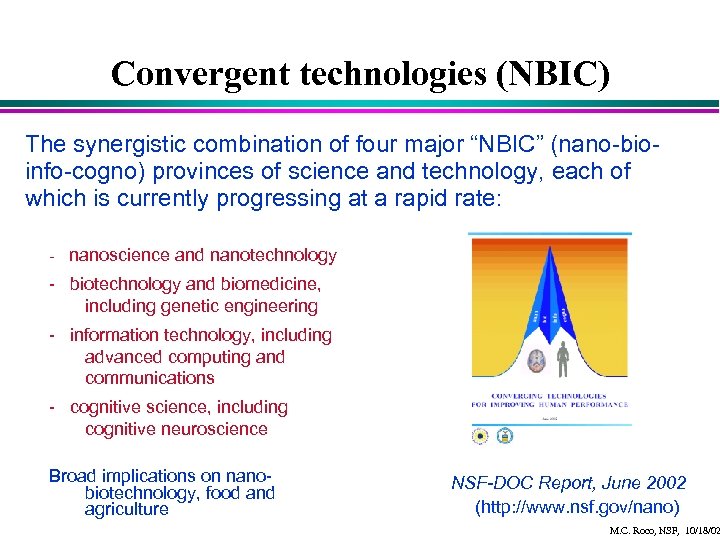 Convergent technologies (NBIC) The synergistic combination of four major “NBIC” (nano-bioinfo-cogno) provinces of science and technology, each of which is currently progressing at a rapid rate: - nanoscience and nanotechnology - biotechnology and biomedicine, including genetic engineering - information technology, including advanced computing and communications - cognitive science, including cognitive neuroscience Broad implications on nanobiotechnology, food and agriculture NSF-DOC Report, June 2002 (http: //www. nsf. gov/nano) M. C. Roco, NSF, 10/18/02
 NNI key issues to be addressed in 2002 and beyond Need for coherent 5 -10 year programs: draft Bill in preparation in Congress “ 21 st Century Nanotechnology R&D Act” 5 -year “National Nanotechnology Program” Horizontal versus vertical S&T development: 0. 5% (on basics) versus 5% (plus precompetitive R&D) of national R&D budget Exploratory research in nanobiomedicine, molecular nanosystems, energy, agriculture and food, improving human performance, others Maintaining focus on: Manufacturing, Infrastructure and Education Partnership with industry Human performance and societal issues International collaboration and competition M. C. Roco, NSF, 10/18/02