 Скачать презентацию EZ Infrastructure for SC cavities production Ambra Gresele
e4521f97bb5a7a3d9c2bc569110545d0.ppt
- Количество слайдов: 24



EZ Infrastructure for SC cavities production Ambra Gresele 1
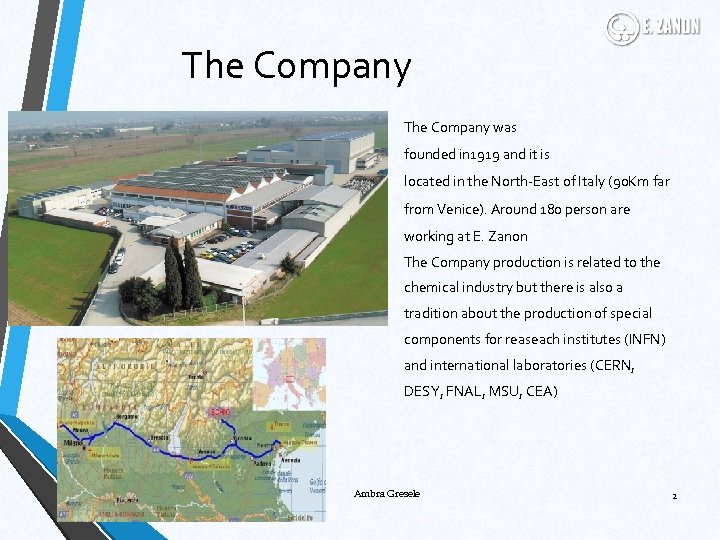
The Company was founded in 1919 and it is located in the North-East of Italy (90 Km far from Venice). Around 180 person are working at E. Zanon The Company production is related to the chemical industry but there is also a tradition about the production of special components for reaseach institutes (INFN) and international laboratories (CERN, DESY, FNAL, MSU, CEA) Ambra Gresele 2
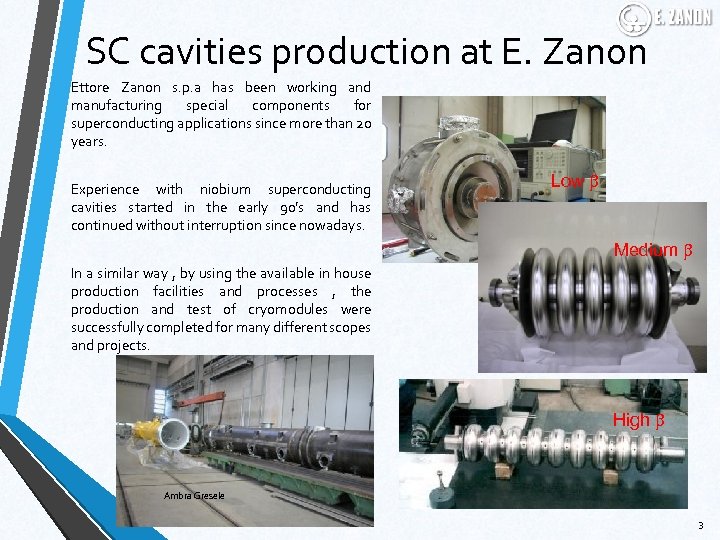
SC cavities production at E. Zanon Ettore Zanon s. p. a has been working and manufacturing special components for superconducting applications since more than 20 years. Experience with niobium superconducting cavities started in the early 90’s and has continued without interruption since nowadays. Low Medium In a similar way , by using the available in house production facilities and processes , the production and test of cryomodules were successfully completed for many different scopes and projects. High Ambra Gresele 3
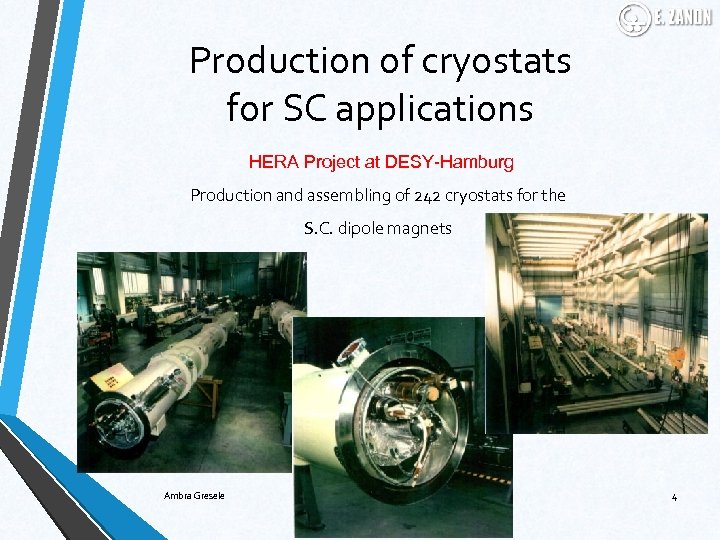
Production of cryostats for SC applications HERA Project at DESY-Hamburg Production and assembling of 242 cryostats for the S. C. dipole magnets Ambra Gresele 4
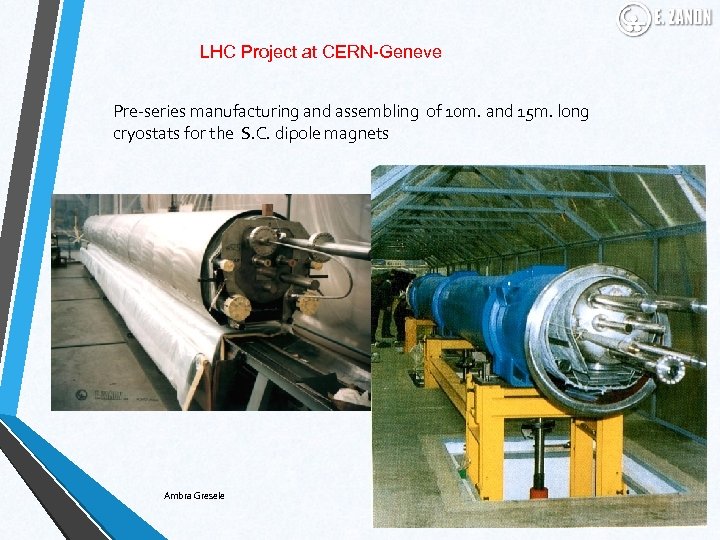
LHC Project at CERN-Geneve Pre-series manufacturing and assembling of 10 m. and 15 m. long cryostats for the S. C. dipole magnets Ambra Gresele 5
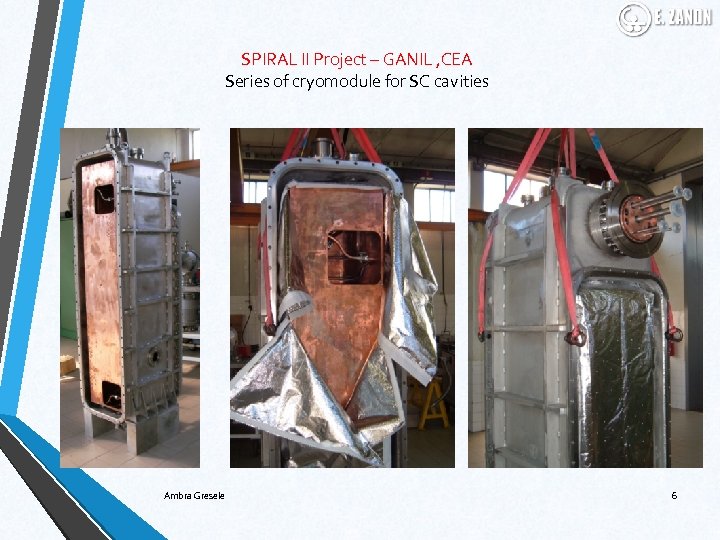
SPIRAL II Project – GANIL , CEA Series of cryomodule for SC cavities Ambra Gresele 6
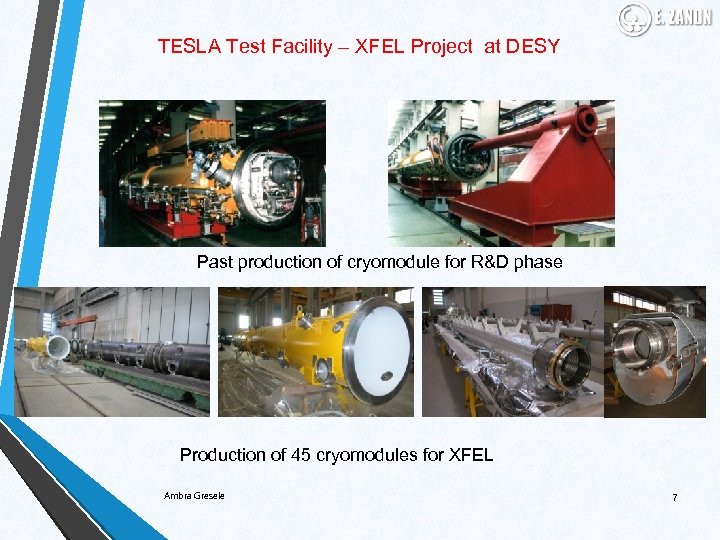
TESLA Test Facility – XFEL Project at DESY Past production of cryomodule for R&D phase Production of 45 cryomodules for XFEL Ambra Gresele 7
Involvement to the EXFEL project A) Manufacture and final treatement of 420 units of the 9 cells , 1, 3 GHz SC cavities Scope of work has included : §Manufacture of the 1, 3 GHz cavities / Manufacture of their Titanium Helium tanks §Integration of the cavities into their tank /Treatments and Surface cleaning treatments §Components manufacture and certification according to PED (Presssure Equipment Directive) §Delivery production rate 4 units/week B) Manufacture and testing of 45 units of XFEL Cryomodules Scope of work has included §Vacuum vessel and cold-mass prefabrication and testing §Delivery to the assembly site ( CEA-France) C) Manufacture and testing of 146 units of Titanium Helium tanks Scope of work has included §Tank prefabrication and He leak check §Delivery to DESY Ambra Gresele 8
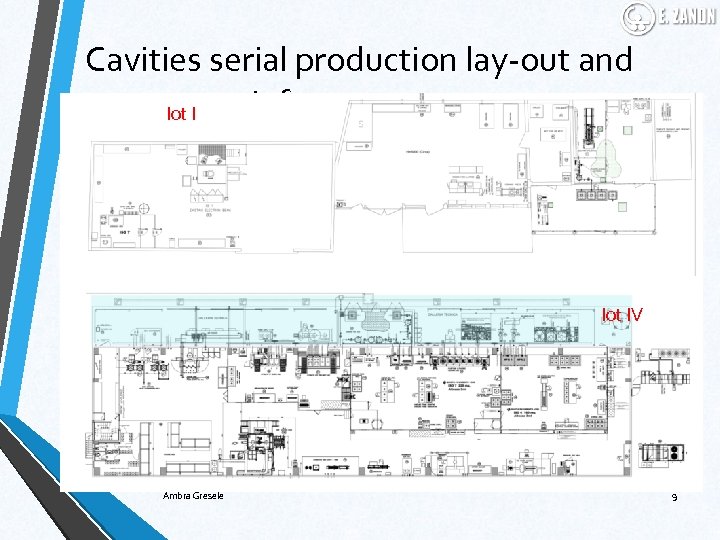
Cavities serial production lay-out and infrastructures lot I 2 buildings are dedicated to the cavities production: 1. Building lot I for the prefabrication of cells, dumbbell, subassemblies, end groups, EB welding, chemistry 2. Building lot IV(renewed building) for final cavity welding, integration with Helium tank, surface treatments lot IV Ambra Gresele 9
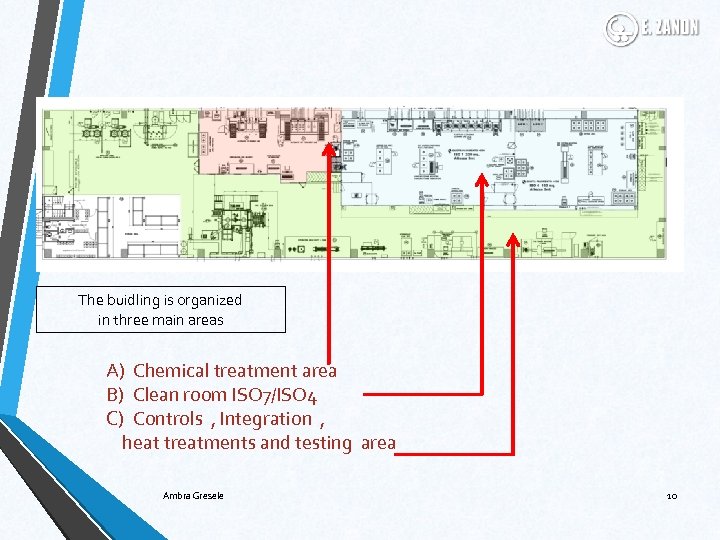
Building lot IV The buidling is organized in three main areas A) Chemical treatment area B) Clean room ISO 7/ISO 4 C) Controls , Integration , heat treatments and testing area Ambra Gresele 10
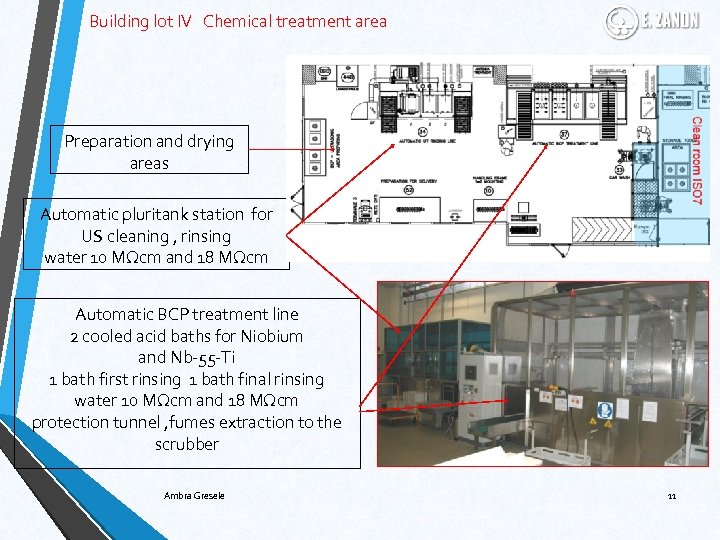
Building lot IV Chemical treatment area Preparation and drying areas Automatic pluritank station for US cleaning , rinsing water 10 MΩcm and 18 MΩcm Automatic BCP treatment line 2 cooled acid baths for Niobium and Nb-55 -Ti 1 bath first rinsing 1 bath final rinsing water 10 MΩcm and 18 MΩcm protection tunnel , fumes extraction to the scrubber Ambra Gresele 11
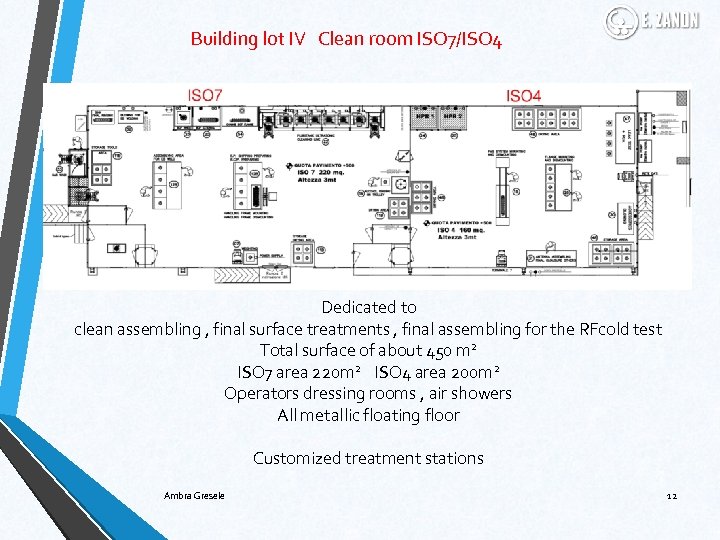
Building lot IV Clean room ISO 7/ISO 4 Dedicated to clean assembling , final surface treatments , final assembling for the RFcold test Total surface of about 450 m 2 ISO 7 area 220 m 2 ISO 4 area 200 m 2 Operators dressing rooms , air showers All metallic floating floor Customized treatment stations Ambra Gresele 12
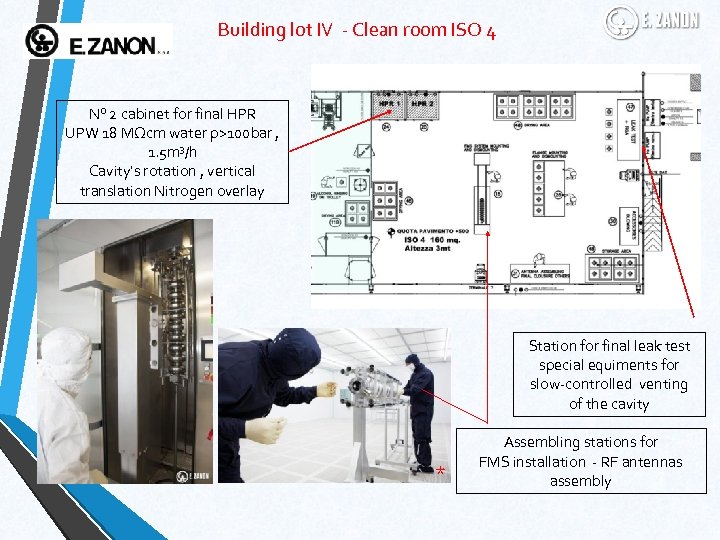
Building lot IV - Clean room ISO 4 N° 2 cabinet for final HPR UPW 18 MΩcm water p>100 bar , 1. 5 m 3/h Cavity's rotation , vertical translation Nitrogen overlay Station for final leak test special equiments for slow-controlled venting of the cavity * Assembling stations for FMS installation - RF antennas assembly
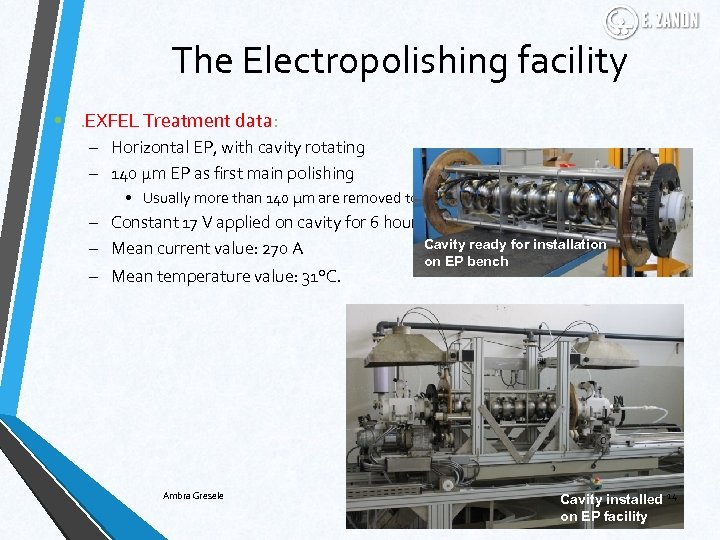
The Electropolishing facility • . EXFEL Treatment data: – Horizontal EP, with cavity rotating – 140 µm EP as first main polishing • Usually more than 140 µm are removed to be on the safe side – Constant 17 V applied on cavity for 6 hours Cavity ready for installation – Mean current value: 270 A – Mean temperature value: 31°C. Ambra Gresele on EP bench Cavity installed on EP facility 14
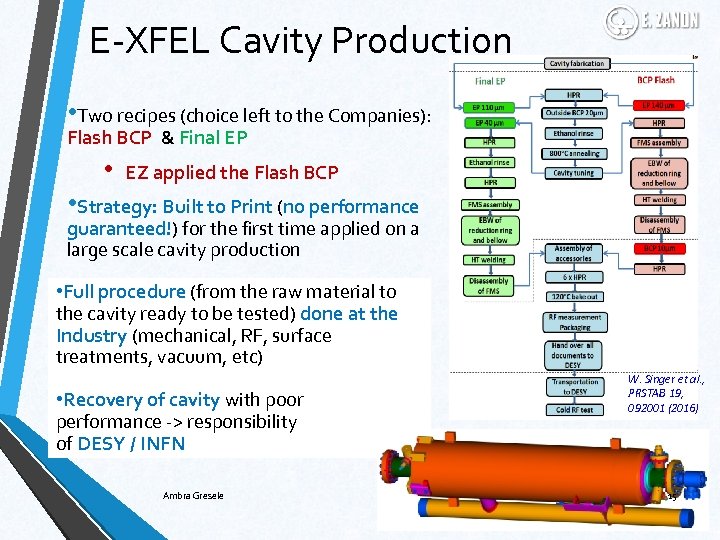
E-XFEL Cavity Production • Two recipes (choice left to the Companies): Flash BCP & Final EP • EZ applied the Flash BCP • Strategy: Built to Print (no performance guaranteed!) for the first time applied on a large scale cavity production • Full procedure (from the raw material to the cavity ready to be tested) done at the Industry (mechanical, RF, surface treatments, vacuum, etc) • Recovery of cavity with poor performance -> responsibility of DESY / INFN Ambra Gresele W. Singer et al. , PRSTAB 19, 092001 (2016) 15
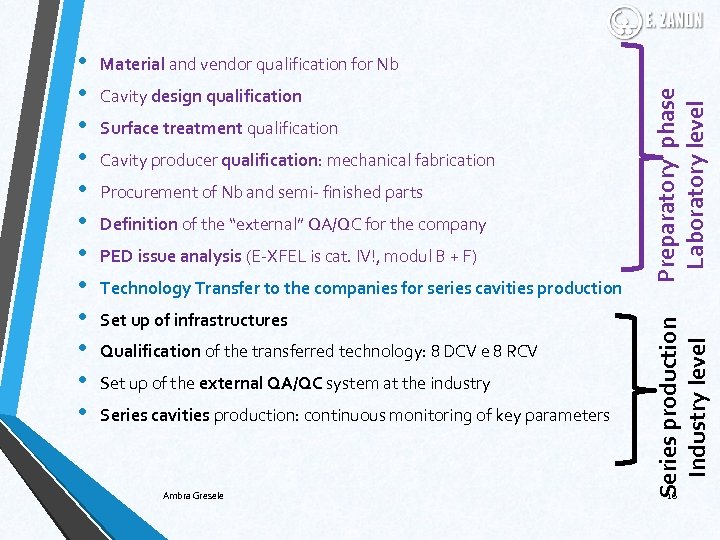
Cavity design qualification Surface treatment qualification Cavity producer qualification: mechanical fabrication Procurement of Nb and semi- finished parts Definition of the “external” QA/QC for the company PED issue analysis (E-XFEL is cat. IV!, modul B + F) Technology Transfer to the companies for series cavities production Set up of infrastructures Qualification of the transferred technology: 8 DCV e 8 RCV Set up of the external QA/QC system at the industry Series cavities production: continuous monitoring of key parameters Ambra Gresele Preparatory phase Laboratory level Material and vendor qualification for Nb Series production Industry level • • • 16
XFEL cavities! Ambra Gresele 17
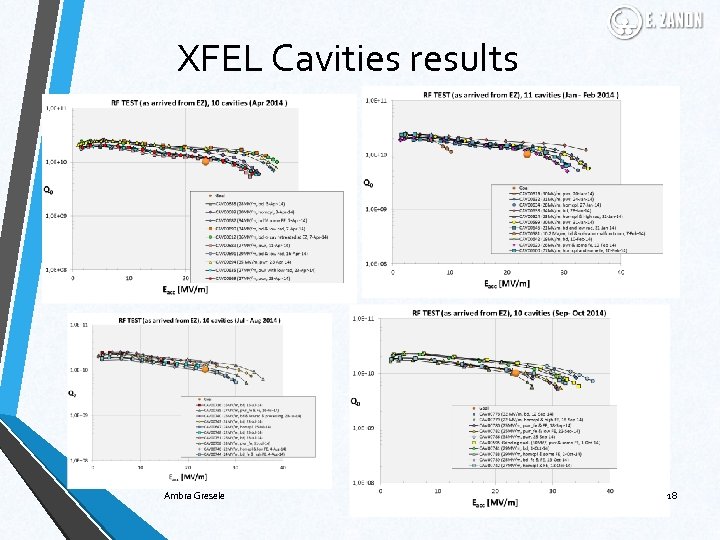
XFEL Cavities results Ambra Gresele 18
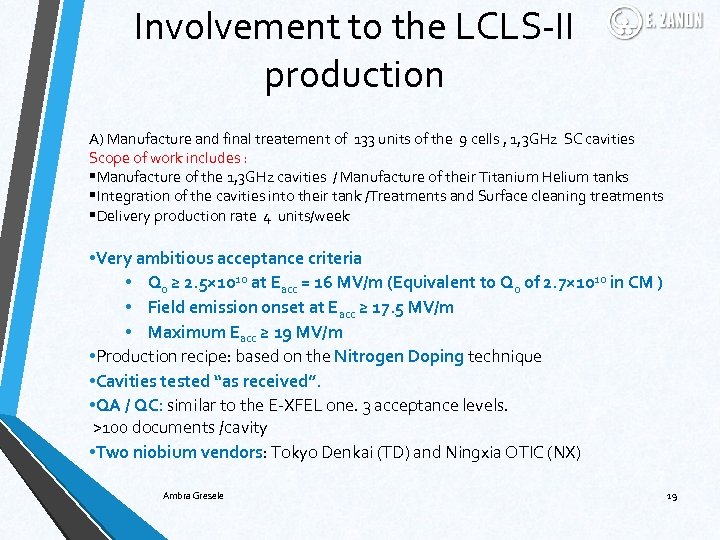
Involvement to the LCLS-II production A) Manufacture and final treatement of 133 units of the 9 cells , 1, 3 GHz SC cavities Scope of work includes : §Manufacture of the 1, 3 GHz cavities / Manufacture of their Titanium Helium tanks §Integration of the cavities into their tank /Treatments and Surface cleaning treatments §Delivery production rate 4 units/week • Very ambitious acceptance criteria • Q 0 ≥ 2. 5× 10¹⁰ at Eacc = 16 MV/m (Equivalent to Q 0 of 2. 7× 10¹⁰ in CM ) • Field emission onset at Eacc ≥ 17. 5 MV/m • Maximum Eacc ≥ 19 MV/m • Production recipe: based on the Nitrogen Doping technique • Cavities tested “as received”. • QA / QC: similar to the E-XFEL one. 3 acceptance levels. >100 documents /cavity • Two niobium vendors: Tokyo Denkai (TD) and Ningxia OTIC (NX) Ambra Gresele 19
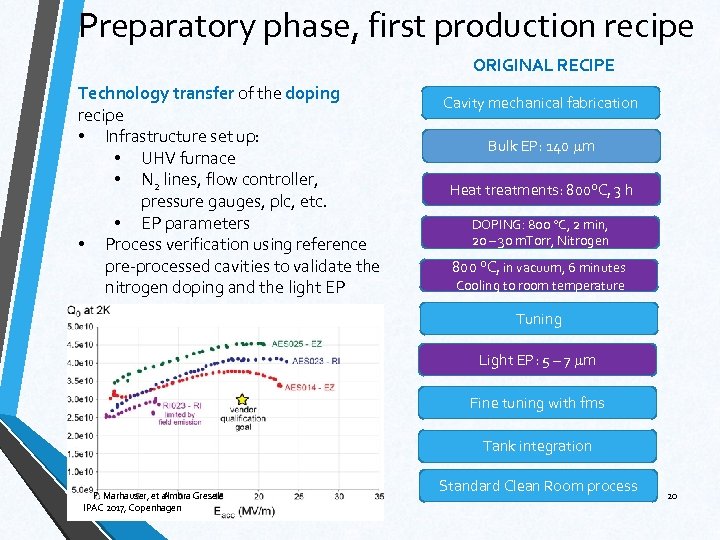
Preparatory phase, first production recipe ORIGINAL RECIPE Technology transfer of the doping recipe • Infrastructure set up: • UHV furnace • N 2 lines, flow controller, pressure gauges, plc, etc. • EP parameters • Process verification using reference pre-processed cavities to validate the nitrogen doping and the light EP Cavity mechanical fabrication Bulk EP: 140 mm Heat treatments: 800°C, 3 h DOPING: 800 °C, 2 min, 20 – 30 m. Torr, Nitrogen 800 °C, in vacuum, 6 minutes Cooling to room temperature Tuning Light EP: 5 – 7 mm Fine tuning with fms Tank integration Ambra Gresele F. Marhauser, et al. IPAC 2017, Copenhagen Standard Clean Room process 20
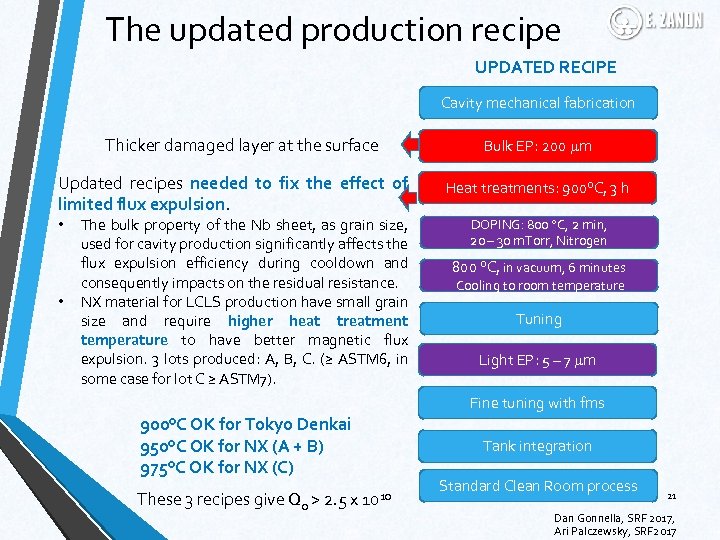
The updated production recipe UPDATED RECIPE Cavity mechanical fabrication Thicker damaged layer at the surface Updated recipes needed to fix the effect of limited flux expulsion. • • The bulk property of the Nb sheet, as grain size, used for cavity production significantly affects the flux expulsion efficiency during cooldown and consequently impacts on the residual resistance. NX material for LCLS production have small grain size and require higher heat treatment temperature to have better magnetic flux expulsion. 3 lots produced: A, B, C. (≥ ASTM 6, in some case for lot C ≥ ASTM 7). Bulk EP: 200 mm 140 Heat treatments: 900°C, 3 h DOPING: 800 °C, 2 min, 20 – 30 m. Torr, Nitrogen 800 °C, in vacuum, 6 minutes Cooling to room temperature Tuning Light EP: 5 – 7 mm Fine tuning with fms 900°C OK for Tokyo Denkai 950°C OK for NX (A + B) 975°C OK for NX (C) These 3 recipes give Q 0 > 2. 5 x Tank integration 1010 Standard Clean Room process 21 Dan Gonnella, SRF 2017, Ari Palczewsky, SRF 2017
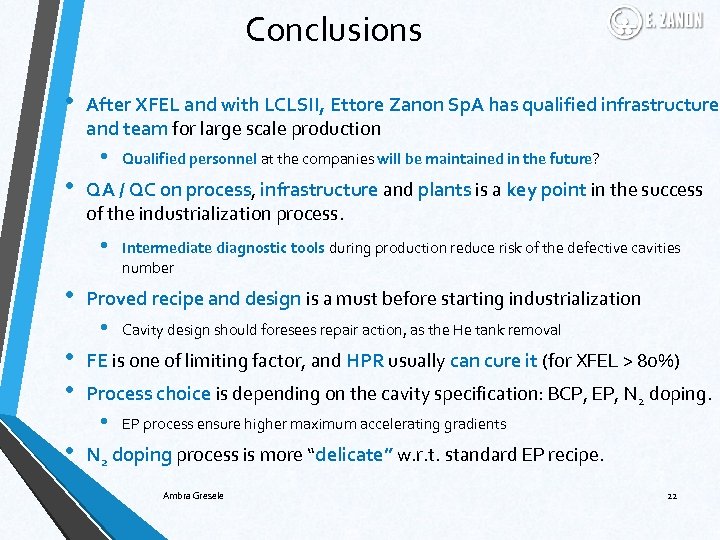
Conclusions • After XFEL and with LCLSII, Ettore Zanon Sp. A has qualified infrastructure and team for large scale production • • QA / QC on process, infrastructure and plants is a key point in the success of the industrialization process. • • Cavity design should foresees repair action, as the He tank removal FE is one of limiting factor, and HPR usually can cure it (for XFEL > 80%) Process choice is depending on the cavity specification: BCP, EP, N 2 doping. • • Intermediate diagnostic tools during production reduce risk of the defective cavities number Proved recipe and design is a must before starting industrialization • • • Qualified personnel at the companies will be maintained in the future? EP process ensure higher maximum accelerating gradients N 2 doping process is more “delicate” w. r. t. standard EP recipe. Ambra Gresele 22
Back-up Ambra Gresele 23
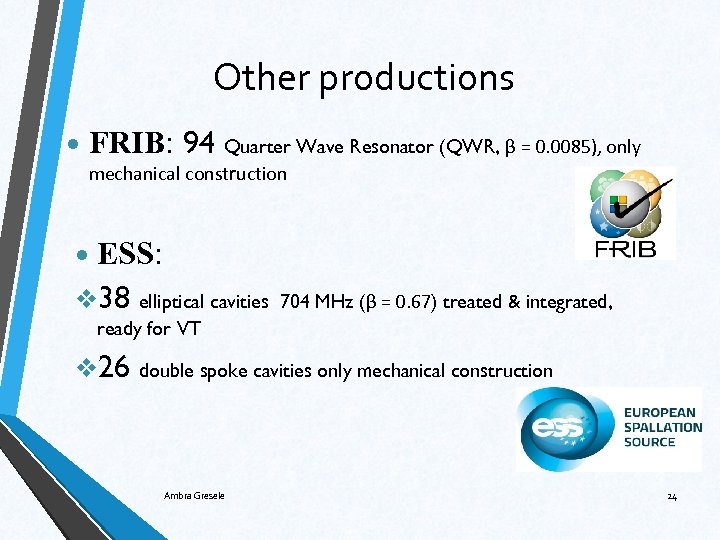
Other productions FRIB: 94 Quarter Wave Resonator (QWR, β = 0. 0085), only mechanical construction ESS: v 38 elliptical cavities 704 MHz (β = 0. 67) treated & integrated, ready for VT v 26 double spoke cavities only mechanical construction Ambra Gresele 24
Скачать презентацию EZ Infrastructure for SC cavities production Ambra Gresele
e4521f97bb5a7a3d9c2bc569110545d0.ppt