 Скачать презентацию EXTERNALITIES Snyder and Nicholson Copyright 2008 by
1e18b250671f08906f5031ca4cd1afea.ppt
- Количество слайдов: 47




EXTERNALITIES Snyder and Nicholson, Copyright © 2008 by Thomson South-Western. All rights reserved.
Externality • An externality occurs whenever the activities of one economic agent affect the activities of another economic agent in ways that are not reflected in market transactions – chemical manufacturers releasing toxic fumes – noise from airplanes – motorists littering roadways

Interfirm Externalities • Consider two firms, one producing good x and the other producing good y • The production of x will have an external effect on the production of y if the output of y depends not only on the level of inputs chosen by the firm but on the level at which x is produced y = f(k, l; x)

Beneficial Externalities • The relationship between the two firms can be beneficial – two firms, one producing honey and the other producing apples
Externalities in Utility • Externalities can also occur if the activities of an economic agent directly affect an individual’s utility – externalities can decrease or increase utility, e. g. smoking, dancing • It is also possible for someone’s utility to be dependent on the utility of another utility = US(x 1, …, xn; UJ) (Similar to the concept of Altruism)
Externalities and Allocative Inefficiency • Externalities lead to inefficient allocations of resources because market prices do not accurately reflect the additional costs imposed on or the benefits provided to third parties • We can show this by using a general equilibrium model with only one representative individual
Externalities and Allocative Inefficiency • Suppose that the individual’s utility function is given by utility = U(x, y) where x and y are the levels of x and y consumed
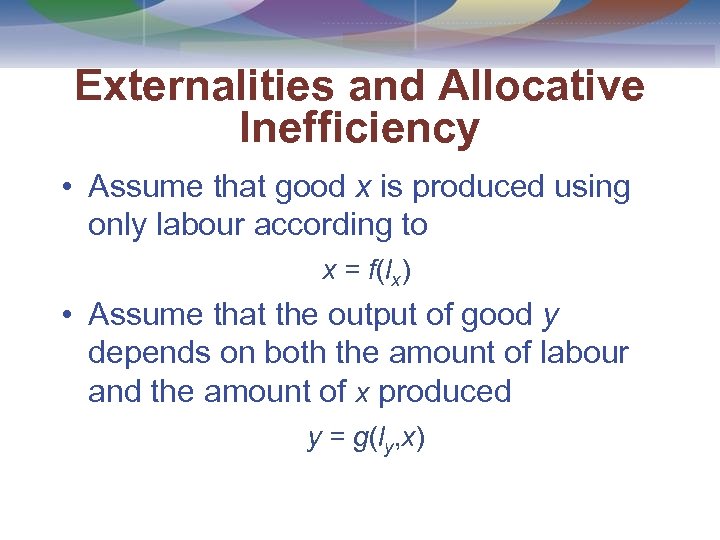
Externalities and Allocative Inefficiency • Assume that good x is produced using only labour according to x = f(lx) • Assume that the output of good y depends on both the amount of labour and the amount of x produced y = g(ly, x)
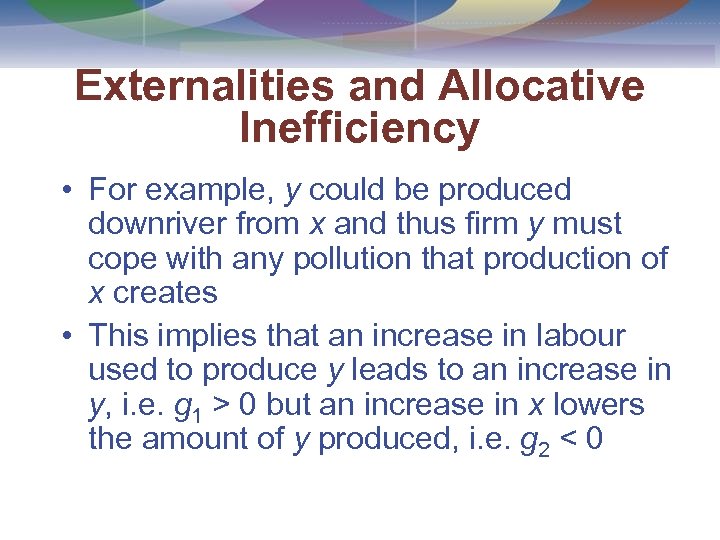
Externalities and Allocative Inefficiency • For example, y could be produced downriver from x and thus firm y must cope with any pollution that production of x creates • This implies that an increase in labour used to produce y leads to an increase in y, i. e. g 1 > 0 but an increase in x lowers the amount of y produced, i. e. g 2 < 0
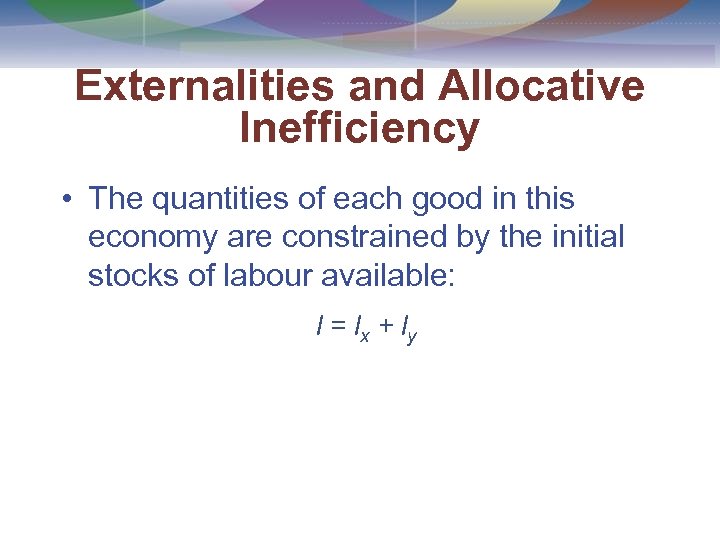
Externalities and Allocative Inefficiency • The quantities of each good in this economy are constrained by the initial stocks of labour available: l = l x + ly
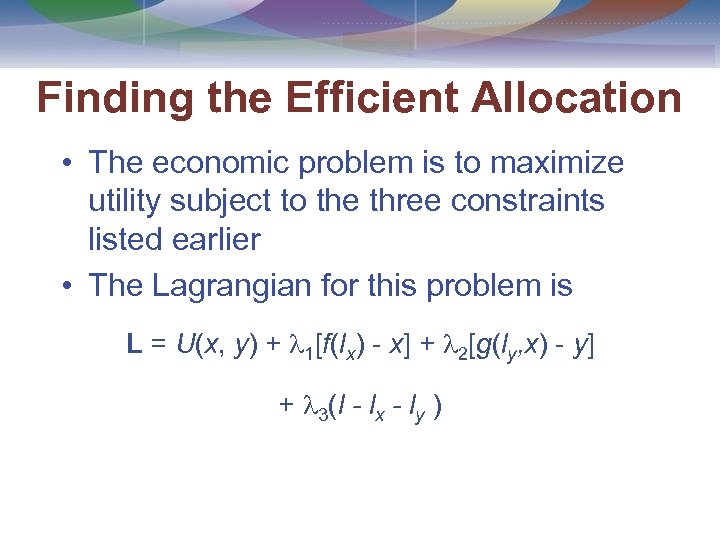
Finding the Efficient Allocation • The economic problem is to maximize utility subject to the three constraints listed earlier • The Lagrangian for this problem is L = U(x, y) + 1[f(lx) - x] + 2[g(ly, x) - y] + 3(l - lx - ly )
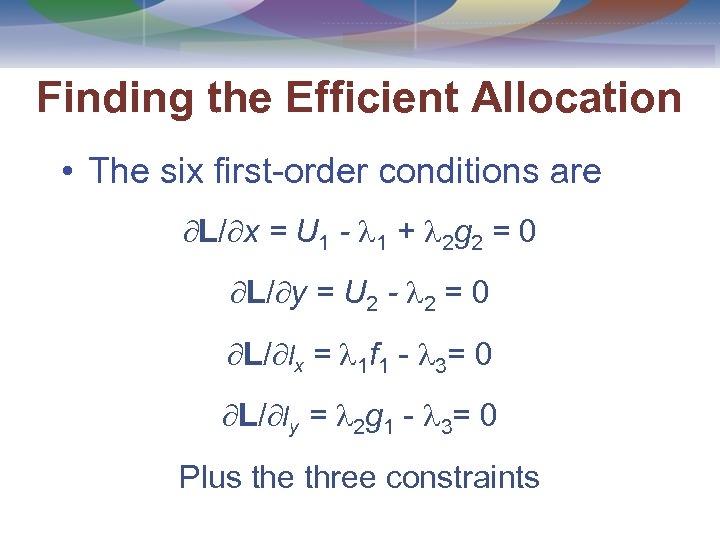
Finding the Efficient Allocation • The six first-order conditions are L/ x = U 1 - 1 + 2 g 2 = 0 L/ y = U 2 - 2 = 0 L/ lx = 1 f 1 - 3= 0 L/ ly = 2 g 1 - 3= 0 Plus the three constraints
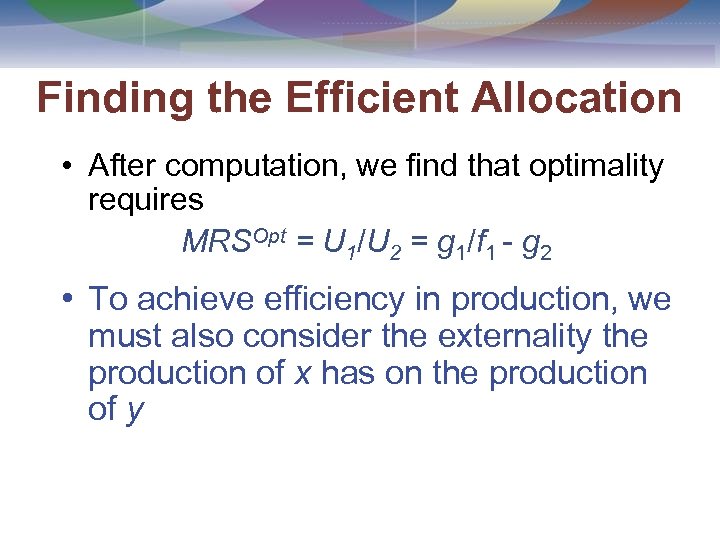
Finding the Efficient Allocation • After computation, we find that optimality requires MRSOpt = U 1/U 2 = g 1/f 1 - g 2 • To achieve efficiency in production, we must also consider the externality the production of x has on the production of y
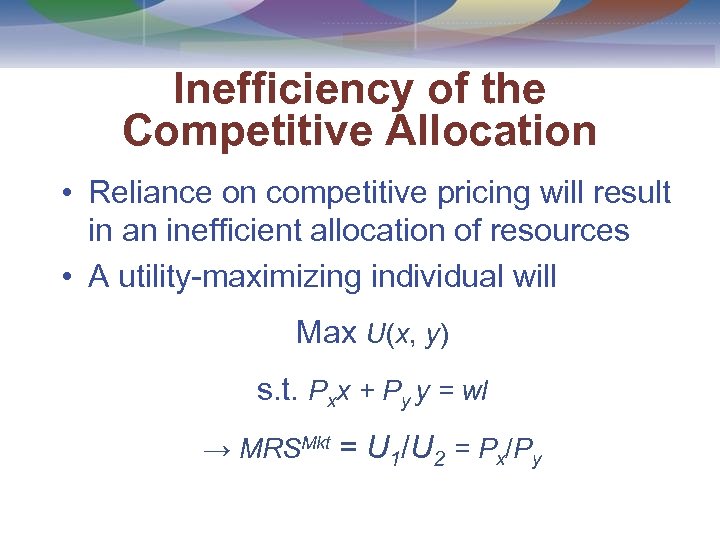
Inefficiency of the Competitive Allocation • Reliance on competitive pricing will result in an inefficient allocation of resources • A utility-maximizing individual will Max U(x, y) s. t. Pxx + Py y = wl → MRSMkt = U 1/U 2 = Px/Py
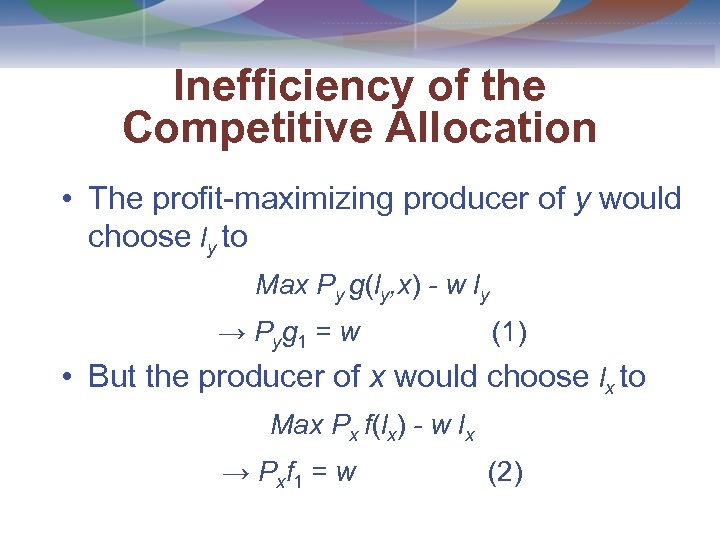
Inefficiency of the Competitive Allocation • The profit-maximizing producer of y would choose ly to Max Py g(ly, x) - w ly → P yg 1 = w (1) • But the producer of x would choose lx to Max Px f(lx) - w lx → P xf 1 = w (2)
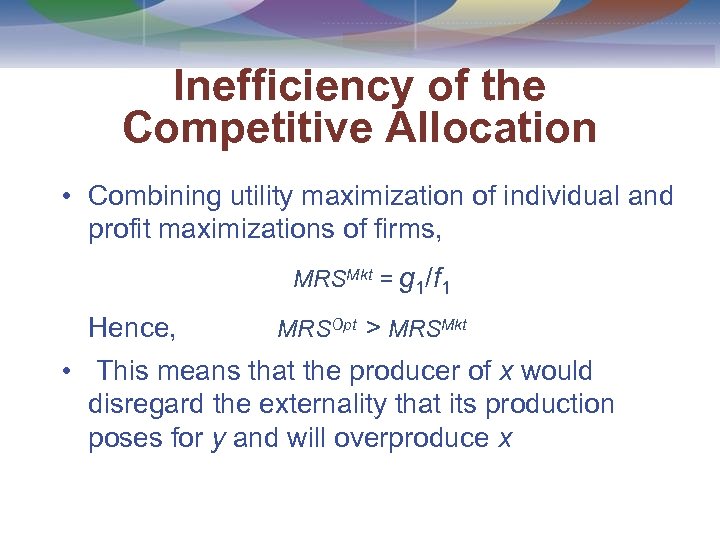
Inefficiency of the Competitive Allocation • Combining utility maximization of individual and profit maximizations of firms, MRSMkt = g 1/f 1 Hence, MRSOpt > MRSMkt • This means that the producer of x would disregard the externality that its production poses for y and will overproduce x
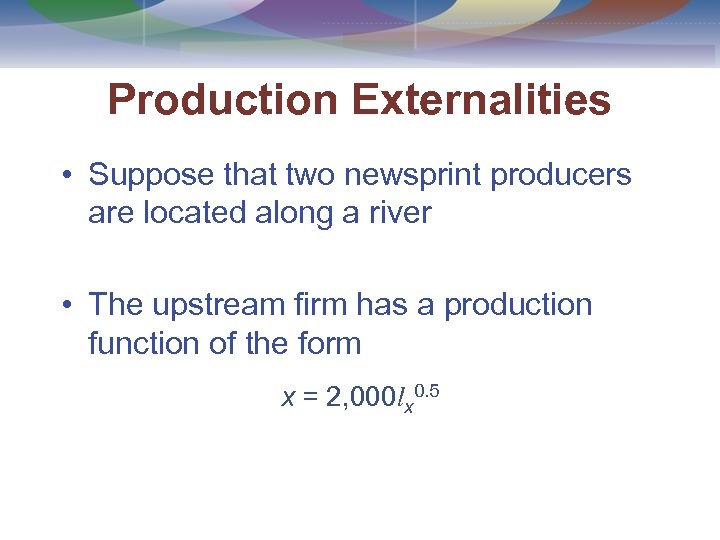
Production Externalities • Suppose that two newsprint producers are located along a river • The upstream firm has a production function of the form x = 2, 000 lx 0. 5
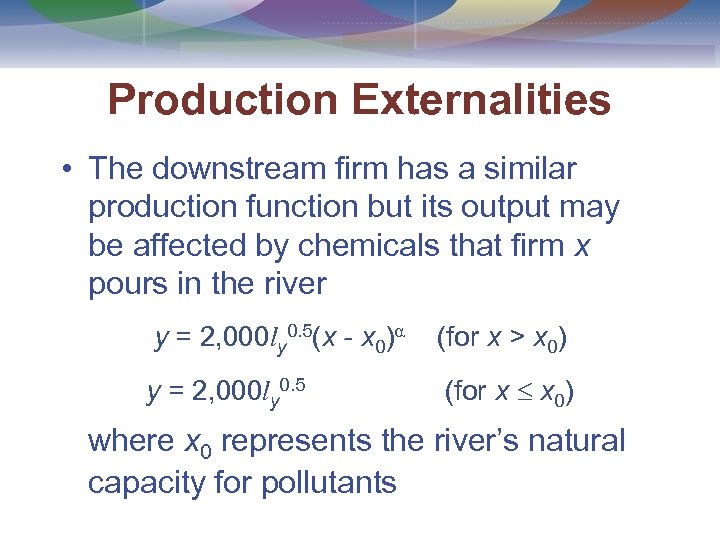
Production Externalities • The downstream firm has a similar production function but its output may be affected by chemicals that firm x pours in the river y = 2, 000 ly 0. 5(x - x 0) (for x > x 0) y = 2, 000 ly 0. 5 (for x x 0) where x 0 represents the river’s natural capacity for pollutants
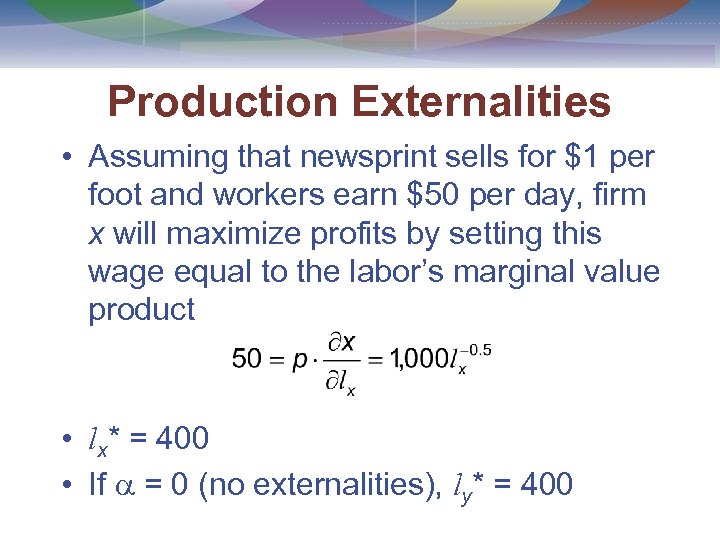
Production Externalities • Assuming that newsprint sells for $1 per foot and workers earn $50 per day, firm x will maximize profits by setting this wage equal to the labor’s marginal value product • lx* = 400 • If = 0 (no externalities), ly* = 400
Production Externalities • When firm x does produce a negative externality ( < 0), its own profitmaximizing decision will be unaffected (lx* = 400 and x* = 40, 000) • But the marginal product of labor will be lower in firm y because of the externality
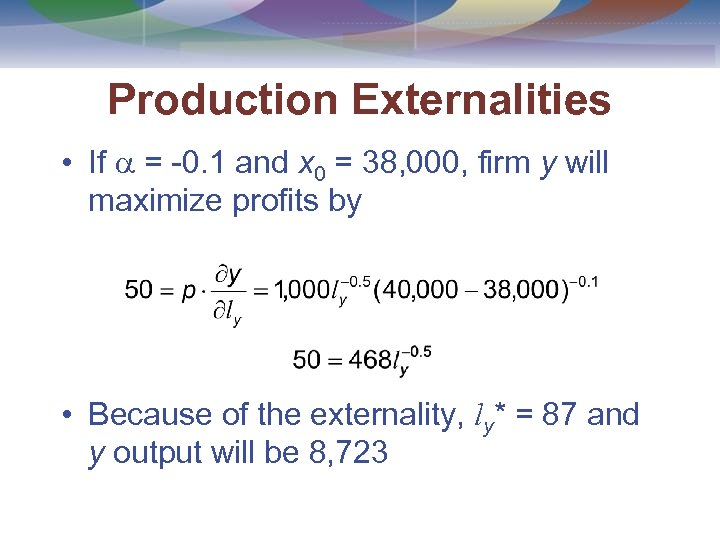
Production Externalities • If = -0. 1 and x 0 = 38, 000, firm y will maximize profits by • Because of the externality, ly* = 87 and y output will be 8, 723
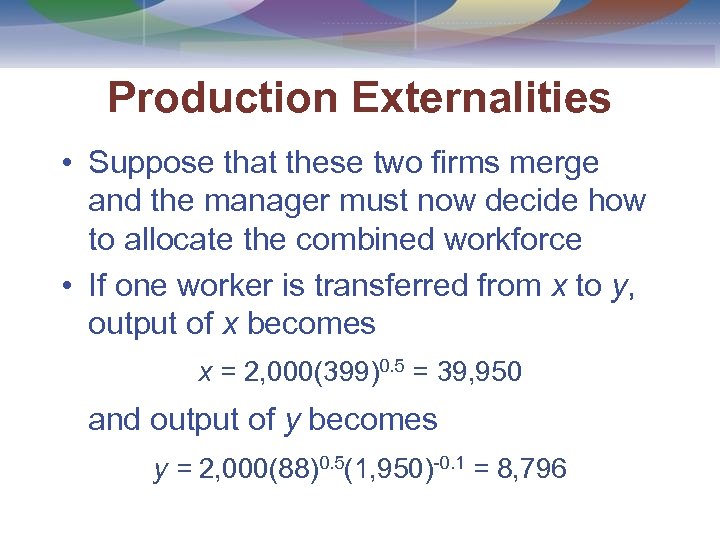
Production Externalities • Suppose that these two firms merge and the manager must now decide how to allocate the combined workforce • If one worker is transferred from x to y, output of x becomes x = 2, 000(399)0. 5 = 39, 950 and output of y becomes y = 2, 000(88)0. 5(1, 950)-0. 1 = 8, 796
Production Externalities • Total output increased with no change in total labor input • The earlier market-based allocation was inefficient because firm x did not take into account the effect of its hiring decisions on firm y
Production Externalities • If firm x was to hire one more worker, its own output would rise to x = 2, 000(401)0. 5 = 40, 050 – the private marginal value product of the 401 st worker is equal to the wage • But, increasing the output of x causes the output of y to fall (by about 21 units) • The social marginal value product of the additional worker is only $29
Solutions to the Externality Problem • The output of the externality-producing activity is too high under a marketdetermined equilibrium • Incentive-based solutions to the externality problem originated with Pigou, who suggested that the most direct solution would be to tax the externality-creating entity
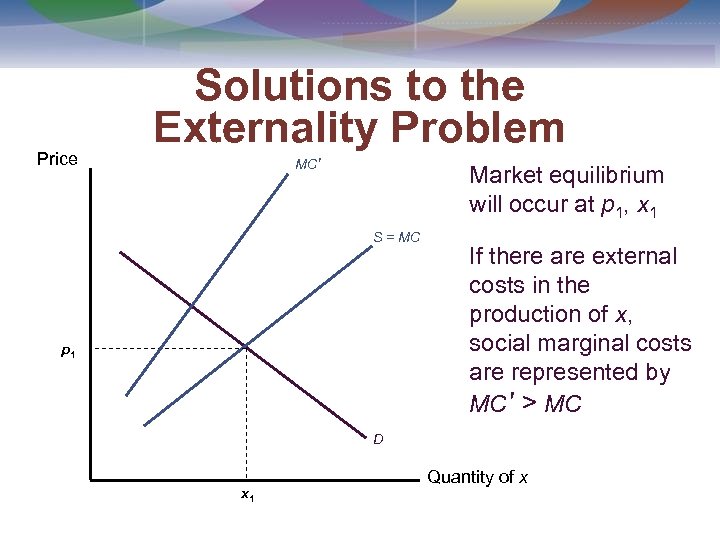
Price Solutions to the Externality Problem MC' Market equilibrium will occur at p 1, x 1 S = MC p 1 If there are external costs in the production of x, social marginal costs are represented by MC' > MC D x 1 Quantity of x
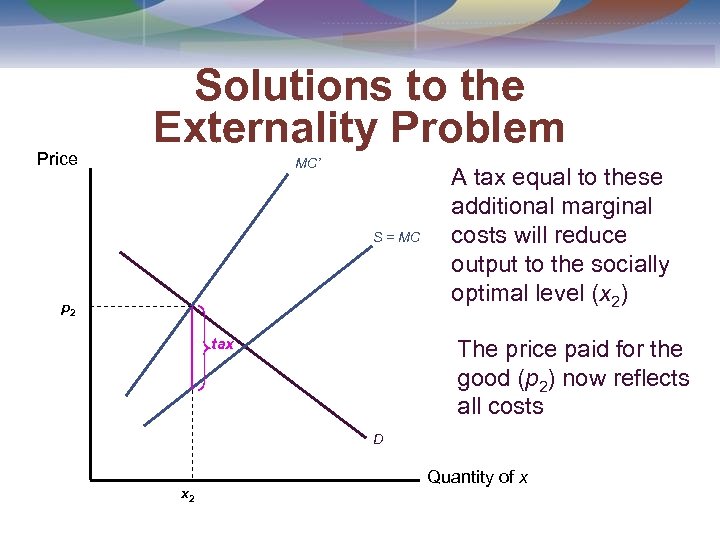
Price Solutions to the Externality Problem MC’ S = MC p 2 tax A tax equal to these additional marginal costs will reduce output to the socially optimal level (x 2) The price paid for the good (p 2) now reflects all costs D x 2 Quantity of x

A Pigouvian Tax on Newsprint • A suitably chosen tax on firm x can cause it to reduce its hiring to a level at which the externality vanishes • Because the river can handle pollutants with an output of x = 38, 000, we might consider a tax that encourages the firm to produce at that level
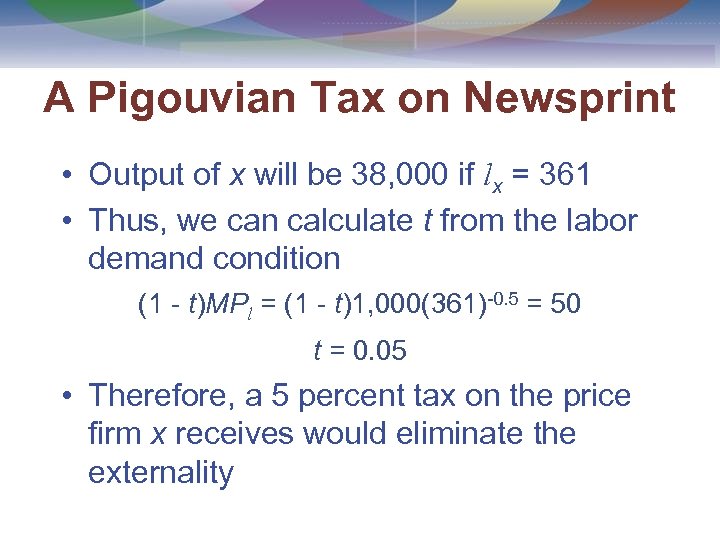
A Pigouvian Tax on Newsprint • Output of x will be 38, 000 if lx = 361 • Thus, we can calculate t from the labor demand condition (1 - t)MPl = (1 - t)1, 000(361)-0. 5 = 50 t = 0. 05 • Therefore, a 5 percent tax on the price firm x receives would eliminate the externality
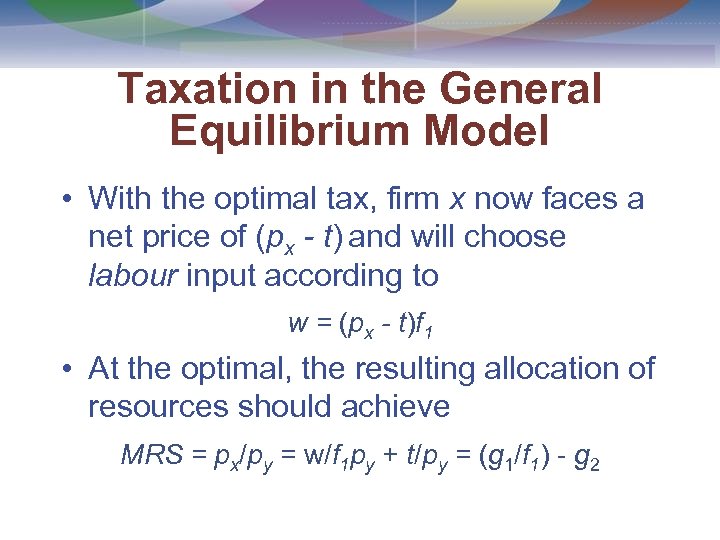
Taxation in the General Equilibrium Model • With the optimal tax, firm x now faces a net price of (px - t) and will choose labour input according to w = (px - t)f 1 • At the optimal, the resulting allocation of resources should achieve MRS = px/py = w/f 1 py + t/py = (g 1/f 1) - g 2
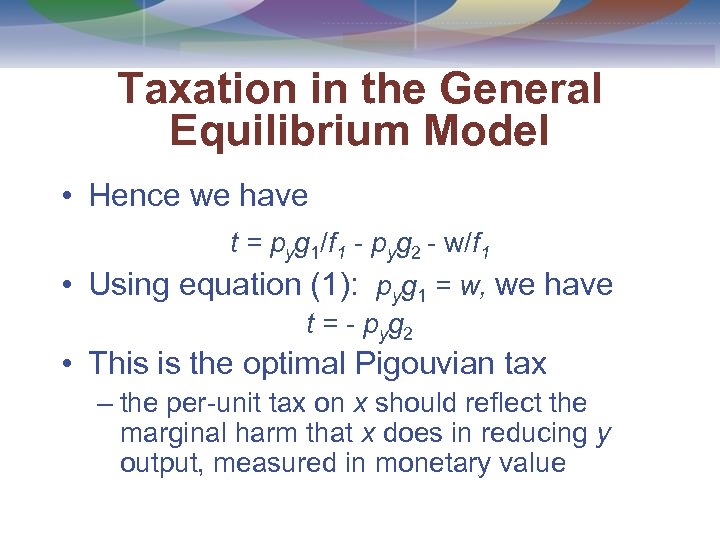
Taxation in the General Equilibrium Model • Hence we have t = pyg 1/f 1 - pyg 2 - w/f 1 • Using equation (1): pyg 1 = w, we have t = - pyg 2 • This is the optimal Pigouvian tax – the per-unit tax on x should reflect the marginal harm that x does in reducing y output, measured in monetary value
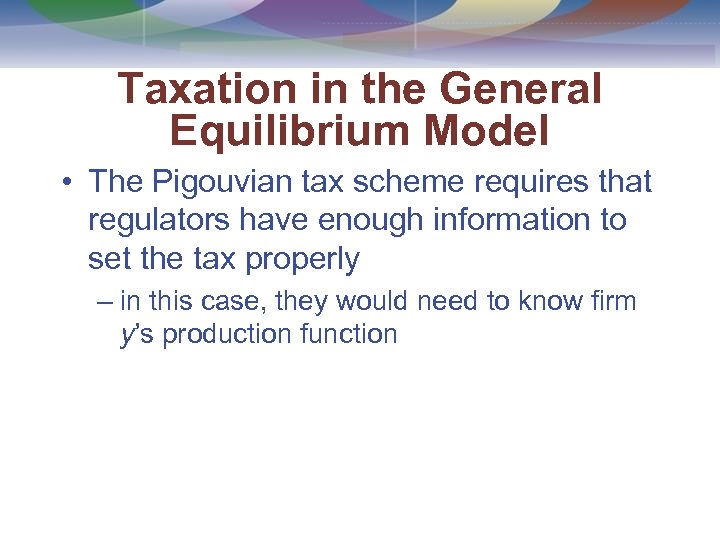
Taxation in the General Equilibrium Model • The Pigouvian tax scheme requires that regulators have enough information to set the tax properly – in this case, they would need to know firm y’s production function
Pollution Rights • An innovation that would mitigate the informational requirements involved with Pigouvian taxation is the creation of a market for “pollution rights” • Suppose that firm x must purchase from firm y the rights to pollute the river they share – x’s choice to purchase these rights is identical to its output choice
Pollution Rights • The net revenue that x receives per unit is given by px - r, where r is the payment the firm must make to firm y for each unit of x it produces • Firm y must decide how many rights to sell firm x by choosing x output to maximize its profits y = pyg(ly, x) – wly + rx
Pollution Rights • The first-order condition for a maximum is y/ x = pyg 2 + r = 0 r = -pyg 2 • The equilibrium solution is identical to that for the Pigouvian tax – from firm x’s point of view, it makes no difference whether it pays the fee to the government or to firm y
The Coase Theorem • The key feature of the pollution rights equilibrium is that the rights are welldefined and tradable with zero transactions costs • The initial assignment of rights is irrelevant – subsequent trading will always achieve the same, efficient equilibrium
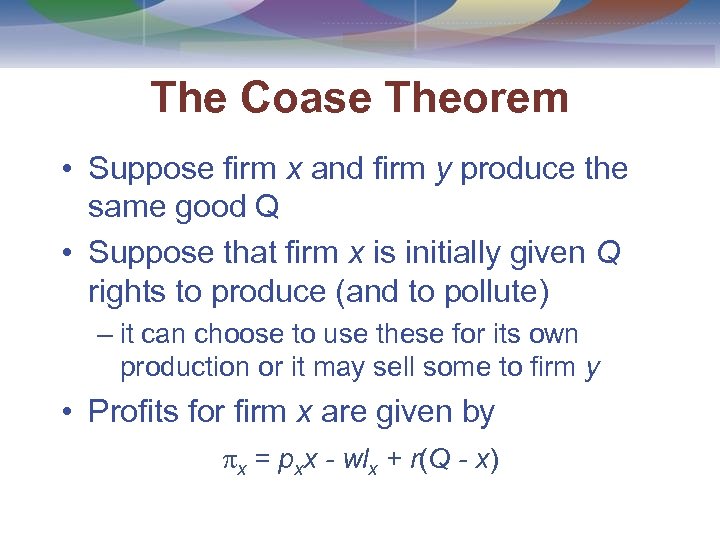
The Coase Theorem • Suppose firm x and firm y produce the same good Q • Suppose that firm x is initially given Q rights to produce (and to pollute) – it can choose to use these for its own production or it may sell some to firm y • Profits for firm x are given by x = pxx - wlx + r(Q - x)
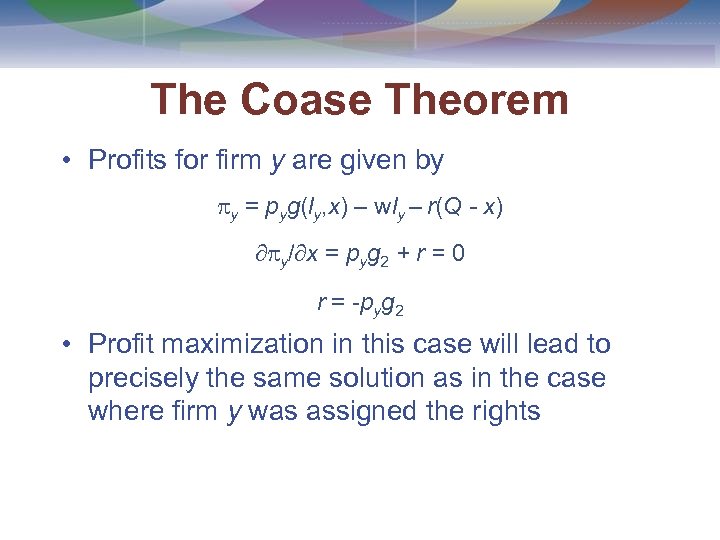
The Coase Theorem • Profits for firm y are given by y = pyg(ly, x) – wly – r(Q - x) y/ x = pyg 2 + r = 0 r = -pyg 2 • Profit maximization in this case will lead to precisely the same solution as in the case where firm y was assigned the rights
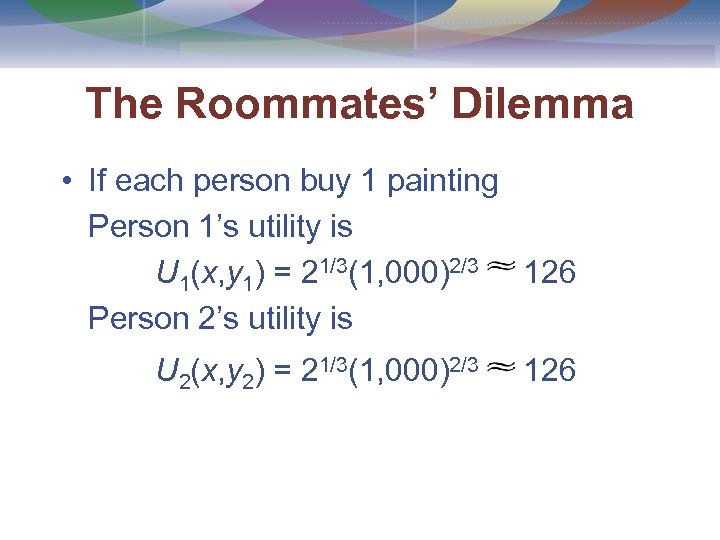
The Roommates’ Dilemma • If each person buy 1 painting Person 1’s utility is U 1(x, y 1) = 21/3(1, 000)2/3 126 Person 2’s utility is U 2(x, y 2) = 21/3(1, 000)2/3 126
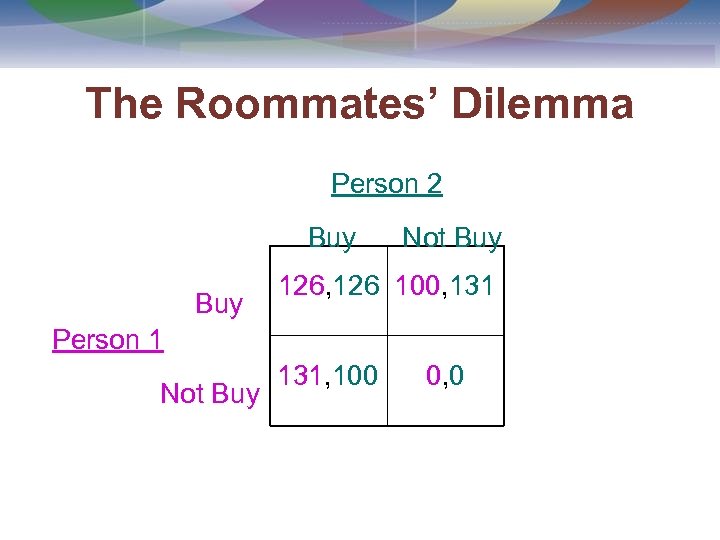
The Roommates’ Dilemma Person 2 Buy Not Buy 126, 126 100, 131 Person 1 Not Buy 131, 100 0, 0
Lindahl Pricing of Public Goods • Swedish economist E. Lindahl suggested that individuals might be willing to be taxed for public goods if they knew that others were being taxed – Lindahl assumed that each individual would be presented by the government with the proportion of a public good’s cost he was expected to pay and then reply with the level of public good he would prefer
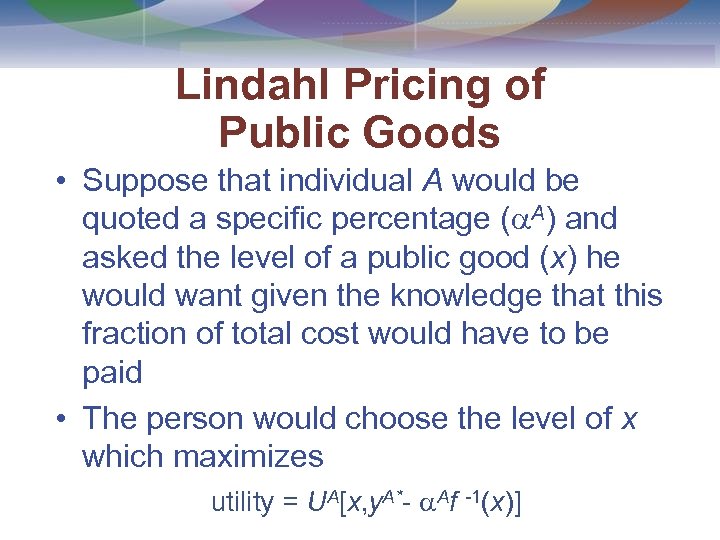
Lindahl Pricing of Public Goods • Suppose that individual A would be quoted a specific percentage ( A) and asked the level of a public good (x) he would want given the knowledge that this fraction of total cost would have to be paid • The person would choose the level of x which maximizes utility = UA[x, y. A*- Af -1(x)]
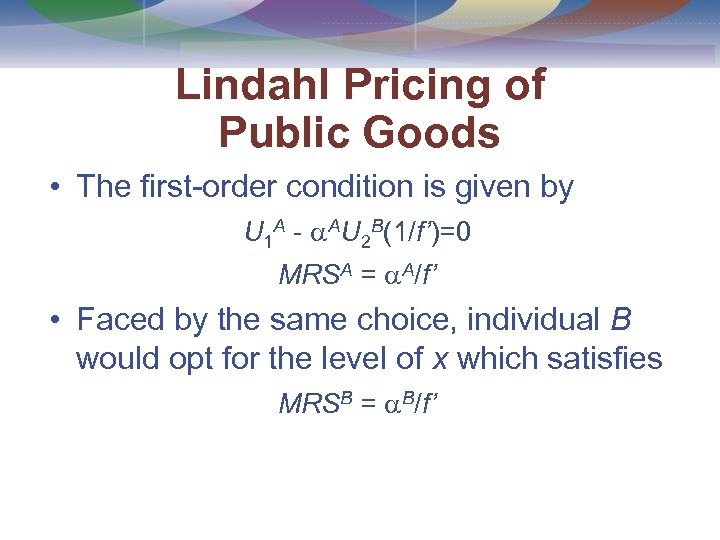
Lindahl Pricing of Public Goods • The first-order condition is given by U 1 A - AU 2 B(1/f’)=0 MRSA = A/f’ • Faced by the same choice, individual B would opt for the level of x which satisfies MRSB = B/f’
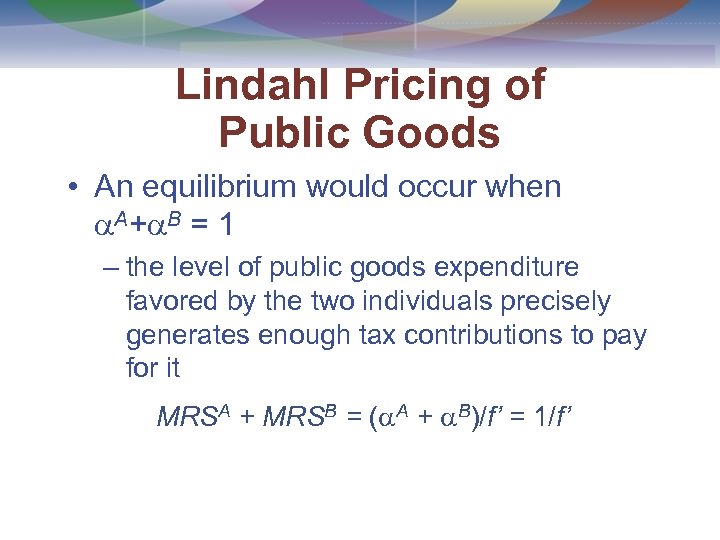
Lindahl Pricing of Public Goods • An equilibrium would occur when A+ B = 1 – the level of public goods expenditure favored by the two individuals precisely generates enough tax contributions to pay for it MRSA + MRSB = ( A + B)/f’ = 1/f’

Shortcomings of the Lindahl Solution • The incentive to be a free rider is very strong – this makes it difficult to envision how the information necessary to compute equilibrium Lindahl shares might be computed • individuals have a clear incentive to understate their true preferences

Important Points to Note: • Externalities may cause a misallocation of resources because of a divergence between private and social marginal cost – traditional solutions to this divergence includes mergers among the affected parties and adoption of suitable Pigouvian taxes or subsidies
Important Points to Note: • If transactions costs are small, private bargaining among the parties affected by an externality may bring social and private costs into line – the proof that resources will be efficiently allocated under such circumstances is sometimes called the Coase theorem
Скачать презентацию EXTERNALITIES Snyder and Nicholson Copyright 2008 by
1e18b250671f08906f5031ca4cd1afea.ppt