


 Скачать презентацию External impediments to SME access to international markets
9d4580a893ed9ce1612edd302e9e0904.ppt
- Количество слайдов: 23
 External impediments to SME access to international markets: What are they and how can they be reduced? UNECE International Conference on “Reducing Barriers to Entrepreneurship and Encouraging Enterprise Development: Policy Options” Geneva 18 -19 June 2007 Barbara Fliess OECD Trade and Agriculture Directorate 1
 Presentation Overview I. Findings from OECD/APEC SME and Policymakers Survey (2006) in regard to barriers to internationalisation II. SME participation in global value chains III. Clustering as approach for overcoming barriers 2
 Some facts Ø Ø SMEs are underrepresented in world trade SMEs face growing competition in their local markets as a result of liberalisation of trade and investment Trading activity for the international firm is becoming more complex than just exporting. Impediments to SME internationalisation are internal and external to the firm. 3
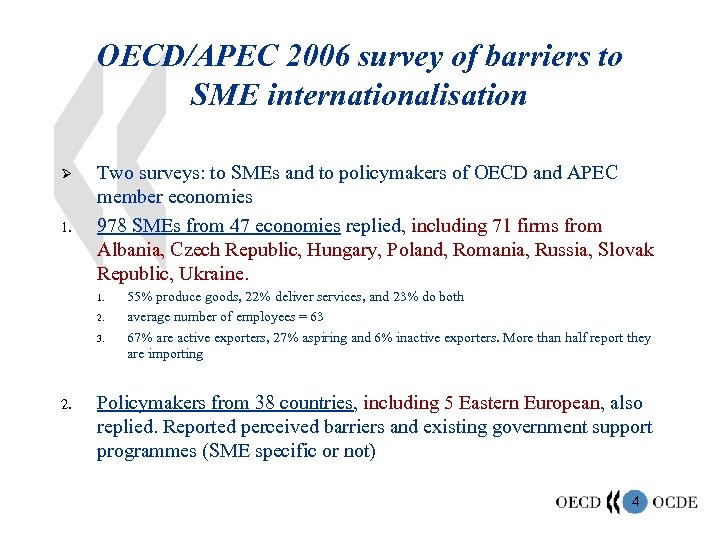 OECD/APEC 2006 survey of barriers to SME internationalisation Ø 1. Two surveys: to SMEs and to policymakers of OECD and APEC member economies 978 SMEs from 47 economies replied, including 71 firms from Albania, Czech Republic, Hungary, Poland, Romania, Russia, Slovak Republic, Ukraine. 1. 2. 3. 2. 55% produce goods, 22% deliver services, and 23% do both average number of employees = 63 67% are active exporters, 27% aspiring and 6% inactive exporters. More than half report they are importing Policymakers from 38 countries, including 5 Eastern European, also replied. Reported perceived barriers and existing government support programmes (SME specific or not) 4
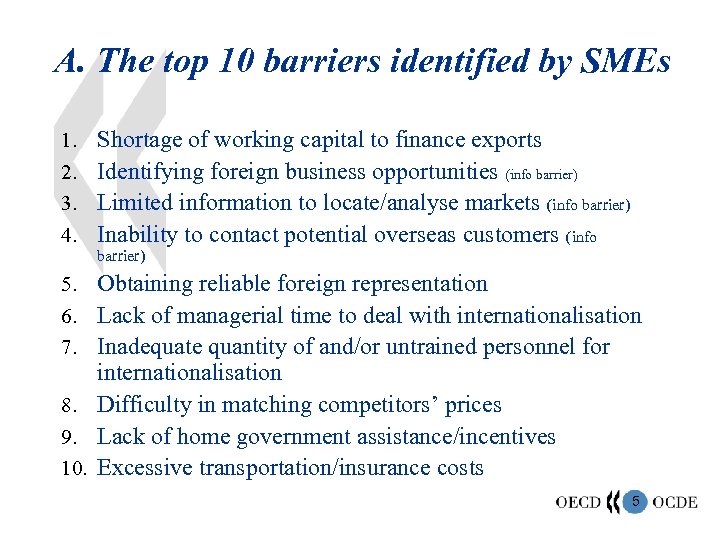 A. The top 10 barriers identified by SMEs 1. Shortage of working capital to finance exports 2. Identifying foreign business opportunities (info barrier) 3. Limited information to locate/analyse markets (info barrier) 4. Inability to contact potential overseas customers (info barrier) 5. Obtaining reliable foreign representation 6. Lack of managerial time to deal with internationalisation 7. Inadequate quantity of and/or untrained personnel for internationalisation 8. Difficulty in matching competitors’ prices 9. Lack of home government assistance/incentives 10. Excessive transportation/insurance costs 5
 Barriers specific to the external business and competitive environment scored low. Experienced firms ranked them higher than firms with no international experience. External barriers include: § Trade barriers (tariffs and non-tariff barriers at border, customs procedures) § Government regulations (product standards and regulatory requirements and compliance procedures, patent and trademark issues) § Supply and demand conditions § Cultural differences SMEs appear to go through a learning process when they engage in international activities. Ø Ø Firms new to international activity value information about markets and opportunities which provide a foothold for them in their international venture. They also need assistance with clarifying and understanding the challenges facing them. Experienced firms need more specialised training and support services as their problems tend to be more specific to the business and the competitive environment. 6
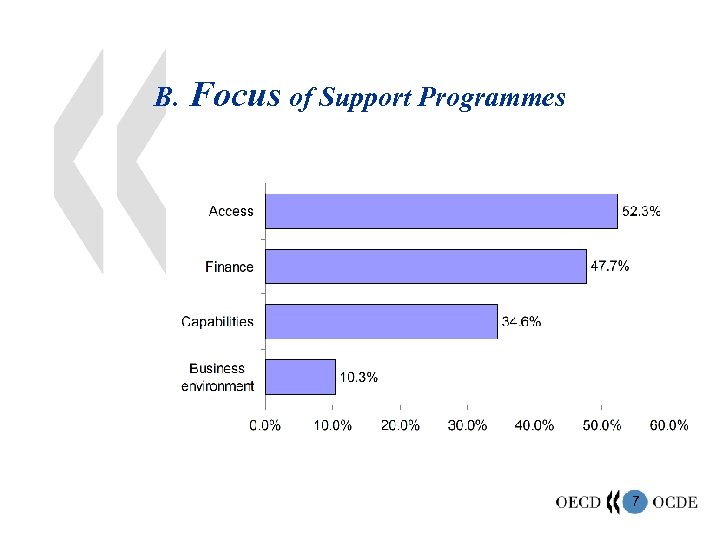 B. Focus of Support Programmes 7
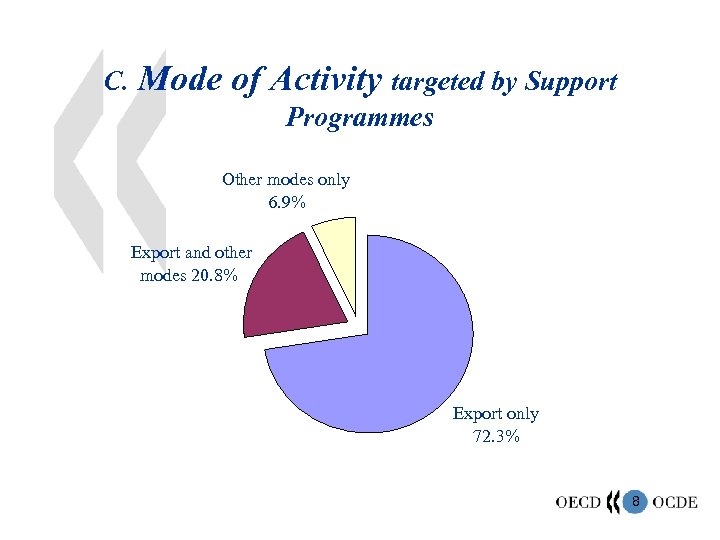 C. Mode of Activity targeted by Support Programmes Other modes only 6. 9% Export and other modes 20. 8% Export only 72. 3% 8
 “Transparency” measures – a first step to addressing barriers in business environment Ø Ø Information about policy barriers to exports and imports and foreign regulations, e. g. through govt. enquiry points, online reference tools on tariffs and other regulations SME input to trade policy (identification of trade barriers, consultations on strategies for addressing barriers, feedback) e. g. via advisory bodies Creation of permanent or ad hoc government units mandated to represent SME views in the regulatory process (SME impact assessments, regulatory reform, removal of administrative burdens) Information about market opportunities abroad, networking e. g. ebulletin boards, trade fairs and missions 9
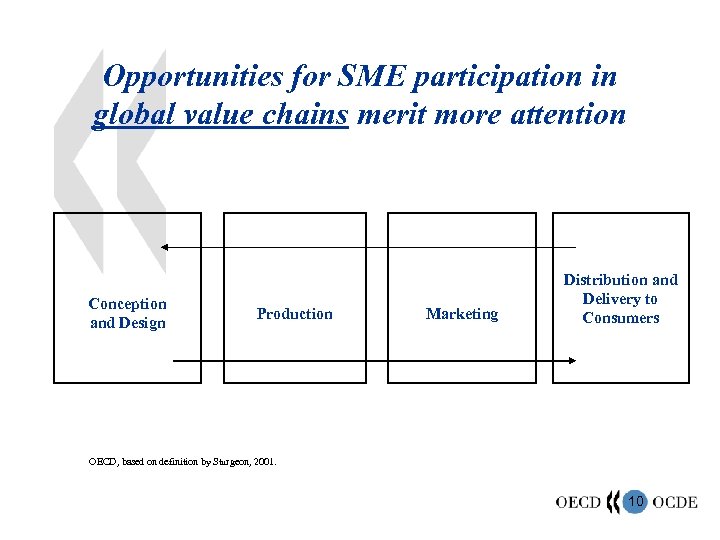 Opportunities for SME participation in global value chains merit more attention Conception and Design Production Marketing Distribution and Delivery to Consumers OECD, based on definition by Sturgeon, 2001. 10
 Ø Producer-driven chains – typical of capital and technologyintensive industries (automobiles, aircraft, computers, semiconductors, heavy machinery). 2 profiles of subcontractors: 1. 2. Ø Suppliers of goods and services with low technology content (call centres, catering, intermediate inputs for machinery etc) Base of suppliers is wide, suppliers easily replaceable. Suppliers of goods and services with high technology content subject to constant innovation (subcontracting partnerships between automobile, aircraft manufacturers and their parts suppliers) Buyer-driven chains – large retailers, marketers and branded manufacturers set up decentralised production networks. Typical of labour-intensive, consumer-oriented goods industries like garments, footwear, toys, house wares, consumer electronics and handicrafts. 11
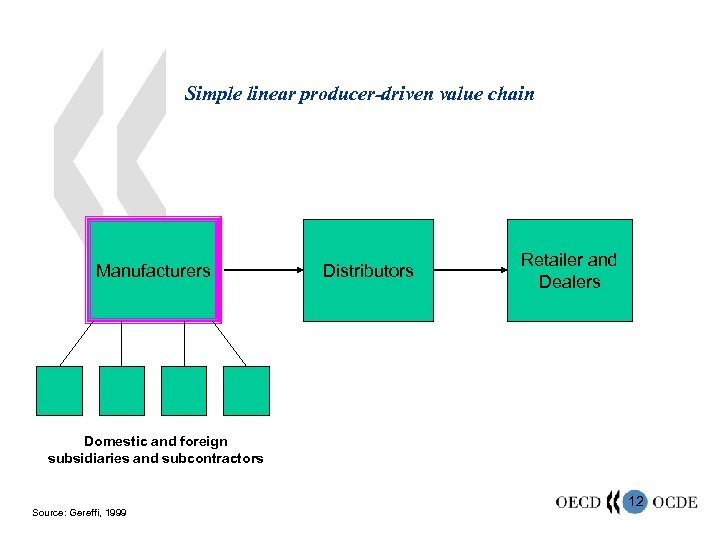 Simple linear producer-driven value chain Manufacturers Distributors Retailer and Dealers Domestic and foreign subsidiaries and subcontractors Source: Gereffi, 1999 12
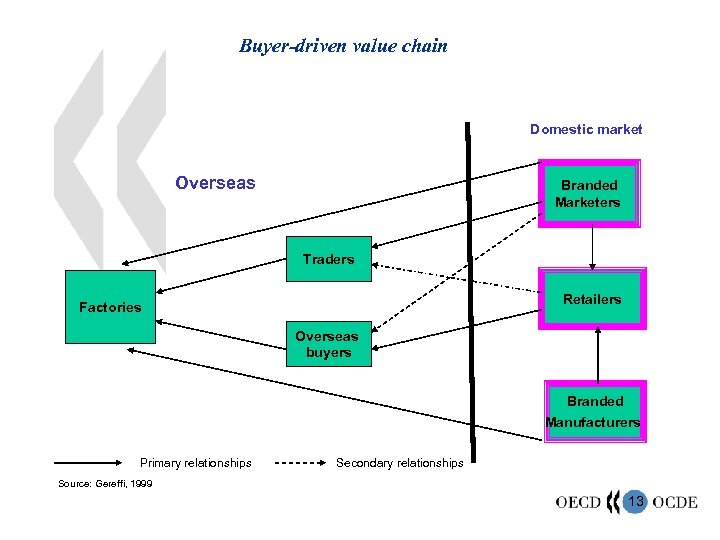 Buyer-driven value chain Domestic market Overseas Branded Marketers Traders Retailers Factories Overseas buyers Branded Manufacturers Primary relationships Secondary relationships Source: Gereffi, 1999 13
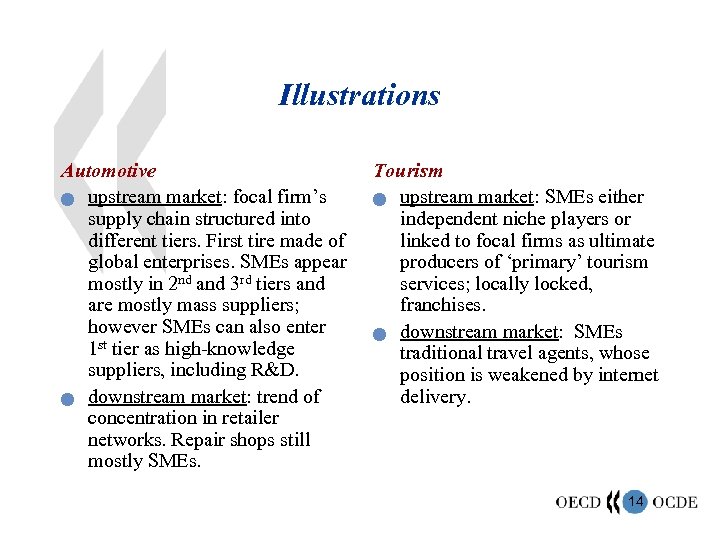 Illustrations Automotive n upstream market: focal firm’s supply chain structured into different tiers. First tire made of global enterprises. SMEs appear mostly in 2 nd and 3 rd tiers and are mostly mass suppliers; however SMEs can also enter 1 st tier as high-knowledge suppliers, including R&D. n downstream market: trend of concentration in retailer networks. Repair shops still mostly SMEs. Tourism n upstream market: SMEs either independent niche players or linked to focal firms as ultimate producers of ‘primary’ tourism services; locally locked, franchises. n downstream market: SMEs traditional travel agents, whose position is weakened by internet delivery. 14
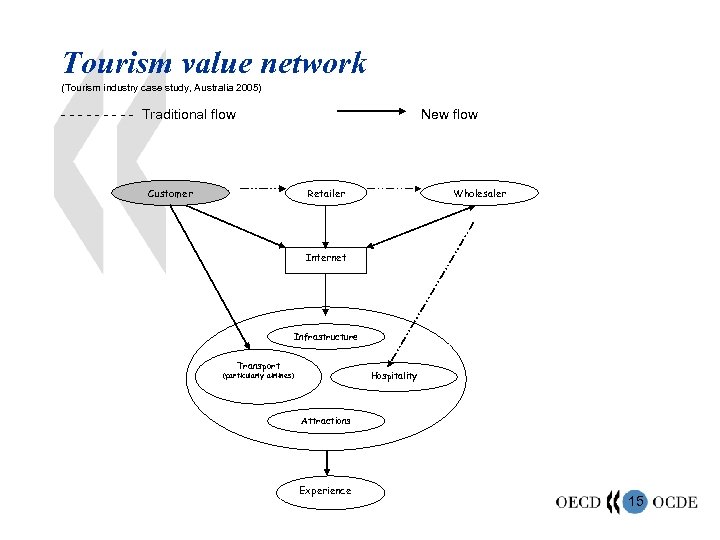 Tourism value network (Tourism industry case study, Australia 2005) - - - - - Traditional flow New flow Customer Retailer Wholesaler Internet Infrastructure Transport Hospitality (particularly airlines) Attractions Experience 15
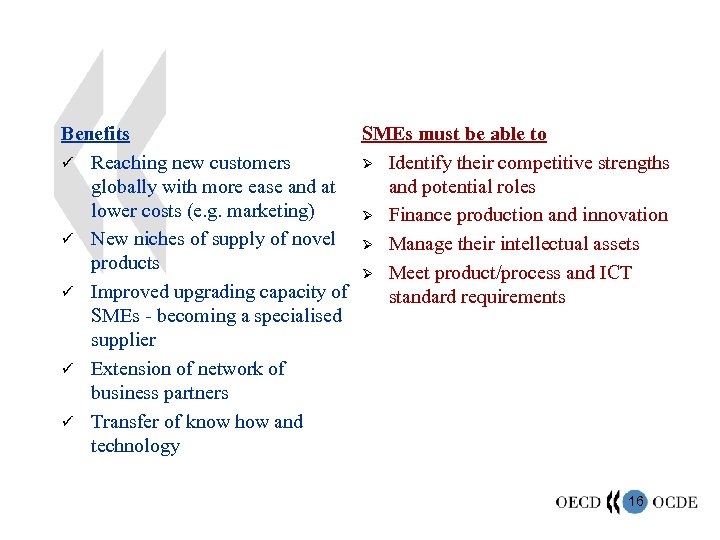 Benefits SMEs must be able to ü Reaching new customers Ø Identify their competitive strengths globally with more ease and at and potential roles lower costs (e. g. marketing) Ø Finance production and innovation ü New niches of supply of novel Ø Manage their intellectual assets products Ø Meet product/process and ICT ü Improved upgrading capacity of standard requirements SMEs - becoming a specialised supplier ü Extension of network of business partners ü Transfer of know how and technology 16
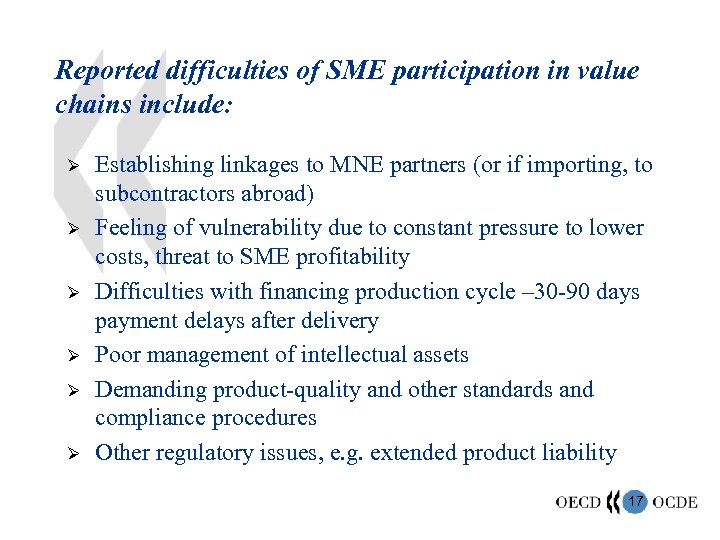 Reported difficulties of SME participation in value chains include: Ø Ø Ø Establishing linkages to MNE partners (or if importing, to subcontractors abroad) Feeling of vulnerability due to constant pressure to lower costs, threat to SME profitability Difficulties with financing production cycle – 30 -90 days payment delays after delivery Poor management of intellectual assets Demanding product-quality and other standards and compliance procedures Other regulatory issues, e. g. extended product liability 17
 What governments can do (I) Ø Ø Ø Raise awareness and help establish linkages – business linkages programmes (support for networking, databases on suppliers and business alliances) Help with innovation and technology capacity – e. g. credit lines for upgrading; promote technology transfer among SMEs and between SMEs and MNEs, public-private partnerships connecting research centres/universities and industry Protection of IPR – e. g. SME competency training, financial support for patent filings, watchdog of IPR violations, lawsuit support. Help with financing – e. g. factoring and reverse factoring for low-tech SMEs Standards-related costs – e. g. SME competency training, help with group certification for SMEs; support for SME participation in standard setting bodies 18
 What governments can do (II) Ø Facilitate SME consortia for joint marketing or joint bidding for procurement contracts Ø Promote and support clusters as one stepping stone towards SME internationalisation 19
 Clusters can reduce many barriers to SME participation in global markets 1. 2. Produce synergy effects Can help overcome disadvantages of small size by pooling resources and undertaking cooperative actions, e. g. - 3. acquisition and joint use of knowledge and information joint testing, quality control joint marketing pooling of resources for human capital development Enhanced bargaining power when negotiating with other actors, including in internationalised value chains 20
 Building international links through clusters Example 1: Slovenia auto and tool manufacturing clusters Local SMEs supply high-quality inputs to Cluster core companies who in turn act as developmental suppliers of complex products/system solutions for end customers abroad. Ø Highly specialised supplier chains are developing inside the clusters. Ø Parts of the value chain with lower value added are outsourced to regions with lower labour costs. Ø Challenges: • focusing local firms’ interest on the development of cluster itself (joint marketing, establishment of sales channels, strengthening of assets and resources) • absence of FDI by foreign end customers in cluster • firms not yet involved in international networks of innovation 21
 Example 2: E-clustering in Latin America (e. g. Bolivia. Mall. com, Tortas. Peru. com) SME sharing development and use of ICT platforms (e-clustering or networked communities) for marketing at global level. Ø Services shared include: - technology (secure platform, back-office), - info collective and dissemination, business intelligence, - capacity-building and - collective services (marketing, payment, branding). Challenges: • new business model based on cooperation + competition. • governance issues (representation and power) • quality-upgrading and reaching new markets (e. g. E-Fashion platforms) Ø 22
 Thank you! Relevant OECD work: • Enhancing the role of SMEs in global value chains. OECD Tokyo Statement on strengthening the role of SMEs in global value chains, at OECD Global conference in Tokyo 31 May – 1 June 2007 http: //www. oecd. org/dataoecd/44/31/38774814. pdf • • OECD-APEC Keynote Paper on Removing Barriers to SME Access to International Markets: Executive Summary , OECD-APEC Global Conference in Athens 6 -8 November 2006 http: //www. oecd. org/dataoecd/4/16/37818320. pdf The Athens Action Plan for removing barriers to SME Access to International Markets, adopted at the OECD-APEC Global Conference in Athens on 8 November 2006, http: //www. oecd. org/dataoecd/4/17/37818332. pdf The role of trade barriers in SME internationalisation. (Barbara Fliess & Carlos Busquets, OECD Trade Policy Working Paper No. 45, 2006) http: //www. oecd. org/dataoecd/34/25/37872326. pdf Regional diversity and local development in Central and Eastern Europe. Seminar in Warsaw on 10 November 2006 organised by OECD LEED Programme, with co-organisers, Presentations made at Seminar available at http: //www. oecd. org/document/8/0, 3343, en_2649_33956792_37737736_1_1, 00. html • • • Business Clusters: Promoting Enterprise in Central and Eastern Europe (OECD, 2005) OECD SME and Entrepreneurship Outlook 2005 (OECD, 2005) Global industrial restructuring: Implications for small firms (Kentaro Sakai, OECD STI Working Paper 2002/4) • Enhancing SME competitiveness. The OECD Bologna Ministerial Conference: Proceedings (OECD, 2001) http: //www. oecd. org/Long. Abstract/0, 2546, fr_2649_34197_2671678_119684_1_1_1, 00. html For more information please visit the OECD’s webpages of (1) Centre for Entrepreneurship, SMEs and Local Development and (2) Trento Centre for Local Development. 23