


 Скачать презентацию External Examiner Induction Janet Lloyd Head of Quality
7f8e21936b5a29c31c75ba7dbdf7463c.ppt
- Количество слайдов: 41
 External Examiner Induction Janet Lloyd Head of Quality and Enhancement 1 November 2017
 Session overview • • • Role of the external examiner Supporting external examiners Overview of academic regulations Two-tiered boards of examiners External examiner reports
 Vision 2025 How “By pioneering exceptional industry What partnerships we will lead the way in real world experiences preparing students for life. ” Why
 ICZ ready curriculum • Industry Collaboration Zones provide new ways for our students, colleagues and industry partners to co-create, experiment and learn together • By September 2018, all programmes will have completed the ICZ curriculum design process
 ICZ curriculum design principles 1. The programme is inclusive 2. The curriculum and delivery are co-created 3. Learning is active and collaborative 4. Learning is real-world and experiential 5. The programme is digitally fluent 6. Learners are autonomous 7. Assessment is authentic 8. Education is for ethical behaviour 9. The curriculum is research-informed 10. There is a clear path to professional
 University Structure The University’s academic structure is based on Schools: • Salford Business School • School of Arts and Media • School of Computing, Science and Engineering • School of Environment and Life Sciences • School of Health & Society • School of Health Sciences • School of the Built Environment and • Salford Languages
 Programme Portfolio • c. 200 UG programmes • c. 190 PGT programmes • c. 240 external examiners
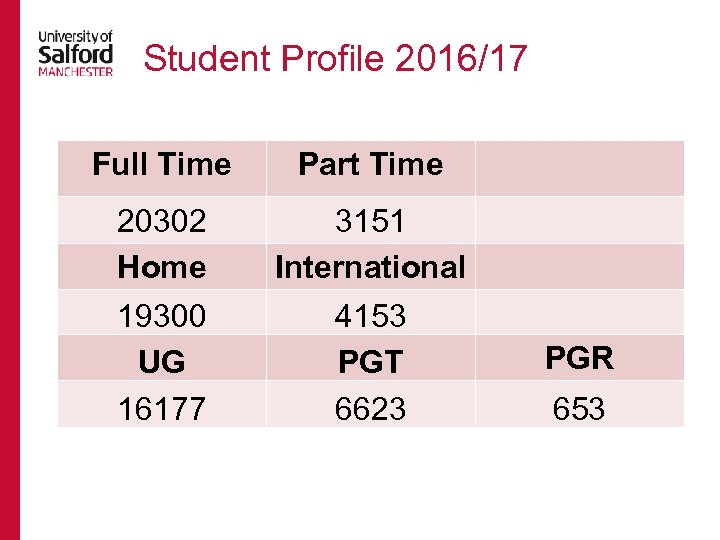 Student Profile 2016/17 Full Time Part Time 20302 Home 3151 International 19300 UG 16177 4153 PGT 6623 PGR 653
 Developing Salford external examiners • HEA degree standards project aims to “design, test and implement a range of approaches to training of external examiners, and will explore approaches to the calibration of standards” in the UK • Course aims to enhance professional practice by promoting deeper understanding of the nature of academic standards, professional judgement and evidence-informed approaches to academic judgements
 Role of an External Examiner
 Role Summary To ensure: • academic standards are appropriate for the award • national comparability of academic standards • assessment process is rigorous and fair, in line with the University’s policies and regulations
 Expectations The University expects external examiners: • to become familiar with the University’s policies and programme information • to advise on programme/module content • to advise on articulation agreements/ routes
 Expectations • to verify and provide feedback on assessments • to moderate samples of student work • to attend ephemeral assessments where necessary • to meet with students where possible
 Expectations • to attend relevant Module/Programme Boards • to sign the record of awards • to ensure equivalence of standards where programmes are delivered by multiple partner institutions
 Expectations • to ensure that the assessment process is rigorous and fair • to submit a written report annually by the published deadline (mid August)
 External Examiner Induction Support for External Examiners Helen Sharman Quality and Enhancement Manager
 Support Available • Website: http: //www. salford. ac. uk/qeo/External. Examiners • Blackboard account – passwords expire after a period of 6 months and need to be reset by contacting ITS on ITS-Service. Desk@salford. ac. uk or 0161 295 2444 • Queries: External. Examiners@salford. ac. uk
 External Examiner Induction Overview of Regulations Policies and Procedures Annette Cooke/Helen Sharman Quality and Enhancement Managers
 Academic Regulations • Apply to all programmes (although there are some programme specific requirements) • Supplementary policies and procedures support the regulations (e. g. Assessment and Feedback, Personal Mitigating Circumstances) • Key documents available at http: //www. salford. ac. uk/qeo/External. Examiners
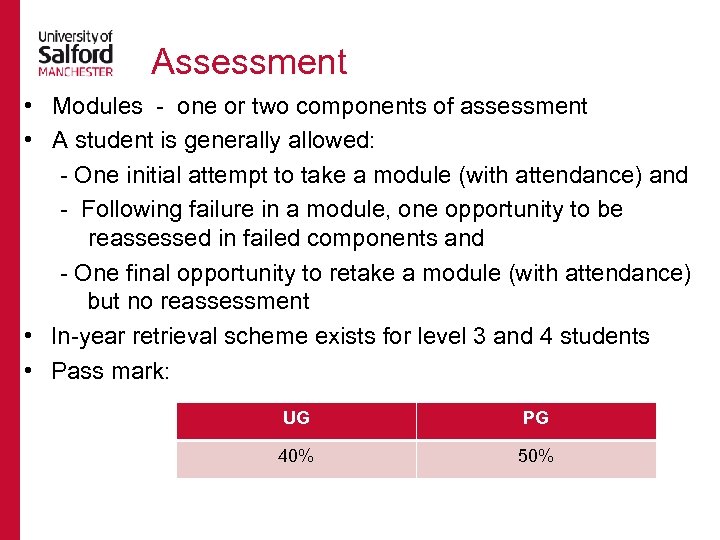 Assessment • Modules - one or two components of assessment • A student is generally allowed: - One initial attempt to take a module (with attendance) and - Following failure in a module, one opportunity to be reassessed in failed components and - One final opportunity to retake a module (with attendance) but no reassessment • In-year retrieval scheme exists for level 3 and 4 students • Pass mark: UG PG 40% 50%
 Assessment • At reassessment component marks are capped at the pass mark, normally the same assessment is set • At retake module marks are capped at the pass mark • UG modules at one level must be passed before progression to next level however limited opportunity to ‘trail a fail’ • Internal verification and moderation required for all assessments • External verification and moderation by external examiners required for assessments contributing to final award classifications • External examiners cannot negotiate individual student marks
 Assessment Marking Scales All elements of assessment are mark out of 100 and recorded as a % mark, unless graded Pass/Fail Level 7 (pass = 50%) Levels 3 -6 (pass = 40%) outstanding 90% – 100% outstanding excellent 80% – 89% excellent very good 70% – 79% very good Good 60% – 69% good satisfactory 50% – 59% fair unsatisfactory 40% – 49% adequate Inadequate 30% – 39% unsatisfactory Poor 20% – 29% poor very poor 10% – 19% very poor extremely poor 0% – 9% extremely poor
 Late Submission Penalties • Late submission penalties: o Up to 1 working day late - penalty of 5 marks o Up to 2 working days late - penalty of 10 marks o Up to 3 working days late - penalty of 15 marks o Up to 4 working days late - penalty of 20 marks • More than 4 working days late, assessment becomes a nonsubmission (and cannot be submitted/marked) • Late submission - if the original mark awarded… o was a pass, the penalised mark cannot go below pass mark o was a fail, no further penalty is applied • Late submission not possible in the reassessment period
 Personal Mitigating Circumstances • By sitting/submitting an assessment, students are deemed to be fit to sit • PMC requests can be considered for: o Absence o Non submission o Late submission • Board of Examiners must decide on the action for accepted PMCs: o o Absence/non submission - offer replacement attempt Late submission – remove late submission penalties
 Compensation • Awarded in some circumstances for 20 credits (levels 3 to 6) or 30 credits (level 7) • Gives credit for the module, no change to module mark
 Degree Classification Standard Honours Degree Programme mark is derived from: 25% of weighted mean mark for best 100 credits at level 5 + 75% of weighted mean mark for best 100 credits at level 6 Integrated Masters 15% of weighted mean mark for best 100 credits at level 5 + 35% of weighted mean mark for best 100 credits at level 6 + 50% of weighted mean mark at level 7
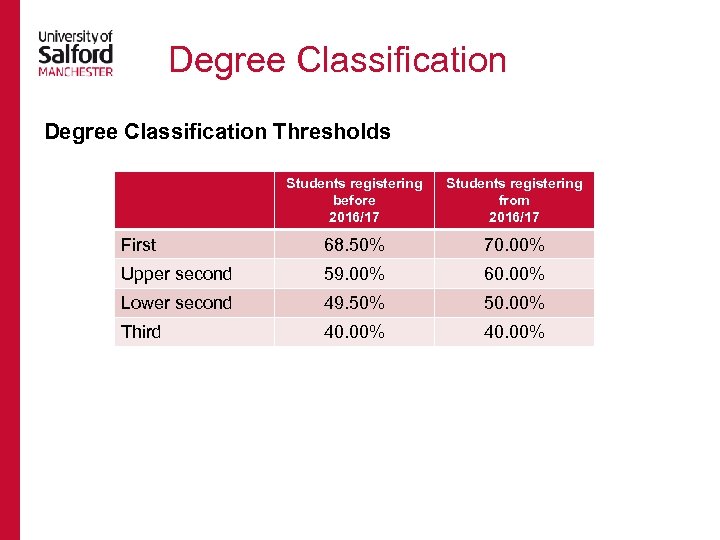 Degree Classification Thresholds Students registering before 2016/17 Students registering from 2016/17 First 68. 50% 70. 00% Upper second 59. 00% 60. 00% Lower second 49. 50% 50. 00% Third 40. 00%
 Degree Classification • No discretion for students close to the next classification boundary • If UG students are a non-standard diet of credits (i. e. not taking 120 credits at levels 5 and 6) the programme mark is calculated on all possible credits i. e. no credits excluded from the calculation
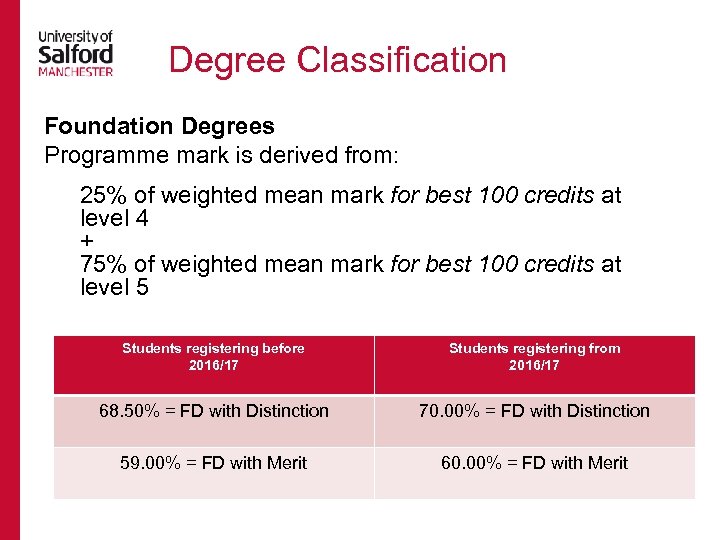 Degree Classification Foundation Degrees Programme mark is derived from: 25% of weighted mean mark for best 100 credits at level 4 + 75% of weighted mean mark for best 100 credits at level 5 Students registering before 2016/17 Students registering from 2016/17 68. 50% = FD with Distinction 70. 00% = FD with Distinction 59. 00% = FD with Merit 60. 00% = FD with Merit
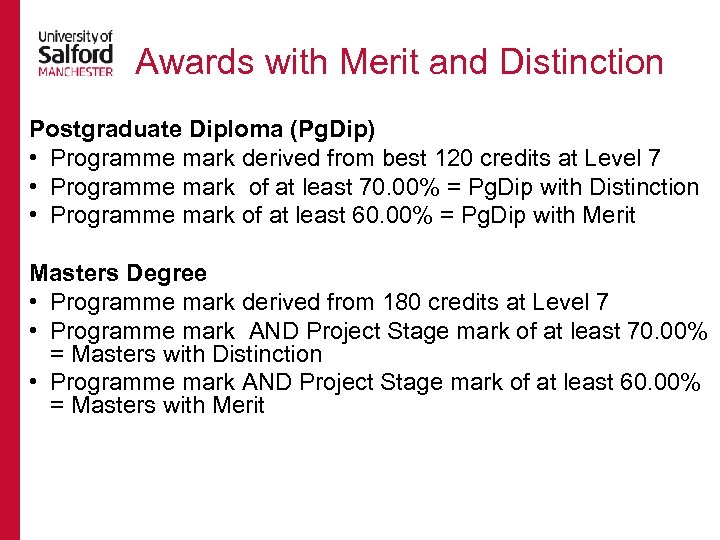 Awards with Merit and Distinction Postgraduate Diploma (Pg. Dip) • Programme mark derived from best 120 credits at Level 7 • Programme mark of at least 70. 00% = Pg. Dip with Distinction • Programme mark of at least 60. 00% = Pg. Dip with Merit Masters Degree • Programme mark derived from 180 credits at Level 7 • Programme mark AND Project Stage mark of at least 70. 00% = Masters with Distinction • Programme mark AND Project Stage mark of at least 60. 00% = Masters with Merit
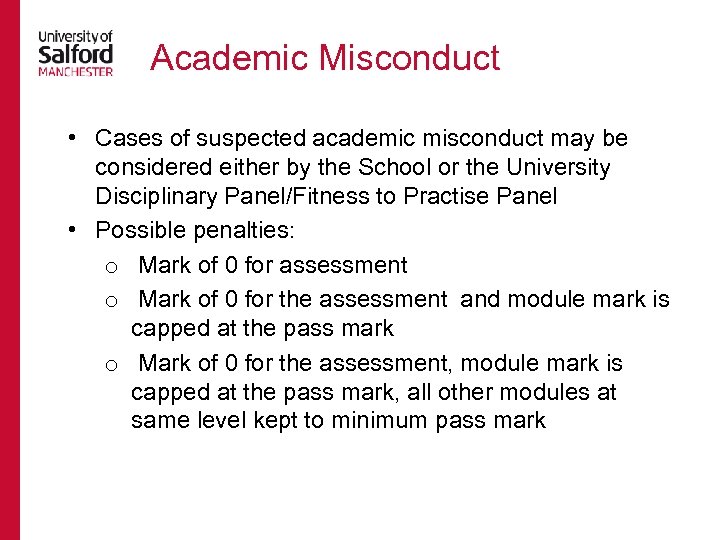 Academic Misconduct • Cases of suspected academic misconduct may be considered either by the School or the University Disciplinary Panel/Fitness to Practise Panel • Possible penalties: o Mark of 0 for assessment o Mark of 0 for the assessment and module mark is capped at the pass mark o Mark of 0 for the assessment, module mark is capped at the pass mark, all other modules at same level kept to minimum pass mark
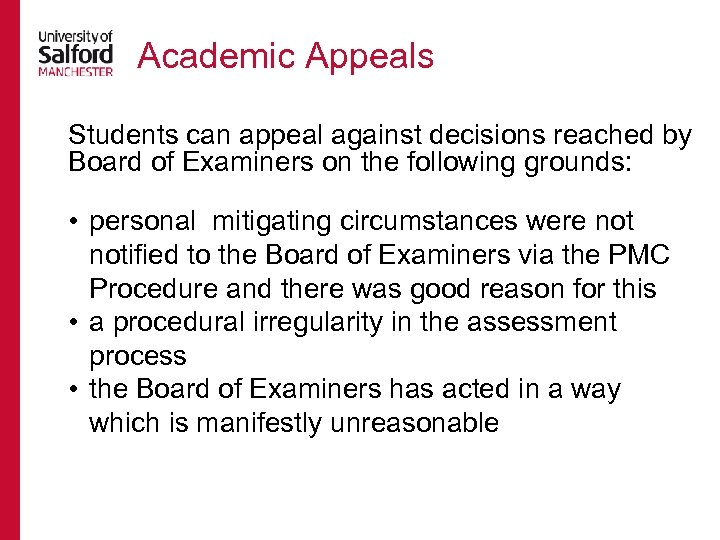 Academic Appeals Students can appeal against decisions reached by Board of Examiners on the following grounds: • personal mitigating circumstances were notified to the Board of Examiners via the PMC Procedure and there was good reason for this • a procedural irregularity in the assessment process • the Board of Examiners has acted in a way which is manifestly unreasonable
 Boards of Examiners Janet Lloyd Head of Quality and Enhancement
 Boards of Examiners are responsible for ensuring that: • institutional regulations and policies on assessment, progression and award are operated correctly • the guiding principle of fairness is operated • marks/awards are appropriate for qualifications at the level and subject • objectivity and consistency is operated • marks and decisions are accurately recorded • sensitivity and confidentiality are maintained
 Functions of Module Boards • Consider student performance across a module cohort • Mark ratification and recording • Consider profile of component/module marks including average and standard deviation • If concerns are raised, empowered to make formulaic, across-the-board changes to sets of marks or (if practicable) to ask internal and external examiners to revisit scripts • Collective decision making
 Functions of Programme Boards • Consider individual student performance • Make decisions on progression and the award of qualifications, acting on the basis of marks ratified by the Module Board • Determine the award of compensation and requirements for reassessment/retake • Ensure personal mitigating circumstances decisions/academic misconduct penalties are recorded and applied as appropriate • Collective decision making
 Role of External Examiner at Board • May attend any meeting of a Board of Examiners • Attendance at Module Boards is normally expected as they operate on a disciplinespecific basis; external examiner comment is particularly welcome • At Programme Boards, the External Examiner principal function is the oversight of the fair operation of the assessment process • Attendance requirement at Programme Board may be met by a single External Examiner
 Role of External Examiner at Board • If unable to attend a meeting, the external examiner shall be available for consultation • External examiners sign the record of awards from the Board of Examiners’ meeting attended, endorsing the assessment outcomes/processes
 External Examiner Induction External Examiner Reports, Responses and Action Planning Dr Janice Allan Associate Dean Academic (Assurance) School of Arts and Media 1 November 2017
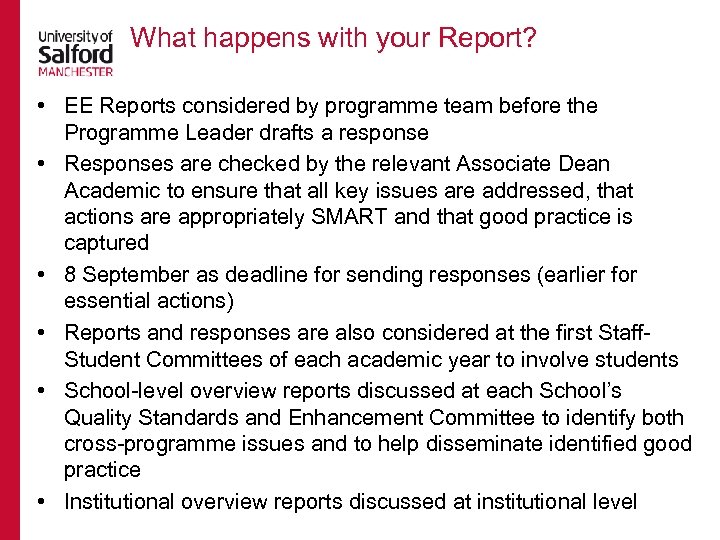 What happens with your Report? • EE Reports considered by programme team before the Programme Leader drafts a response • Responses are checked by the relevant Associate Dean Academic to ensure that all key issues are addressed, that actions are appropriately SMART and that good practice is captured • 8 September as deadline for sending responses (earlier for essential actions) • Reports and responses are also considered at the first Staff. Student Committees of each academic year to involve students • School-level overview reports discussed at each School’s Quality Standards and Enhancement Committee to identify both cross-programme issues and to help disseminate identified good practice • Institutional overview reports discussed at institutional level
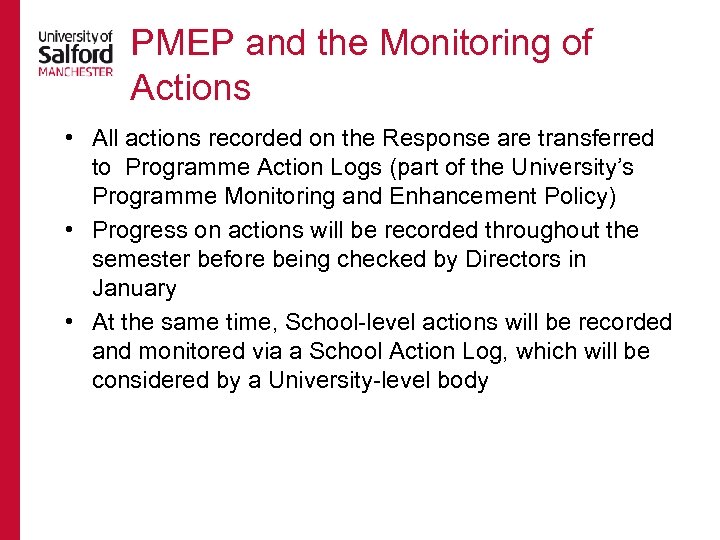 PMEP and the Monitoring of Actions • All actions recorded on the Response are transferred to Programme Action Logs (part of the University’s Programme Monitoring and Enhancement Policy) • Progress on actions will be recorded throughout the semester before being checked by Directors in January • At the same time, School-level actions will be recorded and monitored via a School Action Log, which will be considered by a University-level body