


 Скачать презентацию Extension-généralisation des réciprocités et multilatéralisation des relations Réciprocité
170735794db400f4327dfcf1da44b287.ppt
- Количество слайдов: 2
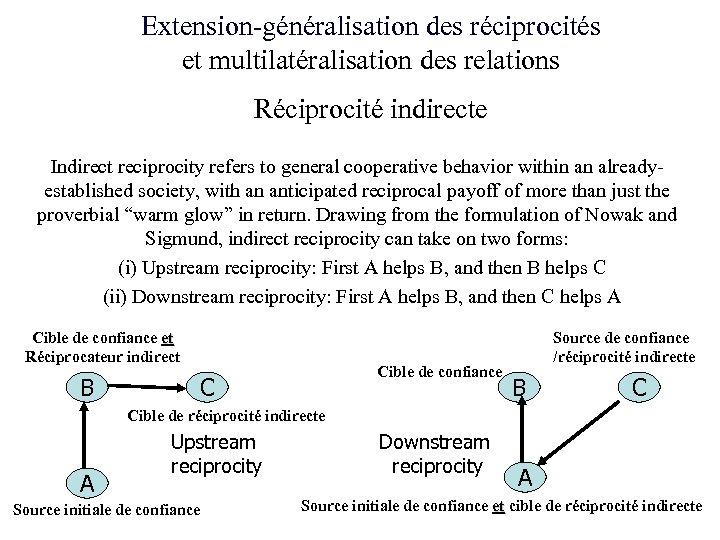 Extension-généralisation des réciprocités et multilatéralisation des relations Réciprocité indirecte Indirect reciprocity refers to general cooperative behavior within an alreadyestablished society, with an anticipated reciprocal payoff of more than just the proverbial “warm glow” in return. Drawing from the formulation of Nowak and Sigmund, indirect reciprocity can take on two forms: (i) Upstream reciprocity: First A helps B, and then B helps C (ii) Downstream reciprocity: First A helps B, and then C helps A Cible de confiance et Réciprocateur indirect B Cible de confiance C Source de confiance /réciprocité indirecte B C Cible de réciprocité indirecte A Upstream reciprocity Source initiale de confiance Downstream reciprocity A Source initiale de confiance et cible de réciprocité indirecte
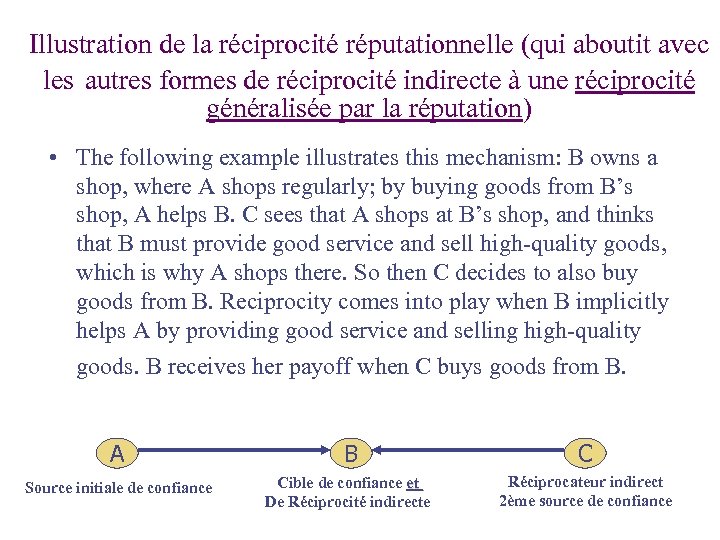 Illustration de la réciprocité réputationnelle (qui aboutit avec les autres formes de réciprocité indirecte à une réciprocité généralisée par la réputation) • The following example illustrates this mechanism: B owns a shop, where A shops regularly; by buying goods from B’s shop, A helps B. C sees that A shops at B’s shop, and thinks that B must provide good service and sell high-quality goods, which is why A shops there. So then C decides to also buy goods from B. Reciprocity comes into play when B implicitly helps A by providing good service and selling high-quality goods. B receives her payoff when C buys goods from B. A B C Source initiale de confiance Cible de confiance et De Réciprocité indirecte Réciprocateur indirect 2ème source de confiance