


 Скачать презентацию Extending the Iron Energy Spectrum Measurements of the
febddec187da156fd151e46631cfcdc7.ppt
- Количество слайдов: 11
 Extending the Iron Energy Spectrum Measurements of the Cosmic Ray Isotope Spectrometer throughout 1997– 2011 A. W. Labrador 1, R. A. Mewaldt 1, W. R. Binns 2, A. C. Cummings 1, G. A. de Nolfo 3, M. H. Israel 2, R. A. Leske 1, E. C. Stone 1, T. T. von Rosenvinge 3, M. E. Wiedenbeck 4 1 California Institute of Technology, Pasadena, CA 91125 USA 2 Washington University, St. Louis, MO 63130 USA 3 NASA/Goddard Space Flight Center, Greenbelt, MD 20771 USA 4 Jet Propulsion Laboratory, Pasadena, CA 91109 USA 32 nd International Cosmic Ray Conference, Beijing 15 August 2011
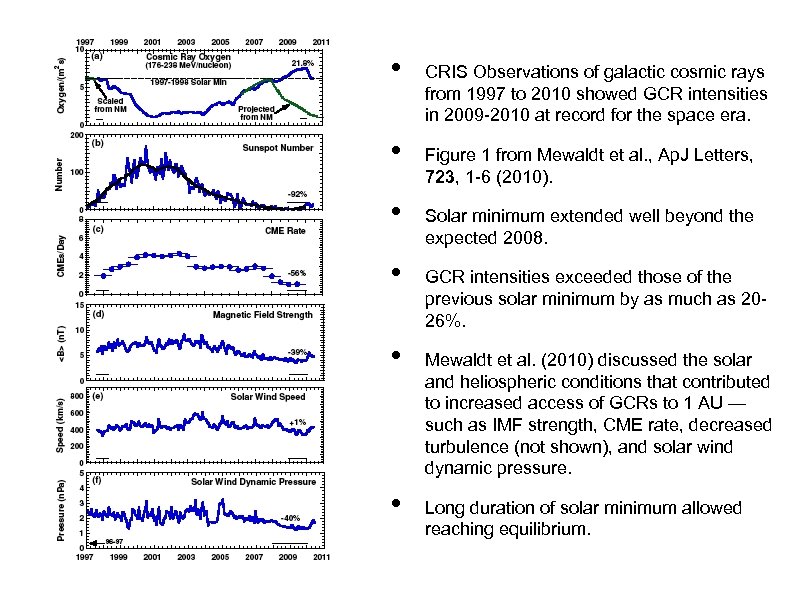 • • • CRIS Observations of galactic cosmic rays from 1997 to 2010 showed GCR intensities in 2009 -2010 at record for the space era. Figure 1 from Mewaldt et al. , Ap. J Letters, 723, 1 -6 (2010). Solar minimum extended well beyond the expected 2008. GCR intensities exceeded those of the previous solar minimum by as much as 2026%. Mewaldt et al. (2010) discussed the solar and heliospheric conditions that contributed to increased access of GCRs to 1 AU — such as IMF strength, CME rate, decreased turbulence (not shown), and solar wind dynamic pressure. Long duration of solar minimum allowed reaching equilibrium.
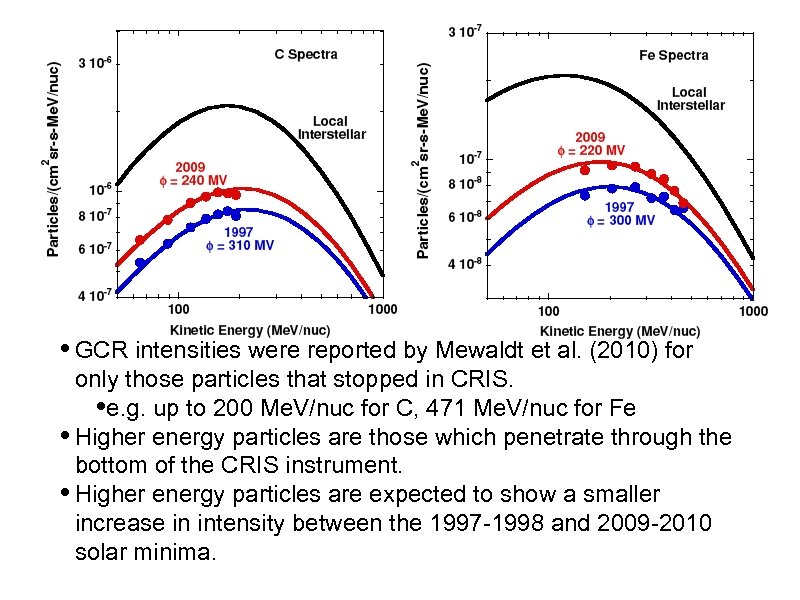 • GCR intensities were reported by Mewaldt et al. (2010) for only those particles that stopped in CRIS. • e. g. up to 200 Me. V/nuc for C, 471 Me. V/nuc for Fe • Higher energy particles are those which penetrate through the bottom of the CRIS instrument. • Higher energy particles are expected to show a smaller increase in intensity between the 1997 -1998 and 2009 -2010 solar minima.
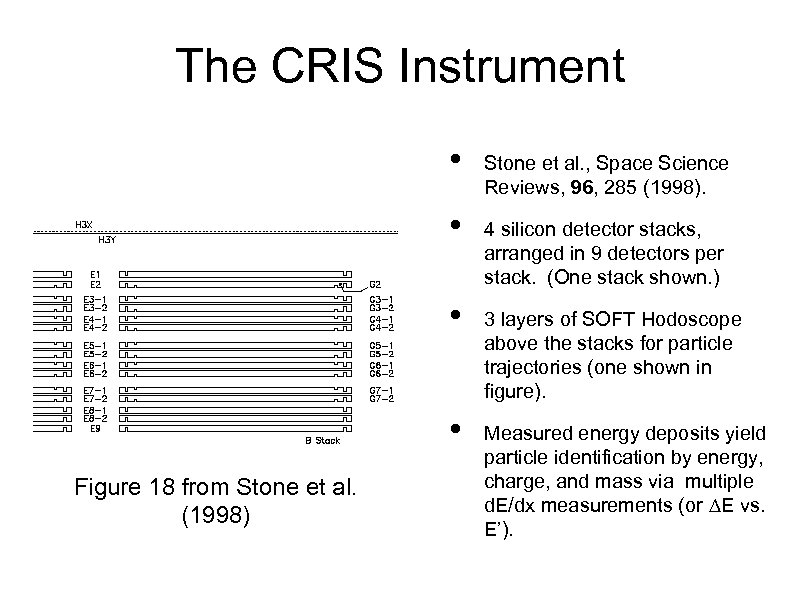 The CRIS Instrument • • Figure 18 from Stone et al. (1998) Stone et al. , Space Science Reviews, 96, 285 (1998). 4 silicon detector stacks, arranged in 9 detectors per stack. (One stack shown. ) 3 layers of SOFT Hodoscope above the stacks for particle trajectories (one shown in figure). Measured energy deposits yield particle identification by energy, charge, and mass via multiple d. E/dx measurements (or ∆E vs. E’).
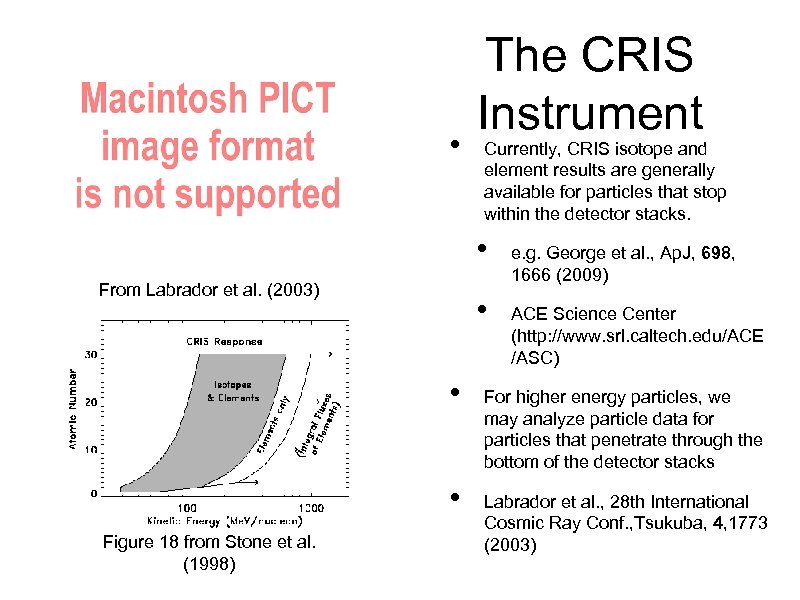 • The CRIS Instrument Currently, CRIS isotope and element results are generally available for particles that stop within the detector stacks. • From Labrador et al. (2003) • • • Figure 18 from Stone et al. (1998) e. g. George et al. , Ap. J, 698, 1666 (2009) ACE Science Center (http: //www. srl. caltech. edu/ACE /ASC) For higher energy particles, we may analyze particle data for particles that penetrate through the bottom of the detector stacks Labrador et al. , 28 th International Cosmic Ray Conf. , Tsukuba, 4, 1773 (2003)
 Data Analysis • Prior penetrating particle analysis for CRIS (e. g. Labrador et al. 2003) relied on applying best-fit d. E/dx calculations applied to CRIS detector measurements (8 detectors) in order to identify individual particles. • • • Energies to ~800 Me. V/nuc (potentially 900 -1000 Me. V/nuc) for Fe. Computationally intensive, time-consuming. For this analysis, we simplify the measurements to ∆E vs. E’ plots and draw boxes identifying Fe events.
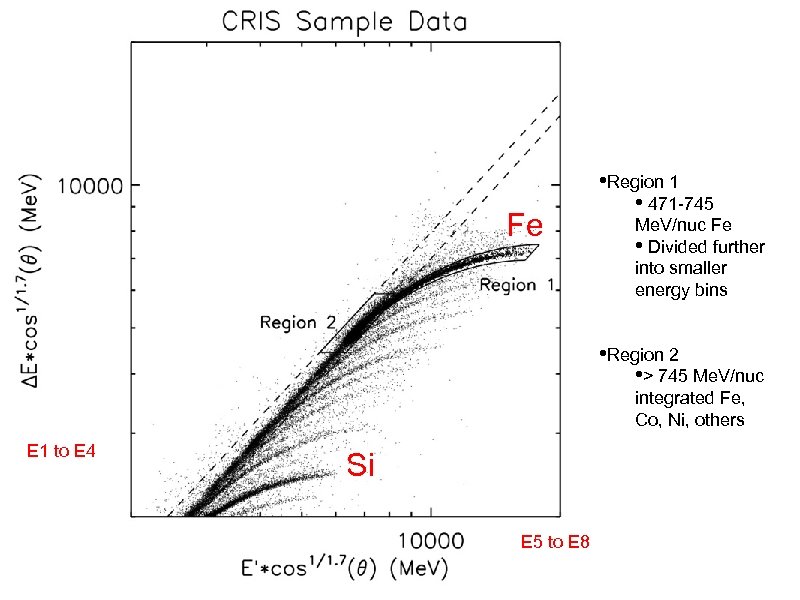 Fe • Region 1 • 471 -745 Me. V/nuc Fe • Divided further into smaller energy bins • Region 2 • > 745 Me. V/nuc integrated Fe, Co, Ni, others E 1 to E 4 Si E 5 to E 8
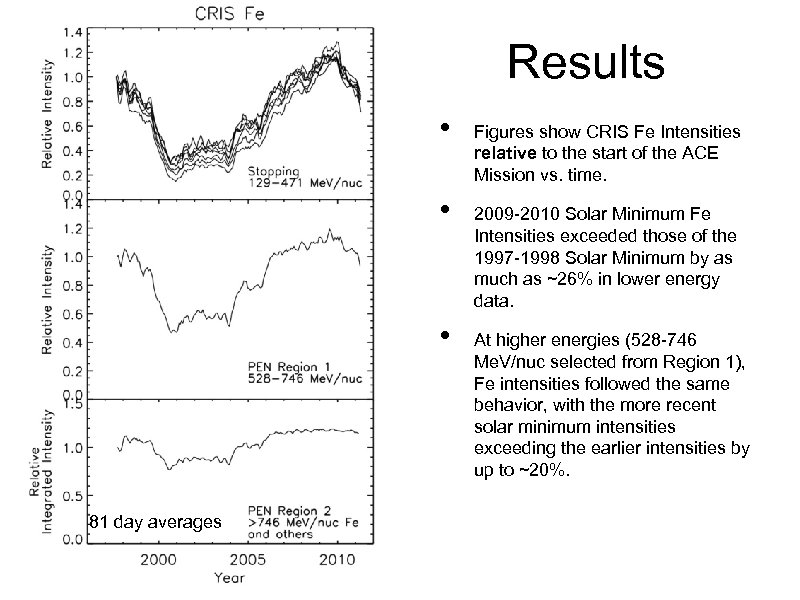 Results • • • 81 day averages Figures show CRIS Fe Intensities relative to the start of the ACE Mission vs. time. 2009 -2010 Solar Minimum Fe Intensities exceeded those of the 1997 -1998 Solar Minimum by as much as ~26% in lower energy data. At higher energies (528 -746 Me. V/nuc selected from Region 1), Fe intensities followed the same behavior, with the more recent solar minimum intensities exceeding the earlier intensities by up to ~20%.
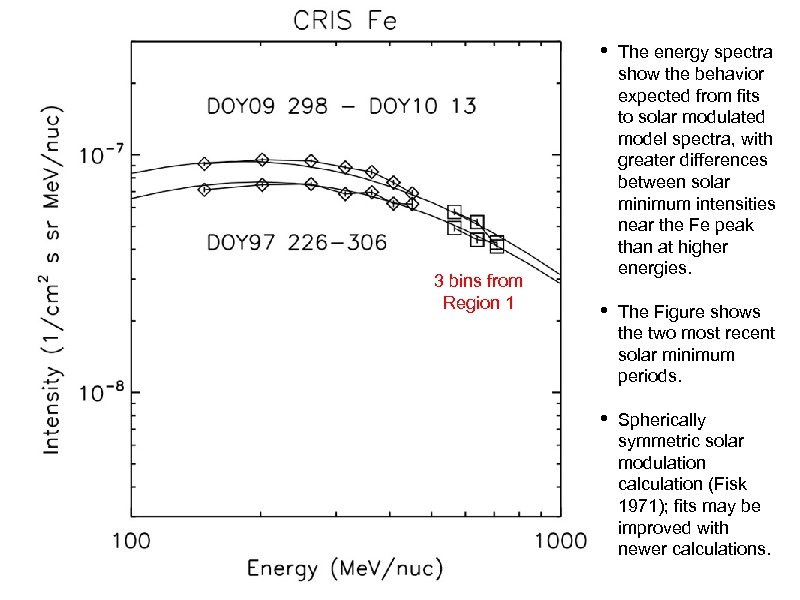 • 3 bins from Region 1 The energy spectra show the behavior expected from fits to solar modulated model spectra, with greater differences between solar minimum intensities near the Fe peak than at higher energies. • The Figure shows the two most recent solar minimum periods. • Spherically symmetric solar modulation calculation (Fisk 1971); fits may be improved with newer calculations.
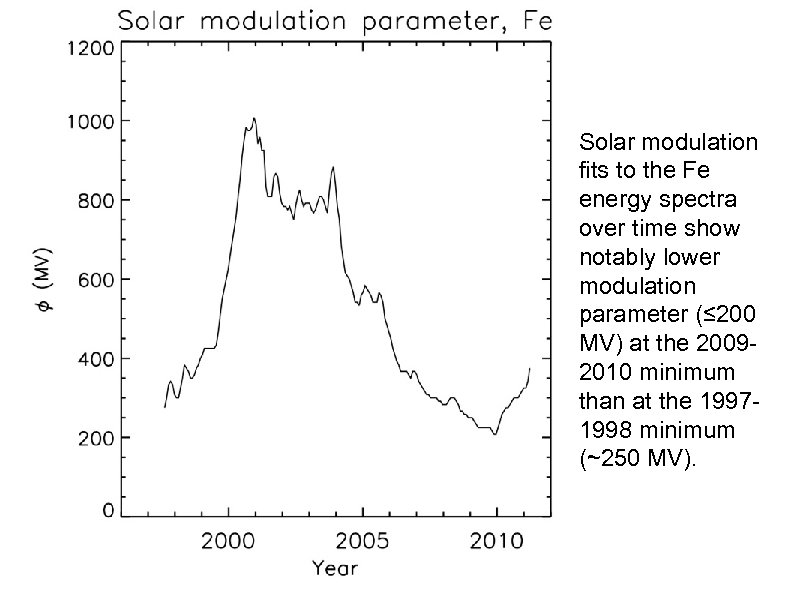 Solar modulation fits to the Fe energy spectra over time show notably lower modulation parameter (≤ 200 MV) at the 20092010 minimum than at the 19971998 minimum (~250 MV).
 Summary • • • Extending the CRIS Fe energy spectra to higher energies (~746 Me. V/nuc compared to ~471 Me. V/nuc) show reasonable continuation of the spectra from lower energies. Time dependent behavior of the higher energy Fe intensities follows the behavior of the lower energy intensities, with the 2009 -2010 solar minimum intensities up to ~20% higher than those at the 19971998 solar minimum. Extending the measurements to other elements will be straightforward.