


 Скачать презентацию Extending the Information Power Grid Throughout the Solar
086dd58f7bf84a1110d3c2d31c06eca3.ppt
- Количество слайдов: 13
 Extending the Information Power Grid Throughout the Solar System Al Globus, CSC at NASA Ames Research Center September 2000 Humanity is Gaia's ticket to the stars (Dinosaurs weren’t space-faring) http: //www. nasa. gov/~globus/papers/AIAAspace 2000. html
 Abstract 4 IPG value to Solar System exploration • help reduce launch costs and failure rates • support automation necessary to exploit solar system exploration by thousands of spacecraft 4 Problems: • low bandwidths • long latencies • intermittent communications • automated spacecraft requiring computation 4 One solution: terrestrial proxies http: //www. nasa. gov/~globus/papers/AIAAspace 2000. html
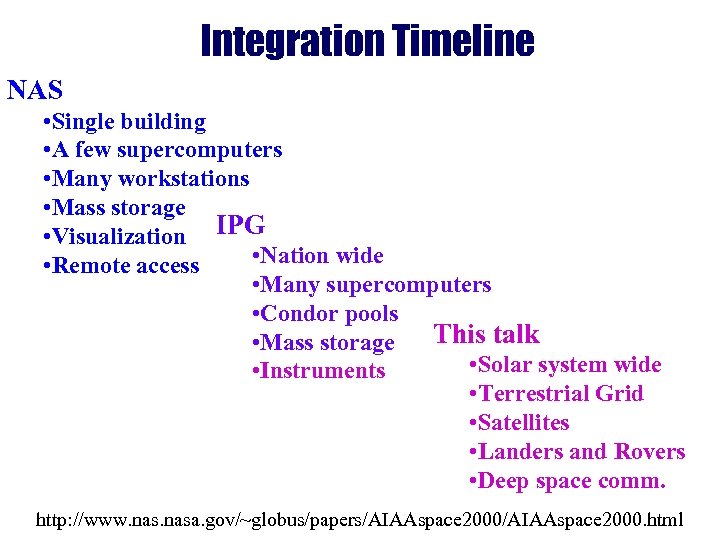 Integration Timeline NAS • Single building • A few supercomputers • Many workstations • Mass storage • Visualization IPG • Nation wide • Remote access • Many supercomputers • Condor pools This talk • Mass storage • Solar system wide • Instruments • Terrestrial Grid • Satellites • Landers and Rovers • Deep space comm. http: //www. nasa. gov/~globus/papers/AIAAspace 2000. html
 Object Oriented Grid 4 Legion (University of Virginia) 4 IPG: object oriented Grid programming environment 4 Each hardware or software resource is a object. • Independent, active, communicate asynchronously. 4 Class objects create new instances, schedule, activate, and provide metadata. 4 Users can define and build class objects. http: //www. nasa. gov/~globus/papers/AIAAspace 2000. html
 Relevant IPG Research 4 Reservations • insure CPUs available for close encounter 4 Co-scheduling • insure DSN and CPU resources available 4 Network scheduling 4 Proxies for firewalls • Extend to represent remote spacecraft to hide: – low bandwidth – long latency – intermittent communication http: //www. nasa. gov/~globus/papers/AIAAspace 2000. html
 Launch: the Key 4 Shuttle $22, 000/kg, ~1% failure rate 4 Commercial launchers, ~= cost, higher failure rate • Exception: Russian Proton reported $2600/kg – Nearly meets NASA 2010 goal $2200/kg 4 Saturn V: 100 ton to LEO @ significantly less person-hours/kg • Launched Skylab space station with one flight 4 Commercial airlines: ~$10/kg, ~1 fatal failure per 2, 000 flights, 100 s million persons/yr 4 This is the problem. http: //www. nasa. gov/~globus/papers/AIAAspace 2000. html
 Launch Data Systems 4 Space Shuttle Independent Assessment Team (SIAT): major opportunities for information technology. • Wiring trend data were very difficult to develop. 4 Surprisingly large fraction of launch failures are directly attributable to information technology failures. • Sea Launch second flight. 4 NASA 2020 goal: $220/kg to orbit with a 0. 01% failure rate, enabling space tourism • Will require much better RLV data systems http: //www. nasa. gov/~globus/papers/AIAAspace 2000. html
 IPG Launch Data System Vision 4 Complete database: human and machine readable 4 Software agent architecture for continuous examination of the database 4 Large computational capabilities 4 Model based reasoning 4 Wearable computers/augmented reality 4 Multi-user virtual reality optimized for launch decision support 4 Automated computationally-intensive software testing http: //www. nasa. gov/~globus/papers/AIAAspace 2000. html
 Solar System Exploration 4 High launch cost of launch = small number exploration satellites • one-of-a-kind personnel-intensive ground stations. 4 Model based autonomy = autonomous spacecraft 4 Requirement drivers • Autonomous spacecraft use of IPG resources • low bandwidths • long latencies • intermittent communications http: //www. nasa. gov/~globus/papers/AIAAspace 2000. html
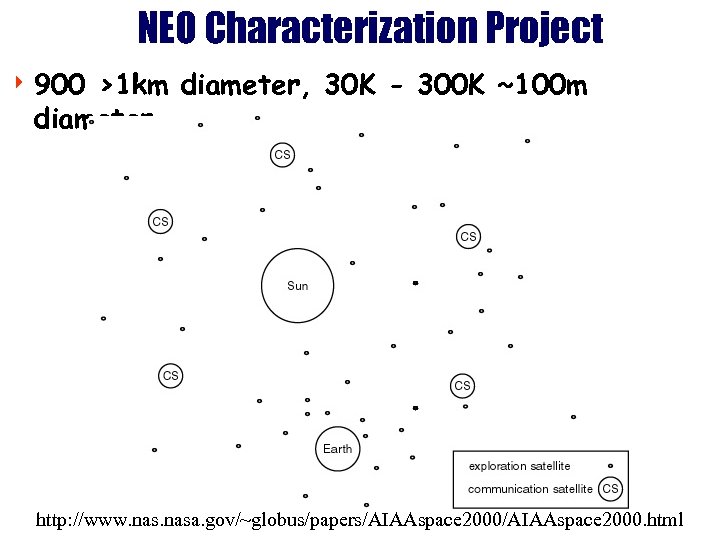 NEO Characterization Project 4 900 >1 km diameter, 30 K - 300 K ~100 m diameter http: //www. nasa. gov/~globus/papers/AIAAspace 2000. html
 Each Spacecraft, Lander, and Rover 4 Represented by an on-board software object. 4 Communicates with terrestrial proxies to hide communication problems • know schedule for co-scheduling and reservations 4 Data stored in Web-accessible archives • virtual solar system 4 Controlled access using IPG security for computational editing http: //www. nasa. gov/~globus/papers/AIAAspace 2000. html
 Spacecraft Use of IPG 4 Autonomous vehicles require occasional largescale processing • trajectory analysis • rendezvous plan generation • surface hardness prediction for choosing sampling sites 4 Proxy negotiates for CPU resources, saves results for next communication window 4 Proxy reserves co-scheduled resources for data analysis during encounters http: //www. nasa. gov/~globus/papers/AIAAspace 2000. html
 Summary 4 IPG vision is an integrated nationwide network of computers, databases, and instruments. 4 IPG throughout the solar system • improve launch costs and failure rates • support thousands of automated spacecraft 4 Low bandwidth, long latencies, intermittent communications may be handled by proxies 4 Proxies can also gather IPG resources to service autonomous spacecraft needs 4 Reach for the Stars! http: //www. nasa. gov/~globus/papers/AIAAspace 2000. html