 Скачать презентацию Ext Miner Combining Multiple Ranking and Clustering Algorithms
644b60da38d56656e7b3e6def6e64fa6.ppt
- Количество слайдов: 19



Ext. Miner: Combining Multiple Ranking and Clustering Algorithms for Structured Document Retrieval Miika Nurminen Anne Honkaranta Tommi Kärkkäinen Faculty of Information Technology University of Jyväskylä, Finland JYVÄSKYLÄN YLIOPISTO l UNIVERSITY OF JYVÄSKYLÄ 1
Motivation • Organizations are provided with overwhelming amount of digital information – New ways for retrieving, filtering and managing information are needed • People find it difficult to express their information needs as index terms and keywords – Even if they do, the retrieved sets of documents do not necessarily match the information needs • Heterogeneous document collections cannot be sufficiently searched when merely index terms are applied – (eg. Plain text vs. HTML vs. Word Doc vs. general XML) • Potential solutions: integration of text mining techniques, providing different views to documents, taking document structure to account JYVÄSKYLÄN YLIOPISTO l UNIVERSITY OF JYVÄSKYLÄ 2
Related work • Extended Vector Model (Fox et al, 1988) combines various document features (such as index terms and links) in ranking • Scatter/Gather-system (Cutting et al, 1992) introduced continuous search process based on clustering • Light. House (Leuski & Allan, 2000) featured tight integration between ranked list and visualization of clusters • (Crouch et al, 2003) have previously applied extended vector model for XML retrieval • MSEEC (Hannappel et al, 1999) presented architecture for combining multiple clustering algorithms • (Ben-Aharon et al, 2003) combined various rankers for content- and structure-based XML search JYVÄSKYLÄN YLIOPISTO l UNIVERSITY OF JYVÄSKYLÄ 3
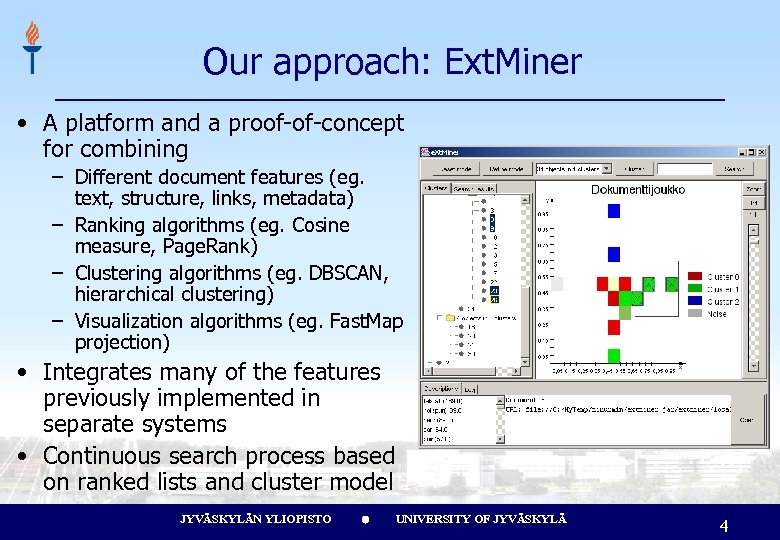
Our approach: Ext. Miner • A platform and a proof-of-concept for combining – Different document features (eg. text, structure, links, metadata) – Ranking algorithms (eg. Cosine measure, Page. Rank) – Clustering algorithms (eg. DBSCAN, hierarchical clustering) – Visualization algorithms (eg. Fast. Map projection) • Integrates many of the features previously implemented in separate systems • Continuous search process based on ranked lists and cluster model JYVÄSKYLÄN YLIOPISTO l UNIVERSITY OF JYVÄSKYLÄ 4
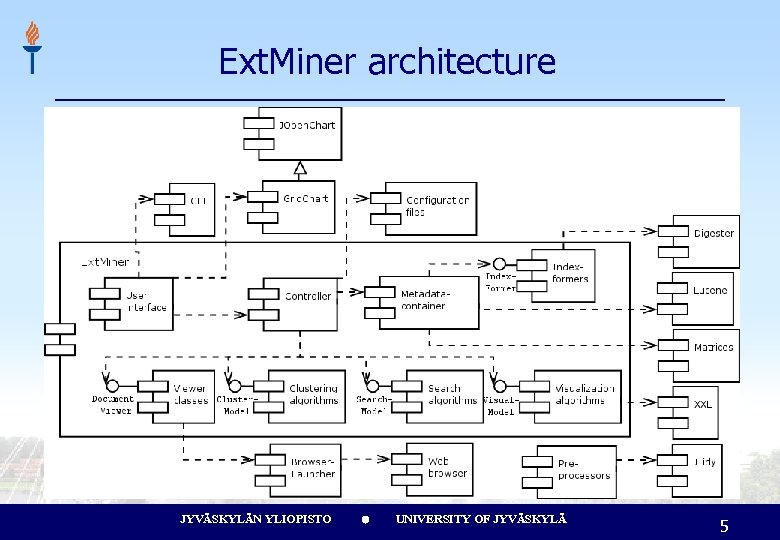
Ext. Miner architecture JYVÄSKYLÄN YLIOPISTO l UNIVERSITY OF JYVÄSKYLÄ 5
Ext. Miner architecture (decomposed) • 3 layers: UI, Application logic and Document index • Document index consists of similarity matrices and a fieldbased term/link index • Application logic includes pluggable ranking, clustering and visualization algorithms and extensible mechanism for index creation from various document repositories • UI provides customizable views for documents, ranked search result list and cluster model tree • Implemented with Java, published as open source. Third-party open source components (eg. Jakarta Lucene, JOpen. Chart) are utilized. JYVÄSKYLÄN YLIOPISTO l UNIVERSITY OF JYVÄSKYLÄ 6
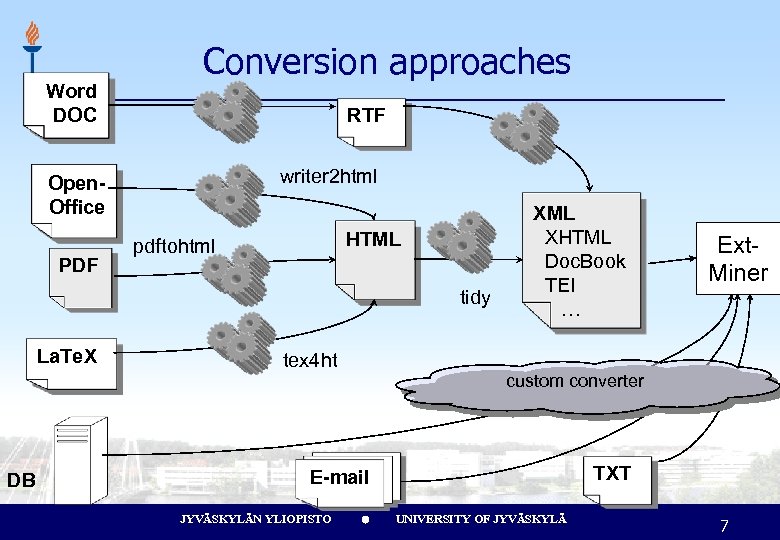
Word DOC Conversion approaches RTF writer 2 html Open. Office PDF HTML pdftohtml tidy La. Te. X DB tex 4 ht XML XHTML Doc. Book TEI … custom converter TXT E-mail JYVÄSKYLÄN YLIOPISTO Ext. Miner l UNIVERSITY OF JYVÄSKYLÄ 7
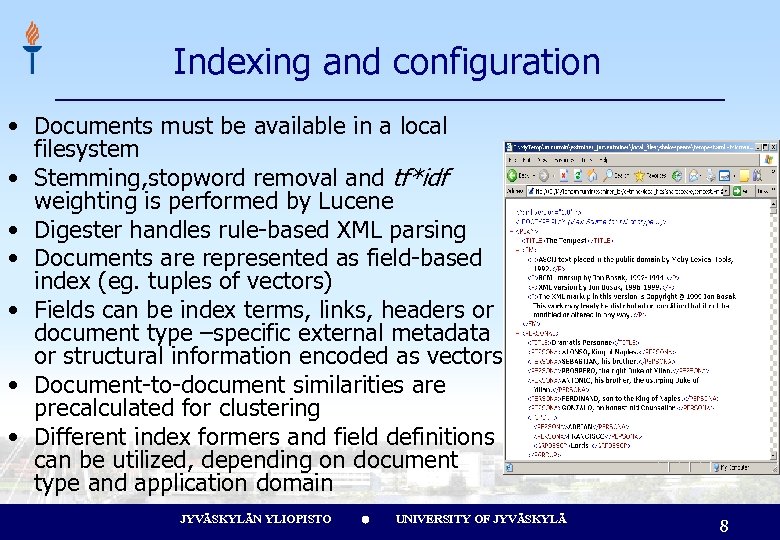
Indexing and configuration • Documents must be available in a local filesystem • Stemming, stopword removal and tf*idf weighting is performed by Lucene • Digester handles rule-based XML parsing • Documents are represented as field-based index (eg. tuples of vectors) • Fields can be index terms, links, headers or document type –specific external metadata or structural information encoded as vectors • Document-to-document similarities are precalculated for clustering • Different index formers and field definitions can be utilized, depending on document type and application domain JYVÄSKYLÄN YLIOPISTO l UNIVERSITY OF JYVÄSKYLÄ 8

Searching and clustering • Extended vector model is applied both in ranking and clustering similarity calculation • Let d be a document and q a query, both represented as tuples of n vectors (fields). Relevance estimate R is calculated as • r denotes the restriction that extracts k-th vector from the tuple, sim is the similarity measure (such as boolean matching, cosine measure or co-citation), w denotes a field-specific weight supplied by the user (or matched evenly by default) • Substitute q with another document and you have a document -to-document similarity measure for clustering • Any metric clustering algorithm can be used, provided that the implemantation is available JYVÄSKYLÄN YLIOPISTO l UNIVERSITY OF JYVÄSKYLÄ 9
User interface and visualization • Iterative search and clustering process – Search and clustering can be performed iteratively and focused to an appropriate subset of the collection • Interactive cluster model – The user can select documents from any of the views provided by the application: ranked list, cluster tree or visual projection. Cluster tree is interactive: a cluster can be marked as noise or subclusters of a single cluster can be merged (useful with hierarchical clustering) • Simultaneous views for lists and clusters – Both views are needed since lists and clusters support different search objectives. Clusters are easy to understand help to cope with ambiguous terms, although they do not improve search quality as such. • Any MDS (multidimensional scaling) –style projection algorithm can be used for visualization (currently Fast. Map) • Documents can be opened in web browser or custom viewer (eg. text editor, XML tree view) JYVÄSKYLÄN YLIOPISTO l UNIVERSITY OF JYVÄSKYLÄ 10
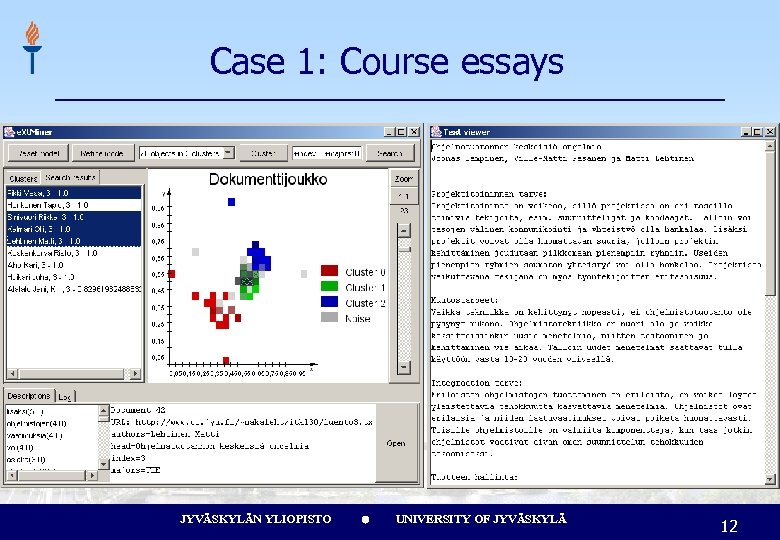
Case 1: Course essays • Introduction to Software Engineering –course was carried out in Fall 2004 at University of Jyväskylä • Each student was assigned to produce 13 essays, one for each lecture. Over 200 signed up to the course, finally over 1000 essays. • Ext. Miner was utilized for checking up and comparing the essays • Fields used: index term and headers were extracted directly from the documents. Author(s), major subject(s) and lecture number was provided as metadata. • The lecturer could retrieve essays from the collection by using each of the fields as search key • Clustering allowed cross-insecting each cluster pertaining to certain lecture or subject matter in relation to each other JYVÄSKYLÄN YLIOPISTO l UNIVERSITY OF JYVÄSKYLÄ 11
Case 1: Course essays JYVÄSKYLÄN YLIOPISTO l UNIVERSITY OF JYVÄSKYLÄ 12
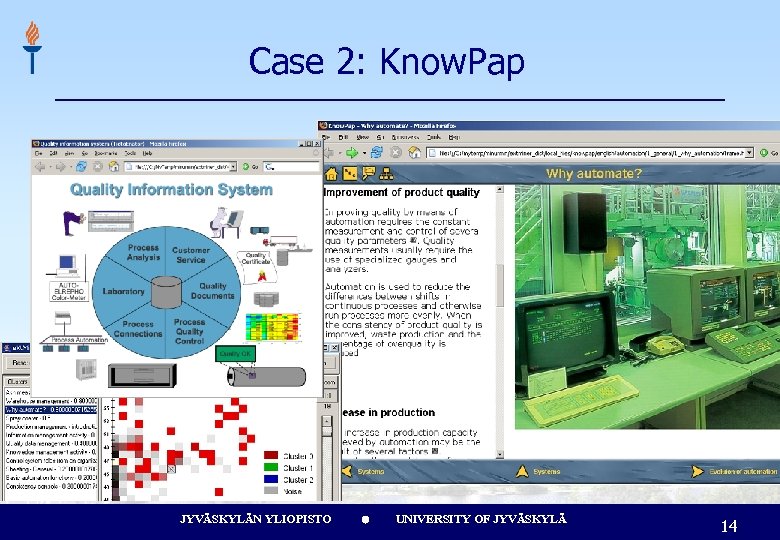
Case 2: Know. Pap • Know. Pap is an e-learning application for paper production technologies, containing a collection of HTML-documents, pictures, video clips and other education material • A subset of 300 documents was imported from Know. Pap web site and indexed in Ext. Miner • Index terms, headers and links to multimedia material (including target type) were extracted from HTML files • With multimedia link index Ext. Miner was used as a proof-ofconcept interface for browsing a simple multimedia ”database”. The user could retrieve web pages or directly multimedia material, depending on query. • Paper technology trainers could use Ext. Miner as a tool for organizing, browsing and retrieving training material components for novel training content JYVÄSKYLÄN YLIOPISTO l UNIVERSITY OF JYVÄSKYLÄ 13
Case 2: Know. Pap JYVÄSKYLÄN YLIOPISTO l UNIVERSITY OF JYVÄSKYLÄ 14
Case 3: References collection • Ext. Miner was used for organizing a collection of references for one of the authors’ thesis (title in English: Data Mining from Structured Documents) • The collection consisted of 145 HTML and PDF documents, the latter were converted to HTML as well. Documents were preprocessed and converted to XML with HTML Tidy. • Over 50% of the documents did not pass the preprocessing stage (malformed HTML, PDF files that were essentially scanned pictures etc), resulting in 69 indexable documents • Only index term and header fields were used • Documents were clustered with both DBSCAN and Group Average hierarchical clustering, resulting in roughly similar cluster models with comparable subject areas JYVÄSKYLÄN YLIOPISTO l UNIVERSITY OF JYVÄSKYLÄ 15
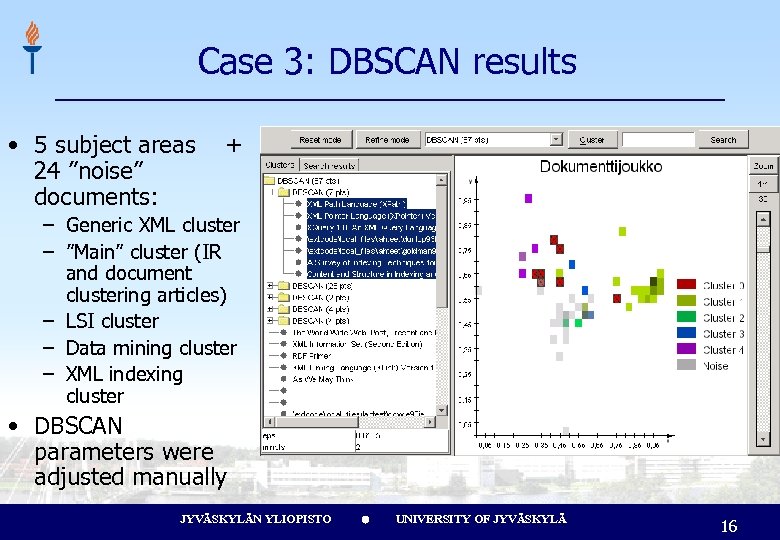
Case 3: DBSCAN results • 5 subject areas 24 ”noise” documents: + – Generic XML cluster – ”Main” cluster (IR and document clustering articles) – LSI cluster – Data mining cluster – XML indexing cluster • DBSCAN parameters were adjusted manually JYVÄSKYLÄN YLIOPISTO l UNIVERSITY OF JYVÄSKYLÄ 16
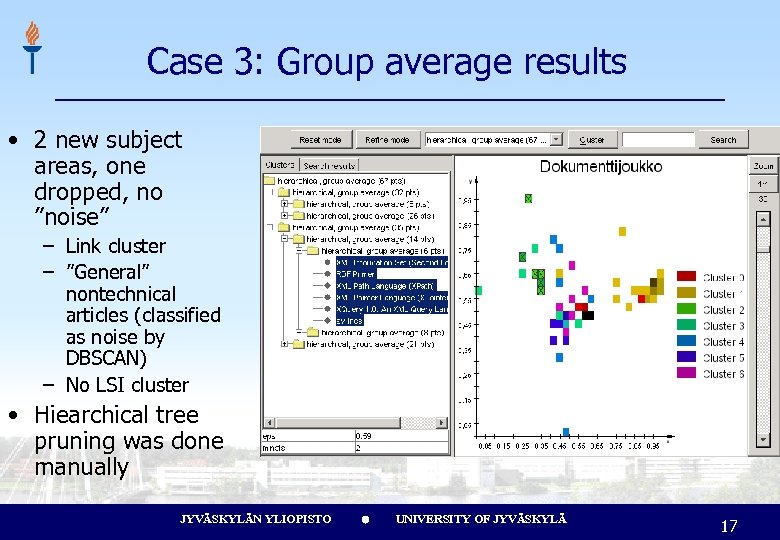
Case 3: Group average results • 2 new subject areas, one dropped, no ”noise” – Link cluster – ”General” nontechnical articles (classified as noise by DBSCAN) – No LSI cluster • Hiearchical tree pruning was done manually JYVÄSKYLÄN YLIOPISTO l UNIVERSITY OF JYVÄSKYLÄ 17
Further research • Ext. Miner shows potential to become a supporting tool for information management in SMEs or organizational workgroups • Can be used as a platform for further IR or data mining research • User interface needs further development, currently not suitable for novice users • Use of Ext. Miner requires manual work for preprocessing heterogeneous source documents • The system should be enhanced with validation functionality for evaluating search and clustering quality with standard test collections • Manual selection of clustering parameters, hierarchical tree pruning or field weights requires expertese • Clustering performance was not adequate with large (>1000) document collections because of O(n 2) time complexity (documentto-document similarities). JYVÄSKYLÄN YLIOPISTO l UNIVERSITY OF JYVÄSKYLÄ 18
Thank you! minurmin@cc. jyu. fi http: //www. mit. jyu. fi/minurmin/ http: //extminer. sf. net/ JYVÄSKYLÄN YLIOPISTO l UNIVERSITY OF JYVÄSKYLÄ 19
Скачать презентацию Ext Miner Combining Multiple Ranking and Clustering Algorithms
644b60da38d56656e7b3e6def6e64fa6.ppt