


 Скачать презентацию Expressive Power How do the sets of
c2a7b5655213a83f0f5f449ea7fe6c56.ppt
- Количество слайдов: 57
 Expressive Power • How do the sets of systems that models can describe compare? – If HRU equivalent to SPM, SPM provides more specific answer to safety question – If HRU describes more systems, SPM applies only to the systems it can describe April 13, 2004 ECS 235 1
 HRU vs. SPM • SPM more abstract – Analyses focus on limits of model, not details of representation • HRU allows revocation – SMP has no equivalent to delete, destroy • HRU allows multiparent creates – SPM cannot express multiparent creates easily, and not at all if the parents are of different types because can • create allows for only one type of creator April 13, 2004 ECS 235 2
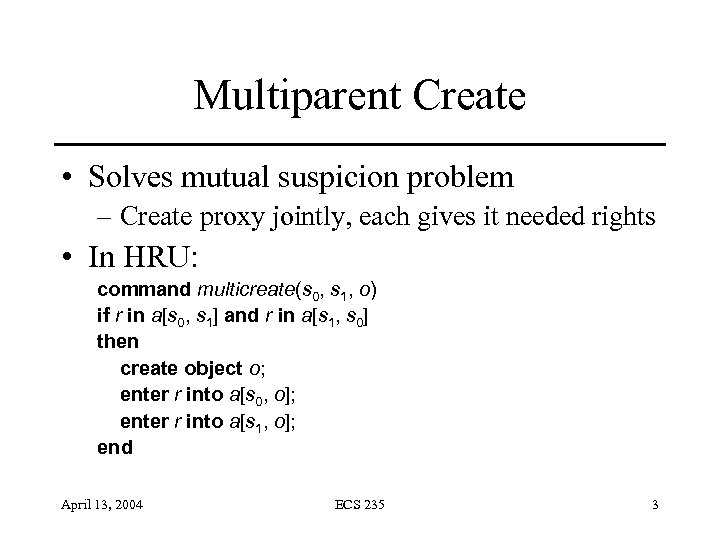 Multiparent Create • Solves mutual suspicion problem – Create proxy jointly, each gives it needed rights • In HRU: command multicreate(s 0, s 1, o) if r in a[s 0, s 1] and r in a[s 1, s 0] then create object o; enter r into a[s 0, o]; enter r into a[s 1, o]; end April 13, 2004 ECS 235 3
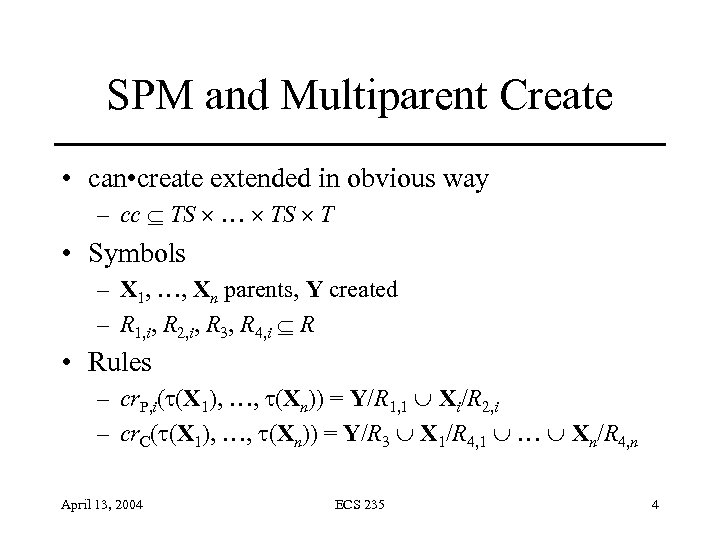 SPM and Multiparent Create • can • create extended in obvious way – cc TS … TS T • Symbols – X 1, …, Xn parents, Y created – R 1, i, R 2, i, R 3, R 4, i R • Rules – cr. P, i( (X 1), …, (Xn)) = Y/R 1, 1 Xi/R 2, i – cr. C( (X 1), …, (Xn)) = Y/R 3 X 1/R 4, 1 … Xn/R 4, n April 13, 2004 ECS 235 4
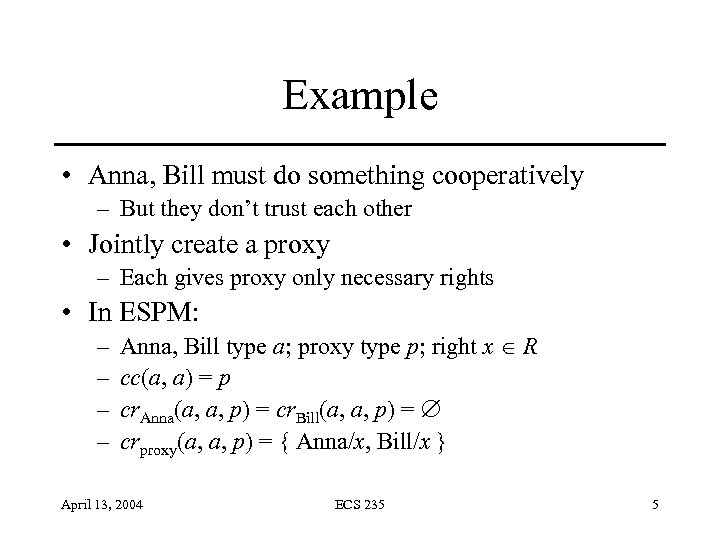 Example • Anna, Bill must do something cooperatively – But they don’t trust each other • Jointly create a proxy – Each gives proxy only necessary rights • In ESPM: – – Anna, Bill type a; proxy type p; right x R cc(a, a) = p cr. Anna(a, a, p) = cr. Bill(a, a, p) = crproxy(a, a, p) = { Anna/x, Bill/x } April 13, 2004 ECS 235 5
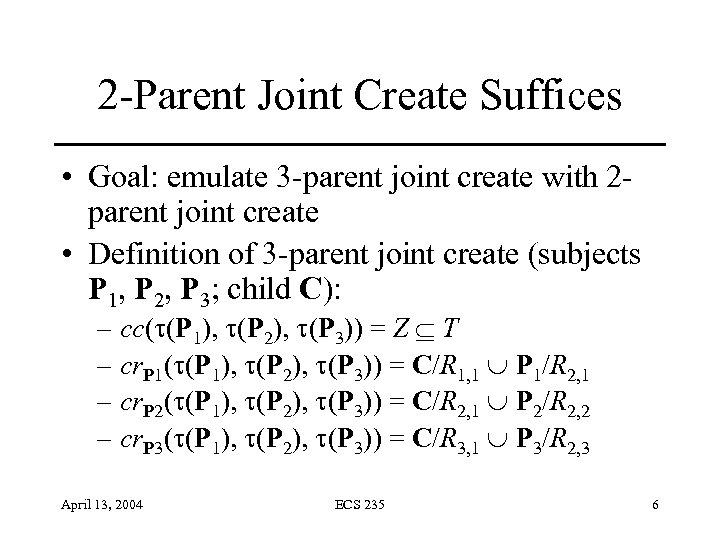 2 -Parent Joint Create Suffices • Goal: emulate 3 -parent joint create with 2 parent joint create • Definition of 3 -parent joint create (subjects P 1, P 2, P 3; child C): – cc( (P 1), (P 2), (P 3)) = Z T – cr. P 1( (P 1), (P 2), (P 3)) = C/R 1, 1 P 1/R 2, 1 – cr. P 2( (P 1), (P 2), (P 3)) = C/R 2, 1 P 2/R 2, 2 – cr. P 3( (P 1), (P 2), (P 3)) = C/R 3, 1 P 3/R 2, 3 April 13, 2004 ECS 235 6
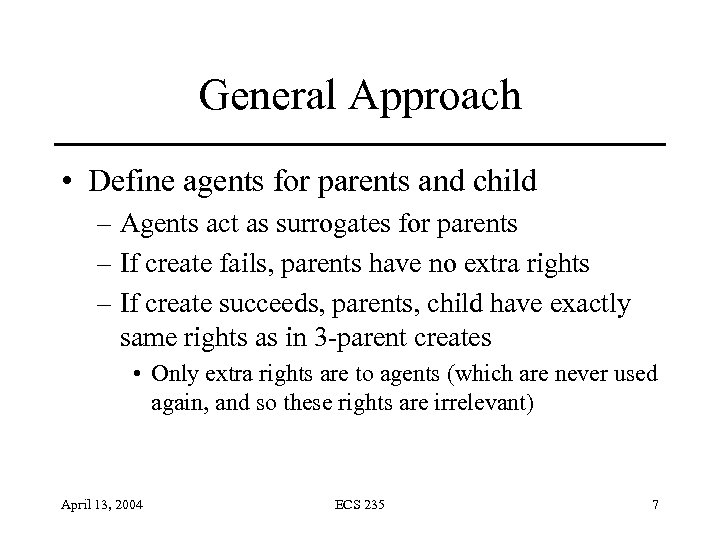 General Approach • Define agents for parents and child – Agents act as surrogates for parents – If create fails, parents have no extra rights – If create succeeds, parents, child have exactly same rights as in 3 -parent creates • Only extra rights are to agents (which are never used again, and so these rights are irrelevant) April 13, 2004 ECS 235 7
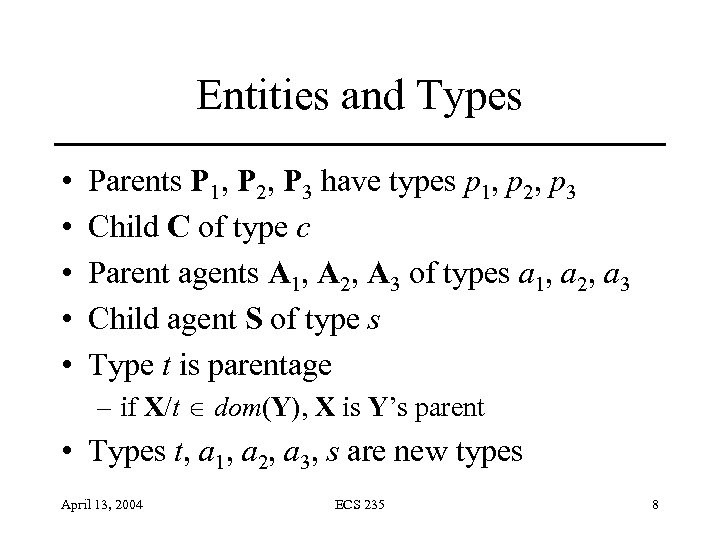 Entities and Types • • • Parents P 1, P 2, P 3 have types p 1, p 2, p 3 Child C of type c Parent agents A 1, A 2, A 3 of types a 1, a 2, a 3 Child agent S of type s Type t is parentage – if X/t dom(Y), X is Y’s parent • Types t, a 1, a 2, a 3, s are new types April 13, 2004 ECS 235 8
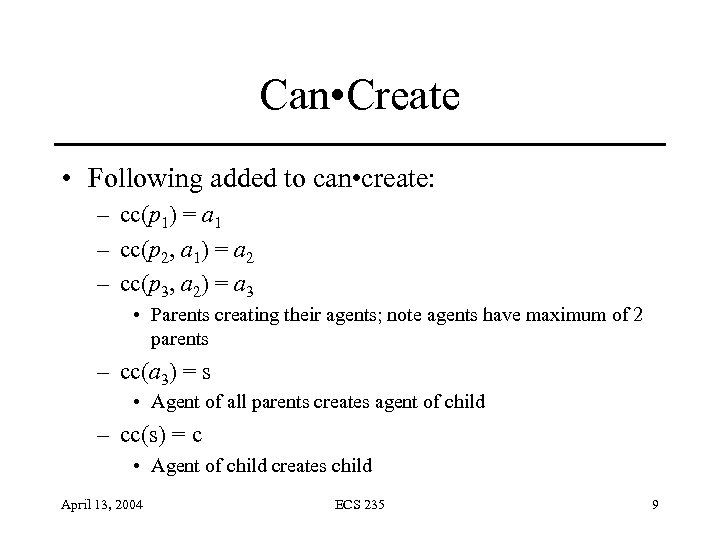 Can • Create • Following added to can • create: – cc(p 1) = a 1 – cc(p 2, a 1) = a 2 – cc(p 3, a 2) = a 3 • Parents creating their agents; note agents have maximum of 2 parents – cc(a 3) = s • Agent of all parents creates agent of child – cc(s) = c • Agent of child creates child April 13, 2004 ECS 235 9
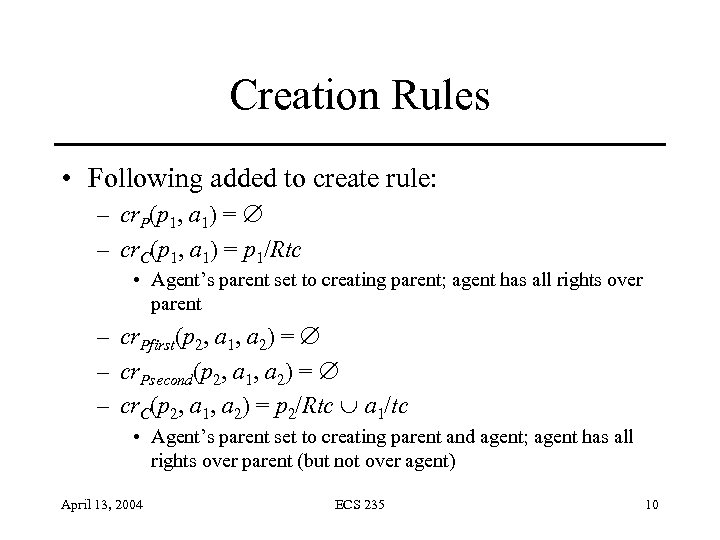 Creation Rules • Following added to create rule: – cr. P(p 1, a 1) = – cr. C(p 1, a 1) = p 1/Rtc • Agent’s parent set to creating parent; agent has all rights over parent – cr. Pfirst(p 2, a 1, a 2) = – cr. Psecond(p 2, a 1, a 2) = – cr. C(p 2, a 1, a 2) = p 2/Rtc a 1/tc • Agent’s parent set to creating parent and agent; agent has all rights over parent (but not over agent) April 13, 2004 ECS 235 10
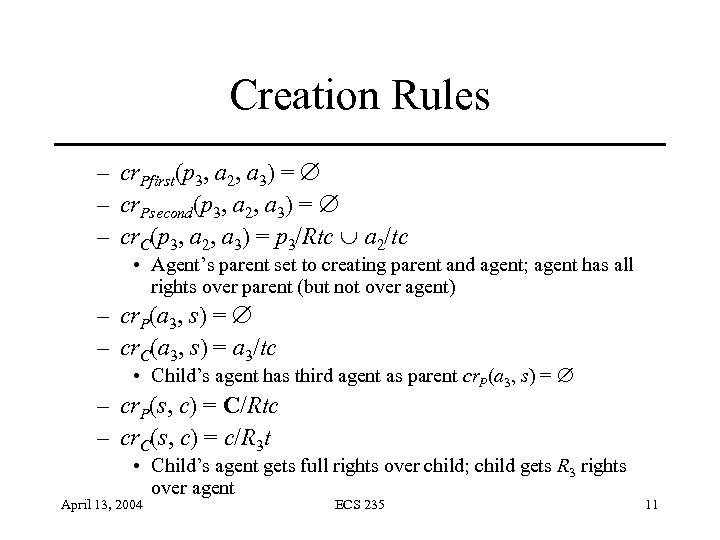 Creation Rules – cr. Pfirst(p 3, a 2, a 3) = – cr. Psecond(p 3, a 2, a 3) = – cr. C(p 3, a 2, a 3) = p 3/Rtc a 2/tc • Agent’s parent set to creating parent and agent; agent has all rights over parent (but not over agent) – cr. P(a 3, s) = – cr. C(a 3, s) = a 3/tc • Child’s agent has third agent as parent cr. P(a 3, s) = – cr. P(s, c) = C/Rtc – cr. C(s, c) = c/R 3 t • Child’s agent gets full rights over child; child gets R 3 rights over agent April 13, 2004 ECS 235 11
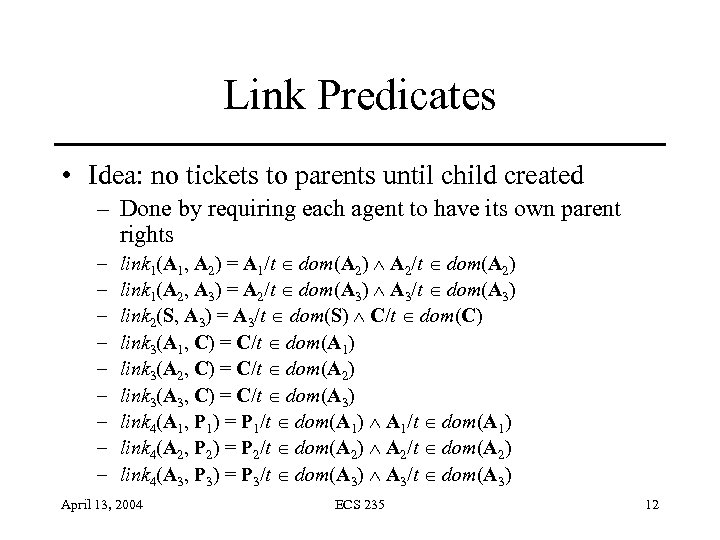 Link Predicates • Idea: no tickets to parents until child created – Done by requiring each agent to have its own parent rights – – – – – link 1(A 1, A 2) = A 1/t dom(A 2) A 2/t dom(A 2) link 1(A 2, A 3) = A 2/t dom(A 3) A 3/t dom(A 3) link 2(S, A 3) = A 3/t dom(S) C/t dom(C) link 3(A 1, C) = C/t dom(A 1) link 3(A 2, C) = C/t dom(A 2) link 3(A 3, C) = C/t dom(A 3) link 4(A 1, P 1) = P 1/t dom(A 1) A 1/t dom(A 1) link 4(A 2, P 2) = P 2/t dom(A 2) A 2/t dom(A 2) link 4(A 3, P 3) = P 3/t dom(A 3) A 3/t dom(A 3) April 13, 2004 ECS 235 12
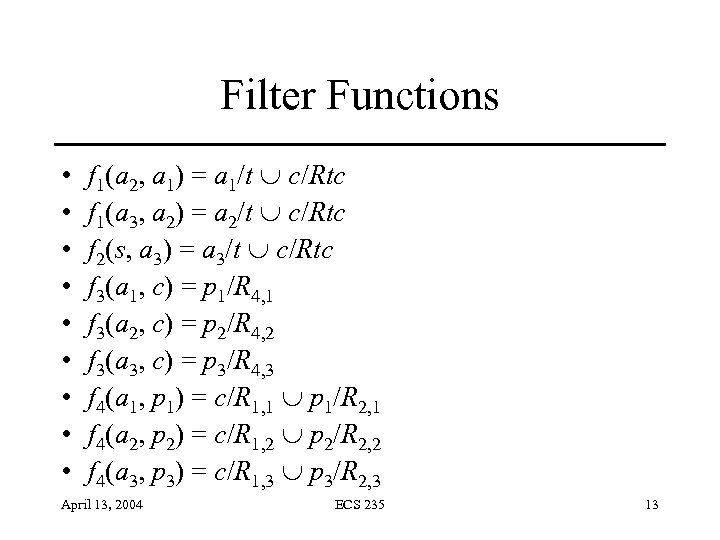 Filter Functions • • • f 1(a 2, a 1) = a 1/t c/Rtc f 1(a 3, a 2) = a 2/t c/Rtc f 2(s, a 3) = a 3/t c/Rtc f 3(a 1, c) = p 1/R 4, 1 f 3(a 2, c) = p 2/R 4, 2 f 3(a 3, c) = p 3/R 4, 3 f 4(a 1, p 1) = c/R 1, 1 p 1/R 2, 1 f 4(a 2, p 2) = c/R 1, 2 p 2/R 2, 2 f 4(a 3, p 3) = c/R 1, 3 p 3/R 2, 3 April 13, 2004 ECS 235 13
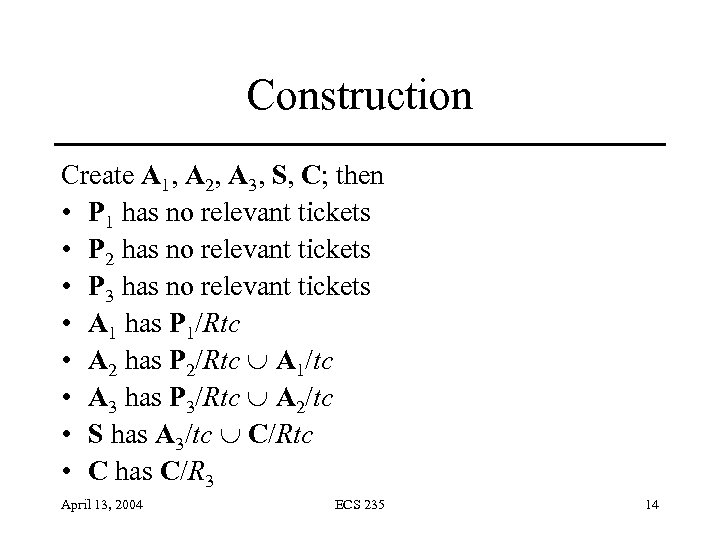 Construction Create A 1, A 2, A 3, S, C; then • P 1 has no relevant tickets • P 2 has no relevant tickets • P 3 has no relevant tickets • A 1 has P 1/Rtc • A 2 has P 2/Rtc A 1/tc • A 3 has P 3/Rtc A 2/tc • S has A 3/tc C/Rtc • C has C/R 3 April 13, 2004 ECS 235 14
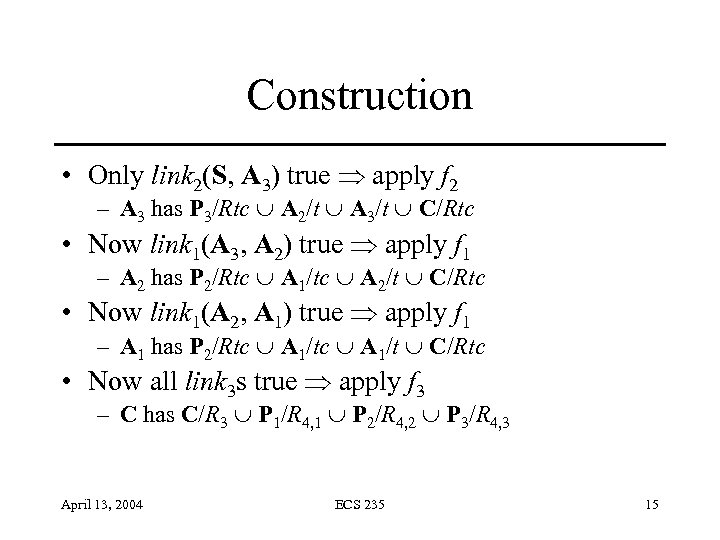 Construction • Only link 2(S, A 3) true apply f 2 – A 3 has P 3/Rtc A 2/t A 3/t C/Rtc • Now link 1(A 3, A 2) true apply f 1 – A 2 has P 2/Rtc A 1/tc A 2/t C/Rtc • Now link 1(A 2, A 1) true apply f 1 – A 1 has P 2/Rtc A 1/t C/Rtc • Now all link 3 s true apply f 3 – C has C/R 3 P 1/R 4, 1 P 2/R 4, 2 P 3/R 4, 3 April 13, 2004 ECS 235 15
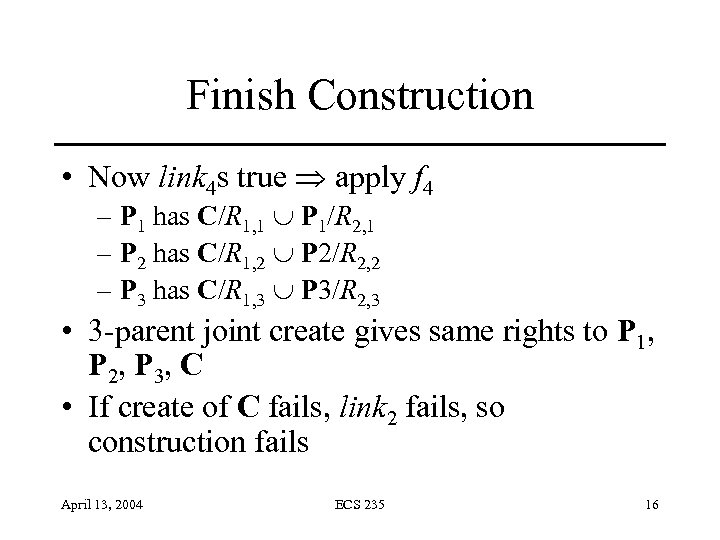 Finish Construction • Now link 4 s true apply f 4 – P 1 has C/R 1, 1 P 1/R 2, 1 – P 2 has C/R 1, 2 P 2/R 2, 2 – P 3 has C/R 1, 3 P 3/R 2, 3 • 3 -parent joint create gives same rights to P 1, P 2, P 3, C • If create of C fails, link 2 fails, so construction fails April 13, 2004 ECS 235 16
 Theorem • The two-parent joint creation operation can implement an n-parent joint creation operation with a fixed number of additional types and rights, and augmentations to the link predicates and filter functions. • Proof: by construction, as above – Difference is that the two systems need not start at the same initial state April 13, 2004 ECS 235 17
 Theorems • Monotonic ESPM and the monotonic HRU model are equivalent. • Safety question in ESPM also decidable if acyclic attenuating scheme April 13, 2004 ECS 235 18
 Expressiveness • Graph-based representation to compare models • Graph – Vertex: represents entity, has static type – Edge: represents right, has static type • Graph rewriting rules: – Initial state operations create graph in a particular state – Node creation operations add nodes, incoming edges – Edge adding operations add new edges between existing vertices April 13, 2004 ECS 235 19
 Example: 3 -Parent Joint Creation • Simulate with 2 -parent – Nodes P 1, P 2, P 3 parents – Create node C with type c with edges of type e – Add node A 1 of type a and edge from P 1 to A 1 of type e´ April 13, 2004 ECS 235 20
 Next Step • A 1, P 2 create A 2; A 2, P 3 create A 3 • Type of nodes, edges are a and e´ April 13, 2004 ECS 235 21
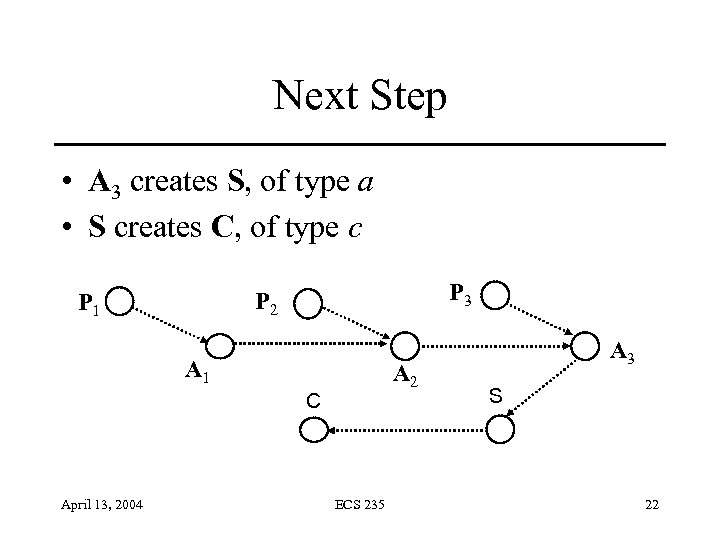 Next Step • A 3 creates S, of type a • S creates C, of type c P 3 P 2 P 1 A 2 C April 13, 2004 ECS 235 A 3 S 22
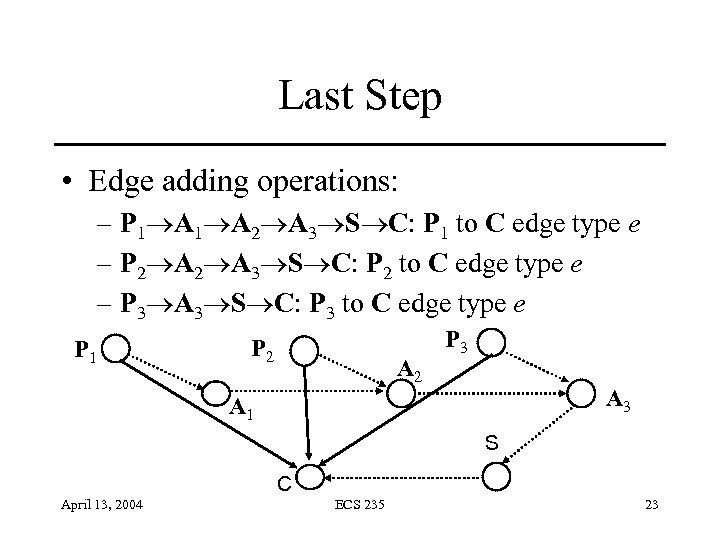 Last Step • Edge adding operations: – P 1 A 2 A 3 S C: P 1 to C edge type e – P 2 A 3 S C: P 2 to C edge type e – P 3 A 3 S C: P 3 to C edge type e P 1 P 2 A 2 P 3 A 1 S C April 13, 2004 ECS 235 23
 Definitions • Scheme: graph representation as above • Model: set of schemes • Schemes A, B correspond if graph for both is identical when all nodes with types not in A and edges with types in A are deleted April 13, 2004 ECS 235 24
 Example • Above 2 -parent joint creation simulation in scheme TWO • Equivalent to 3 -parent joint creation scheme THREE in which P 1, P 2, P 3, C are of same type as in TWO, and edges from P 1, P 2, P 3 to C are of type e, and no types a and e´ exist in TWO April 13, 2004 ECS 235 25
 Simulation Scheme A simulates scheme B iff • every state B can reach has a corresponding state in A that A can reach; and • every state that A can reach either corresponds to a state B can reach, or has a successor state that corresponds to a state B can reach – The last means that A can have intermediate states not corresponding to states in B, like the intermediate ones in TWO in the simulation of THREE April 13, 2004 ECS 235 26
 Expressive Power • If scheme in MA no scheme in MB can simulate, MB less expressive than MA • If every scheme in MA can be simulated by a scheme in MB, MB as expressive as MA • If MA as expressive as MB and vice versa, MA and MB equivalent April 13, 2004 ECS 235 27
 Example • Scheme A in model M – – – Nodes X 1, X 2, X 3 2 -parent joint create 1 node type, 1 edge type No edge adding operations Initial state: X 1, X 2, X 3, no edges • Scheme B in model N – All same as A except no 2 -parent joint create – 1 -parent create • Which is more expressive? April 13, 2004 ECS 235 28
 Can A Simulate B? • Scheme A simulates 1 -parent create: have both parents be same node – Model M as expressive as model N April 13, 2004 ECS 235 29
 Can B Simulate A? • Suppose X 1, X 2 jointly create Y in A – Edges from X 1, X 2 to Y, no edge from X 3 to Y • Can B simulate this? – Without loss of generality, X 1 creates Y – Must have edge adding operation to add edge from X 2 to Y – One type of node, one type of edge, so operation can add edge between any 2 nodes April 13, 2004 ECS 235 30
 No • All nodes in A have even number of incoming edges – 2 -parent create adds 2 incoming edges • Edge adding operation in B that can edge from X 2 to C can add one from X 3 to C – A cannot enter this state – B cannot transition to a state in which Y has even number of incoming edges • No remove rule • So B cannot simulate A; N less expressive than M April 13, 2004 ECS 235 31
 Theorem • Monotonic single-parent models are less expressive than monotonic multiparent models • ESPM more expressive than SPM – ESPM multiparent and monotonic – SPM monotonic but single parent April 13, 2004 ECS 235 32
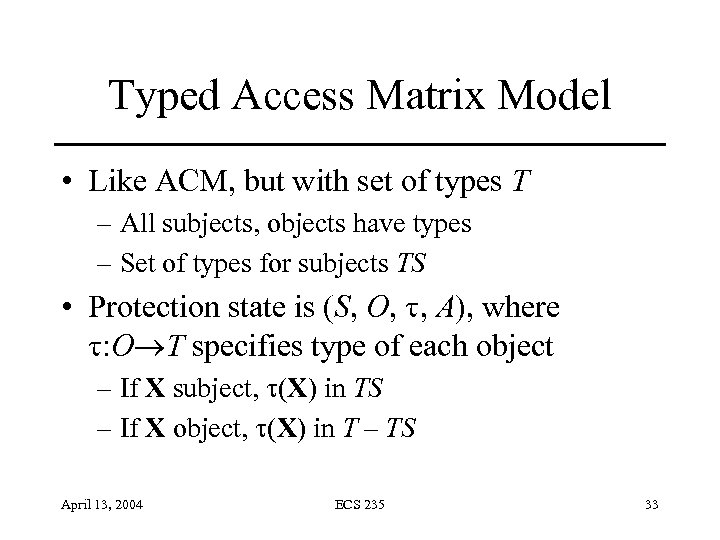 Typed Access Matrix Model • Like ACM, but with set of types T – All subjects, objects have types – Set of types for subjects TS • Protection state is (S, O, , A), where : O T specifies type of each object – If X subject, (X) in TS – If X object, (X) in T – TS April 13, 2004 ECS 235 33
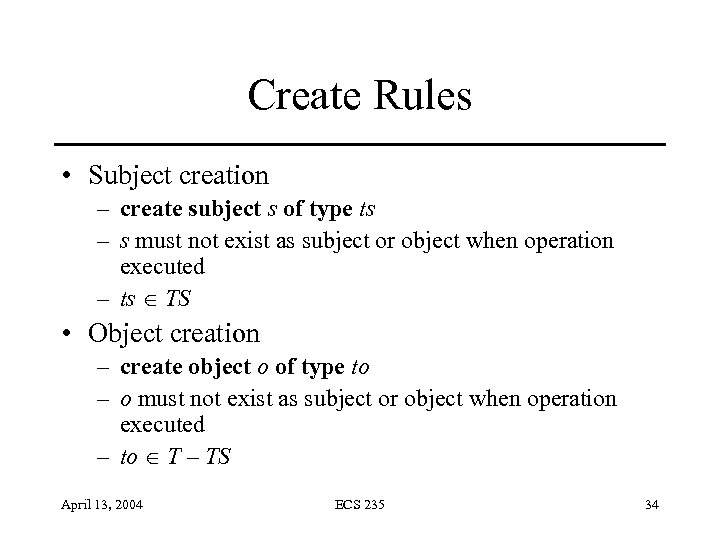 Create Rules • Subject creation – create subject s of type ts – s must not exist as subject or object when operation executed – ts TS • Object creation – create object o of type to – o must not exist as subject or object when operation executed – to T – TS April 13, 2004 ECS 235 34
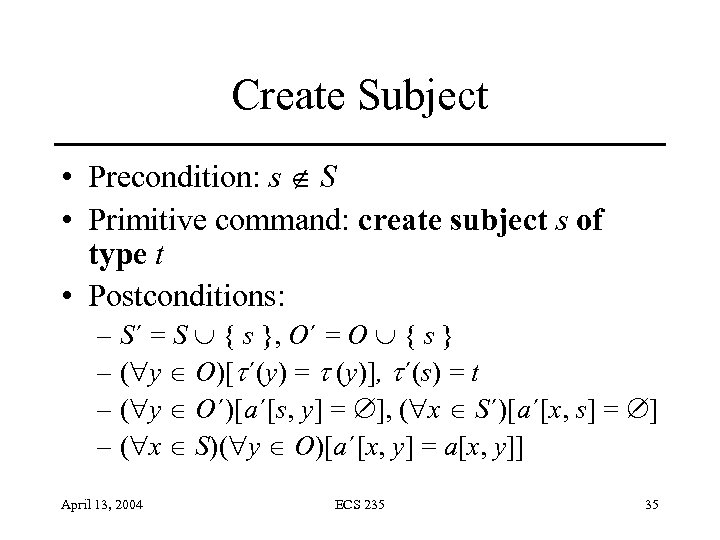 Create Subject • Precondition: s S • Primitive command: create subject s of type t • Postconditions: – S´ = S { s }, O´ = O { s } – ( y O)[ ´(y) = (y)], ´(s) = t – ( y O´)[a´[s, y] = ], ( x S´)[a´[x, s] = ] – ( x S)( y O)[a´[x, y] = a[x, y]] April 13, 2004 ECS 235 35
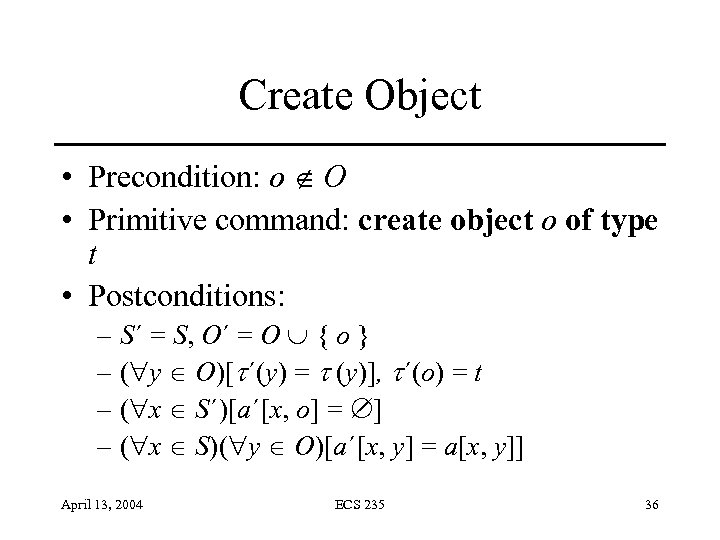 Create Object • Precondition: o O • Primitive command: create object o of type t • Postconditions: – S´ = S, O´ = O { o } – ( y O)[ ´(y) = (y)], ´(o) = t – ( x S´)[a´[x, o] = ] – ( x S)( y O)[a´[x, y] = a[x, y]] April 13, 2004 ECS 235 36
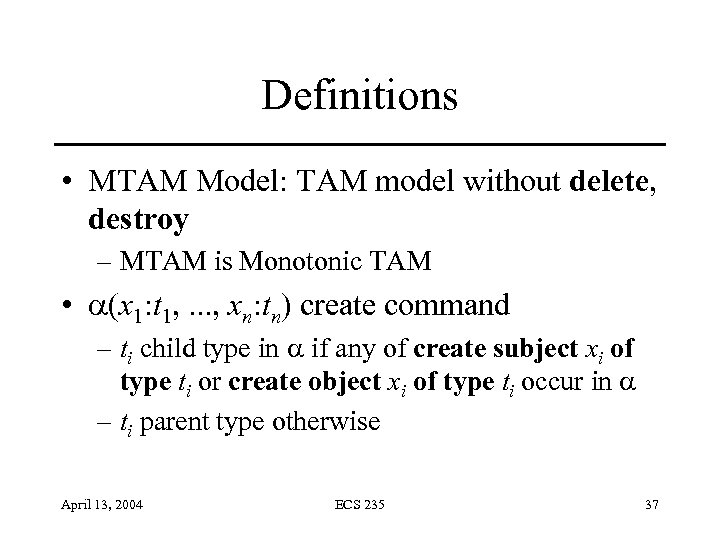 Definitions • MTAM Model: TAM model without delete, destroy – MTAM is Monotonic TAM • (x 1: t 1, . . . , xn: tn) create command – ti child type in if any of create subject xi of type ti or create object xi of type ti occur in – ti parent type otherwise April 13, 2004 ECS 235 37
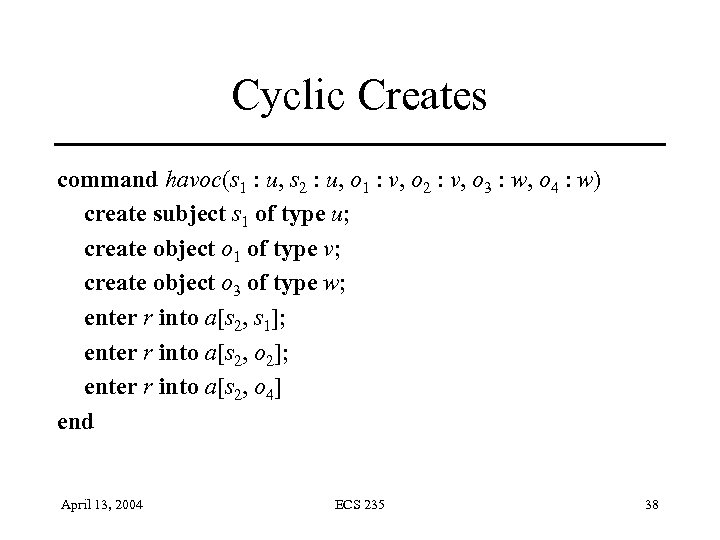 Cyclic Creates command havoc(s 1 : u, s 2 : u, o 1 : v, o 2 : v, o 3 : w, o 4 : w) create subject s 1 of type u; create object o 1 of type v; create object o 3 of type w; enter r into a[s 2, s 1]; enter r into a[s 2, o 2]; enter r into a[s 2, o 4] end April 13, 2004 ECS 235 38
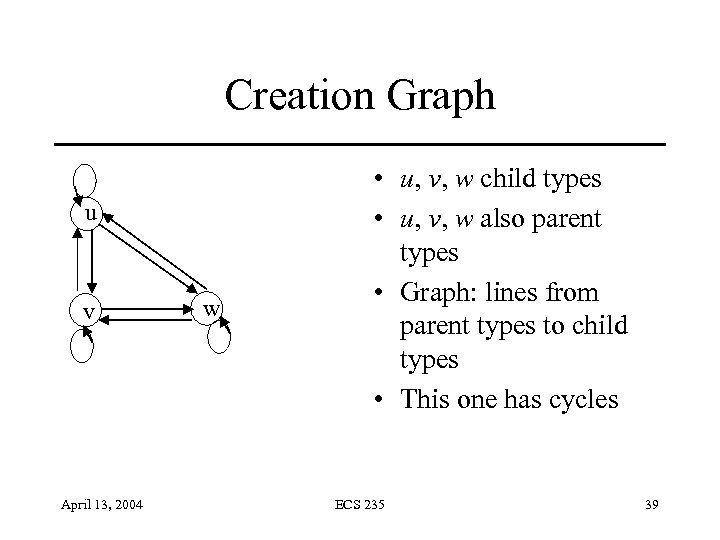 Creation Graph u v April 13, 2004 w • u, v, w child types • u, v, w also parent types • Graph: lines from parent types to child types • This one has cycles ECS 235 39
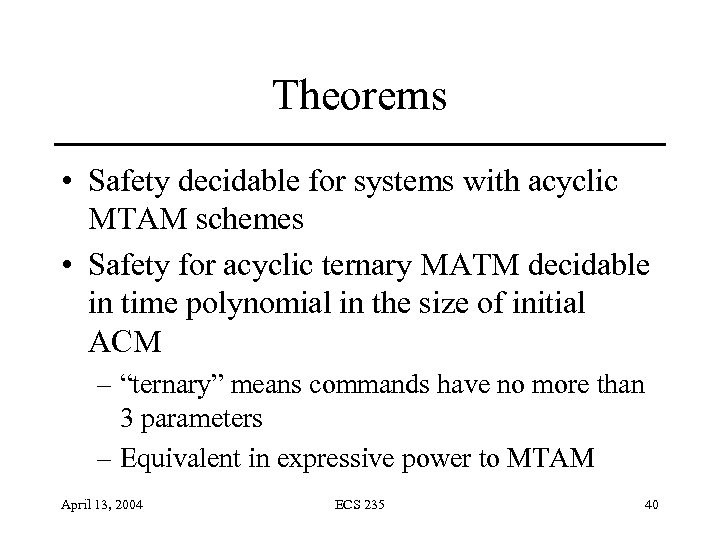 Theorems • Safety decidable for systems with acyclic MTAM schemes • Safety for acyclic ternary MATM decidable in time polynomial in the size of initial ACM – “ternary” means commands have no more than 3 parameters – Equivalent in expressive power to MTAM April 13, 2004 ECS 235 40
 Key Points • Safety problem undecidable • Limiting scope of systems can make problem decidable • Types critical to safety problem’s analysis April 13, 2004 ECS 235 41
 Overview • • • Overview Policies Trust Nature of Security Mechanisms Policy Expression Languages Limits on Secure and Precise Mechanisms April 13, 2004 ECS 235 42
 Security Policy • Policy partitions system states into: – Authorized (secure) • These are states the system can enter – Unauthorized (nonsecure) • If the system enters any of these states, it’s a security violation • Secure system – Starts in authorized state – Never enters unauthorized state April 13, 2004 ECS 235 43
 Confidentiality • X set of entities, I information • I has confidentiality property with respect to X if no x in X can obtain information from I • I can be disclosed to others • Example: – X set of students – I final exam answer key – I is confidential with respect to X if students cannot obtain final exam answer key April 13, 2004 ECS 235 44
 Integrity • X set of entities, I information • I has integrity property with respect to X if all x in X trust information in I • Types of integrity: – trust I, its conveyance and protection (data integrity) – I information about origin of something or an identity (origin integrity, authentication) – I resource: means resource functions as it should (assurance) April 13, 2004 ECS 235 45
 Availability • X set of entities, I resource • I has availability property with respect to X if all x in X can access I • Types of availability: – traditional: x gets access or not – quality of service: promised a level of access (for example, a specific level of bandwidth) and not meet it, even though some access is achieved April 13, 2004 ECS 235 46
 Policy Models • Abstract description of a policy or class of policies • Focus on points of interest in policies – Security levels in multilevel security models – Separation of duty in Clark-Wilson model – Conflict of interest in Chinese Wall model April 13, 2004 ECS 235 47
 Types of Security Policies • Military (governmental) security policy – Policy primarily protecting confidentiality • Commercial security policy – Policy primarily protecting integrity • Confidentiality policy – Policy protecting only confidentiality • Integrity policy – Policy protecting only integrity April 13, 2004 ECS 235 48
 Integrity and Transactions • Begin in consistent state – “Consistent” defined by specification • Perform series of actions (transaction) – Actions cannot be interrupted – If actions complete, system in consistent state – If actions do not complete, system reverts to beginning (consistent) state April 13, 2004 ECS 235 49
 Trust Administrator installs patch 1. Trusts patch came from vendor, not tampered with in transit 2. Trusts vendor tested patch thoroughly 3. Trusts vendor’s test environment corresponds to local environment 4. Trusts patch is installed correctly April 13, 2004 ECS 235 50
 Trust in Formal Verification • Gives formal mathematical proof that given input i, program P produces output o as specified • Suppose a security-related program S formally verified to work with operating system O • What are the assumptions? April 13, 2004 ECS 235 51
 Trust in Formal Methods 1. Proof has no errors • Bugs in automated theorem provers 2. Preconditions hold in environment in which S is to be used 3. S transformed into executable S’ whose actions follow source code – Compiler bugs, linker/loader/library problems 4. Hardware executes S’ as intended – Hardware bugs (Pentium f 00 f bug, for example) April 13, 2004 ECS 235 52
 Types of Access Control • Discretionary Access Control (DAC, IBAC) – individual user sets access control mechanism to allow or deny access to an object • Mandatory Access Control (MAC) – system mechanism controls access to object, and individual cannot alter that access • Originator Controlled Access Control (ORCON) – originator (creator) of information controls who can access information April 13, 2004 ECS 235 53
 Question • Policy disallows cheating – Includes copying homework, with or without permission • • CS class has students do homework on computer Anne forgets to read-protect her homework file Bill copies it Who cheated? – Anne, Bill, or both? April 13, 2004 ECS 235 54
 Answer Part 1 • Bill cheated – Policy forbids copying homework assignment – Bill did it – System entered unauthorized state (Bill having a copy of Anne’s assignment) • If not explicit in computer security policy, certainly implicit – Not credible that a unit of the university allows something that the university as a whole forbids, unless the unit explicitly says so April 13, 2004 ECS 235 55
 Answer Part #2 • Anne didn’t protect her homework – Not required by security policy • She didn’t breach security • If policy said students had to read-protect homework files, then Anna did breach security – She didn’t do so April 13, 2004 ECS 235 56
 Mechanisms • Entity or procedure that enforces some part of the security policy – Access controls (like bits to prevent someone from reading a homework file) – Disallowing people from bringing CDs and floppy disks into a computer facility to control what is placed on systems April 13, 2004 ECS 235 57