 Скачать презентацию EXPLOSIVE DETECTION SYSTEMS EDS Based on GAMMA RESONANCE
d152256cff9f4cc194f1d69597025728.ppt
- Количество слайдов: 54



EXPLOSIVE DETECTION SYSTEMS (EDS) Based on GAMMA RESONANCE TECHNOLOGY (GRT) Scientific Innovations Inc. Joseph H. Brondo, Jr. , CEO Brookhaven National Laboratory Lucian Wielopolski, Ph. D. Inc. Innovations SCIENTIFIC September 2002 Scientific Innovations, Inc Brookhaven National Laboratory
EDS-GRT Objectives A Joint Program by Scientific Innovations, Inc. Brookhaven National Laboratory In Collaboration with Advanced Energy Systems, Inc. NSNRC Rapid deployment of resonance technology for detection and imaging of concealed explosives, chemical warfare agents, and dirty and nuclear bombs in shipping containers Scientific Innovations, Inc Brookhaven National Laboratory
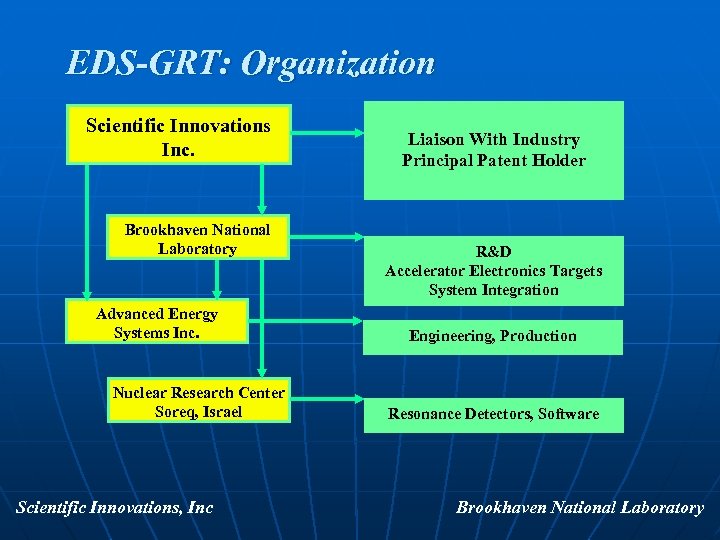
EDS-GRT: Organization Scientific Innovations Inc. Brookhaven National Laboratory Advanced Energy Systems Inc. Nuclear Research Center Soreq, Israel Scientific Innovations, Inc Liaison With Industry Principal Patent Holder R&D Accelerator Electronics Targets System Integration Engineering, Production Resonance Detectors, Software Brookhaven National Laboratory
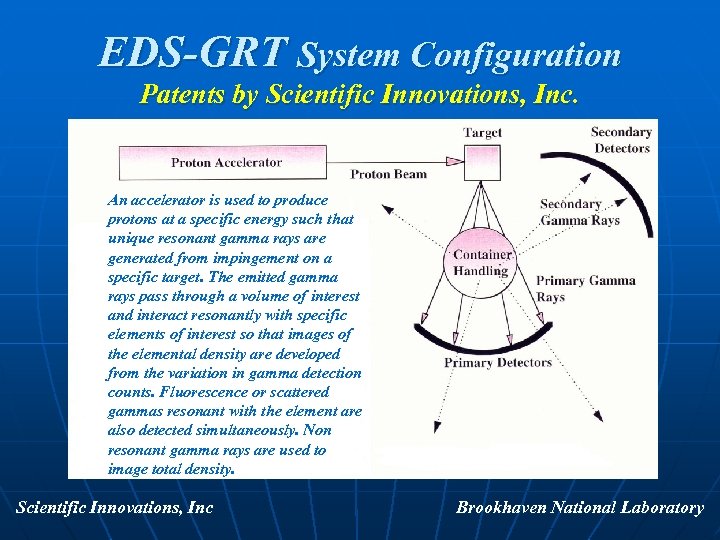
EDS-GRT System Configuration Patents by Scientific Innovations, Inc. An accelerator is used to produce protons at a specific energy such that unique resonant gamma rays are generated from impingement on a specific target. The emitted gamma rays pass through a volume of interest and interact resonantly with specific elements of interest so that images of the elemental density are developed from the variation in gamma detection counts. Fluorescence or scattered gammas resonant with the element are also detected simultaneously. Non resonant gamma rays are used to image total density. Scientific Innovations, Inc Brookhaven National Laboratory
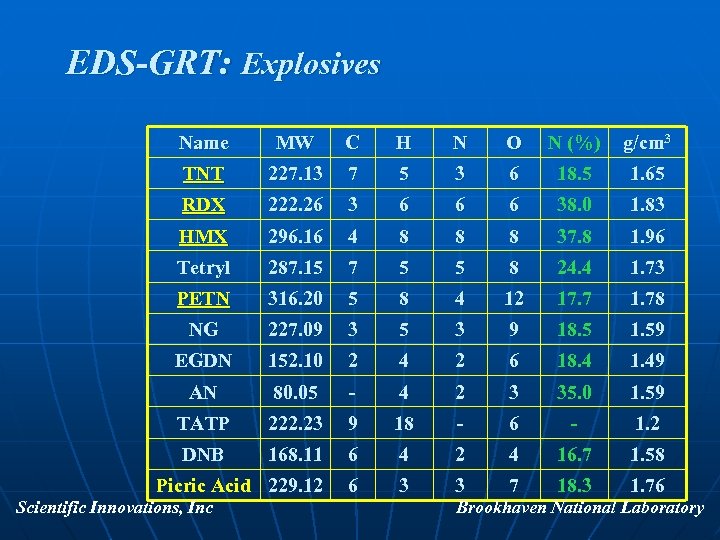
EDS-GRT: Explosives Name MW C H N O N (%) g/cm 3 TNT 227. 13 7 5 3 6 18. 5 1. 65 RDX 222. 26 3 6 6 6 38. 0 1. 83 HMX 296. 16 4 8 8 8 37. 8 1. 96 Tetryl 287. 15 7 5 5 8 24. 4 1. 73 PETN 316. 20 5 8 4 12 17. 7 1. 78 NG 227. 09 3 5 3 9 18. 5 1. 59 EGDN 152. 10 2 4 2 6 18. 4 1. 49 AN 80. 05 - 4 2 3 35. 0 1. 59 TATP 222. 23 9 18 - 6 - 1. 2 DNB 168. 11 6 4 2 4 16. 7 1. 58 Picric Acid 229. 12 6 3 3 7 18. 3 1. 76 Scientific Innovations, Inc Brookhaven National Laboratory
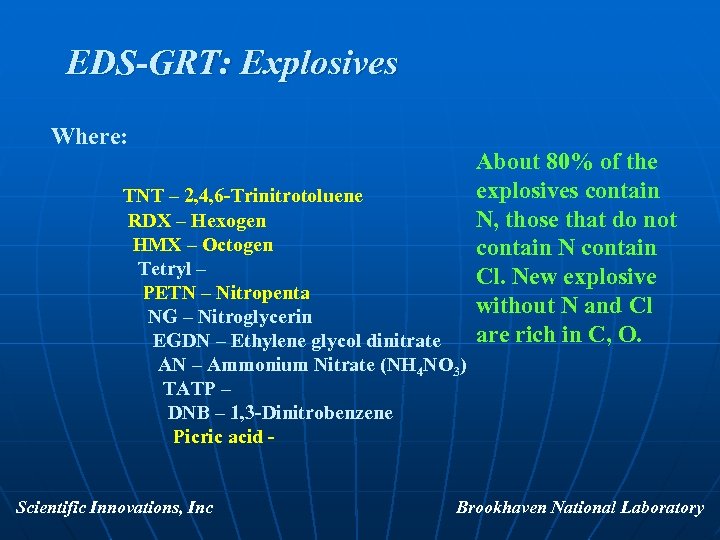
EDS-GRT: Explosives Where: TNT – 2, 4, 6 -Trinitrotoluene RDX – Hexogen HMX – Octogen Tetryl – PETN – Nitropenta NG – Nitroglycerin EGDN – Ethylene glycol dinitrate AN – Ammonium Nitrate (NH 4 NO 3) TATP – DNB – 1, 3 -Dinitrobenzene Picric acid - Scientific Innovations, Inc About 80% of the explosives contain N, those that do not contain N contain Cl. New explosive without N and Cl are rich in C, O. Brookhaven National Laboratory
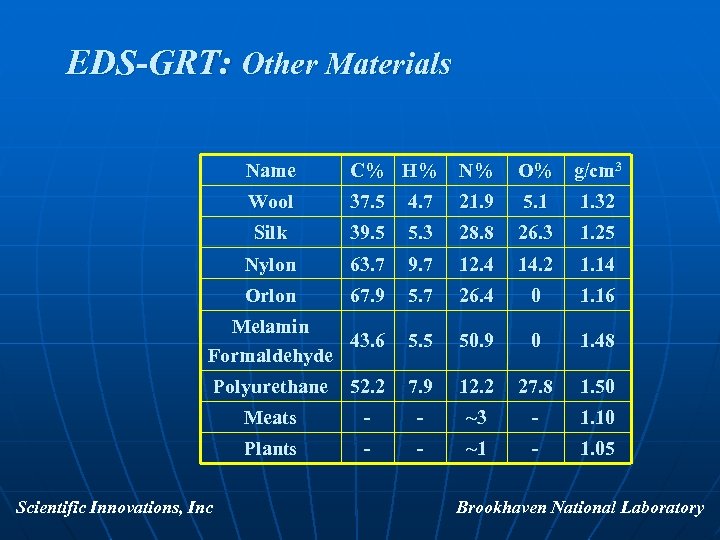
EDS-GRT: Other Materials Name C% H% N% O% g/cm 3 Wool 37. 5 4. 7 21. 9 5. 1 1. 32 Silk 39. 5 5. 3 28. 8 26. 3 1. 25 Nylon 63. 7 9. 7 12. 4 14. 2 1. 14 Orlon 67. 9 5. 7 26. 4 0 1. 16 Melamin 43. 6 Formaldehyde 5. 5 50. 9 0 1. 48 Polyurethane 52. 2 7. 9 12. 2 27. 8 1. 50 Meats - - ~3 - 1. 10 Plants - - ~1 - 1. 05 Scientific Innovations, Inc Brookhaven National Laboratory
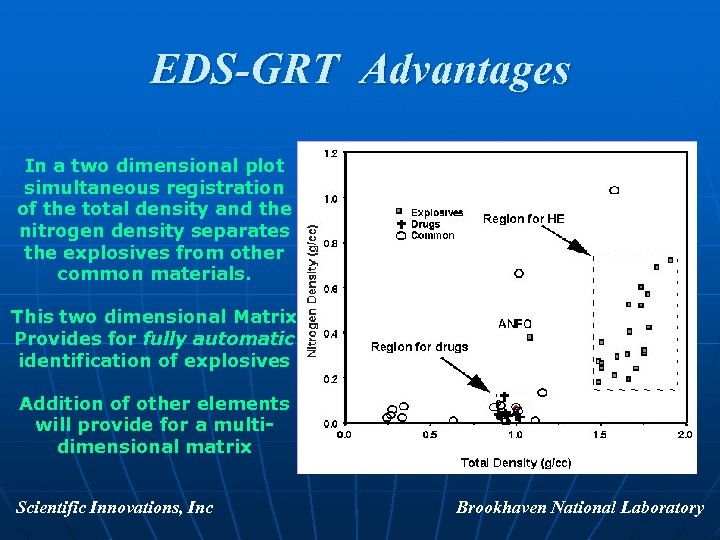
EDS-GRT Advantages In a two dimensional plot simultaneous registration of the total density and the nitrogen density separates the explosives from other common materials. This two dimensional Matrix Provides for fully automatic identification of explosives Addition of other elements will provide for a multidimensional matrix Scientific Innovations, Inc Brookhaven National Laboratory
EDS-GRT: Requirements An ideal EDS system will 1) Detect directly presence of an explosive. 2) Identify the type of explosive. 3) Localize the explosive. 4) Minimize false positives. 5) Operate reliably in the field. 6) Provide high throughput. 7) Would not induce residual activity. Scientific Innovations, Inc Brookhaven National Laboratory
EDS-GRT: Key Advantages • *High Detection Probability (>90%) • * Low False Alarm Rate (<5%) • * High Throughput (400 bags/hr/station, 24 LD-3/hr/station) • Specific Sensitivity to Explosives (N, Cl, O) • No Induced Radioactivity • Multi-port feed-through capability *Based on simulations to satisfy FAA requirements of sensitivity and throughput. Scientific Innovations, Inc Brookhaven National Laboratory
Explosive Detection Systems (EDS) based on Gamma Resonance Technology (GRT) BNL: Lucian Wielopolski, Ph. D. SII: Joseph Brondo, CEO Collaborators AES: Joseph Sredniawski, VP NSNRC: David Vartsky Ph. D. September, 2002 Scientific Innovations, Inc Brookhaven National Laboratory
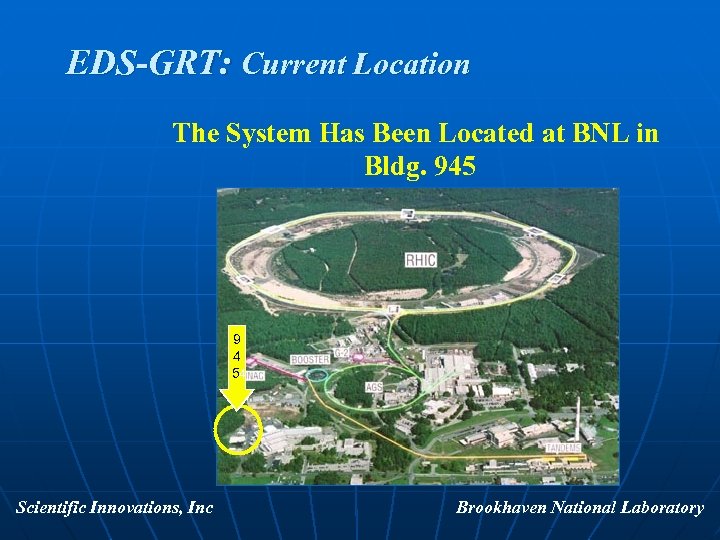
EDS-GRT: Current Location The System Has Been Located at BNL in Bldg. 945 9 4 54 Scientific Innovations, Inc Brookhaven National Laboratory
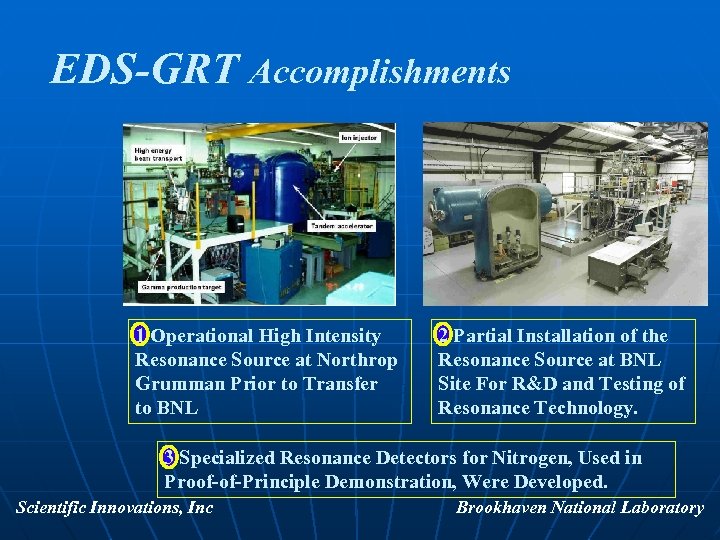
EDS-GRT Accomplishments 1 Operational High Intensity Resonance Source at Northrop Grumman Prior to Transfer to BNL 2 Partial Installation of the Resonance Source at BNL Site For R&D and Testing of Resonance Technology. 3 Specialized Resonance Detectors for Nitrogen, Used in Proof-of-Principle Demonstration, Were Developed. Scientific Innovations, Inc Brookhaven National Laboratory
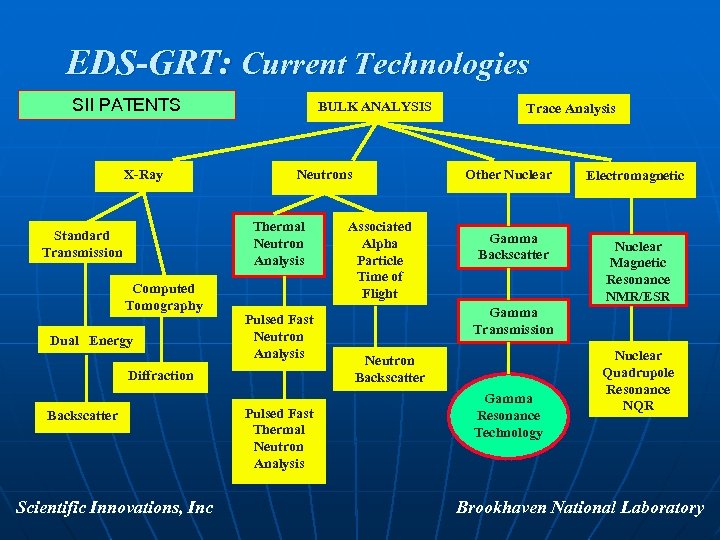
EDS-GRT: Current Technologies SII PATENTS X-Ray BULK ANALYSIS Computed Tomography Dual Energy Pulsed Fast Neutron Analysis Diffraction Backscatter Scientific Innovations, Inc Other Nuclear Neutrons Thermal Neutron Analysis Standard Transmission Pulsed Fast Thermal Neutron Analysis Trace Analysis Associated Alpha Particle Time of Flight Gamma Backscatter Electromagnetic Nuclear Magnetic Resonance NMR/ESR Gamma Transmission Neutron Backscatter Gamma Resonance Technology Nuclear Quadrupole Resonance NQR Brookhaven National Laboratory
EDS-GRT: Basic Principles Gamma Resonance occurs when the energy of a gamma beam is precisely tuned to coincide with a nuclear excitation level in a nucleus of an element of interest. GRT can be implemented in either absorption (transmission) or scattering mode. Scientific Innovations, Inc Brookhaven National Laboratory
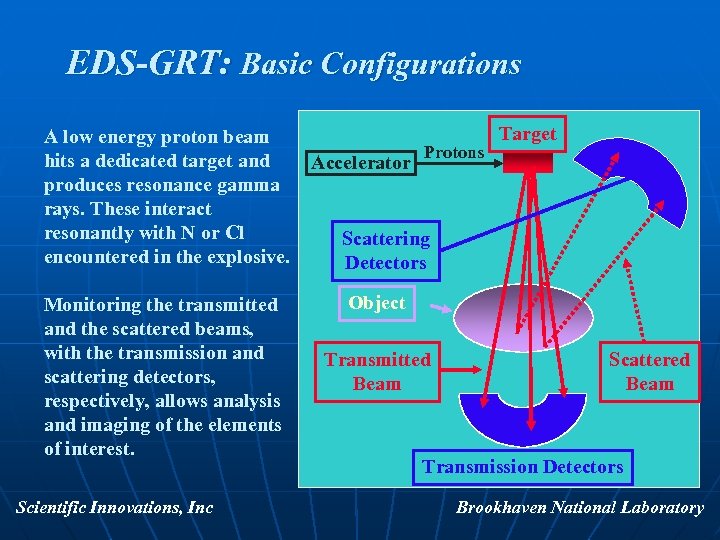
EDS-GRT: Basic Configurations A low energy proton beam hits a dedicated target and produces resonance gamma rays. These interact resonantly with N or Cl encountered in the explosive. Monitoring the transmitted and the scattered beams, with the transmission and scattering detectors, respectively, allows analysis and imaging of the elements of interest. Scientific Innovations, Inc Accelerator Protons Target Scattering Detectors Object Transmitted Beam Scattered Beam Transmission Detectors Brookhaven National Laboratory
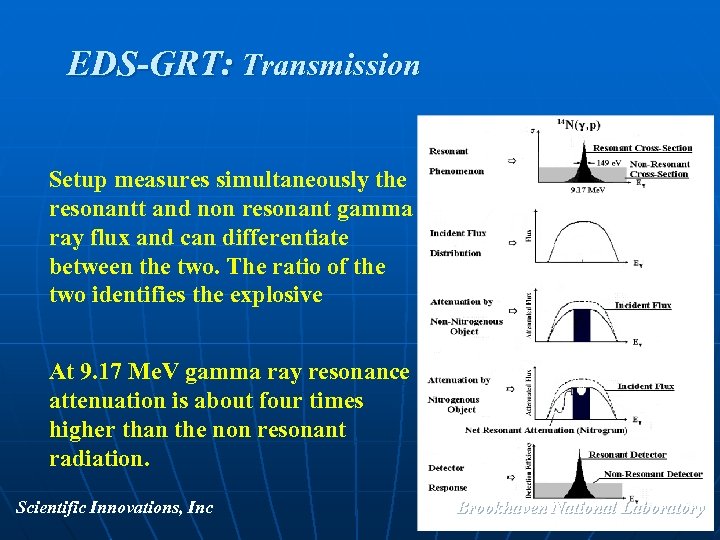
EDS-GRT: Transmission Setup measures simultaneously the resonantt and non resonant gamma ray flux and can differentiate between the two. The ratio of the two identifies the explosive At 9. 17 Me. V gamma ray resonance attenuation is about four times higher than the non resonant radiation. Scientific Innovations, Inc Brookhaven National Laboratory
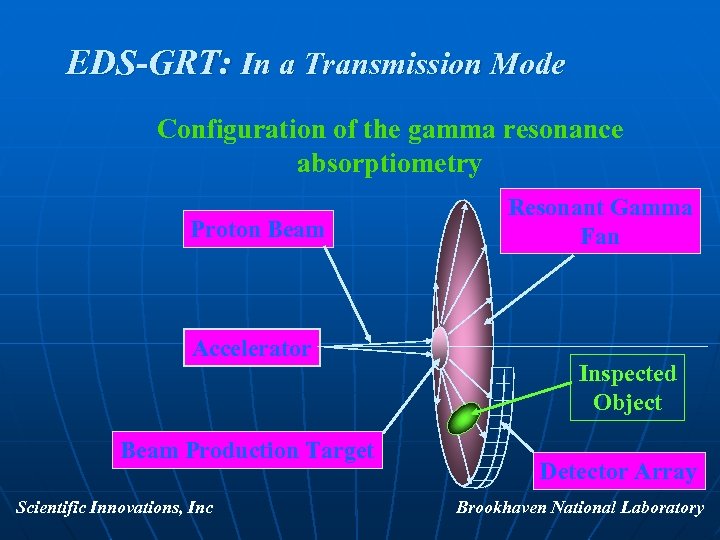
EDS-GRT: In a Transmission Mode Configuration of the gamma resonance absorptiometry Proton Beam Accelerator Beam Production Target Scientific Innovations, Inc Resonant Gamma Fan Inspected Object Detector Array Brookhaven National Laboratory

EDS-GRT Resonance Principle Gamma resonance scanning beam from accelerator based system Accelerator Proton Beam Production Target Object Detector Array Scientific Innovations, Inc SII Patents Patent 5, 040, 200 Patent 5, 293, 414 Patent 6, 215, 851 Resonant Gamma Fan Brookhaven National Laboratory
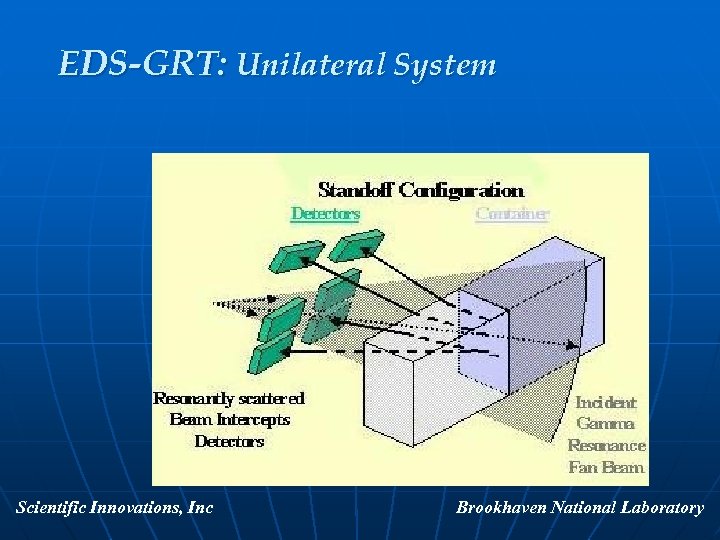
EDS-GRT: Unilateral System Scientific Innovations, Inc Brookhaven National Laboratory
EDS-GRT Accomplishments DC Tandem Accelerator Design Specifications • • Energy tunable up to Beam current, ~2 m. A, up to Total Emittance Beam spread Scientific Innovations, Inc ~ 1. 9 Me. V ~ 10 m. A ~0. 1 pi mm mrad < 25 ke. V Brookhaven National Laboratory
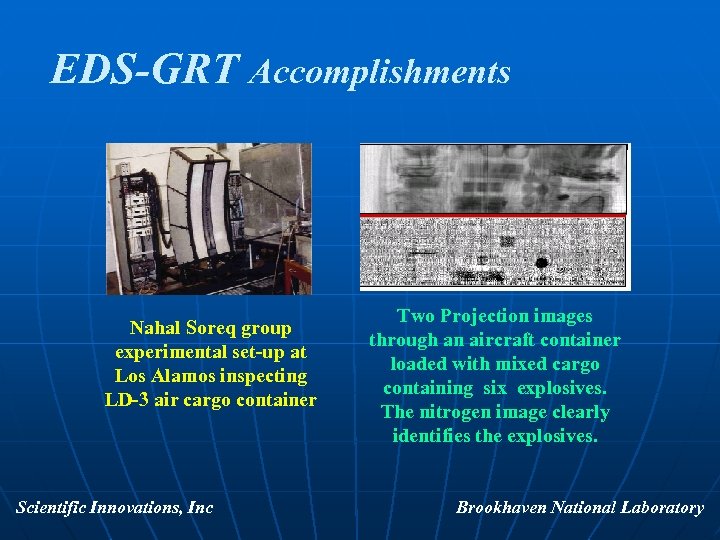
EDS-GRT Accomplishments Nahal Soreq group experimental set-up at Los Alamos inspecting LD-3 air cargo container Scientific Innovations, Inc Two Projection images through an aircraft container loaded with mixed cargo containing six explosives. The nitrogen image clearly identifies the explosives. Brookhaven National Laboratory
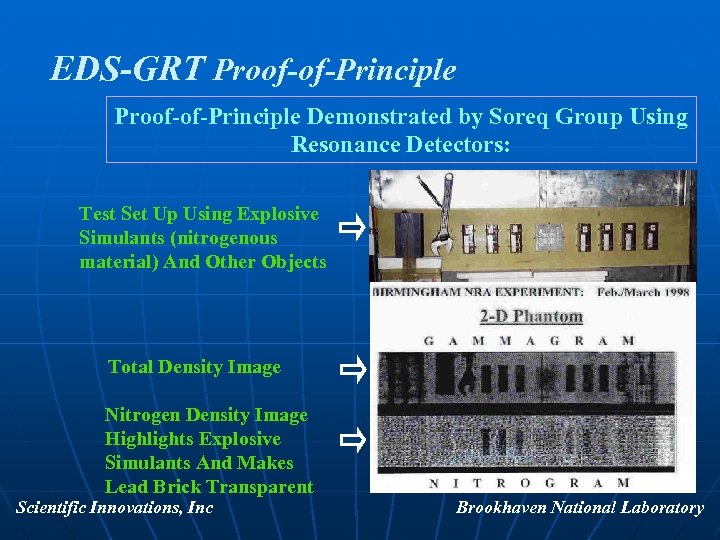
EDS-GRT Proof-of-Principle Demonstrated by Soreq Group Using Resonance Detectors: Test Set Up Using Explosive Simulants (nitrogenous material) And Other Objects Total Density Image Nitrogen Density Image Highlights Explosive Simulants And Makes Lead Brick Transparent Scientific Innovations, Inc Brookhaven National Laboratory
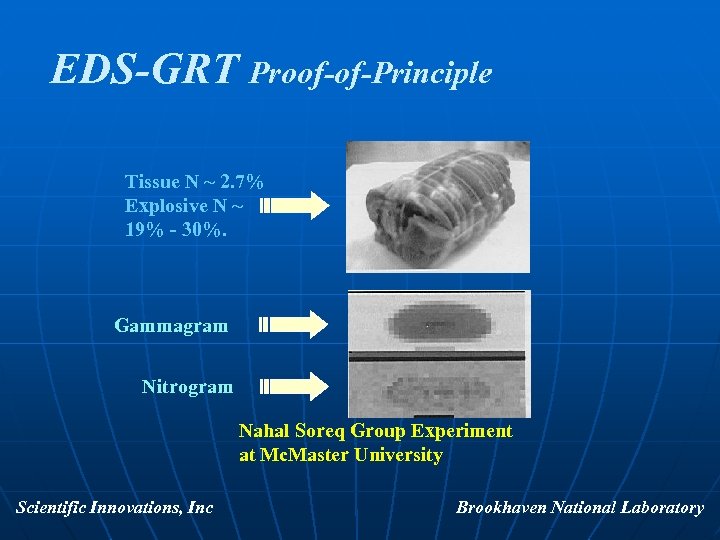
EDS-GRT Proof-of-Principle Tissue N ~ 2. 7% Explosive N ~ 19% - 30%. Gammagram Nitrogram Nahal Soreq Group Experiment at Mc. Master University Scientific Innovations, Inc Brookhaven National Laboratory
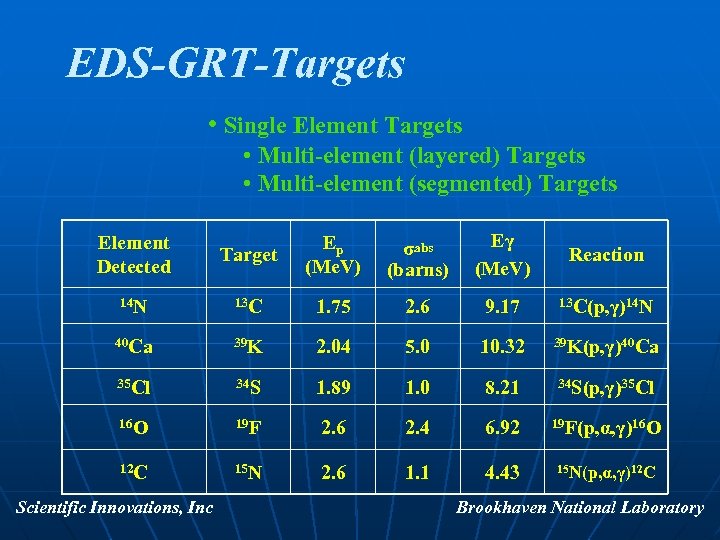
EDS-GRT-Targets • Single Element Targets • Multi-element (layered) Targets • Multi-element (segmented) Targets Target Ep (Me. V) σabs (barns) Eγ (Me. V) Reaction 14 N 13 C 1. 75 2. 6 9. 17 13 C(p, γ)14 N 40 Ca 39 K 2. 04 5. 0 10. 32 39 K(p, γ)40 Ca 35 Cl 34 S 1. 89 1. 0 8. 21 34 S(p, γ)35 Cl 16 O 19 F 2. 6 2. 4 6. 92 19 F(p, α, γ)16 O 12 C 15 N 2. 6 1. 1 4. 43 15 N(p, α, γ)12 C Element Detected Scientific Innovations, Inc Brookhaven National Laboratory
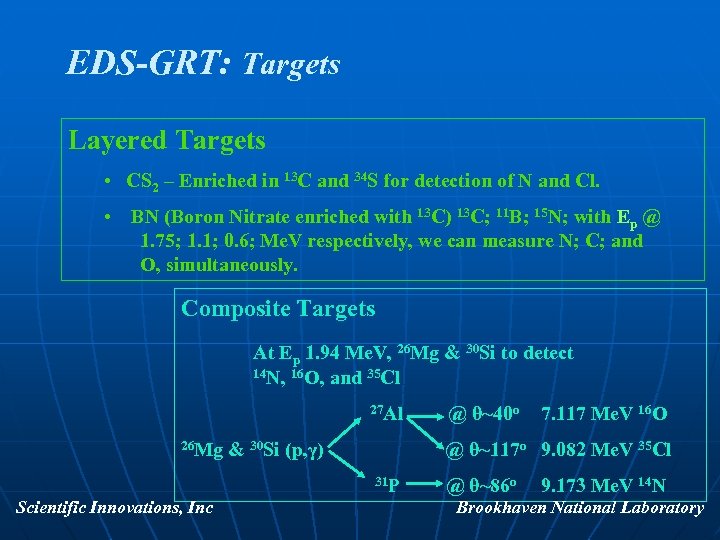
EDS-GRT: Targets Layered Targets • CS 2 – Enriched in 13 C and 34 S for detection of N and Cl. • BN (Boron Nitrate enriched with 13 C) 13 C; 11 B; 15 N; with Ep @ 1. 75; 1. 1; 0. 6; Me. V respectively, we can measure N; C; and O, simultaneously. Composite Targets At Ep 1. 94 Me. V, 26 Mg & 30 Si to detect 14 N, 16 O, and 35 Cl 27 Al 26 Mg & 30 Si (p, γ) 7. 117 Me. V 16 O @ θ~117 o 9. 082 Me. V 35 Cl 31 P Scientific Innovations, Inc @ θ~40 o @ θ~86 o 9. 173 Me. V 14 N Brookhaven National Laboratory
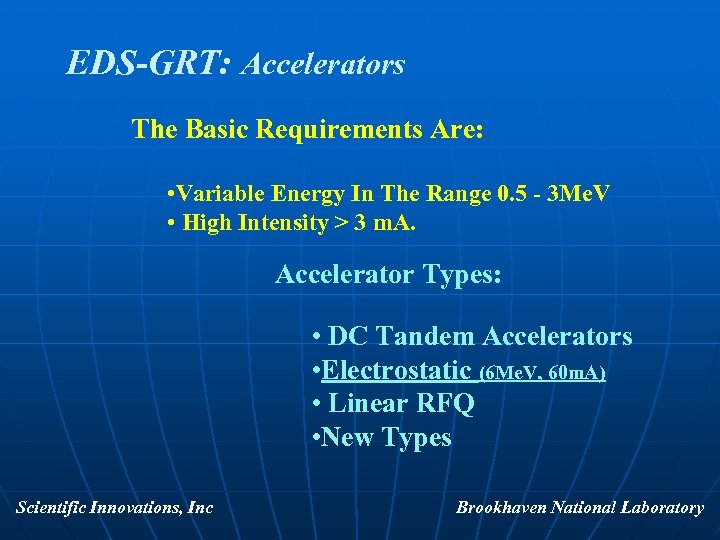
EDS-GRT: Accelerators The Basic Requirements Are: • Variable Energy In The Range 0. 5 - 3 Me. V • High Intensity > 3 m. A. Accelerator Types: • DC Tandem Accelerators • Electrostatic (6 Me. V, 60 m. A) • Linear RFQ • New Types Scientific Innovations, Inc Brookhaven National Laboratory
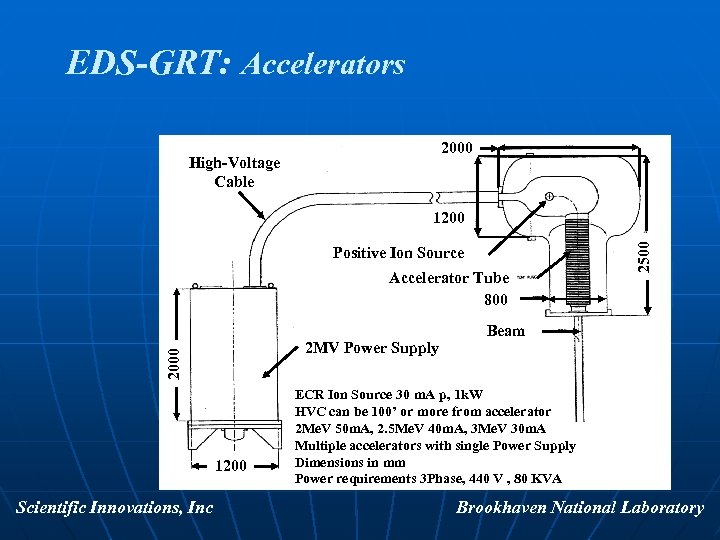
EDS-GRT: Accelerators 2000 High-Voltage Cable Positive Ion Source Accelerator Tube 800 2000 2 MV Power Supply 1200 Scientific Innovations, Inc 2500 1200 Beam ECR Ion Source 30 m. A p, 1 k. W HVC can be 100’ or more from accelerator 2 Me. V 50 m. A, 2. 5 Me. V 40 m. A, 3 Me. V 30 m. A Multiple accelerators with single Power Supply Dimensions in mm Power requirements 3 Phase, 440 V , 80 KVA Brookhaven National Laboratory
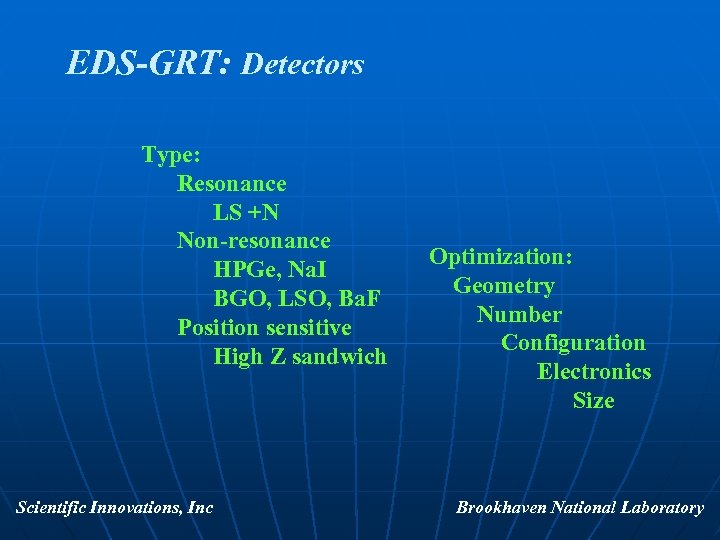
EDS-GRT: Detectors Type: Resonance LS +N Non-resonance HPGe, Na. I BGO, LSO, Ba. F Position sensitive High Z sandwich Scientific Innovations, Inc Optimization: Geometry Number Configuration Electronics Size Brookhaven National Laboratory
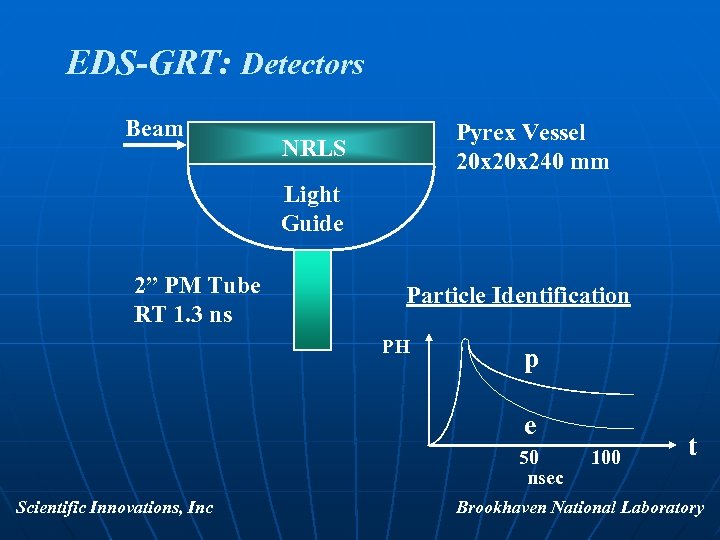
EDS-GRT: Detectors Beam Pyrex Vessel 20 x 240 mm NRLS Light Guide 2” PM Tube RT 1. 3 ns Particle Identification PH p e 50 nsec Scientific Innovations, Inc 100 t Brookhaven National Laboratory
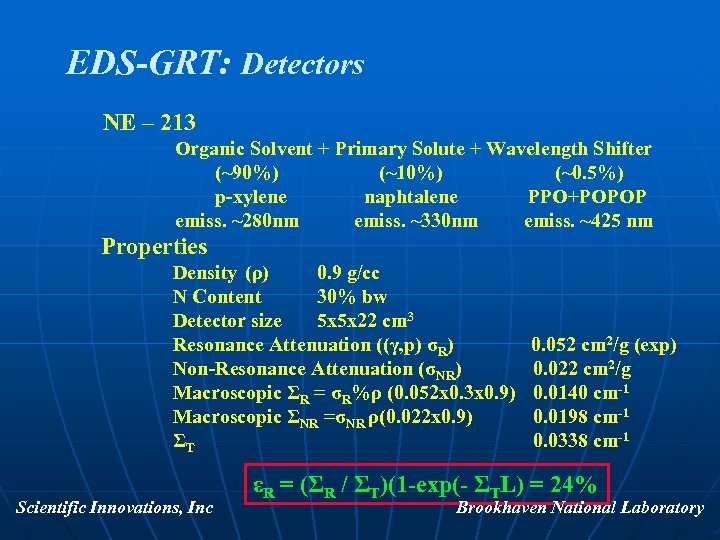
EDS-GRT: Detectors NE – 213 Organic Solvent + Primary Solute + Wavelength Shifter (~90%) (~10%) (~0. 5%) p-xylene naphtalene PPO+POPOP emiss. ~280 nm emiss. ~330 nm emiss. ~425 nm Properties Density (ρ) 0. 9 g/cc N Content 30% bw Detector size 5 x 5 x 22 cm 3 Resonance Attenuation ((γ, p) σR) Non-Resonance Attenuation (σNR) Macroscopic ΣR = σR%ρ (0. 052 x 0. 3 x 0. 9) Macroscopic ΣNR =σNR ρ(0. 022 x 0. 9) ΣT Scientific Innovations, Inc 0. 052 cm 2/g (exp) 0. 022 cm 2/g 0. 0140 cm-1 0. 0198 cm-1 0. 0338 cm-1 εR = (ΣR / ΣT)(1 -exp(- ΣTL) = 24% Brookhaven National Laboratory
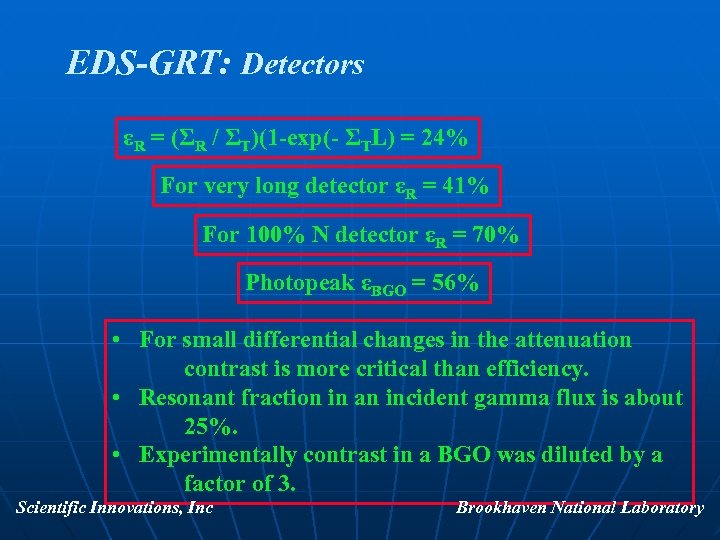
EDS-GRT: Detectors εR = (ΣR / ΣT)(1 -exp(- ΣTL) = 24% For very long detector εR = 41% For 100% N detector εR = 70% Photopeak εBGO = 56% • For small differential changes in the attenuation contrast is more critical than efficiency. • Resonant fraction in an incident gamma flux is about 25%. • Experimentally contrast in a BGO was diluted by a factor of 3. Scientific Innovations, Inc Brookhaven National Laboratory
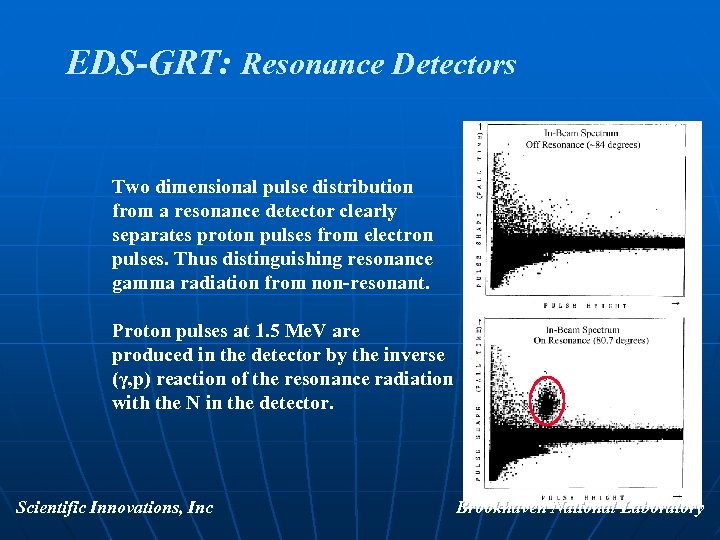
EDS-GRT: Resonance Detectors Two dimensional pulse distribution from a resonance detector clearly separates proton pulses from electron pulses. Thus distinguishing resonance gamma radiation from non-resonant. Proton pulses at 1. 5 Me. V are produced in the detector by the inverse (γ, p) reaction of the resonance radiation with the N in the detector. Scientific Innovations, Inc Brookhaven National Laboratory
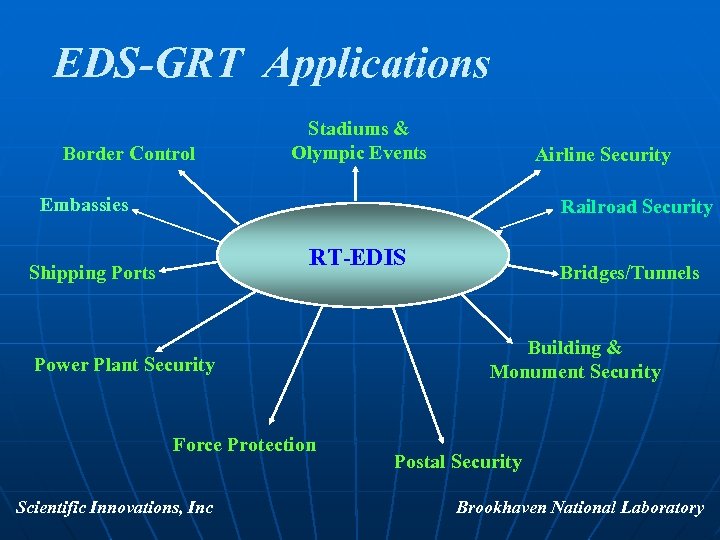
EDS-GRT Applications Border Control Stadiums & Olympic Events Airline Security Embassies Railroad Security RT-EDIS Shipping Ports Power Plant Security Force Protection Scientific Innovations, Inc Bridges/Tunnels Building & Monument Security Postal Security Brookhaven National Laboratory
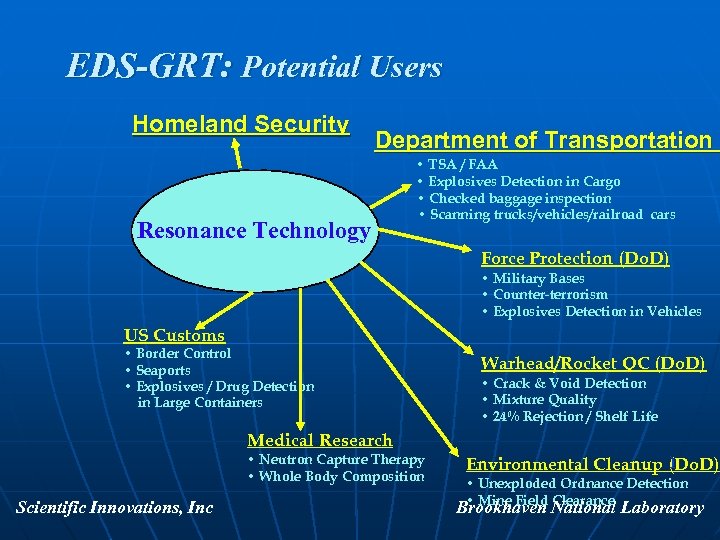
EDS-GRT: Potential Users Homeland Security Department of Transportation ( Resonance Technology • TSA / FAA • Explosives Detection in Cargo • Checked baggage inspection • Scanning trucks/vehicles/railroad cars Force Protection (Do. D) • Military Bases • Counter-terrorism • Explosives Detection in Vehicles US Customs • Border Control • Seaports • Explosives / Drug Detection in Large Containers Warhead/Rocket QC (Do. D) • Crack & Void Detection • Mixture Quality • 24% Rejection / Shelf Life Medical Research • Neutron Capture Therapy • Whole Body Composition Scientific Innovations, Inc ) Environmental Cleanup (Do. D) • Unexploded Ordnance Detection • Mine Field Clearance Brookhaven National Laboratory
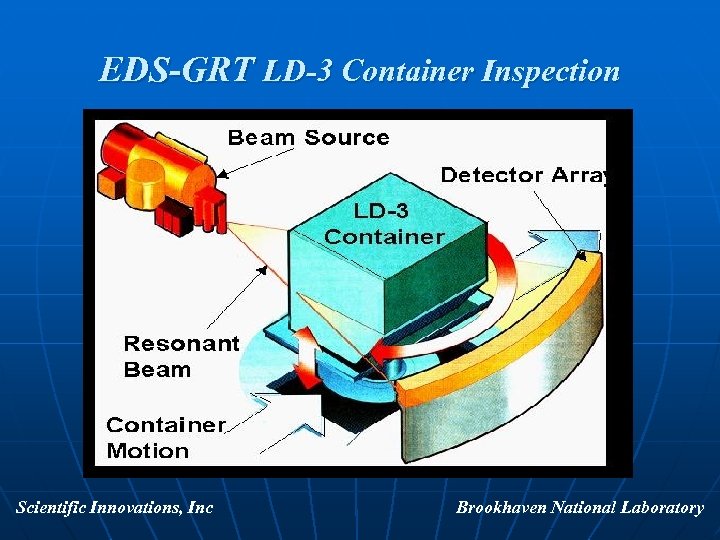
EDS-GRT LD-3 Container Inspection Scientific Innovations, Inc Brookhaven National Laboratory
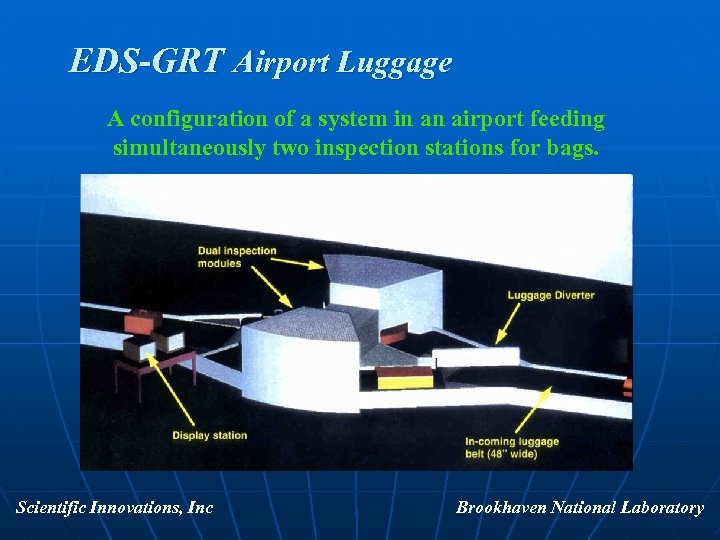
EDS-GRT Airport Luggage A configuration of a system in an airport feeding simultaneously two inspection stations for bags. Scientific Innovations, Inc Brookhaven National Laboratory
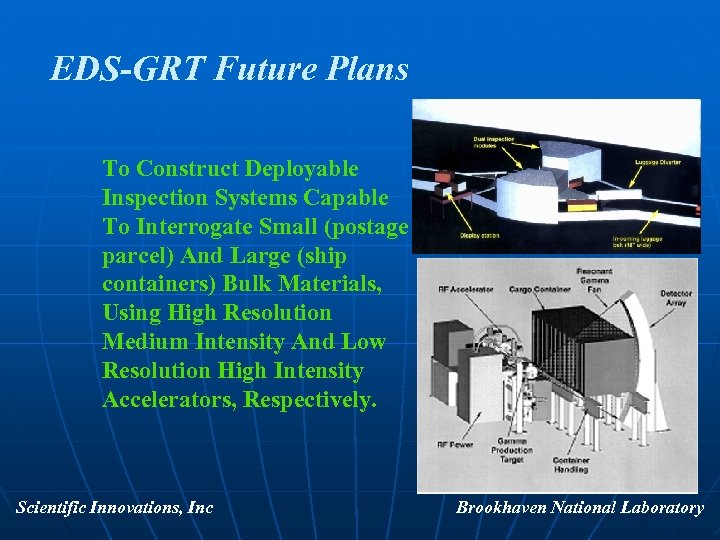
EDS-GRT Future Plans To Construct Deployable Inspection Systems Capable To Interrogate Small (postage parcel) And Large (ship containers) Bulk Materials, Using High Resolution Medium Intensity And Low Resolution High Intensity Accelerators, Respectively. Scientific Innovations, Inc Brookhaven National Laboratory
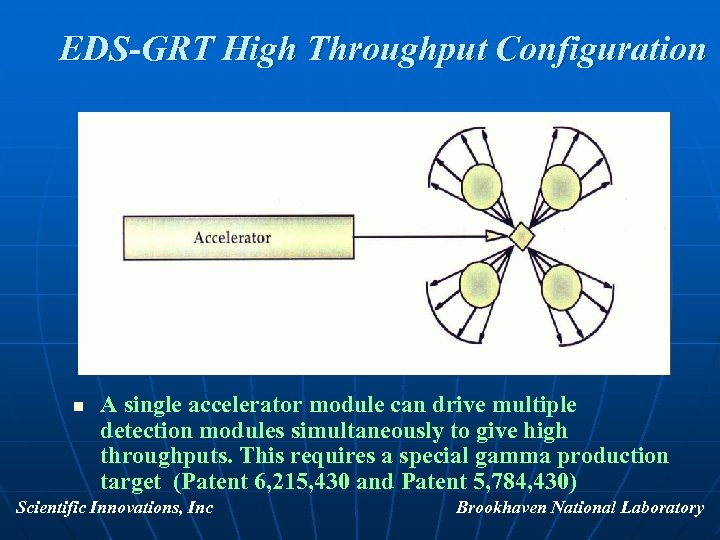
EDS-GRT High Throughput Configuration n A single accelerator module can drive multiple detection modules simultaneously to give high throughputs. This requires a special gamma production target (Patent 6, 215, 430 and Patent 5, 784, 430) Scientific Innovations, Inc Brookhaven National Laboratory
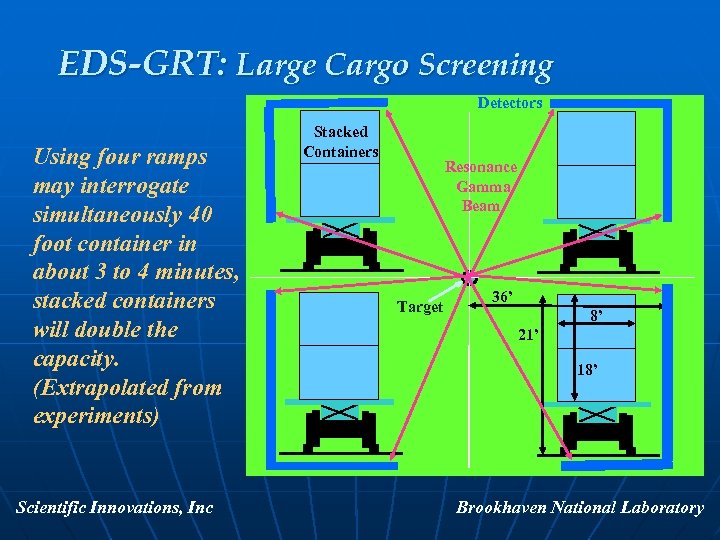
EDS-GRT: Large Cargo Screening Detectors Using four ramps may interrogate simultaneously 40 foot container in about 3 to 4 minutes, stacked containers will double the capacity. (Extrapolated from experiments) Scientific Innovations, Inc Stacked Containers Resonance Gamma Beam Target 36’ 8’ 21’ 18’ Brookhaven National Laboratory
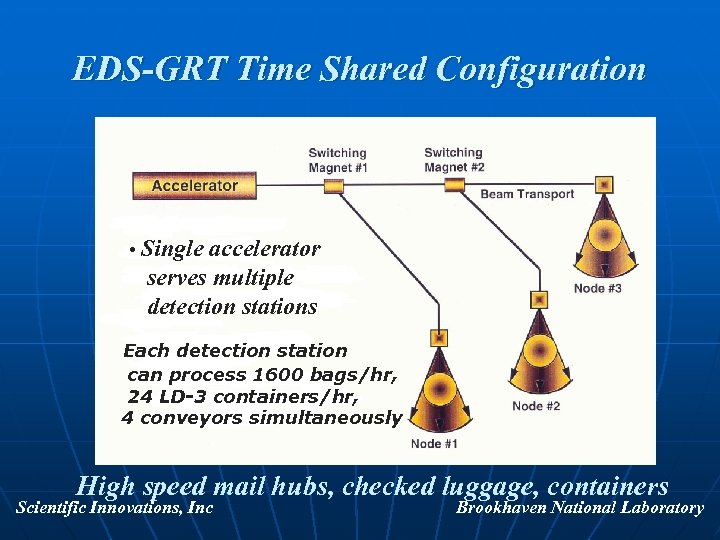
EDS-GRT Time Shared Configuration • Single accelerator serves multiple detection stations Each detection station can process 1600 bags/hr, 24 LD-3 containers/hr, 4 conveyors simultaneously High speed mail hubs, checked luggage, containers Scientific Innovations, Inc Brookhaven National Laboratory
EDS-GRT: Processing Rates • Each target can process about 4 x 400 bags/hr, • 24 LD-3 containers/hr • 4 conveyors simultaneously • Interrogate 40 foot container in about 3 to 4 minutes, stacked containers will double the capacity. (Extrapolated from current measurements. ) Scientific Innovations, Inc Brookhaven National Laboratory
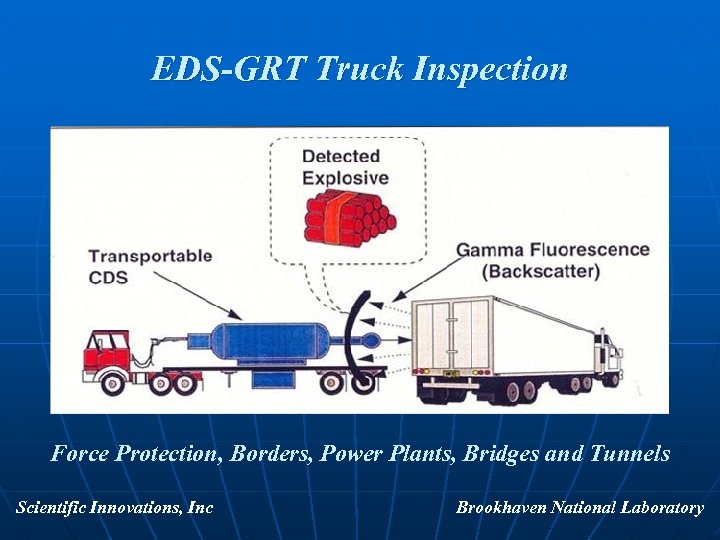
EDS-GRT Truck Inspection Force Protection, Borders, Power Plants, Bridges and Tunnels Scientific Innovations, Inc Brookhaven National Laboratory
EDS-GRT Advantages • High Detection Probability (>90%) • Low False Alarm Rate (<5%) • High Throughput (1600 bags/hr, 24 LD-3/hr, ~3 min/truck)/station • Specific Explosive Signature (Chemical elements) • Fully Automated Decision Making • Single Source Can Feed Multiple Inspection Stations (in parallel or in time share modes) • Suitable for Inspection of Postal Parcels Up To Large Vehicles or Shipping Containers • No Residual Activity • Elemental 3 -D Imaging Capability Scientific Innovations, Inc Brookhaven National Laboratory
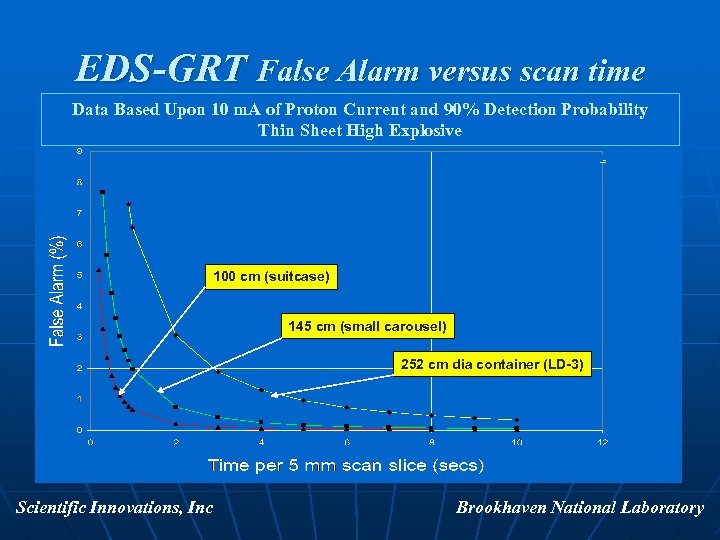
EDS-GRT False Alarm versus scan time Data Based Upon 10 m. A of Proton Current and 90% Detection Probability Thin Sheet High Explosive 100 cm (suitcase) 145 cm (small carousel) 252 cm dia container (LD-3) Scientific Innovations, Inc Brookhaven National Laboratory
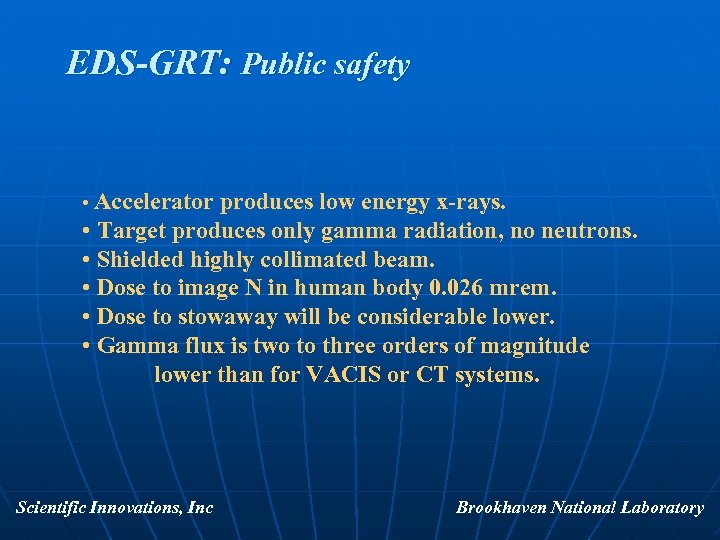
EDS-GRT: Public safety • Accelerator produces low energy x-rays. • Target produces only gamma radiation, no neutrons. • Shielded highly collimated beam. • Dose to image N in human body 0. 026 mrem. • Dose to stowaway will be considerable lower. • Gamma flux is two to three orders of magnitude lower than for VACIS or CT systems. Scientific Innovations, Inc Brookhaven National Laboratory
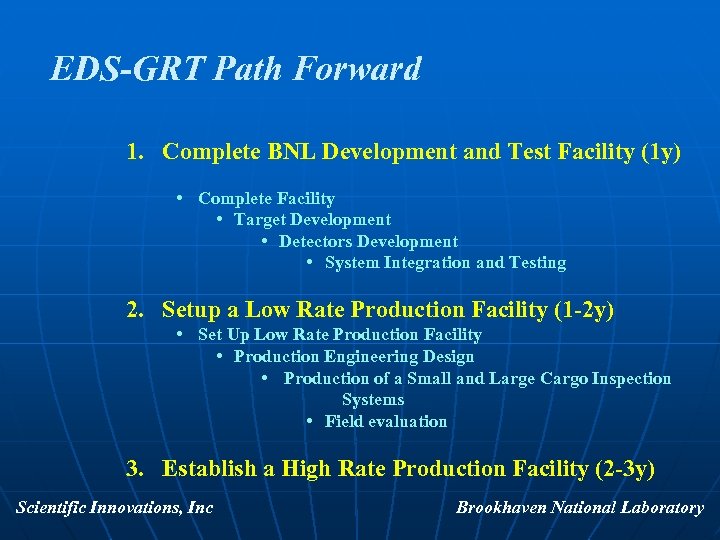
EDS-GRT Path Forward 1. Complete BNL Development and Test Facility (1 y) • Complete Facility • Target Development • Detectors Development • System Integration and Testing 2. Setup a Low Rate Production Facility (1 -2 y) • Set Up Low Rate Production Facility • Production Engineering Design • Production of a Small and Large Cargo Inspection Systems • Field evaluation 3. Establish a High Rate Production Facility (2 -3 y) Scientific Innovations, Inc Brookhaven National Laboratory
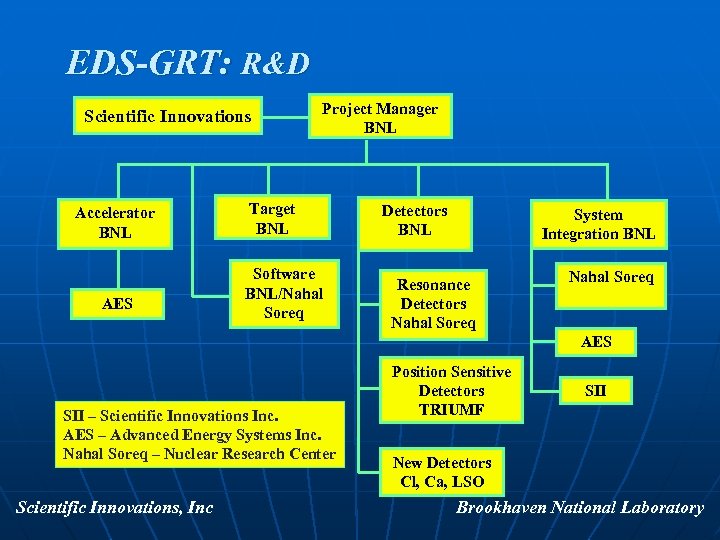
EDS-GRT: R&D Scientific Innovations Accelerator BNL AES Project Manager BNL Target BNL Software BNL/Nahal Soreq Detectors BNL System Integration BNL Resonance Detectors Nahal Soreq AES SII – Scientific Innovations Inc. AES – Advanced Energy Systems Inc. Nahal Soreq – Nuclear Research Center Scientific Innovations, Inc Position Sensitive Detectors TRIUMF SII New Detectors Cl, Ca, LSO Brookhaven National Laboratory
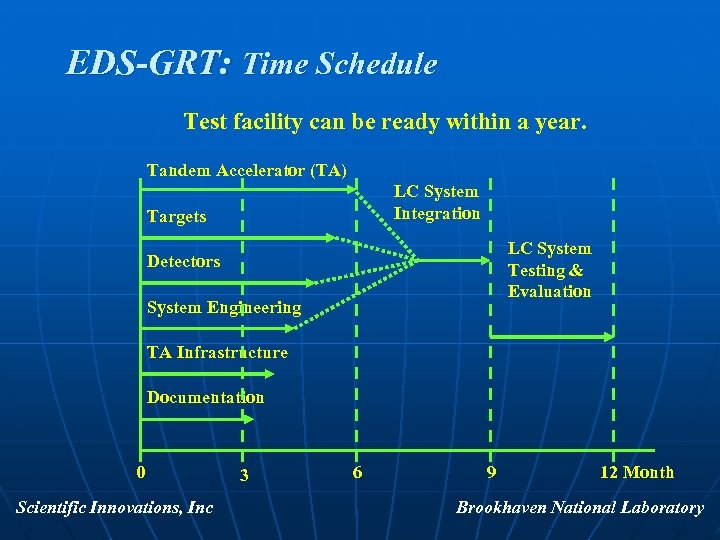
EDS-GRT: Time Schedule Test facility can be ready within a year. Tandem Accelerator (TA) LC System Integration Targets LC System Testing & Evaluation Detectors System Engineering TA Infrastructure Documentation 0 Scientific Innovations, Inc 3 6 9 12 Month Brookhaven National Laboratory
EDS-GRT: GRT versus PFNA • Both technologies provide sensitivity and specificity to the elemental composition of the cargo This is the future way of interogation • GRT is considerable reduced in size. Does not require a separate building, nor extensive shielding ( requires soft X-ray shielding) • GRT does not activate the cargo nor the building. • GRT does not require building decontamination • GRT price is about one third of that announced for PFNA • GRT data analysis for image reconstruction is similar to that used for CT image processing with superior spatial resolution • GRT can feed distributed systems simultaneously and is independent of the cargo content Scientific Innovations, Inc Brookhaven National Laboratory
EDS-GRT: GRT versus PFNA n n GRT has superior penetrability (hydrogenous and densely packed materials with no gray zone) GRT images in both absorption mode (similar to CT providing true total density and beyond CT providing true elemental density) and fluorescence mode for single sided or detection at a distance (standoff detection) n GRT can image and detect thin sheet explosives n GRT can provide simultaneous detection of multiple elements n GRT provides capability for high throughput with low false alarms n n GRT can provide identification of explosive type with elemental discrimination GRT can provide fully automatic threat detection without operator interpretation of image or data Scientific Innovations, Inc Brookhaven National Laboratory
SUMMARY 1. There is a need for new technology to meet future needs of national security. 2. Proof-of-principle of GRT for explosive detection and imaging has been demonstrated. 3. Gamma Resonance Technology is a viable method for detection of explosives and other elements in small and large shipping containers. 4. Life cycle of a unit is 10 to 15 years. Scientific Innovations, Inc Brookhaven National Laboratory
SUMMARY 4. The proposed EDS-GRT fills deficiencies of current x-ray scanners and other systems in use. 5. Extensive expertise at BNL in nuclear physics, particle accelerators, γ ray detectors and systems integration provide high probability for success. 6. A test facility ready for systems testing and prototype certification can be delivered within a year. 7. A field deployable system can be developed within two years. Scientific Innovations, Inc Brookhaven National Laboratory
Scientific Innovations, Inc Brookhaven National Laboratory
Скачать презентацию EXPLOSIVE DETECTION SYSTEMS EDS Based on GAMMA RESONANCE
d152256cff9f4cc194f1d69597025728.ppt