 Скачать презентацию Exploring the role of sensors in health behaviour
17340eb7ad6345bc4ecbdd41ff7217a3.ppt
- Количество слайдов: 16



Exploring the role of sensors in health behaviour Dr. Naomi Klepacz Food, Consumer Behaviour & Health Research Centre School of Psychology Faculty of Health and Medical Sciences University of Surrey N. Klepacz@Surrey. ac. uk 1
What do we mean by ‘behaviour’? An ‘agreed’ social definition of behaviour is… Ø “Anything a person does in response to internal (bodily) or external (environmental) events. ” Ø “Behaviours are physical events that occur in the body and are controlled by the brain. ” Ø Behaviours may be. . . – Overt and directly measureable (e. g. , motor or verbal responses) – Covert and indirectly measureable (e. g. , physiological responses) – Simple/Specific actions (e. g, swallowing a pill) – Complex sequences of actions Hobbs et al. , 2011 2
Why capture health behaviour? • Human behaviours, including tobacco and alcohol consumption, diet, physical activity and sexual practice, area contributing factors to noncommunicable diseases (NCDs) and a leading cause of death in both developed and developing countries. • Even small changes in health behaviour can have a substantial effect on population outcome. • Understanding behaviours and the context in which they occur is essential for developing effective evidence-based health behaviour change interventions and policies. 3
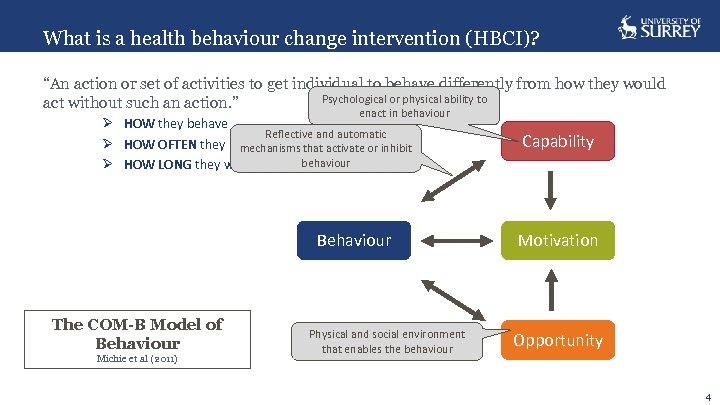
What is a health behaviour change intervention (HBCI)? “An action or set of activities to get individual to behave differently from how they would Psychological or physical ability to act without such an action. ” enact in behaviour Ø HOW they behave Reflective and automatic Ø HOW OFTEN they perform a behaviour or inhibit mechanisms that activate Ø HOW LONG they would act for behaviour Behaviour The COM-B Model of Behaviour Michie et al (2011) Physical and social environment that enables the behaviour Capability Motivation Opportunity 4
Why are Smartphones good for delivering HBCIs? Various features of smartphones make them good candidates for the delivery of HBCIs • • • Portable and highly valued by individuals Switched on and remain on throughout the day Bring HBCIs into real life contexts Cheap, convenient and less stigmatising that alternative interventions Share health and behaviour actions with professionals (and peers) Infer context through location, movement and engagement with social media. Dennison et al. , 2013 • There are now approximately 165, 000 mobile health apps on the market, nearly two thirds of which are wellness apps focusing on exercise, diet and lifestyle. • The remainder focus on specific health conditions, pregnancy and medical information/ reminders. 5
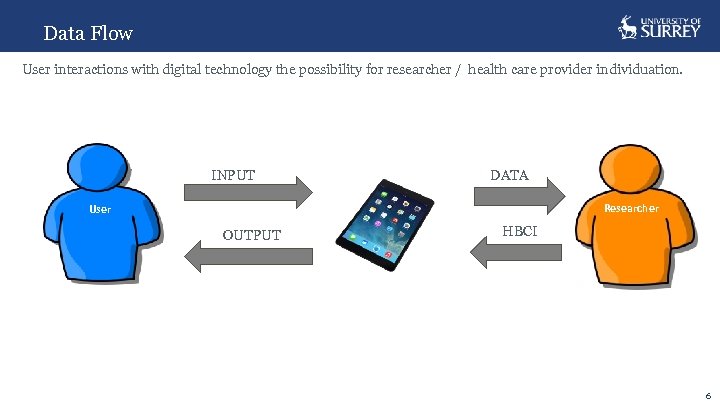
Data Flow User interactions with digital technology the possibility for researcher / health care provider individuation. INPUT DATA Researcher User OUTPUT HBCI 6
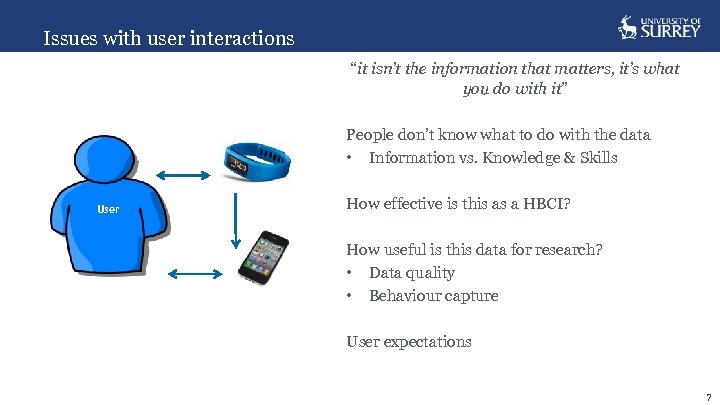
Issues with user interactions “it isn’t the information that matters, it’s what you do with it” People don’t know what to do with the data • Information vs. Knowledge & Skills User How effective is this as a HBCI? How useful is this data for research? • Data quality • Behaviour capture User expectations 7
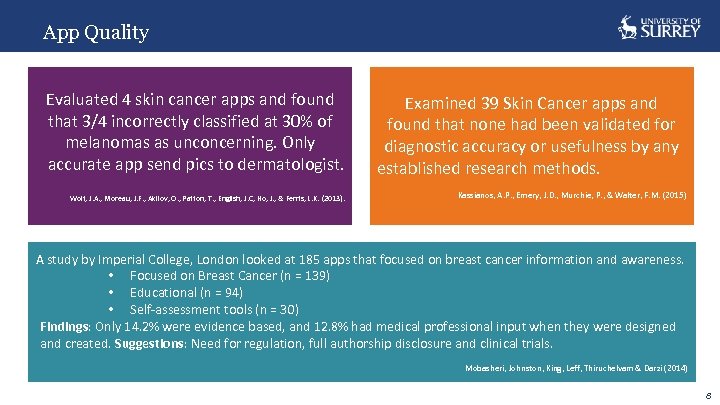
App Quality Evaluated 4 skin cancer apps and found that 3/4 incorrectly classified at 30% of melanomas as unconcerning. Only accurate app send pics to dermatologist. Wolf, J. A. , Moreau, J. F. , Akilov, O. , Patton, T. , English, J. C, Ho, J. , & Ferris, L. K. (2013). Examined 39 Skin Cancer apps and found that none had been validated for diagnostic accuracy or usefulness by any established research methods. Kassianos, A. P. , Emery, J. D. , Murchie, P. , & Walter, F. M. (2015) A study by Imperial College, London looked at 185 apps that focused on breast cancer information and awareness. • Focused on Breast Cancer (n = 139) • Educational (n = 94) • Self-assessment tools (n = 30) Findings: Only 14. 2% were evidence based, and 12. 8% had medical professional input when they were designed and created. Suggestions: Need for regulation, full authorship disclosure and clinical trials. Mobasheri, Johnston, King, Leff, Thiruchelvam & Darzi (2014) 8
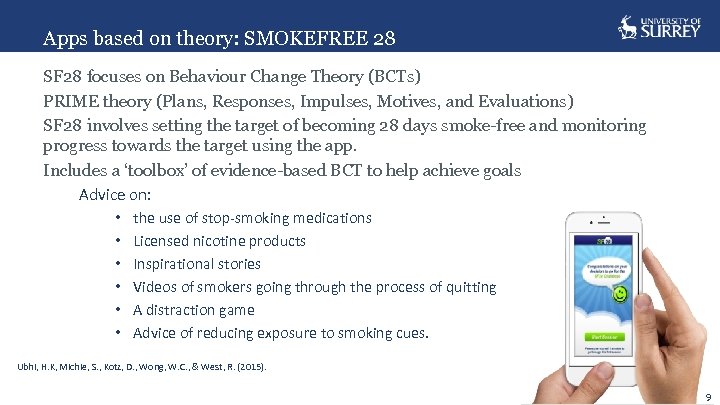
Apps based on theory: SMOKEFREE 28 SF 28 focuses on Behaviour Change Theory (BCTs) PRIME theory (Plans, Responses, Impulses, Motives, and Evaluations) SF 28 involves setting the target of becoming 28 days smoke-free and monitoring progress towards the target using the app. Includes a ‘toolbox’ of evidence-based BCT to help achieve goals Advice on: • the use of stop-smoking medications • Licensed nicotine products • Inspirational stories • Videos of smokers going through the process of quitting • A distraction game • Advice of reducing exposure to smoking cues. Ubhi, H. K, Michie, S. , Kotz, D. , Wong, W. C. , & West, R. (2015). 9
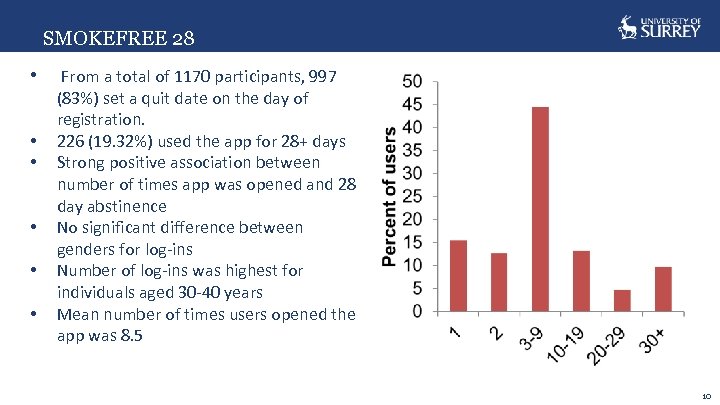
SMOKEFREE 28 • • • From a total of 1170 participants, 997 (83%) set a quit date on the day of registration. 226 (19. 32%) used the app for 28+ days Strong positive association between number of times app was opened and 28 day abstinence No significant difference between genders for log-ins Number of log-ins was highest for individuals aged 30 -40 years Mean number of times users opened the app was 8. 5 10
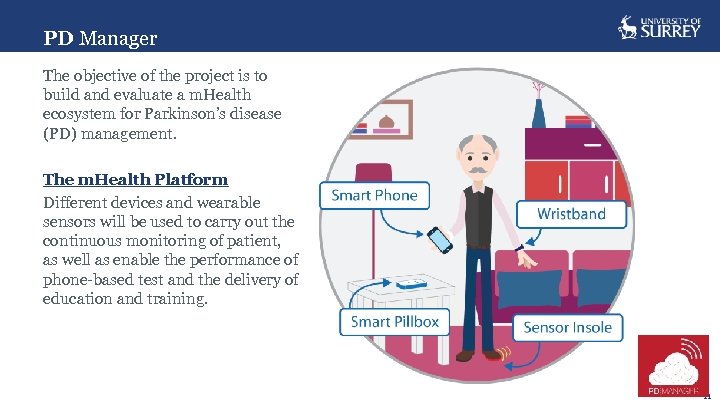
PD Manager The objective of the project is to build and evaluate a m. Health ecosystem for Parkinson’s disease (PD) management. The m. Health Platform Different devices and wearable sensors will be used to carry out the continuous monitoring of patient, as well as enable the performance of phone-based test and the delivery of education and training. 11
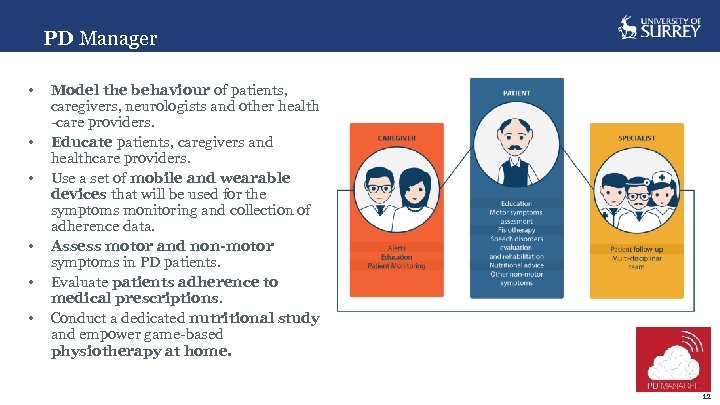
PD Manager • • • Model the behaviour of patients, caregivers, neurologists and other health -care providers. Educate patients, caregivers and healthcare providers. Use a set of mobile and wearable devices that will be used for the symptoms monitoring and collection of adherence data. Assess motor and non-motor symptoms in PD patients. Evaluate patients adherence to medical prescriptions. Conduct a dedicated nutritional study and empower game-based physiotherapy at home. 12
RICHFIELDS: A research Infrastructure (RI) “Designing a world-class infrastructure to facilitate research”. “New ICT technological bring opportunities for researchers to monitor and collect information on behaviours. Everyday, consumers and businesses generate “big data” – large volumes of information, that offer detailed descriptions of behaviours, including time and place (e. g. , using GPS). If these data-rich sources could be linked analysed, they have the potential to contribute greatly towards answering key questions to respond to societal challenges regarding food and health (e. g. , obesity, cardiovascular disease, sustainability). ” RICHFIELDS aims to design a consumer-data platform to collect and connect, compare and share information about food behaviours, to revolutionize research on every-day choices made across Europe. www. richfields. eu 13
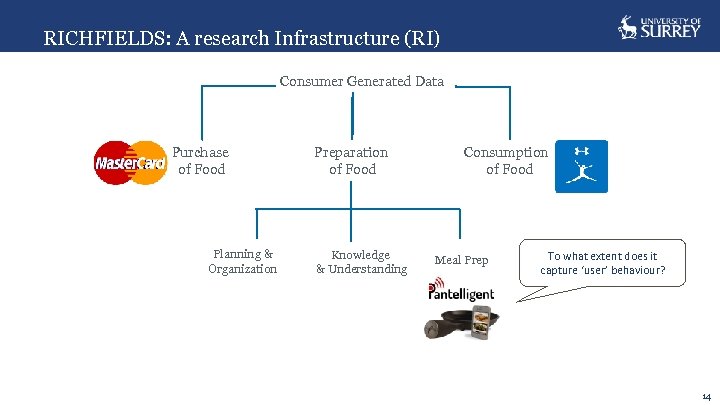
RICHFIELDS: A research Infrastructure (RI) Consumer Generated Data Purchase of Food Planning & Organization Preparation of Food Knowledge & Understanding Consumption of Food Meal Prep To what extent does it capture ‘user’ behaviour? 14
RICHFIELDS: A research Infrastructure (RI) “Can data collected through apps be used in social science research? ” • • Quality of Big Data Behaviour capture Ownership of Data security (Where is the data stored? Who has access? ) Ethics (data privacy, confidentiality & consent) The Ethics Committee User/consumer expectations Legal issues (country & international) • What research questions can I answer with this data? www. richfields. eu 15
With Thanks to. . . Prof Monique Raats (Scientific Advisor RICHFIELDS) Dr Lada Timotijevic (PI PD Manager) and members of the Food, Consumer Behaviour & Health Research Centre. Also, to our Partners…
Скачать презентацию Exploring the role of sensors in health behaviour
17340eb7ad6345bc4ecbdd41ff7217a3.ppt