


 Скачать презентацию Exploring the Power of Links in Data Mining
9d7d56c5f30946a54167d5ee686f5bf0.ppt
- Количество слайдов: 111
 Exploring the Power of Links in Data Mining Jiawei Han 1, Xiaoxin Yin 2, and Philip S. Yu 3 1: University of Illinois at Urbana-Champaign 2: Google Inc. 3: IBM T. J. Watson Research Center ECML/PKDD, Warsaw, Poland, 17– 21 September 2007 1
 Outline Theme: “Knowledge is power, but knowledge is hidden in massive links” n Link Mining: A General Introduction n Cross. Mine: Classification of Multi-relations by Link Analysis n Cross. Clus: Clustering over Multi-relations by User-Guidance n Link. Clus: Efficient Clustering by Exploring the Power Law Distribution n Distinct: Distinguishing Objects with Identical Names by Link Analysis n Truth. Finder: Conformity to Truth with Conflicting Information n Conclusions and Future Work 2
 Link Mining: An Introduction n n Links: Relationships among data objects Link analysis and Web search n Web search: A typical similarity query does not work since it may return > 106 results! And rank cannot just be based on the keyword similarity n Solution: Explore the semantic information carried in hyperlinks Exploring the power of links in Web search n Page. Rank: Capturing page popularity (Brin & Page 1998) n HITS: Capturing authorities & hubs (Chakrabarti, Kleinberg, et al. 1998 & 1999) The success of Google demonstrates the power of links 3
 Information Networks n n Information network: A network where each node represents an entity (e. g. , actor in a social network) and each link (e. g. , tie) a relationship between entities n Each node/link may have attributes, labels, and weights n Link may carry rich semantic information Homogeneous vs. heterogeneous networks n Homogeneous networks n Single object type and single link type n Single model social networks (e. g. , friends) n WWW: a collection of linked Web pages n Heterogeneous networks n Multiple object and link types n Medical network: patients, doctors, disease, contacts, treatments n Bibliographic network: publications, authors, venues 4
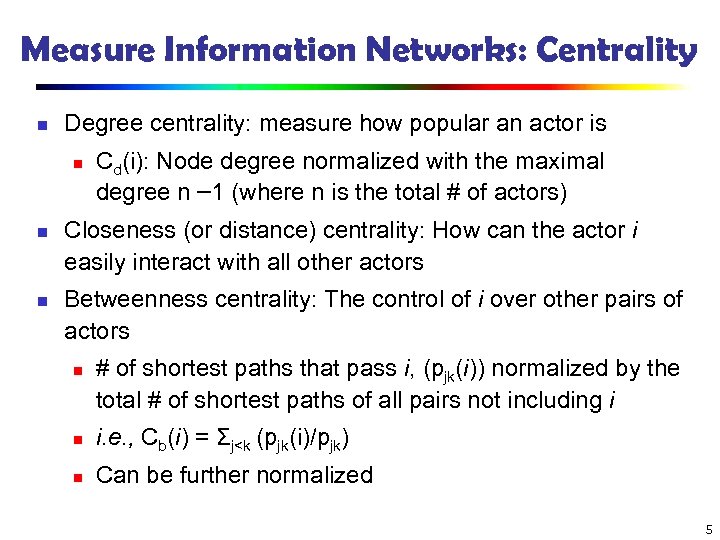 Measure Information Networks: Centrality n Degree centrality: measure how popular an actor is n n n Cd(i): Node degree normalized with the maximal degree n 1 (where n is the total # of actors) Closeness (or distance) centrality: How can the actor i easily interact with all other actors Betweenness centrality: The control of i over other pairs of actors n # of shortest paths that pass i, (pjk(i)) normalized by the total # of shortest paths of all pairs not including i n i. e. , Cb(i) = Σj
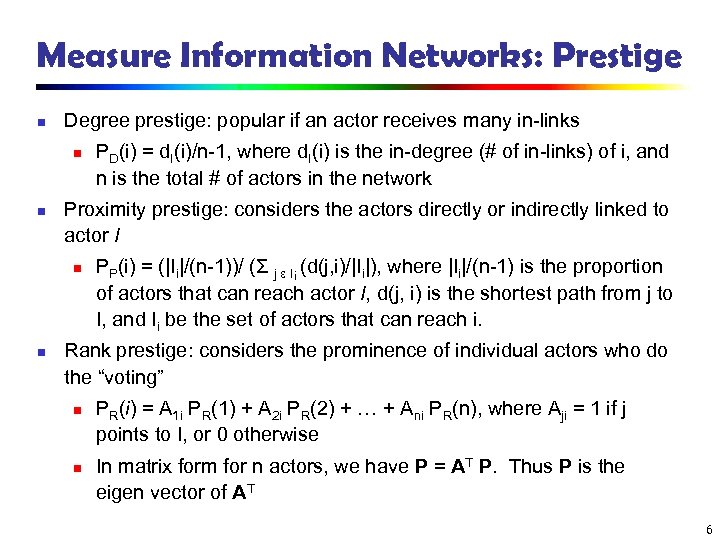 Measure Information Networks: Prestige n Degree prestige: popular if an actor receives many in-links n n Proximity prestige: considers the actors directly or indirectly linked to actor I n n PD(i) = d. I(i)/n-1, where d. I(i) is the in-degree (# of in-links) of i, and n is the total # of actors in the network PP(i) = (|Ii|/(n-1))/ (Σ j ε Ii (d(j, i)/|Ii|), where |Ii|/(n-1) is the proportion of actors that can reach actor I, d(j, i) is the shortest path from j to I, and Ii be the set of actors that can reach i. Rank prestige: considers the prominence of individual actors who do the “voting” n n PR(i) = A 1 i PR(1) + A 2 i PR(2) + … + Ani PR(n), where Aji = 1 if j points to I, or 0 otherwise In matrix form for n actors, we have P = AT P. Thus P is the eigen vector of AT 6
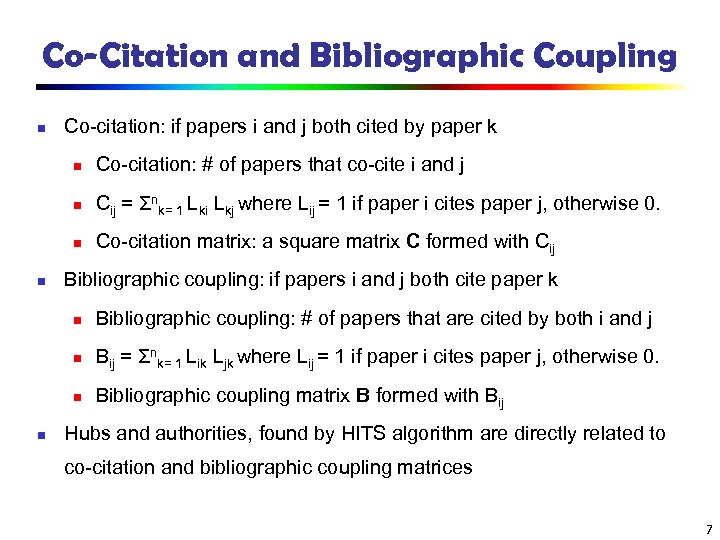 Co-Citation and Bibliographic Coupling n Co-citation: if papers i and j both cited by paper k n n Cij = Σnk= 1 Lki Lkj where Lij = 1 if paper i cites paper j, otherwise 0. n n Co-citation: # of papers that co-cite i and j Co-citation matrix: a square matrix C formed with Cij Bibliographic coupling: if papers i and j both cite paper k n n Bij = Σnk= 1 Lik Ljk where Lij = 1 if paper i cites paper j, otherwise 0. n n Bibliographic coupling: # of papers that are cited by both i and j Bibliographic coupling matrix B formed with Bij Hubs and authorities, found by HITS algorithm are directly related to co-citation and bibliographic coupling matrices 7
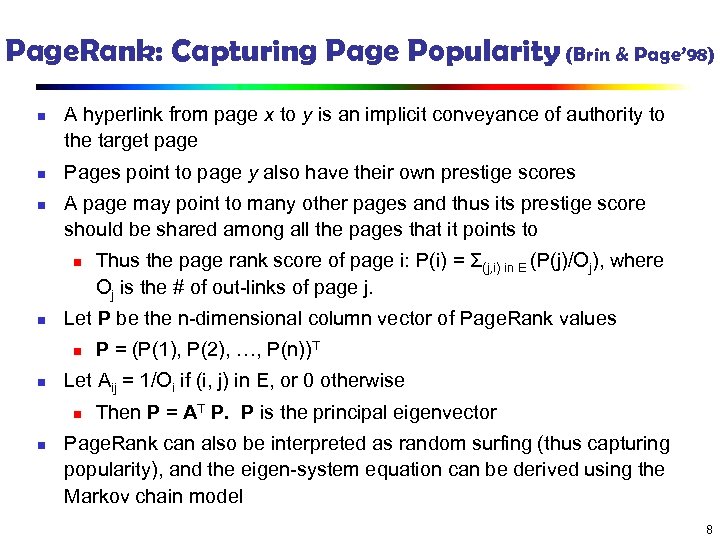 Page. Rank: Capturing Page Popularity (Brin & Page’ 98) n n n A hyperlink from page x to y is an implicit conveyance of authority to the target page Pages point to page y also have their own prestige scores A page may point to many other pages and thus its prestige score should be shared among all the pages that it points to n n Let P be the n-dimensional column vector of Page. Rank values n n P = (P(1), P(2), …, P(n))T Let Aij = 1/Oi if (i, j) in E, or 0 otherwise n n Thus the page rank score of page i: P(i) = Σ(j, i) in E (P(j)/Oj), where Oj is the # of out-links of page j. Then P = AT P. P is the principal eigenvector Page. Rank can also be interpreted as random surfing (thus capturing popularity), and the eigen-system equation can be derived using the Markov chain model 8
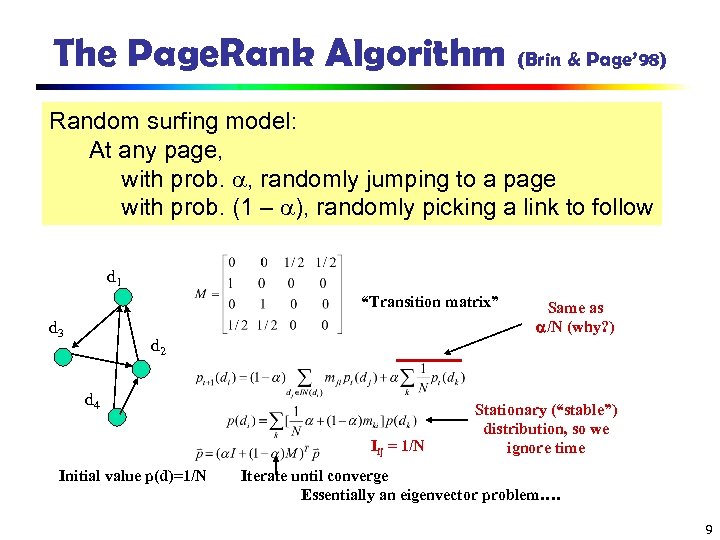 The Page. Rank Algorithm (Brin & Page’ 98) Random surfing model: At any page, with prob. , randomly jumping to a page with prob. (1 – ), randomly picking a link to follow d 1 “Transition matrix” d 3 d 2 d 4 Iij = 1/N Initial value p(d)=1/N Same as /N (why? ) Stationary (“stable”) distribution, so we ignore time Iterate until converge Essentially an eigenvector problem…. 9
 Page. Rank: Strength and Weakness n n n Advantages: n Ability to fight spams: It is not easy for a webpage owner to add inlinks to his page from an important page n A global measure, query-independent: computed offline Disadvantages n Query-independent: may not be authoritative on the query topic n Google may have other ways to deal with it n Tend to favor older pages: with more and stable links Timed Page. Rank: Favors newer pages n Add a damping factor which is a function f(t) where t is the difference between the current time and the time the page was last updated n For a complete new page in a website, which does not have inlinks, use avg rank value of the pages in the website 10
 HITS: Capturing Authorities & Hubs (Kleinberg’ 98) n Intuition n n Different from literature citations, many rivals, such as Toyota and Honda, do not cite each other on the Internet Pages that are widely cited (i. e. , many in-links) are good authorities Pages that cite many other pages (i. e. , many out-links) are good hubs Authorities and hubs have a mutual reinforcement relationship The key idea of HITS (Hypertext Induced Topic Search) n Good authorities are cited by good hubs n Good hubs point to good authorities n Iterative reinforcement … 11
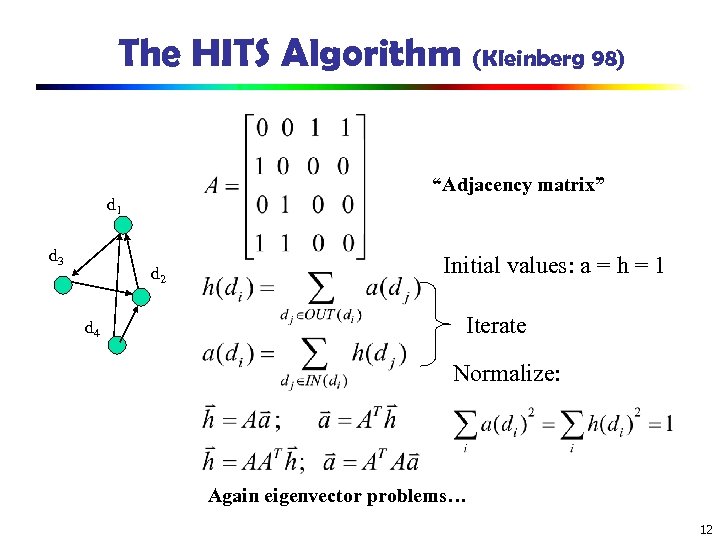 The HITS Algorithm (Kleinberg 98) “Adjacency matrix” d 1 d 3 d 2 d 4 Initial values: a = h = 1 Iterate Normalize: Again eigenvector problems… 12
 HITS: Strength and Weakness n n n Advantages: Rank pages according to the query topic Disadvantages n Does not have anti-spam capability: One may add out-links to his own page that points to many good authorities n Topic-drift: One may collect many pages that have nothing to do with the topic — by just pointing to them n Query-time evaluation: expensive Later studies on HIT improvements n SALA [Lemple & Moran, WWW’ 00], a stochastic alg, two Markov chains, an autority and a hub Markov chain, less susceptible to spam n Weight the links [Bharat & Henzinger SIGIR’ 98]: if there are k edges from documents on a first host to a single document on a second host, give each edge an authority weight of 1/k, … n Handling topic drifting: Content similarity comparison, or segment the page based on the DOM (Document Object Model) tree structure to identify blocks or sub-trees that are more relevant to query topic 13
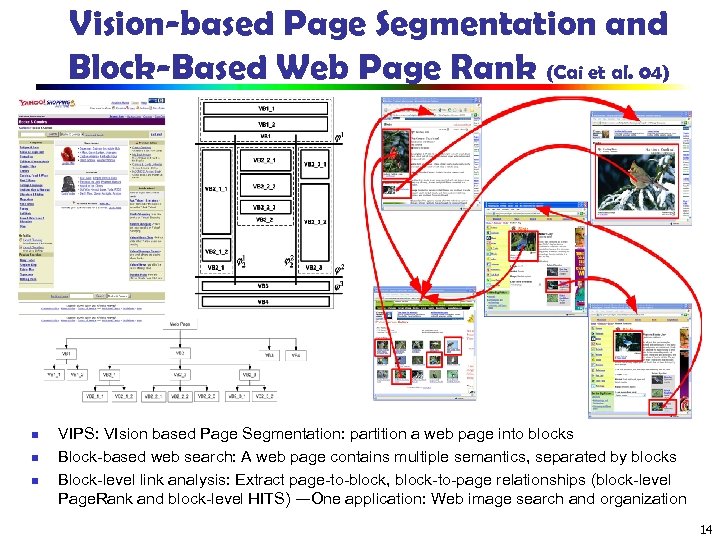 Vision-based Page Segmentation and Block-Based Web Page Rank (Cai et al. 04) n n n VIPS: VIsion based Page Segmentation: partition a web page into blocks Block-based web search: A web page contains multiple semantics, separated by blocks Block-level link analysis: Extract page-to-block, block-to-page relationships (block-level Page. Rank and block-level HITS) ―One application: Web image search and organization 14
 Community Discovery n n Community: A group of entities, G, (e. g. , people or organization) that shares a common theme, T, or is involved in an activity or event n Communities may overlap, and may have hierarchical structures (i. e. , sub-community and sub-theme) Community discovery: n Given a data set containing entities, , discover hidden communities (i. e. , theme represented by a set of key words, and its members) n Different communities: Web pages (hyperlinks, or content words), e-mails (email exchanges, or contents), and text documents (co-occurrence of entities, appearing in the same setence and/or document, or contents) 15
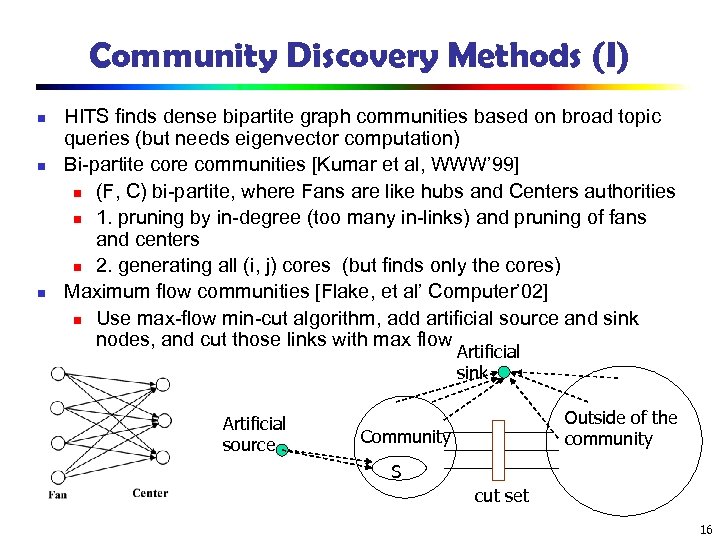 Community Discovery Methods (I) n n n HITS finds dense bipartite graph communities based on broad topic queries (but needs eigenvector computation) Bi-partite core communities [Kumar et al, WWW’ 99] n (F, C) bi-partite, where Fans are like hubs and Centers authorities n 1. pruning by in-degree (too many in-links) and pruning of fans and centers n 2. generating all (i, j) cores (but finds only the cores) Maximum flow communities [Flake, et al’ Computer’ 02] n Use max-flow min-cut algorithm, add artificial source and sink nodes, and cut those links with max flow Artificial sink Artificial source Outside of the community Community S cut set 16
 Community Discovery Methods (II) n n Email communities based on betweenness n An edge x y if there is a minimum # of messages between them n The betweenness of an edge is the # of shortest paths that pass it n Graph partitioning is based on “max-flow min-cut” Overlapping communities of named entities n Overlapping community: A person can belong to > 1 community n Find entity communities from a text corpus n Build a link graph: find named entities in the sentence, link them and attach other keywords n Find all triangles: A triangle ― three entities bound together n Find community cores: a group of tightly bound triangles n Cluster around community cores: assign triangles and pairs not in any core to cores according to their textual content similarities n Rank entities in each community according to degree centrality n Keywords associated with the edges of each community are also ranked, and the top ranked one as theme of the community 17
 Link-Based Object Classification n n Predicting the category of an object based on its attributes, links, and the attributes of linked objects Web: Predict the category of a web page, based on words that occur on the page, links between pages, anchor text, html tags, etc. Citation: Predict the topic of a paper, based on word occurrence, citations, co-citations Epidemics: Predict disease type based on characteristics of the patients infected by the disease Communication: Predict whether a communication contact is by email, phone call or mail 18
 Other Link Mining Tasks n n n Group detection: Cluster the nodes in the graph into groups, e. g. , community identification n Methods: Hierarchical clustering, blockmodeling, spectral graph partitioning, multi-relational clustering Entity Resolution (a. k. a. , deduplication, reference reconciliation, object consolidation): Predict whether two objects are the same, based on their attributes and links Link prediction: Predict whether a link exists Link cardinality estimation: Predict # of links to an object or # of objects reached along a path from an object Subgraph discovery: Find common subgraphs Metadata mining: Schema mapping, schema discovery, schema reformulation 19
 Link Mining Challenges n n n n Logical (e. g. , links) vs. statistical dependencies Feature construction (e. g. , by aggregation & selection) Modeling instances (more predictive) vs. classes (more general) Collective classification: need to handle correlation Collective consolidation: Using a link-based statistical model Effective use of links between labeled & unlabeled data Prediction of prior link probability: model links at higher level Closed vs. open world: We may not know all related factors Challenges common to any link-based statistical model, such as Bayesian Logic Programs, Conditional Random Fields, Probabilistic Relational Models, Relational Markov Networks, Relational Probability Trees, Stochastic Logic Programming. 20
 Outline Theme: “Knowledge is power, but knowledge is hidden in massive links” n Link Mining: A General Introduction n Cross. Mine: Classification of Multi-relations by Link Analysis n Cross. Clus: Clustering over Multi-relations by User-Guidance n Link. Clus: Efficient Clustering by Exploring the Power Law Distribution n Distinct: Distinguishing Objects with Identical Names by Link Analysis n Truth. Finder: Conformity to Truth with Conflicting Information n Conclusions and Future Work 21
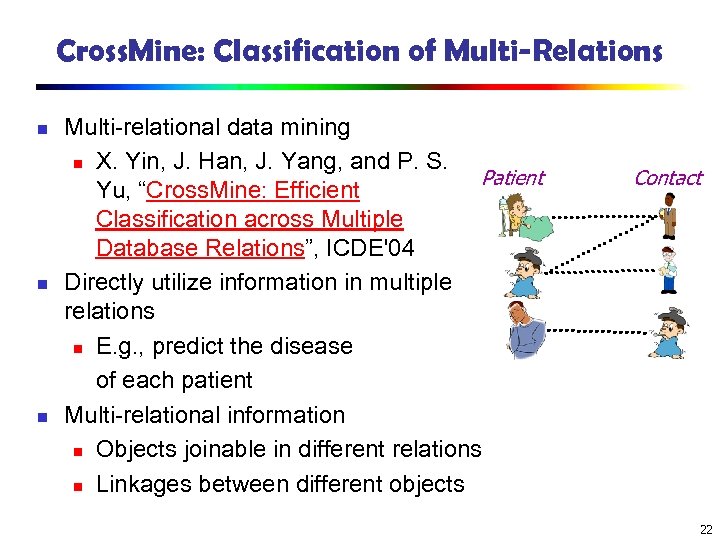 Cross. Mine: Classification of Multi-Relations n n n Multi-relational data mining n X. Yin, J. Han, J. Yang, and P. S. Patient Yu, “Cross. Mine: Efficient Classification across Multiple Database Relations”, ICDE'04 Directly utilize information in multiple relations n E. g. , predict the disease of each patient Multi-relational information n Objects joinable in different relations n Linkages between different objects Contact 22
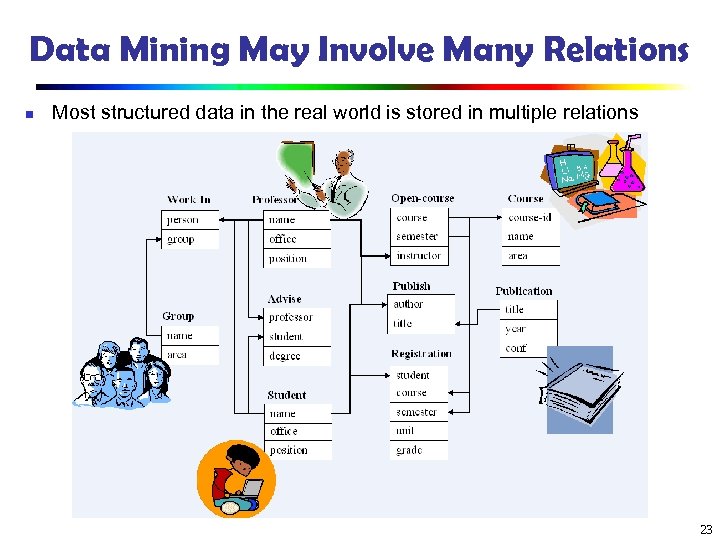 Data Mining May Involve Many Relations n Most structured data in the real world is stored in multiple relations 23
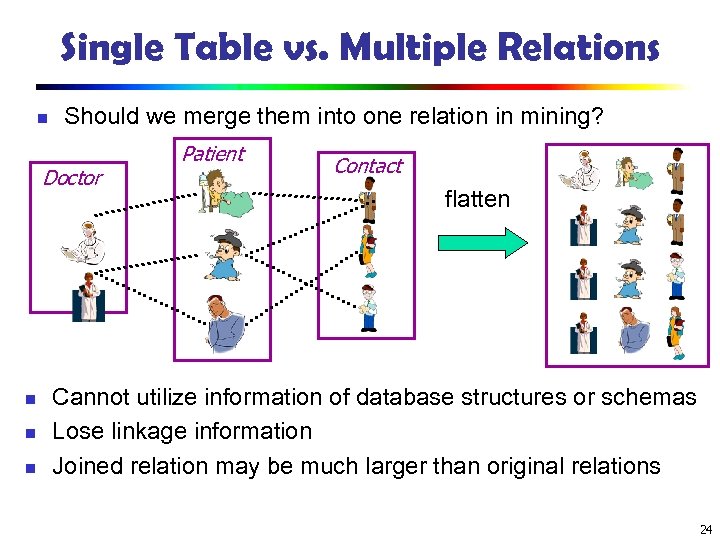 Single Table vs. Multiple Relations n Should we merge them into one relation in mining? Doctor n n n Patient Contact flatten Cannot utilize information of database structures or schemas Lose linkage information Joined relation may be much larger than original relations 24
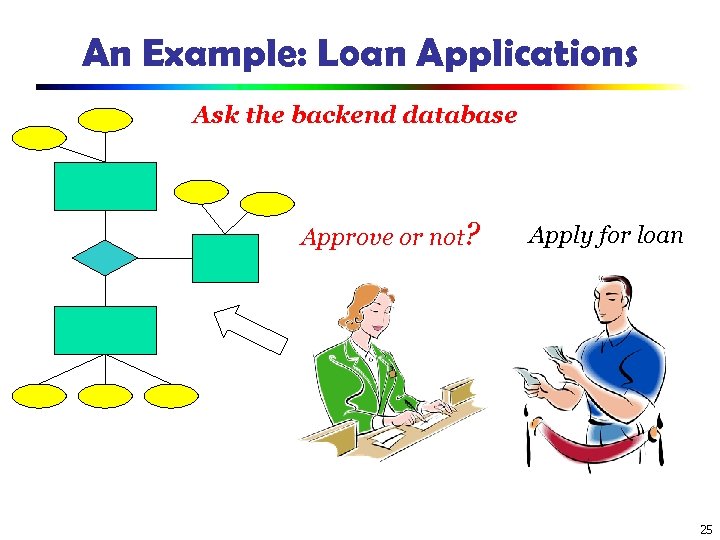 An Example: Loan Applications Ask the backend database Approve or not? Apply for loan 25
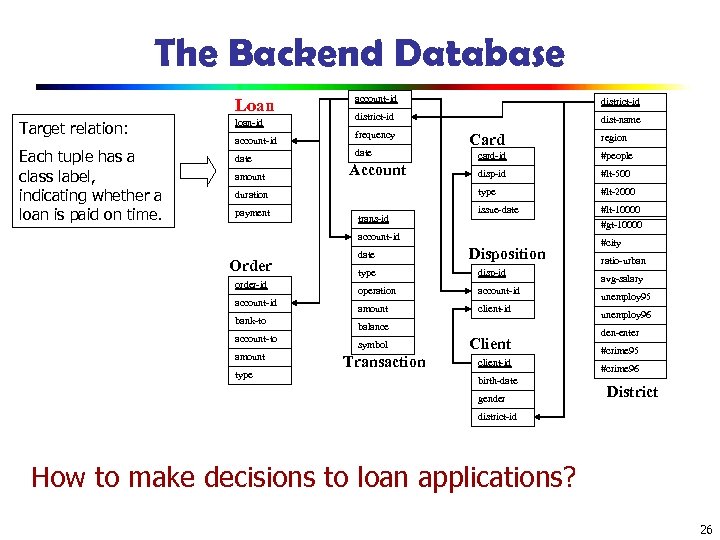 The Backend Database Loan Target relation: Each tuple has a class label, indicating whether a loan is paid on time. loan-id account-id date amount account-id district-id dist-name frequency date trans-id card-id #people disp-id #lt-500 #lt-2000 issue-date #lt-10000 #gt-10000 account-id Order order-id account-id bank-to account-to amount type region type Account duration payment Card date Disposition type disp-id operation account-id amount client-id balance symbol Transaction Client client-id birth-date gender #city ratio-urban avg-salary unemploy 95 unemploy 96 den-enter #crime 95 #crime 96 District district-id How to make decisions to loan applications? 26
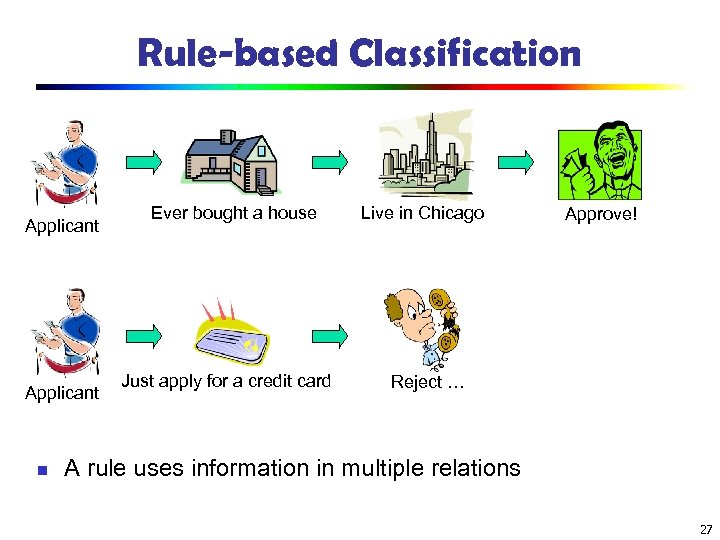 Rule-based Classification Applicant n Ever bought a house Just apply for a credit card Live in Chicago Approve! Reject … A rule uses information in multiple relations 27
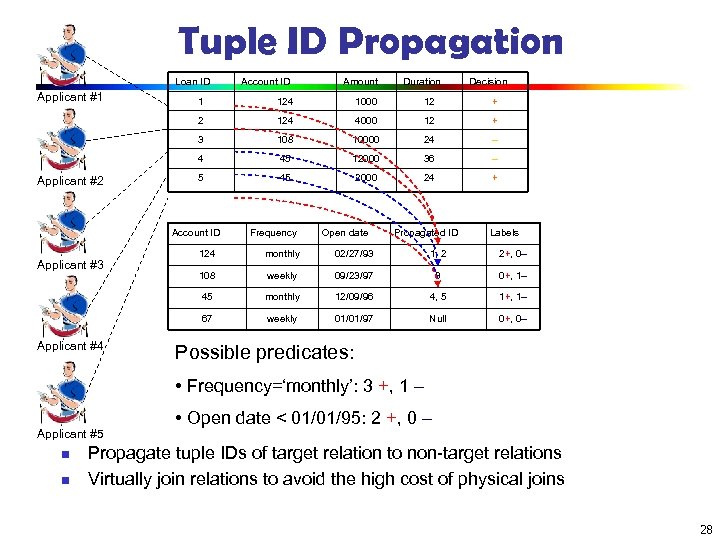 Tuple ID Propagation Loan ID Applicant #1 Account ID Amount Duration Decision 124 1000 12 + 2 124 4000 12 + 3 108 10000 24 – 4 Applicant #2 1 45 12000 36 – 5 45 2000 24 + Account ID Frequency Open date Propagated ID Labels monthly 02/27/93 1, 2 2+, 0– 108 weekly 09/23/97 3 0+, 1– monthly 12/09/96 4, 5 1+, 1– 67 Applicant #4 124 45 Applicant #3 weekly 01/01/97 Null 0+, 0– Possible predicates: • Frequency=‘monthly’: 3 +, 1 – Applicant #5 n n • Open date < 01/01/95: 2 +, 0 – Propagate tuple IDs of target relation to non-target relations Virtually join relations to avoid the high cost of physical joins 28
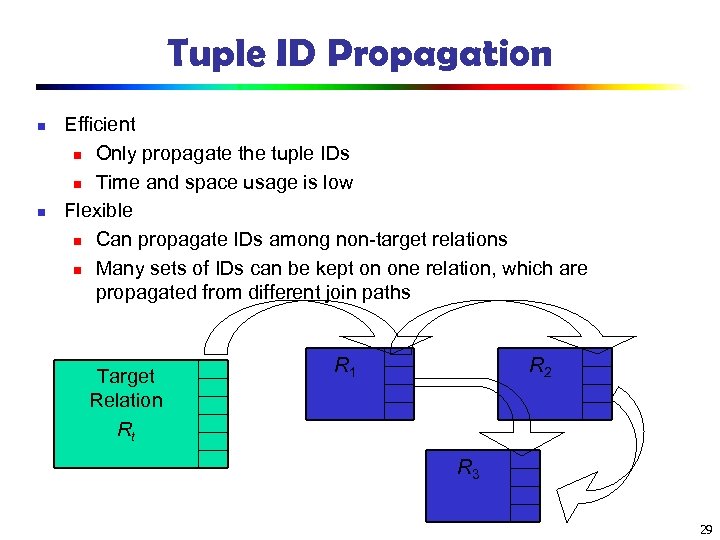 Tuple ID Propagation n n Efficient n Only propagate the tuple IDs n Time and space usage is low Flexible n Can propagate IDs among non-target relations n Many sets of IDs can be kept on one relation, which are propagated from different join paths Target Relation Rt R 1 R 2 R 3 29
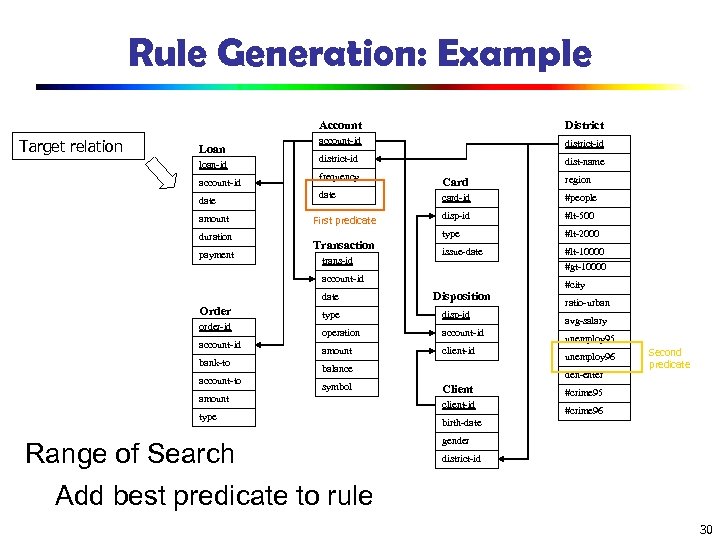 Rule Generation: Example Account Target relation Loan loan-id account-id date amount duration payment District account-id district-id dist-name frequency Card region date card-id #people disp-id #lt-500 type #lt-2000 issue-date #lt-10000 #gt-10000 First predicate Transaction trans-id account-id date Order order-id account-id bank-to account-to Disposition type disp-id operation account-id amount client-id balance symbol amount type Range of Search Add best predicate to rule #city ratio-urban avg-salary unemploy 95 unemploy 96 den-enter Client client-id Second predicate #crime 95 #crime 96 birth-date gender district-id 30
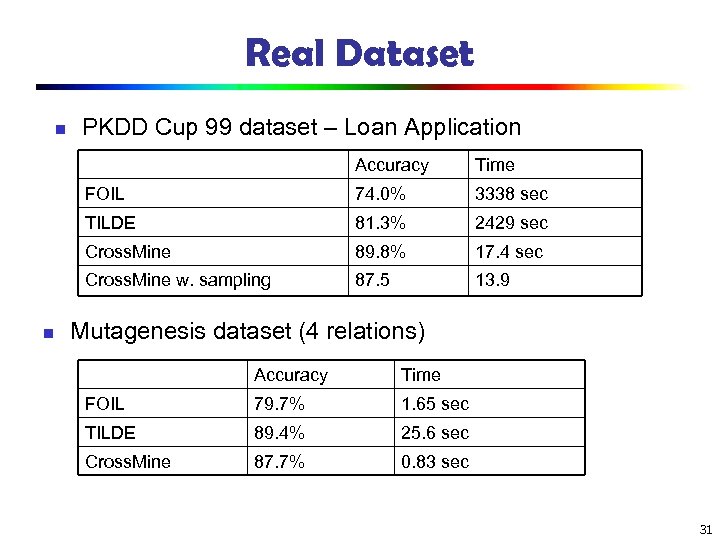 Real Dataset n PKDD Cup 99 dataset – Loan Application Accuracy FOIL 74. 0% 3338 sec TILDE 81. 3% 2429 sec Cross. Mine 89. 8% 17. 4 sec Cross. Mine w. sampling n Time 87. 5 13. 9 Mutagenesis dataset (4 relations) Accuracy Time FOIL 79. 7% 1. 65 sec TILDE 89. 4% 25. 6 sec Cross. Mine 87. 7% 0. 83 sec 31
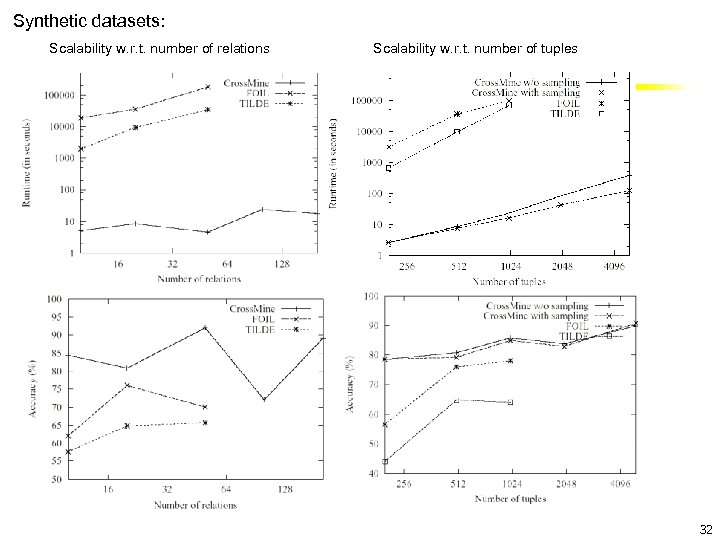 Synthetic datasets: Scalability w. r. t. number of relations Scalability w. r. t. number of tuples 32
 Outline Theme: “Knowledge is power, but knowledge is hidden in massive links” n Link Mining: A General Introduction n Cross. Mine: Classification of Multi-relations by Link Analysis n Cross. Clus: Clustering over Multi-relations by User-Guidance n Link. Clus: Efficient Clustering by Exploring the Power Law Distribution n Distinct: Distinguishing Objects with Identical Names by Link Analysis n Truth. Finder: Conformity to Truth with Conflicting Information n Conclusions and Future Work 33
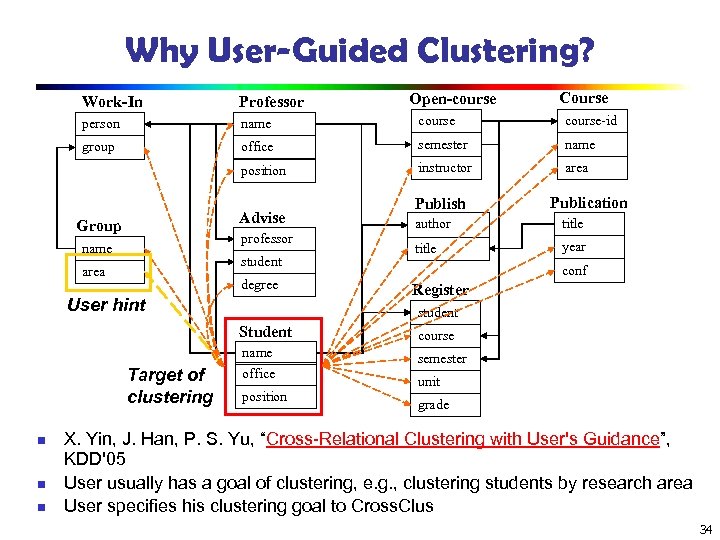 Why User-Guided Clustering? Open-course Course Work-In Professor person name course-id group office semester name position instructor area Advise Group professor name student area degree User hint Publish author title year conf Register student Student Target of clustering n n n Publication course name office semester position unit grade X. Yin, J. Han, P. S. Yu, “Cross-Relational Clustering with User's Guidance”, KDD'05 User usually has a goal of clustering, e. g. , clustering students by research area User specifies his clustering goal to Cross. Clus 34
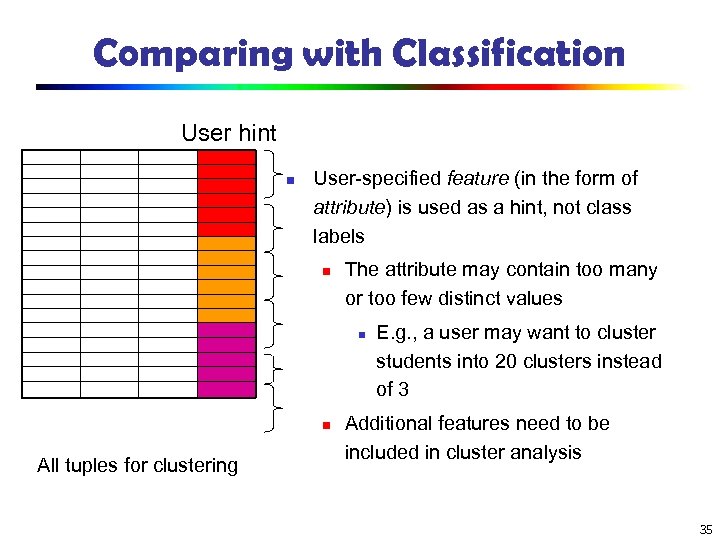 Comparing with Classification User hint n User-specified feature (in the form of attribute) is used as a hint, not class labels n The attribute may contain too many or too few distinct values n n All tuples for clustering E. g. , a user may want to cluster students into 20 clusters instead of 3 Additional features need to be included in cluster analysis 35
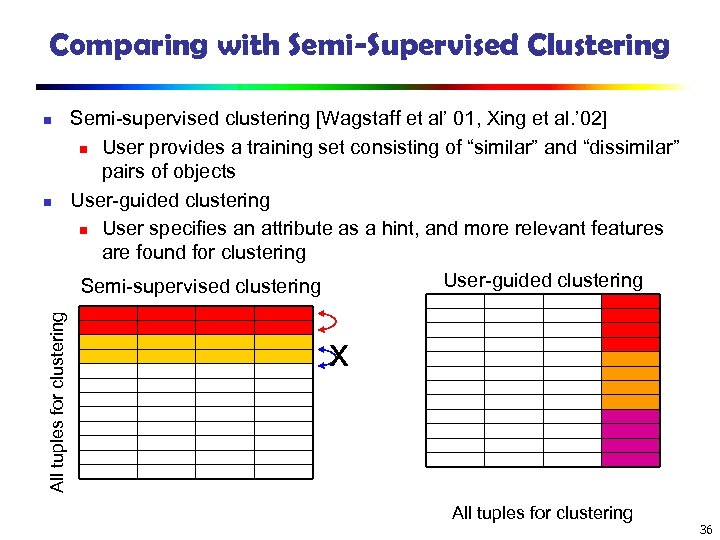 Comparing with Semi-Supervised Clustering n All tuples for clustering n Semi-supervised clustering [Wagstaff et al’ 01, Xing et al. ’ 02] n User provides a training set consisting of “similar” and “dissimilar” pairs of objects User-guided clustering n User specifies an attribute as a hint, and more relevant features are found for clustering User-guided clustering Semi-supervised clustering x All tuples for clustering 36
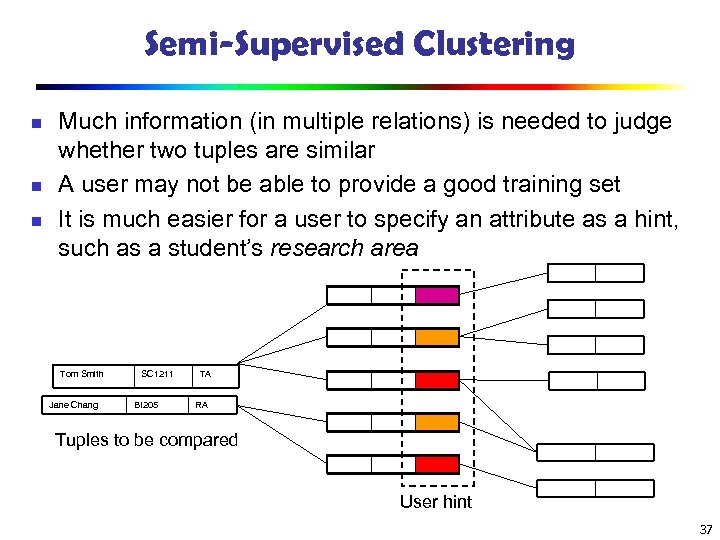 Semi-Supervised Clustering n n n Much information (in multiple relations) is needed to judge whether two tuples are similar A user may not be able to provide a good training set It is much easier for a user to specify an attribute as a hint, such as a student’s research area Tom Smith Jane Chang SC 1211 BI 205 TA RA Tuples to be compared User hint 37
 Cross. Clus: An Overview n n Measure similarity between features by how they group objects into clusters Use a heuristic method to search for pertinent features n n Use tuple ID propagation to create feature values n n Start from user-specified feature and gradually expand search range Features can be easily created during the expansion of search range, by propagating IDs Explore three clustering algorithms: k-means, k-medoids, and hierarchical clustering 38
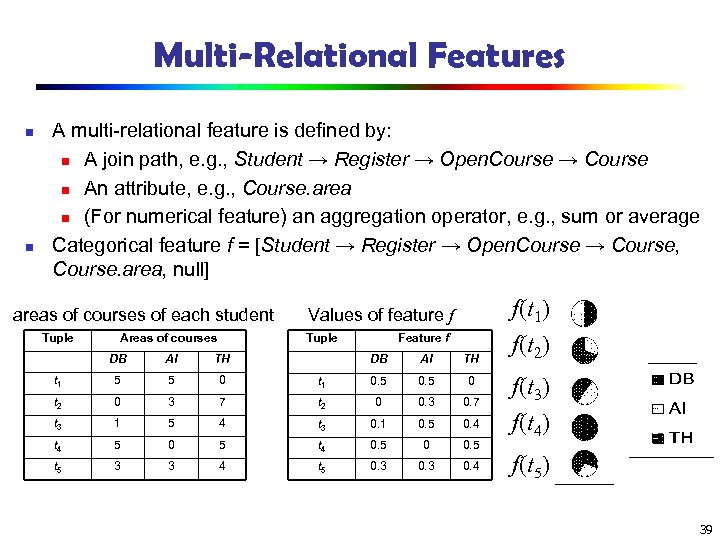 Multi-Relational Features n n A multi-relational feature is defined by: n A join path, e. g. , Student → Register → Open. Course → Course n An attribute, e. g. , Course. area n (For numerical feature) an aggregation operator, e. g. , sum or average Categorical feature f = [Student → Register → Open. Course → Course, Course. area, null] areas of courses of each student Tuple Areas of courses Tuple DB AI TH t 1 5 5 0 t 2 0 3 t 3 1 t 4 t 5 f(t 1) Values of feature f Feature f DB AI TH t 1 0. 5 0 7 t 2 0 0. 3 0. 7 5 4 t 3 0. 1 0. 5 0. 4 5 0 5 t 4 0. 5 0 0. 5 3 3 4 t 5 0. 3 0. 4 f(t 2) f(t 3) f(t 4) f(t 5) 39
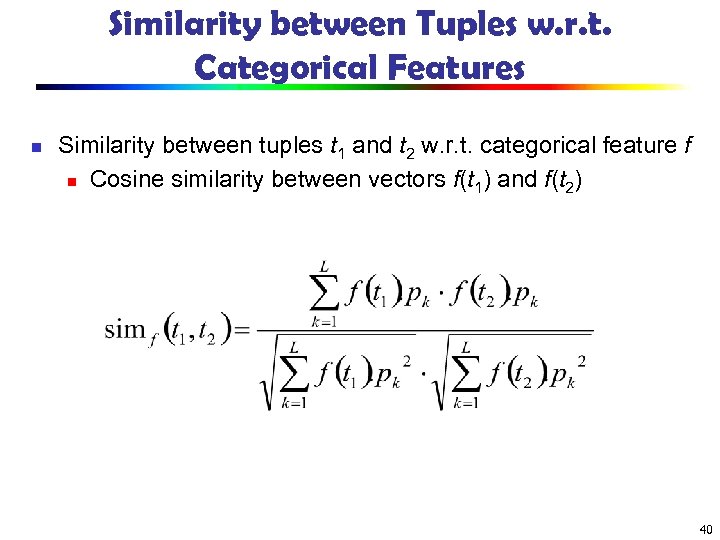 Similarity between Tuples w. r. t. Categorical Features n Similarity between tuples t 1 and t 2 w. r. t. categorical feature f n Cosine similarity between vectors f(t 1) and f(t 2) 40
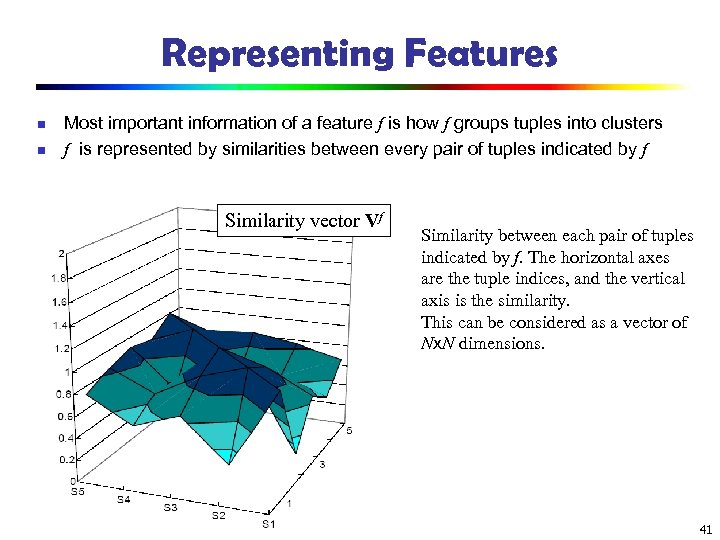 Representing Features n n Most important information of a feature f is how f groups tuples into clusters f is represented by similarities between every pair of tuples indicated by f Similarity vector Vf Similarity between each pair of tuples indicated by f. The horizontal axes are the tuple indices, and the vertical axis is the similarity. This can be considered as a vector of Nx. N dimensions. 41
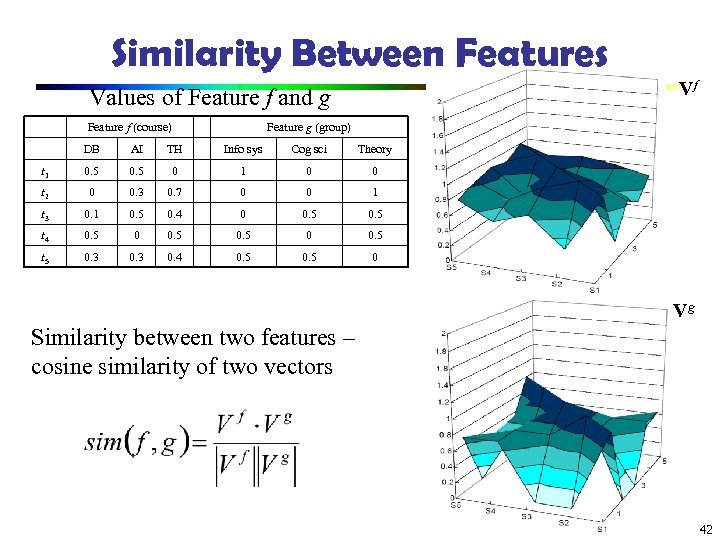 Similarity Between Features Vf Values of Feature f and g Feature f (course) Feature g (group) DB AI TH Info sys Cog sci Theory t 1 0. 5 0 1 0 0 t 2 0 0. 3 0. 7 0 0 1 t 3 0. 1 0. 5 0. 4 0 0. 5 t 4 0. 5 0 0. 5 t 5 0. 3 0. 4 0. 5 0 Vg Similarity between two features – cosine similarity of two vectors 42
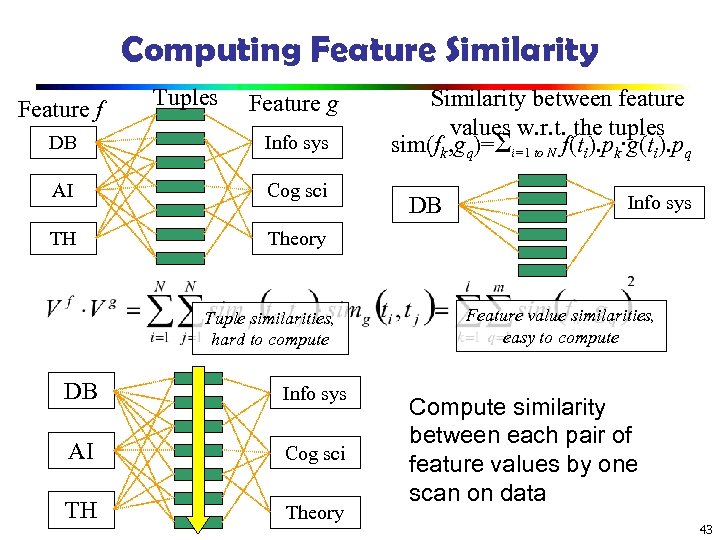 Computing Feature Similarity Feature f Tuples Feature g DB Info sys AI Cog sci TH Similarity between feature values w. r. t. the tuples sim(fk, gq)=Σi=1 to N f(ti). pk∙g(ti). pq Theory Tuple similarities, hard to compute DB Info sys AI Cog sci TH Theory DB Info sys Feature value similarities, easy to compute Compute similarity between each pair of feature values by one scan on data 43
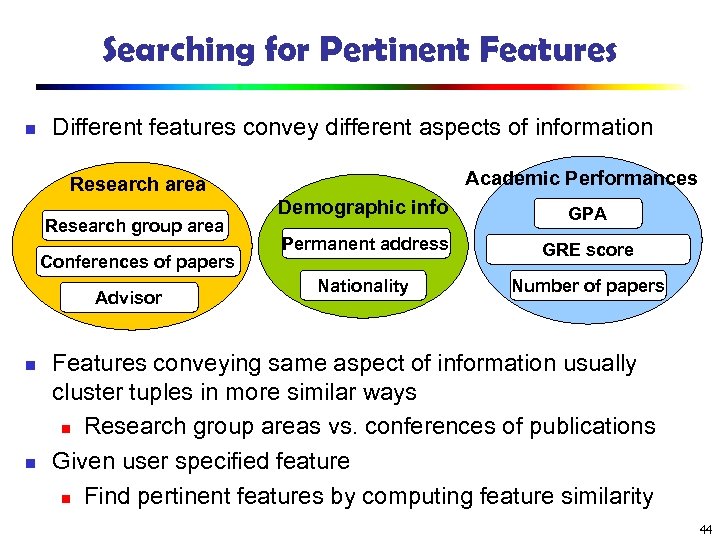 Searching for Pertinent Features n Different features convey different aspects of information Academic Performances Research area Research group area Conferences of papers Advisor n n Demographic info GPA Permanent address GRE score Nationality Number of papers Features conveying same aspect of information usually cluster tuples in more similar ways n Research group areas vs. conferences of publications Given user specified feature n Find pertinent features by computing feature similarity 44
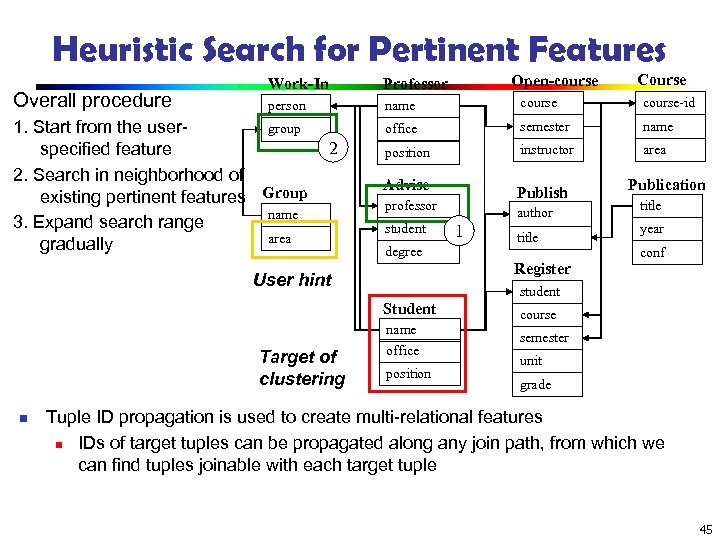 Heuristic Search for Pertinent Features Open-course Course Work-In Professor person name course-id 1. Start from the usergroup specified feature 2. Search in neighborhood of existing pertinent features Group name 3. Expand search range area gradually office semester name position instructor area Overall procedure 2 Advise professor student degree 1 title year conf student Student n author Publication Register User hint Target of clustering Publish name office position course semester unit grade Tuple ID propagation is used to create multi-relational features n IDs of target tuples can be propagated along any join path, from which we can find tuples joinable with each target tuple 45
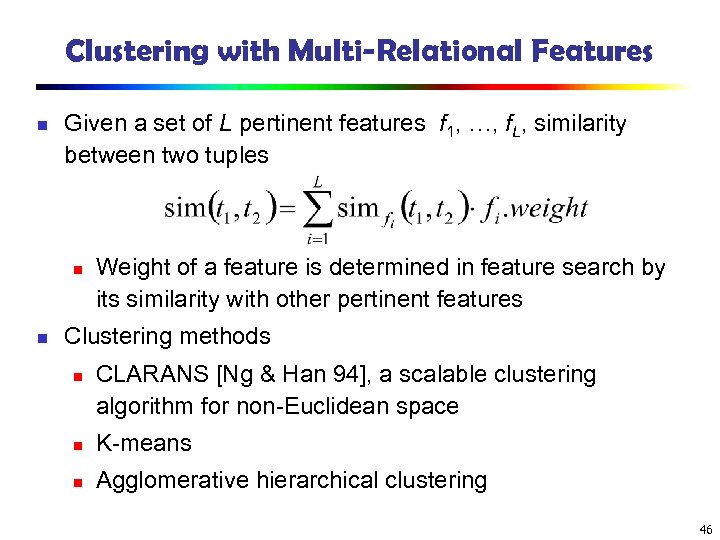 Clustering with Multi-Relational Features n Given a set of L pertinent features f 1, …, f. L, similarity between two tuples n n Weight of a feature is determined in feature search by its similarity with other pertinent features Clustering methods n CLARANS [Ng & Han 94], a scalable clustering algorithm for non-Euclidean space n K-means n Agglomerative hierarchical clustering 46
 Experiments: Compare Cross. Clus with n n n Baseline: Only use the user specified feature PROCLUS [Aggarwal, et al. 99]: a state-of-the-art subspace clustering algorithm n Use a subset of features for each cluster n We convert relational database to a table by propositionalization n User-specified feature is forced to be used in every cluster RDBC [Kirsten and Wrobel’ 00] n A representative ILP clustering algorithm n Use neighbor information of objects for clustering n User-specified feature is forced to be used 47
 Measure of Clustering Accuracy n Measured by manually labeled data n n We manually assign tuples into clusters according to their properties (e. g. , professors in different research areas) Accuracy of clustering: Percentage of pairs of tuples in the same cluster that share common label n n This measure favors many small clusters We let each approach generate the same number of clusters 48
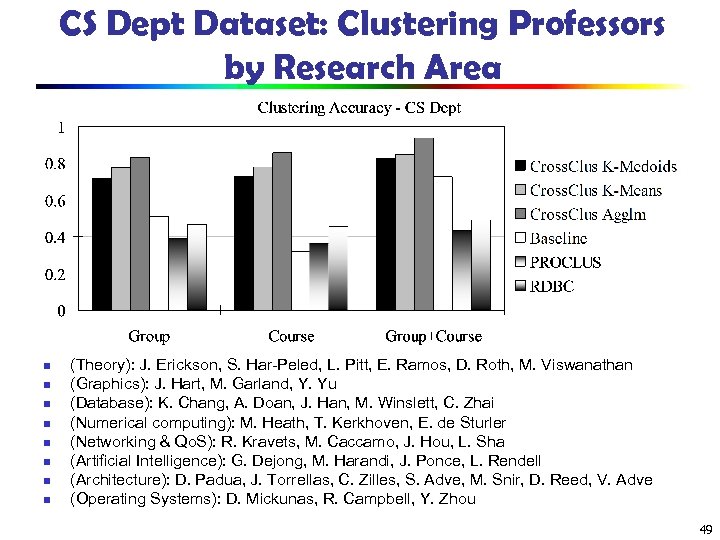 CS Dept Dataset: Clustering Professors by Research Area n n n n (Theory): J. Erickson, S. Har-Peled, L. Pitt, E. Ramos, D. Roth, M. Viswanathan (Graphics): J. Hart, M. Garland, Y. Yu (Database): K. Chang, A. Doan, J. Han, M. Winslett, C. Zhai (Numerical computing): M. Heath, T. Kerkhoven, E. de Sturler (Networking & Qo. S): R. Kravets, M. Caccamo, J. Hou, L. Sha (Artificial Intelligence): G. Dejong, M. Harandi, J. Ponce, L. Rendell (Architecture): D. Padua, J. Torrellas, C. Zilles, S. Adve, M. Snir, D. Reed, V. Adve (Operating Systems): D. Mickunas, R. Campbell, Y. Zhou 49
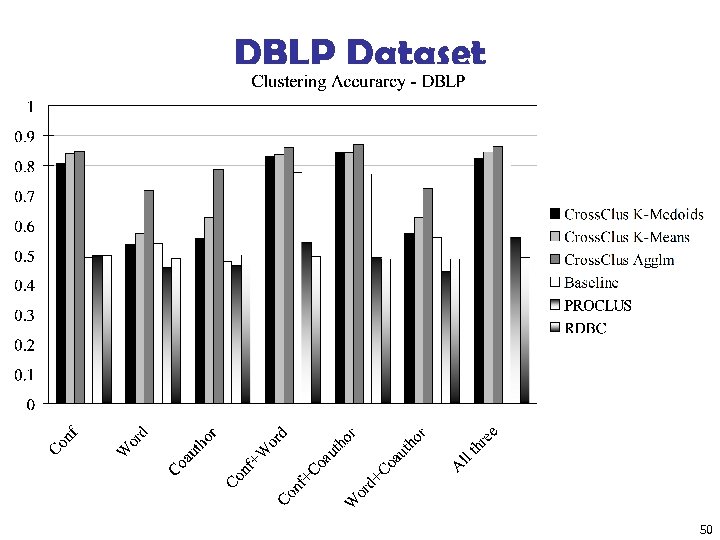 DBLP Dataset 50
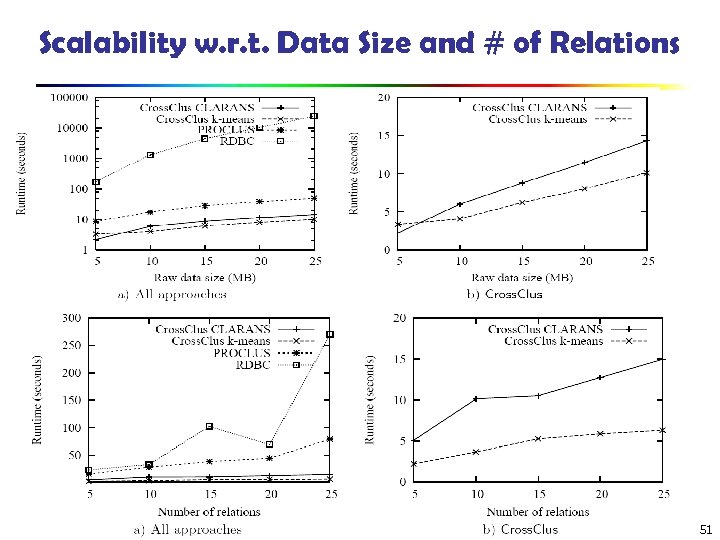 Scalability w. r. t. Data Size and # of Relations 51
 Outline Theme: “Knowledge is power, but knowledge is hidden in massive links” n Link Mining: A General Introduction n Cross. Mine: Classification of Multi-relations by Link Analysis n Cross. Clus: Clustering over Multi-relations by User-Guidance n Link. Clus: Efficient Clustering by Exploring the Power Law Distribution n Distinct: Distinguishing Objects with Identical Names by Link Analysis n Truth. Finder: Conformity to Truth with Conflicting Information n Conclusions and Future Work 52
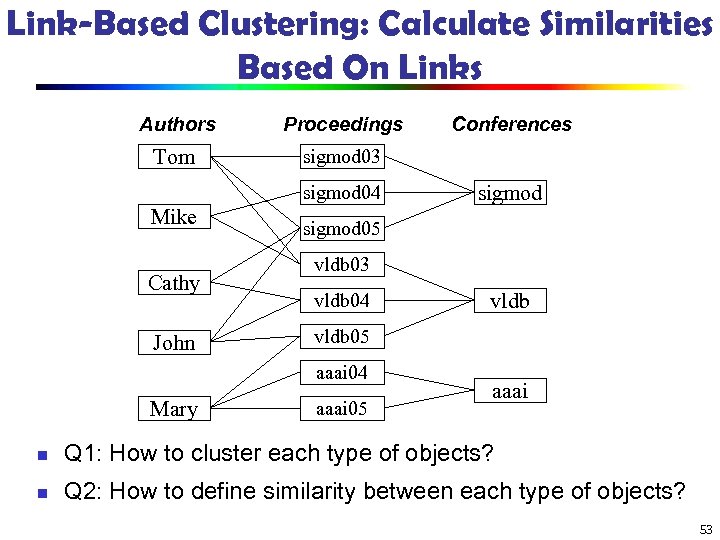 Link-Based Clustering: Calculate Similarities Based On Links Authors Proceedings Tom sigmod 03 sigmod 04 Mike Cathy John sigmod 05 vldb 03 vldb 04 vldb 05 aaai 04 Mary Conferences aaai 05 aaai n Q 1: How to cluster each type of objects? n Q 2: How to define similarity between each type of objects? 53
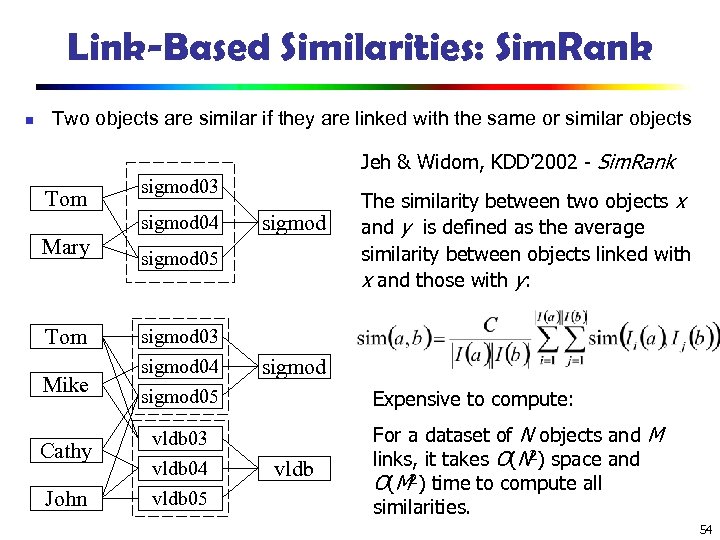 Link-Based Similarities: Sim. Rank n Two objects are similar if they are linked with the same or similar objects Jeh & Widom, KDD’ 2002 - Sim. Rank Tom sigmod 03 sigmod 04 Mary Tom Mike Cathy John sigmod 05 sigmod 03 sigmod 04 sigmod 05 vldb 03 vldb 04 vldb 05 The similarity between two objects x and y is defined as the average similarity between objects linked with x and those with y: sigmod Expensive to compute: vldb For a dataset of N objects and M links, it takes O(N 2) space and O(M 2) time to compute all similarities. 54
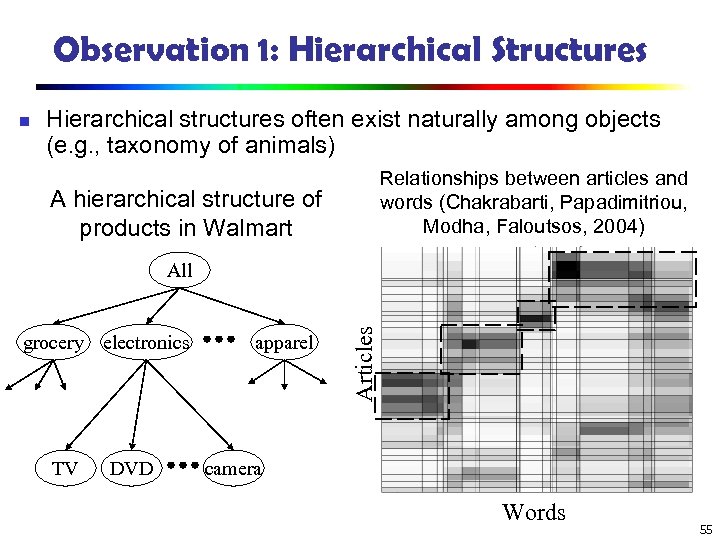 Observation 1: Hierarchical Structures n Hierarchical structures often exist naturally among objects (e. g. , taxonomy of animals) Relationships between articles and words (Chakrabarti, Papadimitriou, Modha, Faloutsos, 2004) A hierarchical structure of products in Walmart grocery electronics TV DVD apparel Articles All camera Words 55
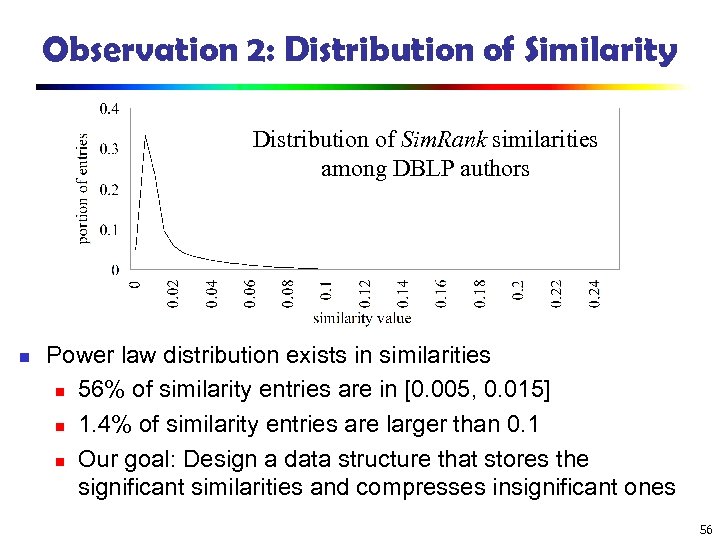 Observation 2: Distribution of Similarity Distribution of Sim. Rank similarities among DBLP authors n Power law distribution exists in similarities n 56% of similarity entries are in [0. 005, 0. 015] n 1. 4% of similarity entries are larger than 0. 1 n Our goal: Design a data structure that stores the significant similarities and compresses insignificant ones 56
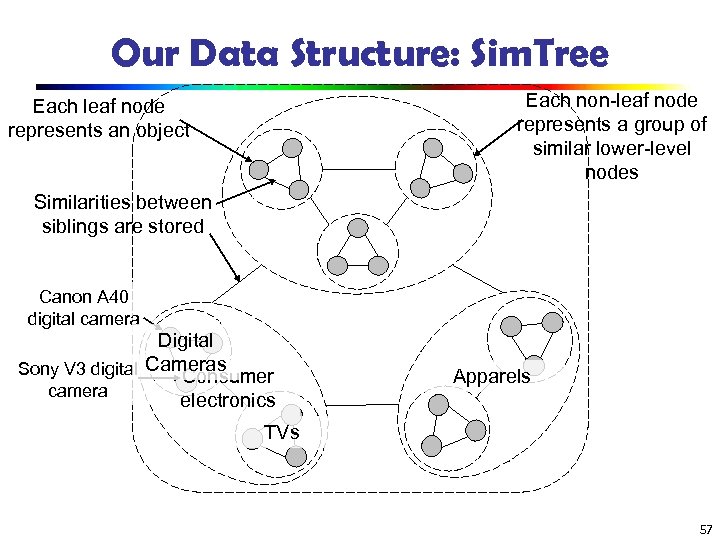 Our Data Structure: Sim. Tree Each non-leaf node represents a group of similar lower-level nodes Each leaf node represents an object Similarities between siblings are stored Canon A 40 digital camera Digital Sony V 3 digital Cameras Consumer camera electronics Apparels TVs 57
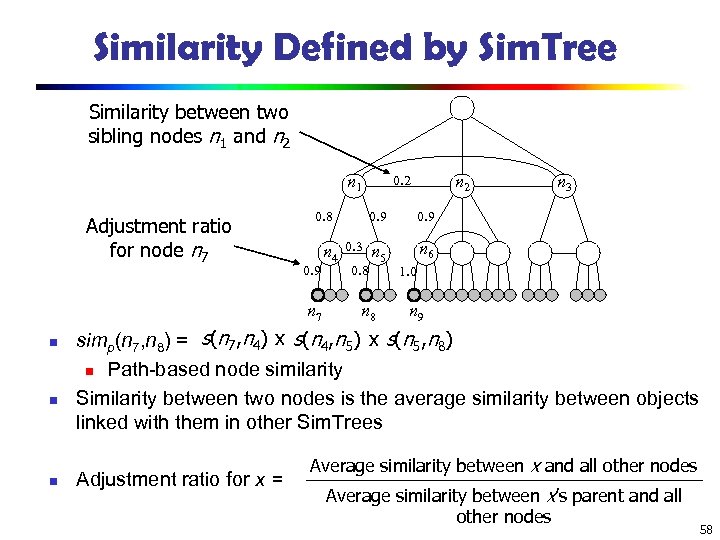 Similarity Defined by Sim. Tree Similarity between two sibling nodes n 1 and n 2 n 1 Adjustment ratio for node n 7 0. 8 0. 9 n 7 n n 4 n 2 0. 9 0. 3 0. 8 0. 9 n 5 n 3 n 6 n 8 1. 0 n 9 simp(n 7, n 8) = s(n 7, n 4) x s(n 4, n 5) x s(n 5, n 8) n Path-based node similarity Similarity between two nodes is the average similarity between objects linked with them in other Sim. Trees Adjustment ratio for x = Average similarity between x and all other nodes Average similarity between x’s parent and all other nodes 58
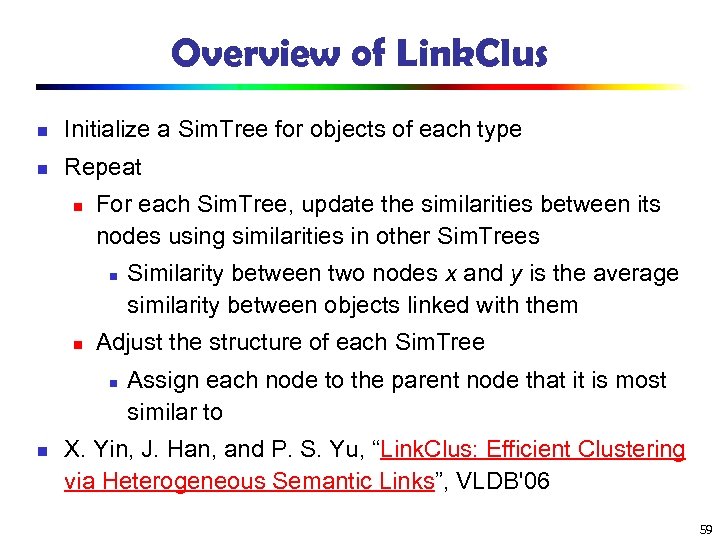 Overview of Link. Clus n Initialize a Sim. Tree for objects of each type n Repeat n For each Sim. Tree, update the similarities between its nodes using similarities in other Sim. Trees n n Adjust the structure of each Sim. Tree n n Similarity between two nodes x and y is the average similarity between objects linked with them Assign each node to the parent node that it is most similar to X. Yin, J. Han, and P. S. Yu, “Link. Clus: Efficient Clustering via Heterogeneous Semantic Links”, VLDB'06 59
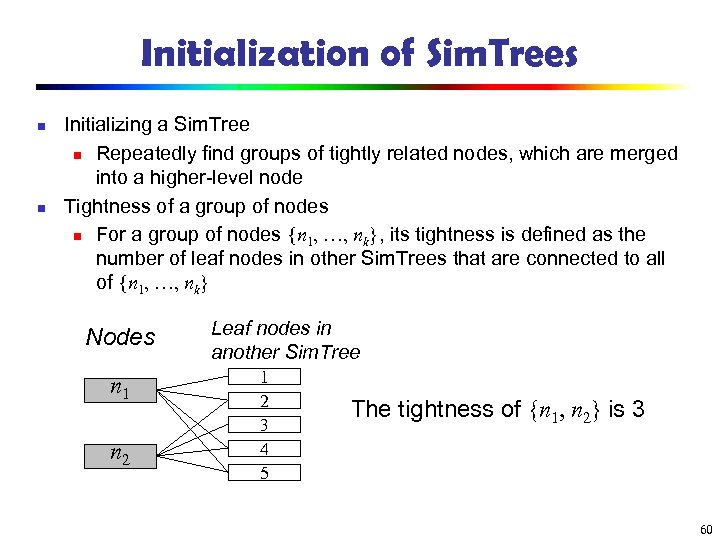 Initialization of Sim. Trees n n Initializing a Sim. Tree n Repeatedly find groups of tightly related nodes, which are merged into a higher-level node Tightness of a group of nodes n For a group of nodes {n 1, …, nk}, its tightness is defined as the number of leaf nodes in other Sim. Trees that are connected to all of {n 1, …, nk} Nodes n 1 n 2 Leaf nodes in another Sim. Tree 1 2 3 4 5 The tightness of {n 1, n 2} is 3 60
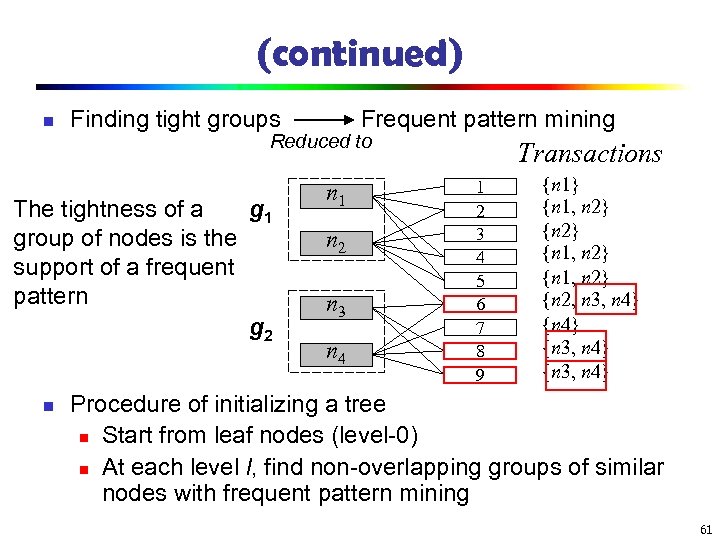 (continued) n Finding tight groups Reduced to The tightness of a g 1 group of nodes is the support of a frequent pattern g 2 n Frequent pattern mining n 1 n 2 n 3 n 4 Transactions 1 2 3 4 5 6 7 8 9 {n 1} {n 1, n 2} {n 2, n 3, n 4} {n 3, n 4} Procedure of initializing a tree n Start from leaf nodes (level-0) n At each level l, find non-overlapping groups of similar nodes with frequent pattern mining 61
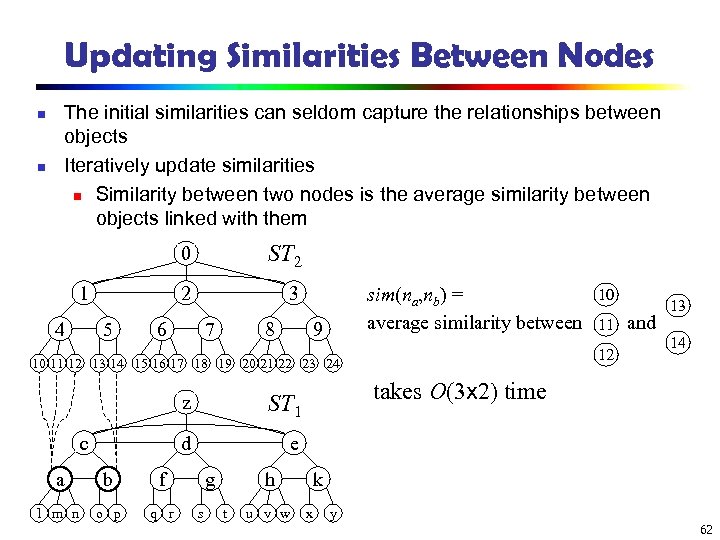 Updating Similarities Between Nodes n n The initial similarities can seldom capture the relationships between objects Iteratively update similarities n Similarity between two nodes is the average similarity between objects linked with them 0 2 1 4 5 ST 2 3 6 7 8 sim(na, nb) = average similarity between 9 a b o p q r 14 e f l m n and 13 takes O(3 x 2) time ST 1 d c 11 12 10 11 12 13 14 15 16 17 18 19 20 21 22 23 24 z 10 g s h t u v w k x y 62
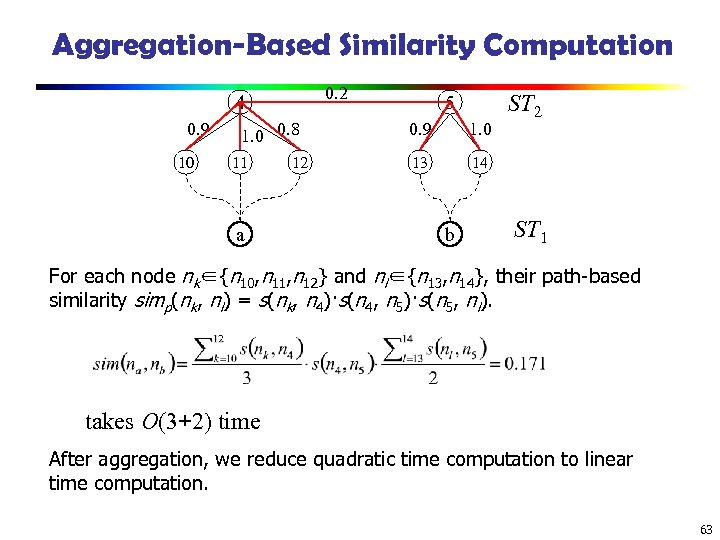 Aggregation-Based Similarity Computation 0. 2 4 0. 9 10 1. 0 0. 8 11 a 12 5 0. 9 1. 0 13 ST 2 14 b ST 1 For each node nk∈{n 10, n 11, n 12} and nl∈{n 13, n 14}, their path-based similarity simp(nk, nl) = s(nk, n 4)·s(n 4, n 5)·s(n 5, nl). takes O(3+2) time After aggregation, we reduce quadratic time computation to linear time computation. 63
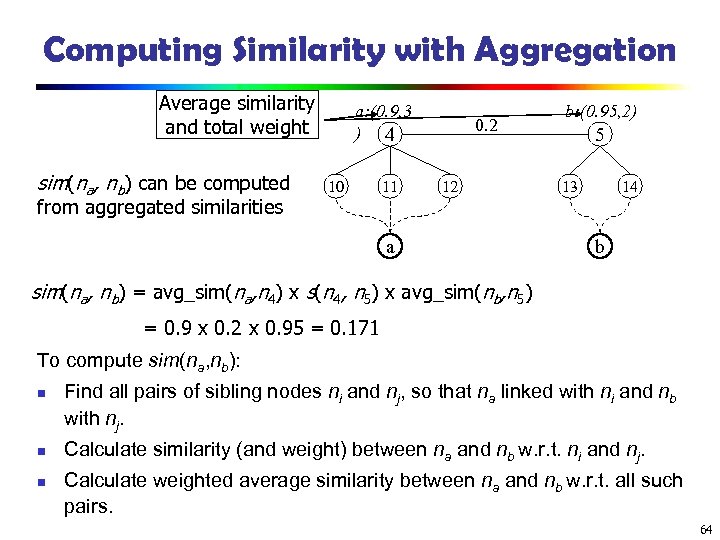 Computing Similarity with Aggregation Average similarity and total weight sim(na, nb) can be computed from aggregated similarities a: (0. 9, 3 ) 4 10 11 0. 2 12 a b: (0. 95, 2) 5 13 14 b sim(na, nb) = avg_sim(na, n 4) x s(n 4, n 5) x avg_sim(nb, n 5) = 0. 9 x 0. 2 x 0. 95 = 0. 171 To compute sim(na, nb): n n n Find all pairs of sibling nodes ni and nj, so that na linked with ni and nb with nj. Calculate similarity (and weight) between na and nb w. r. t. ni and nj. Calculate weighted average similarity between na and nb w. r. t. all such pairs. 64
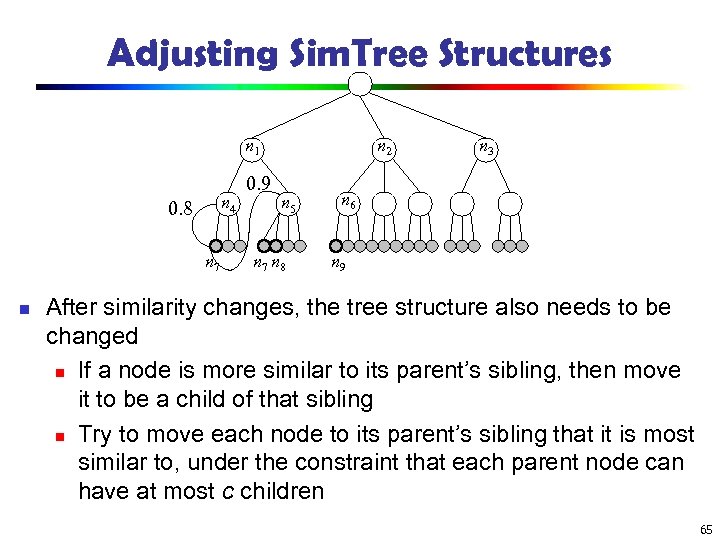 Adjusting Sim. Tree Structures n 1 n 4 0. 8 n 7 n 0. 9 n 2 n 5 n 7 n 8 n 3 n 6 n 9 After similarity changes, the tree structure also needs to be changed n If a node is more similar to its parent’s sibling, then move it to be a child of that sibling n Try to move each node to its parent’s sibling that it is most similar to, under the constraint that each parent node can have at most c children 65
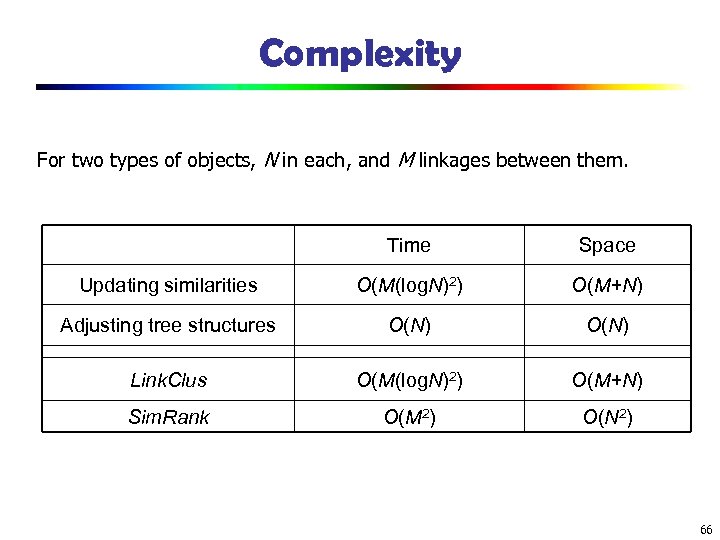 Complexity For two types of objects, N in each, and M linkages between them. Time Space Updating similarities O(M(log. N)2) O(M+N) Adjusting tree structures O(N) Link. Clus O(M(log. N)2) O(M+N) Sim. Rank O(M 2) O(N 2) 66
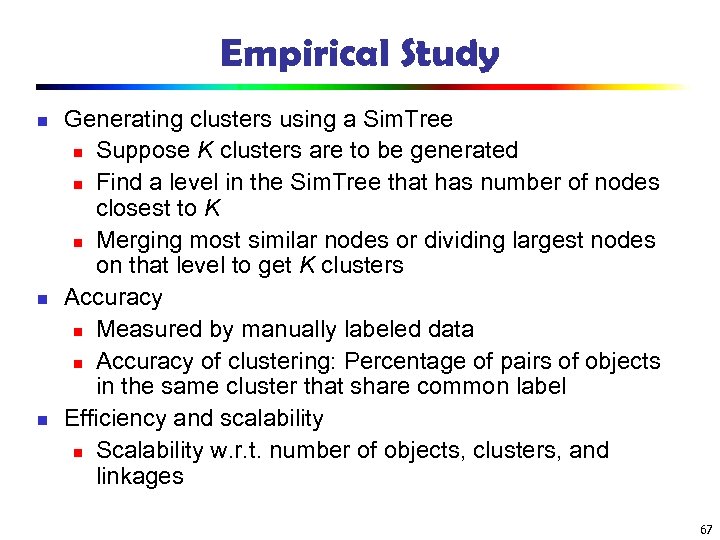 Empirical Study n n n Generating clusters using a Sim. Tree n Suppose K clusters are to be generated n Find a level in the Sim. Tree that has number of nodes closest to K n Merging most similar nodes or dividing largest nodes on that level to get K clusters Accuracy n Measured by manually labeled data n Accuracy of clustering: Percentage of pairs of objects in the same cluster that share common label Efficiency and scalability n Scalability w. r. t. number of objects, clusters, and linkages 67
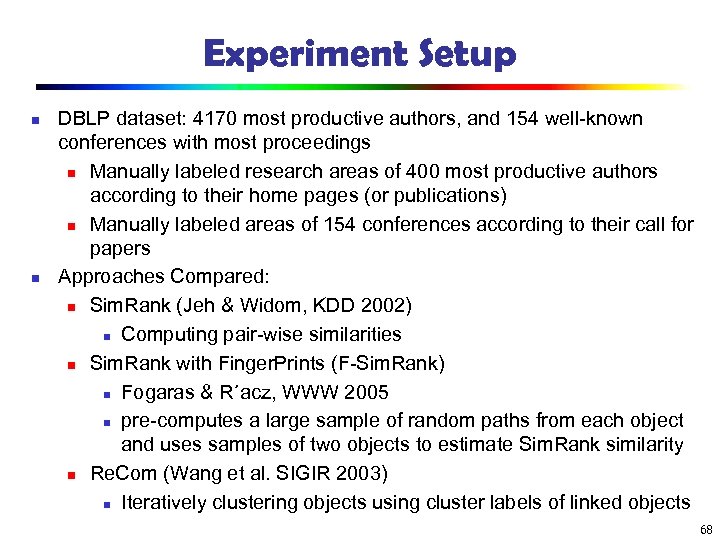 Experiment Setup n n DBLP dataset: 4170 most productive authors, and 154 well-known conferences with most proceedings n Manually labeled research areas of 400 most productive authors according to their home pages (or publications) n Manually labeled areas of 154 conferences according to their call for papers Approaches Compared: n Sim. Rank (Jeh & Widom, KDD 2002) n Computing pair-wise similarities n Sim. Rank with Finger. Prints (F-Sim. Rank) n Fogaras & R´acz, WWW 2005 n pre-computes a large sample of random paths from each object and uses samples of two objects to estimate Sim. Rank similarity n Re. Com (Wang et al. SIGIR 2003) n Iteratively clustering objects using cluster labels of linked objects 68
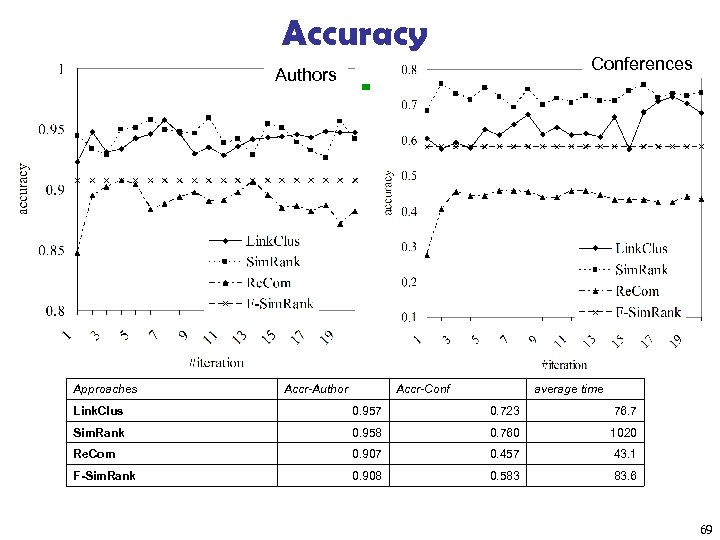 Accuracy Conferences Authors Approaches Accr-Author Accr-Conf average time Link. Clus 0. 957 0. 723 76. 7 Sim. Rank 0. 958 0. 760 1020 Re. Com 0. 907 0. 457 43. 1 F-Sim. Rank 0. 908 0. 583 83. 6 69
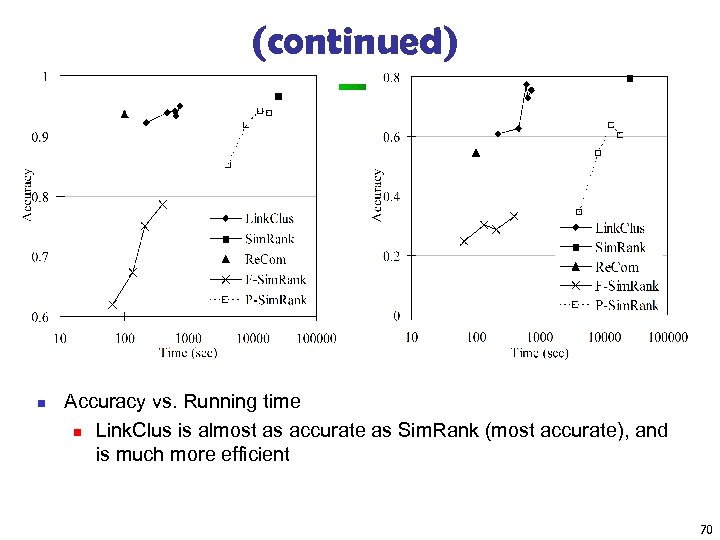 (continued) n Accuracy vs. Running time n Link. Clus is almost as accurate as Sim. Rank (most accurate), and is much more efficient 70
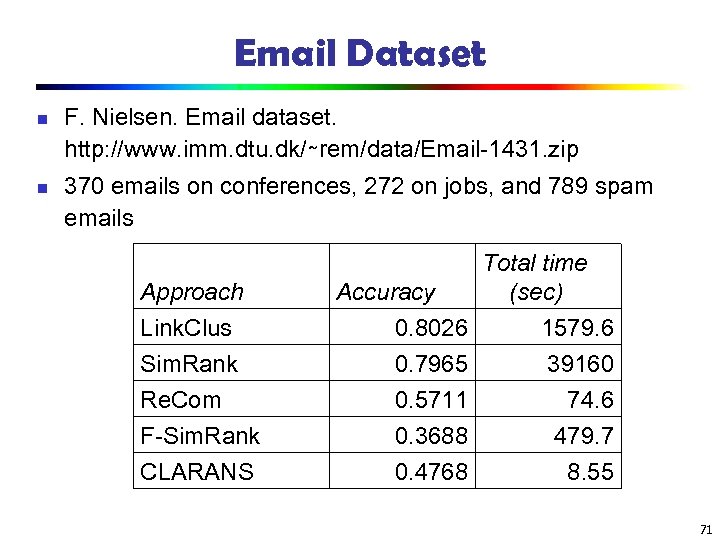 Email Dataset n n F. Nielsen. Email dataset. http: //www. imm. dtu. dk/∼rem/data/Email-1431. zip 370 emails on conferences, 272 on jobs, and 789 spam emails Approach Link. Clus Sim. Rank Re. Com F-Sim. Rank CLARANS Accuracy 0. 8026 0. 7965 0. 5711 0. 3688 0. 4768 Total time (sec) 1579. 6 39160 74. 6 479. 7 8. 55 71
 Outline Theme: “Knowledge is power, but knowledge is hidden in massive links” n Link Mining: A General Introduction n Cross. Mine: Classification of Multi-relations by Link Analysis n Cross. Clus: Clustering over Multi-relations by User-Guidance n Link. Clus: Efficient Clustering by Exploring the Power Law Distribution n Distinct: Distinguishing Objects with Identical Names by Link Analysis n Truth. Finder: Conformity to Truth with Conflicting Information n Conclusions and Future Work 72
 People/Objects Do Share Names n Why distinguishing objects with identical names? n Different objects may share the same n n n n In All. Music. com, 72 songs and 3 albums named “Forgotten” or “The Forgotten” In DBLP, 141 papers are written by at least 14 “Wei Wang” How to distinguish the authors of the 141 papers? Our task: Object distinction n X. Yin, J. Han, and P. S. Yu, “Object Distinction: Distinguishing Objects with Identical Names by Link Analysis”, ICDE'07 73
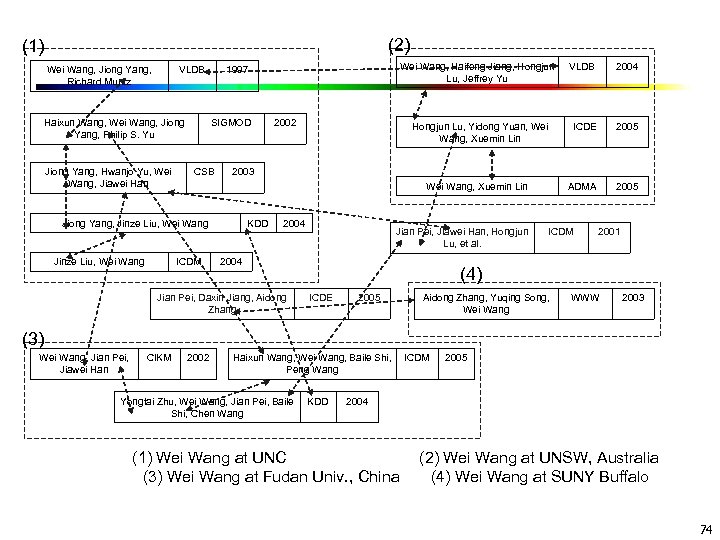 (2) (1) Wei Wang, Jiong Yang, Richard Muntz Haixun Wang, Wei Wang, Jiong Yang, Philip S. Yu Jiong Yang, Hwanjo Yu, Wei Wang, Jiawei Han SIGMOD CSB ICDM 2002 VLDB 2004 Hongjun Lu, Yidong Yuan, Wei Wang, Xuemin Lin 1997 ICDE 2005 ADMA 2005 2003 Jiong Yang, Jinze Liu, Wei Wang, Haifeng Jiang, Hongjun Lu, Jeffrey Yu Wei Wang, Xuemin Lin VLDB KDD 2004 Jian Pei, Jiawei Han, Hongjun Lu, et al. 2004 Jian Pei, Daxin Jiang, Aidong Zhang ICDM 2001 (4) ICDE 2005 Aidong Zhang, Yuqing Song, Wei Wang WWW 2003 (3) Wei Wang, Jian Pei, Jiawei Han CIKM 2002 Haixun Wang, Wei Wang, Baile Shi, Peng Wang Yongtai Zhu, Wei Wang, Jian Pei, Baile Shi, Chen Wang KDD ICDM 2005 2004 (1) Wei Wang at UNC (3) Wei Wang at Fudan Univ. , China (2) Wei Wang at UNSW, Australia (4) Wei Wang at SUNY Buffalo 74
 Challenges of Object Distinction n Related to duplicate detection, but n n Textual similarity cannot be used Different references appear in different contexts (e. g. , different papers), and thus seldom share common attributes Each reference is associated with limited information We need to carefully design an approach and use all information we have 75
 Overview of DISTINCT n Measure similarity between references n Linkages between references n n Neighbor tuples of each reference n n As shown by self-loop property, references to the same object are more likely to be connected Can indicate similarity between their contexts References clustering n Group references according to their similarities 76
 Similarity 1: Link-based Similarity n n n Indicate the overall strength of connections between two references We use random walk probability between the two tuples containing the references Random walk probabilities along different join paths are handled separately n n Because different join paths have different semantic meanings Only consider join paths of length at most 2 L (L is the number of steps of propagating probabilities) 77
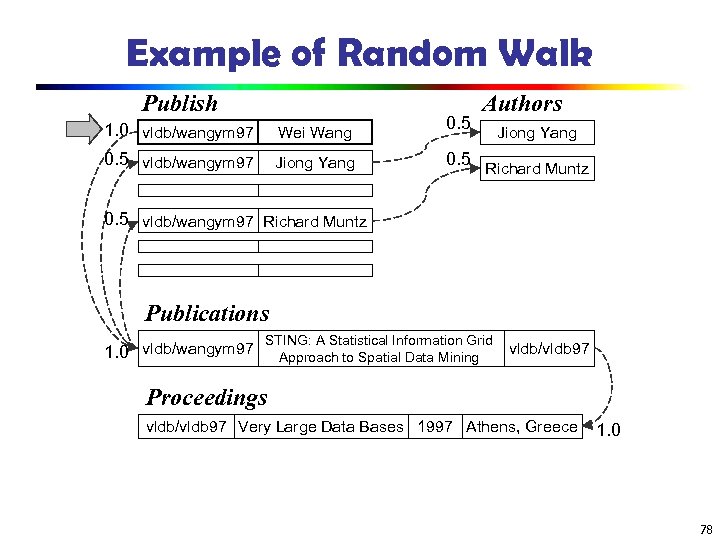 Example of Random Walk Publish 1. 0 vldb/wangym 97 Wei Wang 0. 5 vldb/wangym 97 Jiong Yang 0. 5 Authors Jiong Yang 0. 5 Richard Muntz 0. 5 vldb/wangym 97 Richard Muntz Publications 1. 0 vldb/wangym 97 STING: A Statistical Information Grid Approach to Spatial Data Mining vldb/vldb 97 Proceedings vldb/vldb 97 Very Large Data Bases 1997 Athens, Greece 1. 0 78
 Similarity 2: Neighborhood Similarity n Find the neighbor tuples of each reference n n Weights of neighbor tuples n n n Neighbor tuples within L joins Different neighbor tuples have different connections to a reference Assign each neighbor tuple a weight, which is the probability of walking from the reference to this tuple Similarity: Set resemblance between two sets of neighbor tuples 79
 Training with the “Same” Data Set n Build a training set automatically n n Select distinct names, e. g. , Johannes Gehrke The collaboration behavior within the same community share some similarity Training parameters using a typical and large set of “unambiguous” examples Use SVM to learn a model for combining different join paths n n Each join path is used as two attributes (with linkbased similarity and neighborhood similarity) The model is a weighted sum of all attributes 80
 Clustering References n Why choose agglomerative hierarchical clustering methods? n We do not know number of clusters (real entities) n We only know similarity between references n Equivalent references can be merged into a cluster, which represents a single entity 81
 How to Measure Similarity between Clusters? n Single-link (highest similarity between points in two clusters) ? n n Complete-link (minimum similarity between them)? n n No, because references to different objects can be connected. No, because references to the same object may be weakly connected. Average-link (average similarity between points in two clusters)? n A better measure 82
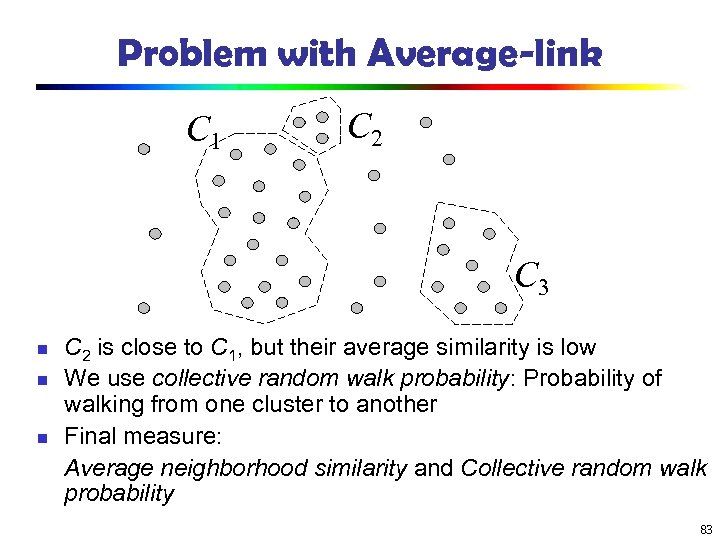 Problem with Average-link C 1 C 2 C 3 n n n C 2 is close to C 1, but their average similarity is low We use collective random walk probability: Probability of walking from one cluster to another Final measure: Average neighborhood similarity and Collective random walk probability 83
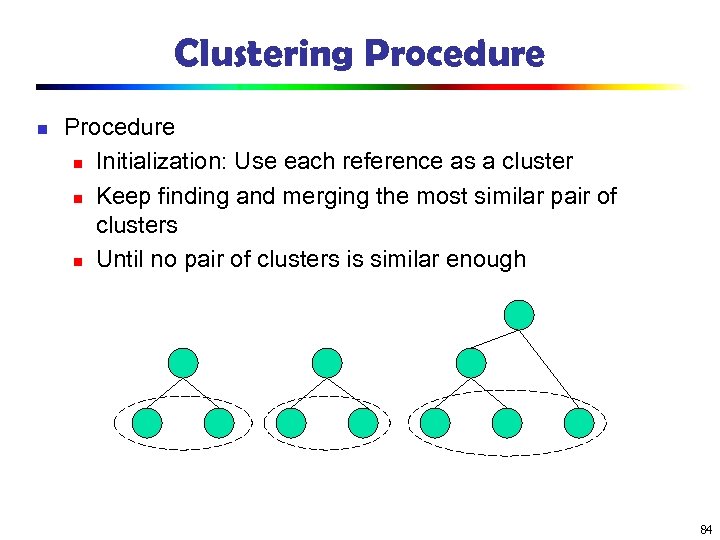 Clustering Procedure n Initialization: Use each reference as a cluster n Keep finding and merging the most similar pair of clusters n Until no pair of clusters is similar enough 84
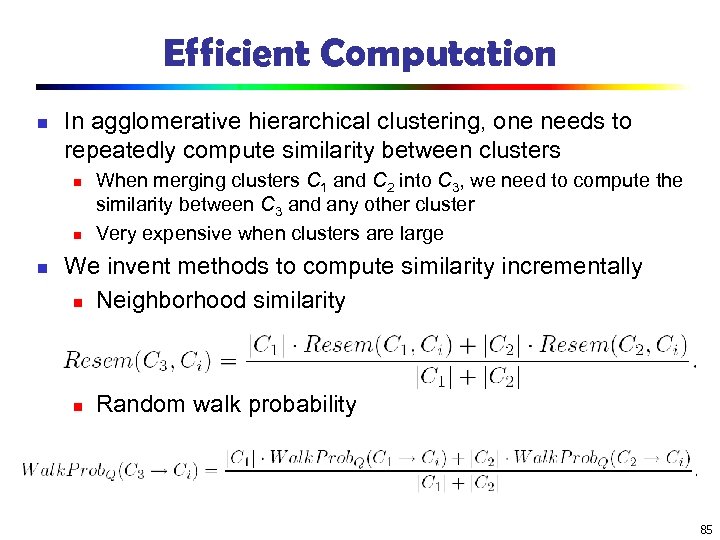 Efficient Computation n In agglomerative hierarchical clustering, one needs to repeatedly compute similarity between clusters n n n When merging clusters C 1 and C 2 into C 3, we need to compute the similarity between C 3 and any other cluster Very expensive when clusters are large We invent methods to compute similarity incrementally n Neighborhood similarity n Random walk probability 85
 Experimental Results n n n Distinguishing references to authors in DBLP Accuracy of reference clustering n True positive: Number of pairs of references to same author in same cluster n False positive: Different authors, in same cluster n False negative: Same author, different clusters n True negative: Different authors, different clusters Measures Precision = TP/(TP+FP) Recall = TP/(TP+FN) f-measure = 2*precision*recall / (precision+recall) Accuracy = TP/(TP+FP+FN) 86
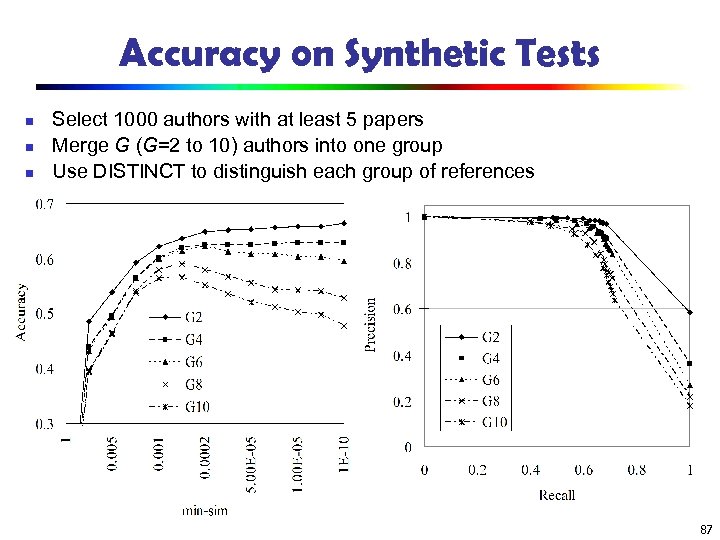 Accuracy on Synthetic Tests n n n Select 1000 authors with at least 5 papers Merge G (G=2 to 10) authors into one group Use DISTINCT to distinguish each group of references 87
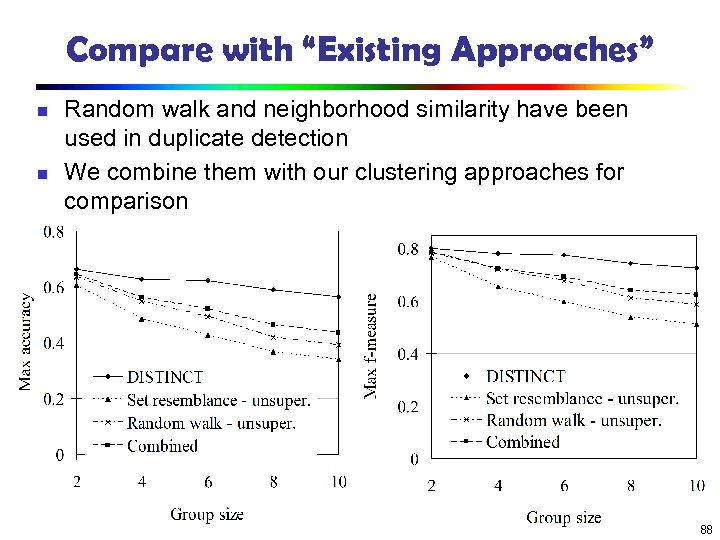 Compare with “Existing Approaches” n n Random walk and neighborhood similarity have been used in duplicate detection We combine them with our clustering approaches for comparison 88
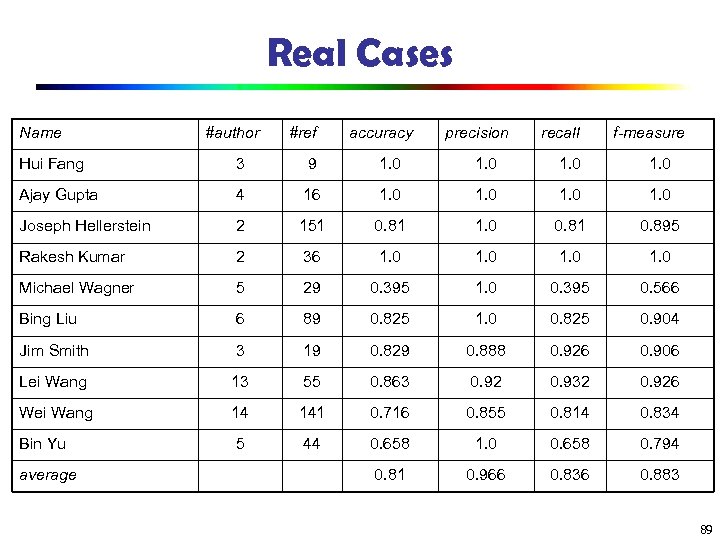 Real Cases Name #author #ref accuracy precision recall f-measure Hui Fang 3 9 1. 0 Ajay Gupta 4 16 1. 0 Joseph Hellerstein 2 151 0. 81 1. 0 0. 81 0. 895 Rakesh Kumar 2 36 1. 0 Michael Wagner 5 29 0. 395 1. 0 0. 395 0. 566 Bing Liu 6 89 0. 825 1. 0 0. 825 0. 904 Jim Smith 3 19 0. 829 0. 888 0. 926 0. 906 Lei Wang 13 55 0. 863 0. 92 0. 932 0. 926 Wei Wang 14 141 0. 716 0. 855 0. 814 0. 834 Bin Yu 5 44 0. 658 1. 0 0. 658 0. 794 0. 81 0. 966 0. 836 0. 883 average 89
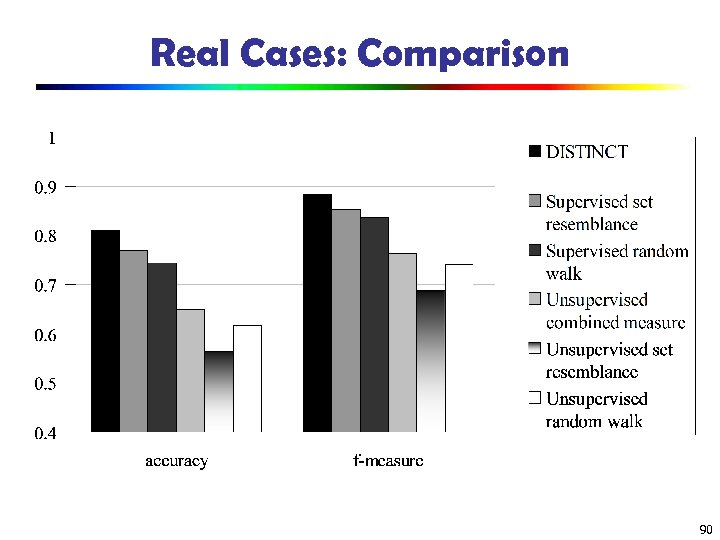 Real Cases: Comparison 90
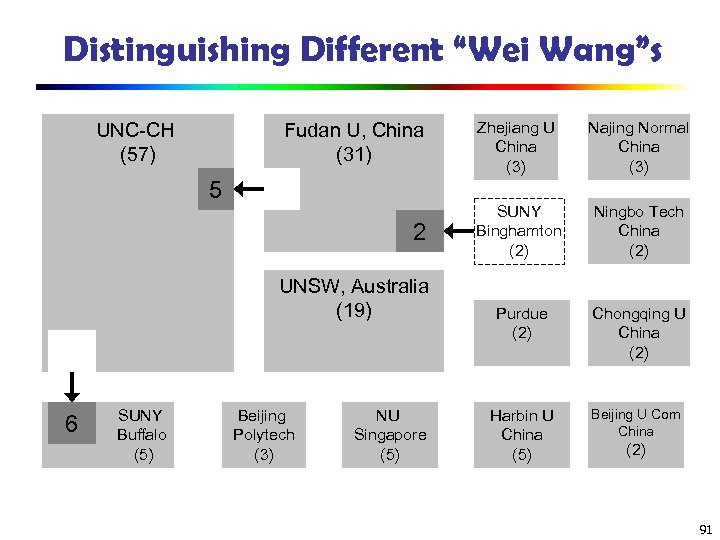 Distinguishing Different “Wei Wang”s UNC-CH (57) Fudan U, China (31) 5 2 UNSW, Australia (19) 6 SUNY Buffalo (5) Beijing Polytech (3) NU Singapore (5) Zhejiang U China (3) Najing Normal China (3) SUNY Binghamton (2) Ningbo Tech China (2) Purdue (2) Chongqing U China (2) Harbin U China (5) Beijing U Com China (2) 91
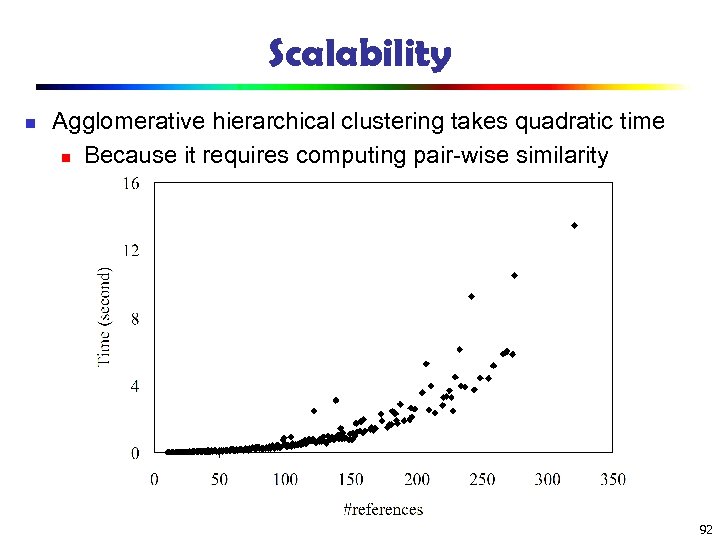 Scalability n Agglomerative hierarchical clustering takes quadratic time n Because it requires computing pair-wise similarity 92
 Outline Theme: “Knowledge is power, but knowledge is hidden in massive links” n Link Mining: A General Introduction n Cross. Mine: Classification of Multi-relations by Link Analysis n Cross. Clus: Clustering over Multi-relations by User-Guidance n Link. Clus: Efficient Clustering by Exploring the Power Law Distribution n Distinct: Distinguishing Objects with Identical Names by Link Analysis n Truth. Finder: Conformity to Truth with Conflicting Information n Conclusions and Future Work 93
![Truth Discovery with Multiple Conflicting Information Providers [KDD’ 07] n n Xiaoxin Yin, Jiawei](https://present5.com/presentation/9d7d56c5f30946a54167d5ee686f5bf0/image-94.jpg "Truth Discovery with Multiple Conflicting Information Providers [KDD’ 07] n n Xiaoxin Yin, Jiawei") Truth Discovery with Multiple Conflicting Information Providers [KDD’ 07] n n Xiaoxin Yin, Jiawei Han, Philip S. Yu, “Truth Discovery with Multiple Conflicting Information Providers on the Web”, KDD’ 07 The trustworthiness problem of the web (according to a survey): n n 26% for web sites that sell products n n 54% of Internet users trust news web sites most of time 12% for blogs Truth. Finder: Truth discovery on the Web by link analysis n n Among multiple conflict results, can we automatically identify which one is likely the true fact? Veracity (conformity to truth): n n Given a large amount of conflicting information about many objects, provided by multiple web sites (or other information providers) How to discover the true fact about each object? 94
Truth Discovery with Multiple Conflicting Information Providers [KDD’ 07] n n Xiaoxin Yin, Jiawei Han, Philip S. Yu, “Truth Discovery with Multiple Conflicting Information Providers on the Web”, KDD’ 07 The trustworthiness problem of the web (according to a survey): n n 26% for web sites that sell products n n 54% of Internet users trust news web sites most of time 12% for blogs Truth. Finder: Truth discovery on the Web by link analysis n n Among multiple conflict results, can we automatically identify which one is likely the true fact? Veracity (conformity to truth): n n Given a large amount of conflicting information about many objects, provided by multiple web sites (or other information providers) How to discover the true fact about each object? 94
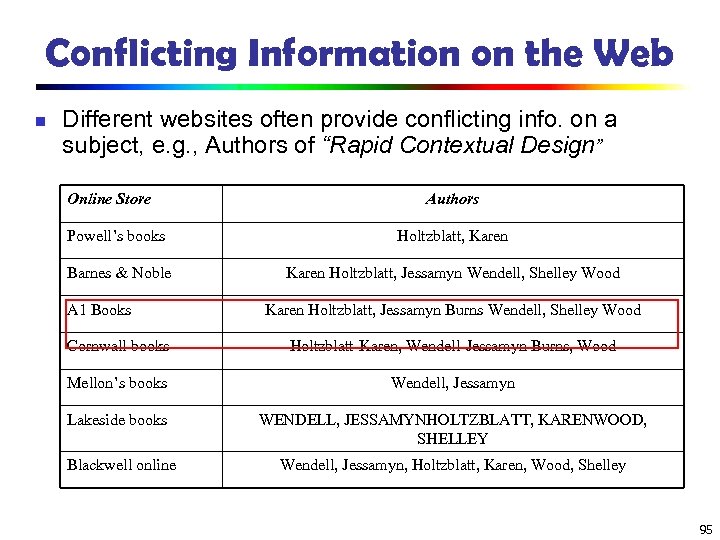 Conflicting Information on the Web n Different websites often provide conflicting info. on a subject, e. g. , Authors of “Rapid Contextual Design” Online Store Authors Powell’s books Holtzblatt, Karen Barnes & Noble Karen Holtzblatt, Jessamyn Wendell, Shelley Wood A 1 Books Karen Holtzblatt, Jessamyn Burns Wendell, Shelley Wood Cornwall books Holtzblatt-Karen, Wendell-Jessamyn Burns, Wood Mellon’s books Wendell, Jessamyn Lakeside books WENDELL, JESSAMYNHOLTZBLATT, KARENWOOD, SHELLEY Blackwell online Wendell, Jessamyn, Holtzblatt, Karen, Wood, Shelley 95
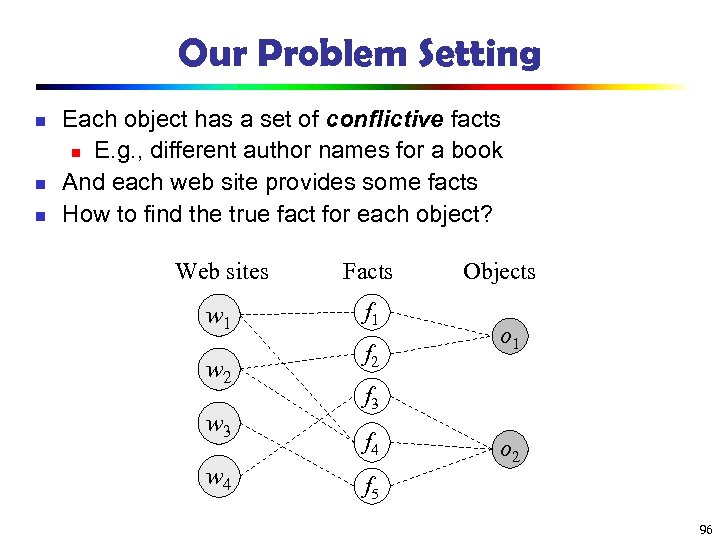 Our Problem Setting n n n Each object has a set of conflictive facts n E. g. , different author names for a book And each web site provides some facts How to find the true fact for each object? Web sites Facts w 1 f 1 w 2 w 3 w 4 f 2 Objects o 1 f 3 f 4 o 2 f 5 96
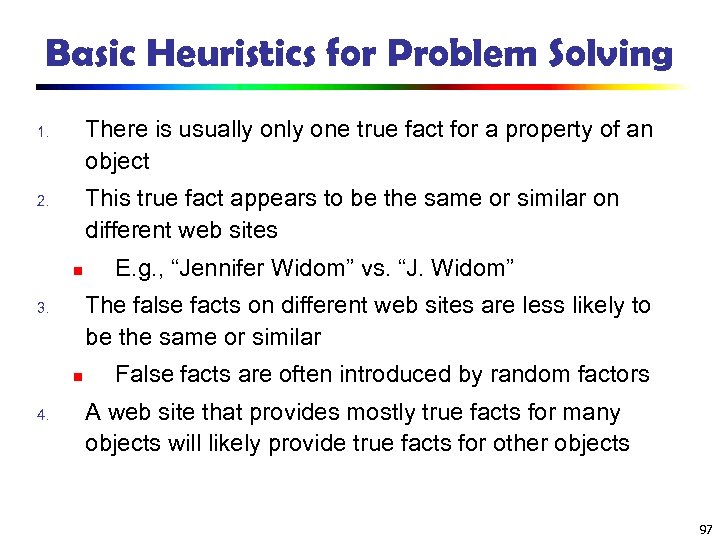 Basic Heuristics for Problem Solving There is usually one true fact for a property of an object 1. This true fact appears to be the same or similar on different web sites 2. n The false facts on different web sites are less likely to be the same or similar 3. n 4. E. g. , “Jennifer Widom” vs. “J. Widom” False facts are often introduced by random factors A web site that provides mostly true facts for many objects will likely provide true facts for other objects 97
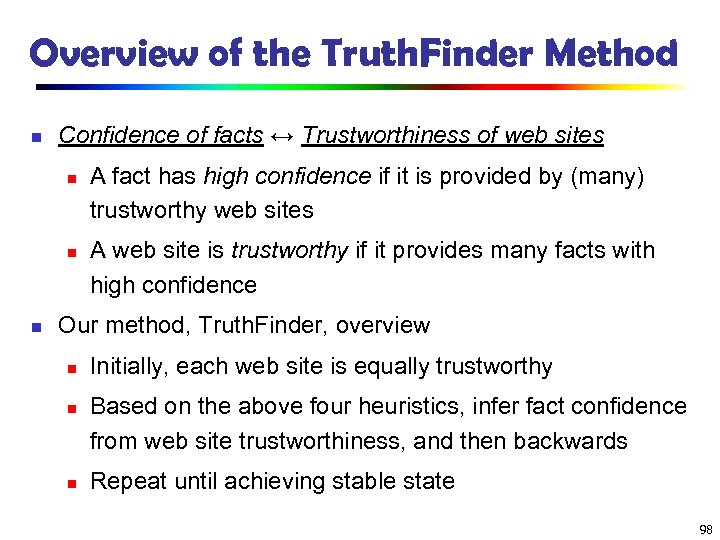 Overview of the Truth. Finder Method n Confidence of facts ↔ Trustworthiness of web sites n n n A fact has high confidence if it is provided by (many) trustworthy web sites A web site is trustworthy if it provides many facts with high confidence Our method, Truth. Finder, overview n n n Initially, each web site is equally trustworthy Based on the above four heuristics, infer fact confidence from web site trustworthiness, and then backwards Repeat until achieving stable state 98
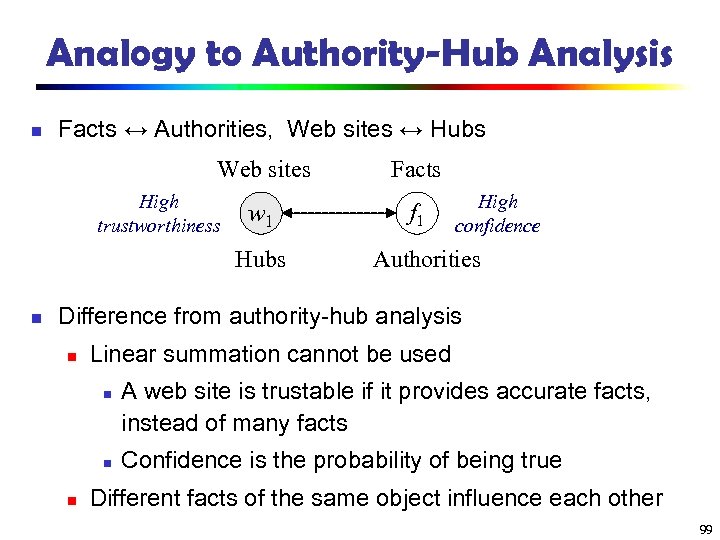 Analogy to Authority-Hub Analysis n Facts ↔ Authorities, Web sites ↔ Hubs Web sites High trustworthiness w 1 Hubs n Facts f 1 High confidence Authorities Difference from authority-hub analysis n Linear summation cannot be used n n n A web site is trustable if it provides accurate facts, instead of many facts Confidence is the probability of being true Different facts of the same object influence each other 99
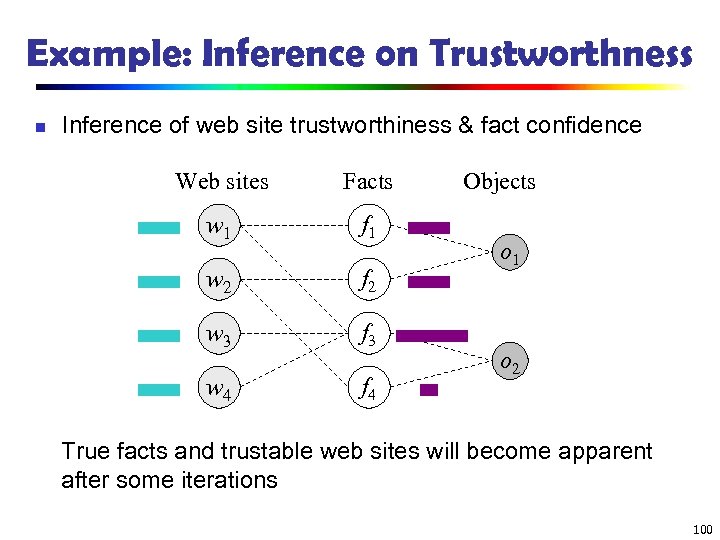 Example: Inference on Trustworthness n Inference of web site trustworthiness & fact confidence Web sites Facts w 1 f 1 w 2 f 2 w 3 f 3 w 4 f 4 Objects o 1 o 2 True facts and trustable web sites will become apparent after some iterations 100
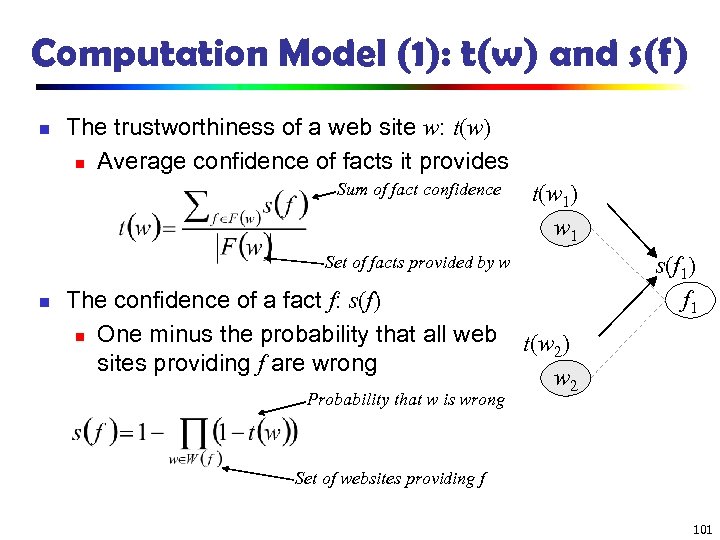 Computation Model (1): t(w) and s(f) n The trustworthiness of a web site w: t(w) n Average confidence of facts it provides Sum of fact confidence t(w 1) w 1 s(f 1) f 1 Set of facts provided by w n The confidence of a fact f: s(f) n One minus the probability that all web sites providing f are wrong Probability that w is wrong t(w 2) w 2 Set of websites providing f 101
 Computation Model (2): Fact Influence n Influence between related facts Example: For a certain book B n w 1 : B is written by “Jennifer Widom” (fact f 1) n w 2 : B is written by “J. Widom” (fact f 2) f 1 and f 2 support each other n n If several other trustworthy web sites say this book is written by “Jeffrey Ullman”, then f 1 and f 2 are likely to be wrong Influence between related facts are very important 102
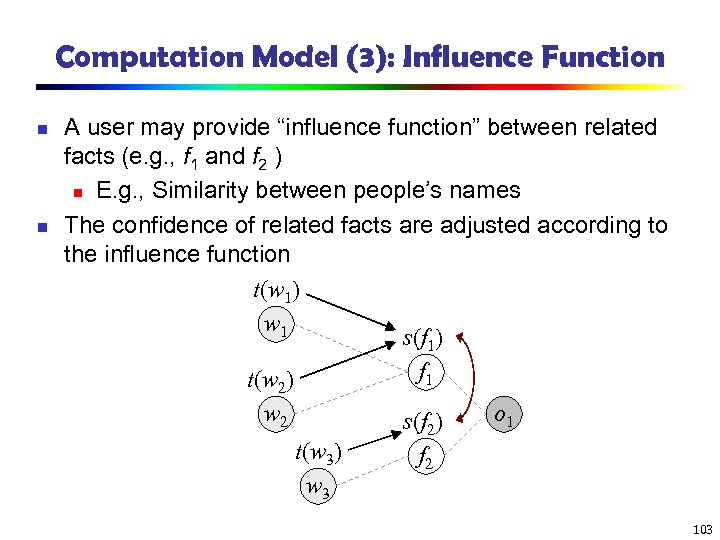 Computation Model (3): Influence Function n n A user may provide “influence function” between related facts (e. g. , f 1 and f 2 ) n E. g. , Similarity between people’s names The confidence of related facts are adjusted according to the influence function t(w 1) w 1 s(f 1) f 1 t(w ) 2 w 2 t(w 3) w 3 s(f 2) f 2 o 1 103
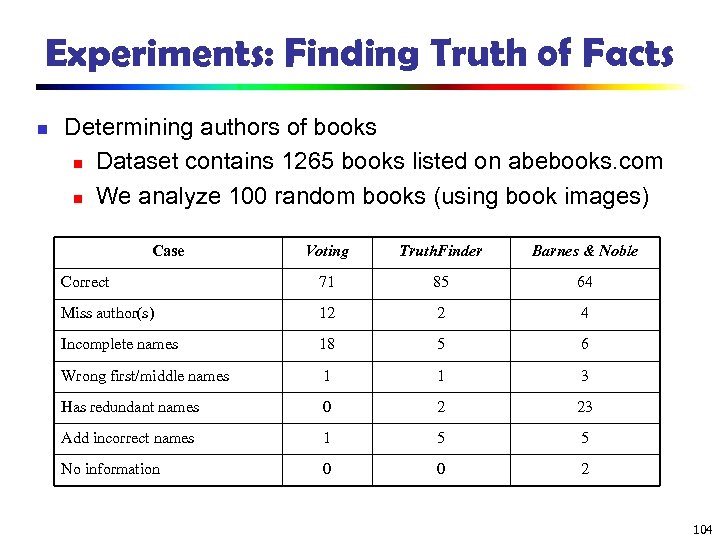 Experiments: Finding Truth of Facts n Determining authors of books n Dataset contains 1265 books listed on abebooks. com n We analyze 100 random books (using book images) Case Voting Truth. Finder Barnes & Noble Correct 71 85 64 Miss author(s) 12 2 4 Incomplete names 18 5 6 Wrong first/middle names 1 1 3 Has redundant names 0 2 23 Add incorrect names 1 5 5 No information 0 0 2 104
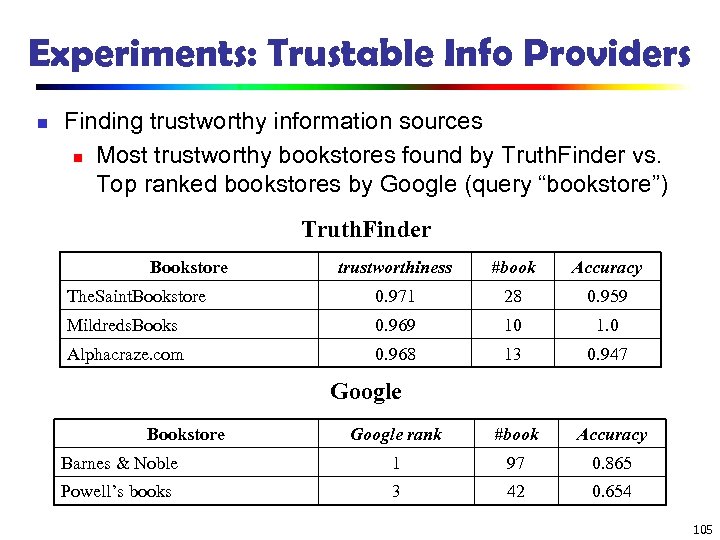 Experiments: Trustable Info Providers n Finding trustworthy information sources n Most trustworthy bookstores found by Truth. Finder vs. Top ranked bookstores by Google (query “bookstore”) Truth. Finder Bookstore trustworthiness #book Accuracy The. Saint. Bookstore 0. 971 28 0. 959 Mildreds. Books 0. 969 10 1. 0 Alphacraze. com 0. 968 13 0. 947 Google rank #book Accuracy Barnes & Noble 1 97 0. 865 Powell’s books 3 42 0. 654 Google Bookstore 105
 Summary: Truth. Finder n n n Veracity: An important problem for Web search and analysis Resolving conflicting facts from multiple websites Our approach: Utilizing the inter-dependency between website trustworthiness and fact confidence to find (1) trustable web sites, and (2) true facts Truth. Finder: A system based on this philosophy n Achieves high accuracy on finding both true facts and high quality web sites Future work: Put the framework into broader application scope n E. g. , Mass collaboration and mass labeling 106
 Outline Theme: “Knowledge is power, but knowledge is hidden in massive links” n Link Mining: A General Introduction n Cross. Mine: Classification of Multi-relations by Link Analysis n Cross. Clus: Clustering over Multi-relations by User-Guidance n Link. Clus: Efficient Clustering by Exploring the Power Law Distribution n Distinct: Distinguishing Objects with Identical Names by Link Analysis n Truth. Finder: Conformity to Truth with Conflicting Information n Conclusions and Future Work 107
 Conclusions n n Knowledge is power, but knowledge is hidden in massive links Exploring links in mining rather than Web page rank and search n Cross. Mine: Classification of multi-relations by link analysis n Cross. Clus: Clustering over multi-relations by user-guidance n n n Link. Clus: Efficient clustering by exploring the power law distribution Distinct: Distinguishing objects with identical names by link analysis Much more to be explored! 108
 References on Information Network Analysis n n n n n S. Brin and L. Page, “The Anatomy of a Large-Scale Hypertextual Web Search Engine”, WWW'98 D. Cai, X. He, J. Wen, and W. Ma, “Block-level Link Analysis”, SIGIR’ 04 S. Chakrabarti, Mining the Web: Statistical Analysis of Hypertex and Semi. Structured Data, Morgan Kaufmann, 2002 S. Chakrabarti, B. E. Dom, R. Kumar, P. Raghavan, S. Rajagopalan, A. Tomkins, D. Gibson, and J. M. Kleinberg, “Mining the Web's Link Structure”, COMPUTER, 32(8): 60 -67, 1999 L. Getoor, “Link mining: a new data mining challenge”, SIGKDD Explorations, 5(1): 84 -89, 2003 G. Jeh and J. Widom, “Simrank: A measure of structural-context similarity”, KDD’ 02 J. M. Kleinberg, “Authoritative Sources in a Hyperlinked Environment”, J. ACM, 46(5): 604 -632, 1999. D. Kempe, J. Kleinberg and E. Tardos, “Maximizing the Spread of Influence through a Social Network”, KDD’ 03. B. Liu, Web Data Mining: Exploring Hyperlinks, Contents, and Usage Data, Springer, 2006 S. Wasserman and K. Faust, Social Network Analysis: Methods and Applications, Cambridge University Press, 1994 109
 References of Our Work in This Tutorial n X. Yin, J. Han, J. Yang, and P. S. Yu, “Cross. Mine: Efficient Classification across Multiple Database Relations”, ICDE'04 (extended version in TKDE’ 06) n X. Yin, J. Han, and P. S. Yu, “Cross-Relational Clustering with User's Guidance”, KDD'05 n X. Yin, J. Han, and P. S. Yu, “Link. Clus: Efficient Clustering via Heterogeneous Semantic Links”, VLDB'06 n X. Yin, J. Han, and P. S. Yu, “Object Distinction: Distinguishing Objects with Identical Names by Link Analysis”, ICDE'07 n X. Yin, J. Han, and P. S. Yu, “Truth Discovery with Multiple Conflicting Information Providers on the Web”, KDD’ 07 Visit www. cs. uiuc. edu/~hanj/pubs/index. htm to download these research papers 110
 Questions 111