


 Скачать презентацию Exploring the grammar of the clause Chapter 8
a77a2cfa4a1efbaa92dbe58c1810e5dd.ppt
- Количество слайдов: 13
 Exploring the grammar of the clause Chapter 8 Longman Student Grammar of Spoken and Written English Biber; Conrad; Leech (2009, p. 221 -262)
 Introduction o The clause is in many ways the key unit of grammar. o Conversation: includes non-clausal material, includes many single-clause units. o News: all words and phrases belong to clauses, there are fewer single-clause units, the clauses contain many words n Teacher – You are late again Alec. Didn`t your alarm go off? n Alec – I threw it away, Miss. n Teacher – Whatever for? n Alec – Because it kept waking me up when I was sleeping.
 Some riddles o If the green house is on the right side of the road, and the red house is on the left side of the road, where is the white house? o In Washington, D. C. n COORDINATION o Why does a chicken lay an egg? o If she dropped it, it would break. n SUBORDINATION (dependent and independent clauses) o Where does Friday come before Thursday? o In the dictionary. n ELLIPSIS o Why are birds poor? o Because money doesn’t grow on trees. n SUBJECT-VERB CONCORD and NEGATION
 Subordination and coordination o Subordination and coordination are ways of ‘deepening’ and ‘broadening’ grammar. o With coordination, two clauses are connected with each having equal status, as in: n It’s old but it’s clean. o With subordination, on the other hand, one clause is embedded as part of another clause, as in: n Although it’s old, it’s clean. o In the case of subordination, one clause (a dependent clause) is embedded as part of another clause (its main clause).
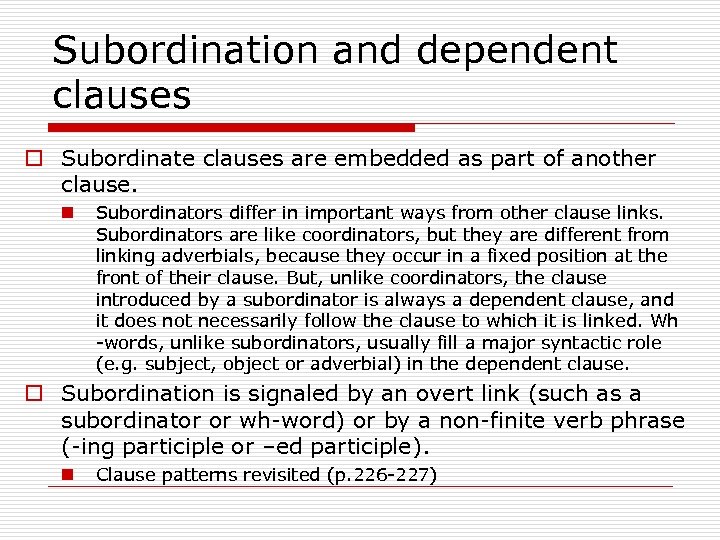 Subordination and dependent clauses o Subordinate clauses are embedded as part of another clause. n Subordinators differ in important ways from other clause links. Subordinators are like coordinators, but they are different from linking adverbials, because they occur in a fixed position at the front of their clause. But, unlike coordinators, the clause introduced by a subordinator is always a dependent clause, and it does not necessarily follow the clause to which it is linked. Wh -words, unlike subordinators, usually fill a major syntactic role (e. g. subject, object or adverbial) in the dependent clause. o Subordination is signaled by an overt link (such as a subordinator or wh-word) or by a non-finite verb phrase (-ing participle or –ed participle). n Clause patterns revisited (p. 226 -227)
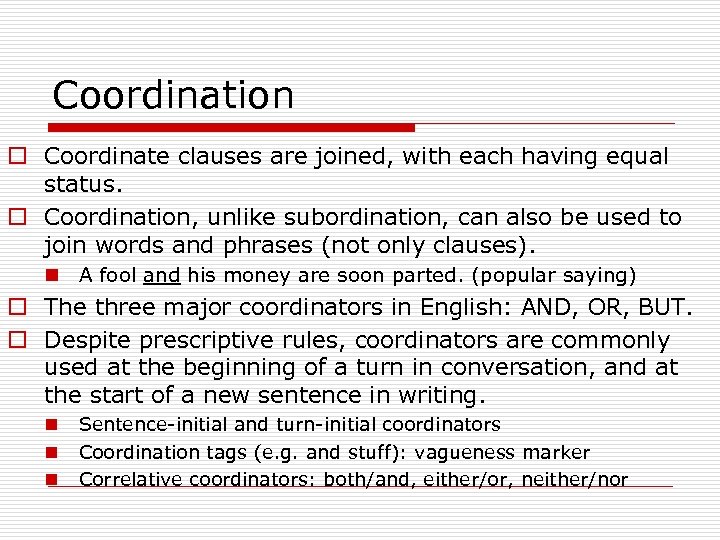 Coordination o Coordinate clauses are joined, with each having equal status. o Coordination, unlike subordination, can also be used to join words and phrases (not only clauses). n A fool and his money are soon parted. (popular saying) o The three major coordinators in English: AND, OR, BUT. o Despite prescriptive rules, coordinators are commonly used at the beginning of a turn in conversation, and at the start of a new sentence in writing. n n n Sentence-initial and turn-initial coordinators Coordination tags (e. g. and stuff): vagueness marker Correlative coordinators: both/and, either/or, neither/nor
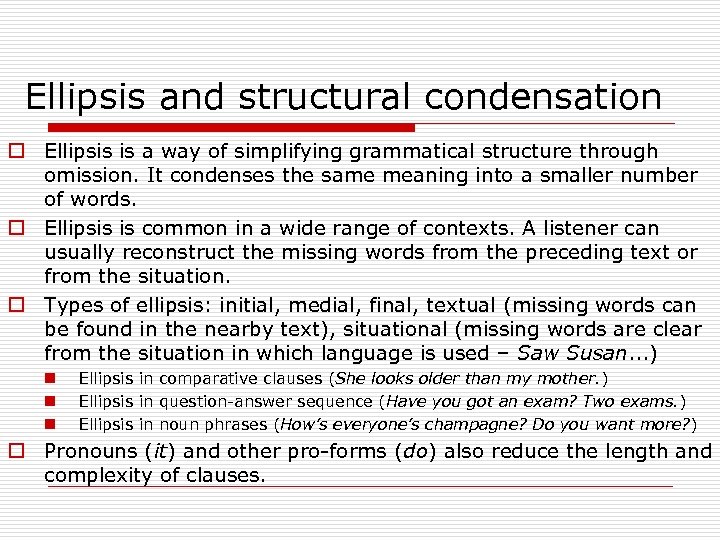 Ellipsis and structural condensation o Ellipsis is a way of simplifying grammatical structure through omission. It condenses the same meaning into a smaller number of words. o Ellipsis is common in a wide range of contexts. A listener can usually reconstruct the missing words from the preceding text or from the situation. o Types of ellipsis: initial, medial, final, textual (missing words can be found in the nearby text), situational (missing words are clear from the situation in which language is used – Saw Susan. . . ) n n n Ellipsis in comparative clauses (She looks older than my mother. ) Ellipsis in question-answer sequence (Have you got an exam? Two exams. ) Ellipsis in noun phrases (How’s everyone’s champagne? Do you want more? ) o Pronouns (it) and other pro-forms (do) also reduce the length and complexity of clauses.
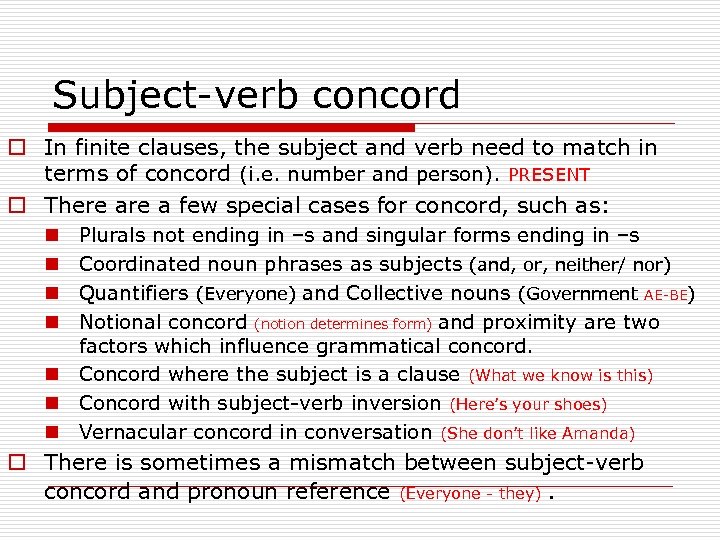 Subject-verb concord o In finite clauses, the subject and verb need to match in terms of concord (i. e. number and person). PRESENT o There a few special cases for concord, such as: Plurals not ending in –s and singular forms ending in –s Coordinated noun phrases as subjects (and, or, neither/ nor) Quantifiers (Everyone) and Collective nouns (Government AE-BE) Notional concord (notion determines form) and proximity are two factors which influence grammatical concord. n Concord where the subject is a clause (What we know is this) n Concord with subject-verb inversion (Here’s your shoes) n Vernacular concord in conversation (She don’t like Amanda) n n o There is sometimes a mismatch between subject-verb concord and pronoun reference (Everyone - they).
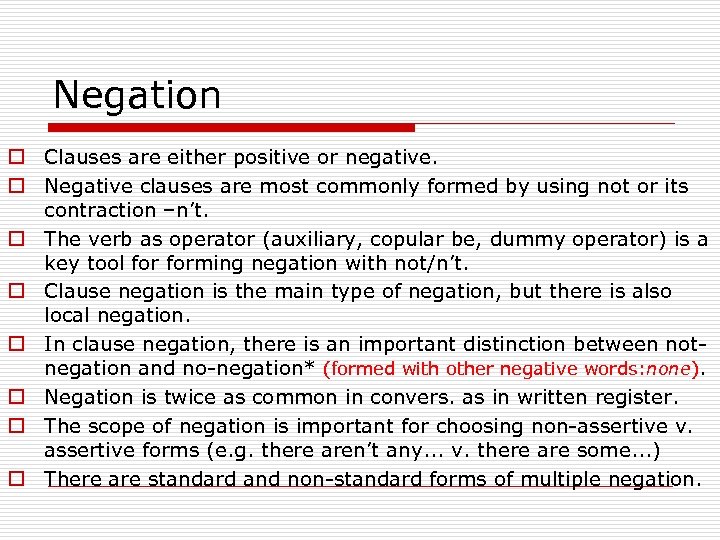 Negation o Clauses are either positive or negative. o Negative clauses are most commonly formed by using not or its contraction –n’t. o The verb as operator (auxiliary, copular be, dummy operator) is a key tool forming negation with not/n’t. o Clause negation is the main type of negation, but there is also local negation. o In clause negation, there is an important distinction between notnegation and no-negation* (formed with other negative words: none). o Negation is twice as common in convers. as in written register. o The scope of negation is important for choosing non-assertive v. assertive forms (e. g. there aren’t any. . . v. there are some. . . ) o There are standard and non-standard forms of multiple negation.
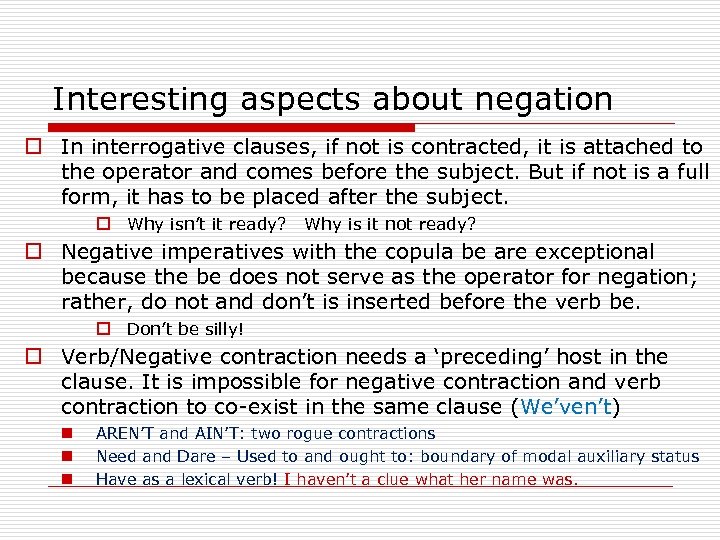 Interesting aspects about negation o In interrogative clauses, if not is contracted, it is attached to the operator and comes before the subject. But if not is a full form, it has to be placed after the subject. o Why isn’t it ready? Why is it not ready? o Negative imperatives with the copula be are exceptional because the be does not serve as the operator for negation; rather, do not and don’t is inserted before the verb be. o Don’t be silly! o Verb/Negative contraction needs a ‘preceding’ host in the clause. It is impossible for negative contraction and verb contraction to co-exist in the same clause (We’ven’t) n n n AREN’T and AIN’T: two rogue contractions Need and Dare – Used to and ought to: boundary of modal auxiliary status Have as a lexical verb! I haven’t a clue what her name was.
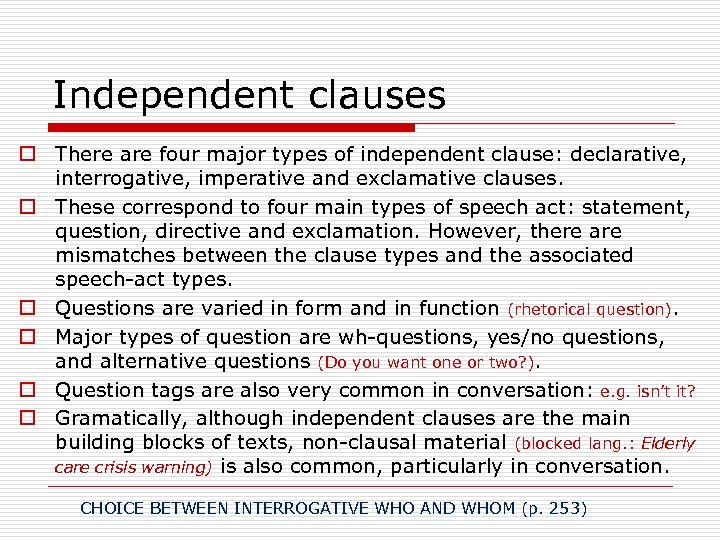 Independent clauses o There are four major types of independent clause: declarative, interrogative, imperative and exclamative clauses. o These correspond to four main types of speech act: statement, question, directive and exclamation. However, there are mismatches between the clause types and the associated speech-act types. o Questions are varied in form and in function (rhetorical question). o Major types of question are wh-questions, yes/no questions, and alternative questions (Do you want one or two? ). o Question tags are also very common in conversation: e. g. isn’t it? o Gramatically, although independent clauses are the main building blocks of texts, non-clausal material (blocked lang. : Elderly care crisis warning) is also common, particularly in conversation. CHOICE BETWEEN INTERROGATIVE WHO AND WHOM (p. 253)
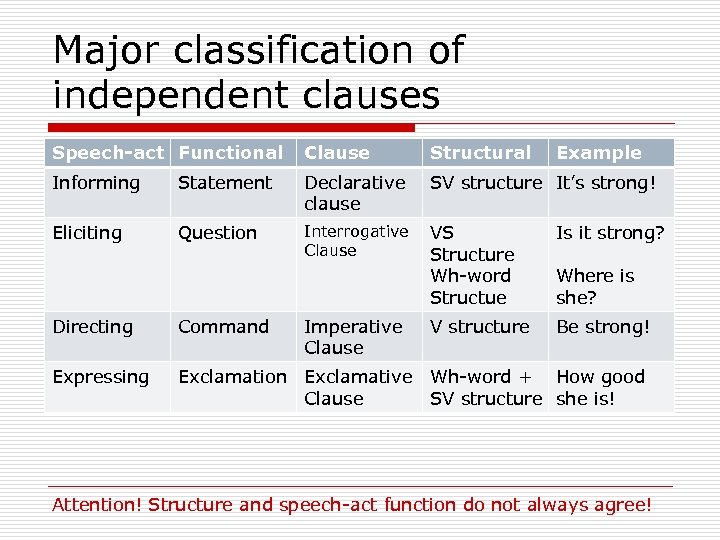 Major classification of independent clauses Speech-act Functional Clause Structural Informing Statement Declarative clause SV structure It’s strong! Eliciting Question Interrogative Clause VS Structure Wh-word Structue Is it strong? V structure Be strong! Imperative Clause Example Where is she? Directing Command Expressing Exclamation Exclamative Wh-word + How good Clause SV structure she is! Attention! Structure and speech-act function do not always agree!
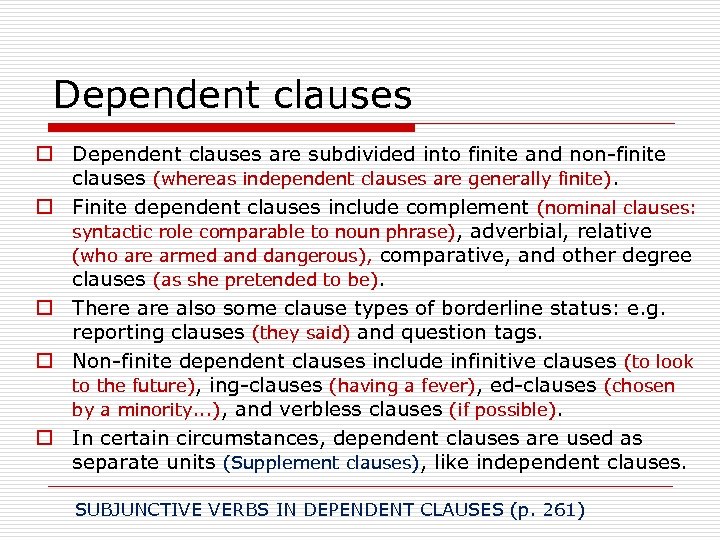 Dependent clauses o Dependent clauses are subdivided into finite and non-finite clauses (whereas independent clauses are generally finite). o Finite dependent clauses include complement (nominal clauses: syntactic role comparable to noun phrase), adverbial, relative (who are armed and dangerous), comparative, and other degree clauses (as she pretended to be). o There also some clause types of borderline status: e. g. reporting clauses (they said) and question tags. o Non-finite dependent clauses include infinitive clauses (to look to the future), ing-clauses (having a fever), ed-clauses (chosen by a minority. . . ), and verbless clauses (if possible). o In certain circumstances, dependent clauses are used as separate units (Supplement clauses), like independent clauses. SUBJUNCTIVE VERBS IN DEPENDENT CLAUSES (p. 261)