


 Скачать презентацию EXPLORING NATIONALISM Focus Questions n n n
17da28501edbb1a55242c91ef2fd1d3a.ppt
- Количество слайдов: 27
 EXPLORING NATIONALISM
 Focus Questions n n n To what extent should nation be the foundation of identity? To what extent should we embrace nationalism? To what extent are nation and identity related?
 Concepts of Nation n People often confuse ‘nation’ and ‘country’. Are they synonyms or not?
 NATION n A nation is a shared state of mind or shared characteristics such as beliefs, language, religion, traditions, customs and culture.
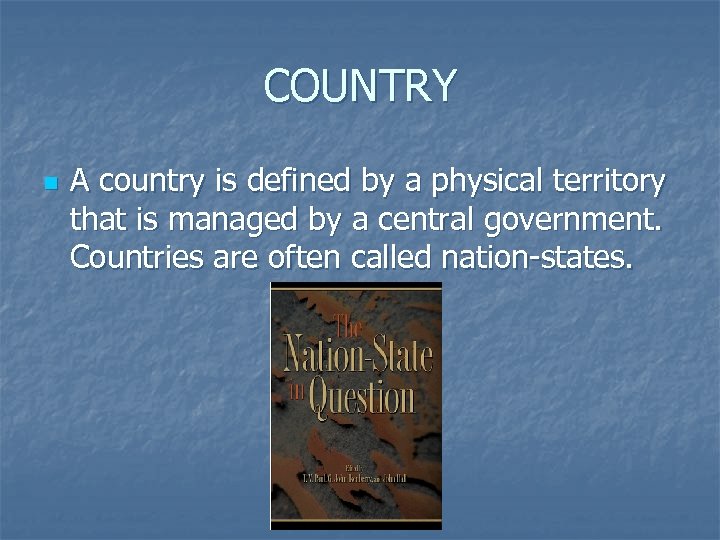 COUNTRY n A country is defined by a physical territory that is managed by a central government. Countries are often called nation-states.
 Nation Concept 1. 2. 3. 4. 5. The nation is the people The nation expresses the soul of the people The nation emerges from a feeling of belonging The nation is an imagined political community The nations exists when people want self government
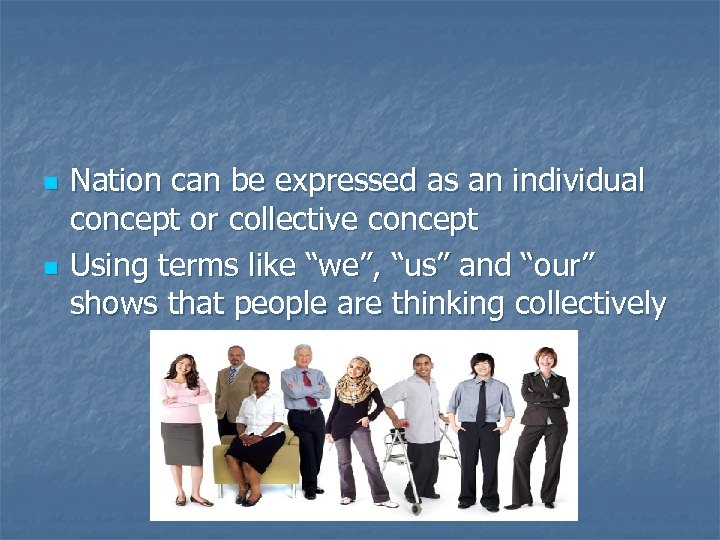 n n Nation can be expressed as an individual concept or collective concept Using terms like “we”, “us” and “our” shows that people are thinking collectively
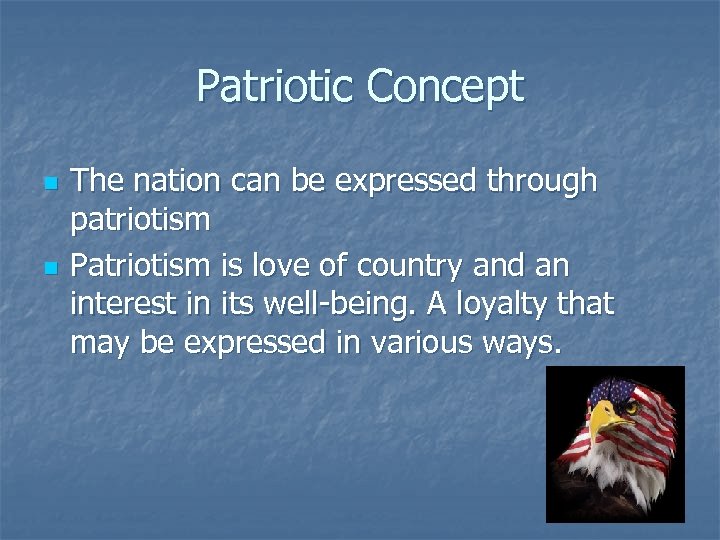 Patriotic Concept n n The nation can be expressed through patriotism Patriotism is love of country and an interest in its well-being. A loyalty that may be expressed in various ways.
 Understandings of Nation People can have various understandings of nationalism n They tend to develop from collective ideas 1. Linguistic 2. Ethnic 3. Cultural 4. Religious 5. Spiritual 6. Geographic 7. Political n
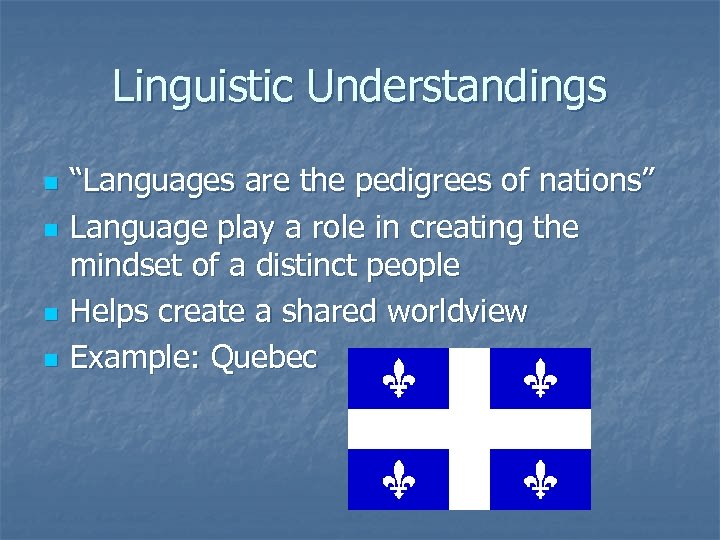 Linguistic Understandings n n “Languages are the pedigrees of nations” Language play a role in creating the mindset of a distinct people Helps create a shared worldview Example: Quebec
 Ethnic Understandings n n n Ethnic: Racial characteristics. Many nations come into being because people share a collective identity based on ethnic characteristics. People relate to common ethnicity as a means of identifying as a collective Example: The Ukrainian nation
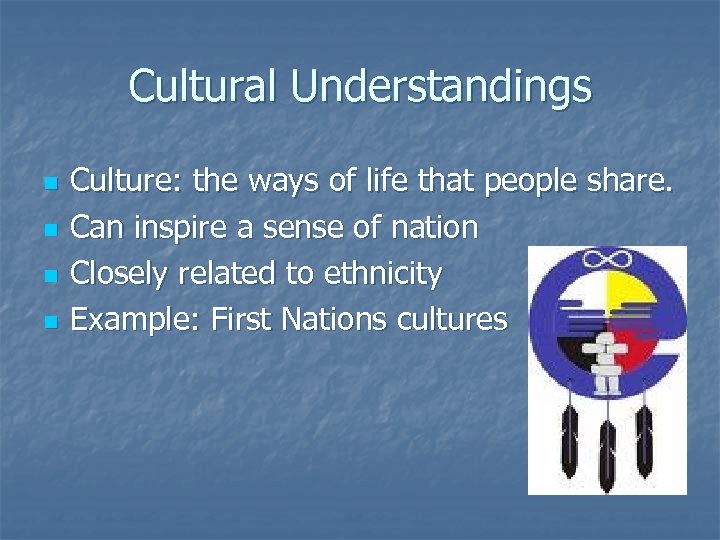 Cultural Understandings n n Culture: the ways of life that people share. Can inspire a sense of nation Closely related to ethnicity Example: First Nations cultures
 Religious Understandings n n n Religion can form an important understanding of nation People can use religion as a means of associating with a collective nation Example: The Jewish nation (Israel)
 Geographic Understandings n n Geography affects development of nations Physical barriers have caused the rise of distinct nations Geography often influences the nationstate Example: Tibet, Yugoslavia
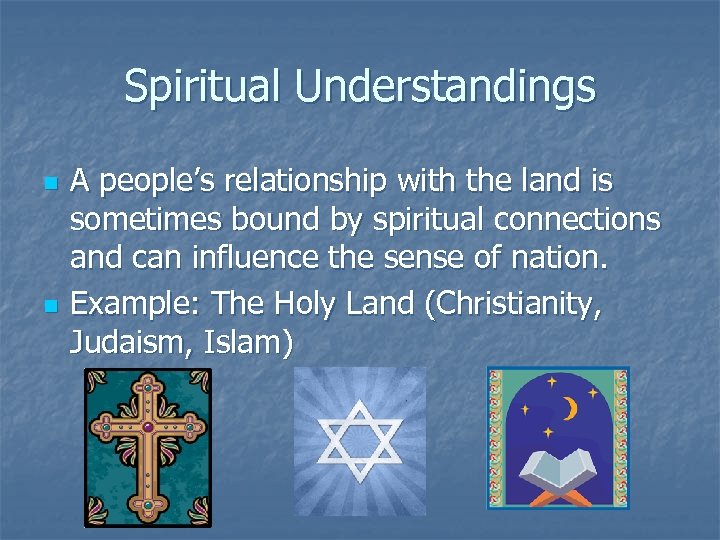 Spiritual Understandings n n A people’s relationship with the land is sometimes bound by spiritual connections and can influence the sense of nation. Example: The Holy Land (Christianity, Judaism, Islam)
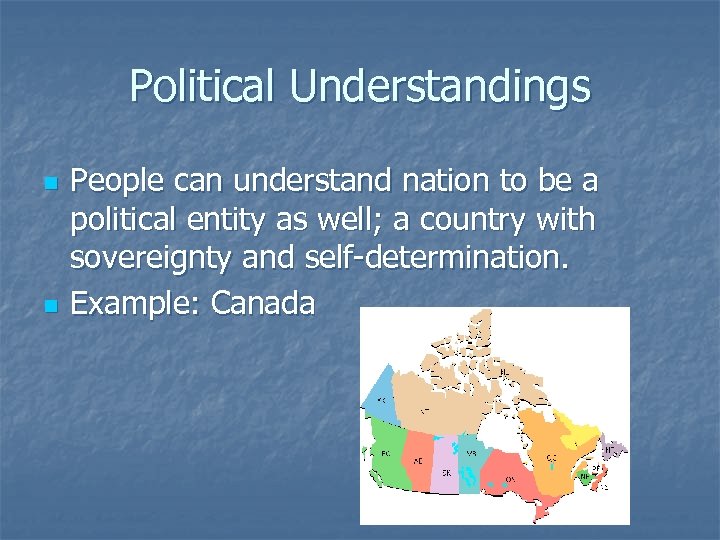 Political Understandings n n People can understand nation to be a political entity as well; a country with sovereignty and self-determination. Example: Canada
 n Sovereignty: The political authority to control one’s own affairs. Sovereignty may be distinguished from, and can sometimes conflict with, self-determination.
 n Self-determination: The power to control one’s own affairs. National selfdetermination is the power of people within a nation-state or nation to make their own decisions about what is in their interest.
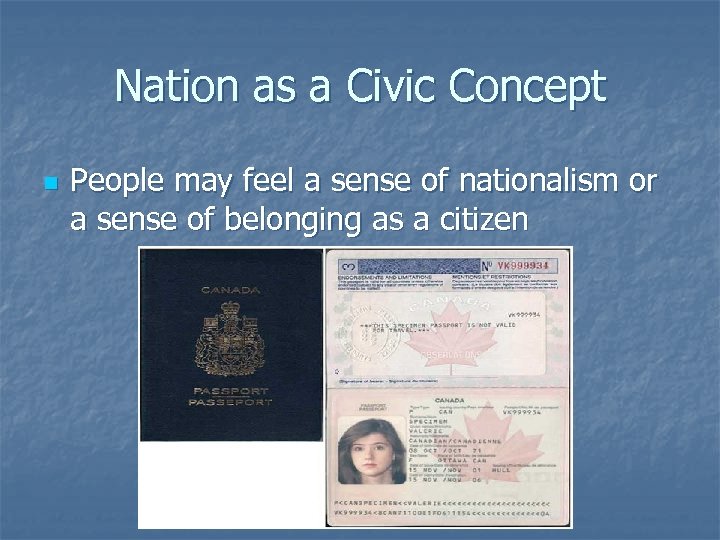 Nation as a Civic Concept n People may feel a sense of nationalism or a sense of belonging as a citizen
 Civic Nation n Civic Nation: A nation created by peopleno matter what their ethnicity, culture, and language-who agree to live according to particular values and beliefs expressed as the rule of law.
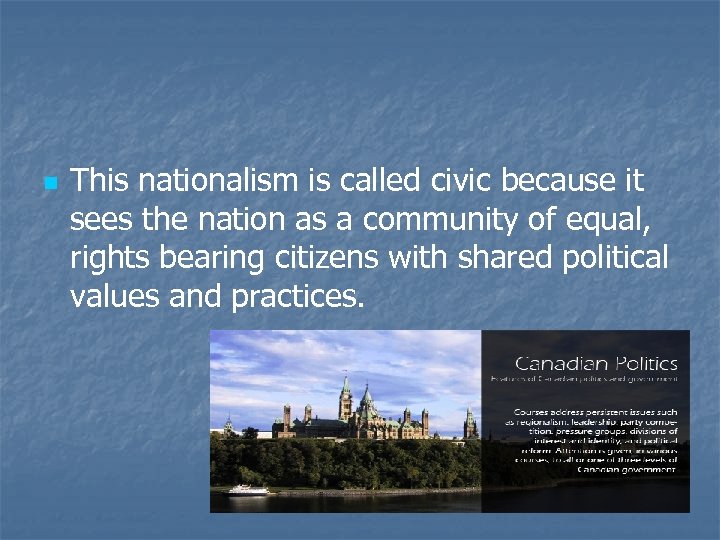 n This nationalism is called civic because it sees the nation as a community of equal, rights bearing citizens with shared political values and practices.
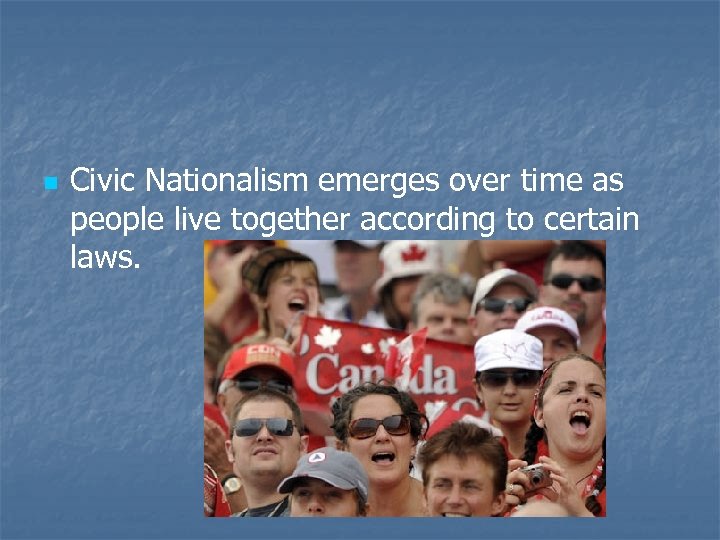 n Civic Nationalism emerges over time as people live together according to certain laws.
 Ethnic Nationalism n n Ethnic nationalism is very different from Civic Nationalism. Ethnic Nationalism: Nationalism that is founded on shared ethnicity, culture and language. People who share these traits may choose to create a nation-state based on their collective identity.
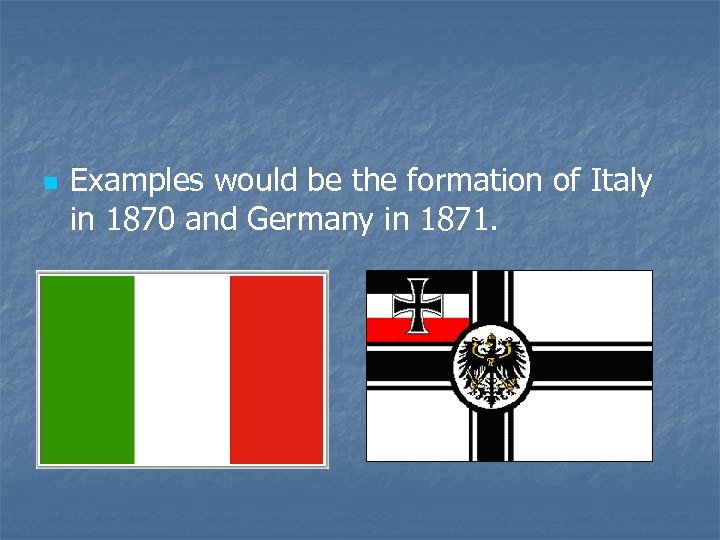 n Examples would be the formation of Italy in 1870 and Germany in 1871.
 National Identity n “National identity describes that condition in which a mass of people have made the same identification with national symbolshave internalized those symbols…” William Bloom
 Myths and National Identity n National myths-shared stories, ideas and beliefs that may or may not be accurateare key to creating a sense of nation. Can include ancient traditional stories to beliefs about what makes a nation special.
 n n National myths are not static, they are always changing. National myths influence people and people influence national myths.