


 Скачать презентацию Exploiting Market Realities to Address National Security s High-Performance
a718259ca3e84bcdcbf4b58e2f4bf57d.ppt
- Количество слайдов: 16
 Exploiting Market Realities to Address National Security’s High-Performance Computing Needs Mark D. Hill Computer Sciences Department University of Wisconsin--Madison (Modified 01/00 for IDA-Bowie) IDA Defense Science Study Group 11/99 Mark D. Hill, University of Wisconsin-Madison
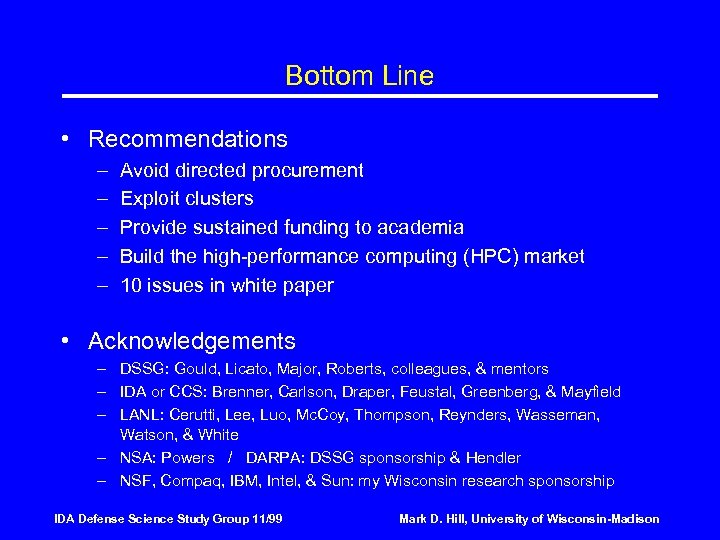
 Bottom Line • Recommendations – – Avoid directed procurement Exploit clusters Provide sustained funding to academia Build the high-performance computing (HPC) market • Talk Outline – – – HPC is important to national security History: PVPs and MPPs Future: Clusters Four Recommendations Summary IDA Defense Science Study Group 11/99 Mark D. Hill, University of Wisconsin-Madison
 HPC is Important to National Security • HPC is the upper extreme of computing – Supercomputers, etc. , costing $10 M-$100 M • HPC delivers for some important problems – Breaking encoded messages (NSA) – Nuclear stockpile stewardship (e. g. , LANL) (without nuclear testing) • Requirements – Trillions of operations per second (tera ops) – Trillions of characters of semiconductor memory (terabytes) – 1015 characters on disks & tapes (petabytes) IDA Defense Science Study Group 11/99 Mark D. Hill, University of Wisconsin-Madison
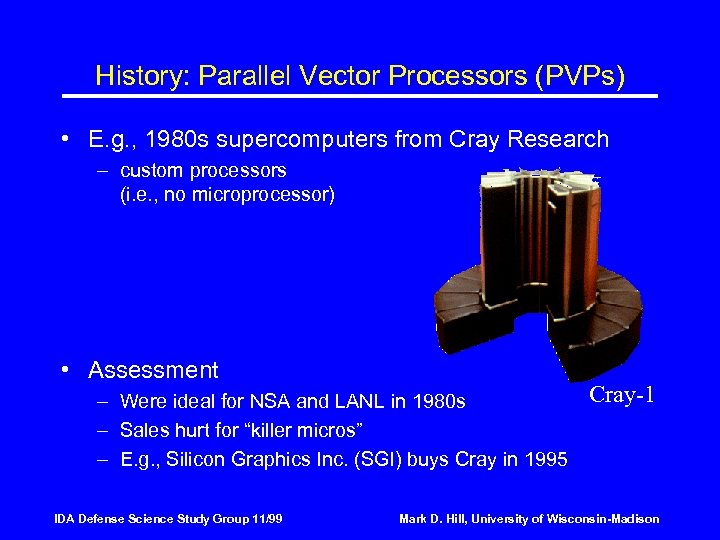 History: Parallel Vector Processors (PVPs) • E. g. , 1980 s supercomputers from Cray Research – custom processors (i. e. , no microprocessor) • Assessment – Were ideal for NSA and LANL in 1980 s – Sales hurt for “killer micros” – E. g. , Silicon Graphics Inc. (SGI) buys Cray in 1995 IDA Defense Science Study Group 11/99 Cray-1 Mark D. Hill, University of Wisconsin-Madison
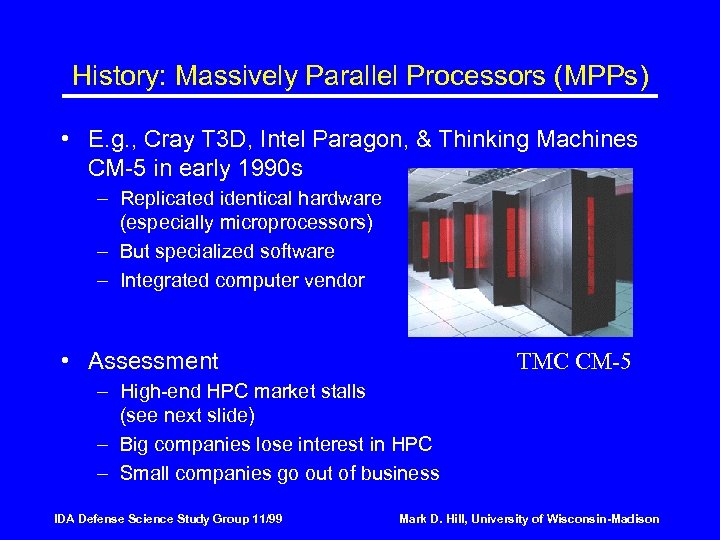 History: Massively Parallel Processors (MPPs) • E. g. , Cray T 3 D, Intel Paragon, & Thinking Machines CM-5 in early 1990 s – Replicated identical hardware (especially microprocessors) – But specialized software – Integrated computer vendor • Assessment TMC CM-5 – High-end HPC market stalls (see next slide) – Big companies lose interest in HPC – Small companies go out of business IDA Defense Science Study Group 11/99 Mark D. Hill, University of Wisconsin-Madison
![HPC Market in Billions US$ [IDC 99] • IDA Defense Science Study Group 11/99](https://present5.com/presentation/a718259ca3e84bcdcbf4b58e2f4bf57d/image-6.jpg "HPC Market in Billions US$ [IDC 99] • IDA Defense Science Study Group 11/99") HPC Market in Billions US$ [IDC 99] • IDA Defense Science Study Group 11/99 Mark D. Hill, University of Wisconsin-Madison
HPC Market in Billions US$ [IDC 99] • IDA Defense Science Study Group 11/99 Mark D. Hill, University of Wisconsin-Madison
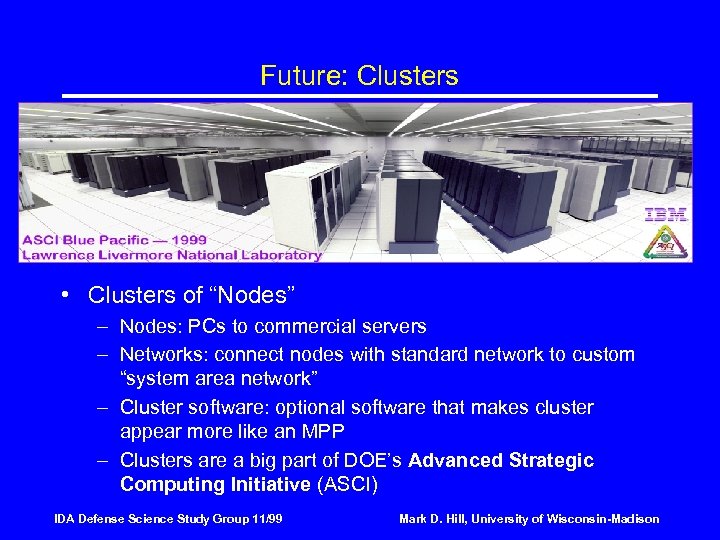 Future: Clusters • Clusters of “Nodes” – Nodes: PCs to commercial servers – Networks: connect nodes with standard network to custom “system area network” – Cluster software: optional software that makes cluster appear more like an MPP – Clusters are a big part of DOE’s Advanced Strategic Computing Initiative (ASCI) IDA Defense Science Study Group 11/99 Mark D. Hill, University of Wisconsin-Madison
 Future: Clusters, continued • Nodes – Commercially viable • PC or server nodes? (You get what you pay for) – Available from multiple vendors – Insures sustained availability • Network – – Commodity LAN? Specialized SAN? You get what you pay for Need to port to new LAN/SAN every few years • Use middleware to rise above the details (e. g. , MPI) IDA Defense Science Study Group 11/99 Mark D. Hill, University of Wisconsin-Madison
 Future: Clusters, continued • Software – Need to port to new cluster every few years – Think about the performance lost from software not working in the first 1. 5 years of a cluster’s 3 -year life • Use shrink-wrapped software whenever possible • Use standard languages & libraries • For custom software: K. I. S. S. • Integration -- Creating a “Computer System” – Hardest problem (done by MPP computer vendor) – Select & deploy network hardware, network protocols, middleware, application library, debuggers, etc. – Who does integration? Customer? 3 rd party? IDA Defense Science Study Group 11/99 Mark D. Hill, University of Wisconsin-Madison
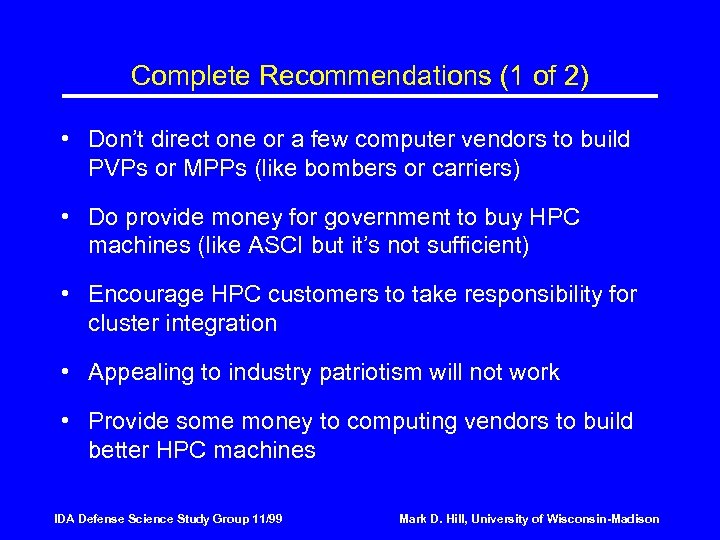
 Recommendation 1: Forget “Procurement” • Can’t buy HPC like bombers or carriers – Computer technology moves too fast for contractor mentality (two times the performance in two years) • Time lags too long • Specifications too detailed – Can’t depend on sustained government commitment (post cold war) – Can’t depend on one company (or a few) • large - “zero billion dollar market” • small - out of business IDA Defense Science Study Group 11/99 Mark D. Hill, University of Wisconsin-Madison
 Recommendation 2: Exploit Clusters • Government should buy Clusters – Customer (e. g. , NSA or LANL) • Is responsible for mission • Should be responsible for cluster integration – But • Sub-contracting integration? • Avoiding duplication of effort? – Many technical problems • Clusters are like Churchill view of democracy • “Democracy is the worst form of government except all the others that have been tried. ” IDA Defense Science Study Group 11/99 Mark D. Hill, University of Wisconsin-Madison
 Recommendaton 3: Fund Academia • (Warning: I have a bias here) • Sustained funding of academia to develop new HPC ideas (as we have done in the past) – Not just Kuhnian paradigm shifts (DARPA) – Not just “trickle down” (DOE ASCI) – The country reaps what it sows IDA Defense Science Study Group 11/99 Mark D. Hill, University of Wisconsin-Madison
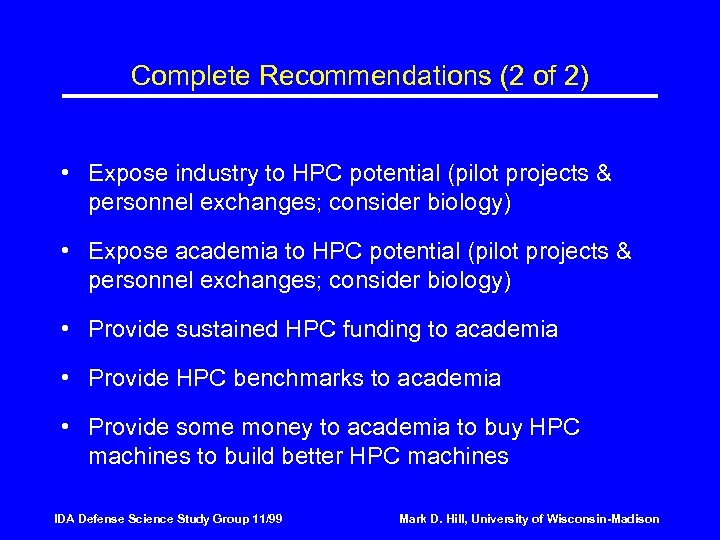
 Recommendation 4: Build HPC Market • Government should encourage private HPC customers to reduce mismatch between needs of government and private sector – Demonstration projects – Personnel exchanges – High risk but high payoff – Unbounded potential in Biology IDA Defense Science Study Group 11/99 Mark D. Hill, University of Wisconsin-Madison
 Bottom Line • Recommendations – – – Avoid directed procurement Exploit clusters Provide sustained funding to academia Build the high-performance computing (HPC) market 10 issues in white paper • Acknowledgements – DSSG: Gould, Licato, Major, Roberts, colleagues, & mentors – IDA or CCS: Brenner, Carlson, Draper, Feustal, Greenberg, & Mayfield – LANL: Cerutti, Lee, Luo, Mc. Coy, Thompson, Reynders, Wasseman, Watson, & White – NSA: Powers / DARPA: DSSG sponsorship & Hendler – NSF, Compaq, IBM, Intel, & Sun: my Wisconsin research sponsorship IDA Defense Science Study Group 11/99 Mark D. Hill, University of Wisconsin-Madison
 Complete Recommendations (1 of 2) • Don’t direct one or a few computer vendors to build PVPs or MPPs (like bombers or carriers) • Do provide money for government to buy HPC machines (like ASCI but it’s not sufficient) • Encourage HPC customers to take responsibility for cluster integration • Appealing to industry patriotism will not work • Provide some money to computing vendors to build better HPC machines IDA Defense Science Study Group 11/99 Mark D. Hill, University of Wisconsin-Madison
 Complete Recommendations (2 of 2) • Expose industry to HPC potential (pilot projects & personnel exchanges; consider biology) • Expose academia to HPC potential (pilot projects & personnel exchanges; consider biology) • Provide sustained HPC funding to academia • Provide HPC benchmarks to academia • Provide some money to academia to buy HPC machines to build better HPC machines IDA Defense Science Study Group 11/99 Mark D. Hill, University of Wisconsin-Madison