


 Скачать презентацию Explaining Recent Trends in Infant Mortality Centers for
f729f1f1181221abad22b68c36112bc6.ppt
- Количество слайдов: 32
 Explaining Recent Trends in Infant Mortality Centers for Disease Control and Prevention National Center for Health Statistics Division of Vital Statistics
 Authors / Acknowledgements Charles J. Rothwell, M. S. , MBA Joyce A. Martin, M. P. H. Paul D. Sutton, Ph. D. Donna L. Hoyert, Ph. D. Kenneth D. Kochanek, M. A.
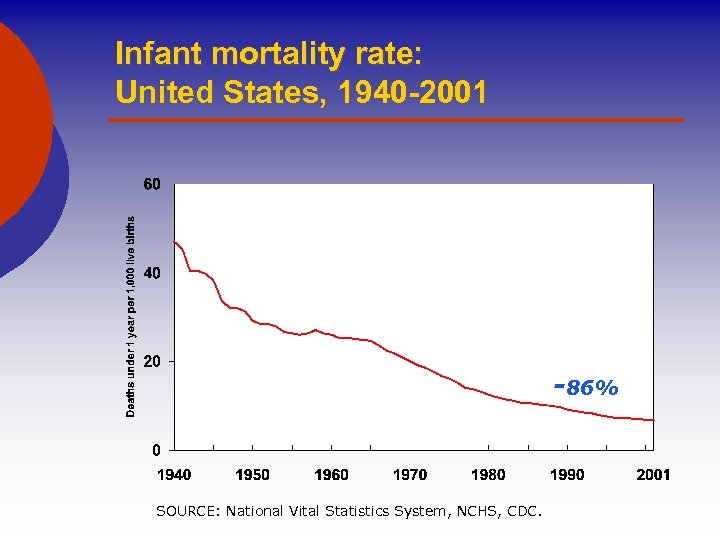 Infant mortality rate: United States, 1940 -2001 -86% SOURCE: National Vital Statistics System, NCHS, CDC.
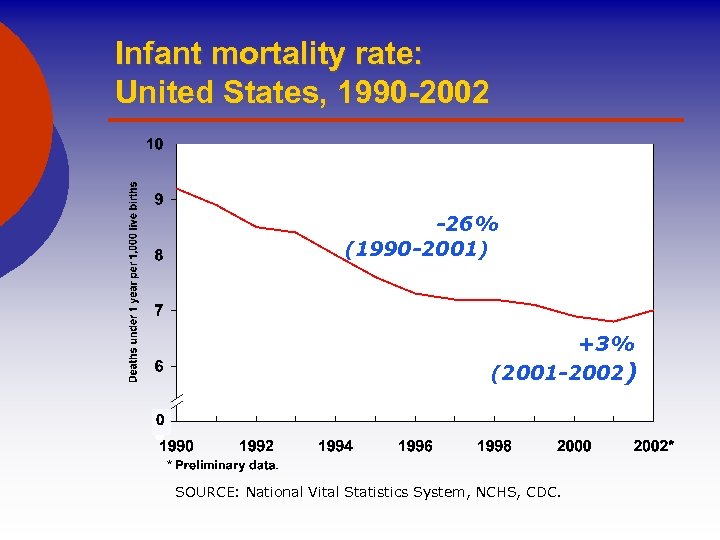 Infant mortality rate: United States, 1990 -2002 -26% (1990 -2001) +3% (2001 -2002) SOURCE: National Vital Statistics System, NCHS, CDC.
 Challenge: Explain increase in the IMR for public release with only limited preliminary data
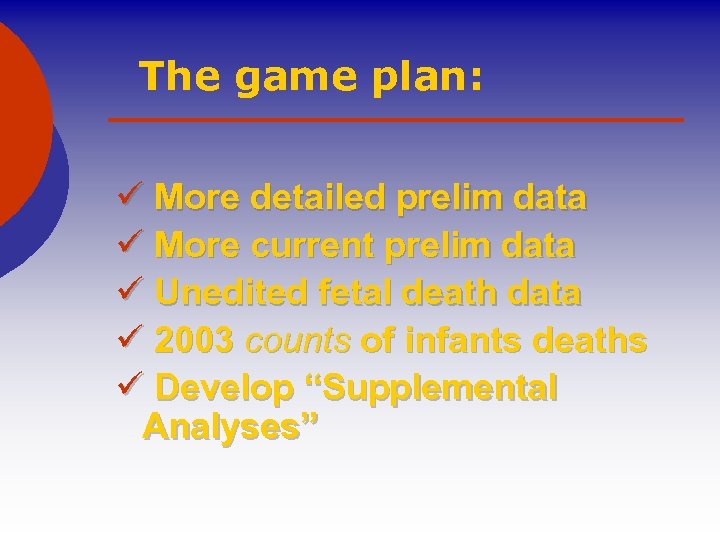 The game plan: ü More detailed prelim data ü More current prelim data ü Unedited fetal death data ü 2003 counts of infants deaths ü Develop “Supplemental Analyses”
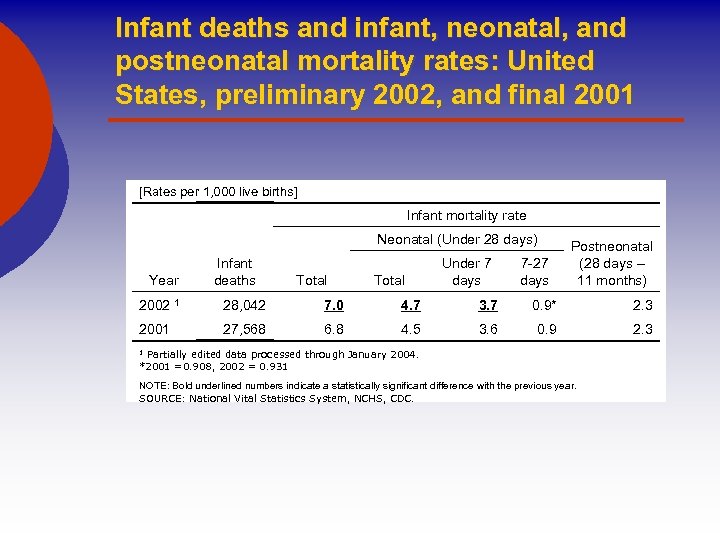 Infant deaths and infant, neonatal, and postneonatal mortality rates: United States, preliminary 2002, and final 2001 [Rates per 1, 000 live births] Infant mortality rate Neonatal (Under 28 days) Year Infant deaths Total Under 7 days 7 -27 days Postneonatal (28 days – 11 months) 2002 1 28, 042 7. 0 4. 7 3. 7 0. 9* 2. 3 2001 27, 568 6. 8 4. 5 3. 6 0. 9 2. 3 Partially edited data processed through January 2004. *2001 =0. 908, 2002 = 0. 931 1 NOTE: Bold underlined numbers indicate a statistically significant difference with the previous year. SOURCE: National Vital Statistics System, NCHS, CDC.
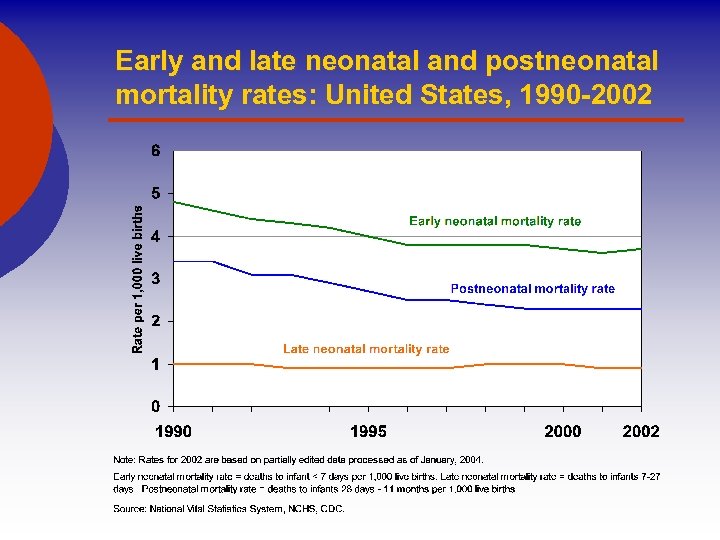 Early and late neonatal and postneonatal mortality rates: United States, 1990 -2002
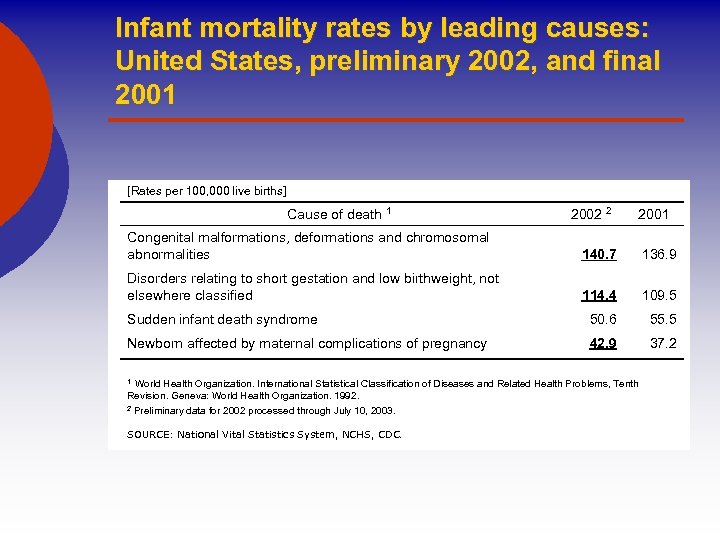 Infant mortality rates by leading causes: United States, preliminary 2002, and final 2001 [Rates per 100, 000 live births] Cause of death 1 2002 2 2001 Congenital malformations, deformations and chromosomal abnormalities 140. 7 136. 9 Disorders relating to short gestation and low birthweight, not elsewhere classified 114. 4 109. 5 Sudden infant death syndrome 50. 6 55. 5 Newborn affected by maternal complications of pregnancy 42. 9 37. 2 1 World Health Organization. International Statistical Classification of Diseases and Related Health Problems, Tenth Revision. Geneva: World Health Organization. 1992. 2 Preliminary data for 2002 processed through July 10, 2003. SOURCE: National Vital Statistics System, NCHS, CDC.
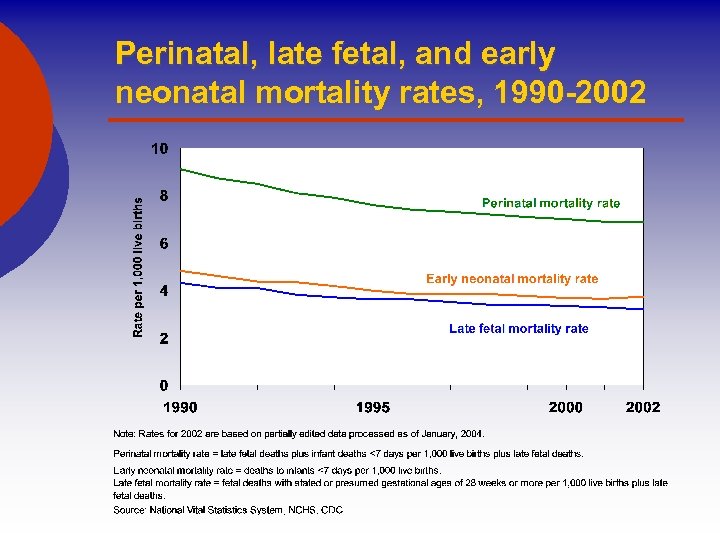 Perinatal, late fetal, and early neonatal mortality rates, 1990 -2002
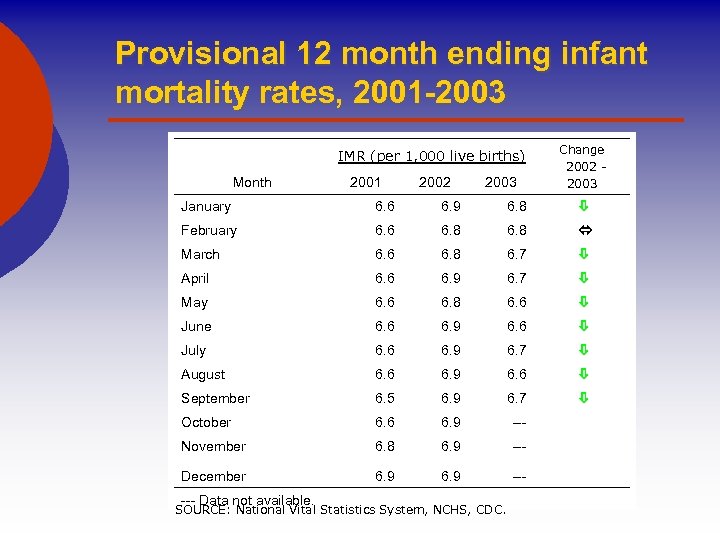 Provisional 12 month ending infant mortality rates, 2001 -2003 IMR (per 1, 000 live births) Month 2001 2002 2003 Change 2002 2003 January 6. 6 6. 9 6. 8 ò February 6. 6 6. 8 ó March 6. 6 6. 8 6. 7 ò April 6. 6 6. 9 6. 7 ò May 6. 6 6. 8 6. 6 ò June 6. 6 6. 9 6. 6 ò July 6. 6 6. 9 6. 7 ò August 6. 6 6. 9 6. 6 ò September 6. 5 6. 9 6. 7 ò October 6. 6 6. 9 --- November 6. 8 6. 9 --- December 6. 9 --- Data not available. SOURCE: National Vital Statistics System, NCHS, CDC.
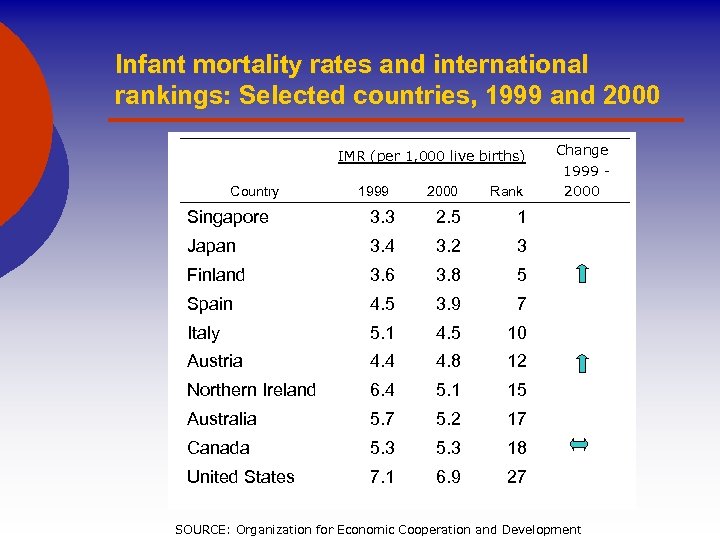 Infant mortality rates and international rankings: Selected countries, 1999 and 2000 IMR (per 1, 000 live births) Country 1999 2000 Rank Singapore 3. 3 2. 5 1 Japan 3. 4 3. 2 3 Finland 3. 6 3. 8 5 Spain 4. 5 3. 9 7 Italy 5. 1 4. 5 10 Austria 4. 4 4. 8 12 Northern Ireland 6. 4 5. 1 15 Australia 5. 7 5. 2 17 Canada 5. 3 18 United States 7. 1 6. 9 Change 1999 2000 27 SOURCE: Organization for Economic Cooperation and Development
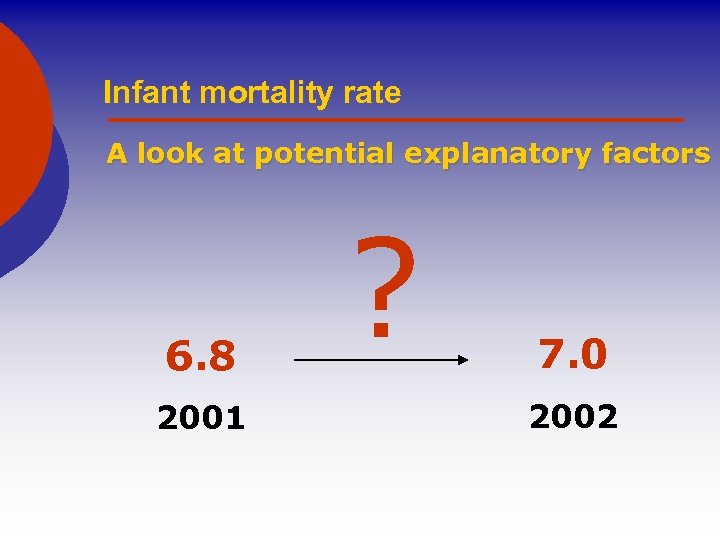 Infant mortality rate A look at potential explanatory factors 6. 8 2001 ? 7. 0 2002
 Preterm and low birthweight rates: United States, 1990 -2002
 Twin birth rate: United States, 1971 -2002
 Triplet+ birth rate: United States, 1980 -2002
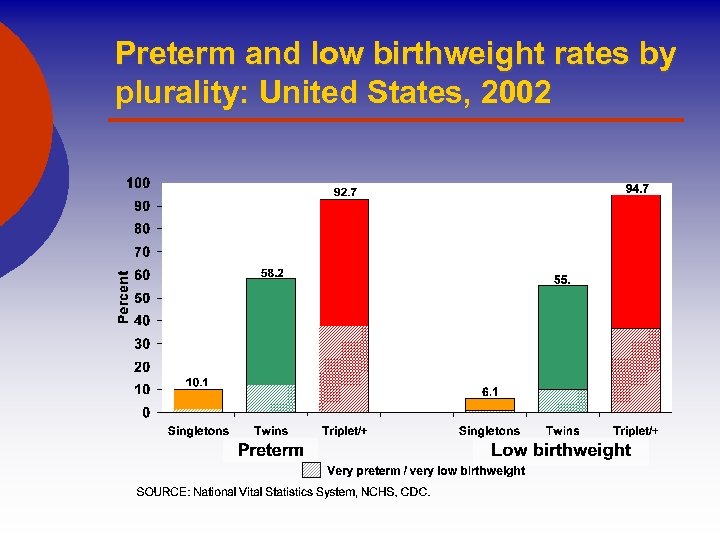 Preterm and low birthweight rates by plurality: United States, 2002
 Preterm and low birthweight rates among singleton births have also been on the rise…
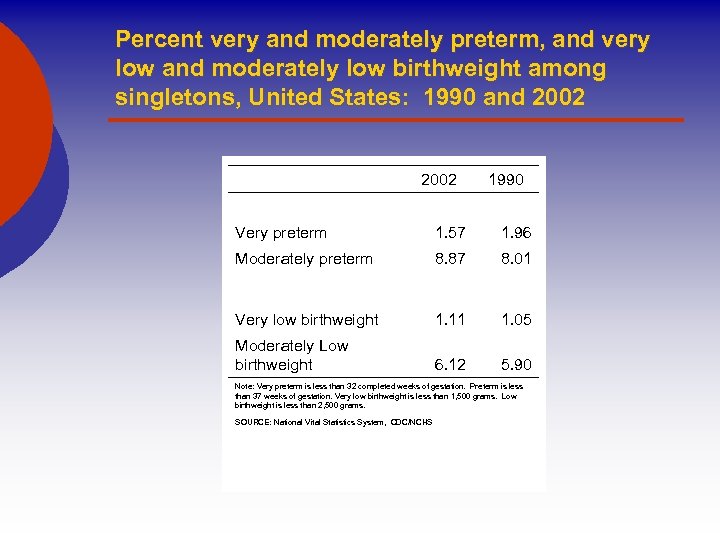 Percent very and moderately preterm, and very low and moderately low birthweight among singletons, United States: 1990 and 2002 1990 Very preterm 1. 57 1. 96 Moderately preterm 8. 87 8. 01 Very low birthweight 1. 11 1. 05 Moderately Low birthweight 6. 12 5. 90 Note: Very preterm is less than 32 completed weeks of gestation. Preterm is less than 37 weeks of gestation. Very low birthweight is less than 1, 500 grams. Low birthweight is less than 2, 500 grams. SOURCE: National Vital Statistics System, CDC/NCHS
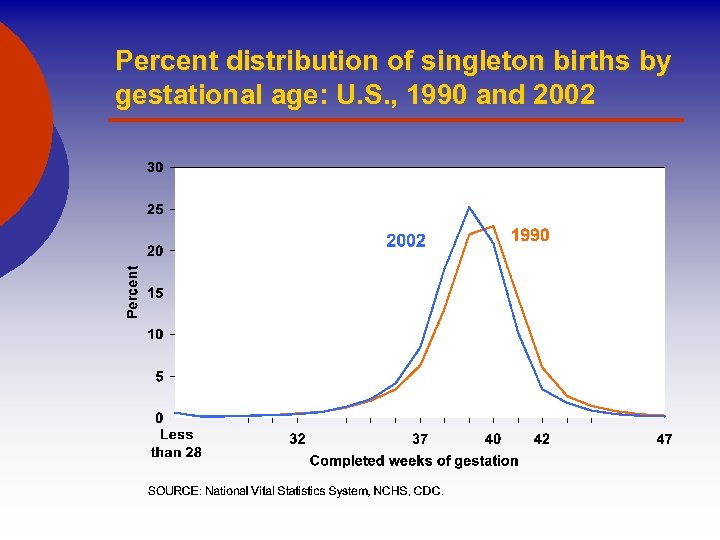 Percent distribution of singleton births by gestational age: U. S. , 1990 and 2002
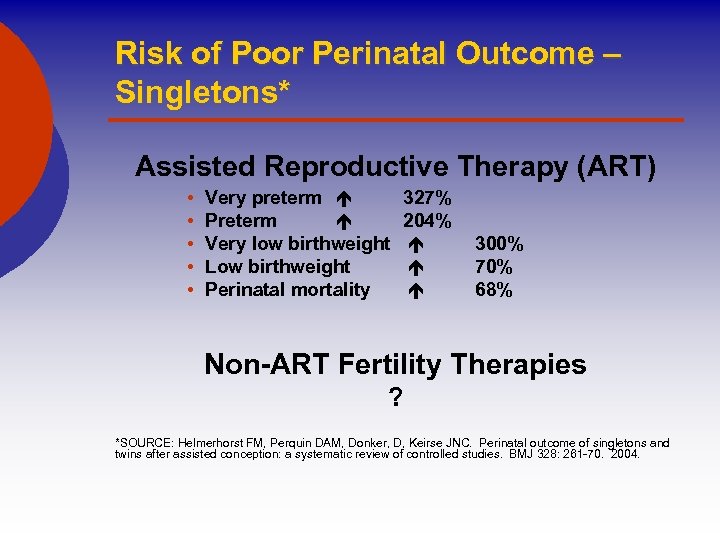 Risk of Poor Perinatal Outcome – Singletons* Assisted Reproductive Therapy (ART) • • • Very preterm Preterm Very low birthweight Low birthweight Perinatal mortality 327% 204% 300% 70% 68% Non-ART Fertility Therapies ? *SOURCE: Helmerhorst FM, Perquin DAM, Donker, D, Keirse JNC. Perinatal outcome of singletons and twins after assisted conception: a systematic review of controlled studies. BMJ 328: 261 -70. 2004.
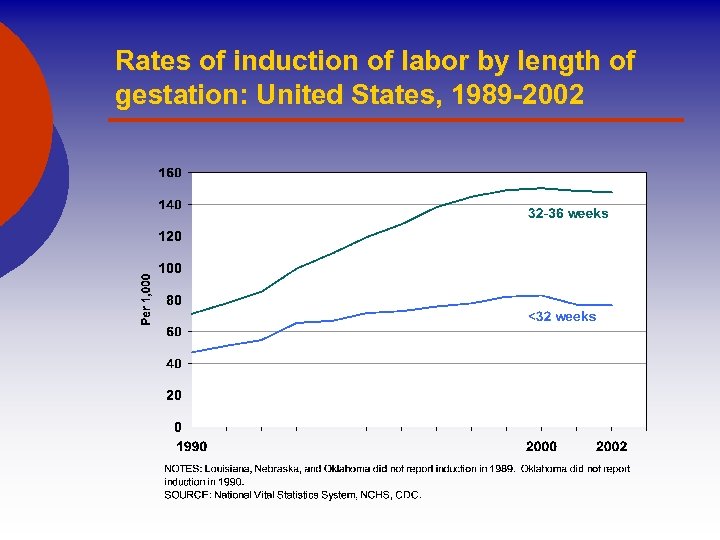 Rates of induction of labor by length of gestation: United States, 1989 -2002
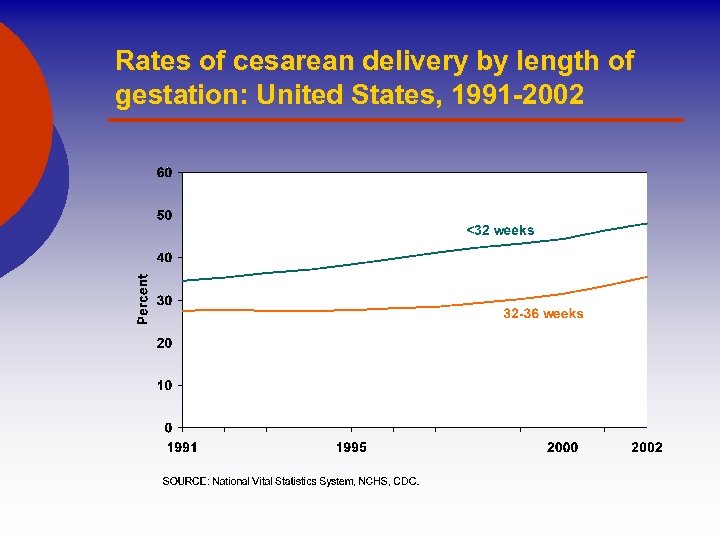 Rates of cesarean delivery by length of gestation: United States, 1991 -2002
 Supplemental Analyses
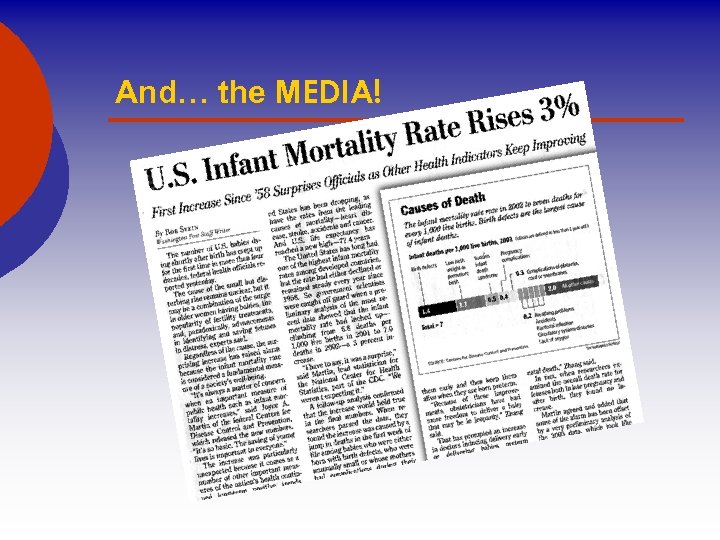 And… the MEDIA!
 Research Agenda: Linked Birth/Infant Death File Is the increase the result of changes in risk BEFORE birth: • Maternal characteristics • age, race, education, medical risk factors, prenatal care, tobacco use • Infant characteristics • • plurality birthweight gestational age congenital anomalies • Characteristics of labor and delivery • PROM • induction of labor • cesarean delivery
 Research Agenda: Linked Birth/Infant Death File – cont. If so, how are these factors associated with age/cause of death? • • Congenital malformations Disorders related to short gestation/low birthweight Maternal complications related to pregnancy Others? ? OR • Is the 2002 increase in the IMR primarily the result of an increase in the risk of death AFTER birth: • changes in birthweight/gestation-specific mortality? • changes in obstetric and neonatal care?
 Re-engineering the Vital Records Process…
 What could we do better with Reengineered Vital Statistics Systems? ü New, improved data items • • • Fertility therapy – drugs & ART Tobacco use before and during pregnancy Infections during pregnancy Maternal morbidity Breast feeding Source of payment for delivery ü Configurable electronic systems • Easily modified to capture information on emerging issues • Easily improve/change items as needed ü Integrated electronic systems • Incorporate electronic data transmission standards • Permit integration with other systems (prenatal care, newborn screening, immunization)
 What could we do better with Reengineered Vital Statistics Systems? – ü Higher quality data • Data edited and queried at the source • Standardized systems across nation ü More standardized data • Standardized collection instruments • Standardized instructions & definitions ü More timely data • Data released within months of event • Births/infant deaths automatically linked = data available simultaneously
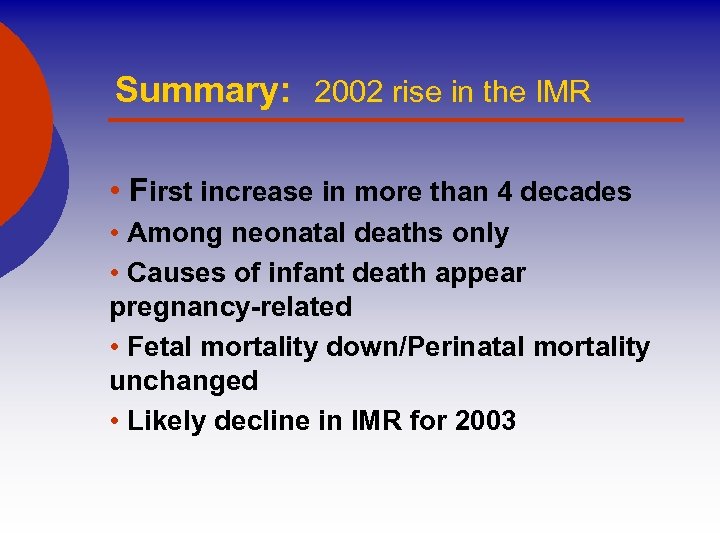 Summary: 2002 rise in the IMR • First increase in more than 4 decades • Among neonatal deaths only • Causes of infant death appear pregnancy-related • Fetal mortality down/Perinatal mortality unchanged • Likely decline in IMR for 2003
 Stay tuned…. Data from the Linked Birth/Infant Death Data Set will allow us to more fully explain this troubling change Øsummer 2004