 Скачать презентацию Expert Knowledge-Based Systems One of AI s
e199fb834adffd3ce641fc5398c3a2bd.ppt
- Количество слайдов: 30



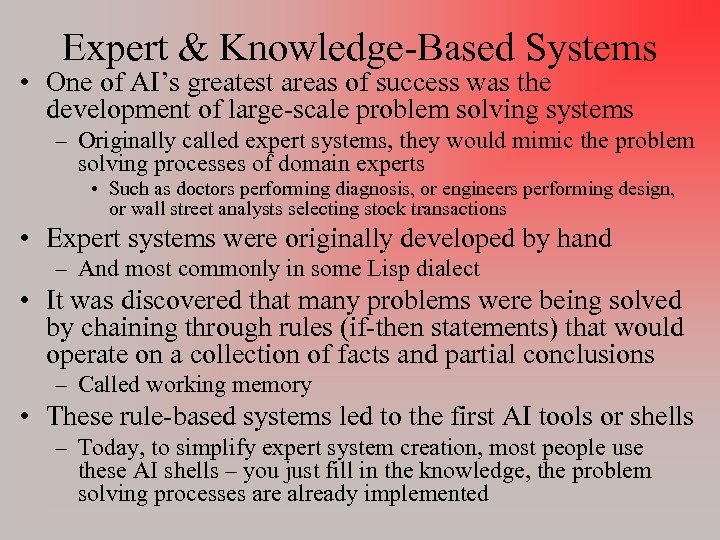
Expert & Knowledge-Based Systems • One of AI’s greatest areas of success was the development of large-scale problem solving systems – Originally called expert systems, they would mimic the problem solving processes of domain experts • Such as doctors performing diagnosis, or engineers performing design, or wall street analysts selecting stock transactions • Expert systems were originally developed by hand – And most commonly in some Lisp dialect • It was discovered that many problems were being solved by chaining through rules (if-then statements) that would operate on a collection of facts and partial conclusions – Called working memory • These rule-based systems led to the first AI tools or shells – Today, to simplify expert system creation, most people use these AI shells – you just fill in the knowledge, the problem solving processes are already implemented
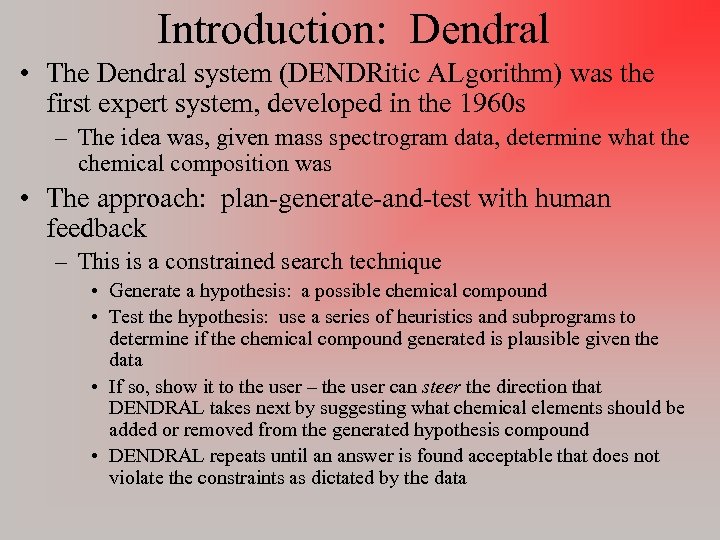
Introduction: Dendral • The Dendral system (DENDRitic ALgorithm) was the first expert system, developed in the 1960 s – The idea was, given mass spectrogram data, determine what the chemical composition was • The approach: plan-generate-and-test with human feedback – This is a constrained search technique • Generate a hypothesis: a possible chemical compound • Test the hypothesis: use a series of heuristics and subprograms to determine if the chemical compound generated is plausible given the data • If so, show it to the user – the user can steer the direction that DENDRAL takes next by suggesting what chemical elements should be added or removed from the generated hypothesis compound • DENDRAL repeats until an answer is found acceptable that does not violate the constraints as dictated by the data
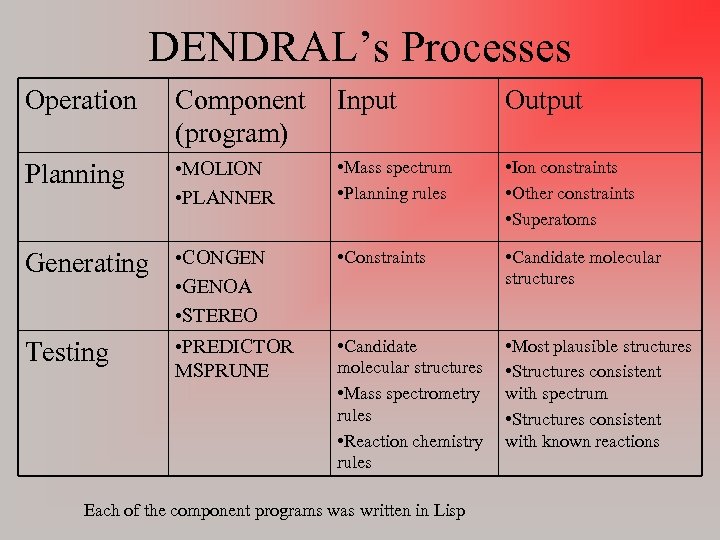
DENDRAL’s Processes Operation Component (program) Input Output Planning • MOLION • PLANNER • Mass spectrum • Planning rules • Ion constraints • Other constraints • Superatoms Generating • CONGEN • GENOA • STEREO • Constraints • Candidate molecular structures Testing • PREDICTOR MSPRUNE • Candidate molecular structures • Mass spectrometry rules • Reaction chemistry rules • Most plausible structures • Structures consistent with spectrum • Structures consistent with known reactions Each of the component programs was written in Lisp
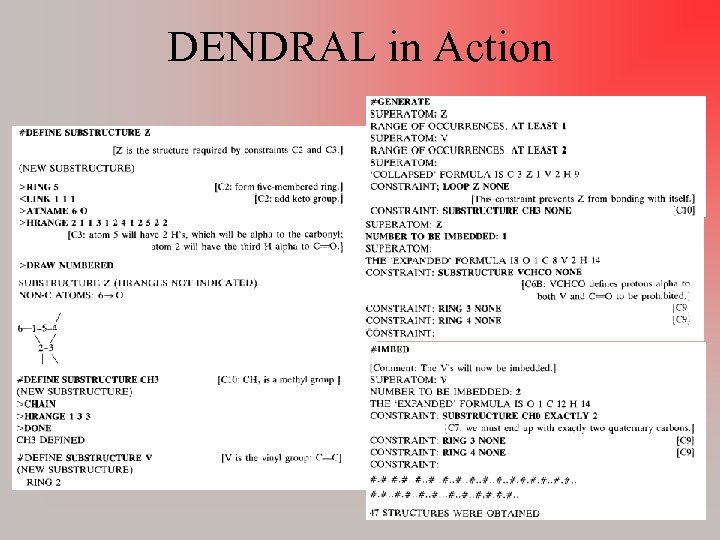
DENDRAL in Action
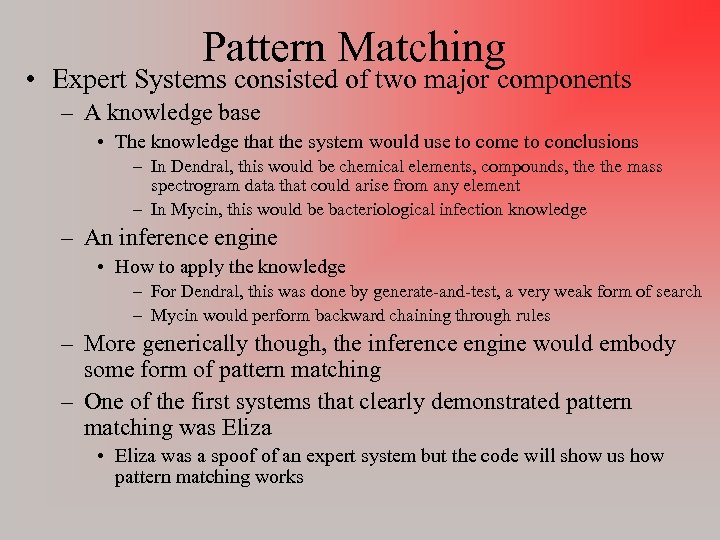
Pattern Matching • Expert Systems consisted of two major components – A knowledge base • The knowledge that the system would use to come to conclusions – In Dendral, this would be chemical elements, compounds, the mass spectrogram data that could arise from any element – In Mycin, this would be bacteriological infection knowledge – An inference engine • How to apply the knowledge – For Dendral, this was done by generate-and-test, a very weak form of search – Mycin would perform backward chaining through rules – More generically though, the inference engine would embody some form of pattern matching – One of the first systems that clearly demonstrated pattern matching was Eliza • Eliza was a spoof of an expert system but the code will show us how pattern matching works
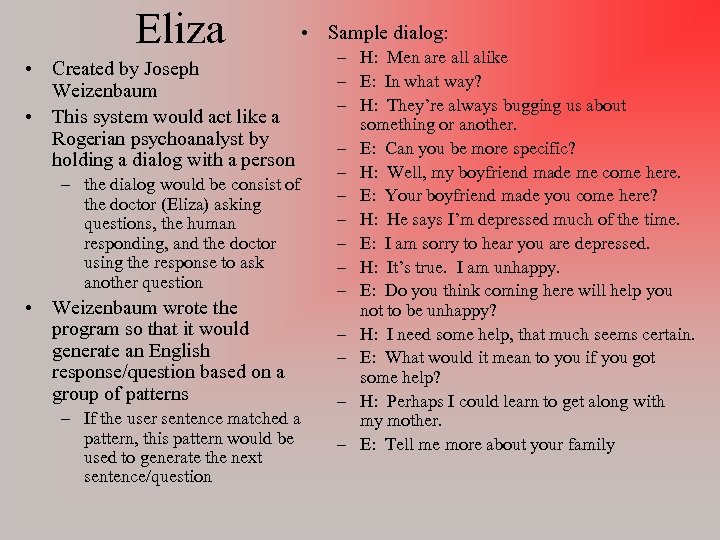
Eliza • Created by Joseph Weizenbaum • This system would act like a Rogerian psychoanalyst by holding a dialog with a person – the dialog would be consist of the doctor (Eliza) asking questions, the human responding, and the doctor using the response to ask another question • Weizenbaum wrote the program so that it would generate an English response/question based on a group of patterns – If the user sentence matched a pattern, this pattern would be used to generate the next sentence/question • Sample dialog: – H: Men are all alike – E: In what way? – H: They’re always bugging us about something or another. – E: Can you be more specific? – H: Well, my boyfriend made me come here. – E: Your boyfriend made you come here? – H: He says I’m depressed much of the time. – E: I am sorry to hear you are depressed. – H: It’s true. I am unhappy. – E: Do you think coming here will help you not to be unhappy? – H: I need some help, that much seems certain. – E: What would it mean to you if you got some help? – H: Perhaps I could learn to get along with my mother. – E: Tell me more about your family
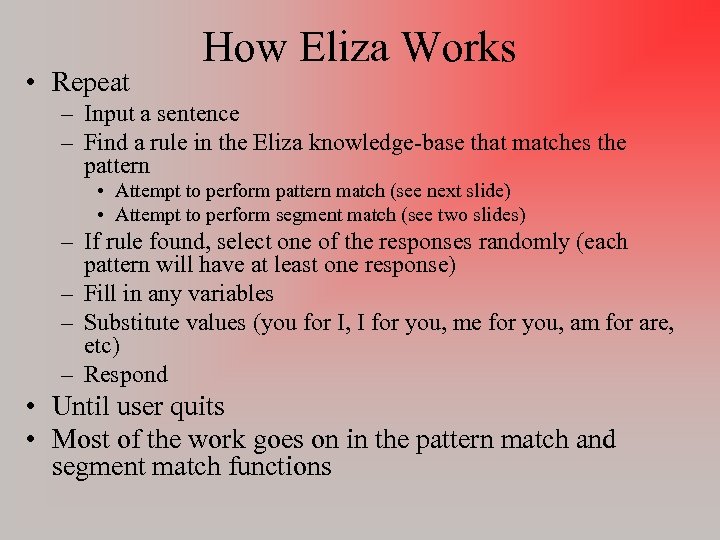
• Repeat How Eliza Works – Input a sentence – Find a rule in the Eliza knowledge-base that matches the pattern • Attempt to perform pattern match (see next slide) • Attempt to perform segment match (see two slides) – If rule found, select one of the responses randomly (each pattern will have at least one response) – Fill in any variables – Substitute values (you for I, I for you, me for you, am for are, etc) – Respond • Until user quits • Most of the work goes on in the pattern match and segment match functions
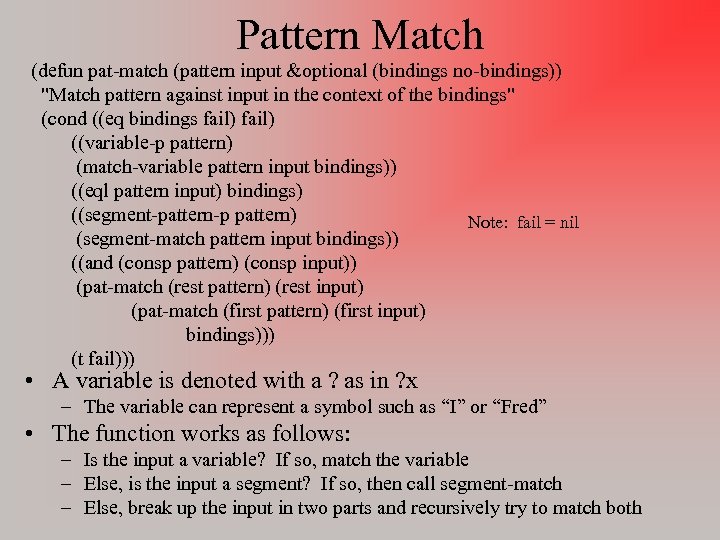
Pattern Match (defun pat-match (pattern input &optional (bindings no-bindings)) "Match pattern against input in the context of the bindings" (cond ((eq bindings fail) ((variable-p pattern) (match-variable pattern input bindings)) ((eql pattern input) bindings) ((segment-pattern-p pattern) Note: fail = nil (segment-match pattern input bindings)) ((and (consp pattern) (consp input)) (pat-match (rest pattern) (rest input) (pat-match (first pattern) (first input) bindings))) (t fail))) • A variable is denoted with a ? as in ? x – The variable can represent a symbol such as “I” or “Fred” • The function works as follows: – Is the input a variable? If so, match the variable – Else, is the input a segment? If so, then call segment-match – Else, break up the input in two parts and recursively try to match both
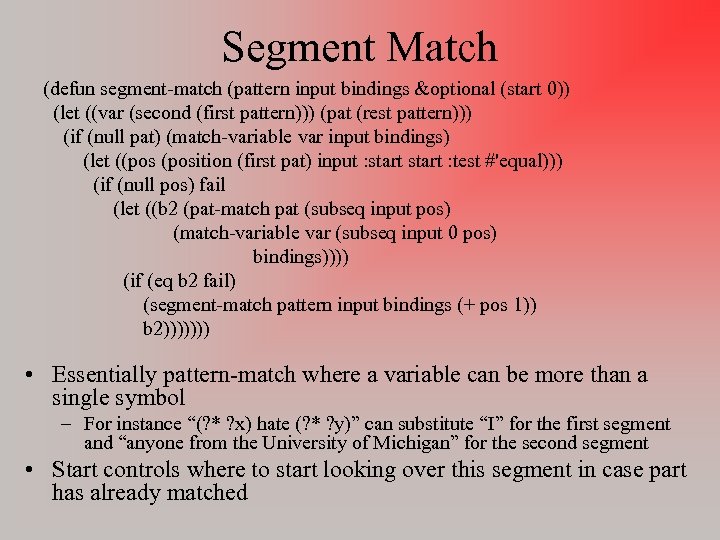
Segment Match (defun segment-match (pattern input bindings &optional (start 0)) (let ((var (second (first pattern))) (pat (rest pattern))) (if (null pat) (match-variable var input bindings) (let ((position (first pat) input : start : test #'equal))) (if (null pos) fail (let ((b 2 (pat-match pat (subseq input pos) (match-variable var (subseq input 0 pos) bindings)))) (if (eq b 2 fail) (segment-match pattern input bindings (+ pos 1)) b 2))))))) • Essentially pattern-match where a variable can be more than a single symbol – For instance “(? * ? x) hate (? * ? y)” can substitute “I” for the first segment and “anyone from the University of Michigan” for the second segment • Start controls where to start looking over this segment in case part has already matched
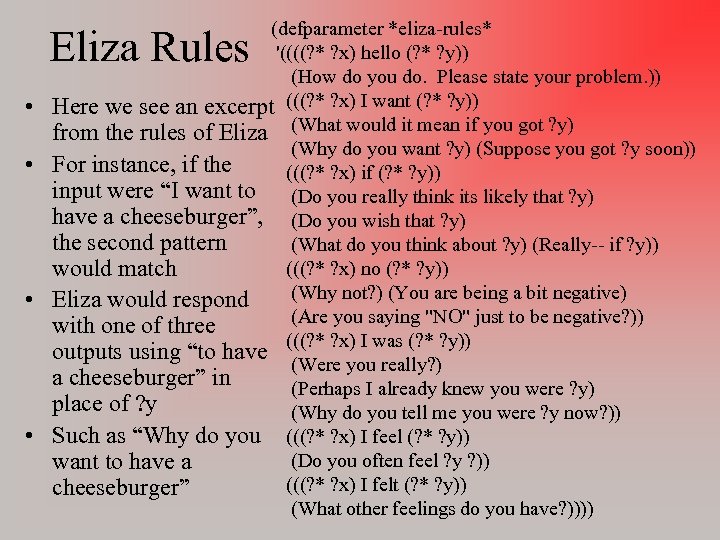
(defparameter *eliza-rules* '((((? * ? x) hello (? * ? y)) (How do you do. Please state your problem. )) Here we see an excerpt (((? * ? x) I want (? * ? y)) from the rules of Eliza (What would it mean if you got ? y) (Why do you want ? y) (Suppose you got ? y soon)) For instance, if the (((? * ? x) if (? * ? y)) input were “I want to (Do you really think its likely that ? y) have a cheeseburger”, (Do you wish that ? y) the second pattern (What do you think about ? y) (Really-- if ? y)) (((? * ? x) no (? * ? y)) would match (Why not? ) (You are being a bit negative) Eliza would respond (Are you saying "NO" just to be negative? )) with one of three (((? * ? x) I was (? * ? y)) outputs using “to have (Were you really? ) a cheeseburger” in (Perhaps I already knew you were ? y) place of ? y (Why do you tell me you were ? y now? )) Such as “Why do you (((? * ? x) I feel (? * ? y)) (Do you often feel ? y ? )) want to have a (((? * ? x) I felt (? * ? y)) cheeseburger” (What other feelings do you have? )))) Eliza Rules • •
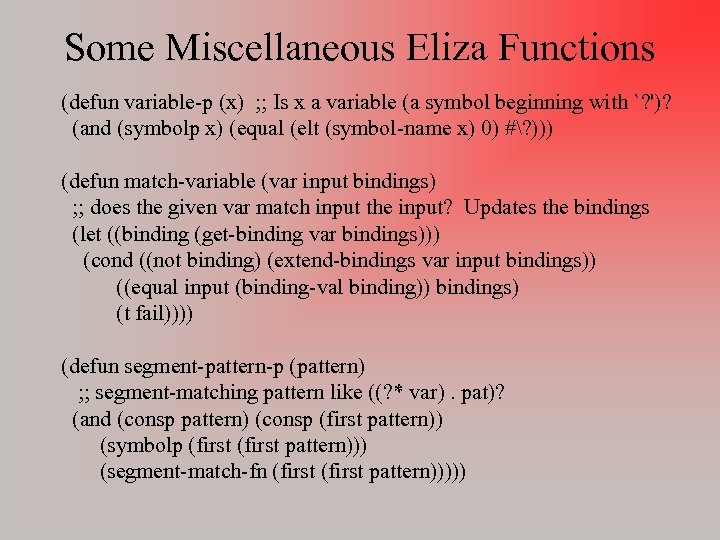
Some Miscellaneous Eliza Functions (defun variable-p (x) ; ; Is x a variable (a symbol beginning with `? ')? (and (symbolp x) (equal (elt (symbol-name x) 0) #? ))) (defun match-variable (var input bindings) ; ; does the given var match input the input? Updates the bindings (let ((binding (get-binding var bindings))) (cond ((not binding) (extend-bindings var input bindings)) ((equal input (binding-val binding)) bindings) (t fail)))) (defun segment-pattern-p (pattern) ; ; segment-matching pattern like ((? * var). pat)? (and (consp pattern) (consp (first pattern)) (symbolp (first pattern))) (segment-match-fn (first pattern)))))
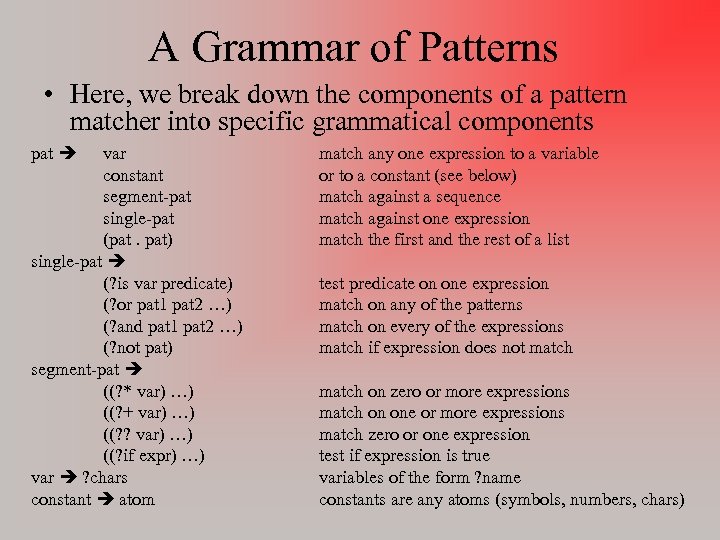
A Grammar of Patterns • Here, we break down the components of a pattern matcher into specific grammatical components pat var constant segment-pat single-pat (pat. pat) single-pat (? is var predicate) (? or pat 1 pat 2 …) (? and pat 1 pat 2 …) (? not pat) segment-pat ((? * var) …) ((? + var) …) ((? ? var) …) ((? if expr) …) var ? chars constant atom match any one expression to a variable or to a constant (see below) match against a sequence match against one expression match the first and the rest of a list test predicate on one expression match on any of the patterns match on every of the expressions match if expression does not match on zero or more expressions match on one or more expressions match zero or one expression test if expression is true variables of the form ? name constants are any atoms (symbols, numbers, chars)
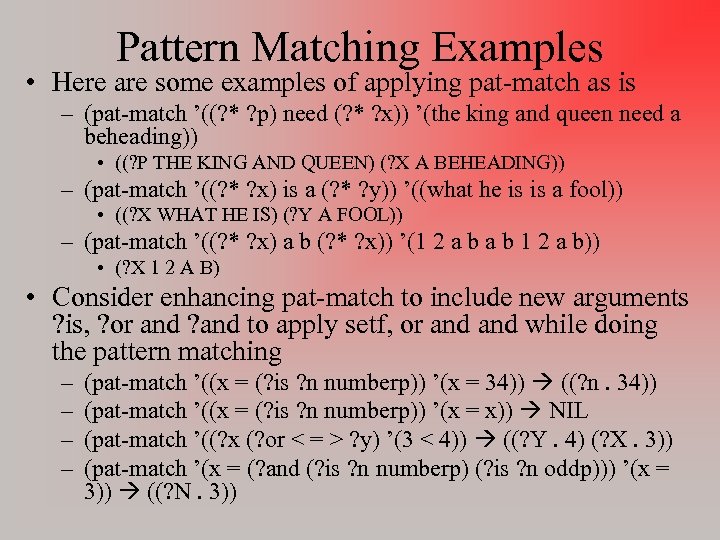
Pattern Matching Examples • Here are some examples of applying pat-match as is – (pat-match ’((? * ? p) need (? * ? x)) ’(the king and queen need a beheading)) • ((? P THE KING AND QUEEN) (? X A BEHEADING)) – (pat-match ’((? * ? x) is a (? * ? y)) ’((what he is is a fool)) • ((? X WHAT HE IS) (? Y A FOOL)) – (pat-match ’((? * ? x) a b (? * ? x)) ’(1 2 a b)) • (? X 1 2 A B) • Consider enhancing pat-match to include new arguments ? is, ? or and ? and to apply setf, or and while doing the pattern matching – – (pat-match ’((x = (? is ? n numberp)) ’(x = 34)) ((? n. 34)) (pat-match ’((x = (? is ? n numberp)) ’(x = x)) NIL (pat-match ’((? x (? or < = > ? y) ’(3 < 4)) ((? Y. 4) (? X. 3)) (pat-match ’(x = (? and (? is ? n numberp) (? is ? n oddp))) ’(x = 3)) ((? N. 3))
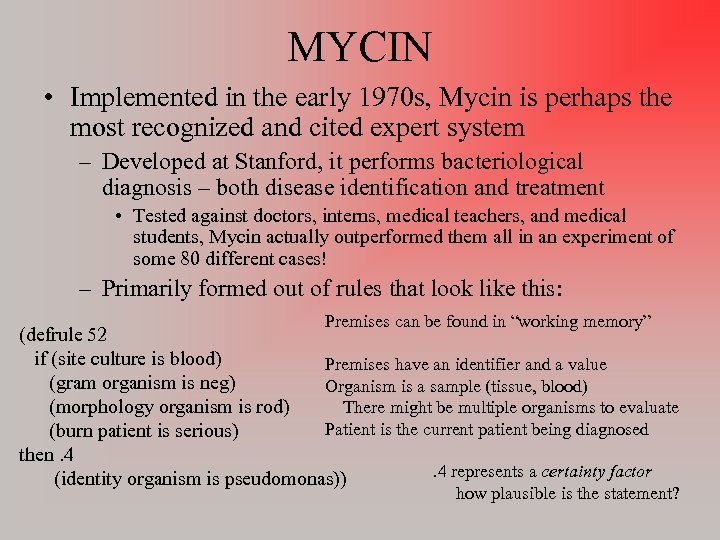
MYCIN • Implemented in the early 1970 s, Mycin is perhaps the most recognized and cited expert system – Developed at Stanford, it performs bacteriological diagnosis – both disease identification and treatment • Tested against doctors, interns, medical teachers, and medical students, Mycin actually outperformed them all in an experiment of some 80 different cases! – Primarily formed out of rules that look like this: Premises can be found in “working memory” (defrule 52 if (site culture is blood) Premises have an identifier and a value (gram organism is neg) Organism is a sample (tissue, blood) (morphology organism is rod) There might be multiple organisms to evaluate Patient is the current patient being diagnosed (burn patient is serious) then. 4. 4 represents a certainty factor (identity organism is pseudomonas)) how plausible is the statement?
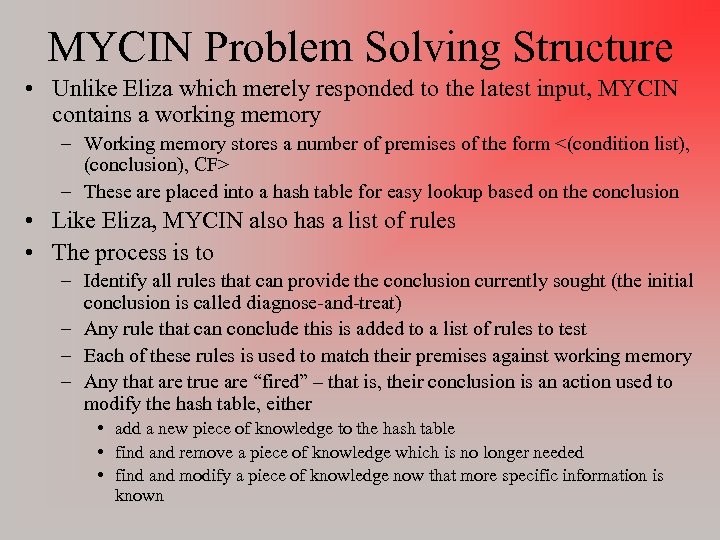
MYCIN Problem Solving Structure • Unlike Eliza which merely responded to the latest input, MYCIN contains a working memory – Working memory stores a number of premises of the form <(condition list), (conclusion), CF> – These are placed into a hash table for easy lookup based on the conclusion • Like Eliza, MYCIN also has a list of rules • The process is to – Identify all rules that can provide the conclusion currently sought (the initial conclusion is called diagnose-and-treat) – Any rule that can conclude this is added to a list of rules to test – Each of these rules is used to match their premises against working memory – Any that are true are “fired” – that is, their conclusion is an action used to modify the hash table, either • add a new piece of knowledge to the hash table • find and remove a piece of knowledge which is no longer needed • find and modify a piece of knowledge now that more specific information is known
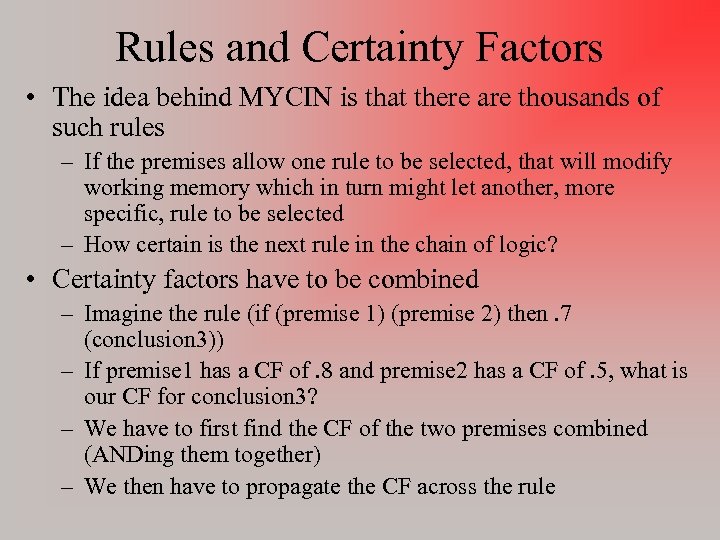
Rules and Certainty Factors • The idea behind MYCIN is that there are thousands of such rules – If the premises allow one rule to be selected, that will modify working memory which in turn might let another, more specific, rule to be selected – How certain is the next rule in the chain of logic? • Certainty factors have to be combined – Imagine the rule (if (premise 1) (premise 2) then. 7 (conclusion 3)) – If premise 1 has a CF of. 8 and premise 2 has a CF of. 5, what is our CF for conclusion 3? – We have to first find the CF of the two premises combined (ANDing them together) – We then have to propagate the CF across the rule
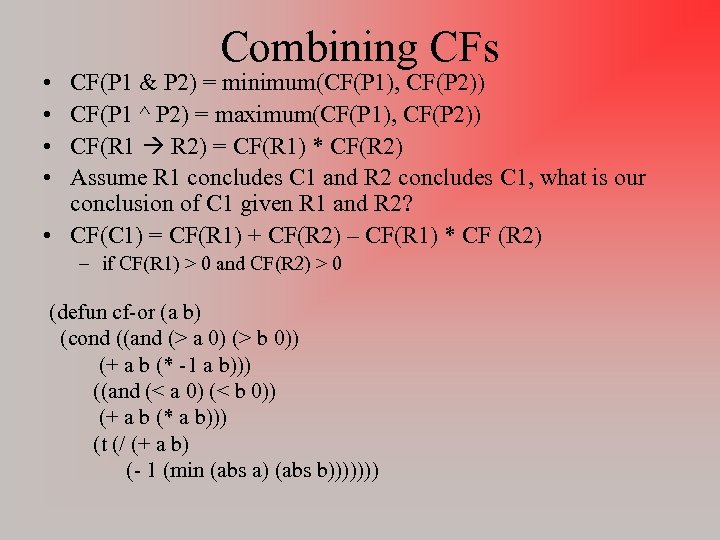
• • Combining CFs CF(P 1 & P 2) = minimum(CF(P 1), CF(P 2)) CF(P 1 ^ P 2) = maximum(CF(P 1), CF(P 2)) CF(R 1 R 2) = CF(R 1) * CF(R 2) Assume R 1 concludes C 1 and R 2 concludes C 1, what is our conclusion of C 1 given R 1 and R 2? • CF(C 1) = CF(R 1) + CF(R 2) – CF(R 1) * CF (R 2) – if CF(R 1) > 0 and CF(R 2) > 0 (defun cf-or (a b) (cond ((and (> a 0) (> b 0)) (+ a b (* -1 a b))) ((and (< a 0) (< b 0)) (+ a b (* a b))) (t (/ (+ a b) (- 1 (min (abs a) (abs b)))))))
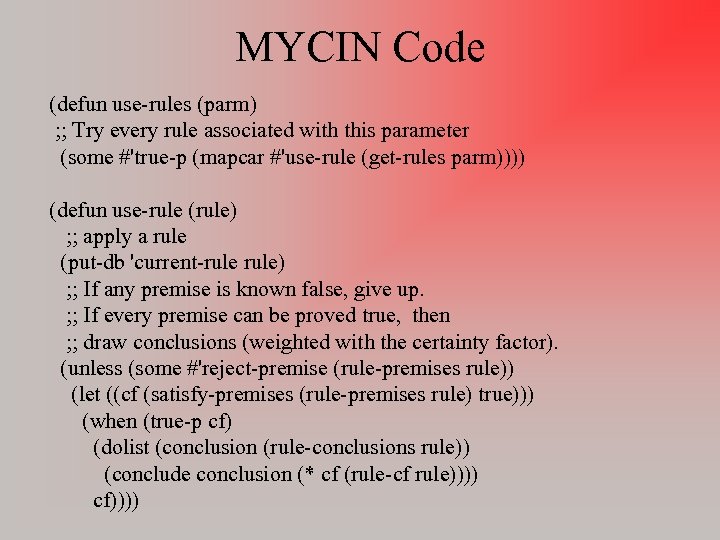
MYCIN Code (defun use-rules (parm) ; ; Try every rule associated with this parameter (some #'true-p (mapcar #'use-rule (get-rules parm)))) (defun use-rule (rule) ; ; apply a rule (put-db 'current-rule) ; ; If any premise is known false, give up. ; ; If every premise can be proved true, then ; ; draw conclusions (weighted with the certainty factor). (unless (some #'reject-premise (rule-premises rule)) (let ((cf (satisfy-premises (rule-premises rule) true))) (when (true-p cf) (dolist (conclusion (rule-conclusions rule)) (conclude conclusion (* cf (rule-cf rule)))) cf))))
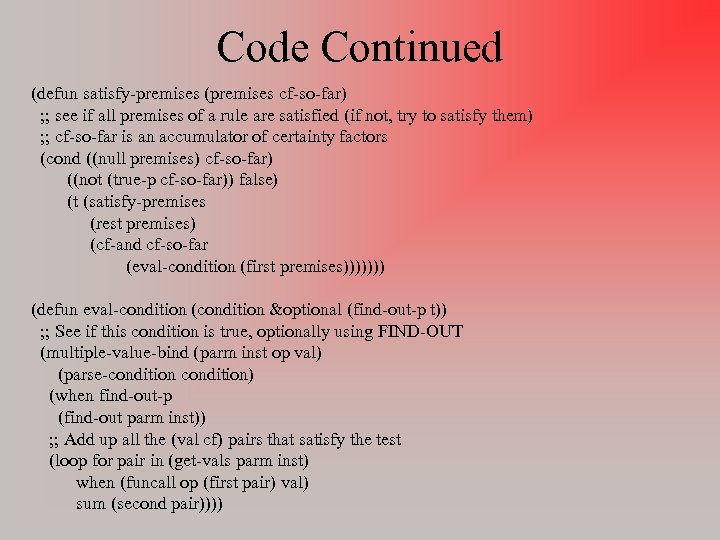
Code Continued (defun satisfy-premises (premises cf-so-far) ; ; see if all premises of a rule are satisfied (if not, try to satisfy them) ; ; cf-so-far is an accumulator of certainty factors (cond ((null premises) cf-so-far) ((not (true-p cf-so-far)) false) (t (satisfy-premises (rest premises) (cf-and cf-so-far (eval-condition (first premises))))))) (defun eval-condition (condition &optional (find-out-p t)) ; ; See if this condition is true, optionally using FIND-OUT (multiple-value-bind (parm inst op val) (parse-condition) (when find-out-p (find-out parm inst)) ; ; Add up all the (val cf) pairs that satisfy the test (loop for pair in (get-vals parm inst) when (funcall op (first pair) val) sum (second pair))))
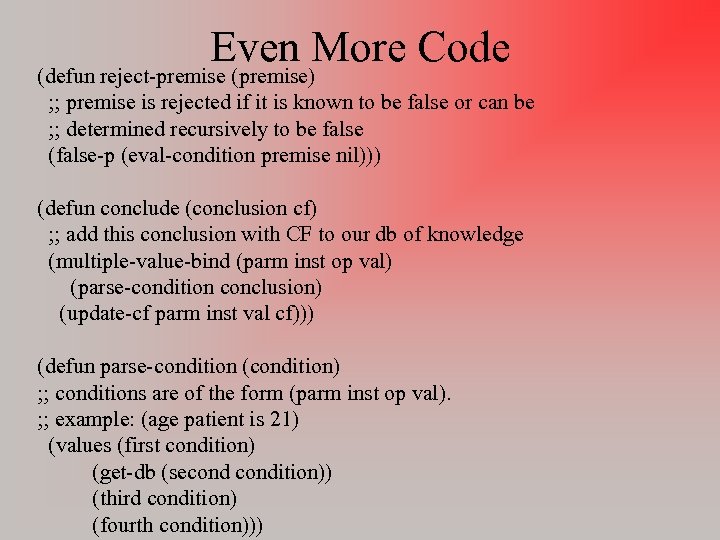
Even More Code (defun reject-premise (premise) ; ; premise is rejected if it is known to be false or can be ; ; determined recursively to be false (false-p (eval-condition premise nil))) (defun conclude (conclusion cf) ; ; add this conclusion with CF to our db of knowledge (multiple-value-bind (parm inst op val) (parse-condition conclusion) (update-cf parm inst val cf))) (defun parse-condition (condition) ; ; conditions are of the form (parm inst op val). ; ; example: (age patient is 21) (values (first condition) (get-db (secondition)) (third condition) (fourth condition)))
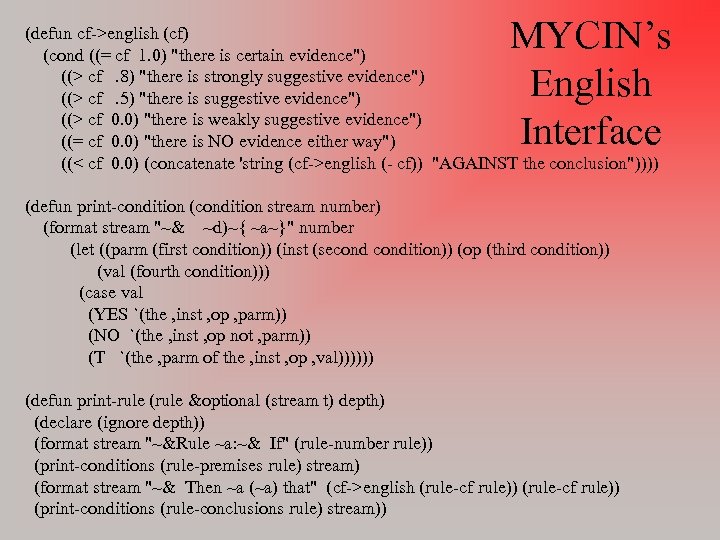
MYCIN’s English Interface (defun cf->english (cf) (cond ((= cf 1. 0) "there is certain evidence") ((> cf. 8) "there is strongly suggestive evidence") ((> cf. 5) "there is suggestive evidence") ((> cf 0. 0) "there is weakly suggestive evidence") ((= cf 0. 0) "there is NO evidence either way") ((< cf 0. 0) (concatenate 'string (cf->english (- cf)) "AGAINST the conclusion")))) (defun print-condition (condition stream number) (format stream "~& ~d)~{ ~a~}" number (let ((parm (first condition)) (inst (secondition)) (op (third condition)) (val (fourth condition))) (case val (YES `(the , inst , op , parm)) (NO `(the , inst , op not , parm)) (T `(the , parm of the , inst , op , val)))))) (defun print-rule (rule &optional (stream t) depth) (declare (ignore depth)) (format stream "~&Rule ~a: ~& If" (rule-number rule)) (print-conditions (rule-premises rule) stream) (format stream "~& Then ~a (~a) that" (cf->english (rule-cf rule)) (print-conditions (rule-conclusions rule) stream))
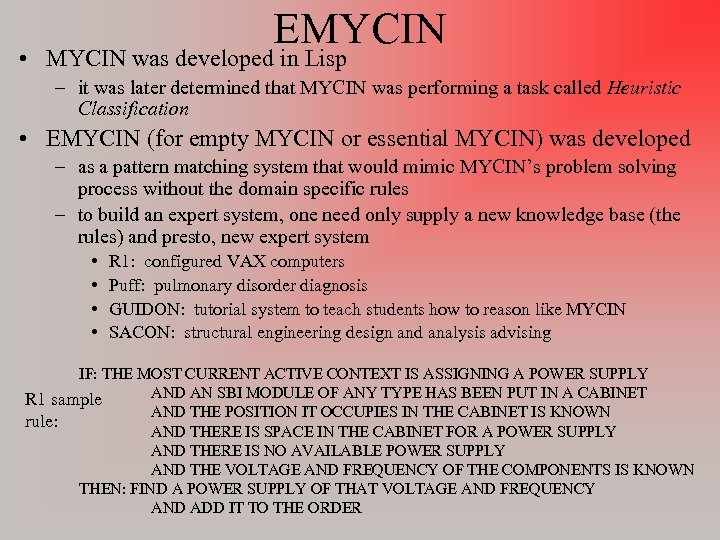
EMYCIN • MYCIN was developed in Lisp – it was later determined that MYCIN was performing a task called Heuristic Classification • EMYCIN (for empty MYCIN or essential MYCIN) was developed – as a pattern matching system that would mimic MYCIN’s problem solving process without the domain specific rules – to build an expert system, one need only supply a new knowledge base (the rules) and presto, new expert system • • R 1: configured VAX computers Puff: pulmonary disorder diagnosis GUIDON: tutorial system to teach students how to reason like MYCIN SACON: structural engineering design and analysis advising IF: THE MOST CURRENT ACTIVE CONTEXT IS ASSIGNING A POWER SUPPLY AND AN SBI MODULE OF ANY TYPE HAS BEEN PUT IN A CABINET R 1 sample AND THE POSITION IT OCCUPIES IN THE CABINET IS KNOWN rule: AND THERE IS SPACE IN THE CABINET FOR A POWER SUPPLY AND THERE IS NO AVAILABLE POWER SUPPLY AND THE VOLTAGE AND FREQUENCY OF THE COMPONENTS IS KNOWN THEN: FIND A POWER SUPPLY OF THAT VOLTAGE AND FREQUENCY AND ADD IT TO THE ORDER
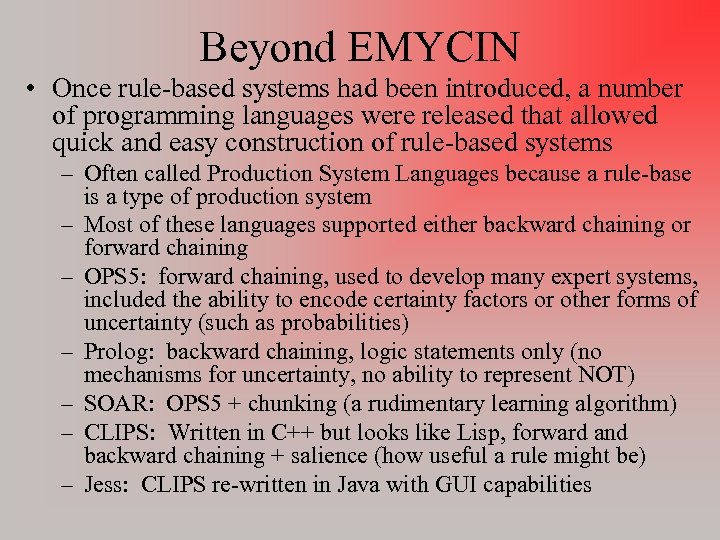
Beyond EMYCIN • Once rule-based systems had been introduced, a number of programming languages were released that allowed quick and easy construction of rule-based systems – Often called Production System Languages because a rule-base is a type of production system – Most of these languages supported either backward chaining or forward chaining – OPS 5: forward chaining, used to develop many expert systems, included the ability to encode certainty factors or other forms of uncertainty (such as probabilities) – Prolog: backward chaining, logic statements only (no mechanisms for uncertainty, no ability to represent NOT) – SOAR: OPS 5 + chunking (a rudimentary learning algorithm) – CLIPS: Written in C++ but looks like Lisp, forward and backward chaining + salience (how useful a rule might be) – Jess: CLIPS re-written in Java with GUI capabilities
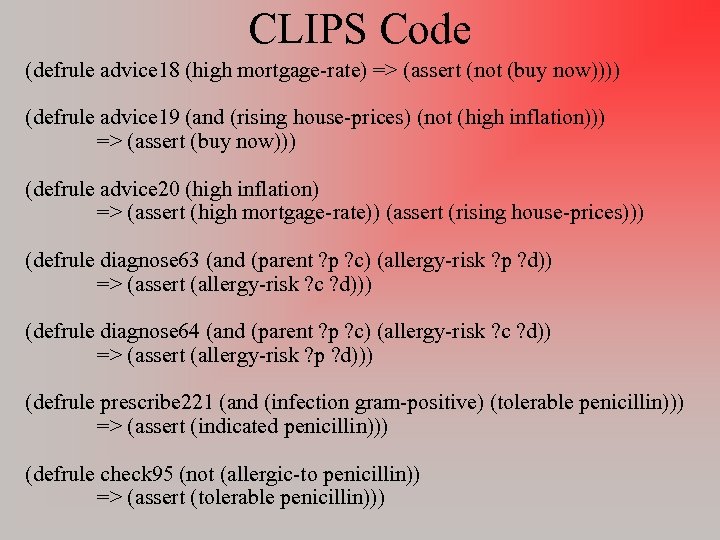
CLIPS Code (defrule advice 18 (high mortgage-rate) => (assert (not (buy now)))) (defrule advice 19 (and (rising house-prices) (not (high inflation))) => (assert (buy now))) (defrule advice 20 (high inflation) => (assert (high mortgage-rate)) (assert (rising house-prices))) (defrule diagnose 63 (and (parent ? p ? c) (allergy-risk ? p ? d)) => (assert (allergy-risk ? c ? d))) (defrule diagnose 64 (and (parent ? p ? c) (allergy-risk ? c ? d)) => (assert (allergy-risk ? p ? d))) (defrule prescribe 221 (and (infection gram-positive) (tolerable penicillin))) => (assert (indicated penicillin))) (defrule check 95 (not (allergic-to penicillin)) => (assert (tolerable penicillin)))
• Critique of Pattern Matching Advantages: – Easy to construct (with an EMYCIN-like shell) – Easy to get knowledge in the form of rules • Disadvantages: – Some knowledge is not necessarily in rule form – Many experts give inconsistent (or hesitate to provide) certainty factors • The biggest problems though are – Expert systems tend to work well when the number of rules is below 10, 000, but once a system has more than 10, 000 rules, its efficiency and accuracy begins to deteriorate – The knowledge is all distributed, finding related rules (to debug the knowledge base) is not easy – Rules are typically at the same level, but knowledge comes in groupings • Some knowledge is not needed early in the diagnostic process (for instance, treatment knowledge) • Other knowledge is not needed because the specific category being analyzed has been ruled out (don’t need to know about Hepatitus if we have ruled out liver disease) – Meta-knowledge: knowledge that will help you select what knowledge to apply or examine
Puff/Centaur • The Puff expert system performed pulmonary disorder diagnosis – Implemented using rules and EMCYIN • Another system, Centaur, used the same knowledge, but in a different way – Rules were grouped together into specialized agents – One agent per diagnostic conclusion – Conclusions were grouped into a hierarchy so that a generic disease would be higher in the disease taxonomy and its children would be more specific instances – Rather than thousands of rules, Centaur had dozens of agents (each implemented as an object) – Each agent contained the knowledge necessary to diagnose that one conclusion
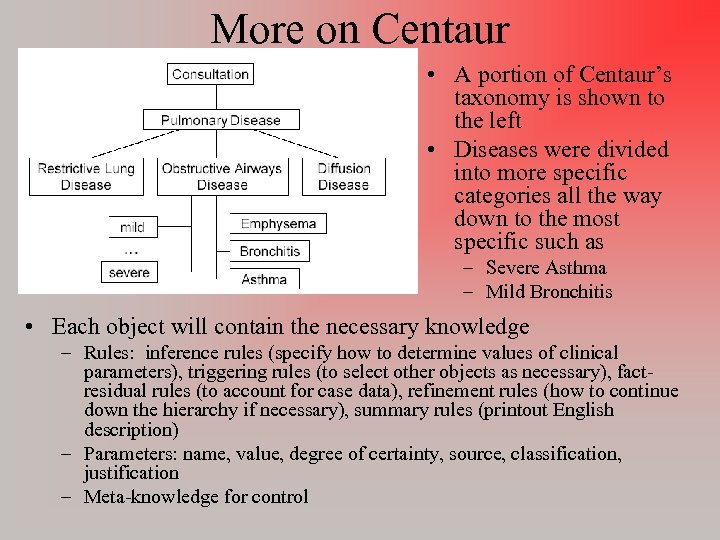
More on Centaur • A portion of Centaur’s taxonomy is shown to the left • Diseases were divided into more specific categories all the way down to the most specific such as – Severe Asthma – Mild Bronchitis • Each object will contain the necessary knowledge – Rules: inference rules (specify how to determine values of clinical parameters), triggering rules (to select other objects as necessary), factresidual rules (to account for case data), refinement rules (how to continue down the hierarchy if necessary), summary rules (printout English description) – Parameters: name, value, degree of certainty, source, classification, justification – Meta-knowledge for control
Taking It Further • MYCIN demonstrated a task called Heuristic Classification but confused matters by forcing all knowledge into rule form • Centaur separated out the classification task from the rules • Taking this further, we can clearly identify different tasks to perform during a problem solving process – We will call these tasks • Thus, we might separate out the knowledge that allows us to categorize diseases from the knowledge that allows us to recognize a specific disease from the knowledge that allows us to explain why we believe a specific disease is responsible for the data – These low-level tasks have been dubbed Generic Tasks
Generic Tasks and AI Tools • Classes: – Classifier (an entire hierarchy) – Classification Specialist (a single node in the hierarchy) – Recognition-Agent (a single set of rules to determine how likely a given concept/hypothesis matches the data available) – Match-1 -Recognition-Agent (an RA with multiple sets of rules) – Discrete-Pattern-Recognition-Agent (an RA with only a single set of rules to match against) – Abducer (an object that knows how to explain data given hypotheses that can explain the data) • A define statement is used to create a new instance – These are macros that create a new class and fill in the various class slots appropriately, including the code to execute to make the object run – Code to examine is available on the website
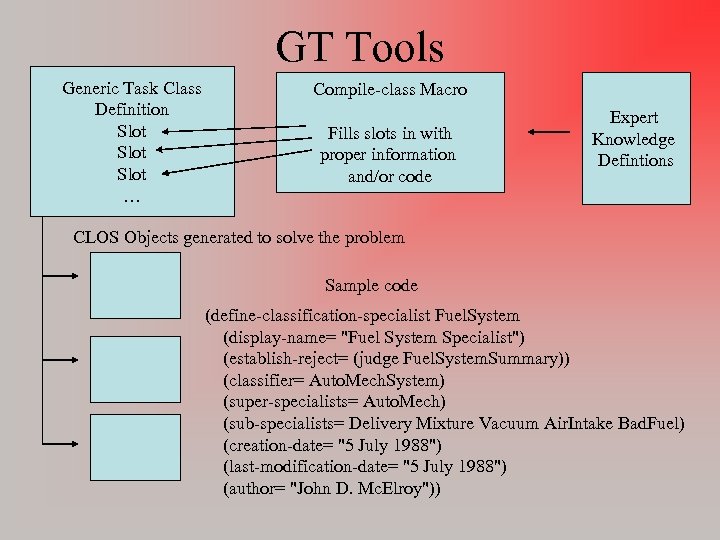
GT Tools Generic Task Class Definition Slot … Compile-class Macro Fills slots in with proper information and/or code Expert Knowledge Defintions CLOS Objects generated to solve the problem Sample code (define-classification-specialist Fuel. System (display-name= "Fuel System Specialist") (establish-reject= (judge Fuel. System. Summary)) (classifier= Auto. Mech. System) (super-specialists= Auto. Mech) (sub-specialists= Delivery Mixture Vacuum Air. Intake Bad. Fuel) (creation-date= "5 July 1988") (last-modification-date= "5 July 1988") (author= "John D. Mc. Elroy"))
Скачать презентацию Expert Knowledge-Based Systems One of AI s
e199fb834adffd3ce641fc5398c3a2bd.ppt