 Скачать презентацию Experimental Research Edited and Presented by Alberto Sangiovanni
24ca7e1337efab2d6ad6799f53a713b2.ppt
- Количество слайдов: 37



Experimental Research Edited and Presented by Alberto Sangiovanni Vincentelli, Co -PI UC Berkeley Chess Review November 18, 2004 Berkeley, CA
Overview • Experimental research is an essential component of CHESS – Feedback on approach – Inspiration for new theory – Impact • Wide range – Industrial cases (to be covered in the afternoon) • Automotive (safety-critical distributed systems) • System-on-Chip (high-complexity platforms) – Internal experimental test benches • Wireless Sensor Networks (security, low power) • UAVs (complex control, sensor integration) – New domains: • Scientific Workflows: Kepler Stochastic • Hybrid Systems in Systems Biology Chess Review, November 18, 2004 2
Overarching Criteria • An application should exercise – Theory: hybrid models, Models of Computation, control algorithms – Tools and Environments – Path to implementation • An application should be relevant for industry or for government agencies Chess Review, November 18, 2004 3
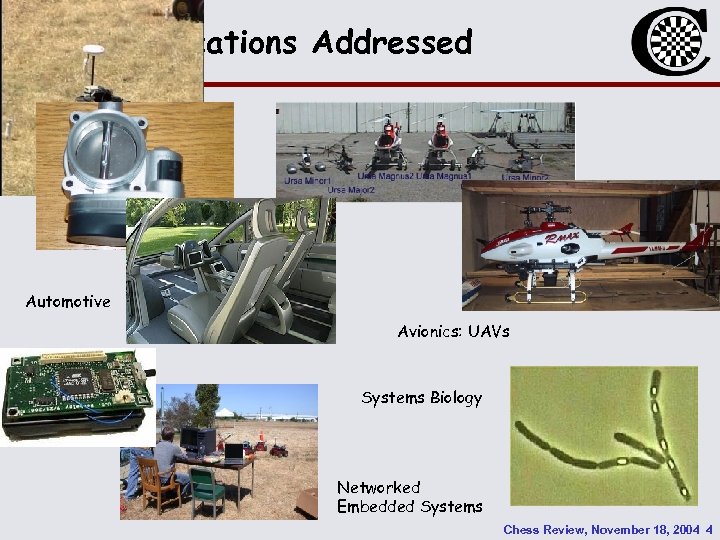
Some Applications Addressed Automotive Avionics: UAVs Systems Biology Networked Embedded Systems Chess Review, November 18, 2004 4
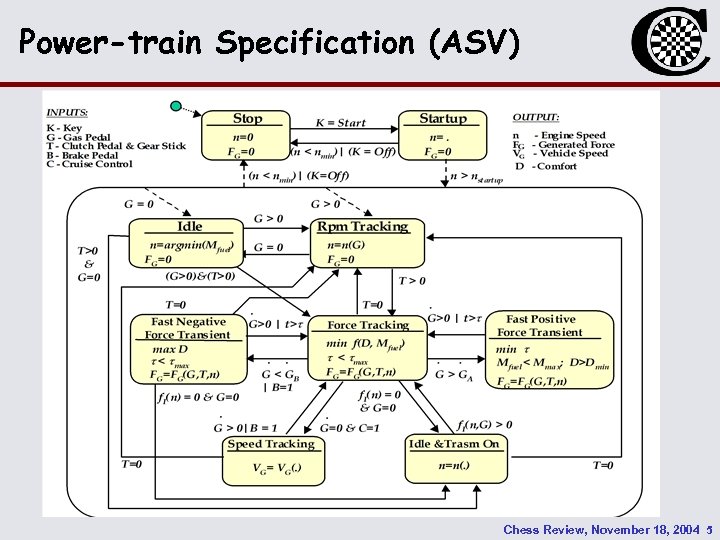
Power-train Specification (ASV) Chess Review, November 18, 2004 5
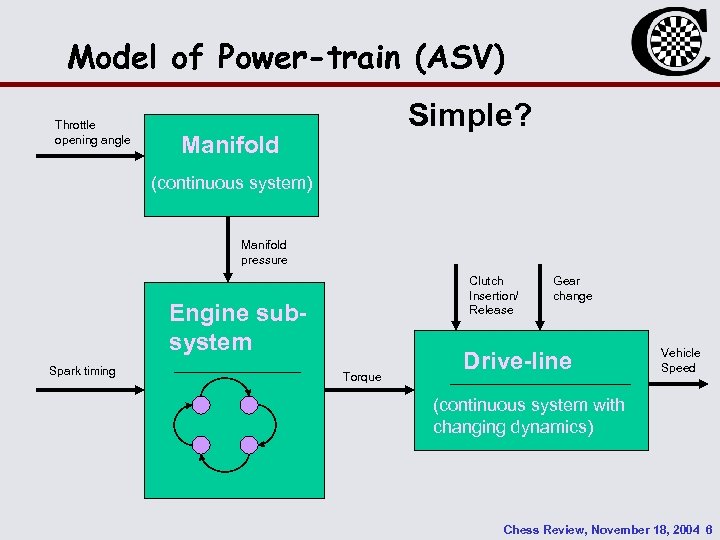
Model of Power-train (ASV) Throttle opening angle Simple? Manifold (continuous system) Manifold pressure Clutch Insertion/ Release Engine subsystem Spark timing Torque Gear change Drive-line Vehicle Speed (continuous system with changing dynamics) Chess Review, November 18, 2004 6
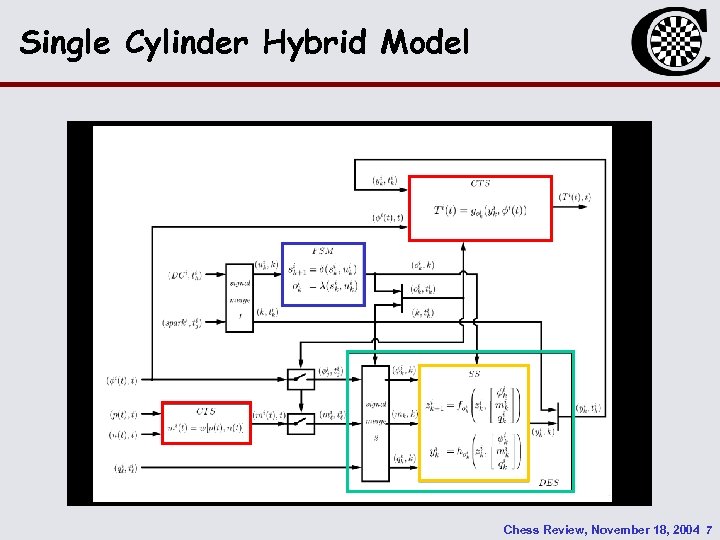
Single Cylinder Hybrid Model Chess Review, November 18, 2004 7
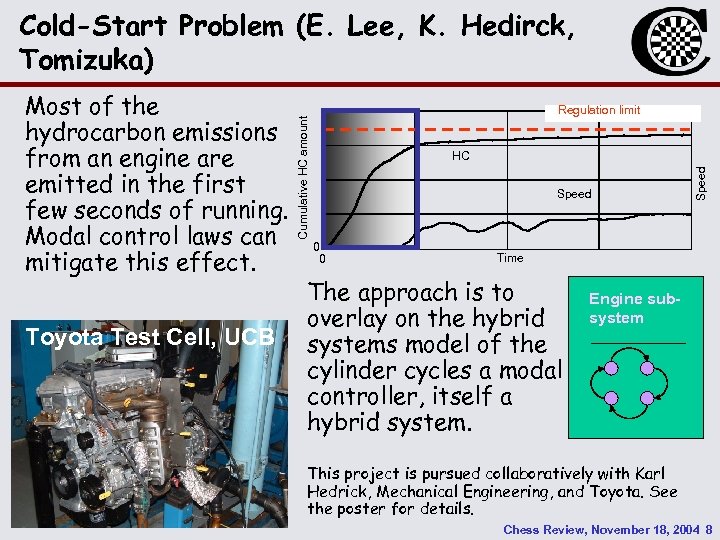
Cold-Start Problem (E. Lee, K. Hedirck, Tomizuka) Toyota Test Cell, UCB Regulation limit Cumulative HC amount HC Speed 0 0 Speed Most of the hydrocarbon emissions from an engine are emitted in the first few seconds of running. Modal control laws can mitigate this effect. Time The approach is to overlay on the hybrid systems model of the cylinder cycles a modal controller, itself a hybrid system. Engine subsystem This project is pursued collaboratively with Karl Hedrick, Mechanical Engineering, and Toyota. See the poster for details. Chess Review, November 18, 2004 8
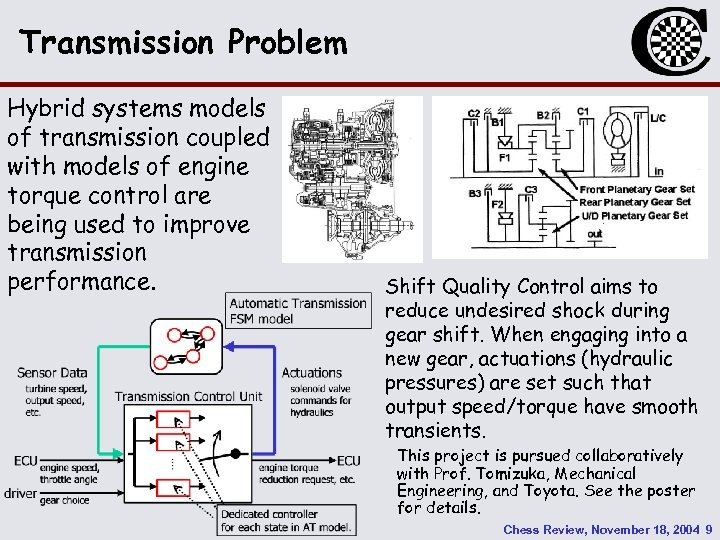
Transmission Problem Hybrid systems models of transmission coupled with models of engine torque control are being used to improve transmission performance. Shift Quality Control aims to reduce undesired shock during gear shift. When engaging into a new gear, actuations (hydraulic pressures) are set such that output speed/torque have smooth transients. This project is pursued collaboratively with Prof. Tomizuka, Mechanical Engineering, and Toyota. See the poster for details. Chess Review, November 18, 2004 9
Outline – Internal experimental test benches • Automotive • Wireless Sensor Networks (security, low power) • UAVs (complex control, sensor integration) – New domains: • Scientific Workflows: Kepler • Stochastic Hybrid Systems in Systems Biology Chess Review, November 18, 2004 10
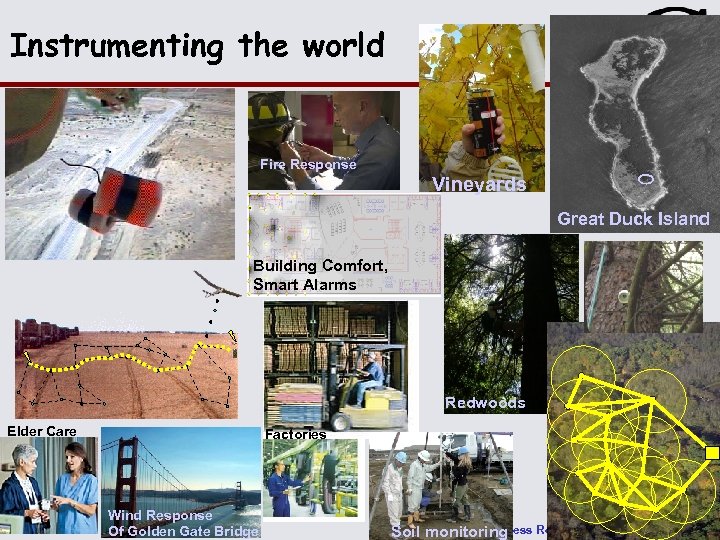
Instrumenting the world Fire Response Vineyards Great Duck Island Building Comfort, Smart Alarms Redwoods Elder Care Factories Wind Response Of Golden Gate Bridge Chess Review, November 18, 2004 Soil monitoring 11
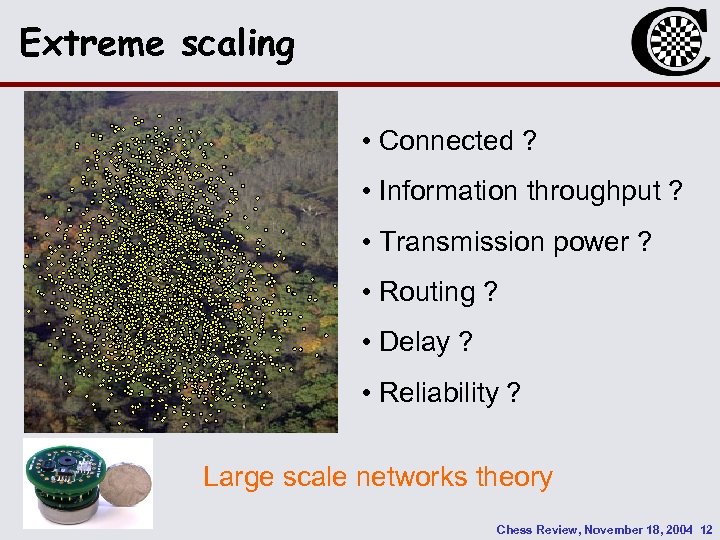
Extreme scaling • Connected ? • Information throughput ? • Transmission power ? • Routing ? • Delay ? • Reliability ? Large scale networks theory Chess Review, November 18, 2004 12
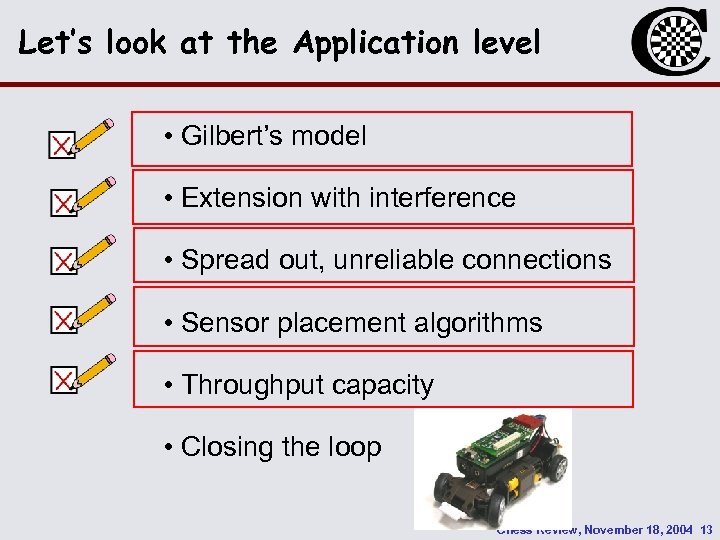
Let’s look at the Application level • Gilbert’s model • Extension with interference • Spread out, unreliable connections • Sensor placement algorithms • Throughput capacity • Closing the loop Chess Review, November 18, 2004 13
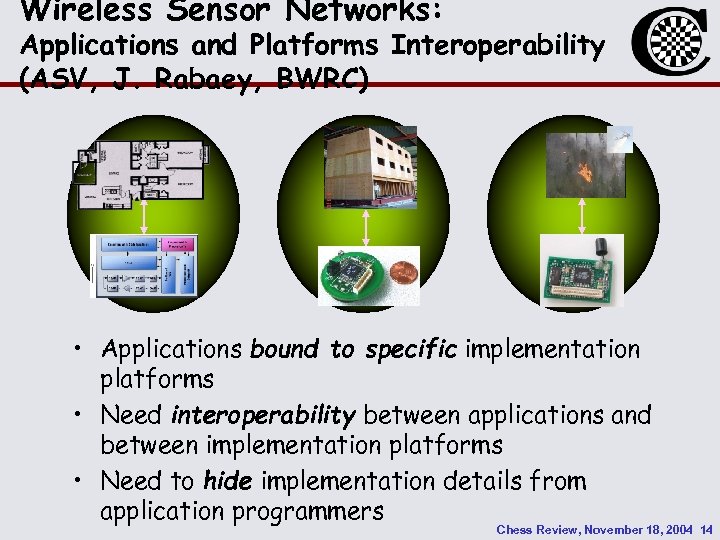
Wireless Sensor Networks: Applications and Platforms Interoperability (ASV, J. Rabaey, BWRC) Application • Applications bound to specific implementation platforms • Need interoperability between applications and between implementation platforms • Need to hide implementation details from application programmers Chess Review, November 18, 2004 14
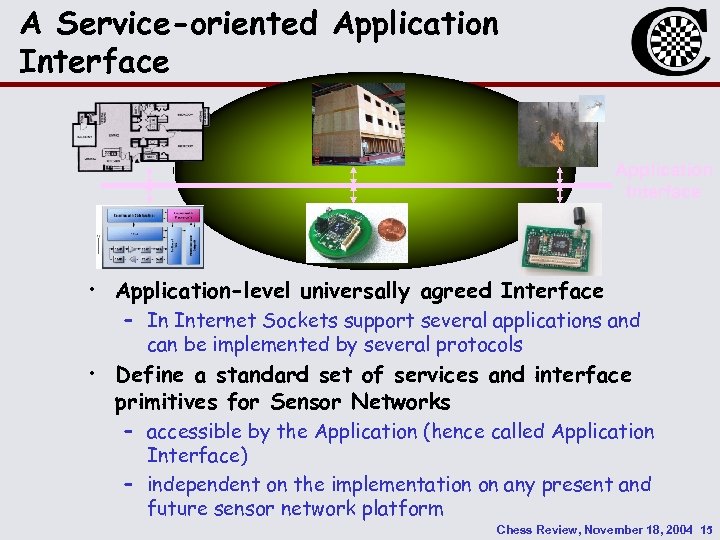
A Service-oriented Application Interface • Application-level universally agreed Interface – In Internet Sockets support several applications and can be implemented by several protocols • Define a standard set of services and interface primitives for Sensor Networks – accessible by the Application (hence called Application Interface) – independent on the implementation on any present and future sensor network platform Chess Review, November 18, 2004 15
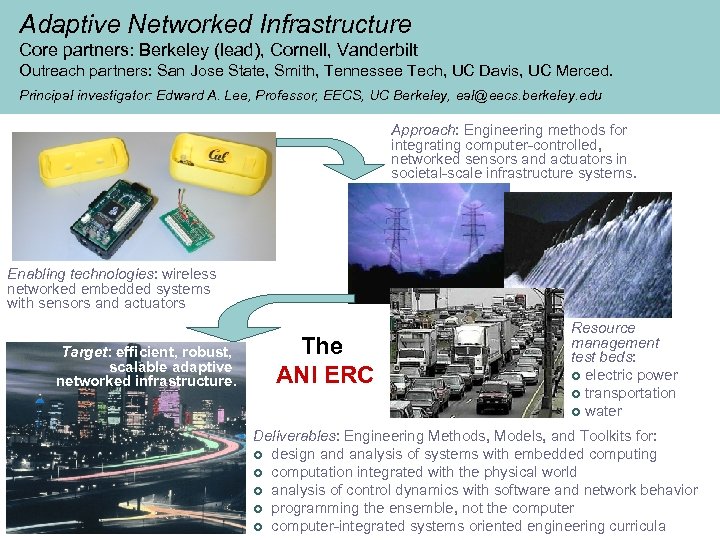
Adaptive Networked Infrastructure Core partners: Berkeley (lead), Cornell, Vanderbilt Outreach partners: San Jose State, Smith, Tennessee Tech, UC Davis, UC Merced. Principal investigator: Edward A. Lee, Professor, EECS, UC Berkeley, eal@eecs. berkeley. edu Approach: Engineering methods for integrating computer-controlled, networked sensors and actuators in societal-scale infrastructure systems. Enabling technologies: wireless networked embedded systems with sensors and actuators Target: efficient, robust, scalable adaptive networked infrastructure. The ANI ERC Resource management test beds: ¢ electric power ¢ transportation ¢ water Deliverables: Engineering Methods, Models, and Toolkits for: ¢ design and analysis of systems with embedded computing ¢ computation integrated with the physical world ¢ analysis of control dynamics with software and network behavior ¢ programming the ensemble, not the computer ¢ computer-integrated systems oriented engineering curricula
Outline – Internal experimental test benches • Automotive • Wireless Sensor Networks (security, low power) • UAVs (complex control, sensor integration) – New domains: • Scientific Workflows: Kepler • Stochastic Hybrid Systems in Systems Biology Chess Review, November 18, 2004 17
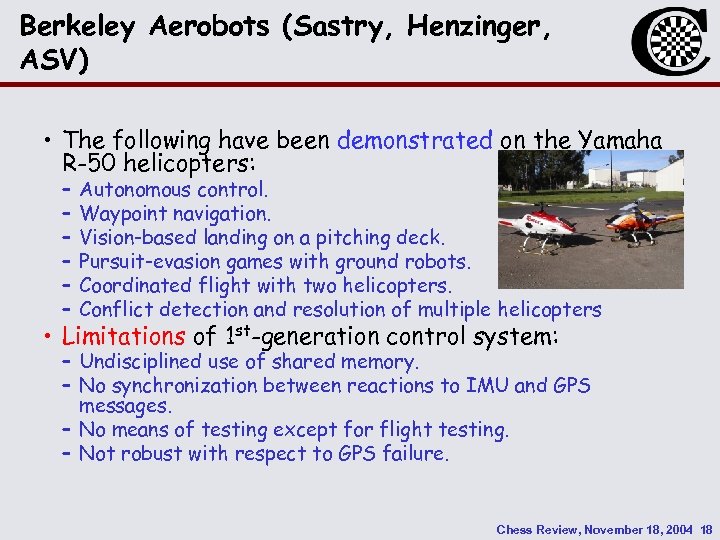
Berkeley Aerobots (Sastry, Henzinger, ASV) • The following have been demonstrated on the Yamaha R-50 helicopters: – – – Autonomous control. Waypoint navigation. Vision-based landing on a pitching deck. Pursuit-evasion games with ground robots. Coordinated flight with two helicopters. Conflict detection and resolution of multiple helicopters • Limitations of 1 st-generation control system: – Undisciplined use of shared memory. – No synchronization between reactions to IMU and GPS messages. – No means of testing except for flight testing. – Not robust with respect to GPS failure. Chess Review, November 18, 2004 18
2 nd-Generation Control System • Our control system is based around Giotto, a time-based language for embedded systems programming. • Giotto is ideal for correcting shortcomings of 1 st-generation system: – Deterministic semantics. – Disciplined use of shared memory. – Carefully implemented inter-task synchronization. – Programmer-specified latencies between sensor input and actuator output. Chess Review, November 18, 2004 19
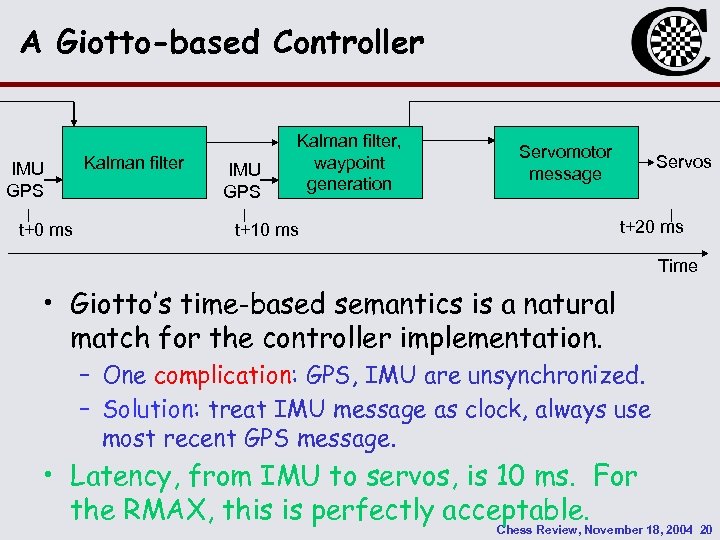
A Giotto-based Controller IMU GPS t+0 ms Kalman filter IMU GPS Kalman filter, waypoint generation Servomotor message Servos t+20 ms t+10 ms Time • Giotto’s time-based semantics is a natural match for the controller implementation. – One complication: GPS, IMU are unsynchronized. – Solution: treat IMU message as clock, always use most recent GPS message. • Latency, from IMU to servos, is 10 ms. For the RMAX, this is perfectly acceptable. Chess Review, November 18, 2004 20
Giotto Implementation • Implementing the controller required porting the Embedded Machine, a virtual machine for executing Giotto programs, to Vx. Works: 1300 lines of C code. – Controller functionality: 700 lines of C code. – E Code, executed by the Embedded Machine: 100 lines. – Instrumentation code (IMU, GPS, and actuators): 1800 lines of C code. • The controller is extremely reliable. Have yet to determine mean time before failure: runs for 34 days at least • The Giotto controller will be flown on the R-Max by December 2004. Chess Review, November 18, 2004 21
Future Work Using x. Giotto and Metro flow, we can quickly evaluate different implementation platforms and synchronization methods • In particular, we wish to: • Implement controller on top of OCP (Boeing’s Open Control Platform) which is being repositoried by ESCHER • Make controller robust to GPS failure. Chess Review, November 18, 2004 22
Pursuit Evasion Games (PEGs) (Sastry) • Consider: – Intelligence gathering, remote-piloted UAV in flight – Alerted (internally, or by an observer) of an adversary over the horizon • What to do? – Time lag is too large for remote “escape” – Adversary will most likely locate UAV shortly – Not enough time to transmit back all data • Proposal: – Turn over control to a switched “intelligent” evader • Controller may also be capable of pursuit/targeting Chess Review, November 18, 2004 23
PEGs: Status • Experience with ground vehicles and rotorcraft combined for fixed-wing demo • Reconfigurable nonlinear-model predictive control used to control evasive/pursuit maneuvers • Flew in Boeing T-33 Jet, June 2004 – Positive response from pursuing/”caught” pilot in F-15, “behaved just like a human” • Possible applications for PEGs with autonomous vehicles – NASA robotics (long lag control) – Underwater security (unmanned submarines) Chess Review, November 18, 2004 24
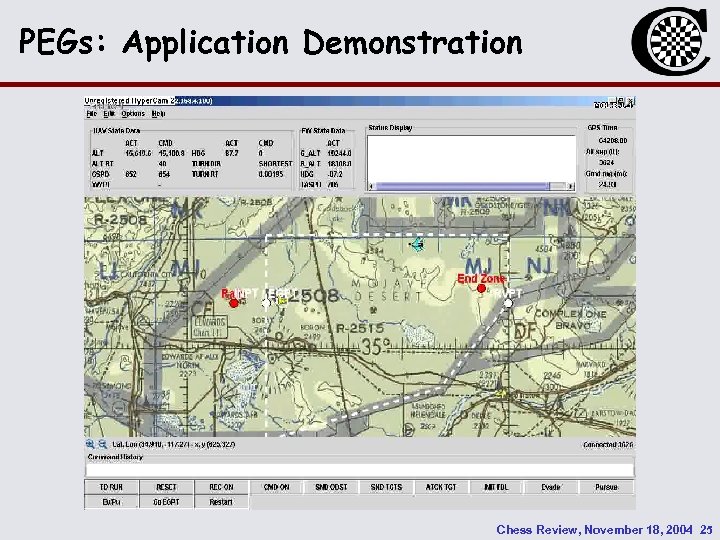
PEGs: Application Demonstration Chess Review, November 18, 2004 25
Outline – Internal experimental test benches • Automotive • Wireless Sensor Networks (security, low power) • UAVs (complex control, sensor integration) – New domains: • Scientific Workflows: Kepler • Stochastic Hybrid Systems in Systems Biology Chess Review, November 18, 2004 26
A New Application of Ptolemy II Kepler – Scientific Workflows (Lee) A distributed workflow system to “provide access to any resource, any data, any service, anytime, anywhere” via a distributed computing platform (aka the “Grid”) supporting “high performance computing, and federated, integrated, mediated databases within a user-friendly workbench / problemsolving environment”. This effort is compatible with the objectives of NSF Cyberinfrastructure, UK’s e-Science Programme, and DOE’s Sci. DAC (Scientific Discovery through Advanced Computing). Chess Review, November 18, 2004 27
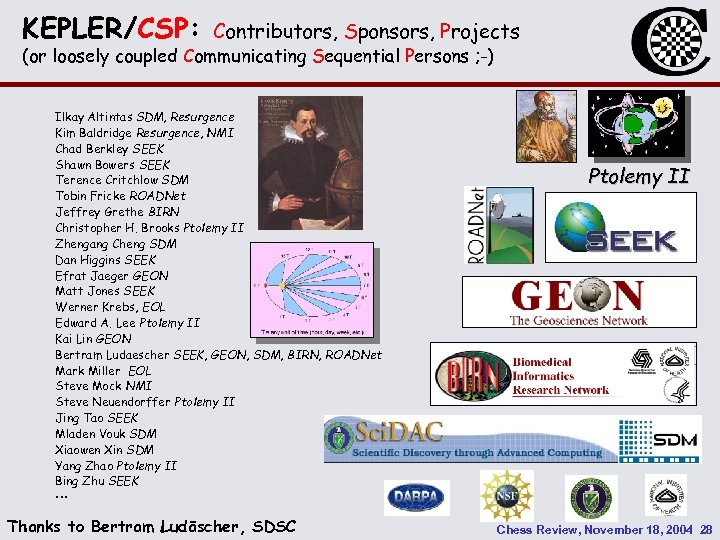
KEPLER/CSP: Contributors, Sponsors, Projects (or loosely coupled Communicating Sequential Persons ; -) Ilkay Altintas SDM, Resurgence Kim Baldridge Resurgence, NMI Chad Berkley SEEK Shawn Bowers SEEK Terence Critchlow SDM Tobin Fricke ROADNet Jeffrey Grethe BIRN Christopher H. Brooks Ptolemy II Zhengang Cheng SDM Dan Higgins SEEK Efrat Jaeger GEON Matt Jones SEEK Werner Krebs, EOL Edward A. Lee Ptolemy II Kai Lin GEON Bertram Ludaescher SEEK, GEON, SDM, BIRN, ROADNet Mark Miller EOL Steve Mock NMI Steve Neuendorffer Ptolemy II Jing Tao SEEK Mladen Vouk SDM Xiaowen Xin SDM Yang Zhao Ptolemy II Bing Zhu SEEK • • • Ptolemy II Thanks to Bertram Ludäscher, SDSC Chess Review, November 18, 2004 28
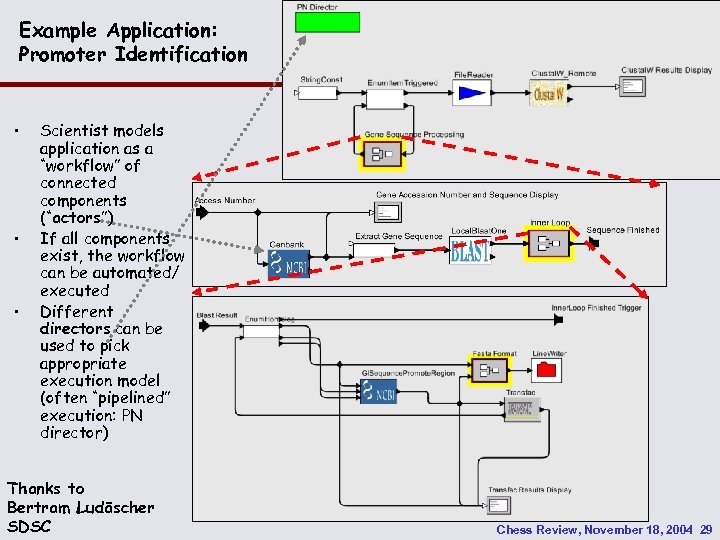
Example Application: Promoter Identification • • • Scientist models application as a “workflow” of connected components (“actors”) If all components exist, the workflow can be automated/ executed Different directors can be used to pick appropriate execution model (often “pipelined” execution: PN director) Thanks to Bertram Ludäscher SDSC Chess Review, November 18, 2004 29
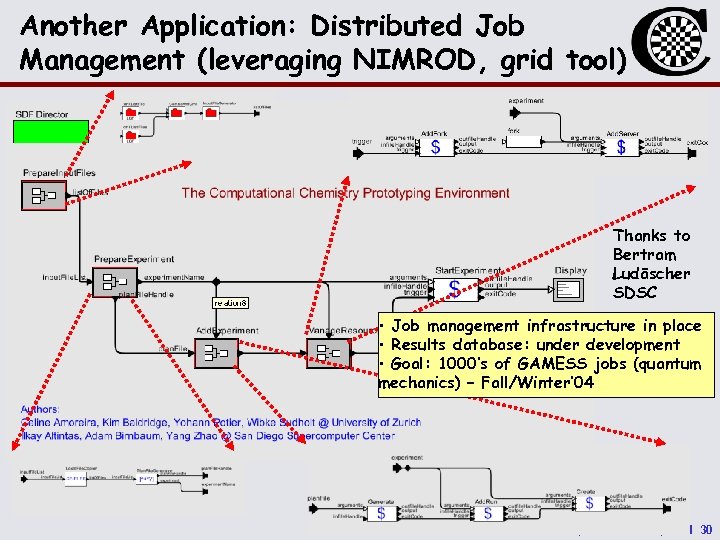
Another Application: Distributed Job Management (leveraging NIMROD, grid tool) Thanks to Bertram Ludäscher SDSC • Job management infrastructure in place • Results database: under development • Goal: 1000’s of GAMESS jobs (quantum mechanics) – Fall/Winter’ 04 Chess Review, November 18, 2004 30
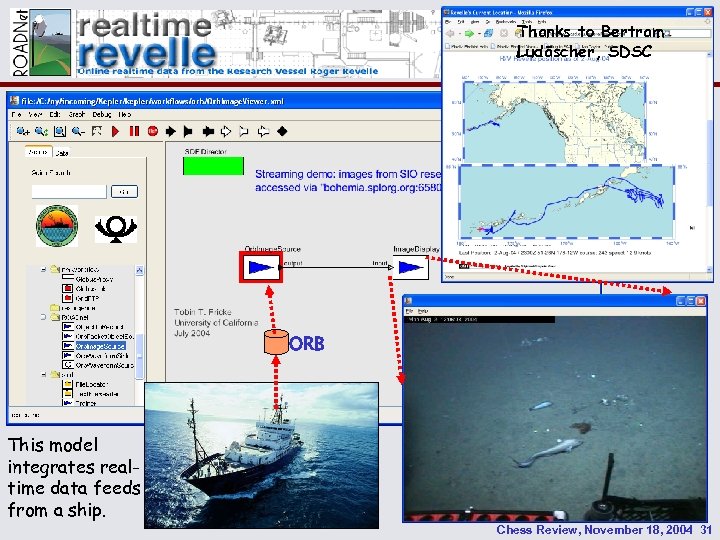
Thanks to Bertram Ludäscher, SDSC ORB This model integrates realtime data feeds from a ship. Chess Review, November 18, 2004 31
Outline – Internal experimental test benches • Wireless Sensor Networks (security, low power) • UAVs (complex control, sensor integration) – New domains: • Scientific Workflows: Kepler • Stochastic Hybrid Systems in Systems Biology Chess Review, November 18, 2004 32
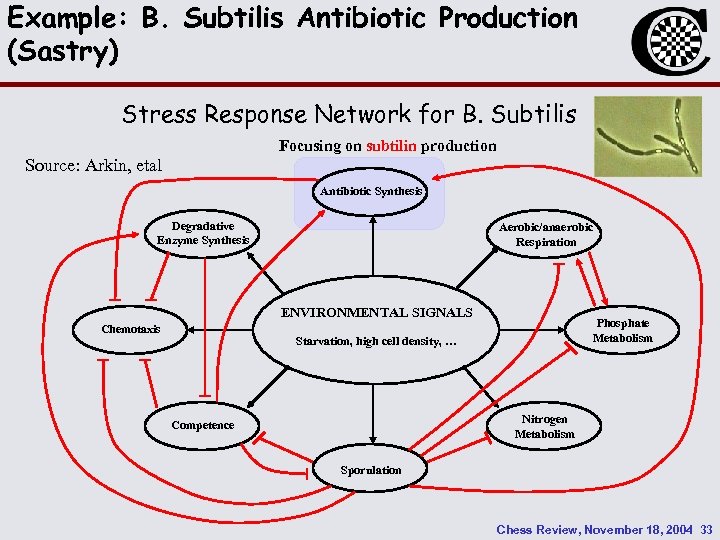
Example: B. Subtilis Antibiotic Production (Sastry) Stress Response Network for B. Subtilis Focusing on subtilin production Source: Arkin, etal Antibiotic Synthesis Degradative Enzyme Synthesis Aerobic/anaerobic Respiration ENVIRONMENTAL SIGNALS Chemotaxis Phosphate Metabolism Starvation, high cell density, … Nitrogen Metabolism Competence Sporulation Chess Review, November 18, 2004 33
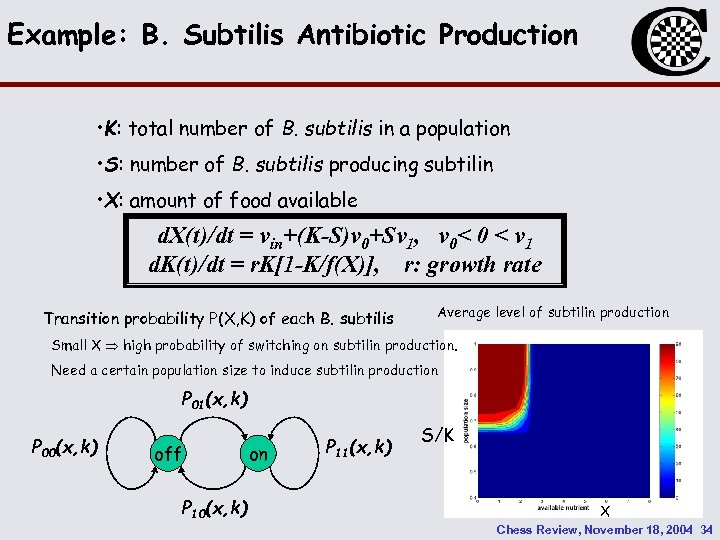
Example: B. Subtilis Antibiotic Production • K: total number of B. subtilis in a population • S: number of B. subtilis producing subtilin • X: amount of food available d. X(t)/dt = vin+(K-S)v 0+Sv 1, v 0< 0 < v 1 d. K(t)/dt = r. K[1 -K/f(X)], r: growth rate Transition probability P(X, K) of each B. subtilis Average level of subtilin production Small X high probability of switching on subtilin production. Need a certain population size to induce subtilin production P 01(x, k) P 00(x, k) off P 10(x, k) on P 11(x, k) S/K X Chess Review, November 18, 2004 34
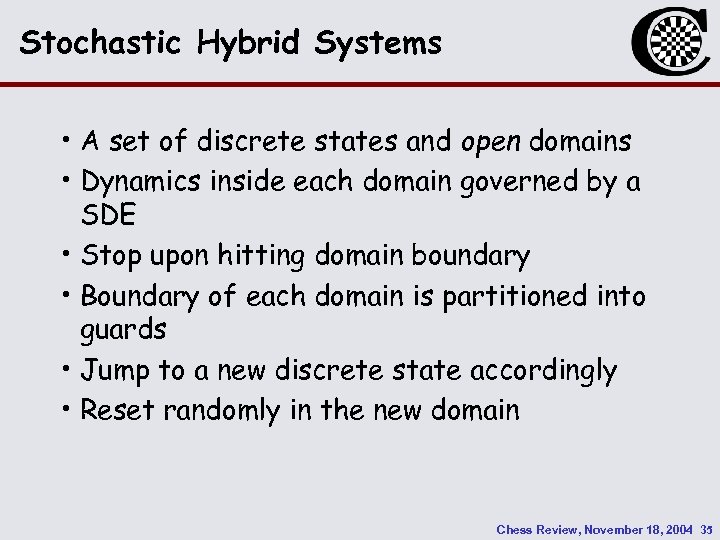
Stochastic Hybrid Systems • A set of discrete states and open domains • Dynamics inside each domain governed by a SDE • Stop upon hitting domain boundary • Boundary of each domain is partitioned into guards • Jump to a new discrete state accordingly • Reset randomly in the new domain Chess Review, November 18, 2004 35
Challenges of Systems (post genomic biology) • Hybrid Systems Models for Intracellular functioning: stochastic hybrid systems • Hybrid Systems tools for ensembles of cells: group behavior of complex networked systems • Biologically complex networks are an exemplar of how networked embedded systems could evolve, self-organize and reprogram themselves (network programming? ) Chess Review, November 18, 2004 36
Concluding Remarks • Applications are critical to drive research and to test quality of results • Safety-critical Real Time and secure system emphasis • Industrial and Experimental Test Benches • Rigorous methodology for hybrid distributed systems Chess Review, November 18, 2004 37
Скачать презентацию Experimental Research Edited and Presented by Alberto Sangiovanni
24ca7e1337efab2d6ad6799f53a713b2.ppt