


 Скачать презентацию Experimental Evaluation of Advanced Automated Geospatial Tools Walter
5894caf0fe8d3251e6ed75a644a2bdb8.ppt
- Количество слайдов: 26
 Experimental Evaluation of Advanced Automated Geospatial Tools Walter Powell - GMU Kathryn Blackmond Laskey - GMU Leonard Adelman - GMU Shiloh Dorgan - GMU Ryan Johnson - GMU Craig Klementowski - VIECORE Rick Yost - VIECORE Daniel Visone - TEC Ken Braswell - TEC
 Thanks to the Team! • U. S. Army Topographic Engineering Center – Michael Powers, Technical Director • GMU Team – Eric Nielsen, C 4 I Center SME – Scott Carey, C 4 I Center SME • VIECORE, FSB – Andrew Goldstein – Mike Altenau • Army Battle Command Battle Lab – Mr. Dick Brown – MAJ John Rainville 2
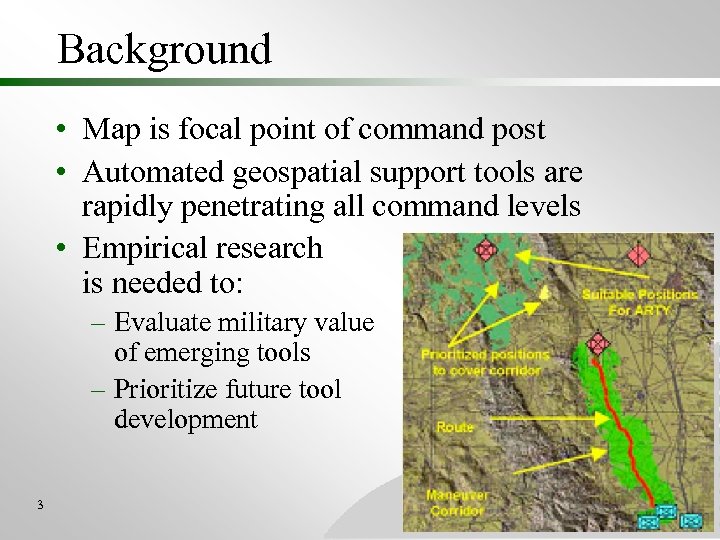 Background • Map is focal point of command post • Automated geospatial support tools are rapidly penetrating all command levels • Empirical research is needed to: – Evaluate military value of emerging tools – Prioritize future tool development 3
 Purpose of Research Program • Sponsored by – U. S. Army Engineer Research and Development Center (ERDC) – U. S. Army Topographical Engineering Center (TEC) • Joint Geospatial Enterprise Services (JGES) – Integrate, test, evaluate, and demonstrate J-GES technologies to support optimal implementation within future net-centric battle command ISR enterprise environments. • General Purpose: – Analyze relevance and measure value of data/information being exploited by users at all echelons • Specific Purpose: – Assess the value-added to Military Decision Making from use of Advanced Automated Geospatial Tools (AAGT) – Evaluate contribution of the Battlespace Terrain Reasoning and Awareness – Battle Command (BTRA-BC) suite of geospatial reasoning tools 4
 BTRA-BC Objective: – Empower commanders, soldiers, and systems with information that allows them to understand incorporate the impacts of terrain and weather on their functional responsibilities and processes • Products – Information and knowledge products that capture integrated terrain and weather effects – Tactical Spatial Objects (TSOs) - Predictive decision tools that exploit these products • Some BTRA-BC products have been fielded in the U. S. Army’s Digital Topographic Support System (DTSS) – Used by U. S. Army for terrain analysis 5
 Current Study • Study Objective – Assess the benefit of BTRA-BC tools to military planners in a complex and realistic scenario – Expand on results of previous experiment (presented at last year’s ICCRTS) • COA generation vs. AA recommendation • Planners vs. terrain analysts • Can tools enable planners to do terrain analysis • Study Method: – Perform experiment to compare performance with and without BTRA-BC TSOs – Participants performed two trials of a military planning task using CSE: (1) With BTRA-BC TSOs, and (2) without BTRA-BC TSOs 6
 Primary Hypotheses 1. 2. Participants who use BTRA-BC TSOs will produce a higher quality plans 3. Participants who use BTRA-BC TSOs will display as good an understanding of the impact of the given terrain on military planning 4. The quality of the output generated with BTRA-BC TSOs will be more uniform 5. There will be little or no learning effect due to evaluation design 6. 7 Participants who use BTRA-BC TSOs will produce military planning output more quickly Participants will consider using BTRA-BC TSOs superior when producing a plan with respect to speed, quality, ease and overall
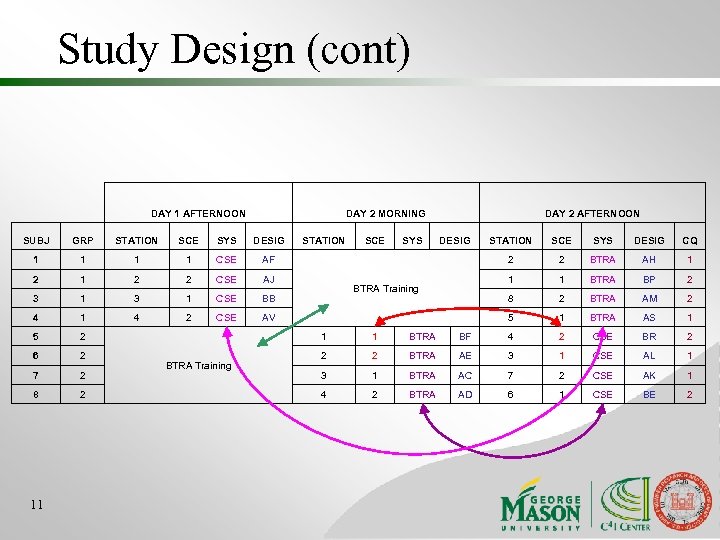
 Study Design • Environment – Commander’s Support Environment (CSE) • Developmental C 2 system • Originally a DARPA initiative – with and without added BTRA-BC TSOs • Participants – 16 U. S. Army officers – Prior training and battalion level planning experience. • Three independent variables – System used (with and without BTRA-BC TSOs) – System Order (which system was used first) – Scenario Order (Which of two near identical scenarios was used first) 8
 Study Design • Within Participants design with respect to System used: – Each subject will solve a planning scenario in both conditions (with and without BTRA TSOs) • Between Participants design – System Order – Scenario Order – Design was counterbalanced on scenario order and system order • Study design minimized the number of participants to obtain required statistical power • Training prior to trials – CSE (4 hours) and – BTRA-BC (2 hours) 9
 Study Design (cont) –Participants – U. S. Army Captains and Majors • Planning experience • Comfortable with digital systems – Anonymous • Randomly assigned participant numbers • Randomly assigned data designators – Experience Questionnaire – Ranked and grouped by experience – Randomly assigned to groups 10
 Study Design (cont) DAY 1 AFTERNOON DAY 2 MORNING SUBJ GRP STATION SCE SYS DESIG 1 1 CSE AF 2 1 2 2 CSE AJ 3 1 CSE BB 4 1 4 2 CSE AV 5 2 6 2 7 2 8 2 11 STATION SCE SYS DAY 2 AFTERNOON DESIG SCE SYS DESIG CQ 2 2 BTRA AH 1 1 1 BTRA BP 2 8 2 BTRA AM 2 5 BTRA Training STATION 1 BTRA AS 1 1 BTRA Training 1 BTRA BF 4 2 CSE BR 2 2 2 BTRA AE 3 1 CSE AL 1 3 1 BTRA AC 7 2 CSE AK 1 4 2 BTRA AD 6 1 CSE BE 2
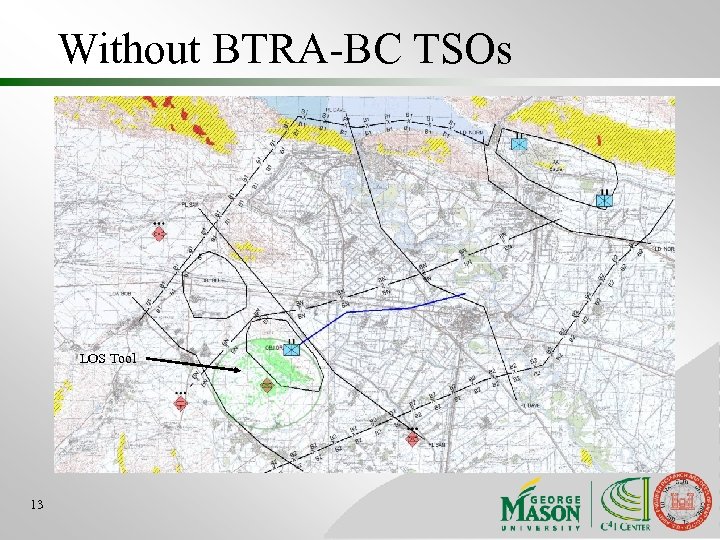
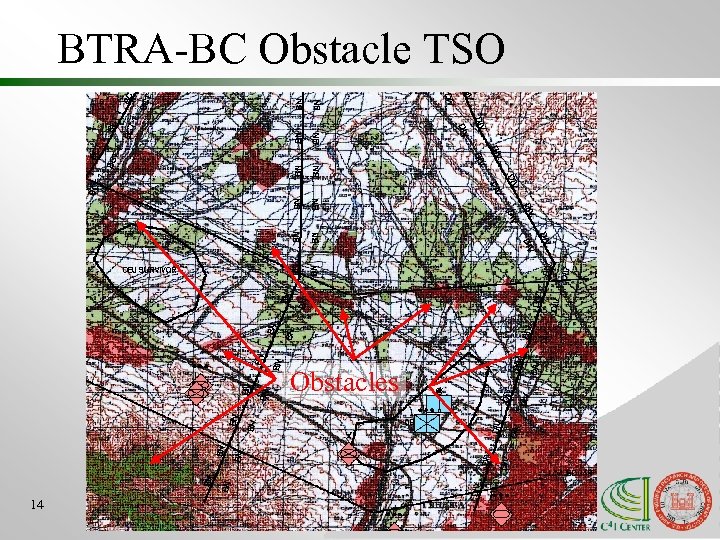
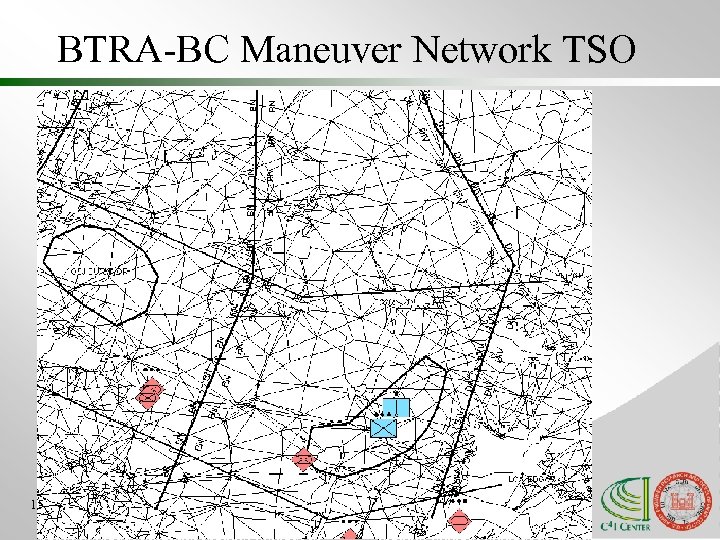
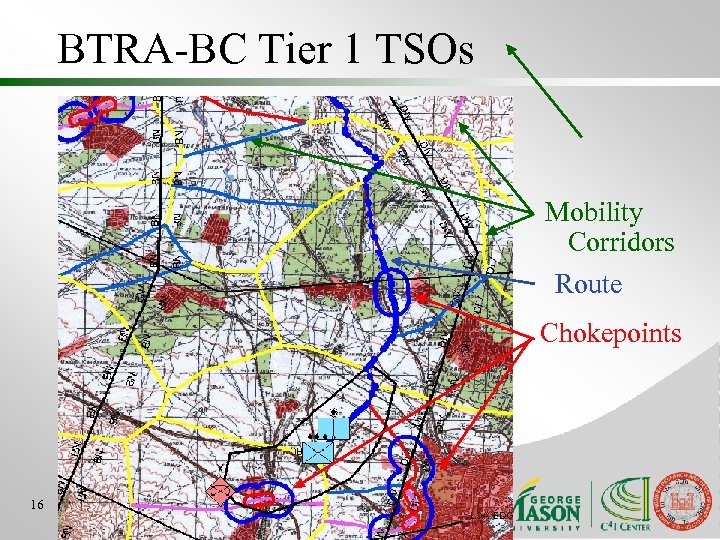
 Experimental Tasks • The evaluation scenario began with analysis of specific terrain and continued to the point of generating a plan of movement and a Course of Action (COA). • Specific tasks : – Digital Plan • Plan movement – – – • • • 12 Identify Mobility Corridors (MC) Categorize Mobility Corridors by size Group Mobility Corridors to form potential Avenues of Approach Identify Choke Points on Avenues of Approach Calculate travel times and coordinate simultaneous arrival Identify Engagement Areas Identify Battle Positions Identify Ambush Sites Identify Named Areas of Interest (NAI) Generate battalion graphics including subordinate echelon Areas of Responsibility
 Without BTRA-BC TSOs LOS Tool 13
 BTRA-BC Obstacle TSO Obstacles 14
 BTRA-BC Maneuver Network TSO 15
 BTRA-BC Tier 1 TSOs Mobility Corridors Route Chokepoints 16
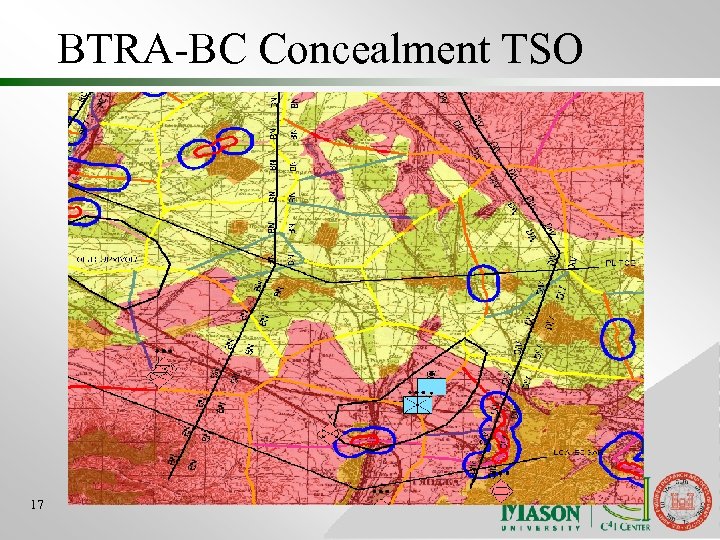 BTRA-BC Concealment TSO 17
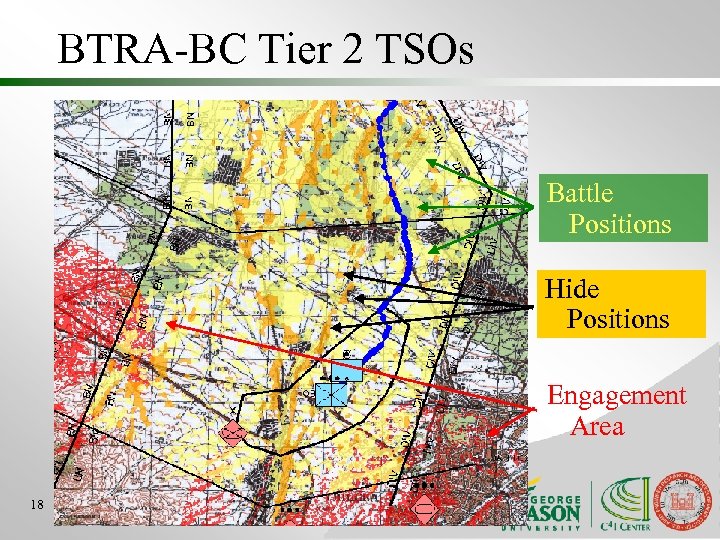 BTRA-BC Tier 2 TSOs Battle Positions Hide Positions Engagement Area 18
 Experimental Tasks (cont) • Specific tasks (cont) – Operation Order • Commander’s Intent • Concept of Operations – Explanation of graphics – Impact of terrain on mission – Terrain Understanding Questionnaire – System Comparison Questionnaire 19
 Measures • Time to complete scenario (H 1, H 5) – Objective – Significant in prior experiment – Possibly less significant in more complex planning • Quality of solutions as judged by expert evaluators (H 2, H 4, H 5) – – Subjective 45 criteria in 15 categories 5 point Likert Scale Independent SMEs • Scores on a questionnaire evaluating subject understanding of the terrain (H 3, H 5) • Scores on a questionnaire evaluating subjective perception of w/ BTRA-BC (H 6) – 5 point Likert scale – Scale Normal and Reversed 20
 Summary • Extension of successful previous experiment • Expanded to evaluate: – Planners ability to evaluate the effects of terrain using BTRA-BC TSOs – Effect of automated tool on decision-making in a complex and realistic scenario • Measures and tasks are critical in designing an experiment that will evaluate the desired criteria • Results will be used to guide the direction of the further development of BTRA-BC 21
 Next Experiment in the Series • Object: Assess the value of Buckeye’s 4 -inch resolution imagery and DTED 5 elevation data • Examining accuracy of data vice effectiveness of tools • Experimental Design – Platoon / reinforced squad – Iraqi city where CIB 1 and Buckeye data are available – Planning task: Evaluation of potential sites for Vehicle Control Point (VCP) – Environment CSE – Participants: 16 infantry E 6 -E 7 or O 2 -O 3 with experience in-country 22
 Questions? 23
 Project Status • Conducted experiment with first 8 participants • SME’s have evaluated plans from first group • Conducting preliminary analyses • Waiting on second 8 participants 24
 Preliminary Results: Time to Solution • Average time to scenario completion (H 1) – w/ BTRA: 147. 5 minutes – w/o BTRA: 143 minutes – No statically significant evidence that the average times are different • Learning effect (H 5) – Preliminary data suggests that participants had a faster time, on average, for the second system used. – Preliminary data suggests that there is statically significant evidence there may be a learning effect (0. 05) 25
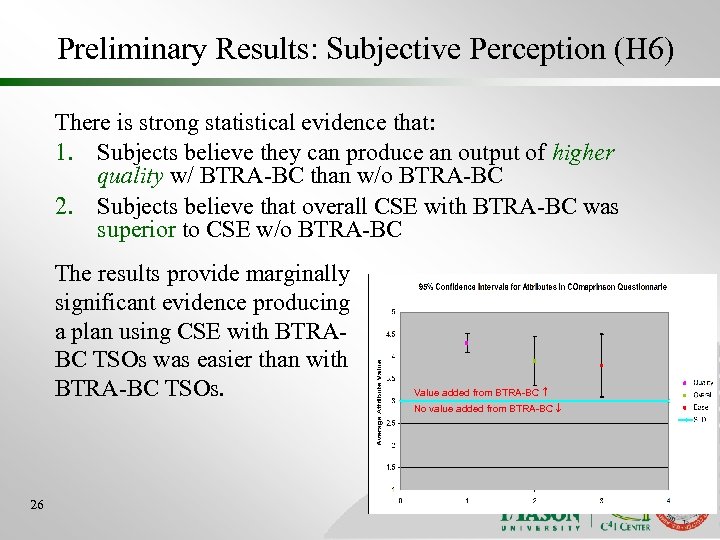 Preliminary Results: Subjective Perception (H 6) There is strong statistical evidence that: 1. Subjects believe they can produce an output of higher quality w/ BTRA-BC than w/o BTRA-BC 2. Subjects believe that overall CSE with BTRA-BC was superior to CSE w/o BTRA-BC The results provide marginally significant evidence producing a plan using CSE with BTRABC TSOs was easier than with BTRA-BC TSOs. Value added from BTRA-BC No value added from BTRA-BC 26