


 Скачать презентацию Experimental Economics 488 SPYROS ALOGOSKOUFIS ANN-RENÉE GUILLEMETTE
2c4386bc2a9ac5d5e4ce3f8915336c5d.ppt
- Количество слайдов: 21
 Experimental Economics 488 SPYROS ALOGOSKOUFIS & ANN-RENÉE GUILLEMETTE
 Commodity and Stock Markets Initial Experiment Age and Experience in Both Markets Final Outcome: Size Manipulation: Small Markets = Commodities Large Markets = Stocks
 The Question Is information incorporated faster and more equitably in a small or large market?
 Clarification How we define “Faster” Periods are in terms of transaction numbers and not seconds. Justification Excludes initial confusion Compare similar observations - linear relationship between average transactions Eliminates practical difficulties
 Expected Outcomes Larger Market More Successful Than Smaller Market Increased Competition - Breakdown of Collusion More Information Available By trading at a high volume, more information is discovered Downside : Speculation of Price Traders with information benefit Faster Convergence Leads to Minimized Losses
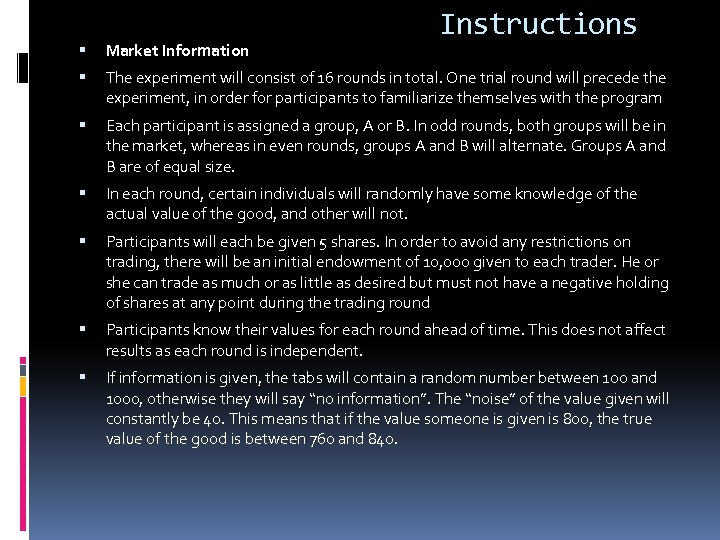 Instructions Market Information The experiment will consist of 16 rounds in total. One trial round will precede the experiment, in order for participants to familiarize themselves with the program Each participant is assigned a group, A or B. In odd rounds, both groups will be in the market, whereas in even rounds, groups A and B will alternate. Groups A and B are of equal size. In each round, certain individuals will randomly have some knowledge of the actual value of the good, and other will not. Participants will each be given 5 shares. In order to avoid any restrictions on trading, there will be an initial endowment of 10, 000 given to each trader. He or she can trade as much or as little as desired but must not have a negative holding of shares at any point during the trading round Participants know their values for each round ahead of time. This does not affect results as each round is independent. If information is given, the tabs will contain a random number between 100 and 1000, otherwise they will say “no information”. The “noise” of the value given will constantly be 40. This means that if the value someone is given is 800, the true value of the good is between 760 and 840.
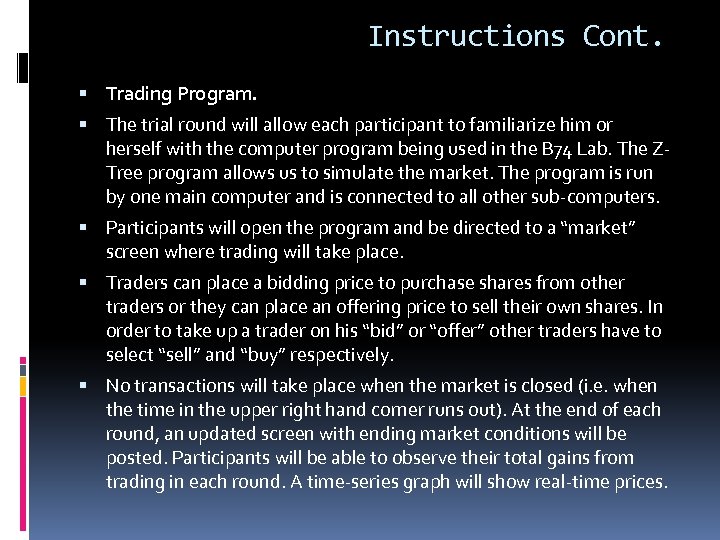 Instructions Cont. Trading Program. The trial round will allow each participant to familiarize him or herself with the computer program being used in the B 74 Lab. The ZTree program allows us to simulate the market. The program is run by one main computer and is connected to all other sub-computers. Participants will open the program and be directed to a “market” screen where trading will take place. Traders can place a bidding price to purchase shares from other traders or they can place an offering price to sell their own shares. In order to take up a trader on his “bid” or “offer” other traders have to select “sell” and “buy” respectively. No transactions will take place when the market is closed (i. e. when the time in the upper right hand corner runs out). At the end of each round, an updated screen with ending market conditions will be posted. Participants will be able to observe their total gains from trading in each round. A time-series graph will show real-time prices.
 Data Analysis Speed Visual - Graphic Representation of Periods Numerical - Measure of speed of conversion and testing Equality Profit per transaction Overall profit. All these observations are comparisons between the larger (odd) and smaller (even) markets.
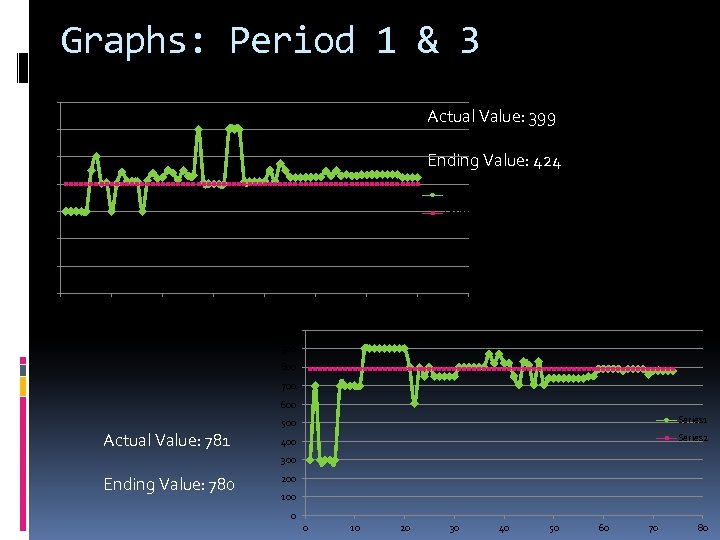 Graphs: Period 1 & 3 700 Actual Value: 399 600 Ending Value: 424 500 400 Series 1 300 Series 2 200 100 0 0 10 20 30 40 50 60 70 80 1000 900 800 700 600 500 Actual Value: 781 Series 1 400 Series 2 300 Ending Value: 780 200 100 0 0 10 20 30 40 50 60 70 80
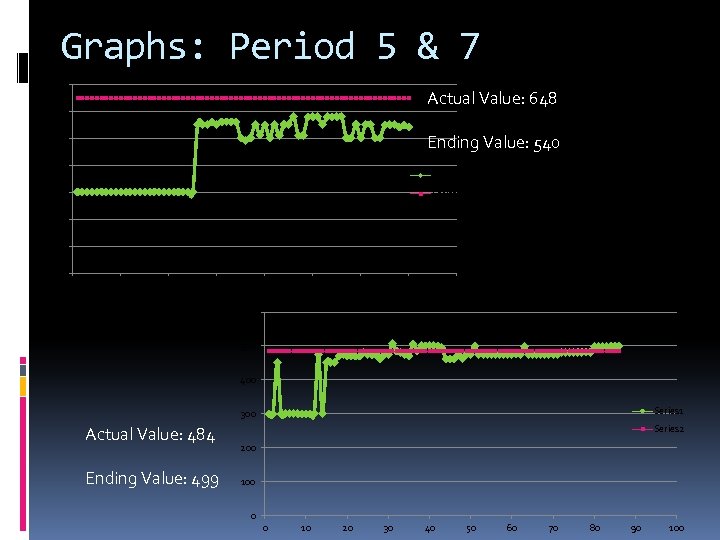 Graphs: Period 5 & 7 700 Actual Value: 648 600 Ending Value: 540 500 400 Series 1 300 Series 2 200 100 0 0 10 20 30 40 50 60 70 80 600 500 400 Series 1 300 Actual Value: 484 Ending Value: 499 Series 2 200 100 0 0 10 20 30 40 50 60 70 80 90 100
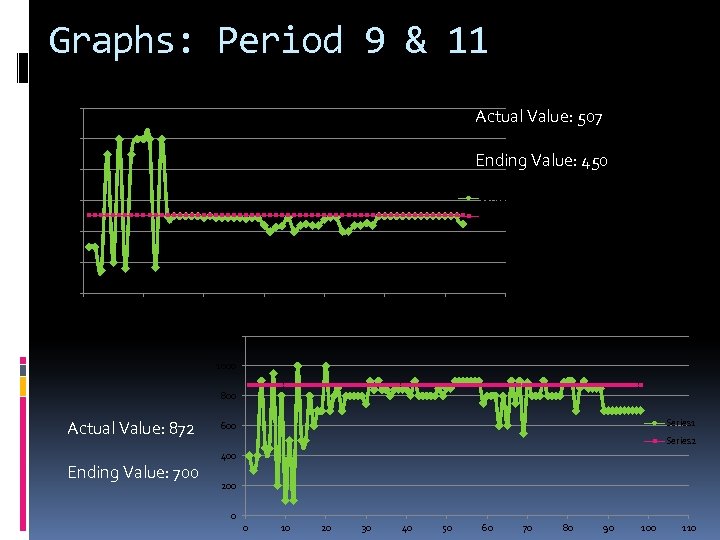 Graphs: Period 9 & 11 1200 Actual Value: 507 1000 Ending Value: 450 800 Series 1 600 Series 2 400 200 0 0 10 20 30 40 50 60 70 1200 1000 800 Actual Value: 872 Ending Value: 700 Series 1 600 Series 2 400 200 0 0 10 20 30 40 50 60 70 80 90 100 110
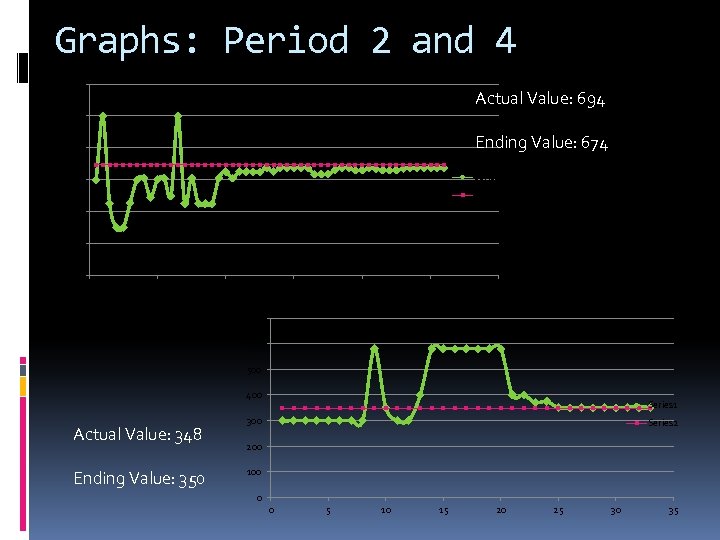 Graphs: Period 2 and 4 1200 Actual Value: 694 1000 800 Ending Value: 674 600 Series 1 Series 2 400 200 0 0 10 20 30 40 50 60 700 600 500 400 Actual Value: 348 Ending Value: 350 Series 1 300 Series 2 200 100 0 0 5 10 15 20 25 30 35
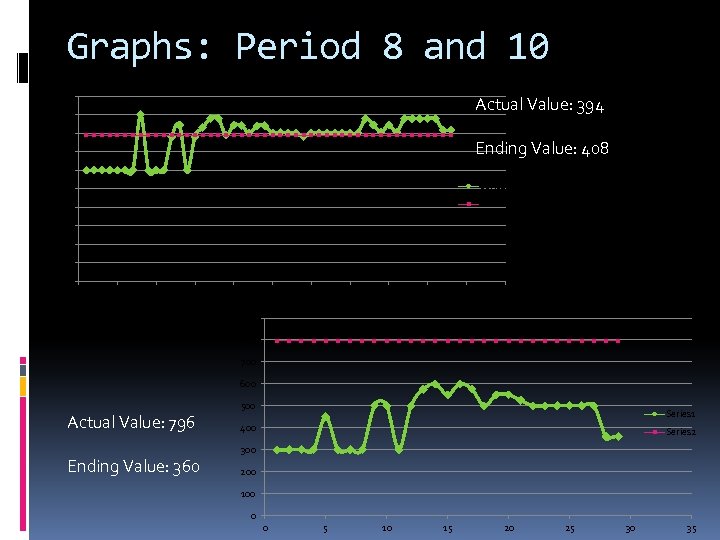 Graphs: Period 8 and 10 500 Actual Value: 394 450 400 Ending Value: 408 350 300 250 Series 1 200 Series 2 150 100 50 0 0 5 10 15 20 25 30 35 40 45 50 55 900 800 700 600 Actual Value: 796 Ending Value: 360 500 Series 1 400 Series 2 300 200 100 0 0 5 10 15 20 25 30 35
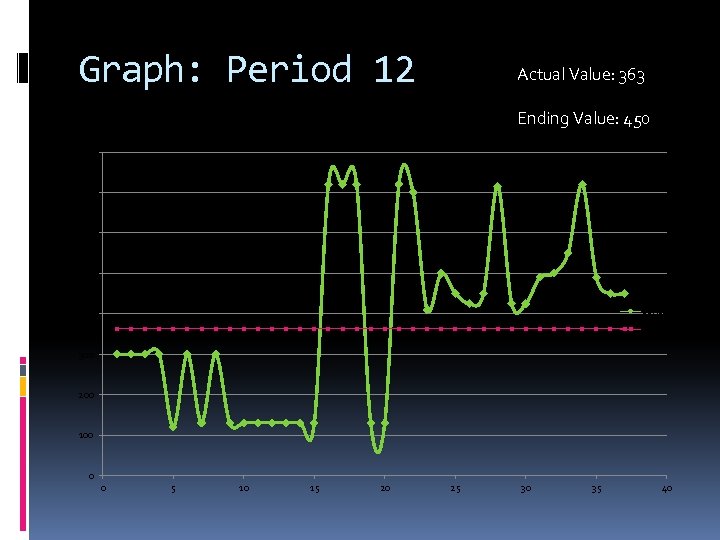 Graph: Period 12 Actual Value: 363 Ending Value: 450 800 700 600 500 Series 1 400 Series 2 300 200 100 0 0 5 10 15 20 25 30 35 40
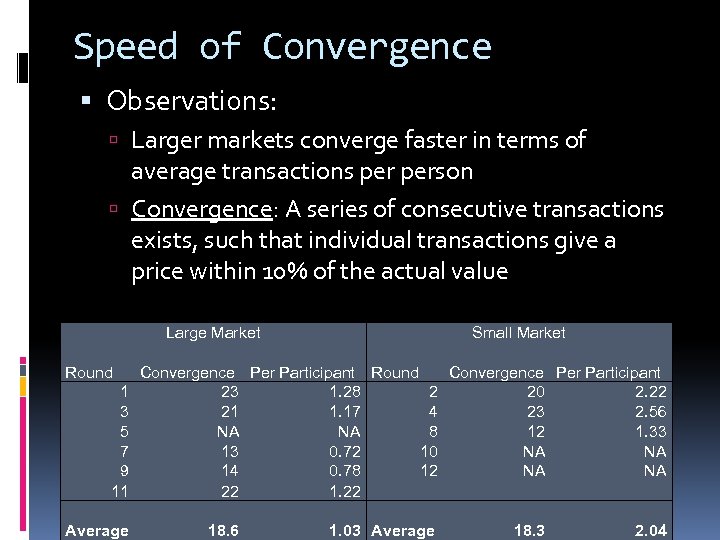 Speed of Convergence Observations: Larger markets converge faster in terms of average transactions person Convergence: A series of consecutive transactions exists, such that individual transactions give a price within 10% of the actual value Large Market Round 1 3 5 7 9 11 Average Small Market Convergence Per Participant Round Convergence Per Participant 23 1. 28 2 20 2. 22 21 1. 17 4 23 2. 56 NA NA 8 12 1. 33 13 0. 72 10 NA NA 14 0. 78 12 NA NA 22 1. 22 18. 6 1. 03 Average 18. 3 2. 04
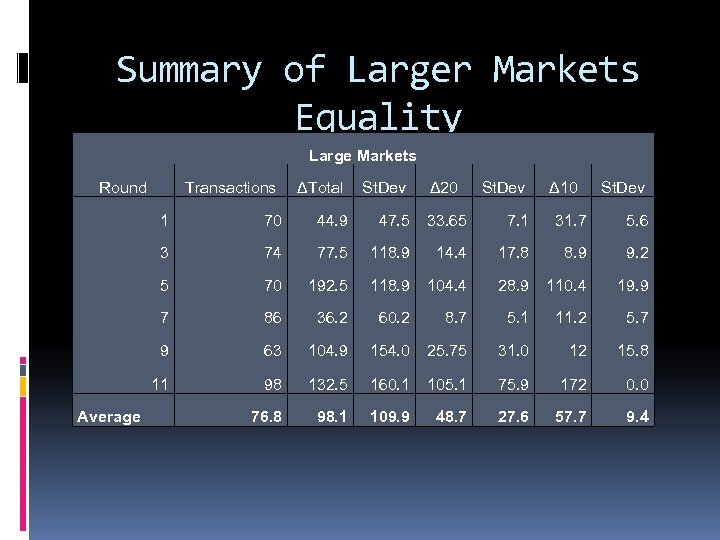 Summary of Larger Markets Equality Large Markets Round Transactions ΔTotal St. Dev Δ 20 St. Dev Δ 10 St. Dev 1 44. 9 47. 5 33. 65 7. 1 31. 7 5. 6 3 74 77. 5 118. 9 14. 4 17. 8 8. 9 9. 2 5 70 192. 5 118. 9 104. 4 28. 9 110. 4 19. 9 7 86 36. 2 60. 2 8. 7 5. 1 11. 2 5. 7 9 63 104. 9 154. 0 25. 75 31. 0 12 15. 8 11 Average 70 98 132. 5 160. 1 105. 1 75. 9 172 0. 0 76. 8 98. 1 109. 9 48. 7 27. 6 57. 7 9. 4
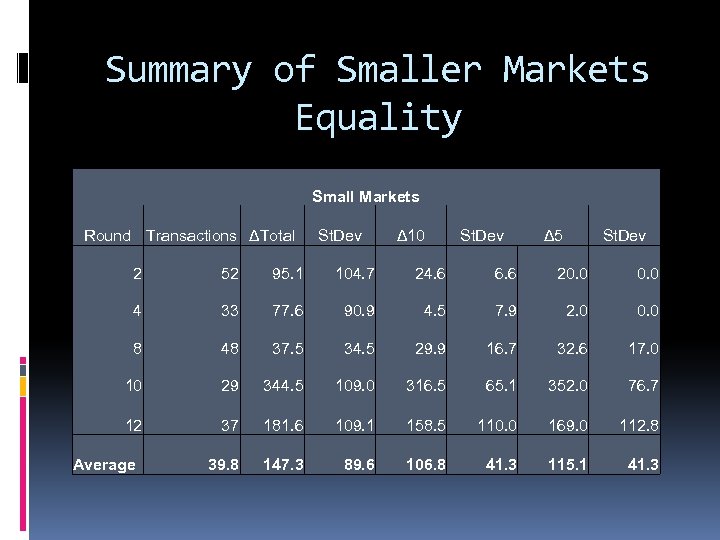 Summary of Smaller Markets Equality Small Markets Round Transactions ΔTotal St. Dev Δ 10 St. Dev Δ 5 St. Dev 2 52 95. 1 104. 7 24. 6 6. 6 20. 0 4 33 77. 6 90. 9 4. 5 7. 9 2. 0 0. 0 8 48 37. 5 34. 5 29. 9 16. 7 32. 6 17. 0 10 29 344. 5 109. 0 316. 5 65. 1 352. 0 76. 7 12 37 181. 6 109. 1 158. 5 110. 0 169. 0 112. 8 39. 8 147. 3 89. 6 106. 8 41. 3 115. 1 41. 3 Average
 Larger markets generate prices closer to the actual value
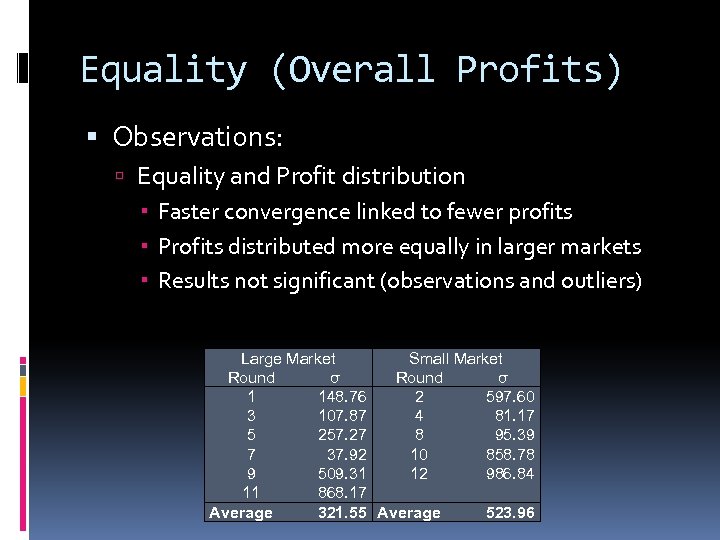 Equality (Overall Profits) Observations: Equality and Profit distribution Faster convergence linked to fewer profits Profits distributed more equally in larger markets Results not significant (observations and outliers) Large Market Small Market Round σ 1 148. 76 2 597. 60 3 107. 87 4 81. 17 5 257. 27 8 95. 39 7 37. 92 10 858. 78 9 509. 31 12 986. 84 11 868. 17 Average 321. 55 Average 523. 96
 Limitations Number of Rounds Time Constraint Personal Error in Data Knowledge of Z-Tree Class Members versus Outside Acquaintances Repeated usage of the program leads to better execution of its functions Focus Issue Participants may lose concentration after several rounds
 Final Thoughts Larger Markets are more equitable and converge faster than smaller markets Possible Causes: Increased Competition in terms of people with information More information available (more likely to cause reactions) Separating Equality from Speed Though highly linked, “faster” does not guarantee “more equitably”