 Скачать презентацию Experiences from applying mbt in an agile scrum
c178ee12cee61f0b2ae12f9ab059140e.ppt
- Количество слайдов: 19



Experiences from applying mbt in an agile scrum context An mbt uc 2011 presentation Athanasios Karapantelakis (athanasios. karapantelakis@ericsson. com) Allan andersson (allan. andersson@ericsson. com) johan malmberg (johan. malmberg@ericsson. com) bogumila rutkowska (bogumila. rutkowska@ericsson. com) Ericsson AB, Tellusborgsvägen 83 -85, 126 25 Stockholm, Sweden
Overview › Introduction to test domain › Approach › Contributions and results › Technical challenges › A mental model for deployment of MBT in SCRUM projects › Conclusion MBT UC 2011 Presentation | © Ericsson AB 2011 | 2011 -08 -01 | Page 2
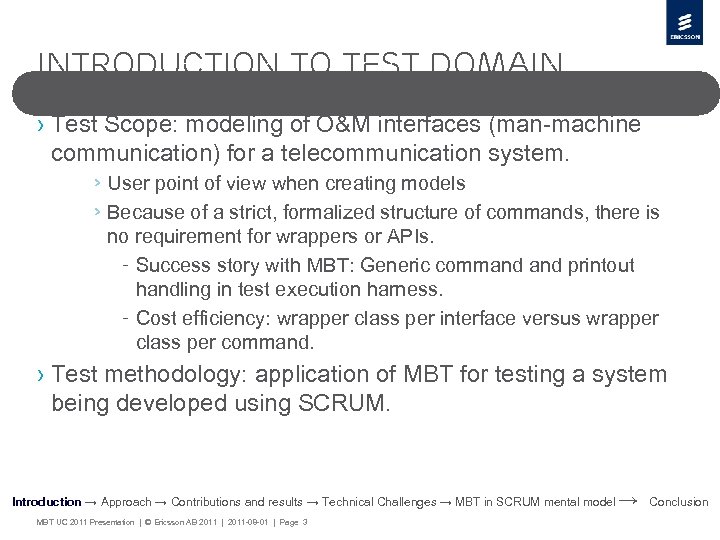
Introduction to test domain › Test Scope: modeling of O&M interfaces (man-machine communication) for a telecommunication system. › User point of view when creating models › Because of a strict, formalized structure of commands, there is no requirement for wrappers or APIs. - Success story with MBT: Generic command printout handling in test execution harness. - Cost efficiency: wrapper class per interface versus wrapper class per command. › Test methodology: application of MBT for testing a system being developed using SCRUM. Introduction → Approach → Contributions and results → Technical Challenges → MBT in SCRUM mental model MBT UC 2011 Presentation | © Ericsson AB 2011 | 2011 -08 -01 | Page 3 → Conclusion
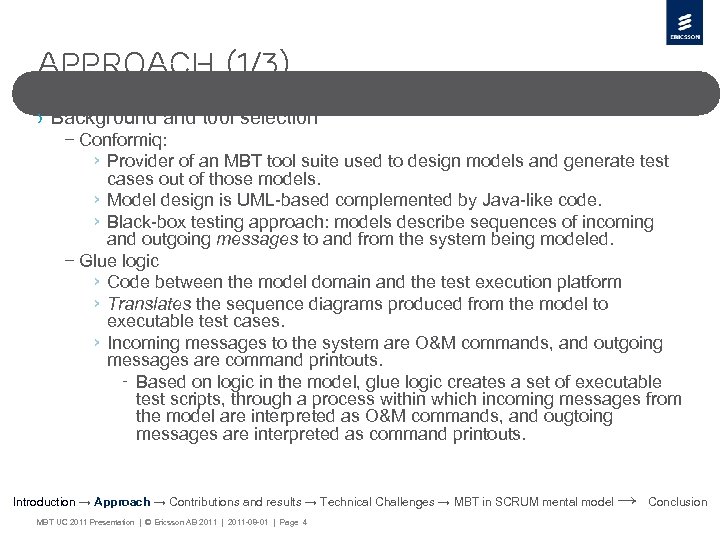
APPROACH (1/3) › Background and tool selection – Conformiq: › Provider of an MBT tool suite used to design models and generate test cases out of those models. › Model design is UML-based complemented by Java-like code. › Black-box testing approach: models describe sequences of incoming and outgoing messages to and from the system being modeled. – Glue logic › Code between the model domain and the test execution platform › Translates the sequence diagrams produced from the model to executable test cases. › Incoming messages to the system are O&M commands, and outgoing messages are command printouts. - Based on logic in the model, glue logic creates a set of executable test scripts, through a process within which incoming messages from the model are interpreted as O&M commands, and ougtoing messages are interpreted as command printouts. Introduction → Approach → Contributions and results → Technical Challenges → MBT in SCRUM mental model MBT UC 2011 Presentation | © Ericsson AB 2011 | 2011 -08 -01 | Page 4 → Conclusion
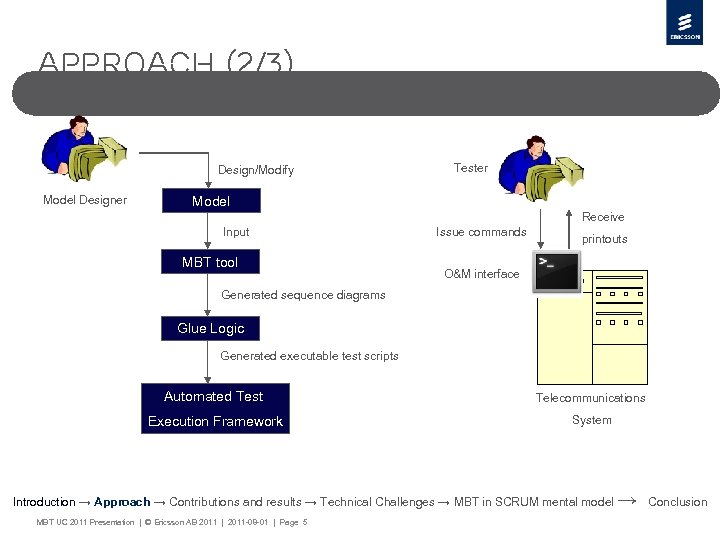
APPROACH (2/3) Design/Modify Model Designer Tester Model Receive Input MBT tool Issue commands printouts O&M interface Generated sequence diagrams Glue Logic Generated executable test scripts Automated Test Telecommunications Execution Framework System Introduction → Approach → Contributions and results → Technical Challenges → MBT in SCRUM mental model MBT UC 2011 Presentation | © Ericsson AB 2011 | 2011 -08 -01 | Page 5 → Conclusion
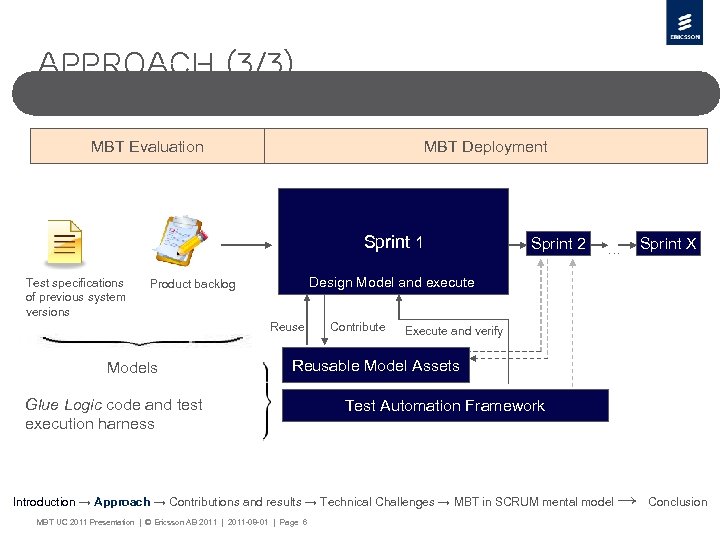
APPROACH (3/3) Timeline MBT Evaluation MBT Deployment Sprint 1 Test specifications of previous system versions … Sprint X Design Model and execute Product backlog Reuse Models Sprint 2 Contribute Execute and verify Reusable Model Assets Glue Logic code and test execution harness Test Automation Framework Introduction → Approach → Contributions and results → Technical Challenges → MBT in SCRUM mental model MBT UC 2011 Presentation | © Ericsson AB 2011 | 2011 -08 -01 | Page 6 → Conclusion
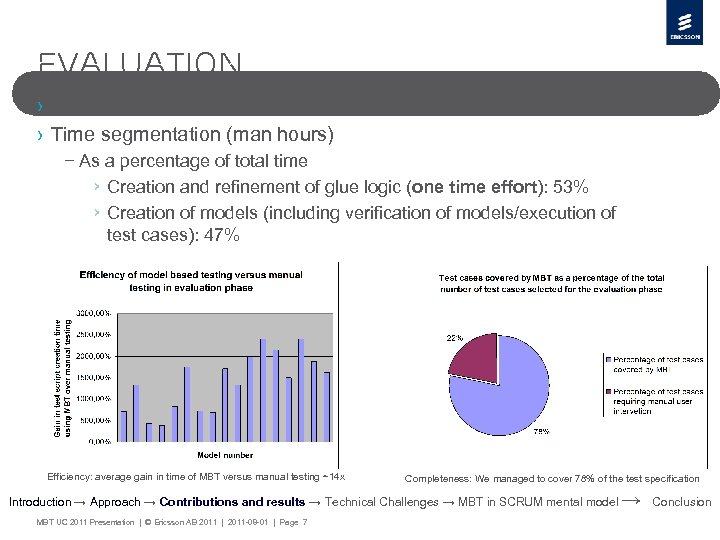
EVALUATION › Duration (approximately two months) › Time segmentation (man hours) – As a percentage of total time › Creation and refinement of glue logic (one time effort): 53% › Creation of models (including verification of models/execution of test cases): 47% Efficiency: average gain in time of MBT versus manual testing ~14 x Completeness: We managed to cover 78% of the test specification Introduction → Approach → Contributions and results → Technical Challenges → MBT in SCRUM mental model MBT UC 2011 Presentation | © Ericsson AB 2011 | 2011 -08 -01 | Page 7 → Conclusion
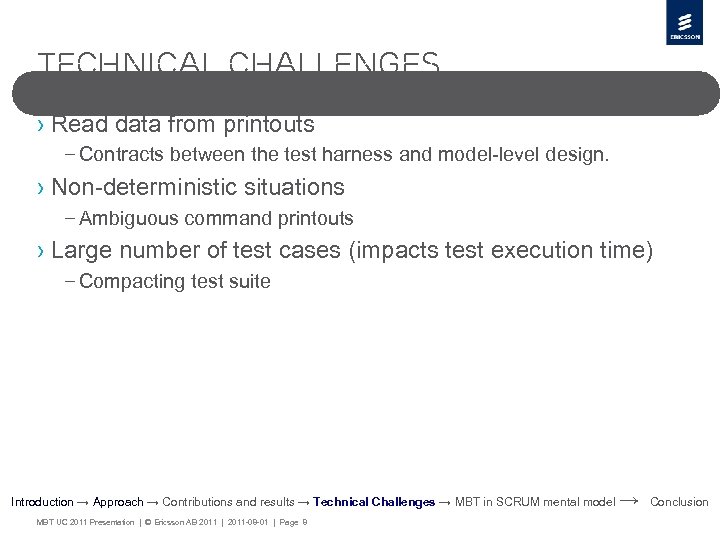
Technical Challenges › Read data from printouts – Contracts between the test harness and model-level design. › Non-deterministic situations – Ambiguous command printouts › Large number of test cases (impacts test execution time) – Compacting test suite Introduction → Approach → Contributions and results → Technical Challenges → MBT in SCRUM mental model MBT UC 2011 Presentation | © Ericsson AB 2011 | 2011 -08 -01 | Page 8 → Conclusion
Modeling a process › Value of modeling the “MBT introduction” process – Simulations help correlate measurable parameters to varying values of preset parameters. – Facilitates project planning, assignment of resources, estimation of costs. › Using System Dynamics (SD) mental models as a tool for planning for MBT deployment within a SCRUM project. – Define MBT introduction stages › Preparation - Automated test execution framework - MBT training › Deployment – Define model parameters › Measurable parameters - Cost of resources, time to deliver, quality › Preset parameters - Number of engineers allocated, project/training deadlines Introduction → Approach → Contributions and results → Technical Challenges → MBT in SCRUM mental model MBT UC 2011 Presentation | © Ericsson AB 2011 | 2011 -08 -01 | Page 9 → Conclusion
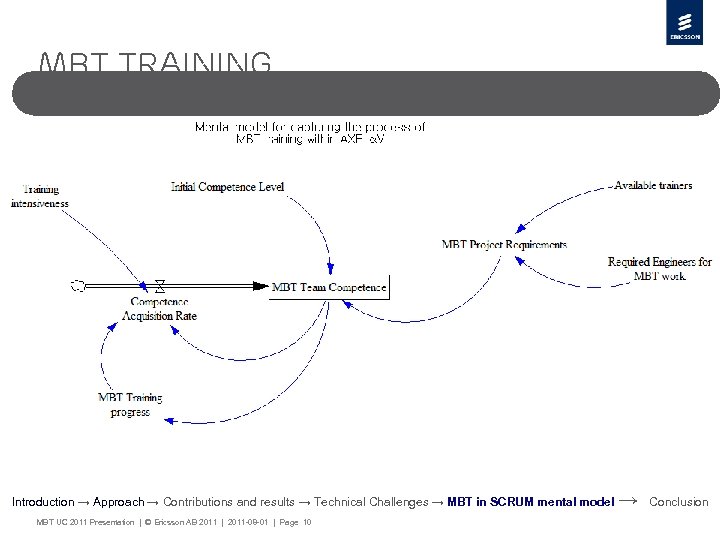
Mbt training Introduction → Approach → Contributions and results → Technical Challenges → MBT in SCRUM mental model MBT UC 2011 Presentation | © Ericsson AB 2011 | 2011 -08 -01 | Page 10 → Conclusion
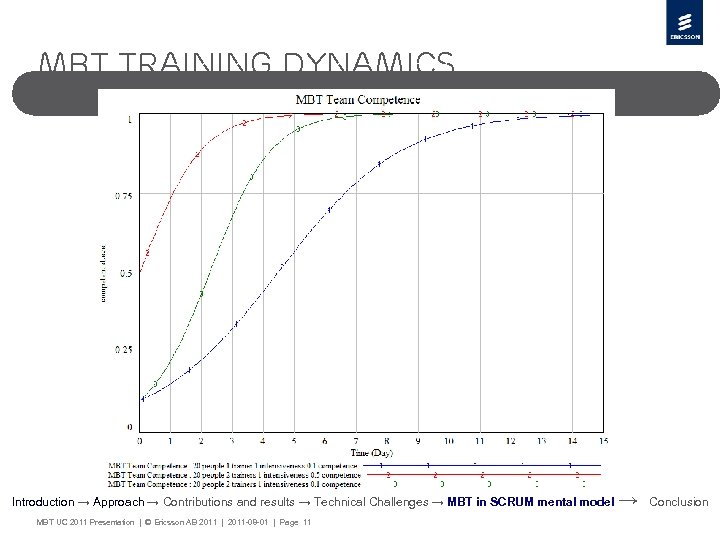
Mbt training dynamics Introduction → Approach → Contributions and results → Technical Challenges → MBT in SCRUM mental model MBT UC 2011 Presentation | © Ericsson AB 2011 | 2011 -08 -01 | Page 11 → Conclusion
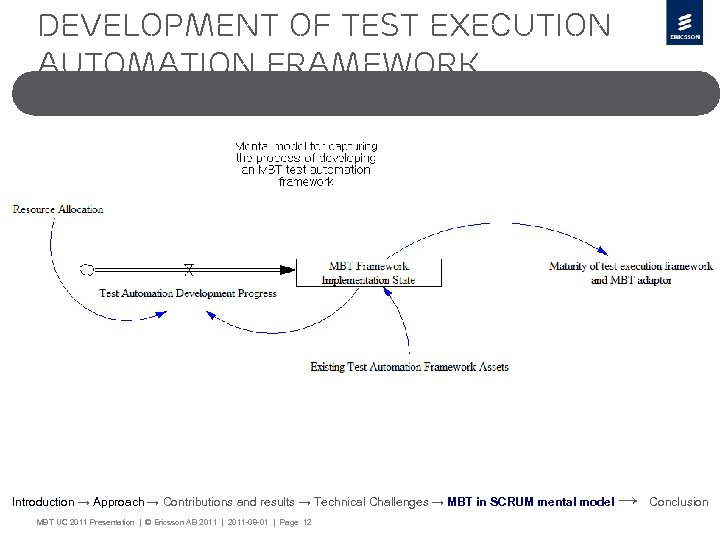
DEVELOPMENT OF TEST execution AUTOMATION FRAMEWORK Introduction → Approach → Contributions and results → Technical Challenges → MBT in SCRUM mental model MBT UC 2011 Presentation | © Ericsson AB 2011 | 2011 -08 -01 | Page 12 → Conclusion
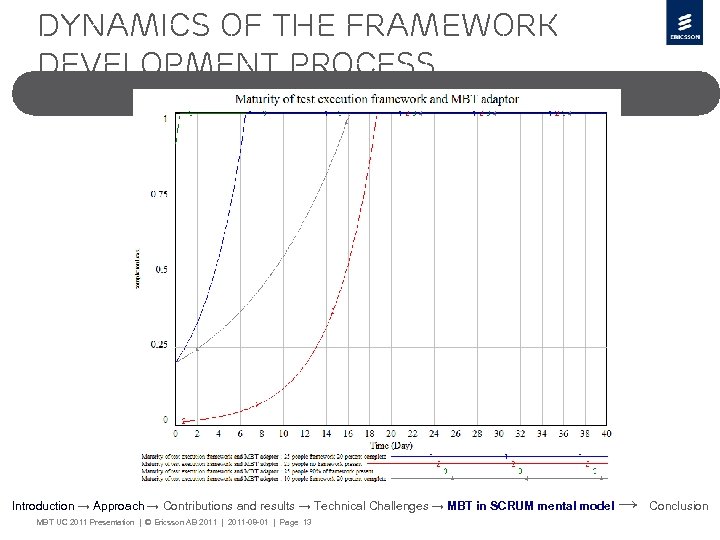
Dynamics of the framework development process Introduction → Approach → Contributions and results → Technical Challenges → MBT in SCRUM mental model MBT UC 2011 Presentation | © Ericsson AB 2011 | 2011 -08 -01 | Page 13 → Conclusion
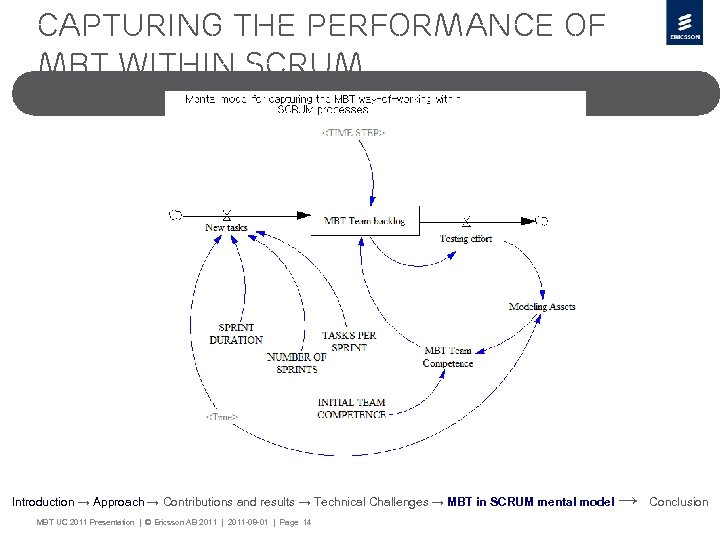
Capturing the performance of mbt within scrum Introduction → Approach → Contributions and results → Technical Challenges → MBT in SCRUM mental model MBT UC 2011 Presentation | © Ericsson AB 2011 | 2011 -08 -01 | Page 14 → Conclusion
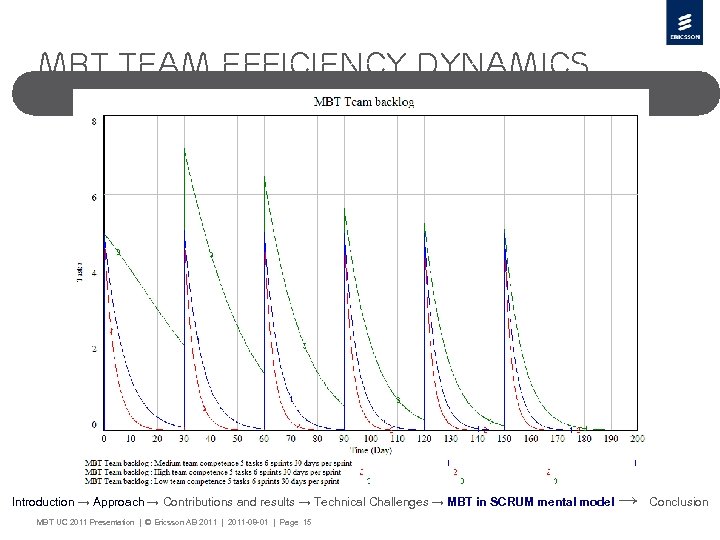
MBT Team efficiency dynamics Introduction → Approach → Contributions and results → Technical Challenges → MBT in SCRUM mental model MBT UC 2011 Presentation | © Ericsson AB 2011 | 2011 -08 -01 | Page 15 → Conclusion
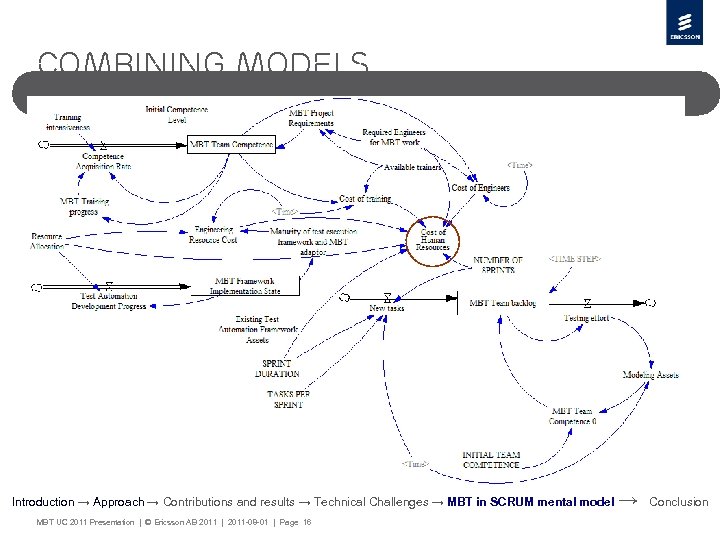
Combining models Introduction → Approach → Contributions and results → Technical Challenges → MBT in SCRUM mental model MBT UC 2011 Presentation | © Ericsson AB 2011 | 2011 -08 -01 | Page 16 → Conclusion
Lessons learned Experiences from evaluation – Models can focus on the final solution › In every sprint, execute only the subset of test cases generated from the model that correspond to implemented functionality. – Design teams may come up with temporary workarounds, not present in the final version › Model workarounds can be introduced and deactivated later › Save efforts for redesigning the model later Experiences from simulation of SD models – SD models capture the inter-relations of variables that determine project success. › Resource allocation, based on engineer experience, that leads to lower costs. › Resource allocation, based on engineer experience, that delivers results faster. - But also: Optimal allocation of engineers that leads to the best compromise of time and costs. Introduction → Approach → Contributions and results → Technical Challenges → MBT in SCRUM mental model MBT UC 2011 Presentation | © Ericsson AB 2011 | 2011 -08 -01 | Page 17 → Conclusion

Planning ahead Stakeholders Draft Formalized Test Specifications Interpret and design model MBT Automated generation Test Scripts A third level of testing process automation Automated execution System Under Test (SUT) – Complete model creation versus model “stubs”. – Generated test cases consistency, correctness. – Reduced testing costs, lead-time. Introduction → Approach → Contributions and results → Technical Challenges → MBT in SCRUM mental model MBT UC 2011 Presentation | © Ericsson AB 2011 | 2011 -08 -01 | Page 18 → Conclusion
 Скачать презентацию Experiences from applying mbt in an agile scrum
c178ee12cee61f0b2ae12f9ab059140e.ppt