


 Скачать презентацию Experience with the ATLAS radiation tolerance policy Philippe
074d0a05d8eca0dcadd53fe58c936332.ppt
- Количество слайдов: 42
 Experience with the ATLAS radiation tolerance policy Philippe Farthouat, PH-ESE philippe. farthouat@cern. ch Chamonix January 2010
 Outline ² ² ² Radiation constraints in ATLAS Why defining a ‶strict″ policy? Main points of the policy How to enforce the policy Experience Are we safe? philippe. farthouat@cern. ch Chamonix January 2010 2
 Outline ² ² ² Radiation constraints in ATLAS Why defining a ‶strict″ policy? Main points of the policy How to enforce the policy Experience Are we safe? philippe. farthouat@cern. ch Chamonix January 2010 3
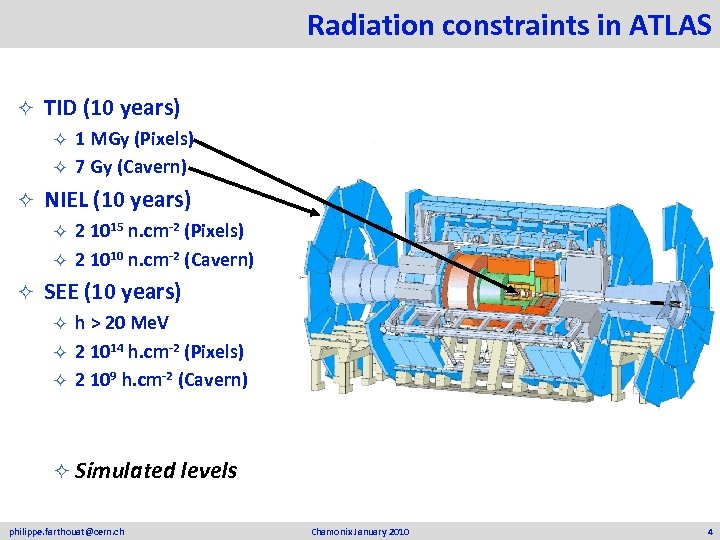 Radiation constraints in ATLAS ² TID (10 years) 1 MGy (Pixels) ² 7 Gy (Cavern) ² ² NIEL (10 years) 2 1015 n. cm-2 (Pixels) ² 2 1010 n. cm-2 (Cavern) ² ² SEE (10 years) h > 20 Me. V ² 2 1014 h. cm-2 (Pixels) ² 2 109 h. cm-2 (Cavern) ² ² Simulated levels philippe. farthouat@cern. ch Chamonix January 2010 4
 Outline ² ² ² Radiation constraints in ATLAS Why defining a ‶strict″ policy? Main points of the policy How to enforce the policy Experience Are we safe? philippe. farthouat@cern. ch Chamonix January 2010 5
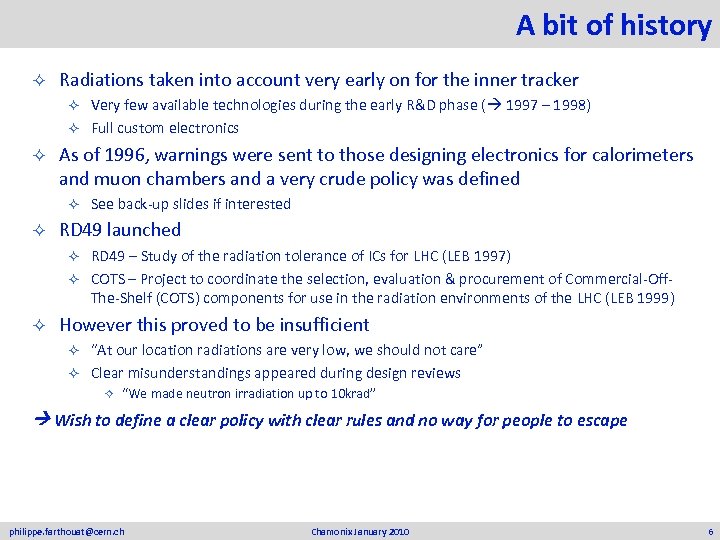 A bit of history ² Radiations taken into account very early on for the inner tracker Very few available technologies during the early R&D phase ( 1997 – 1998) ² Full custom electronics ² ² As of 1996, warnings were sent to those designing electronics for calorimeters and muon chambers and a very crude policy was defined ² ² See back-up slides if interested RD 49 launched RD 49 – Study of the radiation tolerance of ICs for LHC (LEB 1997) ² COTS – Project to coordinate the selection, evaluation & procurement of Commercial-Off. The-Shelf (COTS) components for use in the radiation environments of the LHC (LEB 1999) ² ² However this proved to be insufficient “At our location radiations are very low, we should not care” ² Clear misunderstandings appeared during design reviews ² ² “We made neutron irradiation up to 10 krad” Wish to define a clear policy with clear rules and no way for people to escape philippe. farthouat@cern. ch Chamonix January 2010 6
 Outline ² ² ² Radiation constraints in ATLAS Why defining a ‶strict″ policy? Main points of the policy How to enforce the policy Experience Are we safe? philippe. farthouat@cern. ch Chamonix January 2010 7
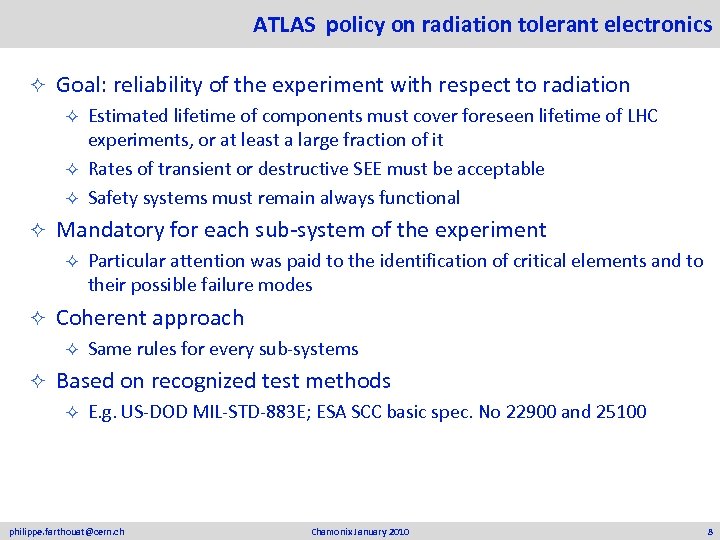 ATLAS policy on radiation tolerant electronics ² Goal: reliability of the experiment with respect to radiation Estimated lifetime of components must cover foreseen lifetime of LHC experiments, or at least a large fraction of it ² Rates of transient or destructive SEE must be acceptable ² Safety systems must remain always functional ² ² Mandatory for each sub-system of the experiment ² ² Coherent approach ² ² Particular attention was paid to the identification of critical elements and to their possible failure modes Same rules for every sub-systems Based on recognized test methods ² E. g. US-DOD MIL-STD-883 E; ESA SCC basic spec. No 22900 and 25100 philippe. farthouat@cern. ch Chamonix January 2010 8
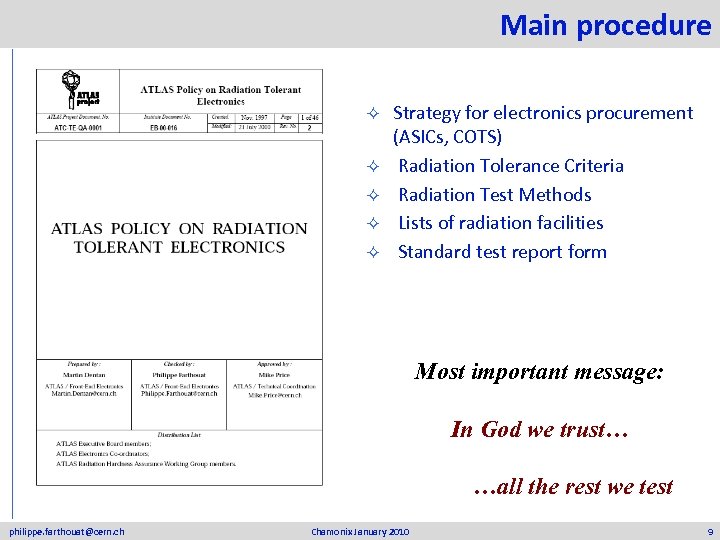 Main procedure ² ² ² Strategy for electronics procurement (ASICs, COTS) Radiation Tolerance Criteria Radiation Test Methods Lists of radiation facilities Standard test report form Most important message: In God we trust… …all the rest we test philippe. farthouat@cern. ch Chamonix January 2010 9
 Design/Procurement strategy ² Whenever possible: ² ² Limit electronics in radiation environment Radiation tolerant COTS: Determine the Radiation Tolerance Criteria (using safety factors when needed) ² Pre-select generic components (radiation tests) ² Easier to start the design with components which have a chance to be OK or to adapt the design to defects which will appear ² It has always been difficult to force people to redo designs ² Purchase batches of pre-selected generic components ² Qualify batches of components (radiation tests) ² Radiation tests can be made on individual components or on boards ² Special agreements with vendors may allow purchasing qualified batches only ² ² philippe. farthouat@cern. ch Was done for instance for ADCs from Analog Devices used in the LAr calorimeter Chamonix January 2010 10
 Tests procedures defined for TID, NIEL and SEE ² The aim was to have normalised radiation tests so that comparisons can easily be done and so that results can be shared ² Some testing procedures which could be painful or difficult to do (e. g. high temperature annealing) could be replaced by some safety factors (largely arbitrary…) ² philippe. farthouat@cern. ch Chamonix January 2010 11
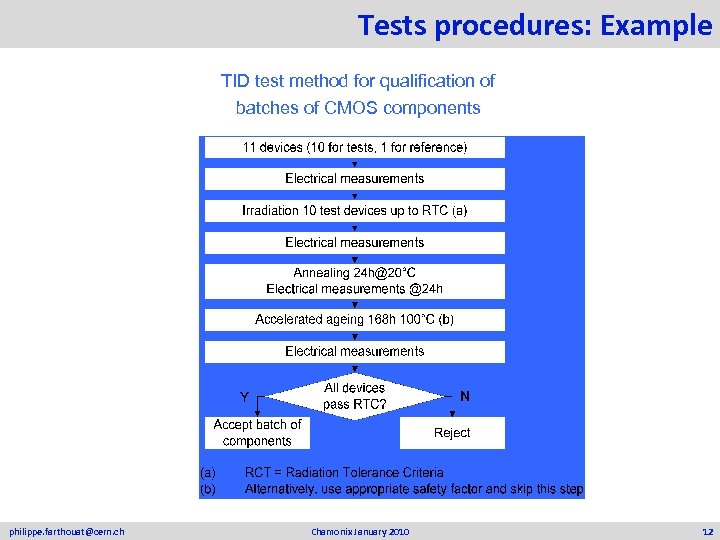 Tests procedures: Example TID test method for qualification of batches of CMOS components philippe. farthouat@cern. ch Chamonix January 2010 12
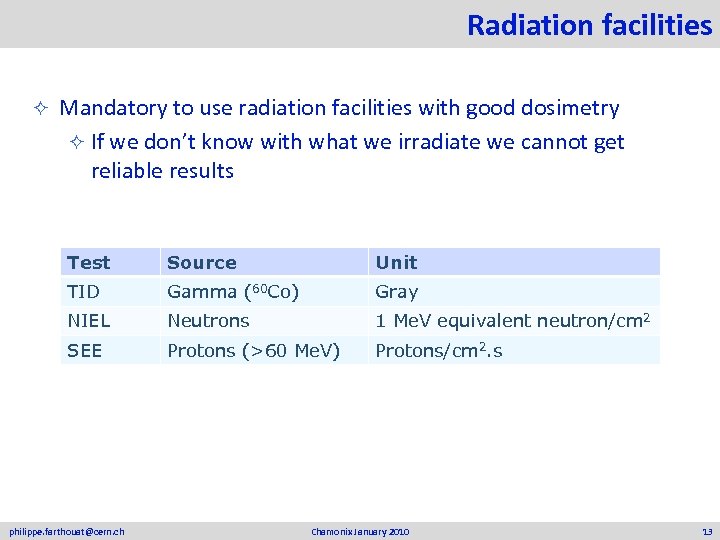 Radiation facilities ² Mandatory to use radiation facilities with good dosimetry ² If we don’t know with what we irradiate we cannot get reliable results Test Source Unit TID Gamma (60 Co) Gray NIEL Neutrons 1 Me. V equivalent neutron/cm 2 SEE Protons (>60 Me. V) Protons/cm 2. s philippe. farthouat@cern. ch Chamonix January 2010 13
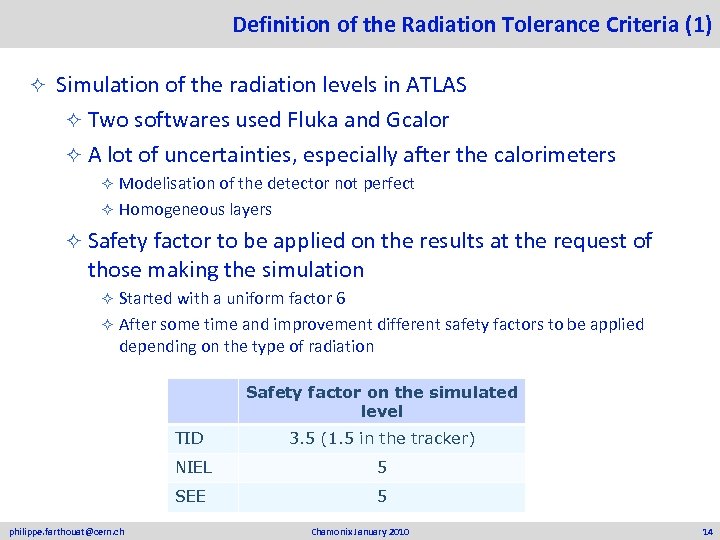 Definition of the Radiation Tolerance Criteria (1) ² Simulation of the radiation levels in ATLAS ² Two softwares used Fluka and Gcalor ² A lot of uncertainties, especially after the calorimeters Modelisation of the detector not perfect ² Homogeneous layers ² ² Safety factor to be applied on the results at the request of those making the simulation Started with a uniform factor 6 ² After some time and improvement different safety factors to be applied depending on the type of radiation ² Safety factor on the simulated level TID NIEL 5 SEE philippe. farthouat@cern. ch 3. 5 (1. 5 in the tracker) 5 Chamonix January 2010 14
 Definition of the Radiation Tolerance Criteria (2) In the case the annealing after radiation tests cannot be done, additional safety factor added to take into account low dose rate ² In the case it is not possible to buy components from a single lot, another safety factor is added to “anticipate” lot to lot variations ² These safety factors are largely arbitrary and there were some complains about them however ² Making the tests properly would avoid them ² The largest uncertainty is with the simulation ² philippe. farthouat@cern. ch Chamonix January 2010 15
 Single event effects No time to measure linear energy transfer (LET) of all devices ² Took benefit of the work done by F. Faccio and M. Huhtinen saying that in our environment one can consider only hadrons above 20 Me. V and do the test with proton of more than 60 Me. V ² Tests only give limits on upsets ² 1 device, 0 upsets after 1011 p. cm-2 would tell us that in a system with 1000 devices receiving 104 p. cm-2. s-1 we can expect up to 10 -4 error every second i. e. up to 1 error every 3 hours… which might be not negligible ² The system has to support this error rate ² ² In ATLAS it translates in % of data loss ² Agreed to reject any component “burning” during SEE tests ² Again it does not mean it will not happen with those accepted components philippe. farthouat@cern. ch Chamonix January 2010 16
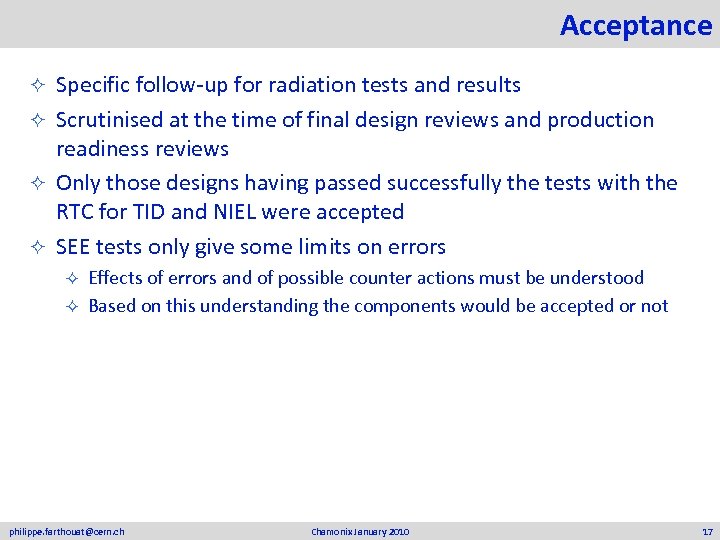 Acceptance Specific follow-up for radiation tests and results ² Scrutinised at the time of final design reviews and production readiness reviews ² Only those designs having passed successfully the tests with the RTC for TID and NIEL were accepted ² SEE tests only give some limits on errors ² Effects of errors and of possible counter actions must be understood ² Based on this understanding the components would be accepted or not ² philippe. farthouat@cern. ch Chamonix January 2010 17
 Outline ² ² ² Radiation constraints in ATLAS Why defining a ‶strict″ policy? Main points of the policy How to enforce the policy Experience Are we safe? philippe. farthouat@cern. ch Chamonix January 2010 18
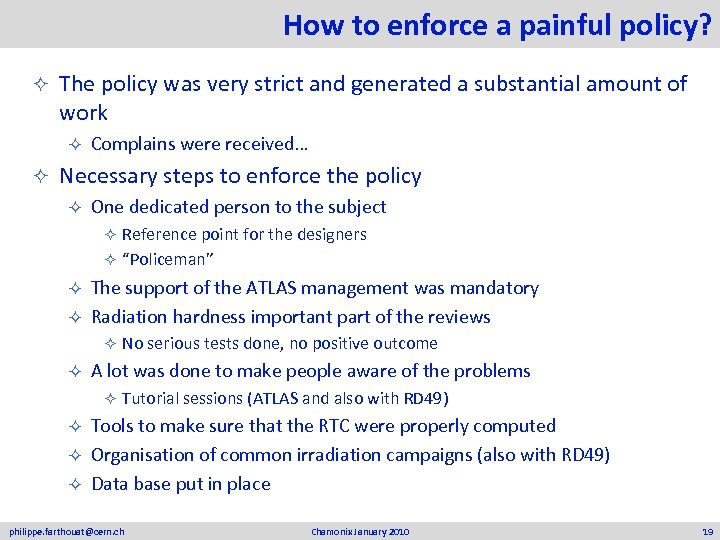 How to enforce a painful policy? ² The policy was very strict and generated a substantial amount of work ² ² Complains were received… Necessary steps to enforce the policy ² One dedicated person to the subject Reference point for the designers ² “Policeman” ² The support of the ATLAS management was mandatory ² Radiation hardness important part of the reviews ² ² ² No serious tests done, no positive outcome A lot was done to make people aware of the problems ² Tutorial sessions (ATLAS and also with RD 49) Tools to make sure that the RTC were properly computed ² Organisation of common irradiation campaigns (also with RD 49) ² Data base put in place ² philippe. farthouat@cern. ch Chamonix January 2010 19
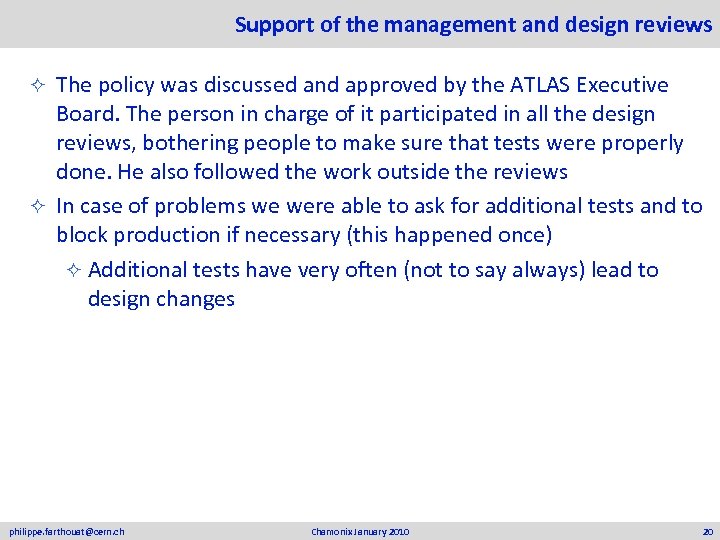 Support of the management and design reviews The policy was discussed and approved by the ATLAS Executive Board. The person in charge of it participated in all the design reviews, bothering people to make sure that tests were properly done. He also followed the work outside the reviews ² In case of problems we were able to ask for additional tests and to block production if necessary (this happened once) ² Additional tests have very often (not to say always) lead to design changes ² philippe. farthouat@cern. ch Chamonix January 2010 20
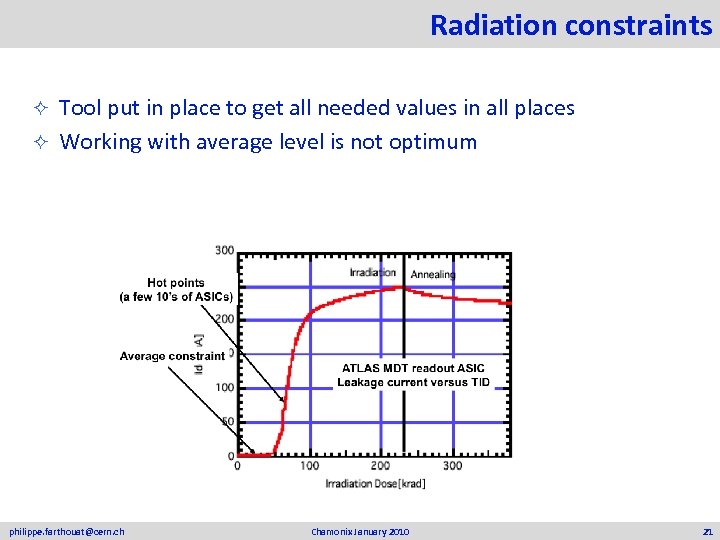 Radiation constraints Tool put in place to get all needed values in all places ² Working with average level is not optimum ² philippe. farthouat@cern. ch Chamonix January 2010 21
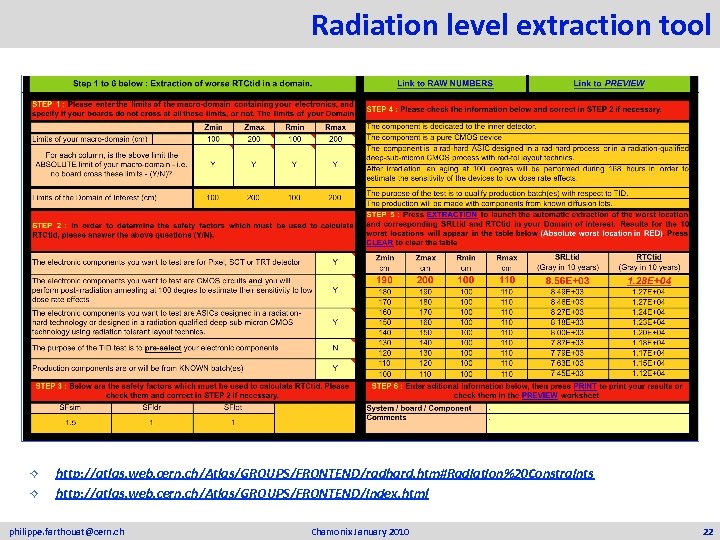 Radiation level extraction tool ² ² http: //atlas. web. cern. ch/Atlas/GROUPS/FRONTEND/radhard. htm#Radiation%20 Constraints http: //atlas. web. cern. ch/Atlas/GROUPS/FRONTEND/index. html philippe. farthouat@cern. ch Chamonix January 2010 22
 Components data base A data base was put in place to collect the results of the tests done on different components ² Note that this can be useful only when the tests are done in a standardised way ² Initially developed for ATLAS by Chris Parkman it was then also used by RD 49 ² However it was not a great success ² The link is still in place and some information can be found ² Very volatile information ² philippe. farthouat@cern. ch Chamonix January 2010 23
 Outline ² ² ² Radiation constraints in ATLAS Why defining a ‶strict″ policy? Main points of the policy How to enforce the policy Experience Are we safe? philippe. farthouat@cern. ch Chamonix January 2010 24
 Examples ² Back-up slides give two typical examples of problems encountered ² LAr calorimeter front-end electronics ² A lot of components in a relatively high radiation level environment ² Development of several ASICs ² Embedded Local Monitor Board (ELMB) ² Radiation tests doen late with respect to the design time philippe. farthouat@cern. ch Chamonix January 2010 25
 Outline ² ² ² Radiation constraints in ATLAS Why defining a ‶strict″ policy? Main points of the policy How to enforce the policy Experience Are we safe? philippe. farthouat@cern. ch Chamonix January 2010 26
 Are we safe? ² How accurate is the simulation? How optimistic/pessimistic have we been with the safety factors? ² ² Next months should give a lot of input Total dose effects In the tracker: radiation hard technologies and a lot of qualification OK ² In the periphery of the detector, total dose effects easily seen (e. g. leakage currents increase). Devices can be (more or less easily) changed « maintenance » problem (cost issue if failures are too early) ² Also applicable to the calorimeters, although the access is less easy ² philippe. farthouat@cern. ch Chamonix January 2010 27
 Are we safe? (cont) ² SEE effects ² The effects were measured and we have some knowledge of the possible failure frequency. However, Measurements gave only some limits ² Not always able to make tests with a lot of devices to reach high statistics (TID effects) ² ² Counter measures implemented ² ² Triple redundant logic, permanent reload of important parameters, N+1 DCDC converters in some power supplies (calorimeter) Statement made that we only loose a small fraction of the detector when it occurs Self recovery implemented (data acquisition); overall dead-time should be under control ² A loss of power supply is more harming ² philippe. farthouat@cern. ch Chamonix January 2010 28
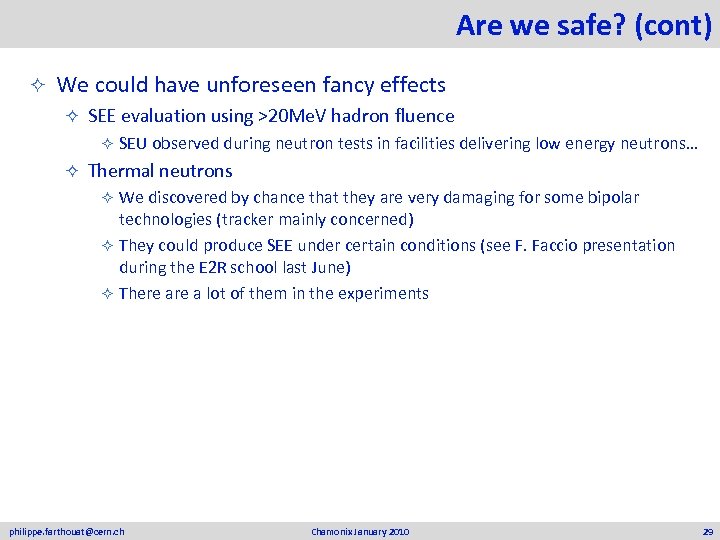 Are we safe? (cont) ² We could have unforeseen fancy effects ² SEE evaluation using >20 Me. V hadron fluence ² ² SEU observed during neutron tests in facilities delivering low energy neutrons… Thermal neutrons We discovered by chance that they are very damaging for some bipolar technologies (tracker mainly concerned) ² They could produce SEE under certain conditions (see F. Faccio presentation during the E 2 R school last June) ² There a lot of them in the experiments ² philippe. farthouat@cern. ch Chamonix January 2010 29
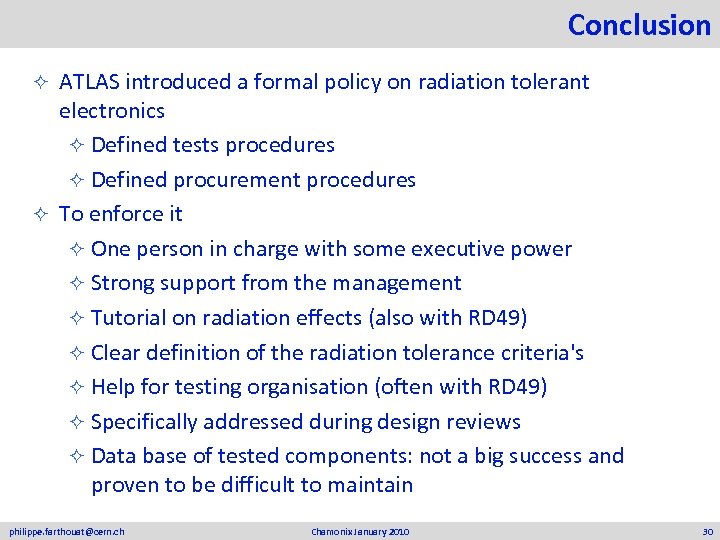 Conclusion ATLAS introduced a formal policy on radiation tolerant electronics ² Defined tests procedures ² Defined procurement procedures ² To enforce it ² One person in charge with some executive power ² Strong support from the management ² Tutorial on radiation effects (also with RD 49) ² Clear definition of the radiation tolerance criteria's ² Help for testing organisation (often with RD 49) ² Specifically addressed during design reviews ² Data base of tested components: not a big success and proven to be difficult to maintain ² philippe. farthouat@cern. ch Chamonix January 2010 30
 Back-up Slides philippe. farthouat@cern. ch Chamonix January 2010 31
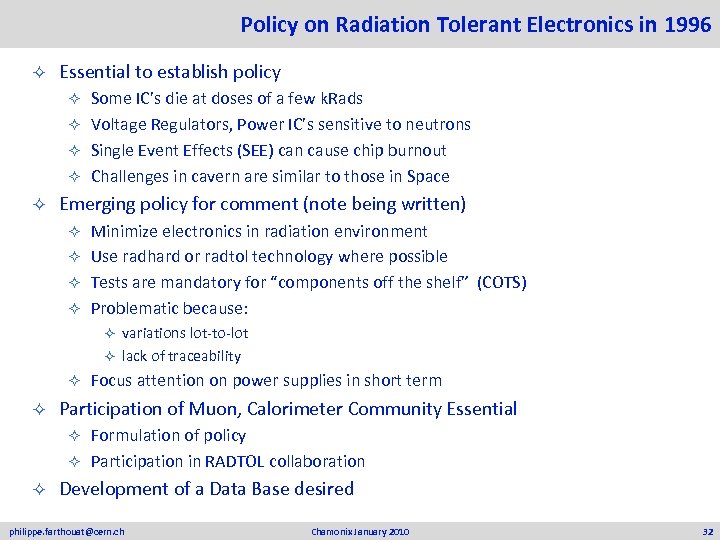 Policy on Radiation Tolerant Electronics in 1996 ² Essential to establish policy Some IC’s die at doses of a few k. Rads ² Voltage Regulators, Power IC’s sensitive to neutrons ² Single Event Effects (SEE) can cause chip burnout ² Challenges in cavern are similar to those in Space ² ² Emerging policy for comment (note being written) Minimize electronics in radiation environment ² Use radhard or radtol technology where possible ² Tests are mandatory for “components off the shelf” (COTS) ² Problematic because: ² variations lot-to-lot ² lack of traceability ² ² ² Focus attention on power supplies in short term Participation of Muon, Calorimeter Community Essential Formulation of policy ² Participation in RADTOL collaboration ² ² Development of a Data Base desired philippe. farthouat@cern. ch Chamonix January 2010 32
 Examples LAr front-end electronics ² A lot of components ² Relatively high level of radiation ² ELMB ² Radiation tests done late with respect to the design time ² philippe. farthouat@cern. ch Chamonix January 2010 33
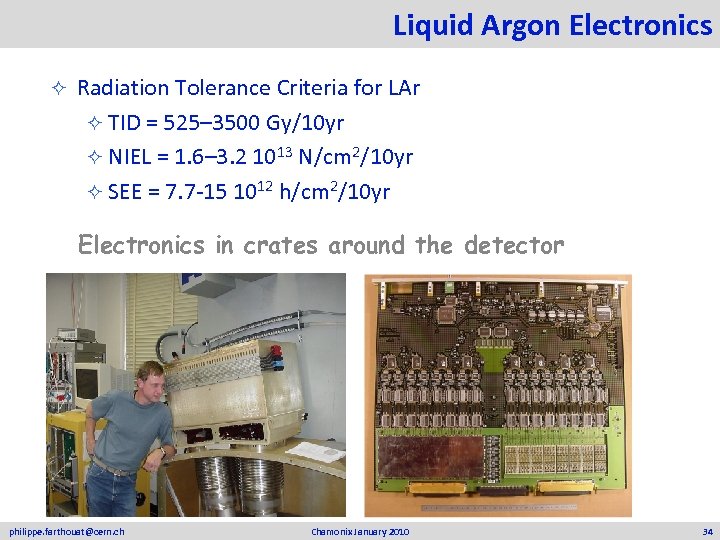 Liquid Argon Electronics ² u Radiation Tolerance Criteria for LAr ² TID = 525– 3500 Gy/10 yr ² NIEL = 1. 6– 3. 2 1013 N/cm 2/10 yr ² SEE = 7. 7 -15 1012 h/cm 2/10 yr Electronics in crates around the detector philippe. farthouat@cern. ch Chamonix January 2010 34
 Liquid Argon Electronics ² 1 responsible per board ² FEB (1600 boards) ² Calib (120 boards) ² Controller (120 boards) ² Tower builder (120 boards) ² Tower driver board (23 boards) ² LV distrib ² 1 responsible for power supplies ² 1 responsible for optical links philippe. farthouat@cern. ch Chamonix January 2010 35
 Liquid Argon Electronics First tests made with COTS were very disappointing… ² Decision to avoid them as much as possible ² A lot of extra design work philippe. farthouat@cern. ch Chamonix January 2010 36
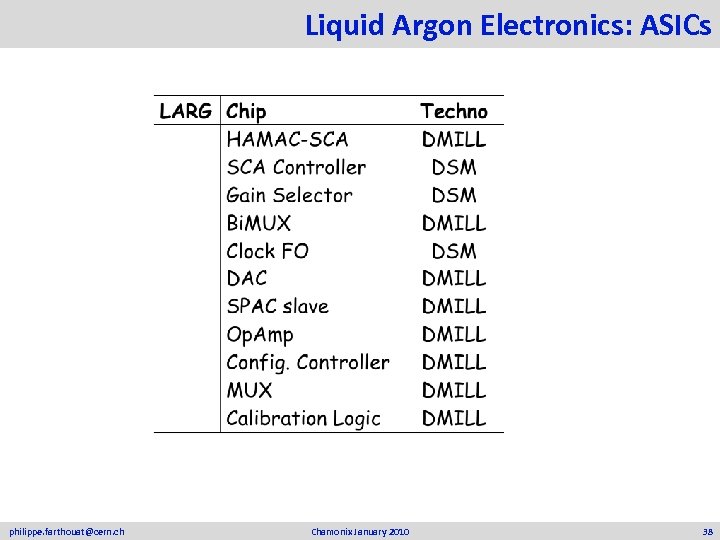
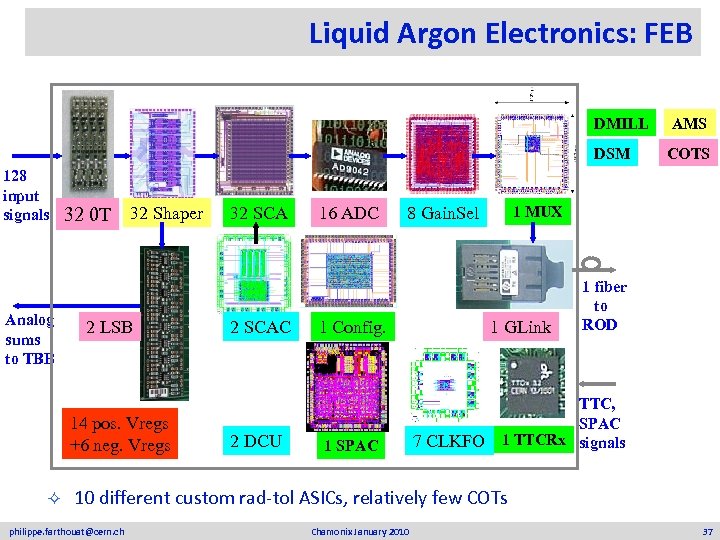 Liquid Argon Electronics: FEB DMILL DSM 128 input signals Analog sums to TBB 32 0 T 32 Shaper 2 LSB 14 pos. Vregs +6 neg. Vregs ² 32 SCAC 2 DCU 16 ADC 1 SPAC 1 GLink 7 CLKFO COTS 1 MUX 8 Gain. Sel 1 Config. AMS 1 fiber to ROD TTC, SPAC 1 TTCRx signals 10 different custom rad-tol ASICs, relatively few COTs philippe. farthouat@cern. ch Chamonix January 2010 37
 Liquid Argon Electronics: ASICs philippe. farthouat@cern. ch Chamonix January 2010 38
 Liquid Argon Electronics: COTS ² One important element was the Analog Design ADC 16 per FEB ² 25600 total ² ² Initially selected by CMS for their calorimeter ² ² 100000 pieces needed Agreement with Analog Design to order per lot and to qualify each lot Only if radiation tests OK we keep the batch and pay for it ² No batch was refused ² This kind of agreement is not easy to get ² philippe. farthouat@cern. ch Chamonix January 2010 39
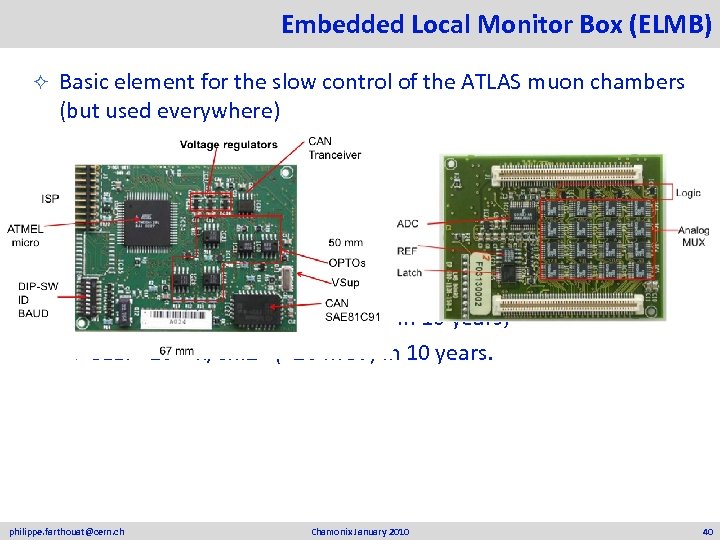 Embedded Local Monitor Box (ELMB) ² Basic element for the slow control of the ATLAS muon chambers (but used everywhere) ² Radiation constraints (including ALL safety factors) ² TID : 140 Gy in 10 years; ² NIEL: ~1012 n/cm 2 (1 Me. V eq. ) in 10 years; ² SEE: ~1011 h/cm 2 (>20 Me. V) in 10 years. philippe. farthouat@cern. ch Chamonix January 2010 40
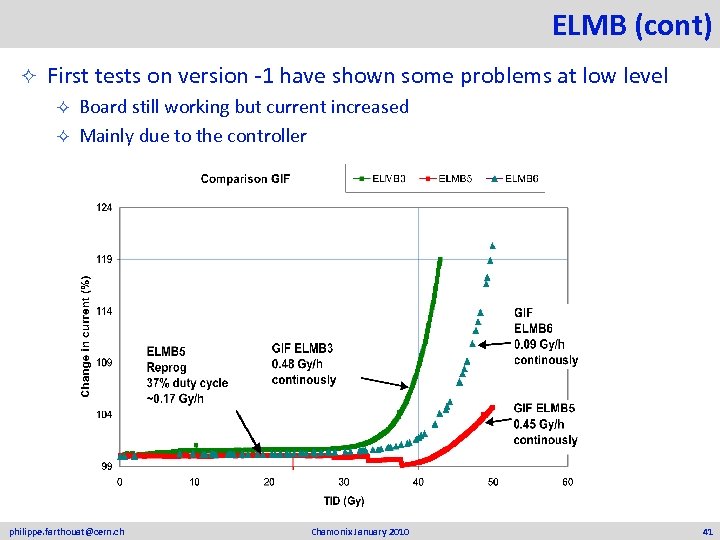 ELMB (cont) ² First tests on version -1 have shown some problems at low level Board still working but current increased ² Mainly due to the controller ² philippe. farthouat@cern. ch Chamonix January 2010 41
 ELMB (cont) ² ² ² Harsh discussions followed… Final version of the ELMB using another controller Decision to order components from the same batches (to avoid some safety factors) and to redo the tests with boards from the preseries ELMB are low cost components in accessible places. Total dose effects can hence be accepted Luckily enough, these tests were positive up to 3 times the required dose… A lot of SEE were observed. None being a show stopper but it required special care in the software development philippe. farthouat@cern. ch Chamonix January 2010 42