


 Скачать презентацию EXPERIENCE SHARING Micro Credit Strategies A PCFC Mindanao
db2efa99b6bca598ef74693dad9e6d5f.ppt
- Количество слайдов: 32
 EXPERIENCE SHARING: Micro Credit Strategies A PCFC Mindanao Team Presentation for the ENRAP II Philippines National Workshop
 OUTLINE OF PRESENTATION ØContributory Factors to MF GROWTH ØStrategic Options in MF ØHighlights on the People’s Credit and Finance Corporation operations
 CONTRIBUTORY FACTORS TO MICROFINANCE GROWTH ØPolicy environment ØResources available for microfinance ØRetail capacity for microfinance
 CONTRIBUTORY FACTORS TO MICROFINANCE GROWTH Policy environment: • BSP started to promote the setting up of specialized microfinance bank • BSP in the process of relaxing the moratorium on branching • BSP set up a microfinance unit within itself to ensure better oversight • The adoption of common standards for all MFIs encourages effective governance
 CONTRIBUTORY FACTORS TO MICROFINANCE GROWTH Resources: • Funds for re-lending (PCFC, LBP, DBP, etc. ) Capability building • Funds (PCFC, PDTF, etc. ) • Providers (FRIEND, EBI, CARD, NWTFI, TSKI, CUES, MABS, Punla, etc. )
 CONTRIBUTORY FACTORS TO MICROFINANCE GROWTH Retail Capacity: • Funds - Wholesalers and retailers Capability building • Funds (PCFC, PDTF, etc. ) • Providers (FRIEND, EBI, CARD, NWTFI, TSKI, CUES, MABS, Punla, etc. )
 CONTRIBUTORY FACTORS TO MICROFINANCE GROWTH Retail Capacity: Common Capability Building Needs • General management skills and systems • Specific topics pertaining to MF technology • Specific topics relative to the type of MFI
 Preparing for Expansion n n Clarify Expansion Strategy vis-à-vis VISION Assess Institutional Status Market and Competitive Analysis Develop Branch Viability Model Project Resource Requirements
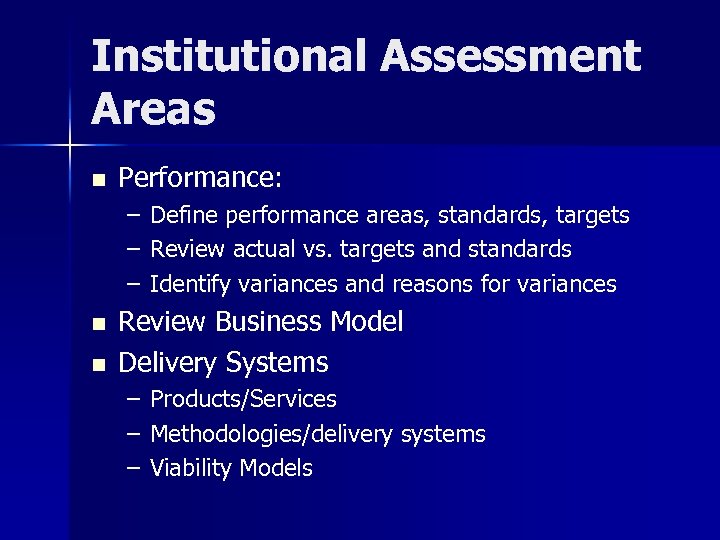 Institutional Assessment Areas n Performance: – – – n n Define performance areas, standards, targets Review actual vs. targets and standards Identify variances and reasons for variances Review Business Model Delivery Systems – – – Products/Services Methodologies/delivery systems Viability Models
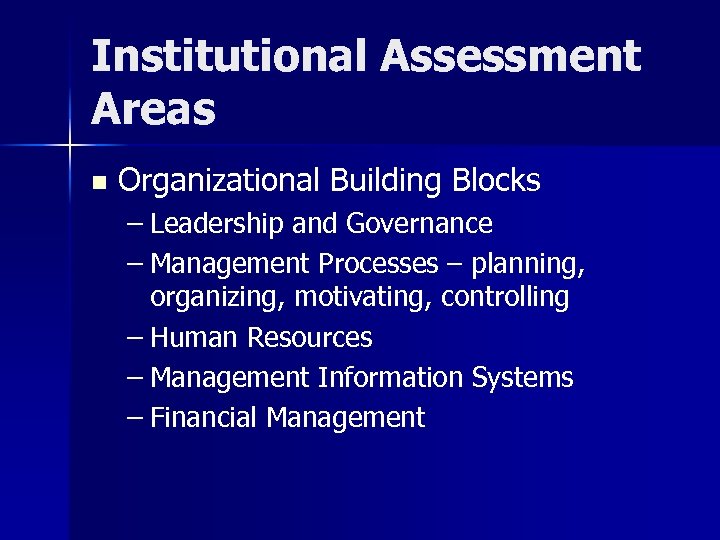 Institutional Assessment Areas n Organizational Building Blocks – Leadership and Governance – Management Processes – planning, organizing, motivating, controlling – Human Resources – Management Information Systems – Financial Management
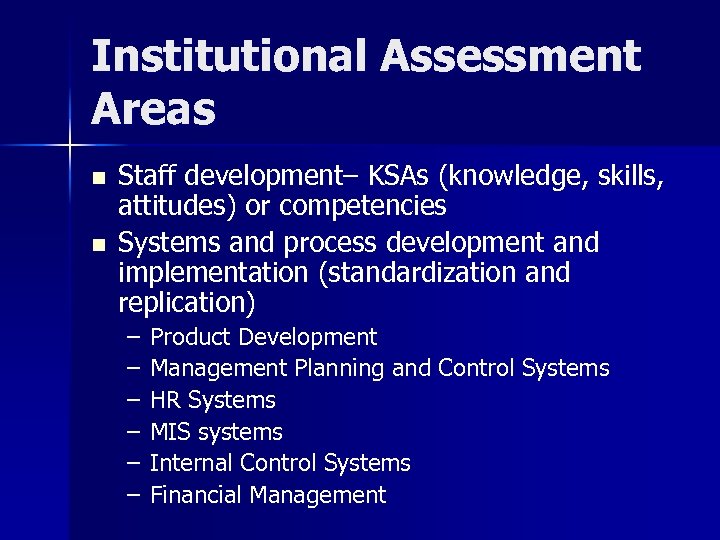 Institutional Assessment Areas n n Staff development– KSAs (knowledge, skills, attitudes) or competencies Systems and process development and implementation (standardization and replication) – – – Product Development Management Planning and Control Systems HR Systems MIS systems Internal Control Systems Financial Management
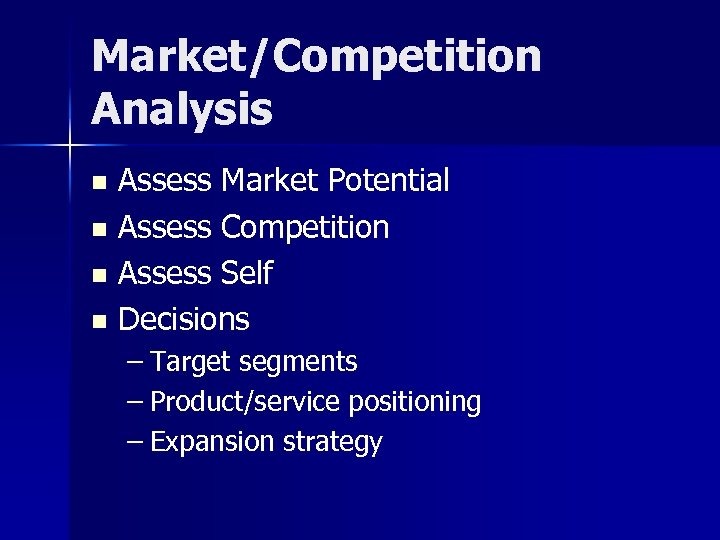 Market/Competition Analysis Assess Market Potential n Assess Competition n Assess Self n Decisions n – Target segments – Product/service positioning – Expansion strategy
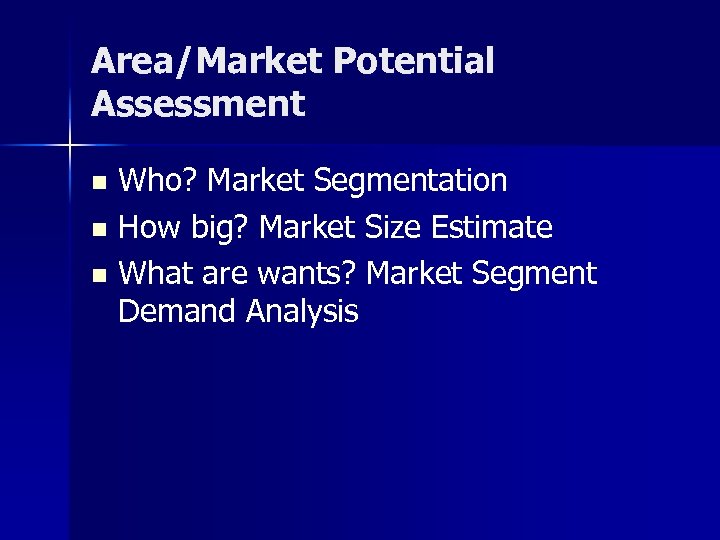 Area/Market Potential Assessment Who? Market Segmentation n How big? Market Size Estimate n What are wants? Market Segment Demand Analysis n
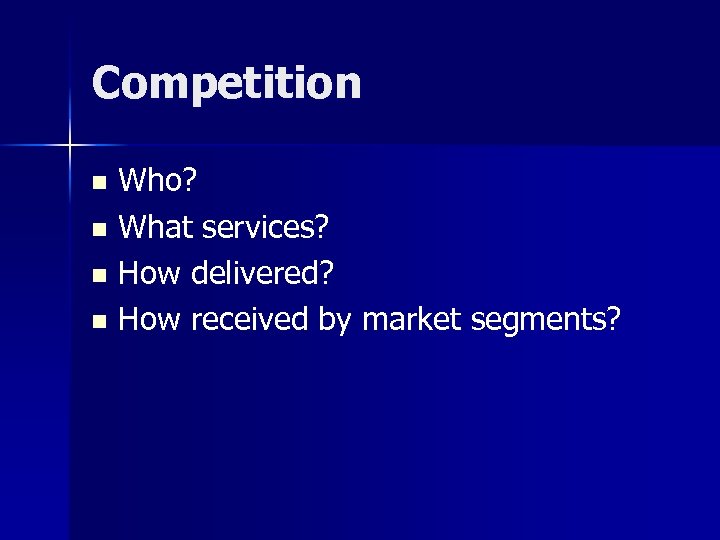 Competition Who? n What services? n How delivered? n How received by market segments? n
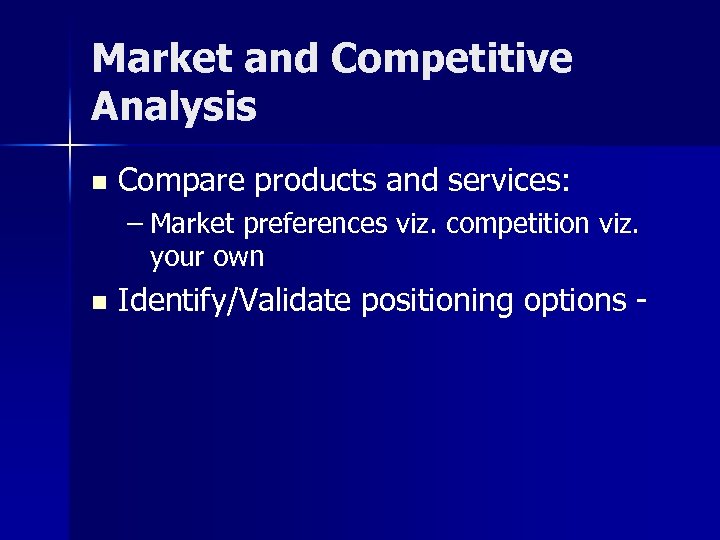 Market and Competitive Analysis n Compare products and services: – Market preferences viz. competition viz. your own n Identify/Validate positioning options -
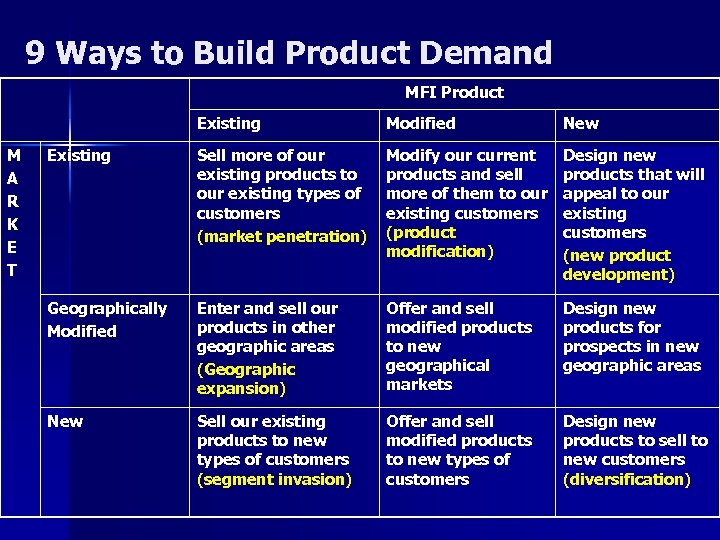 9 Ways to Build Product Demand MFI Product Existing M A R K E T Modified New Existing Sell more of our existing products to our existing types of customers (market penetration) Modify our current products and sell more of them to our existing customers (product modification) Design new products that will appeal to our existing customers (new product development) Geographically Modified Enter and sell our products in other geographic areas (Geographic expansion) Offer and sell modified products to new geographical markets Design new products for prospects in new geographic areas New Sell our existing products to new types of customers (segment invasion) Offer and sell modified products to new types of customers Design new products to sell to new customers (diversification)
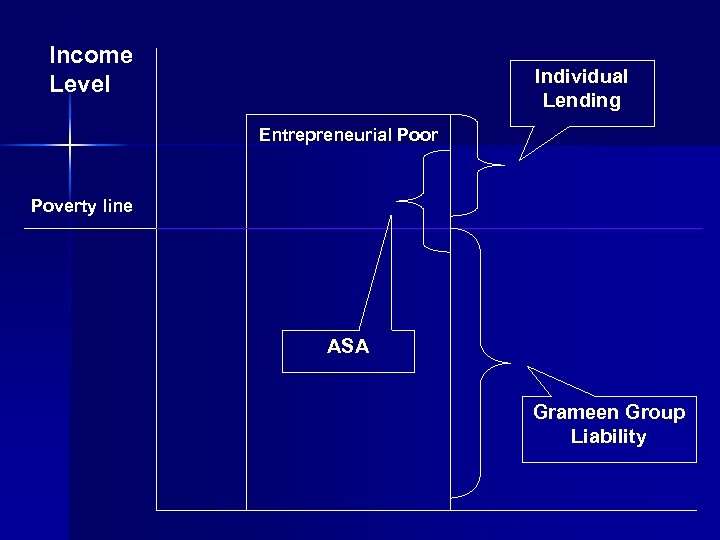 Income Level Individual Lending Entrepreneurial Poor Poverty line ASA Grameen Group Liability
 Difficulty in moving up from small farmer (micro-enterprise) lending n Gap in loans between (roughly) P 100150, 000 and P 1 -2, 000 n Potentially greater risks require analysis of business, not just family cash flows n Analysis is costly and collateral requirements may be more stringent
 Strategic Options • Managing the clients’ risk by offering microinsurance covering death, health and hospitalization benefits; • Building up their assets through funds for housing, their children’s education and their own pension; and, • Capitalizing on economic opportunities and growth by means of enterprise loans, training and marketing linkages.
 Philippine Microfinance Program As implemented by the: Peoples Credit and Finance Corporation (PCFC) in partnership with Private Microfinance Institutions
 People’s Credit & Finance Corporation “The lead government entity specifically tasked to mobilize resources from both local and international funding sources for microfinance services for the exclusive use of the poor”
 PCFC MANDATE : to provide the poor with access to credit BASIC STRATEGIES : • Wholesale Lending to accredited microfinance institutions • Capability Building of MFIs
 PCFC’s Accomplishments
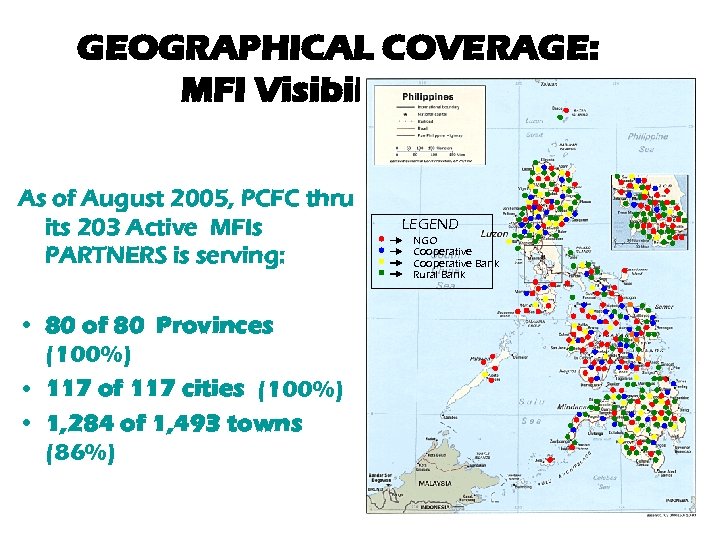 GEOGRAPHICAL COVERAGE: GEOGRAPHICAL COVERAGE MFI Visibility Map As of August 2005, PCFC thru its 203 Active MFIs PARTNERS is serving: • 80 of 80 Provinces (100%) • 117 of 117 cities (100%) • 1, 284 of 1, 493 towns (86%) LEGEND NGO Cooperative Bank Rural Bank `
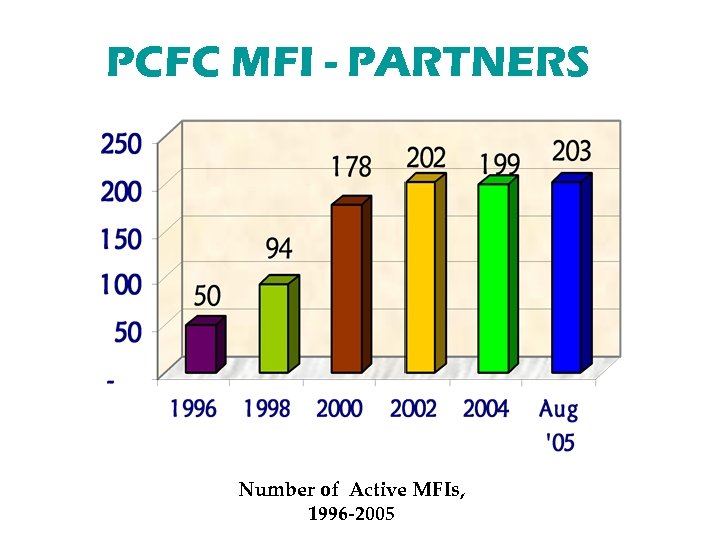 PCFC MFI - PARTNERS Number of Active MFIs, 1996 -2005
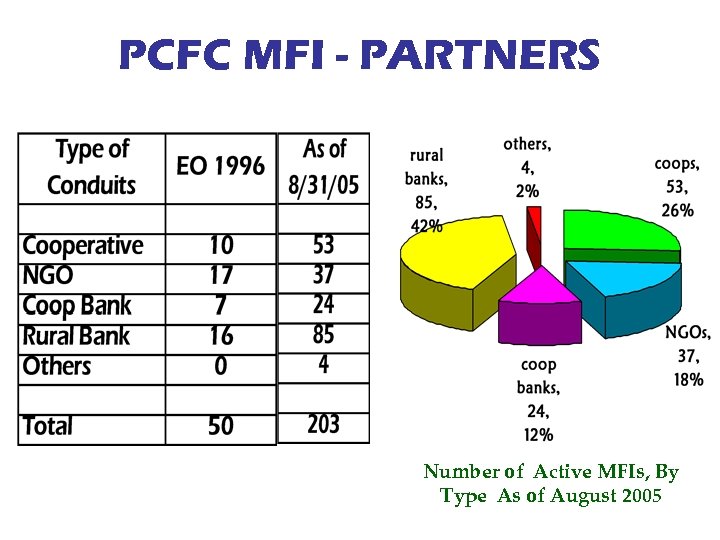 PCFC MFI - PARTNERS Number of Active MFIs, By Type As of August 2005
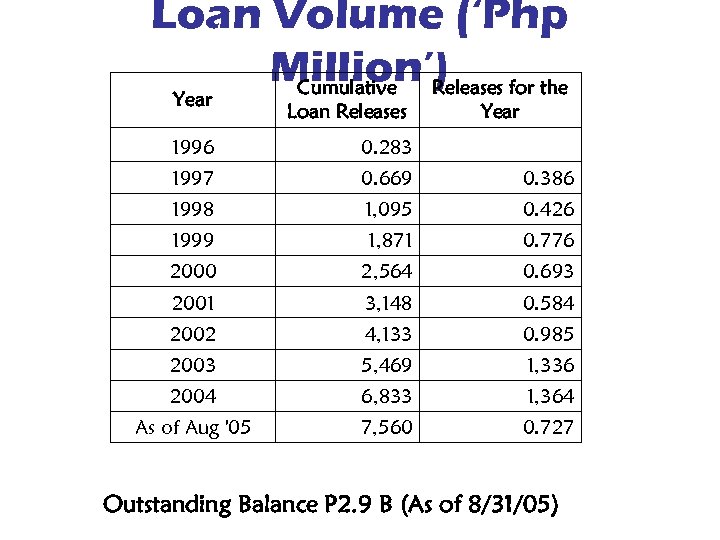 Loan Volume (‘Php Million’) for the Cumulative Releases Year Loan Releases Year 1996 0. 283 1997 0. 669 0. 386 1998 1, 095 0. 426 1999 1, 871 0. 776 2000 2, 564 0. 693 2001 3, 148 0. 584 2002 4, 133 0. 985 2003 5, 469 1, 336 2004 6, 833 1, 364 As of Aug '05 7, 560 0. 727 Outstanding Balance P 2. 9 B (As of 8/31/05)
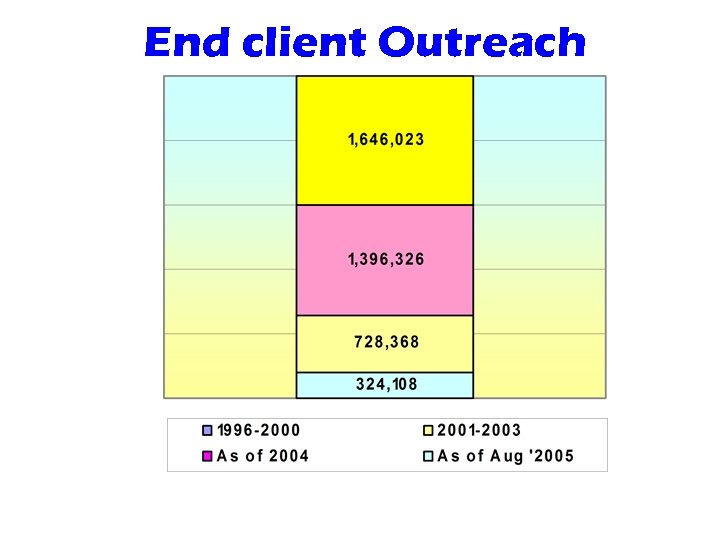 End client Outreach
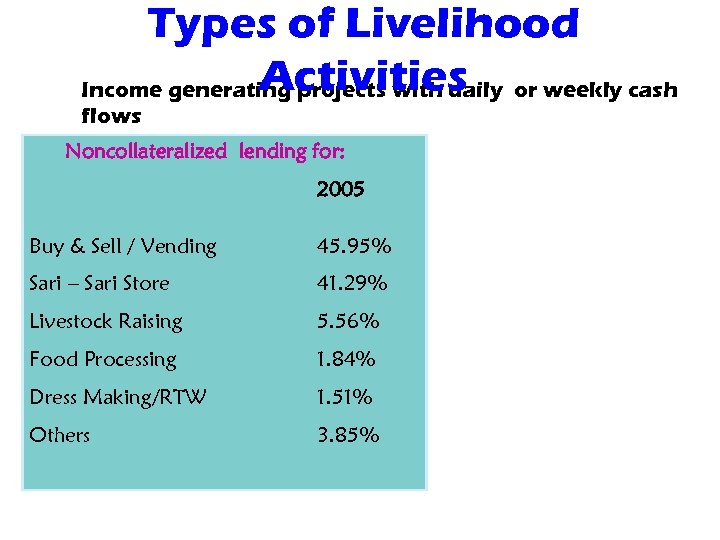 Types of Livelihood Activities Income generating projects with daily or weekly cash flows Noncollateralized lending for: 2005 Buy & Sell / Vending 45. 95% Sari – Sari Store 41. 29% Livestock Raising 5. 56% Food Processing 1. 84% Dress Making/RTW 1. 51% Others 3. 85%
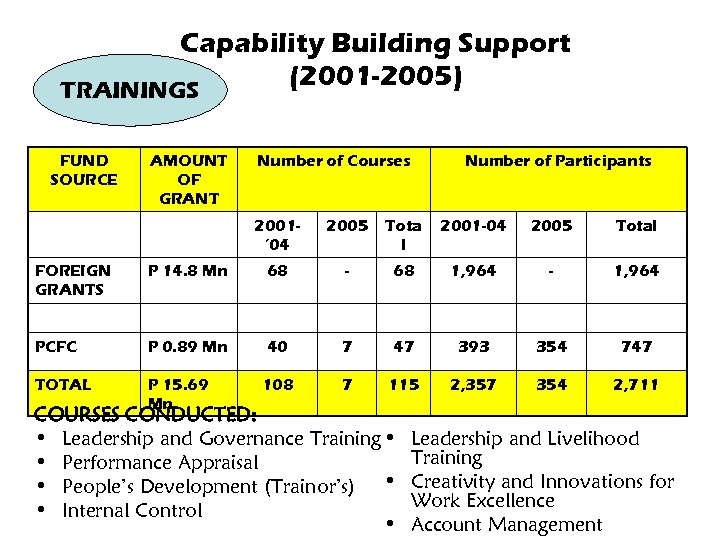 Capability Building Support (2001 -2005) TRAININGS FUND SOURCE AMOUNT OF GRANT Number of Courses Number of Participants 2001’ 04 2005 Tota l 2001 -04 2005 Total FOREIGN GRANTS P 14. 8 Mn 68 - 68 1, 964 - 1, 964 PCFC P 0. 89 Mn 40 7 47 393 354 747 TOTAL P 15. 69 Mn 108 7 115 2, 357 354 2, 711 COURSES CONDUCTED: • Leadership and Governance Training • • Performance Appraisal • People’s Development (Trainor’s) • • Internal Control • Leadership and Livelihood Training Creativity and Innovations for Work Excellence Account Management
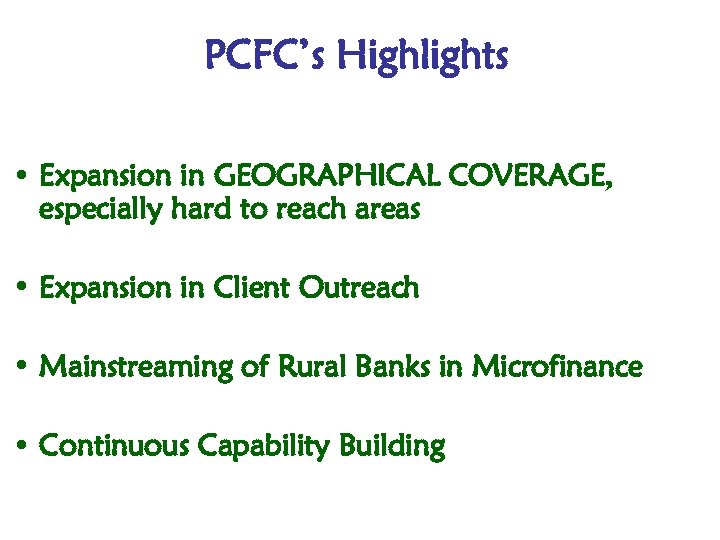 PCFC’s Highlights • Expansion in GEOGRAPHICAL COVERAGE, especially hard to reach areas • Expansion in Client Outreach • Mainstreaming of Rural Banks in Microfinance • Continuous Capability Building
 Thank you and Good Day!